Quick Answer
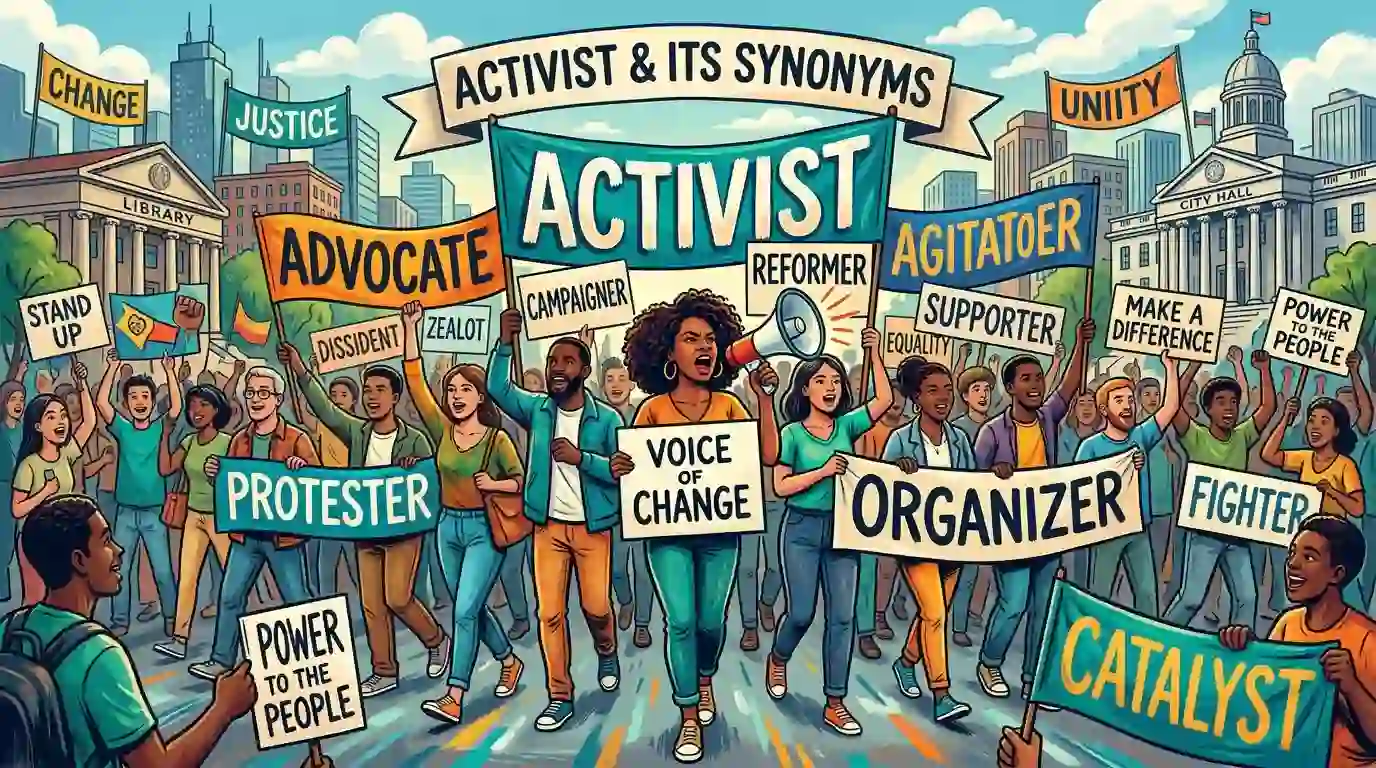
The closest synonyms for activist are advocate, campaigner, protester, reformer, champion, campaign organizer, and demonstrator. However, they are not exact replacements in every sentence. Advocate emphasizes support, campaigner emphasizes organized action, protester emphasizes public opposition, and reform emphasizes efforts to change an existing system.
What Does Activism Mean?
An activist is a person who takes action to support or oppose a social, political, environmental, or other cause.
For example:
The environmental activist organized a campaign to protect the local forest.
The important idea is action. A person can support a cause without being an activist. An activist normally does something to promote change, such as organizing events, campaigning, protesting, educating others, lobbying decision-makers, or working with a community.
Cambridge’s thesaurus shows why choosing an alternative can be difficult. It groups advocate, supporter, proponent, and spokesperson under one sense, while words such as radical, militant, and fanatic appear under another. These words can overlap with activist, but they also carry additional meanings.
That distinction is important for students, ESL learners, writers, journalists, bloggers, and professionals who want precise English.
Best Synonyms for Activist at a Glance
| Word | How close? | Main idea | Register | Connotation |
| Advocate | Very close | Supports a cause | Neutral/Formal | Usually positive |
| Campaigner | Very close | Works in a campaign | Neutral | Neutral/Positive |
| Protester | Close | Publicly opposes something | Neutral | Neutral |
| Reformer | Close | Seeks improvement or reform | Formal | Usually positive |
| Champion | Close | Strongly supports a cause | Neutral | Positive |
| Organizer | Contextual | Coordinates action | Neutral | Neutral |
| Demonstrator | Contextual | Joins a demonstration | Neutral | Neutral |
| Lobbyist | Contextual | Influences decision-makers | Professional | Neutral/Mixed |
| Crusader | Contextual | Fights persistently for a cause | Neutral/Literary | Strong |
| Dissident | Contextual | Opposes established authority | Formal | Strong |
| Militant | Related | Acts in a forceful way | Formal | Can be negative |
| Agitator | Related | Encourages unrest or action | Formal | Often negative |
| Proponent | Related | Supports an idea | Formal/Academic | Neutral |
| Supporter | Related | Backs a cause | Neutral | Neutral |
| Spokesperson | Related | Speaks for a group | Professional | Neutral |
| Environmentalist | Specialized | Supports environmental protection | Neutral/Formal | Neutral |
| Conservationist | Specialized | Protects nature/resources | Formal | Positive |
| Humanitarian | Specialized | Promotes human welfare | Formal | Positive |
| Radical | Not exact | Favors fundamental change | Neutral/Loaded | Depends on context |
| Revolutionary | Not exact | Seeks major or revolutionary change | Formal | Strong |
| Dissenter | Not exact | Publicly disagrees | Formal | Neutral/Negative |
| Objector | Not exact | Expresses opposition | Neutral | Neutral |
| Partisan | Not exact | Strongly supports a side | Formal | Often mixed |
| Fighter | Contextual | Struggles strongly for a cause | Neutral | Strong |
| Defender | Contextual | Protects a person or cause | Neutral | Positive |
Quick Tip: Do not choose a synonym just because a thesaurus lists it. First ask what the person actually does.
1. Advocate
Meaning: An advocate publicly supports or argues for a person, idea, policy, or cause.
Example:
She is an advocate for better access to education.
Best used when: You want to emphasize support, public argument, or recommendation.
Tone: Neutral to formal
Register: Academic, professional, everyday
Frequency: Very common
Approximate CEFR: B2–C1
Common collocations:
- advocate for change
- human rights advocate
- advocate for equality
Nuance: Advocate is probably the safest formal alternative to activist, but it does not always imply direct action.
When not to use it: Do not use advocate when you specifically mean someone participated in a street demonstration.
2. Campaigner
Meaning: A campaigner actively works as part of an organized campaign.
Example:
The climate campaigner called for stronger environmental protections.
Best used when: Organized effort is central to the person’s work.
Tone: Neutral
Register: News, politics, professional, everyday
Frequency: Common
Approximate CEFR: C1
Common collocations:
- human rights campaigner
- environmental campaigner
- campaigner for reform
Nuance: Campaigner is one of the closest alternatives to activist because it clearly suggests sustained action toward a goal.
When not to use it: Avoid it when someone only supports a cause privately.
3. Protester
Meaning: A protester publicly shows disagreement with something.
Example:
Hundreds of protesters gathered outside the building.
Best used when: The person’s action involves a protest or demonstration.
Tone: Neutral
Register: Everyday, news, formal
Frequency: Very common
Approximate CEFR: B2
Common collocations:
- peaceful protester
- anti-war protester
- group of protesters
Important distinction: Not every activist is a protester. Activists can campaign, research, organize, educate, lobby, or raise funds without protesting.
Cambridge specifically defines protesters around publicly showing disagreement.
When not to use it: Do not replace activist with protester if no protest took place.
4. Reformer
Meaning: A reformer works to improve an existing system or institution.
Example:
The education reformer proposed changes to the school system.
Best used when: The goal is reform rather than simply opposition.
Tone: Formal
Register: Academic, historical, political, professional
Frequency: Common
Approximate CEFR: C1
Common collocations:
- social reformer
- political reformer
- education reformer
Nuance: Reformer tells readers what kind of change the person seeks.
When not to use it: Avoid it when there is no attempt to change or improve a system.
5. Champion
Meaning: A champion strongly supports or defends a person, cause, or idea.
Example:
She has become a champion of equal educational opportunities.
Tone: Positive
Register: Neutral, professional, journalistic
Frequency: Very common
Approximate CEFR: B2
Common collocations:
- champion of equality
- champion a cause
- champion human rights
Nuance: Champion often sounds more admiring than activist.
When not to use it: Avoid it when you want completely neutral language about someone’s role.
6. Organizer / Organiser
Meaning: An organizer plans and coordinates activities.
Example:
The community organizer arranged a meeting for local residents.
American English: organizer
British English: organiser
Tone: Neutral
Register: Everyday, professional
Frequency: Very common
Approximate CEFR: B1–B2
Common collocations:
- community organizer
- campaign organizer
- event organizer
Nuance: This word describes the person’s role in coordinating action, not necessarily their beliefs.
When not to use it: Do not use it when the person simply supports a cause but does not organize anything.
7. Demonstrator
Meaning: A demonstrator is someone who takes part in a public demonstration.
Example:
Demonstrators marched through the city center.
Tone: Neutral
Register: News, formal
Frequency: Common
Approximate CEFR: B2
Nuance: It is more specific than activist because it focuses on participation in a demonstration.
When not to use it: Do not use it for an activist who works only through research or advocacy.
8. Lobbyist
Meaning: A lobbyist tries to influence lawmakers or other decision-makers.
Example:
The lobbyist met with lawmakers to discuss the proposed legislation.
Tone: Professional
Register: Political, business, formal
Frequency: Common
Approximate CEFR: C1
Nuance: Lobbying is a particular method of influencing decisions. It should not automatically be treated as activism.
When not to use it: Avoid lobbyists if the person does not try to influence decision-makers.
9. Crusader
Meaning: A crusader persistently fights for a cause.
Example:
She became a crusader for safer roads.
Tone: Strong
Register: Literary, journalistic, figurative
Frequency: Common
Approximate CEFR: C1
Nuance: This word adds a sense of determination and persistence.
When not to use it: Avoid it in highly neutral descriptions if you do not want to add an admiring or dramatic tone.
10. Dissident
Meaning: A dissident openly disagrees with an established political authority, organization, or system.
Example:
The dissident criticized the government’s policies.
Tone: Formal
Register: Political, historical, journalistic
Frequency: Common
Approximate CEFR: C1
Nuance: Dissident focuses on disagreement with authority.
When not to use it: Do not use it for an ordinary community volunteer or environmental campaigner.
11. Militant
Meaning: A militant person supports a cause in a forceful or uncompromising way.
Example:
The organization adopted a militant position on the issue.
Tone: Strong
Register: Formal, news
Frequency: Common
Approximate CEFR: C1
Important: Militant is not a neutral replacement for activists. It can suggest confrontation or forceful methods.
When not to use it: Do not use it simply because someone is active or passionate.
12. Agitator
Meaning: An agitator encourages people to take action, especially by stirring dissatisfaction or opposition.
Example:
The authorities accused the organizer of being a political agitator.
Tone: Often negative
Register: Formal, political, historical
Frequency: Uncommon
Nuance: This word can portray the person as someone who deliberately creates unrest.
When not to use it: Avoid it as a neutral substitute for activists.
13. Proponent
Meaning: A proponent supports an idea, plan, or policy.
Example:
She is a strong proponent of renewable energy.
Tone: Neutral
Register: Academic, formal, professional
Frequency: Common
Approximate CEFR: C1
Nuance: Proponent focuses on support for an idea, not active campaigning.
14. Supporter
Meaning: A supporter backs a person, group, idea, or cause.
Example:
Many supporters attended the community event.
Tone: Neutral
Register: Everyday
Frequency: Very common
Approximate CEFR: B1
Nuance: This is broader and weaker than activist.
Someone can be a supporter without taking any direct action.
15. Spokesperson
Meaning: A spokesperson officially speaks for a group or organization.
Example:
The campaign spokesperson answered questions from reporters.
Tone: Neutral
Register: Professional, media
Frequency: Very common
Approximate CEFR: B2
Nuance: A spokesperson may communicate a group’s position without personally being an activist.
16. Environmentalist
Meaning: An environmentalist supports protecting the natural environment.
Example:
The environmentalist spoke about the effects of plastic pollution.
Tone: Neutral
Register: Everyday, academic, professional
Frequency: Common
Approximate CEFR: C1
Nuance: This is a topic-specific term. An environmentalist may be an activist, but activism is not limited to environmental issues.
17. Conservationist
Meaning: A conservationist works to protect nature, wildlife, or natural resources.
Example:
The conservationist worked to protect the wetland.
Tone: Positive/Neutral
Register: Environmental, academic
Frequency: Common
Approximate CEFR: C1
Difference from environmentalist: Conservationist often focuses more specifically on protecting natural resources, habitats, and wildlife.
18. Humanitarian
Meaning: A humanitarian works to improve human welfare and reduce suffering.
Example:
The humanitarian helped provide food and shelter to displaced families.
Tone: Positive
Register: Formal
Frequency: Common
Approximate CEFR: C1
Important: A humanitarian may support social causes, but the word does not automatically mean activist.
19. Radical
Meaning: A radical supports major or fundamental change.
Example:
The group proposed radical changes to the education system.
Tone: Depends on context
Register: Formal, political, academic
Frequency: Common
Approximate CEFR: C1
Nuance: Radical describes the degree of change or the nature of an idea, not simply active participation.
When not to use it: Do not call someone radical just because they are an activist.
20. Revolutionary
Meaning: A revolutionary supports or participates in fundamental, far-reaching change.
Example:
The movement demanded revolutionary changes to the political system.
Tone: Very strong
Register: Formal, historical, political
Frequency: Common
Nuance: This word is much stronger than activist.
When not to use it: Avoid it unless the context genuinely involves fundamental or revolutionary change.
21. Dissenter
Meaning: A dissenter openly disagrees with an accepted opinion, policy, or authority.
Example:
The dissenter challenged the organization’s official position.
Tone: Neutral to formal
Register: Academic, political, legal
Frequency: Uncommon
Nuance: It focuses on disagreement rather than organized activism.
22. Objector
Meaning: An objector is someone who expresses opposition to something.
Example:
Several objectors raised concerns about the proposed development.
Tone: Neutral
Register: Formal
Frequency: Common
When not to use it: Use an objector when opposition is an important fact. It does not necessarily imply long-term activism.
23. Fighter
Meaning: A fighter is someone who strongly struggles for a cause or against a problem.
Example:
She was a tireless fighter for equal rights.
Tone: Strong and positive in many contexts
Register: Neutral, journalistic
Frequency: Very common
Nuance: Fighter is often figurative. It emphasizes determination rather than a specific form of activism.
24. Defender
Meaning: A defender actively protects a person, cause, right, or principle.
Example:
He became a defender of free speech.
Tone: Positive
Register: Neutral/Formal
Frequency: Very common
Nuance: Defender emphasizes protection, while activist emphasizes action for change or a cause.
25. Partisan
Meaning: A partisan strongly supports one side of a political, social, or ideological conflict.
Example:
The debate attracted supporters from both partisan groups.
Tone: Often mixed or negative
Register: Formal, political
Important: Partisan is not a general synonym for activist. It emphasizes loyalty to one side.
Synonyms by Meaning
The easiest way to choose the correct synonym is to start with the person’s main activity.
If the person supports a cause
Use:
- advocate
- champion
- proponent
- supporter
If the person runs or joins a campaign
Use:
- campaigner
- campaign organizer
- organizer
If the person publicly protests
Use:
- protester
- demonstrator
- marcher
- picketer
If the person seeks system reform
Use:
- reformer
- reformist
If the person tries to influence officials
Use:
- lobbyist
- advocate
If the person opposes authority
Use:
- dissident
- dissenter
- objector
If the person supports major or fundamental change
Use:
- radical
- revolutionary
These categories solve a problem found in many large thesaurus lists: they give learners a long collection of words but do not explain which word actually belongs in a particular sentence. WordHippo, for example, includes many highly specialized and stronger expressions in its broad synonym results.
Activist vs. Advocate vs. Campaigner vs. Protester
This is one of the most useful distinctions to remember.
| Word | Main focus | Example |
| Activist | Active work for change | She is a climate activist. |
| Advocate | Public support | She advocates for clean energy. |
| Campaigner | Organized campaign | She is a climate campaigner. |
| Protester | Public opposition | She joined the climate protest. |
Easy memory rule
Activist = takes action
Advocate = speaks or argues for
Campaigner = works through a campaign
Protester = publicly demonstrates opposition
A single person can fit all four descriptions, but the words highlight different aspects of that person’s activity.
Activist vs. Radical vs. Militant
These words should not be treated as interchangeable.
| Word | What it adds |
| Activist | Active involvement in a cause |
| Radical | Support for fundamental change |
| Militant | Forceful or uncompromising action |
| Revolutionary | Revolutionary or fundamental transformation |
| Agitator | Stirring opposition or unrest |
Cambridge’s thesaurus places radical and militant in its broader synonym grouping for activist, but that does not mean they are interchangeable in every sentence.
Remember: A person can be an activist without being radical or militant.
Frequency Guide
For ESL learners, this practical guide is more useful than a huge list.
Very Common
- activist
- advocate
- supporter
- protester
- champion
- organizer
- defender
Common
- campaigner
- reformer
- lobbyist
- environmentalist
- demonstrator
- proponent
- dissident
- radical
Less Common
- agitator
- dissenter
- crusader
- conservationist
Context-Specific
- militant
- revolutionary
- partisan
- humanitarian
- spokesperson
Frequency can change according to country, subject, and type of writing, so these labels are learner-oriented rather than exact corpus rankings.
American vs. British English
The spelling activist is the same in American and British English.
The most useful spelling difference appears with organizer/organiser:
- American English: organizer
- British English: organiser
Both forms are correct.
Likewise, protester is widely used in both varieties. Some dictionaries also record protestor, but protester is a very common modern form.
Word Origin and First Known Use
The word activist comes from active plus -ist, a suffix used for people associated with a particular activity, belief, or practice.
Merriam-Webster gives 1920 as the first known use of activist as a noun. It also records an earlier adjective use.
The word’s modern sense developed around people who actively support political or social causes.
This history also explains why active is at the heart of the word. An activist is not simply someone who has an opinion. The word traditionally emphasizes active involvement.
Common Collocations
Native English speakers commonly use activists with the cause or area of action.
Social and political
- social activist
- political activist
- human rights activist
- civil rights activist
- labor activist
- peace activist
Environmental
- environmental activist
- climate activist
- animal rights activist
- environmental justice activist
- conservation activist
Community
- community activist
- student activist
- grassroots activist
- local activist
These combinations are useful because they tell the reader what kind of activism the person practices.
Common Mistakes
Common Mistake 1
Mistake: “Everyone who supports a cause is an activist.”
Better: “Everyone who supports a cause is a supporter.”
Why: Activists normally suggest active involvement.
Common Mistake 2
Mistake: “The activist protested, so activist and protester mean exactly the same thing.”
Better: “The activist joined a protest.”
Why: Protester describes a particular action. Activist describes broader involvement.
Common Mistake 3
Mistake: “The peaceful activist was a militant.”
Why: Militants can suggest forceful or uncompromising methods. It adds meaning that activists do not necessarily have.
Common Mistake 4
Mistake: Using radical simply to mean “very active.”
Why: Radical concerns fundamental change or ideas, not just activity.
How to Use Activist Synonyms in Writing
In Academic Essays
Prefer precise words such as:
- advocate
- campaigner
- reformer
- proponent
- activist
Example:
Civil rights campaigners argued for changes to discriminatory laws.
In Professional Writing
Use neutral words:
- advocate
- organizer
- spokesperson
- campaigner
Avoid emotionally loaded words unless the evidence and context justify them.
In Blog Posts
You can alternate between activist and a more precise term.
Instead of:
The activist spoke at the event. The activist organized the event. The activist later wrote about the event.
Try:
The activist spoke at the event. The campaign organizer also coordinated volunteers and later wrote about the project.
This is not simply a synonym replacement. It gives the reader more information.
In Everyday Conversation
The simplest words are often best:
- activist
- supporter
- protester
- campaigner
- advocate
Word Family
| Word | Part of speech | Meaning |
| active | adjective | Doing or participating |
| actively | adverb | In an active way |
| activate | verb | Make something active |
| activation | noun | The act of making something active |
| activism | noun | Active work for a cause |
| activist | noun/adjective | A person involved in activism |
Antonyms and Contrasting Words
There is no single perfect antonym for activist in every situation.
Depending on your meaning, useful contrasts include:
- bystander
- passive observer
- nonparticipant
- inactive person
- passivist
A bystander watches without taking part. A nonparticipant does not participate. These words are often more precise than simply calling someone the “opposite” of an activist.
Mini Practice: Choose the Best Word
Choose from:
advocate | campaigner | protester | reformer | lobbyist
- Someone who tries to influence lawmakers is a ______.
- Someone who joins a public demonstration is a ______.
- Someone who works to improve an existing system is a ______.
- Someone who publicly supports a cause is an ______.
- Someone involved in an organized campaign is a ______.
Answers
- lobbyist
- protester
- reformer
- advocate
- campaigner
Sentence Rewriting Practice
Replace activist with the most precise alternative.
1.
She is an activist for better public transportation.
Possible answer: advocate
2.
The activist joined hundreds of people at the demonstration.
Possible answer: protester or demonstrator
3.
The activist organized volunteers for the campaign.
Possible answer: campaign organizer
4.
The activist wanted to change the education system.
Possible answer: reformer
5.
The activist met with lawmakers to discuss the proposal.
Possible answer: lobbyist, if lobbying is actually the person’s role.
What Is the Best Synonym for Activist?
There is no single best synonym for every situation.
Use advocate when support is the main idea.
Use campaigner when organized campaigning matters.
Use protester when public protest matters.
Use reformers when changing an existing system matters.
Use champion when strong support or defense matters.
Use an organizer when coordinating people and activities matters.
Use lobbyists when influencing decision-makers matters.
This context-first approach is more useful than simply memorizing a long synonym list.
FAQ
What is another word for activist?
The closest alternatives are advocate, campaigner, protester, reformer, champion, and organizer. The correct word depends on the person’s actions. An advocate supports a cause, a campaigner works in an organized campaign, and a protester publicly demonstrates disagreement.
What is a professional synonym for activist?
Advocate, campaigner, reformer, and organizer can work well in professional writing. Advocate is particularly useful when describing someone who supports or promotes a cause without specifying a particular form of activism.
Is an advocate the same as an activist?
Not exactly. An advocate supports or argues for a cause, while an activist generally takes active steps to create or resist change. One person can be both, but advocate does not necessarily imply organized activism or protest.
Is protester a synonym for activist?
It can overlap with activists, but it is narrower. A protester takes part in a public protest, while an activist may campaign, organize, educate, lobby, research, or work with a community without protesting.
What is a synonym for environmental activist?
Depending on the context, you can use environmentalist, conservationist, environmental campaigner, or environmental advocate. Conservationism is especially suitable when the focus is wildlife, habitats, or natural resources.
What is a stronger word than activist?
Words such as militant, radical, or revolutionary can sound stronger, but they are not simple replacements. Each adds a different meaning. Militant suggests forceful action, radical suggests fundamental change, and revolutionary suggests major transformation.
What is the opposite of activist?
There is no universal opposite. Depending on the context, bystander, passive observer, nonparticipant, or inactive person may provide the intended contrast. A bystander watches without taking part, while a nonparticipant simply does not participate.
Can activist be used as an adjective?
Yes. Activist can function as an adjective in expressions such as activist group, activist organization, and activist strategy. The adjective describes something connected with activism or activists.
Five Question Vocabulary Quiz
1. Which word best describes someone who publicly supports a cause?
A. Advocate
B. Bystander
C. Objector
D. Nonparticipant
2. Which word specifically emphasizes participation in a public protest?
A. Reformer
B. Protester
C. Lobbyist
D. Proponent
3. Which word best describes someone working to improve an existing system?
A. Reformer
B. Supporter
C. Spokesperson
D. Partisan
4. Which word can suggest forceful or uncompromising action?
A. Advocate
B. Supporter
C. Militant
D. Organizer
5. Which sentence uses “campaigner” most precisely?
A. The campaigner organized a long-running public campaign.
B. The campaigner simply agreed with the idea privately.
C. The campaigner watched the protest from home.
D. The campaigner had no connection with the cause.
Answer Key
- A
- B
- A
- C
- A
Final Takeaway
The best synonyms for activists depend on what the person actually does. Advocate highlights support, campaigner highlights organized action, protester highlights public opposition, reformer highlights system change, and organizer highlights coordination.
Words such as militant, radical, and revolutionary should be used carefully because they add stronger meanings. Learning these differences will help you write clearer essays, stronger blog posts, better professional messages, and more natural English.
Trusted References
- Cambridge Dictionary and Cambridge Thesaurus, Activist and related vocabulary.
- Merriam-Webster, Activist and related definitions.
- WordHippo, Synonyms for Activists, useful for identifying broad competing synonym sets.
- Different Word For, Activist, useful for comparing contextual alternatives and usage distinctions.
- Griffith University research repository, discussion of terminology used for environmental activists, including organiser and campaigner.

Synonorm is a trusted English vocabulary resource created to help readers find the right words and understand the differences between similar terms. We provide clear explanations of synonyms, meanings, examples, usage, and alternatives. Our content makes vocabulary easier to learn and apply in everyday, academic, and professional English. Synonorm is designed for students, writers, ESL learners, professionals, and anyone who wants to improve their English vocabulary and communicate more clearly.