Quick Answer
The best synonyms of trace depend on the meaning. Use find, locate, detect, discover, or track down when trace means finding something. Use track, follow, or trail when it means following a person, animal, route, or development. For a small amount, use hint, touch, tinge, or iota. For drawing, use outline, sketch, draw, or copy.
What Does Trace Mean?
Have you ever tried to replace the word trace with a synonym and ended up with a sentence that sounds strange? The problem is that trace has several meanings.
You can trace the source of a problem, trace a person’s movements, trace the history of a word, trace a drawing, or find traces of damage. These meanings are related, but they do not all have the same synonyms.
For example, locate works well when you mean “find the position of something,” while track is better when you mean “follow movement.” If you mean a tiny amount, hint, touch, or tinge may work better.
This guide explains the most useful synonyms of trace with meanings, examples, CEFR learner guidance, register, frequency, collocations, connotation, and warnings about when not to use each word.
Pronunciation
Trace: /treɪs/
Pronounced: trays
The spelling and standard pronunciation are the same in American and British English.
Part of Speech
Trace is mainly a noun and a verb.
Trace as a noun
It can mean:
- a small sign or mark
- evidence that something existed or happened
- a tiny amount
- a track or trail
- a drawing or recorded line in some technical contexts
Examples:
- There was no trace of blood.
- We found traces of an older settlement.
- She spoke without a trace of anger.
Trace as a verb
It can mean:
- to find the source or origin of something
- to follow a person, animal, route, or development
- to discover something through investigation
- to copy a drawing by following its lines
- to draw or describe an outline
Examples:
- Scientists traced the problem to a faulty wire.
- We traced the family’s history.
- The child traced the picture with a pencil.
Grammar Patterns for Trace
Some common patterns are especially useful for learners.
Trace + object
Researchers traced the problem.
Trace + object + to
Researchers traced the problem to a faulty machine.
Trace + object + back to
The tradition can be traced back to the 18th century.
A trace of + noun
There was a trace of smoke in the room.
Without a trace
The bird disappeared without a trace.
Traceable to
The error was traceable to a software problem.
Good to Know: When trace means finding an origin, trace A to B is one of its most useful structures.
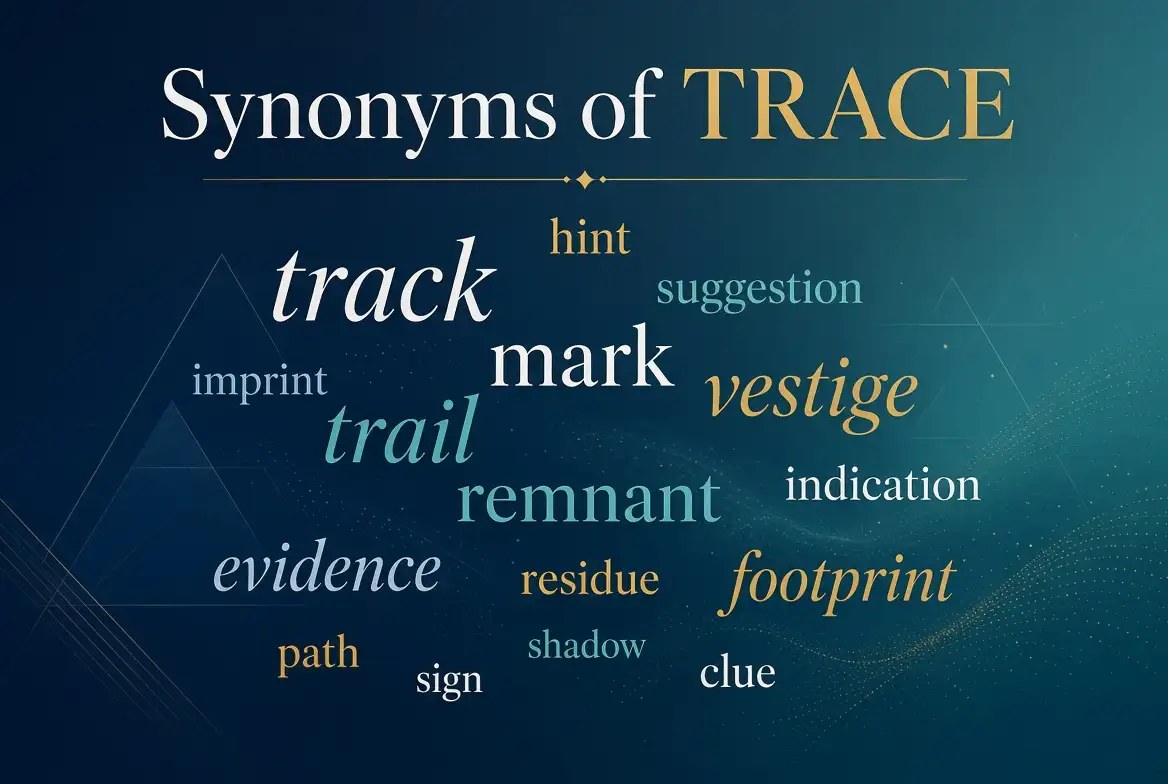
Synonyms of Trace at a Glance
| Synonym | Main sense | Strength | Register | Frequency |
| Find | discover | Strong | Neutral | Very common |
| Locate | find exact position | Strong | Neutral/Formal | Common |
| Detect | discover presence | Strong | Academic/Formal | Common |
| Discover | find or learn | Strong | Neutral | Very common |
| Track | follow movement/development | Strong | Neutral | Very common |
| Track down | find after searching | Strong | Spoken/Neutral | Common |
| Follow | go along or study development | Related | Neutral | Very common |
| Trail | follow clues or movement | Strong | Neutral | Common |
| Pinpoint | identify exactly | Strong | Professional | Common |
| Uncover | reveal something hidden | Strong | Neutral/Formal | Common |
| Mark | visible sign | Related | Neutral | Very common |
| Sign | indication | Related | Neutral | Very common |
| Indication | sign or evidence | Strong | Formal | Common |
| Evidence | information supporting a conclusion | Related | Academic/Formal | Very common |
| Vestige | surviving sign from the past | Strong | Literary/Formal | Uncommon |
| Remnant | remaining part | Strong | Neutral/Formal | Common |
| Hint | slight suggestion | Strong | Neutral | Very common |
| Touch | small amount | Related | Neutral | Very common |
| Tinge | slight quality or color | Strong | Neutral/Literary | Common |
| Iota | extremely small amount | Strong | Formal | Uncommon |
| Outline | outer shape | Strong | Neutral | Common |
| Sketch | rough drawing | Related | Neutral | Common |
| Draw | create lines or picture | Related | Neutral | Very common |
| Copy | reproduce | Related | Neutral | Very common |
| Retrace | follow again | Related | Formal/Neutral | Uncommon |
CEFR note: The CEFR levels below are practical learner guidance, not official CEFR classifications for every individual synonym.
1. Find
Meaning: To discover someone or something after looking for it.
CEFR: A1–A2
Register: Neutral, spoken, academic, business
Frequency: Very common
Connotation: Simple and direct
Examples:
- The police finally found the missing car.
- We need to find the source of the error.
Best used when: You simply mean “discover.”
Common collocations:
- find the source
- find evidence
- find a person
When not to use: Use trace instead when the process of following records, clues, or origins matters.
2. Locate
Meaning: To find the exact position of something or someone.
CEFR: B1
Register: Neutral, formal, business
Frequency: Common
Connotation: Precise
Examples:
- The team located the damaged cable.
- The software helped us locate the missing file.
Best used when: Exact position is important.
Common collocations:
- locate the source
- locate a file
- locate a person
When not to use: Do not use locate when you mean discovering a historical origin.
3. Detect
Meaning: To discover the presence of something, often through careful observation or testing.
CEFR: B1
Register: Academic, scientific, formal
Frequency: Common
Connotation: Technical and investigative
Examples:
- The test detected a small amount of metal.
- The system detected an unusual signal.
Best used when: Something is discovered through testing or observation.
Common collocations:
- detect a problem
- detect a signal
- detect traces
When not to use: Detect does not naturally mean following a person’s journey.
4. Discover
Meaning: To find something or learn something that was previously unknown.
CEFR: A2–B1
Register: Neutral, academic, professional
Frequency: Very common
Connotation: New knowledge or information
Examples:
- Researchers discovered the source of the contamination.
- She discovered that the document was incomplete.
Best used when: The important point is that something becomes known.
Common collocations:
- discover the cause
- discover the source
- discover evidence
When not to use: Use trace if you want to emphasize the process of following something backward.
5. Track
Meaning: To follow the movement, progress, or development of something.
CEFR: A2–B1
Register: Neutral, business, technical
Frequency: Very common
Connotation: Continuous following
Examples:
- The company tracks every package.
- Historians tracked the development of the idea.
Best used when: Movement or progress is the main idea.
Common collocations:
- track progress
- track movement
- track a package
When not to use: Do not automatically use track for every sentence containing trace. “Trace the origin” and “track the origin” do not always mean exactly the same thing.
Merriam-Webster notes that track emphasizes a continuous line or route, while trace can suggest a broader mark or detectable effect.
6. Track Down
Meaning: To find someone or something after searching for it.
CEFR: B1
Register: Neutral, spoken
Frequency: Common
Connotation: Effort or difficulty
Examples:
- We finally tracked down the missing report.
- The journalist tracked down the original source.
Best used when: The search takes time or effort.
Common collocations:
- track down a person
- track down information
- track down the source
When not to use: In highly formal writing, locate may sound more polished.
7. Follow
Meaning: To go along a route or examine the development of something.
CEFR: A1
Register: Neutral
Frequency: Very common
Connotation: Broad and flexible
Examples:
- We followed the river toward the village.
- The book follows the history of the movement.
Best used when: A path, sequence, or development is being examined.
Common collocations:
- follow a trail
- follow a path
- follow a history
When not to use: Follow is broader than trace and does not always suggest investigation.
8. Trail
Meaning: To follow a person, animal, or route by using movement or clues.
CEFR: B1
Register: Neutral, narrative
Frequency: Common
Connotation: Physical pursuit or clues
Examples:
- The detectives trailed the suspect.
- The hikers trailed the animal through the forest.
Best used when: You are following someone or something.
Common collocations:
- trail a suspect
- trail an animal
- follow a trail
When not to use: Do not use it as a general synonym for discovering an abstract origin.
9. Pinpoint
Meaning: To identify something exactly.
CEFR: B2
Register: Professional, academic, neutral
Frequency: Common
Connotation: High precision
Examples:
- Engineers pinpointed the cause of the failure.
- The map helped us pinpoint the location.
Best used when: Accuracy matters.
Common collocations:
- pinpoint the cause
- pinpoint the location
- pinpoint the source
When not to use: Avoid it when you only have a general idea.
10. Uncover
Meaning: To discover something hidden or unknown.
CEFR: B2
Register: Neutral, journalism, academic
Frequency: Common
Connotation: Something was concealed or difficult to find
Examples:
- The investigation uncovered several errors.
- Researchers uncovered new evidence.
Best used when: Information was hidden or unknown.
Common collocations:
- uncover evidence
- uncover the truth
- uncover a problem
When not to use: Do not use it for simply finding a misplaced object.
11. Mark
Meaning: A visible sign, line, or impression left by something.
CEFR: A1
Register: Neutral
Frequency: Very common
Connotation: Physical or symbolic sign
Examples:
- The boots left marks in the mud.
- The wall still showed marks from the fire.
Best used when: Trace means a physical sign.
Common collocations:
- leave a mark
- visible mark
- mark of damage
When not to use: Mark is much broader than trace.
12. Sign
Meaning: Something that shows that a condition, event, or quality exists.
CEFR: A1–A2
Register: Neutral
Frequency: Very common
Connotation: General indication
Examples:
- The footprints were a sign that someone had entered.
- There was no sign of damage.
Best used when: You mean a general indication.
Common collocations:
- sign of change
- sign of damage
- sign of life
When not to use: A sign does not have to be a physical trace.
13. Indication
Meaning: Something that suggests that something is true or exists.
CEFR: B2
Register: Formal, academic, business
Frequency: Common
Connotation: More formal than sign
Examples:
- The results gave no indication of a serious problem.
- Her expression was an indication of concern.
Best used when: You need a formal word for “sign.”
Common collocations:
- clear indication
- strong indication
- indication of change
When not to use: It can sound unnecessarily formal in casual conversation.
14. Evidence
Meaning: Facts or signs that help prove or support an idea.
CEFR: B1
Register: Academic, legal, professional
Frequency: Very common
Connotation: Stronger and more objective than a simple sign
Examples:
- Investigators found evidence of damage.
- There was no evidence that the file had been changed.
Best used when: A trace helps support a conclusion.
Common collocations:
- evidence of
- strong evidence
- evidence shows
When not to use: Do not call every trace evidence. A trace may be too weak or ambiguous to support a conclusion.
15. Vestige
Meaning: A small remaining sign or part of something that existed in the past.
CEFR: C1–C2
Register: Literary, formal, academic
Frequency: Uncommon
Connotation: Historical and often slightly literary
Examples:
- Only a few vestiges of the old town remain.
- The ruins are vestiges of an earlier civilization.
Best used when: Something from the past has mostly disappeared.
Common collocations:
- vestige of the past
- last vestiges
- ancient vestiges
When not to use: Avoid it in basic conversation when remnant or trace would be clearer.
16. Remnant
Meaning: A part that remains after most of something has disappeared.
CEFR: B2
Register: Neutral, formal
Frequency: Common
Examples:
- The ruins are remnants of an ancient settlement.
- A small remnant of the original paint remained.
Best used when: A remaining physical or historical part matters.
Common collocations:
- remnants of the past
- remaining remnant
- remnants of a building
When not to use: Do not use it for every tiny emotional quality.
17. Hint
Meaning: A small sign or suggestion of something.
CEFR: A2
Register: Neutral, spoken
Frequency: Very common
Connotation: Slight and indirect
Examples:
- There was a hint of sadness in her voice.
- I noticed a hint of doubt in his answer.
Best used when: The trace is an emotion, quality, or suggestion.
Common collocations:
- hint of sadness
- hint of doubt
- hint of danger
When not to use: Do not use hint for footprints or physical trails.
18. Touch
Meaning: A small amount or slight quality of something.
CEFR: A2
Register: Neutral, conversational
Frequency: Very common
Connotation: Often soft or natural
Examples:
- The sauce has a touch of garlic.
- There was a touch of humor in her speech.
Best used when: You want a natural way to describe a small amount.
Common collocations:
- touch of humor
- touch of color
- touch of sadness
When not to use: It does not normally replace trace when trace means a trail or mark.
19. Tinge
Meaning: A slight amount of a quality or color.
CEFR: B2
Register: Neutral, literary
Frequency: Common
Connotation: Often noticeable but slight
Examples:
- Her voice had a tinge of disappointment.
- The sky had a tinge of orange.
Best used when: You are describing color, emotion, or another subtle quality.
Common collocations:
- tinge of sadness
- tinge of red
- tinge of bitterness
When not to use: It does not mean “find” or “follow.”
20. Iota
Meaning: An extremely small amount.
CEFR: C1
Register: Formal, literary
Frequency: Uncommon
Connotation: Emphasizes extreme smallness
Examples:
- The new plan has not changed one iota.
- There was not an iota of doubt in her mind.
Best used when: You want to strongly emphasize “even the smallest amount.”
Common collocations:
- one iota
- not an iota of doubt
- not one iota
When not to use: It is too formal for many simple everyday sentences.
21. Outline
Meaning: To show the outer shape of something or describe its main parts.
CEFR: B1
Register: Neutral, academic, professional
Frequency: Common
Examples:
- She outlined the shape of the leaf.
- The report outlines the main causes of the problem.
Best used when: Trace means showing a shape or describing development.
Common collocations:
- outline a plan
- outline a shape
- outline the main points
When not to use: Do not use outline when you mean exact copying of an image.
22. Sketch
Meaning: To make a quick or rough drawing.
CEFR: B1
Register: Neutral, artistic
Frequency: Common
Examples:
- He sketched the building in his notebook.
- She sketched a rough website design.
Best used when: The drawing is quick or rough.
Common collocations:
- sketch a design
- rough sketch
- sketch a face
When not to use: Sketch does not necessarily mean copying an existing image.
23. Draw
Meaning: To make a picture, shape, or line with a pen, pencil, or similar tool.
CEFR: A1
Register: Neutral
Frequency: Very common
Examples:
- She drew the outline of the house.
- The student drew a map of the area.
Best used when: You need a simple everyday word for making lines or pictures.
Common collocations:
- draw a line
- draw a shape
- draw an outline
When not to use: Draw may mean creating an original picture, while trace often means following an existing outline.
24. Copy
Meaning: To reproduce something so that it is the same or very similar.
CEFR: A1
Register: Neutral
Frequency: Very common
Examples:
- The child copied the shape carefully.
- She copied the diagram into her notebook.
Best used when: Reproduction is more important than following lines.
Common collocations:
- copy a drawing
- copy a design
- copy a pattern
When not to use: Copy can suggest reproducing the whole object, while trace specifically emphasizes following its lines.
25. Retrace
Meaning: To follow the same path, route, or sequence again.
CEFR: C1
Register: Neutral, formal, literary
Frequency: Uncommon
Examples:
- We retraced our steps to find the phone.
- The historian retraced the explorer’s journey.
Best used when: Someone goes back over a previous route or sequence.
Common collocations:
- retrace your steps
- retrace a journey
- retrace a route
When not to use: Do not use it for following a route for the first time.
Strongest Synonyms vs Related Words
Not every word listed above is a direct replacement for trace. This distinction is important for accurate writing.
Strongest Contextual Synonyms
These are the closest choices when the specific meaning matches:
- find
- locate
- detect
- discover
- track
- track down
- follow
- trail
- outline
- draw
- copy
Strong Related Words
These overlap with a particular sense:
- mark
- sign
- indication
- evidence
- remnant
- vestige
- hint
- touch
- tinge
- iota
- sketch
- retrace
Remember: A thesaurus relationship does not mean two words can replace each other in every sentence. Collins, for example, separates trace into distinct senses such as find, search for, outline, copy, track, bit, and indication.
Choose the Right Synonym of Trace
Use this quick decision guide before replacing trace.
| What do you mean? | Best choice | Why |
| Find something | find | Simple and broad |
| Find an exact position | locate | Focuses on position |
| Discover through testing | detect | Often technical |
| Learn something unknown | discover | Focuses on new knowledge |
| Follow movement | track | Focuses on movement |
| Find after a difficult search | track down | Shows effort |
| Follow a person or animal | trail | Suggests pursuit |
| Identify exactly | pinpoint | Shows precision |
| Reveal hidden information | uncover | Suggests discovery |
| A physical sign | mark | Focuses on visible impression |
| General indication | sign | Broad indication |
| Formal indication | indication | More formal |
| Supporting information | evidence | Supports a conclusion |
| Something surviving from the past | vestige | Historical remnant |
| Remaining part | remnant | Something left over |
| Slight suggestion | hint | Indirect suggestion |
| Small amount | touch | Natural everyday choice |
| Slight color/emotion | tinge | Subtle quality |
| Extremely tiny amount | iota | Emphasizes smallness |
| Outer shape | outline | Shape or main structure |
| Rough drawing | sketch | Quick drawing |
| Make a picture | draw | General drawing verb |
| Reproduce an image | copy | Reproduction |
| Follow again | retrace | Repeat a route |
Trace vs Track vs Trail vs Follow
These four words cause many learner errors.
Trace
Focuses on finding, reconstructing, or discovering a source, origin, route, or history.
Scientists traced the contamination to the factory.
Track
Focuses on following movement, progress, or a changing situation.
The app tracks the package.
Trail
Often focuses on following a person, animal, or clues.
Detectives trailed the suspect.
Follow
Is the broadest word and simply means going after something or examining its development.
The documentary follows the history of the city.
Trace vs Evidence
This is another important distinction.
A trace is a remaining mark, sign, or tiny amount.
Evidence is information that supports a conclusion.
For example:
Investigators found a trace of blood.
The blood is a trace.
The blood provided evidence that someone had been injured.
Now the trace is being interpreted as evidence.
Therefore, evidence is not a perfect synonym for trace.
Trace vs Vestige vs Remnant
These words overlap, but their focus differs.
| Word | Main idea | Example |
| Trace | Any small sign or effect | There was no trace of smoke. |
| Vestige | Small surviving sign from the past | Few vestiges of the old culture remain. |
| Remnant | Part left after something disappears | The wall is a remnant of the old building. |
Merriam-Webster makes a similar distinction by noting that vestige points toward a tangible reminder of something past, while track suggests a continuous line that can be followed.
Common Mistakes
Common Mistake Box
Mistake 1
Wrong: The police traced the suspect for three hours.
Better: The police tracked the suspect for three hours.
Why: Track naturally describes continuous movement.
Mistake 2
Wrong: Scientists tracked the origin of the word.
Better: Scientists traced the origin of the word.
Why: Trace the origin is a standard pattern for investigating history or etymology.
Mistake 3
Wrong: There was evidence of sadness in her voice.
Possible but different: There was a trace/hint/tinge of sadness in her voice.
Why: If you mean a very slight emotional quality, hint or trace is often more precise. Evidence suggests information supporting a conclusion.
Mistake 4
Wrong: She sketched the picture by putting transparent paper over it.
Better: She traced the picture.
Why: Trace specifically describes following existing lines.
Mistake 5
Wrong: The tradition tracks back to ancient times.
Better: The tradition traces back to ancient times.
Even more natural:
The tradition can be traced back to ancient times.
Common Collocations With Trace
Native and proficient speakers commonly use trace in these patterns:
- trace the source
- trace the origin
- trace the history
- trace the development
- trace the cause
- trace the problem
- trace a route
- trace a family history
- trace a family tree
- trace the outline
- trace a pattern
- traces of blood
- traces of damage
- traces of pollution
- traces of DNA
- a trace of sadness
- a trace of humor
- without a trace
- disappear without a trace
- trace back to
- can be traced to
Current thesaurus examples also show frequent patterns such as trace the origin, trace the evolution, traces of a substance, trace a lineage, and trace something back to a cause or period.
British vs American English
For the core word trace, American and British English use the same spelling:
- American: trace
- British: trace
The standard pronunciation is also the same:
/treɪs/
The major meanings are shared across both varieties.
Some related vocabulary can vary. For example, British English can use words such as footpath in contexts where American English may use walkway, but these are differences in the surrounding vocabulary, not a major difference in the core word trace.
Collins documents both American and British synonym groupings for trace, including the senses of finding, searching, copying, following, indicating, and describing a small amount.
Word Origin and First Known Use
The word trace has a long history in English.
Merriam-Webster dates the noun and verb to the 14th century. The word entered English through Middle English from Anglo-French tracer, meaning “to trace.” The verb’s deeper history is connected with Vulgar Latin and Latin trahere, meaning “to pull” or “draw.”
The historical development helps explain why modern English uses trace for both following a path and drawing a line. Both ideas involve following or making a line or course.
Word Family
Useful words related to trace include:
- trace
- traced
- tracing
- traceable
- traceability
- tracer
- retrace
- traceless
Traceable is especially useful in business, science, manufacturing, and supply-chain contexts.
The product’s ingredients are fully traceable.
Antonyms
There is no single antonym for every meaning of trace.
Depending on the context, possible opposites include:
- lose
- miss
- overlook
- erase
- remove
- conceal
- destroy
- obliterate
For example:
The police traced the missing vehicle.
Possible opposite:
The police lost the vehicle.
But:
She traced the drawing.
A possible opposite is:
She erased the drawing.
The correct antonym depends on the sense.
How to Use Trace in Different Types of Writing
Academic Writing
Use trace when explaining historical development:
This study traces the development of online education.
Use detect when discussing scientific findings:
The test detected traces of contamination.
Business Writing
Use trace or locate for sources and records:
We traced the issue to a database error.
Please help us locate the missing invoice.
Blog Writing
Use trace naturally when explaining origins:
This tradition can be traced back to the early 19th century.
Storytelling
Use trail, track, or follow when describing movement:
The hikers followed the trail into the valley.
Everyday Conversation
Choose simpler words such as:
- find
- follow
- track
- hint
- touch
These usually sound more natural than advanced words such as vestige or iota.
Mini Practice Exercises
Fill in the Blanks
Choose from trace, locate, track, hint, vestige.
- The researchers tried to ______ the source of the problem.
- The map helped us ______ the missing village.
- The app lets customers ______ their packages.
- There was a ______ of sadness in his voice.
- Only a few ______ of the old building remain.
Answers
- trace
- locate
- track
- hint
- vestiges
Rewrite the Sentences
Replace trace with the most natural alternative.
- The company traced the missing package.
- There was a trace of humor in his answer.
- The detectives traced the suspect through the city.
- She traced the picture.
- The report traces the development of the technology.
Possible Answers
- The company located/tracked down the missing package.
- There was a hint/touch of humor in his answer.
- The detectives tracked/trailed the suspect through the city.
- She copied the picture by following its lines.
- The report follows/charts the development of the technology.
Matching Exercise
Match each word with its strongest meaning.
| Word | Meaning |
| 1. Locate | A. Very small amount |
| 2. Track | B. Exact position |
| 3. Tinge | C. Follow movement |
| 4. Vestige | D. Historical remnant |
| 5. Pinpoint | E. Identify exactly |
Answers: 1-B, 2-C, 3-A, 4-D, 5-E
Frequently Asked Questions
What are the best synonyms of trace?
The best synonyms depend on the sense. Find, locate, detect, discover, track, follow, trail, hint, indication, vestige, outline, and copy can all work in specific contexts. However, they are not interchangeable in every sentence because trace has several meanings.
What is the simplest synonym for trace?
Find is often the simplest synonym when trace means discovering someone or something. For example, “Police traced the missing car” can become “Police found the missing car.” However, find does not always show the investigative process implied by trace.
Is track a synonym for trace?
Yes, but only in some contexts. Track is especially useful when you mean following movement, progress, or a route. Trace is often better for discovering a source, origin, history, or cause. The two overlap, but they are not identical.
What is a synonym for trace meaning a small amount?
Good choices include hint, touch, tinge, bit, drop, and iota, depending on context. Hint works well with emotions and qualities, while iota strongly emphasizes an extremely small amount.
What is the difference between trace and evidence?
A trace is a small mark, sign, remaining effect, or amount. Evidence is information that supports a conclusion. A trace can serve as evidence, but the two words are not exact synonyms.
What is the difference between trace and locate?
Location means finding the exact position of something. Trace can mean locating something, but it can also mean following a history, discovering an origin, finding a cause, or copying a drawing. Therefore, trace has a wider range of meanings.
Is trace formal or informal?
Trace is a neutral and very common English word. It works in everyday speech, academic writing, journalism, technical writing, business communication, and storytelling. Some synonyms, such as vestige and iota, are much more formal or literary.
What is the opposite of trace?
There is no single opposite. If trace means find, possible opposites include lose, miss, and overlook. If it means leaving a mark, erasing or removing may work. The correct opposite depends on the sentence.
Vocabulary Quiz
1. Which word best means “find the exact position”?
A. Hint
B. Locate
C. Sketch
D. Vestige
2. Which word best describes the following movement?
A. Tinge
B. Track
C. Remnant
D. Outline
3. Which word means an extremely small amount?
A. Trail
B. Iota
C. Locate
D. Discover
4. Which word describes something surviving from the past?
A. Find
B. Vestige
C. Draw
D. Detect
5. Which word is most natural for a slight suggestion of sadness?
A. Locate
B. Track
C. Hint
D. Pinpoint
Answer Key
- B. Locate
- B. Track
- B. Iota
- B. Vestige
- C. Hint
Conclusion
Learning the synonyms of trace is not about memorizing a long list of similar words. It is about choosing the word that matches your exact meaning.
Use locate for position, track for movement, detect for discovery through testing, hint for a slight suggestion, vestige for something left from the past, and outline or copy for drawing. Practice these words in essays, emails, conversations, and everyday writing to make your English clearer and more precise.
Trusted References
- Cambridge Dictionary and Thesaurus for definitions, pronunciation, usage, and synonym groupings.
- Collins English Thesaurus for sense-based synonym distinctions in American and British English.
- Merriam-Webster for definitions, word history, etymology, and distinctions between trace, track, and vestige.
- Thesaurus.com for broader synonym coverage and contemporary example usage.

Synonorm is a trusted English vocabulary resource created to help readers find the right words and understand the differences between similar terms. We provide clear explanations of synonyms, meanings, examples, usage, and alternatives. Our content makes vocabulary easier to learn and apply in everyday, academic, and professional English. Synonorm is designed for students, writers, ESL learners, professionals, and anyone who wants to improve their English vocabulary and communicate more clearly.