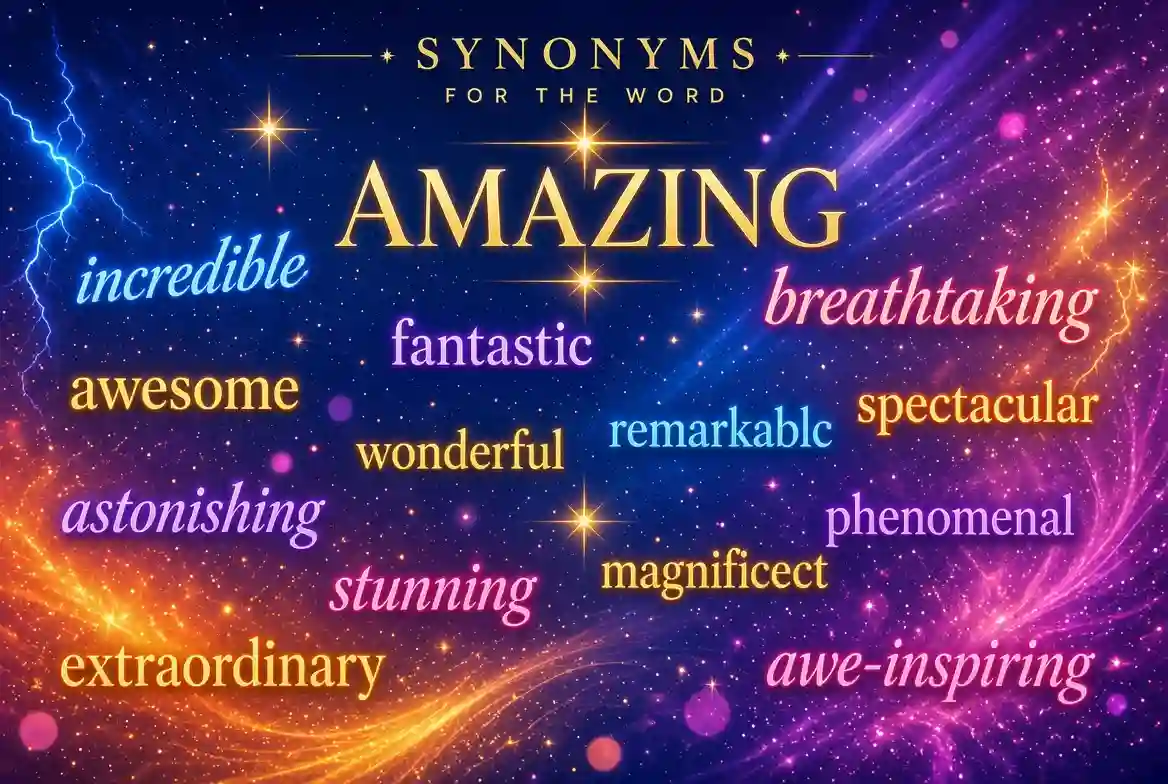
Have you ever used the word amazing so many times that your writing starts to sound repetitive? You are not alone. Amazing is a useful everyday adjective, but English gives you many more precise choices.
You can use astonishing when something is highly surprising, breathtaking when something is exceptionally beautiful, impressive when you want to praise skill or achievement, and wonderful when you want to express warmth and pleasure.
The best synonym depends on what you actually mean. This guide explains the most useful alternatives, their differences, natural examples, common collocations, and the situations where each word works best.
Quick Answer: What Are the Best Synonyms for Amazing?
Common synonyms for amazing include astonishing, astounding, incredible, remarkable, extraordinary, impressive, outstanding, spectacular, stunning, breathtaking, phenomenal, wonderful, marvelous, fantastic, brilliant, and awesome. They are not all interchangeable. Choose based on whether you want to express surprise, beauty, excellence, admiration, excitement, or strong approval.
What Does Amazing Mean?
Amazing is an adjective that commonly describes something that is extremely surprising or very good.
For example:
- The magician performed an amazing trick.
- We had an amazing vacation.
- It is amazing how quickly she learned the language.
Cambridge gives two important uses: extremely surprising and, informally, very good.
Oxford similarly explains amazing as very surprising, especially in a way that creates pleasure or admiration.
That difference matters when choosing a synonym.
If you mean surprising, try astonishing or astounding.
If you mean very good, wonderful or excellent may be more natural.
If you mean beautiful, breathtaking may be more precise.
Pronunciation of Amazing
IPA: /əˈmeɪ.zɪŋ/
It is pronounced the same way in standard American and British English. Cambridge lists /əˈmeɪ.zɪŋ/ for both varieties.
A simple pronunciation guide is:
uh-MAY-zing
The stress falls on the second syllable.
Part of Speech
Amazing is mainly an adjective.
Examples:
- She had an amazing idea.
- The view was amazing.
- That was an amazing performance.
It comes from the verb amaze.
The main related forms are:
| Word | Part of Speech | Example |
| amaze | Verb | The results amazed everyone. |
| amazed | Adjective | We were amazed by the results. |
| amazing | Adjective | The results were amazing. |
| amazement | Noun | She stared in amazement. |
| amazingly | Adverb | He performed amazingly well. |
Amazing vs. Amazed
This is one of the most important distinctions for English learners.
Amazing describes the thing that creates the feeling:
The movie was amazing.
Amazed describes the person experiencing the feeling:
I was amazed by the movie.
Oxford gives examples of amazed with both at and by, such as “amazed at” and “amazed by.”
Remember: The thing is amazing. The person is amazed.
Word Origin
Amazing comes from the verb amaze, with the adjective formed from its present participle.
For a modern English learner, the most useful point is not the historical timeline but the connection between the word family:
amaze → amazed → amazing → amazement → amazingly
This makes it easier to understand how the word behaves in different sentences.
CEFR Level
Approximate CEFR level: A2–B1, depending on meaning and learner reference.
Cambridge lists amazing as B1 for the meaning “extremely surprising,” while its Essential Dictionary lists the informal approving meaning “very good” at A2.
Oxford also includes amazing in its learner vocabulary resources and provides common usage patterns such as amazing achievement, amazing experience, and amazing discovery.
For learners, this is a useful everyday adjective to master because it appears in both conversation and general writing.
Grammar and Common Sentence Patterns
Amazing + noun
Use amazing before a noun.
- an amazing story
- an amazing opportunity
- an amazing achievement
- an amazing experience
Be + amazing
- The concert was amazing.
- Her performance was amazing.
It is amazing that…
Use this structure when you want to emphasize surprise.
- It is amazing that he finished so quickly.
- It is amazing that nobody noticed the mistake.
It is amazing how…
- It is amazing how quickly children learn.
- It is amazing how much the city has changed.
Oxford records these patterns as common uses of amazing.
American vs. British English
American and British English usage is broadly the same.
There is no important spelling difference in amazing, and the standard pronunciation is also essentially the same. Cambridge lists the same IPA pronunciation for both varieties.
Some synonyms, such as brilliant, may feel more strongly associated with British everyday speech in certain contexts, but the word itself is also understood and used in American English.
Quick Comparison of Synonyms for Amazing
| Word | Main Idea | Tone | Best Context |
| Astonishing | Strong surprise | Strong | Surprising facts or results |
| Astounding | Extreme surprise | Strong | Numbers, achievements, discoveries |
| Incredible | Surprise or excellence | Strong | Everyday and general use |
| Remarkable | Worth special attention | Neutral/Formal | Academic and professional writing |
| Extraordinary | Far beyond normal | Formal | Achievements and unusual situations |
| Impressive | Creates admiration | Neutral | Skills, work, results |
| Outstanding | Exceptionally good | Formal/Neutral | Performance and achievement |
| Spectacular | Dramatic or visually impressive | Strong | Events, scenery, performances |
| Breathtaking | Exceptionally beautiful | Emotional | Nature, views, art |
| Stunning | Extremely impressive or beautiful | Strong | Appearance, results, events |
| Phenomenal | Exceptionally successful or impressive | Strong | Success, talent, growth |
| Wonderful | Very pleasant or enjoyable | Warm | Experiences and personal communication |
| Fantastic | Very good or exciting | Informal/Neutral | Conversation and casual writing |
| Brilliant | Excellent or clever | Enthusiastic | Ideas, work, performance |
| Awesome | Extremely good | Informal | Conversation and social media |
How to Choose the Right Synonym
Instead of asking, “What is another word for amazing?” ask:
What exactly makes this thing amazing?
| If You Mean… | Try… |
| Extremely surprising | astonishing |
| Shockingly impressive | astounding |
| Very good in general | incredible |
| Worth special attention | remarkable |
| Far beyond normal | extraordinary |
| Deserving admiration | impressive |
| Better than most | outstanding |
| Dramatic or exciting | spectacular |
| Beautiful and powerful | breathtaking |
| Visually impressive | stunning |
| Extremely successful | phenomenal |
| Pleasant and enjoyable | wonderful |
| Casual strong approval | awesome |
| Excellent or clever | brilliant |
Astonishing
Meaning: Extremely surprising.
Examples:
- The scientist made an astonishing discovery.
- Her recovery was astonishingly fast.
Best Used When: Something produces a strong feeling of surprise.
Tone: Strong, neutral
Register: General, journalism, formal writing
Nuance: Astonishing is closer to the surprise side of amazing. It is not simply a synonym for “pleasant.”
Common Collocations:
- astonishing result
- astonishing discovery
- astonishing speed
When Not to Use It: Avoid it when you only mean that something was enjoyable.
Astounding
Meaning: Extremely surprising or impressive.
Examples:
- The athlete achieved an astounding record.
- The project required an astounding amount of work.
Best Used When: Numbers, achievements, discoveries, or results are far beyond expectations.
Tone: Very strong
Register: General, journalism, formal writing
Nuance: Astounding often feels dramatic and powerful.
Common Collocations:
- astounding achievement
- astounding success
- astounding figure
When Not to Use It: It may sound exaggerated for a small achievement.
Incredible
Meaning: Extremely impressive, surprising, or difficult to believe.
Examples:
- She has an incredible memory.
- The team made an incredible comeback.
Best Used When: You need a natural, flexible alternative in everyday English.
Tone: Strong and enthusiastic
Register: General, spoken, written
Nuance: Incredible is extremely versatile. Depending on context, it can mean either “very impressive” or “hard to believe.”
Common Collocations:
- incredible talent
- incredible story
- incredible opportunity
Remarkable
Meaning: Unusual or impressive enough to deserve attention.
Examples:
- She made remarkable progress this year.
- The report shows a remarkable improvement.
Best Used When: Talking about progress, achievements, qualities, or unusual facts.
Tone: Positive and measured
Register: Academic, professional, general
Nuance: Remarkable is often more restrained and professional than amazing.
Common Collocations:
- remarkable progress
- remarkable achievement
- remarkable ability
Extraordinary
Meaning: Very unusual or far beyond what is normal.
Examples:
- The rescue team showed extraordinary courage.
- She has an extraordinary ability to remember names.
Best Used When: Something clearly goes beyond ordinary expectations.
Tone: Strong
Register: Formal, professional, general
Nuance: It emphasizes being unusual or exceptional rather than simply enjoyable.
Common Collocations:
- extraordinary talent
- extraordinary circumstances
- extraordinary achievement
Impressive
Meaning: Causing admiration because of quality, skill, size, or achievement.
Examples:
- Your presentation was impressive.
- The company achieved impressive results.
Best Used When: Praising someone’s work, ability, performance, or results.
Tone: Positive and measured
Register: Business, academic, general
Nuance: Impressive is often one of the safest choices for professional writing.
Common Collocations:
- impressive results
- impressive performance
- impressive skills
Outstanding
Meaning: Exceptionally good.
Examples:
- She gave an outstanding presentation.
- The restaurant is known for its outstanding service.
Best Used When: Something performs at a particularly high level.
Tone: Strongly positive
Register: Professional, academic, general
Nuance: Outstanding can suggest that something stands above other examples.
Common Collocations:
- outstanding work
- outstanding performance
- outstanding achievement
Spectacular
Meaning: Very impressive, exciting, or visually dramatic.
Examples:
- We watched a spectacular sunset.
- The team produced a spectacular comeback.
Best Used When: Something is dramatic, exciting, or visually striking.
Tone: Strong and vivid
Register: General, journalism, creative writing
Nuance: This word adds drama. It is stronger and more colorful than a simple good.
Common Collocations:
- spectacular view
- spectacular performance
- spectacular display
Breathtaking
Meaning: Extremely beautiful or impressive.
Examples:
- The mountain offered breathtaking views.
- The dancer gave a breathtaking performance.
Best Used When: Describing scenery, beauty, art, performances, or powerful experiences.
Tone: Emotional
Register: General, descriptive, literary
Nuance: It suggests that something is so beautiful or impressive that it creates a powerful emotional reaction.
Common Collocations:
- breathtaking scenery
- breathtaking view
- breathtaking beauty
Stunning
Meaning: Extremely impressive, attractive, or surprising.
Examples:
- The building has a stunning design.
- The team recorded a stunning victory.
Best Used When: Something has a strong visual or emotional impact.
Tone: Strong
Register: General
Nuance: Stunning is especially natural for appearance, design, beauty, and surprising results.
Common Collocations:
- stunning design
- stunning beauty
- stunning victory
Phenomenal
Meaning: Extremely impressive or successful.
Examples:
- The company experienced phenomenal growth.
- She has shown phenomenal talent.
Best Used When: Describing success, growth, talent, or performance.
Tone: Very positive
Register: Business, journalism, general
Nuance: It often suggests an unusually high level of achievement.
Common Collocations:
- phenomenal success
- phenomenal growth
- phenomenal talent
Wonderful
Meaning: Very good, enjoyable, or pleasing.
Examples:
- We had a wonderful vacation.
- Thank you for the wonderful gift.
Best Used When: You want to express warmth, pleasure, or happiness.
Tone: Warm and positive
Register: General, spoken, written
Nuance: Wonderful is usually about pleasure rather than surprise.
Common Collocations:
- wonderful experience
- wonderful opportunity
- wonderful news
Fantastic
Meaning: Extremely good, enjoyable, or exciting.
Examples:
- You did a fantastic job.
- We had a fantastic weekend.
Best Used When: Casual praise or enthusiastic conversation.
Tone: Energetic
Register: Informal to neutral
Nuance: It usually communicates strong approval rather than astonishment.
Common Collocations:
- fantastic job
- fantastic opportunity
- fantastic result
Brilliant
Meaning: Extremely good, clever, or impressive.
Examples:
- That was a brilliant idea.
- She found a brilliant solution to the problem.
Best Used When: Praising intelligence, ideas, solutions, work, or performances.
Tone: Enthusiastic
Register: General, spoken, written
Nuance: Unlike breathtaking, brilliant often focuses on intelligence or quality.
Common Collocations:
- brilliant idea
- brilliant solution
- brilliant performance
Awesome
Meaning: Extremely good or impressive.
Examples:
- That concert was awesome.
- You did an awesome job.
Best Used When: Friendly conversation, texts, and informal social media.
Tone: Enthusiastic and casual
Register: Informal
Nuance: Awesome is much more casual than remarkable or outstanding.
Common Collocations:
- awesome job
- awesome idea
- awesome experience
When Not to Use It: Avoid it in highly formal academic or professional writing unless the context specifically calls for an informal voice.
Marvelous
Meaning: Extremely good, enjoyable, or impressive.
Examples:
- We had a marvelous evening.
- She gave a marvelous performance.
Best Used When: Expressing warm admiration or enthusiasm.
Tone: Warm and positive
Register: General, literary in some contexts
Nuance: Marvelous can sound slightly more traditional than amazing in some varieties of English.
Common Collocations:
- marvelous opportunity
- marvelous experience
- marvelous performance
Exceptional
Meaning: Unusually good or far above normal.
Examples:
- The student showed exceptional ability.
- The hotel provides exceptional service.
Best Used When: Formal praise is needed.
Tone: Strong and professional
Register: Business, academic
Nuance: It is more formal and measured than amazing.
Common Collocations:
- exceptional quality
- exceptional talent
- exceptional performance
Magnificent
Meaning: Extremely impressive, beautiful, or grand.
Examples:
- The palace looked magnificent at sunset.
- They enjoyed a magnificent view of the valley.
Best Used When: Describing grandeur, beauty, architecture, nature, or important occasions.
Tone: Grand and expressive
Register: General, literary
Nuance: Magnificent often suggests size, beauty, richness, or grandeur.
Common Collocations:
- magnificent building
- magnificent view
- magnificent performance
Awe-Inspiring
Meaning: Causing a strong feeling of admiration, wonder, or awe.
Examples:
- The canyon was awe-inspiring.
- Her courage during the crisis was awe-inspiring.
Best Used When: Something creates deep wonder or admiration.
Tone: Strong and emotional
Register: General, descriptive, literary
Nuance: This phrase is more emotionally powerful than ordinary amazing.
Common Collocations:
- awe-inspiring sight
- awe-inspiring landscape
- awe-inspiring courage
Fantastic Alternatives That Depend on Context
Some words are useful alternatives only in particular situations.
Fascinating
Use fascinating when something holds your attention because it is extremely interesting.
The professor gave a fascinating lecture.
It does not necessarily mean something is beautiful or excellent.
Captivating
Use captivating when something strongly attracts and holds attention.
She told a captivating story.
Admirable
Use admirably when something deserves respect or approval.
His patience was admirable.
Exciting
Use exciting when something creates enthusiasm or anticipation.
The final match was exciting.
Beautiful
Use beautiful when appearance or aesthetic quality is the main point.
The garden was beautiful.
These words overlap with amazing in some contexts, but they should not be treated as exact replacements in every sentence.
Commonly Confused Words
| Word | Main Difference | Example |
| Amazing | Broad sense of surprise or strong approval | The performance was amazing. |
| Astonishing | Strong emphasis on surprise | The result was astonishing. |
| Wonderful | Emphasis on pleasure | We had a wonderful day. |
| Impressive | Emphasis on admiration | Her skills were impressive. |
| Outstanding | Emphasis on exceptional quality | His work was outstanding. |
Common Mistakes
Common Mistake
Incorrect:
The students were amazed by the results.
Correct:
The students were amazed by the results.
Why?
The students experience the feeling, so we are amazed.
Incorrect:
The movie was amazing.
Correct:
The movie was amazing.
Why?
The movie creates the feeling, so it is amazing.
Less Natural in a Formal Report:
The team did an awesome job.
More Suitable:
The team delivered an outstanding performance.
Why?
Awesome is informal, while outstanding fits professional writing better.
Writing Tips: Do Not Replace Every Repeated Word
Good writing is not about finding a different synonym every time you use the same word.
Suppose you write:
The amazing results came from an amazing team using an amazing strategy.
Simply replacing the three uses with unrelated synonyms may make the sentence sound forced.
A better approach is to become more specific:
The impressive results came from a highly skilled team using an effective strategy.
The second sentence gives the reader more information.
For essays
Prefer precise words such as:
- remarkable
- significant
- extraordinary
- impressive
- exceptional
For business writing
Useful choices include:
- impressive
- outstanding
- exceptional
- remarkable
For stories
Descriptive choices can include:
- breathtaking
- astonishing
- spectacular
- magnificent
- awe-inspiring
For social media
Natural informal choices include:
- amazing
- awesome
- fantastic
- incredible
- brilliant
For everyday conversation
The simplest words are often best:
- amazing
- wonderful
- incredible
- fantastic
- awesome
Writing Tip: Choose the word that adds meaning, not simply the word that looks more advanced.
Related Vocabulary
Antonyms of Amazing
Depending on the context, possible opposites include:
- ordinary
- unremarkable
- unimpressive
- mediocre
- mundane
- typical
- dull
- boring
The correct opposite depends on the sense of amazing.
For example:
an amazing performance → a mediocre performance
But:
an amazing view → an ordinary view
Common Expressions
These expressions can sometimes communicate a similar feeling, although they are not exact synonyms:
- out of this world
- beyond belief
- hard to believe
- one of a kind
- second to none
- take your breath away
- leave someone speechless
- a sight to behold
Word Family
- amaze — verb
- amazed — adjective
- amazing — adjective
- amazement — noun
- amazingly — adverb
Oxford lists amazingly as an adverb and provides examples such as “amazingly cheap” and “did amazingly well.”
Natural Collocations With Amazing
Learning common word combinations can make your English sound more natural.
Amazing + noun
- amazing experience
- amazing opportunity
- amazing achievement
- amazing story
- amazing discovery
- amazing performance
- amazing results
- amazing talent
- amazing view
- amazing news
Verb + amazing
- be amazing
- seem amazing
- look amazing
- sound amazing
- feel amazing
These patterns are more useful for learners than memorizing isolated synonym lists.
When Should You Avoid Amazing?
There is nothing wrong with using amazing. It is a normal and useful English word.
However, it may be too general when you know exactly what you want to say.
Instead of:
She gave an amazing presentation.
You could write:
She gave an impressive presentation.
Instead of:
The mountain view was amazing.
You could write:
The mountain view was breathtaking.
Instead of:
The company’s growth was amazing.
You could write:
The company experienced phenomenal growth.
The more specific word gives the reader a clearer picture.
Mini Practice Exercises
Fill in the Blanks
Choose the best word.
- The Grand Canyon offered a __________ view.
- The scientist made an __________ discovery.
- She delivered an __________ presentation at the conference.
Answers:
- breathtaking
- astonishing
- impressive
Rewrite the Sentences
Replace amazing with a more precise alternative.
- The team achieved an amazing result.
- We had an amazing vacation.
Possible answers:
- The team achieved an outstanding result.
- We had a wonderful vacation.
More than one answer can sometimes work because context affects synonym choice.
Matching Activity
Match each word with its main meaning.
- Breathtaking
- Remarkable
- Awesome
A. Informal strong approval
B. Exceptionally beautiful or impressive
C. Worth special attention
Answers:
1-B
2-C
3-A
Frequently Asked Questions
What is another word for amazing?
Common alternatives include astonishing, astounding, incredible, remarkable, extraordinary, impressive, outstanding, spectacular, stunning, breathtaking, wonderful, and fantastic. The best choice depends on the sentence. For example, breathtaking works especially well for beautiful scenery, while astonishing emphasizes surprise.
What is the best synonym for amazing?
There is no single best synonym. Astonishing is a strong choice when something is surprising. Impressive works well for achievements and skills. Wonderful expresses pleasure, while breathtaking is especially useful for beauty and powerful visual experiences.
Is amazing a formal word?
Yes. Amazing is a neutral everyday adjective and can appear in both speech and writing. However, its informal meaning “very good” is especially common in conversation. In formal writing, a more precise word such as remarkable, impressive, or exceptional may sometimes be better.
Is incredible the same as amazing?
The two words overlap strongly, but they are not identical in every context. Incredible can emphasize something that is difficult to believe, while amazing can also simply mean very good. In many everyday sentences, however, they can be natural alternatives.
What is the opposite of amazing?
Possible opposites include ordinary, unremarkable, unimpressive, mediocre, mundane, and typical. The best choice depends on the intended meaning. If amazing means extremely beautiful, unattractive may provide a more relevant contrast.
What is the difference between amazing and astonishing?
Both can describe something that creates strong surprise. Astonishing focuses more strongly on the unexpected nature of something, while amazing has a wider range of modern uses and can also mean very good. Cambridge and Oxford both identify surprise as a central meaning of amazing.
What is the difference between amazing and wonderful?
Amazing can express surprise, admiration, or strong approval. Wonderful usually focuses on pleasure and positive feelings. You might describe an unexpected scientific discovery as amazing, while a relaxing family holiday may be wonderful.
How do you use amazing in a sentence?
You can use amazing before a noun, after forms of be, or in structures such as “It is amazing that…” For example: “She had an amazing opportunity,” “The concert was amazing,” and “It is amazing how quickly he learned.” Oxford documents these common sentence patterns.
Vocabulary Quiz
1. Which word best emphasizes surprise?
A. Wonderful
B. Astonishing
C. Pleasant
D. Ordinary
Answer: B. Astonishing
It strongly emphasizes surprise.
2. Which word is most suitable for beautiful scenery?
A. Breathtaking
B. Mediocre
C. Typical
D. Unremarkable
Answer: A. Breathtaking
It is commonly used for exceptionally beautiful or impressive views.
3. Which word is best for professional praise?
A. Awesome
B. Outstanding
C. Cool
D. Fun
Answer: B. Outstanding
It is a natural choice for professional and academic contexts.
4. Choose the correct sentence.
A. I was amazed by the results.
B. I was amazed by the results.
C. I was amazed by the results.
D. I was amazed by the results.
Answer: B. I was amazed by the results.
The person experiencing the feeling is amazed.
5. Which word is most informal?
A. Exceptional
B. Remarkable
C. Awesome
D. Extraordinary
Answer: C. Awesome
It is especially common in casual speech, texts, and friendly online communication.
Final Thoughts
Learning synonyms for amazing is not about replacing one word with a more complicated word. It is about choosing a language that expresses your exact meaning. Use astonishing for strong surprise, impressive for admiration, breathtaking for beauty, outstanding for exceptional performance, and wonderful for warm approval.
The more you practice these differences in essays, emails, conversations, and everyday writing, the more natural your vocabulary will become. Start with a few useful alternatives and learn when each one fits. Precision will always make your English stronger than simply using more words.
References
- Cambridge Dictionary: amazing
- Cambridge Dictionary: pronunciation of amazing
- Oxford Learner’s Dictionaries: amazing
- Oxford Learner’s Dictionaries: amazed
- Oxford Learner’s Dictionaries: amazingly

Synonorm is a trusted English vocabulary resource created to help readers find the right words and understand the differences between similar terms. We provide clear explanations of synonyms, meanings, examples, usage, and alternatives. Our content makes vocabulary easier to learn and apply in everyday, academic, and professional English. Synonorm is designed for students, writers, ESL learners, professionals, and anyone who wants to improve their English vocabulary and communicate more clearly.