Have you ever used the word cute so many times that you wanted a better way to describe something? Maybe you are talking about a puppy, a baby, an outfit, a smile, or even a small apartment.
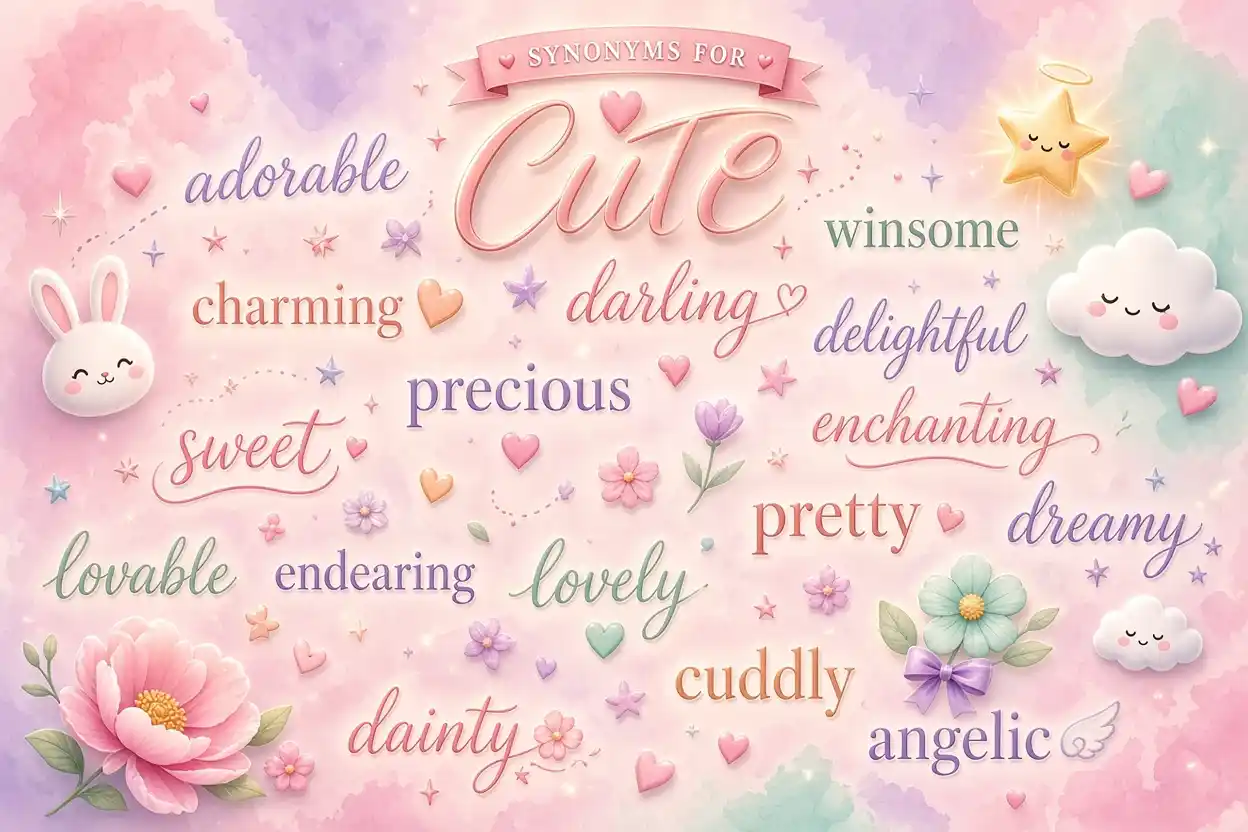
There are plenty of words that can replace cute, but they do not all mean exactly the same thing. Adorable suggests strong affection, charming focuses on pleasant appeal, pretty usually describes appearance, and sweet often adds warmth or kindness.
This guide explores the most useful synonyms for cute, explains their subtle differences, and shows you how native speakers naturally use them. It is useful for students, ESL learners, writers, bloggers, teachers, and anyone who wants more precise English.
Quick Answer: What Are the Best Synonyms for Cute?
The best synonyms for cute include adorable, charming, sweet, appealing, attractive, lovely, pretty, delightful, endearing, lovable, and engaging. The right choice depends on context. Use adorable for strong affection, pretty for pleasant appearance, charming for personality or overall appeal, and sweet for warmth or kindness.
What Does Cute Mean?
Cute is an adjective that usually describes someone or something as pleasant and attractive, especially when it is small, young, delicate, or charming. Cambridge gives examples involving a baby and a small apartment, while Collins lists appealing, sweet, attractive, and engaging among its synonyms.
For example:
- That puppy is cute.
- She bought a cute little bag.
- Your baby brother is so cute.
- That’s a cute idea.
The word can also have other meanings. In mainly US informal English, cute can describe someone as sexually attractive. It can also describe clever or shrewd behavior, as in “a cute trick.”
That is important because the best synonym depends on which meaning of cute you intend.
Pronunciation of Cute
IPA: /kjuːt/
It sounds like kyoot.
Cambridge gives /kjuːt/ for both British and American English.
Part of Speech
Cute is primarily an adjective.
Examples:
- She has a cute smile.
- That kitten is cute.
- This is the cutest little café.
- Your new shoes are cuter than mine.
Its common related forms include:
- cuter: comparative adjective
- cutest: superlative adjective
- cuteness: noun
- cutely: adverb
Cambridge defines cuteness as the quality of being pleasant and attractive.
Origin of the Word Cute
The history of cuteness is more interesting than it first appears.
The modern word developed as a shortened form of acute. Collins records an early sense connected with cleverness and gives the word origin as an 18th-century shortening of acute.
Over time, cute developed the familiar sense of being attractive, charming, dainty, or pleasing.
So the modern meaning is not simply the same as the word’s earliest meaning. English words often change meaning as speakers use them in new ways.
Is Cute Formal or Informal?
Cute is generally informal.
It is very natural in:
- Everyday conversation
- Text messages
- Social media
- Personal communication
- Casual writing
- Descriptions of babies and animals
For more formal writing, words such as attractive, appealing, pleasing, or engaging may sometimes work better.
For example:
Informal:
The website has a cute design.
More professional:
The website has an appealing design.
Neither sentence is automatically better. The right choice depends on the audience and purpose.
Synonyms for Cute at a Glance
| Word | What It Emphasizes | Tone | Best Context |
| Adorable | Strong affection | Warm | Babies, pets, people |
| Charming | Pleasant appeal | Warm | People, places, behavior |
| Sweet | Warmth or kindness | Warm | People, gestures, expressions |
| Lovely | General pleasantness | Warm | People, things, experiences |
| Pretty | Pleasant appearance | Neutral | People, clothes, objects |
| Attractive | General appeal | Neutral | People, designs, objects |
| Appealing | Ability to attract interest | Neutral | Ideas, products, designs |
| Delightful | Pleasure and enjoyment | Positive | Experiences, people, places |
| Endearing | Ability to inspire affection | Warm | Personality, habits, behavior |
| Lovable | Easy to love | Warm | People, pets, characters |
| Engaging | Ability to hold attention | Positive | People, writing, presentations |
| Beautiful | Strong beauty | Neutral | People, art, nature |
| Gorgeous | Striking beauty | Informal | People, clothes, places |
| Winsome | Gentle charm | Literary | Smiles, personalities |
| Winning | Ability to gain approval | Positive | Smiles, personalities |
| Cutesy | Artificial or excessive cuteness | Informal, often negative | Designs, behavior |
Collins lists appealing, sweet, attractive, engaging, charming, delightful, lovable, winsome, winning, and cutesy among its thesaurus alternatives for cute.
The Closest Synonyms for Cute
Not all words in a thesaurus list are equally close. These are some of the most useful choices when you genuinely want to replace cute.
1. Adorable
Adorable is probably the strongest everyday alternative when you want to express affection.
Example:
The puppy looked adorable in its little sweater.
Compared with cute, adorable usually carries more emotional warmth.
Best for: babies, children, animals, smiles, affectionate descriptions.
Common combinations:
- adorable baby
- adorable puppy
- adorable smile
Cute vs. adorable:
The kitten is cute.
This is a simple observation.
The kitten is adorable.
This shows stronger affection.
2. Charming
Charming describes something pleasant or attractive that makes people like it.
Examples:
She has a charming personality.
We stayed in a charming little village.
It is especially useful because it can describe personality, behavior, places, and appearance, not just physical looks.
Best for: people, smiles, personalities, homes, villages, manners.
Cute often focuses on appearance. Charming often focuses on overall appeal.
3. Sweet
Sweet is a warm and flexible word.
That was such a sweet message.
She has a sweet little smile.
It can describe appearance, but it often says something about kindness, affection, innocence, or behavior.
Best for: people, children, gestures, messages, smiles, actions.
A useful distinction is:
Her dress is cute.
Focuses on appearance.
That was sweet of her.
Focuses on kindness.
4. Lovely
Love is broader than cute. It can mean attractive, pleasant, enjoyable, or delightful.
You have a lovely smile.
We had a lovely evening.
It works especially well when you want a warm compliment without sounding overly excited.
Best for: people, places, experiences, clothes, voices, smiles.
5. Pretty
Pretty usually focuses on appearance.
She wore a pretty blue dress.
The garden looks pretty in spring.
It is often a better choice than cute when you simply mean pleasantly attractive.
However, pretty does not necessarily carry the playful or youthful feeling that cute can have.
6. Attractive
Attractive is more neutral and objective.
The apartment has an attractive design.
He is an attractive man.
It works well in professional and general writing because it sounds less playful than cute.
Best for: people, products, designs, places, offers, features.
For example:
The website has a cute design.
sounds casual.
The website has an attractive design.
sounds more professional.
7. Appealing
Appealing means attractive or interesting enough to make someone like something or want it.
The simple design is very appealing.
The idea sounds appealing to students.
This word is especially useful for ideas, products, services, designs, and experiences.
It is therefore a useful alternative to cute in professional writing, but it is not a perfect replacement in every personal situation.
8. Delightful
Delightful describes something that gives pleasure or makes an experience enjoyable.
We had a delightful conversation.
The little restaurant was delightful.
It is not mainly about physical appearance. It is about the pleasant experience something creates.
9. Endearing
Something is endearing when it makes people feel affection.
His shy smile was endearing.
Her little mistakes were strangely endearing.
This is a particularly useful word when cute refers to a person’s behavior, personality, habits, or small imperfections.
10. Lovable
Lovable means easy to love or feel affection for.
The dog has a lovable personality.
He created a lovable character for the children’s book.
It focuses more on emotional attachment than physical appearance.
11. Engaging
Engaging means interesting or pleasant enough to hold someone’s attention.
She has an engaging personality.
The teacher gave an engaging presentation.
It is a useful word for people, speakers, stories, lessons, and writing.
Calling a presentation cute would usually sound strange. Calling it engaging makes much more sense.
12. Beautiful
Beautiful is a much stronger word for beauty.
The sunset was beautiful.
She has a beautiful voice.
It can overlap with cute, but the feeling is different.
A tiny puppy may be cute.
A breathtaking mountain may be beautiful.
Of course, something can be both.
13. Gorgeous
Gorgeous means extremely attractive or beautiful.
You look gorgeous in that dress.
The view from the hotel was gorgeous.
It is common in informal conversation and often expresses strong admiration.
It is generally much stronger than cute when discussing beauty.
14. Winsome
Winsome means attractive or charming in a gentle, appealing way.
She gave him a winsome smile.
The character has a winsome personality.
It is less common in everyday conversation and has a somewhat literary feel.
Use it when you want your writing to sound more expressive, not when you simply need an everyday replacement.
15. Winning
Winning can describe a personality, smile, or manner that naturally gains approval or affection.
He has a winning smile.
Her winning personality made everyone feel welcome.
It is related to cute, but it focuses on the ability to win people over.
16. Cutesy
Cutesy deserves special attention because it is often misunderstood.
It does not simply mean “very cute.”
Cambridge labels it informal and disapproving. It describes something artificially attractive or pleasant, especially in a childish way.
The store was filled with cutesy decorations.
I don’t like the cutesy style of the advertisement.
So cutesy can suggest that something is overly cute, artificial, or childish.
Related Words That Are Not Exact Synonyms
Some words are connected to cute but should not be treated as direct replacements.
Playful
Describes fun-loving behavior.
The puppy is playful.
It does not necessarily mean the puppy is attractive.
Dainty
Describes something small and delicate.
She wore a dainty necklace.
It focuses on delicacy rather than general charm.
Eye-catching
Describes something that attracts visual attention.
The poster has an eye-catching design.
It does not necessarily mean cute.
Alluring
Means strongly attractive or tempting.
The perfume has an alluring scent.
It can carry a more sophisticated or sensual meaning, so it is not a general substitute for cute.
Pleasant
Means agreeable or enjoyable.
We had a pleasant conversation.
It is much more neutral than cute.
Remember: A related word can be useful in the same topic without being a true synonym.
Cute vs. Adorable vs. Charming vs. Pretty
These four words are among the easiest to confuse.
| Word | Main Idea | Example |
| Cute | Charming, attractive, often youthful or playful | That kitten is cute. |
| Adorable | Very lovable or appealing | That kitten is adorable. |
| Charming | Pleasant and attractive in character or manner | She has a charming personality. |
| Pretty | Pleasant to look at | She wore a pretty dress. |
Think of them this way:
Cute = charming and attractive
Adorable = strongly lovable
Charming = pleasantly appealing
Pretty = pleasantly attractive in appearance
Common Collocations With Cute
Native speakers commonly use cute with words such as:
- cute baby
- cute puppy
- cute kitten
- cute dog
- cute couple
- cute little house
- cute dress
- cute outfit
- cute smile
- cute idea
- cute picture
- cute shoes
Collins also identifies combinations such as cute animal, cute cat, cute couple, cute dog, and cute puppy in its collocation material.
Common Mistakes
Common Mistake 1: Treating every thesaurus word as an exact replacement
Incorrect idea:
If a dictionary lists two words together, they must work in every sentence.
Better approach:
Check the meaning and context first.
For example:
The puppy is cute.
can naturally become:
The puppy is adorable.
But:
The puppy is eye-catching.
changes the meaning. Now you are talking about attracting visual attention, not affection.
Common Mistake 2: Using cutesy as a simple compliment
Problem:
Cutesy can sound critical.
Better:
Use cute or adorable when you want a straightforward positive compliment.
Common Mistake 3: Using gorgeous when you only mean cute
Problem:
Gorgeous is much stronger and usually focuses on striking beauty.
Better:
Use cute, pretty, or lovely when the subject has a softer or more playful appeal.
Common Mistake 4: Replacing repeated words without thinking
Good writing does not require a different synonym every time you use a word.
Sometimes repeating cute is the most natural choice.
How to Use These Words in Different Situations
For Babies and Children
Best choices:
- cute
- adorable
- sweet
- lovely
- endearing
Example:
Her baby has the most adorable smile.
For Pets
Best choices:
- cute
- adorable
- lovable
- playful
- sweet
Example:
Our new puppy is adorable but very playful.
For Clothes
Best choices:
- cute
- pretty
- attractive
- lovely
- eye-catching
Example:
That’s a cute jacket.
Or:
That’s a really eye-catching jacket.
The second sentence emphasizes attention rather than affection.
For People
The right word depends heavily on what you mean.
Appearance:
- attractive
- pretty
- beautiful
- gorgeous
- cute
Personality:
- charming
- sweet
- lovable
- engaging
- delightful
For example:
She is cute.
can describe appearance in an informal way.
She is charming.
usually says more about her personality or manner.
For Professional Writing
Avoid overly casual choices when the context calls for a neutral tone.
Instead of:
The company has a cute logo.
You might write:
The company has an appealing logo.
Instead of:
The website looks cute.
You might write:
The website has an attractive, approachable design.
This is not because cute is grammatically wrong. It is simply a question of register.
Frequency and Natural Usage
Cute is a very common everyday adjective.
It is particularly natural in informal speech and personal communication. Cambridge and Collins both give ordinary examples involving babies, animals, and small homes.
Among alternatives, words such as adorable, charming, sweet, lovely, pretty, beautiful, and attractive are also widely understood.
Words such as winsome and fetching are less common in ordinary modern conversation.
This does not make them wrong. It simply means they are more limited by style and context.
Antonyms and Opposites
There is no single opposite of cute in every situation.
If cute means attractive, possible opposites include:
- unattractive
- ugly
- plain
If it means pleasant or charming, you might use:
- unpleasant
- unattractive
- off-putting
The correct opposite depends on the particular meaning.
Practice Exercises
Fill in the Blanks
Choose the best word.
- The little kitten was so ________ that everyone wanted to hold it.
A. adorable
B. formal
C. unpleasant - She has a very ________ personality and makes people feel comfortable.
A. dainty
B. charming
C. eye-catching - The new advertisement has an ________ design that immediately attracts attention.
A. lovable
B. eye-catching
C. sweet
Rewrite the Sentences
- Replace cute with a word that expresses stronger affection:
The puppy is very cute.
Possible answer: The puppy is very adorable.
- Replace cute with a word that focuses on pleasant personality:
She is cute.
Possible answer: She is charming.
Matching Activity
Match each word with its best meaning.
| Word | Meaning |
| 1. Adorable | A. Pleasant and attractive in character |
| 2. Charming | B. Extremely lovable |
| 3. Eye-catching | C. Designed to attract visual attention |
Answers: 1-B, 2-A, 3-C
Frequently Asked Questions
What is another word for cute?
Common alternatives include adorable, charming, sweet, lovely, pretty, attractive, appealing, delightful, endearing, and lovable. The best choice depends on what you want to emphasize. Adorable suggests affection, while pretty focuses more on appearance and charming often describes personality or overall appeal.
What is the best synonym for cute?
There is no single best synonym. Adorable is often the closest choice when you mean very cute and lovable. Charming works well for personality, pretty for appearance, and attractive for a more neutral description.
Is adorable stronger than cute?
Usually, yes. Adorable often expresses a stronger emotional reaction than cute. Calling a puppy cute simply describes its appeal, while calling it adorable usually shows that you feel especially fond of it.
Is cute formal or informal?
Cute is generally informal, especially when it means attractive, charming, or appealing. It is very common in everyday conversation, messages, and social media. In professional writing, attractive, appealing, or pleasing may sometimes be more appropriate.
Is pretty the same as cute?
Not exactly. Pretty mainly describes pleasant physical appearance, while cute can suggest charm, youthfulness, smallness, playfulness, or affection. A dress can be both pretty and cute, but the two words create slightly different impressions.
What is the difference between cute and charming?
Cute often describes something attractive in a youthful, playful, or delicate way. Charming suggests an appealing quality that makes someone or something pleasant or likable. A person can be cute because of appearance and charming because of personality.
Is cutesy a positive word?
Not always. Cutesy is often used critically to describe something that is artificially or excessively cute, particularly in a childish style. Cambridge marks the word as informal and disapproving.
Can cute mean clever?
Yes. In US English, cute can describe someone as clever or shrewd, and it can sometimes suggest that the person is being overly clever or trying to be amusing. This meaning is different from the familiar “adorable” sense.
Vocabulary Quiz
1. Which word usually expresses the strongest affection?
A. Attractive
B. Pleasant
C. Adorable
D. Appealing
Answer: C. Adorable
2. Which word is best for a person’s pleasant personality?
A. Charming
B. Dainty
C. Eye-catching
D. Pretty
Answer: A. Charming
3. Which word focuses on visual attention?
A. Lovable
B. Sweet
C. Eye-catching
D. Endearing
Answer: C. Eye-catching
4. Which word can have a critical meaning suggesting excessive cuteness?
A. Lovely
B. Cutesy
C. Adorable
D. Beautiful
Answer: B. Cutesy
5. Which sentence sounds most natural?
A. The kitten is adorable.
B. The kitten is professional.
C. The kitten is formal.
D. The kitten is academic.
Answer: A. The kitten is adorable.
Final Takeaway
There are many useful synonyms for cute, but the best word depends on what you really want to say. Choose adorable for strong affection, charming for pleasant personality, pretty for appearance, sweet for warmth, and attractive for a neutral tone.
Good vocabulary is not about using the biggest number of synonyms. It is about choosing the most precise word for the situation. Practice these alternatives in conversations, essays, emails, stories, and everyday writing, and your English will become more natural and expressive.
References
- Cambridge Dictionary: Cute
- Cambridge Dictionary: Cutesy
- Cambridge Dictionary: Cute Pronunciation
- Collins English Dictionary: Cute
- Collins English Thesaurus: Cute

Synonorm is a trusted English vocabulary resource created to help readers find the right words and understand the differences between similar terms. We provide clear explanations of synonyms, meanings, examples, usage, and alternatives. Our content makes vocabulary easier to learn and apply in everyday, academic, and professional English. Synonorm is designed for students, writers, ESL learners, professionals, and anyone who wants to improve their English vocabulary and communicate more clearly.