Have you ever used important several times in the same essay, email, or article and felt that your writing sounded repetitive? You are not alone. Important is one of the most useful English adjectives, but it is also a broad word.
The best synonyms for importance depend on what you actually mean. If something is necessary, use essentials. If it can change an outcome, crucial or pivotal may work better. If a person has power over others, influence is more precise.
This guide explains the differences in simple English so you can choose words naturally instead of replacing important with a random thesaurus word.
Quick Answer
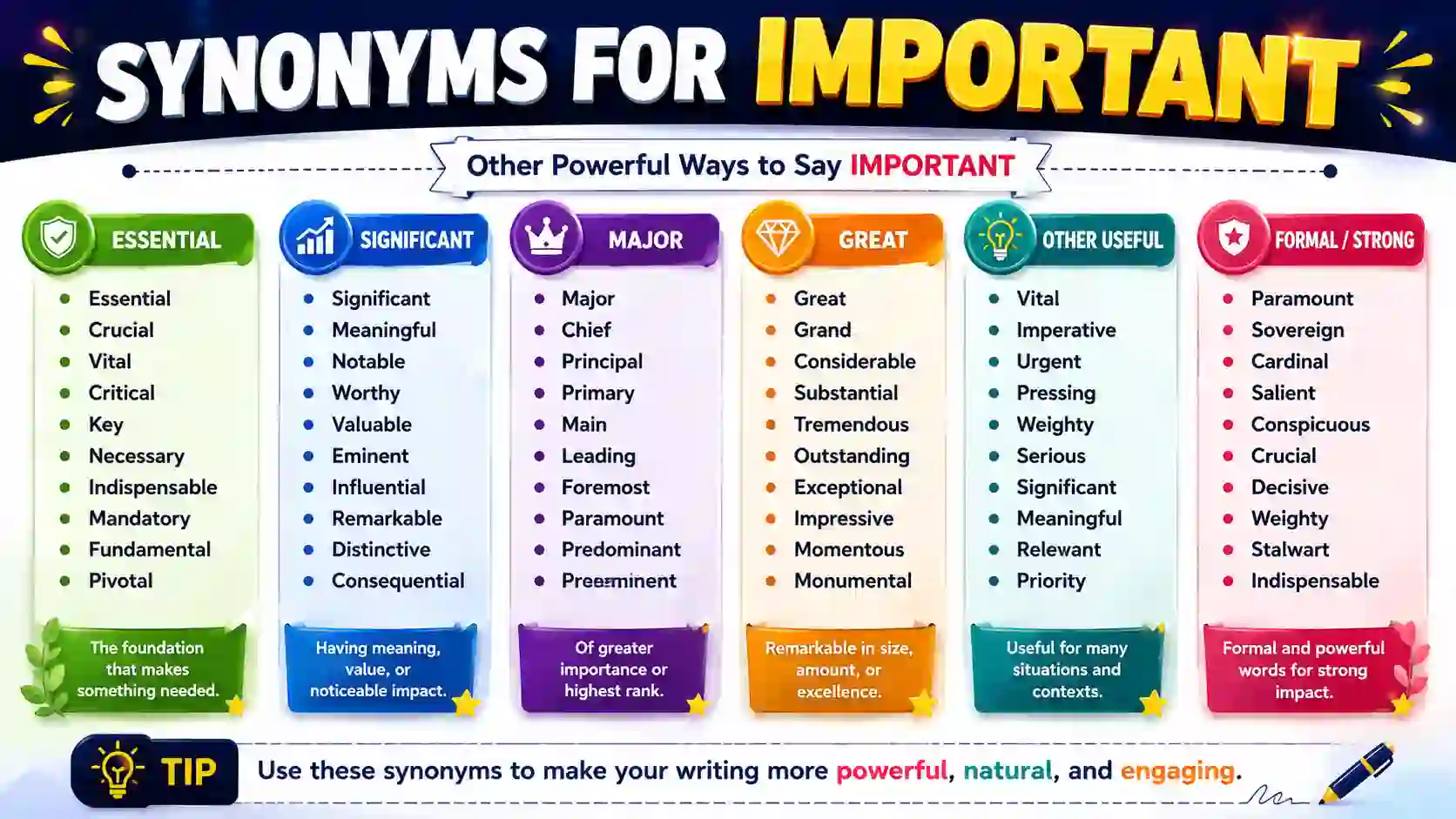
Common synonyms for important include significant, essential, crucial, vital, critical, major, meaningful, influential, key, pivotal, substantial, notable, consequential, prominent, and momentous. These words are related, but they are not interchangeable in every sentence. The right choice depends on whether you mean necessary, influential, valuable, noticeable, or highly significant.
What Does Important Mean?
Important means having great value, meaning, influence, or effect. It can describe a thing, idea, decision, event, person, or relationship.
For example:
Getting enough sleep is important for your health.
Here, it is important that sleep has great value for your health.
The word can also describe a person who has influence or authority:
She is an important member of the research team.
Cambridge and Oxford both recognize these broad uses, including great value or effect and, when describing people, influence or authority.
Pronunciation
Important
- UK: /ɪmˈpɔː.tənt/
- US: /ɪmˈpɔːr.tənt/
- Simple pronunciation: im-POR-tuhnt
There is no spelling difference between American and British English. The main pronunciation difference is that the American form normally includes the r sound, while standard British pronunciation does not pronounce that /r/ in the same position.
Part of Speech
Important is mainly an adjective.
- Adjective: This is an important decision.
- Noun: The importance of exercise is well known.
- Adverb: More importantly, everyone agreed.
Common Grammar Patterns
important to + person
Family is important to me.
important for + person or purpose
Exercise is important for good health.
It is important to + verb
It is important to check your work.
It is important that + clause
It is important that students understand the rules.
more important than
Good communication is more important than expensive equipment.
These patterns are standard English usage and are also reflected in learner dictionaries.
Quick Synonym Guide
| Word | Main idea | Register | Frequency |
| Significant | Great meaning or effect | Neutral/Formal | Very common |
| Essential | Necessary | Neutral/Formal | Very common |
| Crucial | Extremely important to an outcome | Neutral/Formal | Very common |
| Vital | Necessary or extremely important | Neutral/Formal | Common |
| Critical | Extremely important in a serious situation | Formal/Professional | Very common |
| Major | Large or highly significant | Neutral | Very common |
| Meaningful | Personally valuable or significant | Neutral | Common |
| Influential | Able to affect people or events | Neutral/Formal | Common |
| Key | Central to success or understanding | Neutral/Business | Very common |
| Pivotal | Changes or determines an outcome | Formal/Academic | Common |
| Substantial | Large in amount, degree, or effect | Formal | Common |
| Notable | Worth noticing | Neutral/Formal | Common |
| Consequential | Producing important results | Formal | Uncommon |
| Prominent | Well-known or important in a field | Formal | Common |
| Relevant | Directly connected to the matter | Academic/Business | Very common |
| Central | At the heart of an issue | Neutral/Academic | Common |
| Valuable | Worthwhile or useful | Neutral | Very common |
| Momentous | Extremely important with lasting effects | Formal/Literary | Uncommon |
| Imperative | Urgently necessary | Formal/Business | Common |
| Substantive | Serious and meaningful rather than superficial | Formal/Academic | Uncommon |
25 Useful Synonyms for Important
1. Significant
Meaning: Having great meaning, importance, or effect.
Example 1: The study found a significant improvement in reading skills.
Example 2: Her discovery had a significant impact on medical research.
Best used when: Something has a noticeable or meaningful effect.
Register: Neutral to formal
CEFR: B2
Frequency: Very common
Common collocations:
- significant change
- significant impact
- significant difference
When not to use it: Do not use significant simply to mean necessary. In that case, essential is usually better.
2. Essential
Meaning: Necessary or needed.
Example 1: Clean water is essential for human life.
Example 2: Good communication is essential for teamwork.
Best used when: Something cannot reasonably be removed or ignored.
Register: Neutral/Formal
CEFR: B1
Frequency: Very common
Common collocations:
- essential information
- essential skill
- essential part
When not to use it: Do not call something essential when it is merely helpful.
Cambridge defines essential as necessary or needed and specifically contrasts it with things that are merely optional.
3. Crucial
Meaning: Extremely important because the result depends on it.
Example 1: Good planning was crucial to the project’s success.
Example 2: The final interview was crucial to her career.
Best used when: Something can strongly affect an outcome.
Register: Neutral/Formal
CEFR: B2
Frequency: Very common
Common collocations:
- crucial role
- crucial decision
- crucial moment
When not to use it: Avoid it for small matters that have little effect on the result.
4. Vital
Meaning: Extremely important or necessary.
Example 1: Sleep is vital for good health.
Example 2: Accurate information is vital during an emergency.
Best used when: Something is necessary for health, survival, success, or proper functioning.
Register: Neutral/Formal
CEFR: B2
Frequency: Common
Common collocations:
- vital information
- vital role
- vital part
When not to use it: It can sound too strong if the matter is only mildly useful.
5. Critical
Meaning: Extremely important, especially when the situation is serious.
Example 1: Timing was critical during the rescue operation.
Example 2: The team needs critical information before making a decision.
Best used when: The situation has serious consequences.
Register: Formal/Professional
CEFR: B2
Frequency: Very common
Common collocations:
- critical issue
- critical factor
- critical stage
When not to use it: Remember that critical also means expressing criticism or careful judgment.
6. Major
Meaning: Large, serious, or highly significant.
Example 1: The company announced a major change in its policy.
Example 2: She played a major role in the project.
Best used when: Describing important changes, problems, decisions, events, or roles.
Register: Neutral
CEFR: B1
Frequency: Very common
Common collocations:
- major change
- major problem
- major decision
When not to use it: Major does not necessarily mean necessary.
7. Meaningful
Meaning: Having personal, emotional, or special value.
Example 1: Her advice was meaningful to me.
Example 2: They had a meaningful conversation about their future.
Best used when: The importance comes from personal value or emotional significance.
Register: Neutral
CEFR: B1-B2
Frequency: Common
Common collocations:
- meaningful conversation
- meaningful experience
- meaningful relationship
When not to use it: Do not use meaning as a replacement for essential.
8. Influential
Meaning: Able to affect people, ideas, decisions, or events.
Example 1: She became an influential voice in education.
Example 2: The book was influential in shaping modern design.
Best used when: You are talking about power or influence.
Register: Neutral/Formal
CEFR: B2
Frequency: Common
Common collocations:
- influential figure
- influential leader
- influential writer
When not to use it: Something can be important without influencing anyone.
9. Key
Meaning: Especially important to achieving a result or understanding an issue.
Example 1: Practice is key to improving your English.
Example 2: Trust is a key part of a healthy relationship.
Best used when: You want a short, natural word for something central.
Register: Neutral/Business/Spoken
CEFR: B1
Frequency: Very common
Common collocations:
- key factor
- key role
- key point
When not to use it: In very formal writing, crucial or central may sometimes express the idea more precisely.
10. Pivotal
Meaning: Extremely important because it strongly affects what happens next.
Example 1: The meeting was pivotal to the company’s future.
Example 2: Her research played a pivotal role in the discovery.
Best used when: One event, decision, or person changes the direction of events.
Register: Formal/Academic
CEFR: C1
Frequency: Common in formal writing
Common collocations:
- pivotal role
- pivotal moment
- pivotal decision
When not to use it: It can sound unnecessarily formal in casual conversation.
11. Substantial
Meaning: Large or important in amount, degree, or effect.
Example 1: The company made a substantial investment.
Example 2: The new policy produced substantial improvements.
Best used when: Importance is connected with size, amount, or effect.
Register: Formal/Academic/Business
CEFR: B2
Frequency: Common
Common collocations:
- substantial increase
- substantial evidence
- substantial improvement
When not to use it: It is not usually the best choice for emotional importance.
12. Notable
Meaning: Worth noticing because it is unusual, impressive, or significant.
Example 1: The report showed a notable improvement.
Example 2: She made a notable contribution to the project.
Best used when: Something stands out and deserves attention.
Register: Neutral/Formal
CEFR: B2
Frequency: Common
Common collocations:
- notable achievement
- notable difference
- notable example
When not to use it: Something can be notable without being necessary.
13. Consequential
Meaning: Having important results or effects.
Example 1: The court made a consequential decision.
Example 2: Small choices can sometimes have consequential effects.
Best used when: You want to emphasize consequences.
Register: Formal/Academic
CEFR: C1
Frequency: Uncommon
Common collocations:
- consequential decision
- consequential event
- consequential change
When not to use it: It may sound too formal when important or significant would be clearer.
14. Prominent
Meaning: Well known, noticeable, or important in a particular field or group.
Example 1: She is a prominent scientist.
Example 2: The issue became prominent in the national debate.
Best used when: Talking about well-known people, organizations, issues, or positions.
Register: Formal/Professional
CEFR: B2
Frequency: Common
Common collocations:
- prominent figure
- prominent role
- prominent position
When not to use it: Prominent often means visible or well known, not necessarily essential.
15. Relevant
Meaning: Directly connected to the subject or situation.
Example 1: Please include only relevant information.
Example 2: Her previous experience is relevant to the position.
Best used when: Something has a clear connection to the topic.
Register: Academic/Business/Neutral
CEFR: B1
Frequency: Very common
Common collocations:
- relevant information
- relevant experience
- relevant evidence
When not to use it: Something can be relevant without being important.
This is one of the most important distinctions for ESL learners. Relevant answers “Does this connect to the topic?” while important answers “Does this have great value or effect?”
16. Central
Meaning: At the heart or main part of an issue.
Example 1: Trust is central to a successful relationship.
Example 2: Education is central to the organization’s mission.
Best used when: Something is a main part of an idea or situation.
Register: Neutral/Academic
CEFR: B1-B2
Frequency: Common
Common collocations:
- central idea
- central issue
- central role
When not to use it: It does not always mean something is necessary.
17. Valuable
Meaning: Worth a lot because it is useful, helpful, or worthwhile.
Example 1: Her feedback was valuable to the team.
Example 2: The internship gave him valuable experience.
Best used when: You want to emphasize usefulness or worth.
Register: Neutral
CEFR: B1
Frequency: Very common
Common collocations:
- valuable advice
- valuable experience
- valuable information
When not to use it: Something may be valuable without being important to a particular decision.
18. Momentous
Meaning: Extremely important and likely to have lasting effects.
Example 1: The country faced a momentous decision.
Example 2: It was a momentous day in her career.
Best used when: An event has serious or lasting significance.
Register: Formal/Literary
CEFR: C1-C2
Frequency: Uncommon
Common collocations:
- momentous decision
- momentous occasion
- momentous event
When not to use it: It sounds dramatic for ordinary situations.
19. Imperative
Meaning: Extremely important and necessary.
Example 1: It is imperative that we act quickly.
Example 2: Protecting customer information is imperative.
Best used when: You want to stress strong necessity, often with urgency.
Register: Formal/Business/Academic
CEFR: C1
Frequency: Common in formal writing
Common collocations:
- imperative to act
- imperative need
- imperative that
When not to use it: It can sound too formal in everyday conversation.
20. Substantive
Meaning: Serious, meaningful, and dealing with real issues rather than superficial matters.
Example 1: The two sides reached a substantive agreement.
Example 2: The report contains substantive evidence.
Best used when: Writing about research, policy, negotiations, or serious discussions.
Register: Academic/Formal/Business
CEFR: C1
Frequency: Uncommon
When not to use it: It is not a natural replacement for important in most everyday sentences.
21. Foremost
Meaning: Most important or best known among a group.
Example 1: She is one of the country’s foremost experts on climate science.
Example 2: Safety is our foremost concern.
Best used when: Something ranks above other priorities or people.
Register: Formal
CEFR: C1
Frequency: Uncommon
Common collocations:
- foremost concern
- foremost expert
- foremost priority
When not to use it: Avoid it when you simply mean important in a general sense.
22. Paramount
Meaning: More important than anything else.
Example 1: Patient safety is of paramount importance.
Example 2: Protecting children must remain paramount.
Best used when: One priority clearly comes above all others.
Register: Formal
CEFR: C1-C2
Frequency: Uncommon
Common collocations:
- paramount importance
- paramount concern
- paramount consideration
When not to use it: It is too formal for most casual conversations.
23. Fundamental
Meaning: Basic and extremely important to the development or existence of something.
Example 1: Trust is fundamental to a healthy relationship.
Example 2: Reading is a fundamental skill for students.
Best used when: Something forms a basic foundation.
Register: Neutral/Academic
CEFR: B2
Frequency: Common
Common collocations:
- fundamental principle
- fundamental skill
- fundamental problem
When not to use it: Do not use it simply to mean famous or valuable.
24. Urgent
Meaning: Requiring immediate attention or action.
Example 1: The hospital issued an urgent request for blood donors.
Example 2: We need an urgent response to the problem.
Best used when: Something is important because it cannot wait.
Register: Neutral/Formal
CEFR: B1
Frequency: Very common
Common collocations:
- urgent need
- urgent request
- urgent action
When not to use it: Urgent focuses on time pressure, not importance alone.
25. Serious
Meaning: Important enough to require careful thought or attention, often because there may be harmful consequences.
Example 1: The company is facing a serious financial problem.
Example 2: We need to have a serious discussion about the issue.
Best used when: The situation involves risk, difficulty, or consequences.
Register: Neutral
CEFR: B1
Frequency: Very common
Common collocations:
- serious problem
- serious concern
- serious issue
When not to use it: Something can be important without being serious.
Strongest Synonyms for Important
When you need to show very high importance, these are usually the strongest choices:
- Essential = necessary
- Crucial = extremely important to an outcome
- Vital = necessary for health, survival, or success
- Critical = extremely important in a serious situation
- Pivotal = strongly affects what happens next
- Imperative = urgently necessary
- Paramount = more important than everything else
- Momentous = extremely significant with lasting effects
Do not assume that “strongest” means “best.” A word is only strong when it matches the intended meaning.
Best Synonym by Context
| Situation | Natural choice |
| Something is necessary | Essential |
| Success depends on it | Crucial |
| Health or survival depends on it | Vital |
| A serious situation | Critical |
| A large change or event | Major |
| A person has influence | Influential |
| Something is central to success | Key |
| Something changes the direction of events | Pivotal |
| Something has great meaning or effect | Significant |
| Something is connected to the topic | Relevant |
| Something has personal value | Meaningful |
| Something deserves attention | Notable |
| Something has lasting historical importance | Momentous |
| Something requires immediate action | Urgent |
| One thing matters above everything else | Paramount |
Choose the Right Synonym: Side-by-Side Examples
Consider this sentence:
Education is important for a successful career.
You could change it in several ways, but each version gives a slightly different message:
Education is essential for a successful career.
This says education is necessary.
Education is crucial for a successful career.
This emphasizes its effect on the outcome.
Education is valuable for a successful career.
This focuses on its usefulness.
Education is fundamental to a successful career.
This presents education as a basic foundation.
Education is significant for a successful career.
This emphasizes its importance or effect but sounds more general.
This is why good vocabulary learning is not about memorizing a long synonym list. It is about understanding the small differences between related words.
Commonly Confused Words
| Word | What it really emphasizes | Example |
| Important | Great value or effect | This is an important decision. |
| Essential | Necessity | Water is essential for life. |
| Significant | Meaning, effect, or measurable difference | The study found a significant change. |
| Relevant | Connection to the topic | Please provide relevant evidence. |
| Influential | Power to affect people or events | She is an influential writer. |
| Valuable | Usefulness or worth | His advice was valuable. |
Remember
Important does not mean all of these things at once.
A piece of information can be:
- important because it matters
- essential because you need it
- relevant because it relates to the topic
- valuable because it is useful
- influential because it affects people
- significant because it has a meaningful effect
That distinction will make your English sound much more natural.
Common Mistakes
Mistake 1
Wrong idea: Every synonym can replace important.
Better: Choose the word according to meaning.
For example:
Water is important for life.
Natural: Water is essential for life.
Here, essentials are stronger because water is necessary.
Mistake 2
This information is influential.
This sounds unnatural if you mean the information is simply useful or important.
Better:
This information is valuable.
Use influential when something has the power to affect people, opinions, or events.
Mistake 3
This detail is essential to the topic.
If the detail is simply connected to the topic, relevant may be better:
This detail is relevant to the topic.
Mistake 4
Using very formal words everywhere.
It is paramount that you send me your homework.
This sounds unnecessarily formal for a teacher speaking casually to a student.
A more natural sentence is:
It is important that you send me your homework.
Good writing is not about using the most difficult word. It is about using the most accurate word.
Writing Tips for Different Situations
In Essays
Avoid repeating:
Education is important. It is important for society. It is important for children.
Instead:
Education is essential for children. It plays a significant role in society and is crucial for long-term development.
The words are not just replacements. They communicate slightly different ideas.
In Professional Emails
Prefer clear words:
- important
- key
- essential
- relevant
- significant
Example:
Please review the key points before tomorrow’s meeting.
In Academic Writing
Useful choices include:
- significant
- substantial
- relevant
- crucial
- fundamental
- consequential
But do not replace important just to make your writing sound academic.
In Business Writing
Words such as key, critical, significant, essential, and major are often natural.
Customer feedback is a key factor in product development.
In Everyday Conversation
Simple English is usually best.
It’s important to me.
You do not need to say:
It is of paramount importance to me.
The second sentence is grammatically correct, but it sounds much more formal.
Antonyms of Important
Common opposites include:
- unimportant
- insignificant
- minor
- trivial
- irrelevant
- inconsequential
- secondary
- negligible
The best opposite depends on the meaning.
For example:
an important detail → an insignificant detail
But:
important information → irrelevant information
These are not always exact opposites because irrelevant means unrelated, not simply low in importance.
Word Family
The main forms are:
Important → adjective
Importance → noun
Importantly → adverb
Examples:
This is an important issue.
We understand the importance of education.
More importantly, everyone agreed.
Cambridge lists importance and importantly as related forms of important.
Word Origin and First Known Use
Important comes from Medieval Latin important- and is related to importare. Oxford explains the historical sense as “being of consequence” and traces the word to Late Middle English.
Merriam-Webster gives the 15th century as the first known use of important.
The older history is useful because it helps explain why the modern word can refer to something that has weight, consequence, value, or effect.
American vs British English
There is no important spelling difference:
American: important
British: important
The main difference is pronunciation.
- British: /ɪmˈpɔː.tənt/
- American: /ɪmˈpɔːr.tənt/
The synonyms in this article are also generally used in both varieties. Differences are more likely to involve register, frequency, or personal style than spelling.
Mini Practice
Fill in the Blanks
Choose from essential, relevant, influential, crucial, and urgent.
- Clean water is ________ for human life.
- Please remove any information that is not ________ to the question.
- She became an ________ voice in modern education.
- Good timing was ________ to the success of the operation.
- The hospital needs an ________ supply of medicine.
Answers
- essential
- relevant
- influential
- crucial
- urgent
Rewrite the Sentences
Replace important with a more precise word.
- Practice is important for learning English.
- She is an important person in the industry.
- This information is important to the report.
- The decision was important for the company’s future.
Possible Answers
- Practice is essential for learning English.
- She is an influential person in the industry.
- This information is relevant to the report.
- The decision was crucial for the company’s future.
Other answers can also be correct if the meaning remains accurate.
Vocabulary Quiz
1. Which word means “necessary”?
A. Relevant
B. Essential
C. Notable
D. Prominent
2. Which word best describes a person who can strongly affect others?
A. Valuable
B. Influential
C. Fundamental
D. Substantial
3. Which word emphasizes connection to a topic?
A. Relevant
B. Momentous
C. Vital
D. Paramount
4. Which word suggests that something can change the direction of events?
A. Meaningful
B. Pivotal
C. Major
D. Valuable
5. Which word is most appropriate when immediate action is needed?
A. Urgent
B. Notable
C. Distinguished
D. Meaningful
Answer Key
- B. Essential
- B. Influential
- A. Relevant
- B. Pivotal
- A. Urgent
FAQs
What are the best synonyms for important?
The best choices include significant, essential, crucial, vital, critical, major, meaningful, influential, key, and pivotal. The right word depends on your intended meaning. Essential means necessary, while influential focuses on power and pivotal focuses on an effect on future events.
What is a strong word for important?
Crucial, essential, vital, critical, and pivotal are strong choices. However, each has a different focus. Essential means necessary, crucial emphasizes an outcome, vital often suggests necessity for health or success, and pivotal suggests that something changes what happens next.
What is a formal synonym for important?
Useful formal alternatives include significant, substantial, consequential, pivotal, fundamental, paramount, and imperative. However, formal does not automatically mean better. In many professional and academic sentences, the simple word important remains completely appropriate.
What is another word for very important?
Depending on the context, you can use crucial, essential, vital, critical, pivotal, imperative, paramount, or momentous. The choice should reflect the reason something is important rather than simply replacing very important with the strongest-looking word.
What is the best synonym for important in an essay?
Significant, crucial, essential, key, fundamental, and substantial can work well in essays. The best choice depends on the sentence. For example, significant impact sounds natural, while essential skill is better when something is necessary.
Is significant the same as important?
Not always. The two words overlap, but significant often emphasizes meaning, effect, or a noticeable difference. Important is broader and can also express personal value, necessity, or influence. Corpus research has found differences in the contexts and collocations of important, significant, and crucial.
Is relevant a synonym for important?
Sometimes, but not always. Relevant means directly connected to the subject or situation. Something can be relevant without being very important. For example, a small detail may be relevant to a discussion even if it has little effect on the final decision.
What is the opposite of important?
Common antonyms include unimportant, insignificant, minor, trivial, irrelevant, and inconsequential. The best choice depends on the meaning. Irrelevant means unrelated, while insignificant means having little importance or effect.
Final Takeaway
Learning synonyms is most useful when you learn the difference between them, not just the words themselves. Use essential when something is necessary, significant when it has great meaning or effect, crucial when an outcome depends on it, and influential when someone or something has power to affect others.
The next time you write an essay, email, blog post, or message, stop before replacing important. Ask yourself what you really mean. That small habit will help you choose more precise vocabulary and make your English sound more natural.
References
- Cambridge Dictionary, important and related usage information.
- Oxford Learner’s Dictionaries, important, pronunciation, grammar, collocations, and word origin.
- Merriam-Webster, important, definition, etymology, and first known use.
- Collins English Dictionary and Thesaurus, important and its contextual synonym groups.
- Chaokongjakra, “Is it ‘important,’ ‘significant,’ or ‘crucial’?”, a corpus-based study of English synonym usage.

Synonorm is a trusted English vocabulary resource created to help readers find the right words and understand the differences between similar terms. We provide clear explanations of synonyms, meanings, examples, usage, and alternatives. Our content makes vocabulary easier to learn and apply in everyday, academic, and professional English. Synonorm is designed for students, writers, ESL learners, professionals, and anyone who wants to improve their English vocabulary and communicate more clearly.