Quick Answer
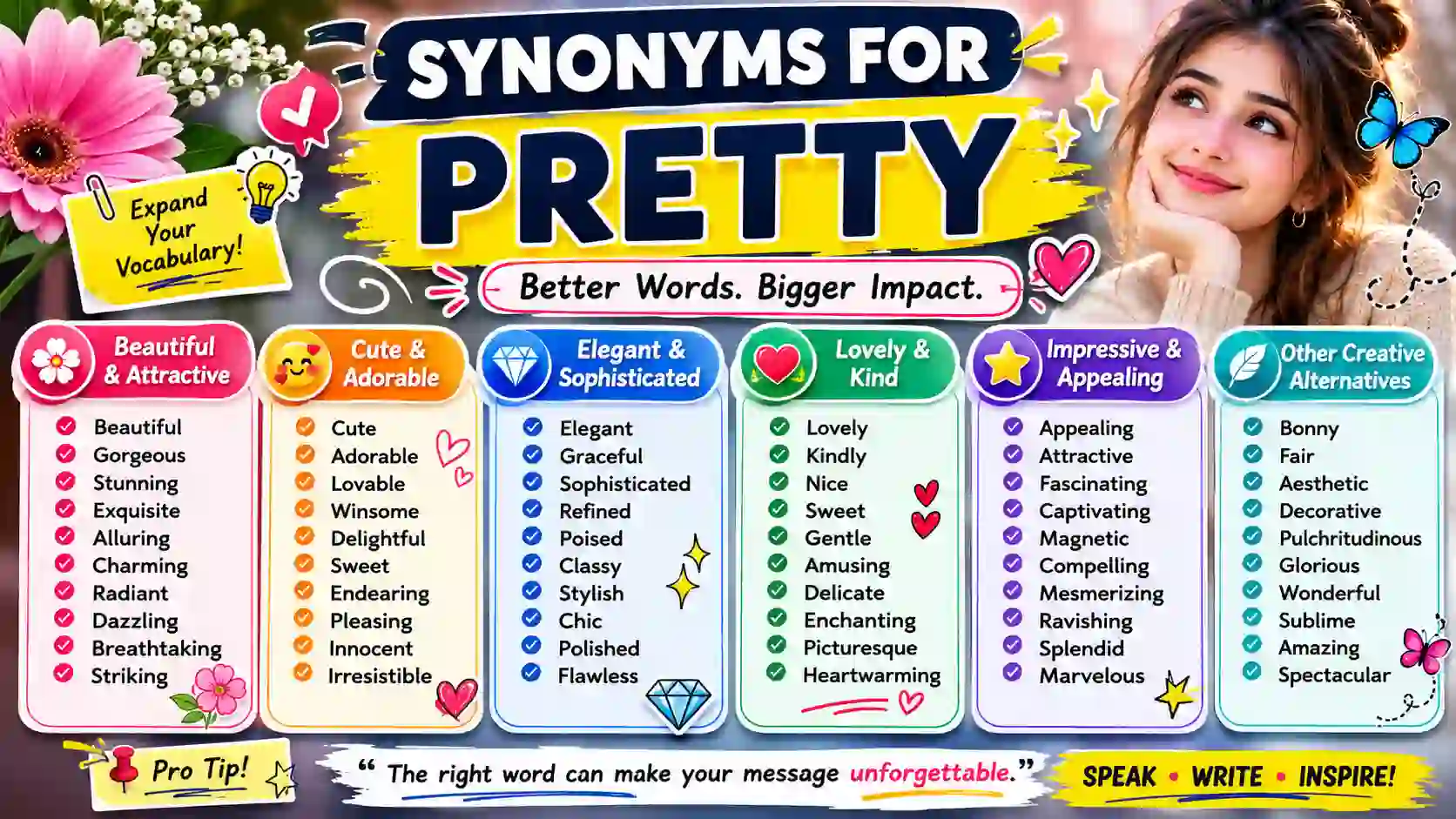
Common alternatives to pretty include beautiful, attractive, lovely, good-looking, handsome, gorgeous, stunning, charming, elegant, graceful, cute, striking, exquisite, and appealing. They are not all interchangeable. Pretty often suggests pleasant, delicate, or graceful beauty, while words such as stunning and gorgeous express a stronger reaction. The best choice depends on the person, object, place, and tone.
What Does Pretty Mean?
Have you ever used the word pretty so often that you wanted a more precise way to describe something beautiful?
English gives you many choices, but each one adds a slightly different feeling.
Pretty usually means pleasant or attractive to look at. It can describe a person, dress, garden, picture, building, or other thing. It often carries a sense of delicate, graceful, or pleasing beauty. Oxford notes that it is especially common when talking about girls or women and can suggest small or delicate features.
For example:
She wore a pretty dress.
You could replace pretty with beautiful, lovely, elegant, or stunning, but each choice changes the meaning a little.
That is the key to learning synonyms. You do not simply swap one word for another. You choose the word that gives your sentence the right strength, tone, and feeling.
Good to Know: Pretty also works as an informal adverb. In pretty good or pretty difficult, it means quite or fairly, not attractive.
Pronunciation
Pretty
- British English: /ˈprɪt.i/
- American English: /ˈprɪt̬.i/
- Simple pronunciation: PRIT-ee
The spelling is the same in American and British English. The main difference is the pronunciation of the middle t.
Part of Speech
Pretty as an adjective
This is the meaning most learners want when looking for alternatives.
She has a pretty smile.
It is a pretty village.
Pretty as an adverb
Here, it means quite, fairly, or to some extent.
The exam was pretty difficult.
I am pretty sure.
This use is informal.
Pretty as a verb
The verb is much less common. To pretty up means to make something more attractive.
They prettied up the room before the party.
Merriam-Webster lists this verb use, as well as noun uses, but learners generally do not need them for everyday synonym practice.
Quick Comparison: Which Word Should You Choose?
| Word | Main idea | Strength | Register |
| Pretty | Pleasant, delicate beauty | Moderate | Neutral |
| Beautiful | Strong general beauty | Strong | Neutral |
| Attractive | General appeal | Moderate-strong | Neutral |
| Lovely | Warm, gentle beauty | Strong | Neutral |
| Gorgeous | Very beautiful | Very strong | Informal |
| Stunning | Visually impressive | Very strong | Neutral |
| Handsome | Attractive, often masculine | Strong | Neutral |
| Good-looking | Pleasant appearance | Moderate | Neutral |
| Charming | Attractive and likeable | Strong | Neutral |
| Elegant | Stylish and refined | Strong | Neutral/formal |
| Graceful | Beautiful in movement or form | Strong | Neutral |
| Cute | Sweet or endearing | Moderate | Informal |
| Striking | Noticeably impressive | Strong | Neutral |
| Exquisite | Delicate and exceptionally beautiful | Very strong | Formal/literary |
| Appealing | Attractive or interesting | Moderate | Neutral/formal |
| Alluring | Strongly attractive | Strong | Literary/formal |
| Captivating | Holds your attention | Strong | Literary |
| Dainty | Small and delicate | Moderate | Descriptive |
| Delightful | Very pleasant or charming | Moderate | Neutral |
| Pleasing | Gives visual or sensory pleasure | Moderate | Formal/neutral |
The Best Synonyms for Pretty
1. Beautiful
Meaning: Very pleasant to look at or experience.
Example:
The lake looked beautiful in the morning light.
Best for: People, places, nature, art, objects, and experiences.
Tone: Neutral
CEFR: A1–A2
Frequency: Very common
Nuance: Beautiful is usually stronger and broader than pretty. You can call a landscape beautiful, but pretty may sound too mild if the view is truly impressive.
Common collocations:
- beautiful woman
- beautiful scenery
- beautiful smile
When not to use it: If you want to suggest small, delicate, or modest beauty, pretty may be more precise.
2. Attractive
Meaning: Pleasant or appealing to look at.
Example:
The new website has a clean and attractive design.
Best for: People, products, buildings, designs, and ideas.
Tone: Neutral
CEFR: A2
Frequency: Very common
Nuance: This is one of the most flexible choices. Unlike pretty, it does not strongly suggest delicate beauty.
Common collocations:
- attractive design
- attractive person
- attractive offer
When not to use it: It can sound too neutral if you want to give a warm personal compliment.
3. Lovely
Meaning: Beautiful, pleasant, or charming in a warm way.
Example:
She has a lovely smile.
Best for: People, places, experiences, and things that create a warm feeling.
Tone: Warm, friendly
CEFR: A2
Frequency: Common
Nuance: Lovely is close to beautiful, but it often feels softer and more affectionate. Cambridge marks this use as mainly British in its thesaurus.
Common collocations:
- lovely smile
- lovely evening
- lovely garden
When not to use it: Use a more neutral term such as attractive in technical descriptions.
4. Gorgeous
Meaning: Extremely beautiful or attractive.
Example:
You look gorgeous in that dress.
Best for: Strong compliments about people, clothes, places, and views.
Tone: Informal, enthusiastic
CEFR: B1
Frequency: Common
Nuance: This is much stronger than pretty.
Common collocations:
- gorgeous dress
- gorgeous view
- gorgeous hair
When not to use it: It can sound too emotional for formal academic writing.
5. Stunning
Meaning: Extremely impressive or beautiful.
Example:
The photographer captured a stunning sunset.
Best for: People, views, photographs, designs, and visual scenes.
Tone: Strong, expressive
CEFR: B2
Frequency: Common
Nuance: Stunning suggests that something immediately catches your attention.
Common collocations:
- stunning view
- stunning photograph
- stunning appearance
When not to use it: Do not use it for something that is only mildly attractive.
6. Handsome
Meaning: Attractive in a strong, pleasing, or well-proportioned way.
Example:
He is a tall, handsome man.
Best for: Traditionally men, although it can also describe women, buildings, objects, or sums of money in other contexts.
Tone: Neutral
CEFR: A2
Frequency: Common
Nuance: Oxford explains that handsome traditionally suggests stronger features or pleasing proportions, especially when describing a man.
Common collocations:
- handsome man
- handsome face
- handsome building
When not to use it: Do not automatically use it as the male version of pretty. The two words carry different connotations.
7. Good-Looking
Meaning: Attractive in appearance.
Example:
He is a good-looking young actor.
Best for: People and sometimes things with attractive designs.
Tone: Neutral, conversational
CEFR: A2
Frequency: Common
Nuance: It is straightforward and less emotionally expressive than gorgeous or stunning.
Common collocations:
- good-looking man
- good-looking woman
- good-looking design
When not to use it: It may sound less polished than attractive in formal writing.
8. Charming
Meaning: Attractive in a pleasant way that makes people like someone or something.
Example:
We stayed in a charming little village.
Best for: People, places, homes, personalities, and experiences.
Tone: Warm, positive
CEFR: B1
Frequency: Common
Nuance: Charming is about more than physical appearance. Personality and atmosphere can also be charming.
Common collocations:
- charming smile
- charming village
- charming personality
When not to use it: If you only want to describe physical appearance, attractive may be more exact.
9. Elegant
Meaning: Attractive because of style, simplicity, and good taste.
Example:
She wore an elegant black dress.
Best for: Clothes, people, buildings, interiors, designs, and even solutions.
Tone: Refined
CEFR: B1
Frequency: Common
Nuance: Elegant does not mean simply “more beautiful.” It emphasizes sophistication and style.
Common collocations:
- elegant dress
- elegant design
- elegant solution
When not to use it: A playful toy may be cute without being elegant.
10. Graceful
Meaning: Beautiful because of smooth, natural, or controlled movement or form.
Example:
The dancer made a graceful turn.
Best for: People, dancers, animals, movements, gestures, and shapes.
Tone: Refined
CEFR: B2
Frequency: Common
Nuance: This word is especially useful when movement is part of the beauty.
Common collocations:
- graceful movement
- graceful dancer
- graceful gesture
When not to use it: Do not use it simply because an object has attractive colors or decoration.
11. Cute
Meaning: Attractive in a sweet, small, playful, or endearing way.
Example:
That puppy is so cute.
Best for: Children, animals, clothes, objects, and informal compliments.
Tone: Informal
CEFR: A2
Frequency: Very common
Nuance: Cute is not simply a weaker version of beautiful. It adds sweetness or charm.
Common collocations:
- cute puppy
- cute outfit
- cute baby
When not to use it: Avoid it in formal professional descriptions.
12. Striking
Meaning: Very noticeable because of an unusual or impressive appearance.
Example:
She has striking blue eyes.
Best for: People, architecture, artwork, photographs, colors, and contrasts.
Tone: Strong
CEFR: B2
Frequency: Common
Nuance: Striking emphasizes visual impact rather than delicate beauty.
Common collocations:
- striking appearance
- striking contrast
- striking design
13. Exquisite
Meaning: Extremely beautiful, delicate, and often carefully made.
Example:
The necklace was decorated with exquisite details.
Best for: Jewelry, art, craftsmanship, food, fabrics, and fine details.
Tone: Formal/literary
CEFR: C1
Frequency: Uncommon
Nuance: This word suggests exceptional quality as well as beauty.
Common collocations:
- exquisite detail
- exquisite craftsmanship
- exquisite beauty
When not to use it: It sounds exaggerated for an ordinary object.
14. Appealing
Meaning: Attractive or interesting in a way that makes people like or choose something.
Example:
The simple design is very appealing.
Best for: Designs, products, ideas, styles, and sometimes people.
Tone: Neutral/formal
CEFR: B1
Frequency: Common
Nuance: Appealing can describe intellectual or practical attraction, not just beauty.
Common collocations:
- appealing design
- appealing idea
- appealing style
15. Alluring
Meaning: Very attractive in a way that draws people toward someone or something.
Example:
The quiet island had an alluring beauty.
Best for: People, places, smells, sounds, and experiences.
Tone: Literary/formal
CEFR: C1
Frequency: Uncommon
Nuance: It can suggest fascination or temptation, so it is stronger and more suggestive than pretty.
When not to use it: Avoid it for ordinary compliments.
16. Captivating
Meaning: So attractive or interesting that it holds your attention.
Example:
Her captivating smile made the photograph memorable.
Best for: People, photographs, stories, performances, and views.
Tone: Expressive
CEFR: C1
Frequency: Common
Nuance: The important idea is not only beauty but also the ability to hold attention.
17. Dainty
Meaning: Small, delicate, and attractive.
Example:
She wore a dainty silver bracelet.
Best for: Jewelry, flowers, hands, decorations, and small objects.
Tone: Delicate, descriptive
CEFR: B2
Frequency: Uncommon
Nuance: This is much narrower than pretty.
When not to use it: Do not describe something large, bold, or powerful as dainty.
18. Delightful
Meaning: Very pleasant, enjoyable, or charming.
Example:
We spent a delightful afternoon in the garden.
Best for: Experiences, people, places, events, and things that give pleasure.
Tone: Warm
CEFR: B2
Frequency: Common
Nuance: It focuses more on pleasure than physical beauty.
19. Pleasing
Meaning: Pleasant to the senses or mind.
Example:
The room has a simple and pleasing design.
Best for: Colors, designs, sounds, appearances, and artistic choices.
Tone: Neutral/formal
CEFR: B1
Frequency: Common
Nuance: It is more objective and less emotional than beautiful.
20. Fetching
Meaning: Attractive in a pleasing or stylish way.
Example:
That jacket looks rather fetching on you.
Best for: Playful or old-fashioned descriptions.
Tone: Informal, old-fashioned
CEFR: C1
Frequency: Rare
Nuance: It is a real English word, but modern speakers use it far less often than attractive or good-looking.
When not to use it: Avoid it in beginner-level writing unless you are deliberately using a playful style.
21. Comely
Meaning: Attractive or pleasant-looking.
Example:
The poem describes a comely young woman.
Best for: Historical or literary writing.
Tone: Literary, old-fashioned
CEFR: C2
Frequency: Rare
Nuance: It is a legitimate synonym, but it is not a practical everyday replacement for pretty. Merriam-Webster distinguishes comely from beautiful and pretty by its cooler, more approving sense of attractiveness.
22. Fair
Meaning: Beautiful or attractive in certain traditional or literary uses.
Example:
The old poem tells of a fair maiden.
Best for: Poetry, stories, historical writing, and traditional expressions.
Tone: Literary/traditional
CEFR: B1 for common meanings, higher for this sense
Frequency: Rare for this meaning
Important: Fair has many other meanings, including just, reasonable, and light in color. Context matters.
23. Ravishing
Meaning: Extremely beautiful or attractive.
Example:
She looked ravishing in the evening gown.
Best for: Dramatic descriptions and literary writing.
Tone: Very expressive
CEFR: C1
Frequency: Uncommon
Nuance: This is far stronger than pretty and can sound old-fashioned or theatrical.
24. Winsome
Meaning: Pleasant and attractive in a cheerful, innocent, or charming way.
Example:
Her winsome smile made the interview feel relaxed.
Best for: Literary descriptions of personality and expression.
Tone: Literary
CEFR: C1
Frequency: Rare
Nuance: It combines attractiveness with charm and friendliness.
25. Beauteous
Meaning: Beautiful.
Example:
The poet described the beautiful landscape in glowing detail.
Best for: Poetry and deliberately literary writing.
Tone: Literary
CEFR: C2
Frequency: Rare
Nuance: It is a genuine word but not a natural everyday replacement for pretty.
Synonym Groups by Meaning
Instead of memorizing 25 words as one long list, group them by the feeling they express.
For Everyday Beauty
Use:
- pretty
- beautiful
- attractive
- lovely
- good-looking
These are the most useful choices for everyday English.
For Very Strong Beauty
Use:
- gorgeous
- stunning
- exquisite
- ravishing
These words create a stronger reaction than pretty.
For Style and Sophistication
Use:
- elegant
- graceful
- refined
- striking
These words describe a particular kind of beauty rather than beauty in general.
For Sweetness and Charm
Use:
- cute
- charming
- winsome
- delightful
- lovely
These are useful when warmth or personality matters.
For Literary Writing
Use:
- alluring
- exquisite
- comely
- ravishing
- winsome
- beauteous
These words can add character to stories and poetry, but they are less common in everyday conversation.
Choose the Right Word
Here is a simple way to make the choice.
She has a pretty smile.
If you mean:
- warm and affectionate: She has a lovely smile.
- very beautiful: She has a beautiful smile.
- extremely impressive: She has a stunning smile.
- sweet and endearing: She has a cute smile.
- captivating: She has a captivating smile.
- charming: She has a charming smile.
The sentence changes slightly each time. That is why good synonym use is about precision, not just variety.
Pretty vs Beautiful vs Attractive vs Lovely
| Word | Main difference |
| Pretty | Pleasant, delicate, or graceful beauty |
| Beautiful | Stronger and broader sense of beauty |
| Attractive | General visual or personal appeal |
| Lovely | Warm, gentle, affectionate beauty |
| Gorgeous | Very strong, enthusiastic beauty |
Merriam-Webster makes a similar distinction, noting that pretty often suggests a more superficial or delicate attractiveness, while beautiful can evoke a deeper or stronger aesthetic response.
Common Mistakes English Learners Make
Common Mistake 1
Incorrect idea: Every synonym can replace pretty.
Better approach: Choose based on context.
A pretty dress can be beautiful, elegant, or stunning, but handsome would usually be unnatural.
Common Mistake 2
Using gorgeous in formal academic writing
Better:
The building has an elegant design.
Instead of:
The building has a gorgeous design.
Gorgeous is common and natural in conversation, but it is more expressive and informal.
Common Mistake 3
Using cute when you mean sophisticated
The woman wore a cute black evening gown.
This is possible, but if the dress is stylish and refined, elegant may communicate your meaning better.
Common Mistake 4
Assuming pretty only describes people
You can say:
- pretty dress
- pretty garden
- pretty village
- pretty picture
- pretty flowers
- pretty colors
Cambridge and Oxford both give examples of pretty being used for things and places as well as people.
American vs British English
The adjective pretty is standard in both American and British English.
Spelling
There is no major spelling difference:
British: pretty
American: pretty
Pronunciation
British: /ˈprɪt.i/
American: /ˈprɪt̬.i/
Usage
The basic adjective meaning is shared across both varieties.
One useful difference is that lovely is particularly common in British English, while American English often favors words such as beautiful, pretty, attractive, and gorgeous depending on context. Cambridge labels lovely as mainly UK in this thesaurus entry.
Word Origin of Pretty
The history of pretty is more complicated than its modern meaning suggests.
Merriam-Webster traces the word to Middle English forms and an Old English source connected with prætt, a word associated with a trick or cleverness. Over centuries, its meanings developed and eventually included ideas of pleasant appearance and attractiveness.
This is a useful example of how English changes over time. A modern speaker normally thinks of pretty as meaning attractive or pleasant to look at, but the word has a much older and more varied history.
Antonyms of Pretty
The opposite depends on what you are describing.
Common choices include:
- ugly
- unattractive
- plain
- unpleasant-looking
- hideous
Plain needs special care. It does not necessarily mean ugly. It can mean ordinary-looking or lacking distinctive beauty.
Useful Collocations
Learning words in combinations can make your English sound much more natural.
Pretty
- pretty face
- pretty dress
- pretty flowers
- pretty village
- pretty picture
Beautiful
- beautiful scenery
- beautiful smile
- beautiful woman
- beautiful place
Attractive
- attractive design
- attractive person
- attractive option
Elegant
- elegant dress
- elegant design
- elegant solution
Stunning
- stunning view
- stunning photograph
- stunning appearance
Charming
- charming village
- charming personality
- charming smile
How to Use These Words in Different Types of Writing
Essays
Choose precise and neutral words.
Good choices:
- attractive
- beautiful
- elegant
- appealing
Avoid filling an essay with emotional words such as gorgeous unless the subject requires that tone.
Blog Posts
You have more freedom.
This charming little town is surrounded by beautiful hills.
The combination feels more natural than repeating pretty several times.
Professional Writing
Use:
- attractive
- appealing
- elegant
- pleasing
For example:
The company created an appealing and user-friendly design.
Stories
You can use stronger descriptive vocabulary:
The garden looked enchanting under the evening light.
Or:
She entered the room with a graceful smile.
Social Media
Informal choices work well:
- gorgeous
- stunning
- cute
- beautiful
- lovely
Mini Practice
Fill in the Blank
Choose the best word.
- The puppy is so ______.
- She wore an ______ evening dress.
- The mountain view was absolutely ______.
- He is a tall and ______ man.
- We stayed in a ______ little village.
Possible answers:
- cute
- elegant
- stunning
- handsome
- charming
Rewrite the Sentence
Replace pretty with a more precise word.
1. She has a pretty smile.
Possible answers:
- She has a lovely smile.
- She has a beautiful smile.
- She has a charming smile.
2. The room has a pretty design.
Possible answers:
- The room has an elegant design.
- The room has an attractive design.
- The room has a pleasing design.
There is not always one correct synonym. The best choice depends on the meaning you want.
Vocabulary Quiz
1. Which word usually suggests a very high level of beauty?
A. Dainty
B. Gorgeous
C. Plain
D. Fair
2. Which word is most closely connected with sophistication and style?
A. Cute
B. Elegant
C. Sweet
D. Pretty
3. Which word is best for smooth, beautiful movement?
A. Graceful
B. Attractive
C. Gorgeous
D. Lovely
4. Which word is especially useful for a sweet or playful appearance?
A. Exquisite
B. Cute
C. Striking
D. Formal
5. Which word is more literary and uncommon?
A. Beautiful
B. Attractive
C. Comely
D. Good-looking
Answer Key
- B. Gorgeous
- B. Elegant
- A. Graceful
- B. Cute
- C. Comely
FAQs
What is the best synonym for pretty?
Beautiful is usually the best broad synonym, but the ideal choice depends on context. Use lovely for warmth, attractive for a neutral description, gorgeous for strong admiration, and elegant when style and sophistication are important.
What is a stronger word than pretty?
Beautiful, gorgeous, stunning, exquisite, and ravishing can all be stronger choices. However, they are not interchangeable. Stunning emphasizes visual impact, while exquisite suggests delicate beauty and exceptional quality.
What is a synonym for pretty for a girl?
Common choices include beautiful, lovely, attractive, gorgeous, charming, cute, and stunning. Pretty itself often suggests pleasant or delicate beauty, particularly when describing a girl or woman.
What is a synonym for pretty for a boy?
Handsome, good-looking, attractive, and sometimes striking are natural choices. Pretty can describe males in some contexts, but handsome is the traditional word for a man and often suggests strong or well-proportioned features.
Is beautiful stronger than pretty?
Usually, yes. Pretty often suggests pleasant, delicate, or moderate beauty, while beautiful can express a stronger and broader sense of beauty. The difference is not absolute, though, and context affects the meaning.
What is a formal synonym for pretty?
Useful formal or professional alternatives include attractive, appealing, elegant, pleasing, and exquisite. The right word depends on the subject. For example, an elegant design and an appealing design sound natural in professional writing.
What is the difference between pretty and cute?
Pretty usually focuses on attractiveness or beauty. Cute adds a sense of sweetness, smallness, playfulness, or affection. A puppy can be cute, while a landscape may be pretty. A person can be both.
Can pretty mean quite or fairly?
Yes. In informal English, pretty can be an adverb meaning quite, fairly, or to some extent, as in pretty good or pretty difficult. This is different from the adjective meaning attractive.
Final Takeaway
The best way to improve your vocabulary is not to memorize a huge list of replacements. Learn the difference between the words. Use pretty for pleasant or delicate beauty, beautiful for broad and strong beauty, attractive for a neutral description, lovely for warmth, gorgeous for enthusiastic praise, elegant for sophistication, graceful for beautiful movement, and cute for sweetness.
Once you understand those differences, your English becomes more natural and precise. Try using one new word in an email, essay, conversation, or social post today. That small habit will help turn passive vocabulary into words you can actually use.
Trusted References
- Cambridge Dictionary and Thesaurus: definitions, pronunciation, usage, and synonym comparisons.
- Oxford Advanced Learner’s Dictionary: meaning, usage, and comparisons with beautiful, handsome, attractive, and lovely.
- Merriam-Webster: definitions, synonym distinctions, word forms, and usage information.

Synonorm is a trusted English vocabulary resource created to help readers find the right words and understand the differences between similar terms. We provide clear explanations of synonyms, meanings, examples, usage, and alternatives. Our content makes vocabulary easier to learn and apply in everyday, academic, and professional English. Synonorm is designed for students, writers, ESL learners, professionals, and anyone who wants to improve their English vocabulary and communicate more clearly.