Quick Answer
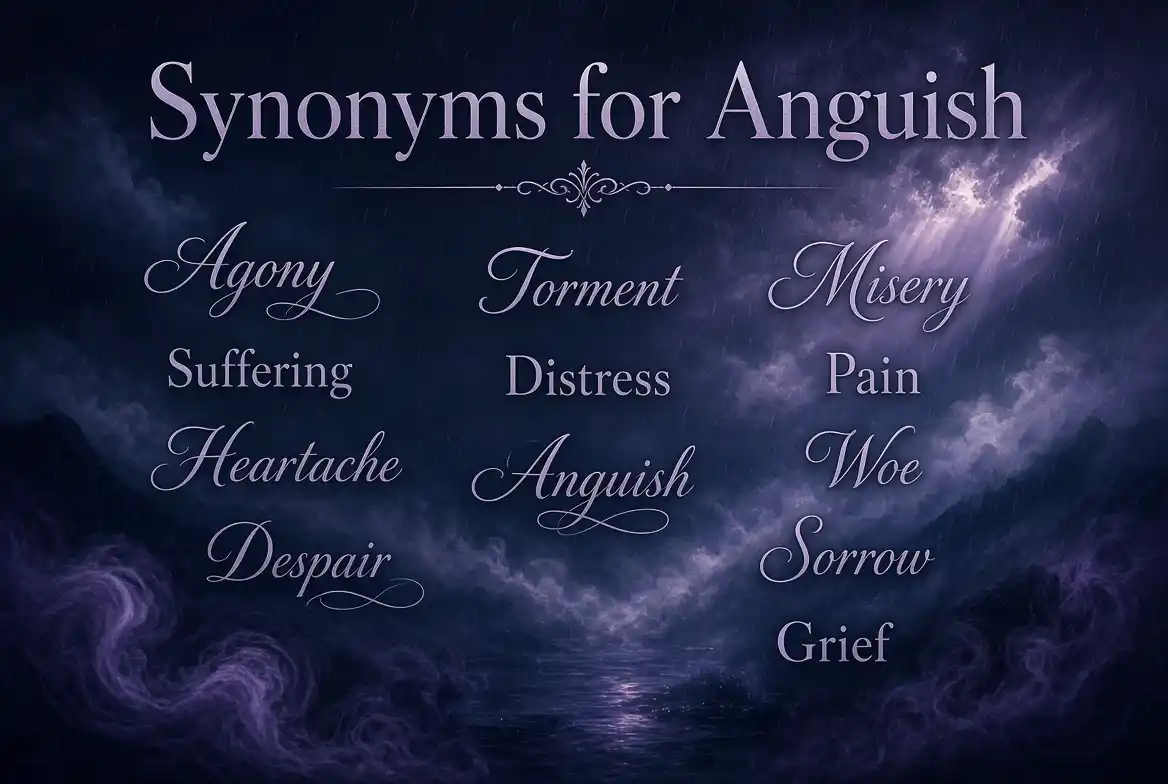
The closest synonyms for anguish include distress, agony, suffering, torment, misery, pain, grief, sorrow, heartache, heartbreak, and torture. However, these words are not always interchangeable. Agony stresses extreme pain, grief usually follows a major loss, despair focuses on hopelessness, and anxiety centers on worry or fear.
What Does Anguish Mean?
Anguish means severe physical or mental suffering, pain, or unhappiness. It is a strong word that often describes an experience that feels deeply painful and difficult to bear.
For example:
She was in anguish while waiting for news about her brother.
Here, anguish is stronger than ordinary sadness. It suggests deep emotional suffering.
Oxford classifies anguish as a formal, uncountable noun meaning severe physical or mental pain, difficulty, or unhappiness. Cambridge similarly defines it as extreme unhappiness caused by physical or mental suffering.
If you are looking for synonyms for anguish, the best choice depends on the exact kind of suffering you want to describe.
Pronunciation
Anguish
IPA: /ˈæŋɡwɪʃ/
Pronounced: ANG-gwish
British and American English use the same spelling and essentially the same pronunciation.
Part of Speech
Anguish as a Noun
As a noun, anguish means severe suffering.
Example:
His face showed deep anguish.
This is the most common learner use.
Anguish as a Verb
Anguish can also function as a verb.
Example:
She anguished over the difficult decision.
As a verb, it means to suffer or cause intense emotional pain. Collins records both transitive and intransitive verb uses.
Related Forms
- anguish — noun/verb
- anguished — adjective
- anguishing — present participle
- anguishes — third-person singular verb
Grammar and Common Patterns
Because anguish is normally uncountable when used as a noun, these patterns are especially useful:
- in anguish
- with anguish
- deep anguish
- great anguish
- mental anguish
- emotional anguish
- cause anguish
- feel anguish
- experience anguish
- anguish over something
- anguish at something
Oxford records collocations such as a cry of anguish, a scream of anguish, pain and anguish, and combinations with deep, great, and bitter.
Correct
She felt deep anguish after the loss.
Usually Incorrect for Learners
She felt an anguish after the loss.
Use deep anguish rather than an anguish when you mean general emotional suffering.
Quick Synonyms for Anguish
| Word | Closeness | Intensity | Register |
| Distress | Very close | Strong | Neutral/Formal |
| Agony | Very close | Extreme | Neutral |
| Suffering | Very close | Strong | Neutral/Formal |
| Torment | Very close | Extreme | Neutral/Literary |
| Pain | Close | Variable | Neutral |
| Misery | Close | Strong | Neutral |
| Grief | Context-specific | Strong | Neutral/Formal |
| Sorrow | Context-specific | Strong | Literary/Formal |
| Heartache | Context-specific | Strong | Neutral |
| Heartbreak | Context-specific | Strong | Neutral |
| Despair | Related | Extreme | Neutral/Formal |
| Torture | Strong alternative | Extreme | Neutral |
| Woe | Related | Strong | Literary |
| Affliction | Related | Strong | Formal |
| Anxiety | Partial synonym | Variable | Neutral/Formal |
| Sadness | Broader/Weaker | Mild–Strong | Neutral |
| Hurt | Broader/Weaker | Variable | Informal/Neutral |
| Ache | Context-specific | Mild–Strong | Neutral |
| Pang | Specific | Brief | Literary |
| Angst | Context-specific | Strong | Neutral |
Remember: A thesaurus can group words by similarity, but similarity does not mean that every word can replace anguish in every sentence. Cambridge and Thesaurus.com both show overlapping but differently grouped vocabulary around anguish.
25 Synonyms and Related Alternatives for Anguish
1. Distress
Meaning: Serious emotional or physical suffering.
Examples:
- The accident caused great distress among the passengers.
- She showed signs of emotional distress.
Best Used When: You want a broad, natural word for serious suffering.
Tone: Neutral/Formal
CEFR: Approx. B2
Frequency: Very common
Common Collocations:
- emotional distress
- severe distress
- cause distress
When Not to Use: Do not use it when you specifically mean sadness after someone’s death. Grief is more precise.
2. Agony
Meaning: Extremely severe physical or emotional pain.
Examples:
- He was in agony after the accident.
- Waiting for the final decision was agony.
Best Used When: You want to stress extreme pain.
Tone: Neutral
CEFR: Approx. B2
Frequency: Common
Common Collocations:
- in agony
- unbearable agony
- mental agony
When Not to Use: Avoid it for a small disappointment because it sounds excessively strong.
3. Suffering
Meaning: The experience of physical or emotional pain.
Examples:
- The organization works to reduce human suffering.
- Years of illness caused considerable suffering.
Best Used When: You are talking about pain in a broad sense.
Tone: Neutral/Formal
CEFR: Approx. B1–B2
Frequency: Very common
Common Collocations:
- human suffering
- emotional suffering
- physical suffering
4. Pain
Meaning: Physical or emotional suffering.
Examples:
- The loss caused him deep pain.
- She tried to hide her emotional pain.
Best Used When: You need a simple and widely understood word.
Tone: Neutral
CEFR: B1
Frequency: Very common
Important Nuance: Pain is broader than anguish. It can describe anything from mild discomfort to extreme suffering.
5. Torment
Meaning: Severe and often continuing physical or emotional suffering.
Examples:
- Guilt became a source of constant torment.
- He lived in emotional torment for years.
Best Used When: The suffering feels prolonged, relentless, or mentally exhausting.
Tone: Neutral/Literary
CEFR: C1
Frequency: Common
Common Collocations:
- mental torment
- constant torment
- emotional torment
6. Misery
Meaning: Extreme unhappiness or suffering.
Examples:
- The long separation brought her great misery.
- He spent months in misery after the loss.
Best Used When: You mean a continuing state of unhappiness.
Tone: Neutral
CEFR: B2
Frequency: Common
Common Collocations:
- deep misery
- live in misery
- cause misery
7. Grief
Meaning: Deep sadness caused by loss, especially someone’s death.
Examples:
- She struggled with grief after her mother’s death.
- His grief was obvious during the funeral.
Best Used When: The suffering comes from bereavement or another major loss.
Tone: Neutral/Formal
CEFR: B2
Frequency: Very common
When Not to Use: Do not use grief for every type of emotional pain.
8. Sorrow
Meaning: Deep sadness caused by loss, disappointment, or misfortune.
Examples:
- His letter expressed deep sorrow.
- The novel explores sorrow, loss, and hope.
Best Used When: You want a more literary or formal alternative to sadness.
Tone: Literary/Formal
CEFR: B2–C1
Frequency: Common
9. Heartache
Meaning: Deep emotional pain, especially from loss or disappointment.
Examples:
- The breakup left her with years of heartache.
- His song captures the heartache of separation.
Best Used When: The suffering is personal and deeply emotional.
Tone: Neutral
CEFR: Approx. B2
Frequency: Common
10. Heartbreak
Meaning: Extreme emotional pain caused by personal or romantic loss.
Examples:
- The breakup caused a terrible heartbreak.
- She slowly recovered from the heartbreak.
Best Used When: A relationship or personal loss is central.
Tone: Neutral
CEFR: Approx. B2
Frequency: Common
When Not to Use: It is not a natural substitute for physical pain or general worry.
11. Despair
Meaning: A feeling that there is little or no hope.
Examples:
- Repeated failures pushed him toward despair.
- She spoke about the situation in despair.
Best Used When: Hopelessness is the main idea.
Tone: Neutral/Formal
CEFR: B2–C1
Frequency: Common
Common Collocations:
- deep despair
- fall into despair
- utter despair
12. Torture
Meaning: Extremely severe physical or emotional suffering.
Examples:
- The uncertainty was torture for her.
- Waiting for the verdict felt like torture.
Best Used When: You want very strong language.
Tone: Neutral/Strong
CEFR: B2
Frequency: Common
When Not to Use: Avoid it for minor problems because it can sound exaggerated.
13. Woe
Meaning: Great trouble, sadness, or suffering.
Examples:
- The poem describes war and woe.
- He shared his financial woes with his friend.
Best Used When: You want literary, expressive, or sometimes humorous language.
Tone: Literary
CEFR: C1
Frequency: Uncommon
14. Affliction
Meaning: Serious suffering caused by a difficult condition or problem.
Examples:
- The disease became a lifelong affliction.
- The community faced several serious afflictions.
Best Used When: Talking about a continuing condition or serious burden.
Tone: Formal
CEFR: C1
Frequency: Uncommon
15. Anxiety
Meaning: Strong worry or nervousness about something that may happen.
Examples:
- Anxiety kept him awake before the interview.
- She felt anxiety while waiting for the results.
Best Used When: Fear, worry, or uncertainty is the main idea.
Tone: Neutral/Formal
CEFR: B2
Frequency: Very common
Important: Anxiety is not a perfect synonym for anguish. Anxiety focuses on worry, while anguish focuses on intense suffering.
16. Sadness
Meaning: The feeling of being unhappy.
Examples:
- A quiet sadness filled the room.
- She felt sadness when she left her hometown.
Best Used When: You need a general word for unhappiness.
Tone: Neutral
CEFR: A2–B1
Frequency: Very common
Important: Sadness is normally weaker than anguish.
17. Hurt
Meaning: Physical or emotional pain.
Examples:
- His words caused deep hurt.
- She was still dealing with the hurt from the argument.
Best Used When: You want natural everyday English.
Tone: Informal/Neutral
CEFR: A2–B1
Frequency: Very common
18. Ache
Meaning: A continuing physical or emotional pain.
Examples:
- He felt a dull ache in his shoulder.
- She carried an ache of loneliness for years.
Best Used When: The pain continues rather than appearing as one sharp moment.
Tone: Neutral
CEFR: B1
Frequency: Common
19. Pang
Meaning: A sudden, brief feeling of emotional or physical pain.
Examples:
- He felt a pang of regret.
- A pang of loneliness hit her unexpectedly.
Best Used When: The feeling is sudden and usually short.
Tone: Neutral/Literary
CEFR: C1
Frequency: Uncommon
Common Collocations:
- a pang of regret
- a pang of guilt
- a pang of sadness
20. Angst
Meaning: Strong worry, fear, or emotional unease.
Examples:
- The novel explores teenage angst.
- His writing reflects the angst of growing older.
Best Used When: Discussing deep emotional uncertainty, especially in personal, artistic, or social contexts.
Tone: Neutral/Informal
CEFR: C1
Frequency: Common in specific contexts
When Not to Use: Do not use it for ordinary physical pain.
21. Wretchedness
Meaning: A state of great unhappiness or misery.
Examples:
- The character’s wretchedness was clear throughout the novel.
- Years of isolation left him in deep wretchedness.
Best Used When: Writing in a literary or strongly descriptive style.
Tone: Literary
CEFR: C1
Frequency: Rare
22. Desolation
Meaning: A deep feeling of loneliness, emptiness, or sadness.
Examples:
- The empty house gave him a feeling of desolation.
- She experienced profound desolation after leaving her family.
Best Used When: Emptiness and loneliness are central to suffering.
Tone: Literary/Formal
CEFR: C1
Frequency: Uncommon
23. Melancholy
Meaning: A deep, thoughtful, or lasting sadness.
Examples:
- The music has a gentle air of melancholy.
- Autumn often gives the poet a sense of melancholy.
Best Used When: The sadness is reflective rather than intensely painful.
Tone: Literary
CEFR: C1
Frequency: Common in literary contexts
When Not to Use: It is usually too mild for extreme anguish.
24. Throe
Meaning: A severe or painful struggle, usually used in the plural.
Examples:
- The country was in the throes of a major crisis.
- She worked through the throes of grief.
Best Used When: Writing in formal or literary contexts about an intense struggle.
Tone: Formal/Literary
CEFR: C1–C2
Frequency: Rare
25. Trouble
Meaning: Difficulty, worry, or a difficult situation.
Examples:
- He was troubled by the decision.
- The family faced serious trouble after the accident.
Best Used When: You need a much softer and broader alternative.
Tone: Neutral
CEFR: A2–B1
Frequency: Very common
Important: Trouble is usually much weaker than anguish, so it should not replace it when extreme suffering matters.
Strongest Synonyms for Anguish
If intensity is your main concern, these words usually communicate the greatest suffering:
- agony
- torment
- torture
- despair
- distress
- suffering
However, intensity is not the only factor. Grief may be the more accurate choice than agony when someone is suffering because of bereavement.
Best Synonym by Context
| Context | Recommended Word | Why |
| Extreme physical pain | Agony | Strongly emphasizes intensity |
| General severe suffering | Distress | Broad and natural |
| Long-lasting mental suffering | Torment | Suggests continuing pain |
| Death or major loss | Grief | Strongly connected with loss |
| Romantic separation | Heartbreak | Specific to emotional loss |
| Personal emotional pain | Heartache | Warm, personal nuance |
| No hope | Despair | Centers on hopelessness |
| Future-related worry | Anxiety | Centers on uncertainty |
| General unhappiness | Sadness | Simple and broad |
| Sudden brief pain | Pang | Suggests a short emotional hit |
| Literary sadness | Sorrow | More formal and expressive |
| Mild emotional pain | Hurt | Natural everyday choice |
A Simple Intensity Guide
Sadness → hurt → distress → suffering → anguish → agony/torment
This is only a learning guide, not a fixed dictionary scale. Context can change the strength of each word.
Which Synonym Should You Choose?
Compare these sentences:
She felt sadness after the argument.
This sounds ordinary.
She felt distressed after the argument.
This sounds more serious.
She felt anguish after the argument.
This suggests very deep suffering.
She felt agony after the argument.
This makes the suffering sound extreme.
She felt despair after the argument.
This adds the idea that she felt there was no hope.
The lesson is simple: good synonym choice is about meaning, not just replacing one word with another.
Commonly Confused Words
| Word | Main Idea | Example |
| Anguish | Extreme suffering | She cried in anguish. |
| Anxiety | Worry or fear | Anxiety kept him awake. |
| Grief | Deep sadness after loss | He struggled with grief. |
| Agony | Extreme pain | She was in agony. |
| Sadness | General unhappiness | He felt sadness after leaving. |
Anguish vs. Distress
These are among the closest choices.
Distress is broad and can describe serious emotional suffering.
Anguish usually sounds more intense and emotionally painful.
The news caused distress.
The news caused deep anguish.
The second sentence communicates stronger suffering.
Anguish vs. Agony
Both can describe extreme suffering.
Agony often focuses strongly on pain or unbearable intensity.
Anguish often has a deeper emotional or mental dimension.
Both can describe physical and emotional suffering, depending on context. Cambridge’s thesaurus places anguish among the close alternatives for agony.
Anguish vs. Grief
Grief specifically points toward loss, especially death.
Anguish is broader.
She experienced grief after her father’s death.
She experienced anguish while watching him suffer.
The two words can overlap, but they focus on different aspects of the experience.
Common Mistakes
Mistake: I felt an anguish after the news.
Correction: I felt deep anguish after the news.
Why: Anguish is normally an uncountable noun in this use.
Mistake: I was in grief because my laptop stopped working.
Correction: I was upset because my laptop stopped working.
Why: Grief usually describes serious loss.
Mistake: The small delay caused me agony.
Correction: The long wait caused me frustration.
Why: Agony is much stronger than ordinary annoyance.
Mistake: Anxiety means exactly the same as anguish.
Correction: Anxiety and anguish overlap, but anxiety focuses more on worry or fear, while anguish emphasizes severe suffering.
Mistake: Every synonym can replace anguish.
Correction: Choose according to context, intensity, and emotional focus.
Writing Tips
Essays
For academic writing, choose distress, suffering, grief, emotional pain, or despair according to the exact meaning.
Professional Communication
Avoid dramatic words unless the situation genuinely involves severe suffering.
Instead of:
The delay caused me torture.
A professional writer might say:
The prolonged delay caused significant distress.
Stories
Literary writing gives you more freedom. Anguish, torment, sorrow, heartache, desolation, and despair can create strong emotional detail.
Blog Posts
Avoid repeating anguish in every paragraph. Use a precise alternative only when the meaning changes.
Everyday Conversation
Simple words such as hurt, sadness, worry, pain, and upset often sound more natural.
Writing Tip: A good synonym should make the sentence more precise, not merely make it sound more complicated.
Related Vocabulary
Antonyms
Depending on context, useful opposites include:
- comfort
- relief
- ease
- happiness
- joy
- pleasure
- solace
- consolation
Cambridge lists words such as comfort, relief, solace, and consolation among related opposites for anguish.
Useful Expressions
- in anguish
- cry of anguish
- scream of anguish
- deep anguish
- emotional anguish
- mental anguish
- pain and anguish
- suffer anguish
- cause anguish
- anguish over a decision
Oxford specifically records several of these collocations, including in anguish, with anguish, a cry of anguish, and pain and anguish.
Word Origin and Etymology
The history of anguish helps explain its powerful meaning.
Oxford traces the word through Middle English and Old French to Latin angustia, meaning “tightness” and, by extension, distress. It is related to Latin angustus, meaning “narrow.” Collins gives a similar route through Old French and Latin.
This older sense of “tightness” provides a useful way to remember the word: severe anguish can feel as though emotional pain is closing in around a person.
American vs. British English
There is no major spelling difference:
- British English: anguish
- American English: anguish
The pronunciation is also essentially the same in both varieties. Cambridge provides the same IPA pronunciation for UK and US English.
The word appears in both varieties, especially in serious writing, literature, journalism, and discussions of emotional or physical suffering.
CEFR and Learner Guidance
CEFR levels can help learners decide which words to study first, but not every dictionary assigns an official CEFR level to every synonym.
A practical learning order is:
Beginner Friendly
- pain
- sadness
- hurt
- trouble
Intermediate
- distress
- suffering
- agony
- grief
- misery
- sorrow
- anxiety
Advanced
- anguish
- torment
- despair
- affliction
- heartache
- heartbreak
- melancholy
- desolation
Advanced/Literary
- woe
- pang
- throe
- wretchedness
Treat these levels as learning guidance rather than official dictionary classifications.
Mini Practice Exercises
Exercise 1: Fill in the Blank
Choose from grief, agony, anxiety, heartbreak, and distress.
- The family experienced deep ______ after the death.
- The injury left him in ______.
- She felt intense ______ before the interview.
- The breakup caused terrible ______.
- The disaster caused emotional ______ among residents.
Answers
- grief
- agony
- anxiety
- heartbreak
- distress
Exercise 2: Choose the Best Word
- Which word best describes sadness after someone’s death?
A. Anxiety
B. Grief
C. Ache
D. Trouble
Answer: B. Grief
- Which word emphasizes extreme pain?
A. Sadness
B. Agony
C. Trouble
D. Melancholy
Answer: B. Agony
- Which word focuses on hopelessness?
A. Despair
B. Hurt
C. Ache
D. Pang
Answer: A. Despair
- Which word is especially associated with romantic loss?
A. Heartbreak
B. Affliction
C. Anxiety
D. Woe
Answer: A. Heartbreak
- Which word usually describes a short, sudden feeling of pain?
A. Misery
B. Pang
C. Grief
D. Suffering
Answer: B. Pang
Sentence Rewriting Practice
Replace anguish with a more precise word.
1. She felt anguish after her father died.
Possible answer:
She felt grief after her father died.
2. He was in anguish because of the severe injury.
Possible answer:
He was in agony because of the severe injury.
3. She felt anguish while waiting for the uncertain result.
Possible answer:
She felt anxiety while waiting for the uncertain result.
4. The breakup caused him anguish.
Possible answer:
The breakup caused him heartbreak.
The important lesson is that there may be more than one grammatically possible answer, but the most accurate synonym depends on context.
FAQ: Synonyms for Anguish
What is the closest synonym for anguish?
Distress is one of the closest broad alternatives to anguish. Agony, suffering, pain, and torment are also close. The best choice depends on whether you want to emphasize general suffering, extreme pain, or prolonged emotional torment.
What is a stronger word than anguish?
There is no single universally “stronger” synonym because intensity depends on context. Agony, torment, and torture can sound extremely intense. Despair can be stronger when the main idea is complete hopelessness rather than pain itself.
What is another word for deep emotional anguish?
Useful choices include heartache, heartbreak, grief, torment, despair, sorrow, and emotional suffering. The best word depends on the cause. Use grief for loss, heartbreak for personal or romantic loss, and despair when hopelessness is central.
Is pain a synonym for anguish?
Yes, but pain is broader. It can describe mild, moderate, or severe physical or emotional discomfort. Anguish normally communicates much deeper suffering, especially intense emotional or mental pain.
What is the difference between anguish and distress?
Both describe serious suffering, but anguish usually sounds more intense and emotionally painful. Distress is broader and can describe serious worry, discomfort, or suffering without necessarily reaching the same emotional intensity.
Is anguish a formal word?
Yes. Oxford labels anguish as a formal noun. It is common in serious writing, literature, journalism, and discussions of severe suffering. In casual conversation, speakers may choose simpler words such as pain, hurt, sadness, or worry.
Is anguish countable or uncountable?
In its normal noun use, anguish is uncountable. Natural expressions include “deep anguish,” “great anguish,” and “in anguish.” Learners should normally avoid “an anguish” when describing general suffering.
Can anguish be used as a verb?
Yes. Anguish can be used as a verb meaning to suffer or cause intense suffering. For example: “She was anguished over the decision.” Collins records both transitive and intransitive verb uses.
Conclusion
Learning synonyms for anguish is most useful when you understand the difference between them. Use agony for extreme pain, grief for loss, heartbreak for personal or romantic loss, anxiety for worry, despair for hopelessness, and torment for prolonged suffering.
Do not simply replace one word with another. Choose the word that expresses the exact emotion, intensity, and context you mean. That approach will make your essays, conversations, emails, and creative writing clearer and more natural.
References
- Oxford Advanced Learner’s Dictionary, “anguish”: definition, grammar, collocations, pronunciation, and etymology.
- Cambridge Dictionary, “anguish”: UK/US definitions, pronunciation, examples, and corpus-based usage.
- Collins English Dictionary, “anguish”: definitions, verb uses, synonyms, and word origin.
- Thesaurus.com, “Anguish Synonyms & Antonyms”: synonym grouping and intensity relationships.
- Cambridge English Thesaurus, “agony” and related vocabulary: synonym relationships and contextual usage.

Synonorm is a trusted English vocabulary resource created to help readers find the right words and understand the differences between similar terms. We provide clear explanations of synonyms, meanings, examples, usage, and alternatives. Our content makes vocabulary easier to learn and apply in everyday, academic, and professional English. Synonorm is designed for students, writers, ESL learners, professionals, and anyone who wants to improve their English vocabulary and communicate more clearly.