Quick Answer
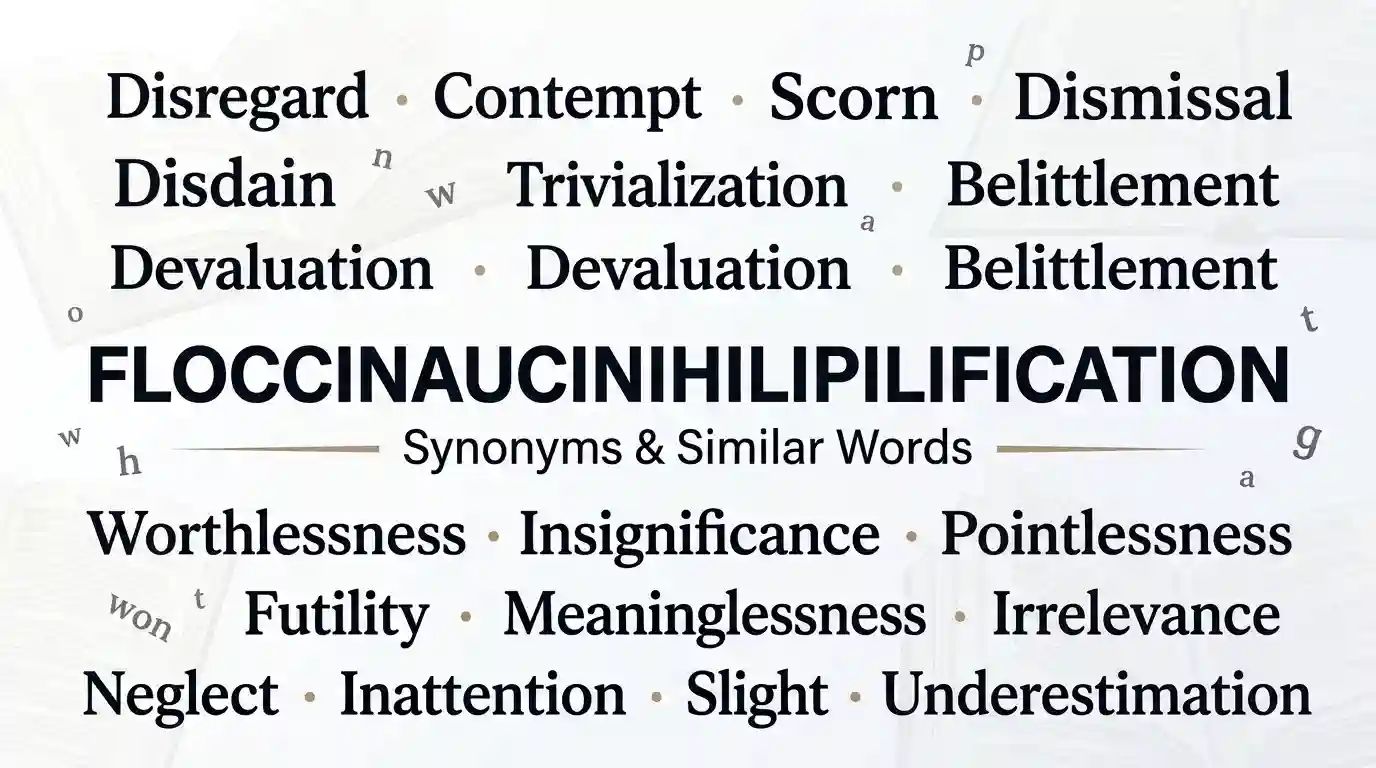
The closest synonyms of floccinaucinihilipilification are devaluation, undervaluation, belittlement, disparagement, denigration, and trivialization. The word means the act or habit of judging something to be worthless or of little value. Words such as dismissal, disdain, contempt, and disregard are related, but each adds a different meaning.
What Does Floccinaucinihilipilification Mean?
Have you ever looked at a very long English word and wondered whether there is a much simpler way to say it?
Floccinaucinihilipilification is a perfect example.
It means the act or habit of estimating something as worthless or having little value. The word is a noun, and dictionaries describe it as rare. It is often discussed because of its extraordinary length, but its meaning is actually quite simple.
For example:
The critic’s floccinaucinihilipilification of the young artist’s work seemed unfair.
In ordinary English, you could say:
The critic’s belittlement of the young artist’s work seemed unfair.
That is the key to understanding its synonyms. You should not replace the word with just any negative word. The best alternative depends on why something is being considered worthless.
Pronunciation
Floccinaucinihilipilification
A useful pronunciation guide is:
flok-si-naw-si-ni-hil-i-pil-i-fi-KAY-shun
It has a large number of syllables, so breaking it into smaller parts makes it easier to pronounce.
The spelling is the same in American and British English. Pronunciation can vary slightly between the two varieties.
Part of Speech
Floccinaucinihilipilification is a noun.
It normally refers to an act, process, attitude, or habit of treating something as worthless.
Common pattern
the floccinaucinihilipilification of + noun
Examples:
- the floccinaucinihilipilification of art
- the floccinaucinihilipilification of scientific evidence
- the floccinaucinihilipilification of someone’s achievements
Is it countable?
It is normally treated as an uncountable noun.
You would usually say:
His floccinaucinihilipilification of the proposal was obvious.
rather than:
His floccinaucinihilipilifications were obvious.
How Difficult Is This Word?
There is no widely accepted official CEFR level for floccinaucinihilipilification.
For practical learner guidance, however, it should be treated as C2+ or specialist vocabulary because it is extremely rare and has little value in everyday communication.
That does not mean a learner needs to memorize it.
In fact, knowing its shorter alternatives is much more useful.
Learner-friendly progression
- A1–A2: worthless, useless, unimportant
- B1: dismiss, ignore, underestimate
- B2: belittle, undervalue, trivialize
- C1: disparage, denigrate, devalue
- C2+: floccinaucinihilipilification
This is a practical difficulty guide, not an official CEFR classification.
The Closest Synonyms
The most useful close alternatives are:
- Devaluation
- Undervaluation
- Belittlement
- Disparagement
- Denigration
- Trivialization
- Depreciation
These words overlap strongly with the original meaning, but they are not interchangeable in every sentence.
1. Devaluation
Meaning: Devaluation means treating something as having less value than it previously had or deserves.
Example 1:
The report criticized the devaluation of creative work.
Example 2:
The company’s decision caused a devaluation of the brand.
Best used when: The main idea is a reduction in perceived or assigned value.
Register: Formal, academic, business
Frequency: Common
Collocations:
- devaluation of assets
- currency devaluation
- devaluation of labor
When not to use it
Do not use devaluation simply to mean ignoring something. If nobody pays attention to an idea, disregard or dismissal may be better.
2. Undervaluation
Meaning: Undervaluation means judging something as less valuable than it really is.
Example 1:
The study highlighted the undervaluation of unpaid care work.
Example 2:
The artist believed her early paintings suffered from undervaluation.
Best used when: Something genuinely has value but people fail to recognize enough of it.
Register: Formal, academic, business
Frequency: Common
Collocations:
- undervaluation of skills
- undervaluation of labor
- undervaluation of assets
Key nuance
Undervaluation often suggests that the judgment is wrong.
That makes it especially useful when you want to say that something deserves more respect or value.
3. Belittlement
Meaning: Belittlement means making a person, achievement, idea, or thing seem less important or worthy.
Example 1:
Constant belittlement of young employees can damage their confidence.
Example 2:
She objected to the belittling of her research.
Best used when: Someone actively makes another person or their work seem small or unimportant.
Register: Neutral to formal
Frequency: Common
Collocations:
- constant belittlement
- public belittlement
- belittlement of someone’s achievements
When not to use it
Avoid it when the only meaning is a financial fall in value. Depreciation or devaluation may be more precise.
4. Disparagement
Meaning: Disparagement means speaking about someone or something in a way that reduces its reputation, value, or importance.
Example 1:
The writer rejected the unfair disparagement of traditional medicine.
Example 2:
His remarks amounted to disparagement of the entire profession.
Best used when: Negative comments are actively lowering someone’s perceived worth.
Register: Formal
Frequency: Common
Collocations:
- unfair disparagement
- public disparagement
- disparagement of someone’s work
Nuance
Disparagement usually involves negative language or criticism, while floccinaucinihilipilification can describe the broader judgment or habit of treating something as worthless.
5. Denigration
Meaning: Denigration means unfairly presenting someone or something as bad, worthless, or unimportant.
Example 1:
The article was criticized for its denigration of local artists.
Example 2:
Political debate should not become a form of personal denigration.
Best used when: Strong negative treatment damages someone’s reputation or standing.
Register: Formal, academic
Frequency: Uncommon
Collocations:
- deliberate denigration
- public denigration
- denigration of a group
Nuance
Denigration is usually stronger than simple dismissal.
6. Trivialization
Meaning: Trivialization means treating something important or serious as if it were minor.
Example 1:
The documentary warned against the trivialization of domestic violence.
Example 2:
His joke led to the trivialization of a serious problem.
Best used when: Something serious is made to appear less important.
Register: Formal, academic
Frequency: Common
Collocations:
- trivialization of serious issues
- trivialization of violence
- cultural trivialization
Key difference
If something is treated as worthless, use devaluation or belittlement.
If something serious is treated as minor, use trivialization.
7. Depreciation
Meaning: Depreciation means a fall in value, especially the financial value of an asset.
Example 1:
The vehicle experienced significant depreciation after several years.
Example 2:
The accountant calculated the depreciation of the equipment.
Best used when: You are discussing economic or measurable loss of value.
Register: Business, financial, formal
Frequency: Common
Important warning
Depreciation is not a universal synonym for floccinaucinihilipilification.
In finance and accounting, it has a specific technical meaning.
Related Words That Are NOT Exact Synonyms
This distinction is where many synonym articles become misleading.
8. Dismissal
Meaning: Refusing to consider something important, useful, or worthy of attention.
Example:
His dismissal of the evidence surprised the researchers.
Why it is related: Dismissing something can imply that you consider it unimportant.
But: Dismissal focuses on refusing to consider something, not necessarily judging it as worthless.
9. Disregard
Meaning: Lack of attention or concern.
Example:
His disregard for safety rules caused problems.
Why it is related: A person who considers something worthless may disregard it.
But: You can disregard something without believing it has no value.
10. Disdain
Meaning: A strong feeling that someone or something is beneath respect.
Example:
She spoke with disdain about dishonest business practices.
Why it is related: Disdain can involve treating something as beneath consideration.
But: It adds an emotional sense of superiority or contempt.
11. Contempt
Meaning: A strong feeling that someone or something is unworthy of respect.
Example:
He treated the dishonest proposal with contempt.
Why it is related: Contempt can involve judging something as unworthy.
But: Contempt is a strong emotional attitude, not simply an assessment of value.
12. Derision
Meaning: Derision means treating someone or something as ridiculous or worthy of mockery.
Example:
The proposal was greeted with public derision.
Why it is related: People may ridicule things they consider worthless.
But: Mockery is essential to derision. Without mockery, another word is probably better.
13. Underestimation
Meaning: Underestimation means judging something to be less capable, valuable, important, or significant than it really is.
Example:
The team’s victory revealed the earlier underestimation of its abilities.
Why it is related: Both involve assigning too little value.
But: Underestimation usually implies an incorrectly low judgment, whereas floccinaucinihilipilification can describe the act or habit itself.
14. Minimization
Meaning: Minimization means making something appear less important, serious, or significant.
Example:
The report criticized the minimization of the problem.
Why it is related: It overlaps with trivialization.
But: Minimization does not necessarily mean considering something worthless.
15. Scorn
Meaning: Scorn is strong contempt or disrespect.
Example:
The speaker expressed scorn for dishonest advertising.
Why it is related: Scorn can involve treating something as beneath consideration.
But: It is strongly emotional and often openly hostile.
Best Synonym by Context
| What you want to say | Best choice |
| Something is given less value | Devaluation |
| Something deserves more value than people give it | Undervaluation |
| Someone is made to seem small | Belittlement |
| Negative criticism lowers someone’s worth | Disparagement |
| Someone’s reputation is attacked | Denigration |
| A serious issue is made to seem minor | Trivialization |
| An asset loses financial value | Depreciation |
| An idea is brushed aside | Dismissal |
| Something receives no attention | Disregard |
| Something is viewed with superiority | Disdain |
| Something is treated as unworthy of respect | Contempt |
| Something is mocked | Derision |
| Something is judged too low | Underestimation |
Quick Tip: Do not ask only, “What is a synonym for this word?” Ask, “What exactly is happening in my sentence?” That question usually leads you to the more accurate synonym.
Formality, Register, and Frequency Guide
| Word | Register | Approx. frequency in general English | Main nuance |
| Devaluation | Formal/business | Common | Reduced value |
| Undervaluation | Formal/academic | Common | Value judged too low |
| Belittlement | Neutral/formal | Common | Making something seem small |
| Disparagement | Formal | Common | Negative criticism |
| Denigration | Formal | Uncommon | Strongly lowering reputation |
| Trivialization | Formal/academic | Common | Making serious things seem minor |
| Depreciation | Business/financial | Common | Loss of monetary value |
| Dismissal | Neutral | Very common | Refusal to consider |
| Disregard | Neutral/formal | Common | Lack of attention |
| Disdain | Formal/literary | Common | Strong lack of respect |
| Contempt | Formal/neutral | Common | Strong disrespect |
| Derision | Formal/literary | Uncommon | Mockery |
| Scorn | Formal/literary | Common | Open contempt |
| Floccinaucinihilipilification | Rare/literary/playful | Very rare | Estimating something as worthless |
These frequency descriptions are practical learner guidance rather than formal corpus rankings.
Word Origin and Etymology
The unusual structure of floccinaucinihilipilification comes from a series of Latin expressions associated with things of little or no value.
The components flocci, nauci, nihili, and pili are associated with ideas such as a small amount, nothing, or something of little worth.
Historical evidence is important here. The word is recorded from the 18th century, with a 1741 use associated with William Shenstone. That means explanations claiming that the word was first invented in the much later Eton grammar tradition should be treated carefully. Historical discussion also connects its unusual sequence to earlier Latin grammar traditions.
This history makes the word more interesting than simply calling it “one of the longest English words.”
Why Is This Word Famous?
Its meaning is ordinary enough, but its spelling is extraordinary.
The word contains 29 letters, which is one reason vocabulary learners often encounter it in lists of unusually long English words.
Its rarity also gives it a playful quality. A writer may use it deliberately to sound humorous, learned, or exaggerated.
That does not mean it is the best word for everyday writing.
In most cases:
Simple and accurate beats are long and impressive.
How Native Speakers Would Usually Say It
Instead of:
The manager’s floccinaucinihilipilification of my proposal was frustrating.
A normal speaker might say:
The manager’s dismissal of my proposal was frustrating.
Or:
The manager belittled my proposal.
Or:
The manager treated my proposal as worthless.
These alternatives are easier to understand and much more natural.
Common Collocations
Because the target word itself is extremely rare, natural collocations are more useful when learned through its common alternatives.
Devaluation
- devaluation of assets
- devaluation of labor
- devaluation of currency
Belittlement
- constant belittlement
- public belittlement
- belittlement of achievements
Disparagement
- unfair disparagement
- public disparagement
- disparagement of someone’s work
Trivialization
- trivialization of serious issues
- trivialization of violence
- trivialization of history
Dismissal
- outright dismissal
- quick dismissal
- dismissal of evidence
Disregard
- complete disregard
- blatant disregard
- disregard for safety
Common Mistakes
Common Mistake Box
Mistake 1: Using “contempt” as an exact synonym
Correction: Use contempt when strong disrespect or moral disapproval is involved.
Why: The original word is about estimating value. Contempt adds a stronger emotional reaction.
Mistake 2: Using “depreciation” for every kind of low value
Correction: Use depreciation mainly for a decrease in financial or economic value.
Mistake 3: Using “derision” for simple criticism
Correction: Use derision only when ridicule or mockery is part of the meaning.
Mistake 4: Assuming “dismissal” always means worthlessness
Correction: Dismissal can simply mean refusing to consider something.
Mistake 5: Calling every related word an exact synonym
Correction: Separate close synonyms from related words.
This distinction makes your writing much more precise.
How to Use the Word in Writing
Academic Writing
You can use it when discussing attitudes toward ideas, research, culture, or evidence, but a simpler alternative will usually be clearer.
Better everyday academic choices include:
- devaluation
- trivialization
- undervaluation
- dismissal
Professional Writing
Avoid the word unless the unusual vocabulary is intentional.
Instead of:
The proposal suffered from floccinaucinihilipilification.
Write:
The proposal was dismissed without proper consideration.
Creative Writing
The word can work well when you want a humorous or deliberately elaborate effect.
For example:
His speech was less an argument than an impressive exercise in floccinaucinihilipilification.
Here, the unusual word itself becomes part of the style.
Everyday Conversation
Usually avoid it.
Say:
- That’s being dismissed.
- They are undervaluing the work.
- He is belittling her idea.
- They are treating it as unimportant.
These expressions sound much more natural.
American vs. British English
There is no major spelling difference:
American English: floccinaucinihilipilification
British English: floccinaucinihilipilification
The pronunciation may vary slightly because of normal differences between American and British English pronunciation.
The important point is that usage frequency is low in both varieties.
Antonyms
If floccinaucinihilipilification means judging something as worthless, useful opposites include:
- appreciation
- recognition
- valuation
- esteem
- respect
- admiration
- praise
- commendation
Example
Negative:
The article showed the devaluation of traditional knowledge.
Positive:
The article showed a growing appreciation of traditional knowledge.
Mini Practice
Fill in the blanks
Choose from:
devaluation | dismissal | trivialization | derision | undervaluation
- The committee’s ________ of the evidence was criticized.
- The study found the ________ of unpaid care work.
- The comedian’s remarks led to the ________ of a serious issue.
- The company’s assets suffered significantly ________.
- The proposal was met with public ________.
Answers
- dismissal
- undervaluation
- trivialization
- devaluation
- derision
Rewrite Practice
Replace the bold phrase with the most precise synonym.
1.
The company gave too little value to its employees’ skills.
Answer: The company undervalued its employees’ skills.
2.
The manager made the junior employee’s idea seem small and unimportant.
Answer: The manager belittled the junior employee’s idea.
3.
The article made the serious problem seem minor.
Answer: The article trivialized the serious problem.
Vocabulary Quiz
1. What does floccinaucinihilipilification mean?
A. Careful appreciation
B. Estimating something as worthless
C. Public celebration
D. Detailed examination
2. Which word best describes judging something as less valuable than it really is?
A. Derision
B. Undervaluation
C. Contempt
D. Disregard
3. Which word includes mockery?
A. Derision
B. Depreciation
C. Valuation
D. Dismissal
4. Which word is especially associated with financial loss of value?
A. Belittlement
B. Disdain
C. Depreciation
D. Trivialization
5. Which word is best for making a serious issue seem minor?
A. Trivialization
B. Admiration
C. Recognition
D. Appreciation
Answers:
- B
- B
- A
- C
- A
Frequently Asked Questions
What is the closest synonym of floccinaucinihilipilification?
The closest alternatives are devaluation, undervaluation, belittlement, disparagement, denigration, and trivialization. There is no single perfect replacement because each word emphasizes a slightly different part of the idea. Undervaluation focuses on assigning too little value, while belittlement focuses on making something seem less important.
What is floccinaucinihilipilification in simple words?
It means treating or judging something as worthless or unimportant. The word describes an act or habit rather than a physical object. In everyday English, people would normally say dismissal, undervaluation, belittlement, or treating something as worthless instead.
Is floccinaucinihilipilification a real English word?
Yes. It is recorded in English dictionaries and has historical usage dating to the 18th century. It is a noun meaning the act or habit of estimating something as worthless. Its rarity and unusual length are major reasons it is famous among vocabulary learners.
Is floccinaucinihilipilification commonly used?
No. It is extremely rare compared with words such as dismissal, devaluation, and belittlement. It is more likely to appear in vocabulary discussions, word lists, humorous writing, or discussions about unusually long English words.
What is the opposite of floccinaucinihilipilification?
Possible opposites include appreciation, recognition, esteem, respect, admiration, and valuation. The best antonym depends on context. If the idea is recognizing someone’s true worth, appreciation or recognition may be the most natural choice.
Is dismissal the same as floccinaucinihilipilification?
Not exactly. Dismissal means refusing to consider something or treating it as unworthy of attention. Floccinaucinihilipilification specifically refers to estimating something as worthless or having little value. The meanings overlap, but they are not identical.
Why is floccinaucinihilipilification so long?
Its unusual form comes from several Latin expressions associated with little or no value, combined with an English noun-forming ending. Historical evidence places the word in the 18th century, rather than making it a modern invention.
Should English learners use this word?
They can recognize it, but they rarely need to use it. For clear communication, shorter words such as devalue, undervalue, belittle, dismiss, and trivialize are usually better. The word is most useful when studying vocabulary, word formation, etymology, or deliberately humorous writing.
Final Takeaway
Floccinaucinihilipilification is a rare and fascinating word for the act or habit of treating something as worthless. Its best close alternatives include devaluation, undervaluation, belittlement, disparagement, denigration, and trivialization.
But the right synonym depends on the situation. Use devaluation for reduced value, undervaluation for value judged too low, belittlement for making something seem small, trivialization for making something serious seem minor, and dismissal when an idea is simply brushed aside. The most useful vocabulary skill is not knowing the longest word. It is knowing which word expresses your exact meaning.
Trusted Sources for Verification
- Oxford English Dictionary
- Cambridge Dictionary
- Collins English Dictionary
- Dictionary.com
- Etymonline

Synonorm is a trusted English vocabulary resource created to help readers find the right words and understand the differences between similar terms. We provide clear explanations of synonyms, meanings, examples, usage, and alternatives. Our content makes vocabulary easier to learn and apply in everyday, academic, and professional English. Synonorm is designed for students, writers, ESL learners, professionals, and anyone who wants to improve their English vocabulary and communicate more clearly.