Quick Answer: What Are the Best Synonyms for Stupor?
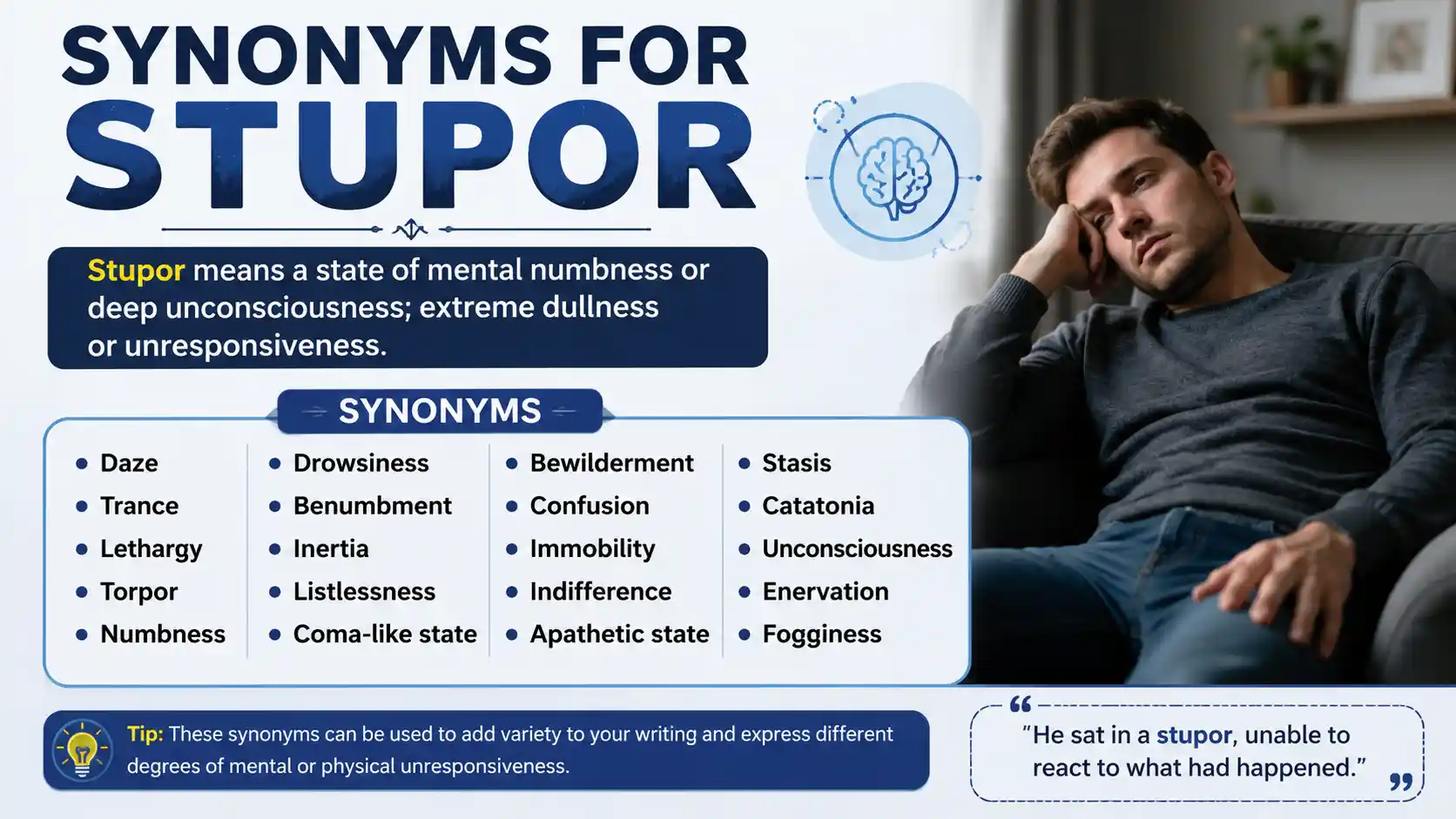
The best synonyms for stupor include daze, torpor, lethargy, stupefaction, numbness, insensibility, somnolence, drowsiness, sleepiness, trance, and unconsciousness. However, they are not always exact replacements. Stupor usually suggests greatly reduced awareness or responsiveness, while words such as lethargy focus more on low energy and daze often describes confusion after shock or surprise.
Introduction
Have you ever felt so shocked, tired, or confused that you could hardly think clearly? You might describe that condition as a stupor.
For example, after hearing the sudden news, he sat in a stupor and could not respond.
The word stupor describes a state in which a person has greatly reduced awareness, clear thinking, or responsiveness. It can be connected with shock, alcohol, drugs, illness, extreme tiredness, or emotional distress. Major dictionaries distinguish it from ordinary tiredness because stupor suggests a much deeper dulling of the mind or senses.
If you are searching for synonyms for stupor, this guide will help you choose the right word for essays, stories, emails, professional writing, conversations, and vocabulary practice.
The most important lesson is simple: not every synonym has exactly the same meaning. Choosing between daze, lethargy, torpor, and numbness depends on what caused the condition and what you want to emphasize.
Pronunciation
Stupor
British English: /ˈstjuː.pə(r)/
American English: /ˈstuː.pər/
Pronounced as:
STOO-puh in American English
STYOO-puh in many British pronunciations
Cambridge and Oxford both show a difference between common British and American pronunciations.
Part of Speech
Stupor is primarily a noun.
- Noun: He was in a stupor.
- Plural noun: Several patients were found in different states of stupor.
- Adjective: stuporous, meaning affected by or resembling stupor.
- Adverb: stuporously, a rare form.
- Verb: There is no common everyday verb to stupor.
The adjective stuporous is recorded in English and means marked or affected by stupor.
CEFR Level
Oxford Learner’s Dictionaries lists stupor as B1. CEFR levels for individual synonyms can vary between dictionaries and learning systems, so the levels below are approximate learner guidance rather than universal official ratings.
Grammar and Usage
The most common pattern is:
in + a + stupor
Examples:
- She sat in a stupor after hearing the news.
- He was in a drunken stupor.
- The patient remained in a deep stupor.
Other useful patterns include:
- fall into a stupor
- go into a stupor
- come out of a stupor
- wake from a stupor
- rouse someone from a stupor
Oxford specifically records combinations such as fall into, go into, and in a stupor.
Remember: stupor is normally a noun. Do not write “He was stupored.”
Synonyms for Stupor: Quick Comparison
| Synonym | Strength | Formality |
| Daze | Strong | Neutral |
| Stupefaction | Strongest | Formal |
| Insensibility | Strongest | Formal |
| Near-unconsciousness | Strongest | Formal |
| Unconsciousness | Strongest | Neutral |
| Torpor | Strong | Formal |
| Lethargy | Strong | Neutral |
| Numbness | Strong | Neutral |
| Lassitude | Related | Formal |
| Languor | Related | Literary |
| Somnolence | Strong | Formal |
| Drowsiness | Related | Neutral |
| Sleepiness | Related | Informal/Neutral |
| Apathy | Related | Neutral |
| Trance | Strong | Neutral |
| Blackout | Strong | Informal/Neutral |
| Inertia | Related | Formal |
| Inertness | Related | Formal |
| Listlessness | Related | Neutral |
| Hebetude | Strong | Literary/Rare |
| Stunned state | Strong | Neutral |
| Stunned condition | Strong | Neutral |
| Mental fog | Related | Informal |
| Unresponsiveness | Strong | Formal |
| Stupefied state | Strong | Formal |
25 Useful Synonyms for Stupor
Daze
Meaning: A confused or stunned mental state in which you cannot think clearly.
Examples:
- The sudden announcement left the students in a daze.
- She walked home in a daze after the accident.
Best Used When: Shock or surprise causes temporary confusion.
Tone: Neutral
CEFR: B1-B2
Frequency: Very common
Common collocations: in a daze, leave someone in a daze, walk around in a daze
Connotation: Usually suggests confusion rather than complete loss of consciousness.
When Not to Use: Do not use daze when someone is completely unconscious.
Torpor
Meaning: A state of very low physical or mental activity.
Examples:
- The hot afternoon pushed the workers into a state of torpor.
- The organization slowly fell into a bureaucratic torpor.
Best Used When: You want to emphasize extreme sluggishness or inactivity.
Tone: Formal
CEFR: C1
Frequency: Common
Common collocations: fall into torpor, state of torpor, mental torpor
Connotation: Often suggests prolonged inactivity rather than sudden shock.
Merriam-Webster distinguishes torpor from stupor by noting that torpor emphasizes extreme sluggishness or suspended activity.
When Not to Use: Avoid it when a person is nearly unconscious because of an injury or drug.
Lethargy
Meaning: A strong lack of energy that makes activity difficult.
Examples:
- He struggled with lethargy after several nights of poor sleep.
- The illness left her feeling weak and full of lethargy.
Best Used When: Low energy and drowsiness are the main ideas.
Tone: Neutral/Formal
CEFR: B2
Frequency: Common
Common collocations: extreme lethargy, sudden lethargy, suffer from lethargy
Connotation: More about lack of energy than mental shock.
When Not to Use: Do not use it as a direct replacement for stupor when someone is almost unconscious.
Stupefaction
Meaning: A state of extreme surprise, shock, or mental dullness.
Examples:
- The decision left the entire team in stupefaction.
- He stared at the screen in complete stupefaction.
Best Used When: You want a formal word for extreme shock or mental dullness.
Tone: Formal
CEFR: C1-C2
Frequency: Uncommon
Common collocations: complete stupefaction, state of stupefaction, stare in stupefaction
Connotation: Stronger and more dramatic than daze.
When Not to Use: Avoid it in casual conversation unless the dramatic tone is intentional.
Numbness
Meaning: A lack of physical feeling or emotional response.
Examples:
- She felt emotional numbness after the loss.
- The shock left him with a strange sense of numbness.
Best Used When: You want to describe reduced feeling rather than confusion.
Tone: Neutral
CEFR: B2
Frequency: Very common
Common collocations: emotional numbness, physical numbness, feeling of numbness
Connotation: Can be physical or emotional.
When Not to Use: Do not use it when the main idea is sleepiness.
Insensibility
Meaning: A state in which someone cannot respond normally to what is happening around them.
Examples:
- The patient had fallen into insensibility.
- The blow caused temporary insensibility.
Best Used When: Writing formally about severely reduced awareness.
Tone: Formal
CEFR: C1-C2
Frequency: Uncommon
Common collocations: fall into insensibility, state of insensibility, complete insensibility
Connotation: More clinical and severe than daze.
When Not to Use: It is usually too formal for ordinary conversation.
Somnolence
Meaning: A strong tendency to sleep or a state of unusual sleepiness.
Examples:
- The medicine caused considerable somnolence.
- Afternoon somnolence made it difficult to concentrate.
Best Used When: Sleepiness is the main feature.
Tone: Formal/Medical
CEFR: C1-C2
Frequency: Uncommon
Common collocations: daytime somnolence, excessive somnolence, medication-induced somnolence
Connotation: Clinical and technical.
When Not to Use: Do not use it simply to describe emotional shock.
Drowsiness
Meaning: A feeling that you want to sleep.
Examples:
- The long journey caused mild drowsiness.
- The medicine may cause drowsiness.
Best Used When: Someone is sleepy but still awake and aware.
Tone: Neutral
CEFR: B1-B2
Frequency: Very common
Common collocations: cause drowsiness, extreme drowsiness, afternoon drowsiness
Connotation: Much milder than stupor.
When Not to Use: Avoid using drowsiness when someone cannot respond normally.
Sleepiness
Meaning: The ordinary feeling of wanting to sleep.
Examples:
- A warm room often makes me feel sleepy.
- His sleepiness disappeared after a short walk.
Best Used When: Talking about everyday tiredness.
Tone: Neutral/Informal
CEFR: A2-B1
Frequency: Very common
Common collocations: morning sleepiness, sudden sleepiness, feeling of sleepiness
Connotation: Mild and ordinary.
When Not to Use: It is far too weak for a serious state of reduced consciousness.
Trance
Meaning: A state in which someone seems unaware of what is happening around them.
Examples:
- She stared at the painting as if she were in a trance.
- He walked through the room in a dreamlike trance.
Best Used When: Someone appears deeply absorbed or unaware.
Tone: Neutral/Literary
CEFR: B2
Frequency: Common
Common collocations: fall into a trance, dreamlike trance, hypnotic trance
Connotation: Can sound mysterious, dreamlike, or psychological.
When Not to Use: Do not automatically use trance for medical unconsciousness.
Blackout
Meaning: A temporary loss of consciousness or memory.
Examples:
- He experienced a blackout after the injury.
- She had no memory of the night because of a blackout.
Best Used When: Loss of consciousness or memory is central.
Tone: Neutral/Informal
CEFR: B2
Frequency: Common
Common collocations: experience a blackout, suffer a blackout, blackout drunk
Connotation: Often associated with alcohol, injury, or memory loss.
When Not to Use: A person can be in a stupor without having a complete blackout.
Unconsciousness
Meaning: A state in which a person is not conscious or aware.
Examples:
- The fall caused a brief period of unconsciousness.
- He was taken to the hospital after losing consciousness.
Best Used When: You mean actual loss of consciousness.
Tone: Formal/Neutral
CEFR: B2
Frequency: Common
Connotation: Stronger and more specific than stupor.
When Not to Use: Do not use it when someone is awake but confused.
Near-Unconsciousness
Meaning: A condition very close to being unconscious.
Examples:
- The patient appeared to be in a state of near-unconsciousness.
- Extreme exhaustion left him close to near-unconsciousness.
Best Used When: You need a precise descriptive phrase.
Tone: Formal/Medical
CEFR: C1
Frequency: Uncommon
Connotation: Serious and clinical.
When Not to Use: Avoid it for ordinary tiredness.
Apathy
Meaning: A lack of interest, feeling, or concern.
Examples:
- The long crisis created a sense of apathy among residents.
- His apathy made it difficult for him to take action.
Best Used When: Emotional indifference is the main idea.
Tone: Neutral/Formal
CEFR: B2
Frequency: Common
Connotation: Emotional or motivational rather than physical.
When Not to Use: Apathy does not normally mean being almost unconscious.
Lassitude
Meaning: A feeling of physical or mental weakness and lack of energy.
Examples:
- She experienced lassitude after a long illness.
- The summer heat brought a feeling of lassitude.
Best Used When: Fatigue, weakness, or poor health causes inactivity.
Tone: Formal
CEFR: C1
Frequency: Uncommon
Connotation: Softer and less dramatic than stupor.
Merriam-Webster notes that lassitude especially stresses listlessness caused by fatigue or poor health.
When Not to Use: It is not a good choice for sudden shock-induced confusion.
Languor
Meaning: A relaxed but weak or inactive state.
Examples:
- The heat filled the town with languor.
- He spent the afternoon in a pleasant state of languor.
Best Used When: The mood is slow, relaxed, or weak rather than severely impaired.
Tone: Literary
CEFR: C1-C2
Frequency: Uncommon
Connotation: Can have a dreamy or even pleasant feeling.
When Not to Use: Do not use it for serious unconsciousness.
Inertia
Meaning: A condition in which someone does not act or change.
Examples:
- Years of organizational inertia prevented reform.
- After the failure, the team struggled to overcome its inertia.
Best Used When: Inaction is the main idea.
Tone: Formal/Academic
CEFR: B2-C1
Frequency: Common
Connotation: Often describes systems, groups, or behavior rather than consciousness.
When Not to Use: It is not an exact synonym for a medically impaired state.
Inertness
Meaning: A condition of being inactive, motionless, or lacking energy.
Examples:
- The machine’s inertness made the problem obvious.
- His physical inertness worried the people around him.
Best Used When: You want to emphasize lack of movement or activity.
Tone: Formal
CEFR: C1
Frequency: Uncommon
Connotation: Focuses on inactivity.
When Not to Use: Avoid it if confusion or loss of awareness is the key idea.
Listlessness
Meaning: A lack of energy, interest, or enthusiasm.
Examples:
- The students showed unusual listlessness after lunch.
- His listlessness continued throughout the day.
Best Used When: Someone lacks energy or motivation.
Tone: Neutral
CEFR: B2
Frequency: Common
Connotation: Usually mild compared with stupor.
When Not to Use: It does not normally suggest near-unconsciousness.
Hebetude
Meaning: Mental dullness or a lack of sharpness.
Examples:
- The writer described the character’s heritage after years of isolation.
- The report discussed mental hebetude caused by prolonged stress.
Best Used When: You need a rare literary or highly formal term for dullness.
Tone: Literary/Formal
CEFR: C2
Frequency: Rare
Connotation: Intellectual dullness rather than sleepiness.
When Not to Use: Avoid it in normal conversation because most English speakers rarely use it.
Stunned State
Meaning: A condition of shock or confusion after something surprising or upsetting.
Examples:
- The players remained in a stunned state after the final whistle.
- The family sat in a stunned state after hearing the news.
Best Used When: Shock is the main cause.
Tone: Neutral
CEFR: B1-B2
Frequency: Common as a phrase
Connotation: Strong emotional surprise.
When Not to Use: It is not necessarily related to drugs, alcohol, or physical unconsciousness.
Unresponsiveness
Meaning: A condition in which someone does not respond normally to people or events.
Examples:
- The doctor was concerned about the patient’s unresponsiveness.
- His sudden unresponsiveness required immediate attention.
Best Used When: The person’s lack of response is the main point.
Tone: Formal/Medical
CEFR: C1
Frequency: Common in professional contexts
Connotation: Clinical and objective.
When Not to Use: Do not use it to mean simple tiredness.
Stupefied State
Meaning: A condition of extreme confusion or mental dullness.
Examples:
- He stood in a stupefied state after the announcement.
- The unexpected result left her in a stupefied state.
Best Used When: You want to stress extreme surprise and confusion.
Tone: Formal
CEFR: C1
Frequency: Uncommon
Connotation: Stronger and more dramatic than daze.
When Not to Use: It does not always imply physical unconsciousness.
Strongest Synonyms
When you need the closest and strongest alternatives, consider:
- Stupefaction
- Insensibility
- Near-unconsciousness
- Unconsciousness
- Unresponsiveness
- Daze
These words are useful when awareness, response, or mental clarity has been seriously reduced.
Strong Synonyms
These are useful when the person is very inactive, sleepy, confused, or mentally dull:
- Torpor
- Lethargy
- Numbness
- Somnolence
- Trance
- Stunned state
- Stupefied state
Related Words
These are connected to stupor but are not always interchangeable:
- Apathy
- Lassitude
- Languor
- Drowsiness
- Sleepiness
- Inertia
- Listlessness
- Inertness
- Mental fog
Choose the Right Synonym: Side-by-Side Comparison
| If you mean… | Best word | Why? |
| Shock and confusion | Daze | Common and natural |
| Extreme mental dullness | Stupefaction | Strong and formal |
| Very low activity | Torpor | Emphasizes sluggishness |
| Lack of energy | Lethargy | Focuses on tiredness |
| Loss of feeling | Numbness | Physical or emotional |
| Strong sleepiness | Somnolence | Formal and clinical |
| Ordinary sleepiness | Drowsiness | Mild and common |
| No awareness | Unconsciousness | More specific |
| No normal response | Unresponsiveness | Clinical and precise |
| Emotional indifference | Apathy | Focuses on feeling |
| Dreamlike awareness | Trance | Absorbed or unaware |
| Loss of memory | Blackout | Often temporary |
| Mental dullness | Hebetude | Rare and literary |
Quick Tip: If you are unsure, daze is often the safest everyday alternative. If the person is sleepy and weak, choose lethargy or drowsiness. If awareness is severely reduced, stupor or unresponsiveness may be more accurate.
Commonly Confused Words
| Word | Difference | Example |
| Stupor | Severe dullness or reduced awareness | He sat in a stupor. |
| Daze | Confusion after shock or surprise | The news left her in a daze. |
| Lethargy | Lack of energy | The illness caused lethargy. |
| Torpor | Extreme sluggishness or inactivity | The office fell into torpor. |
| Trance | Dreamlike or absorbed state | She stared ahead in a trance. |
Common Mistakes
Common Mistake Box
Mistake: He was very stupor.
Correction: He was in a stupor.
Explanation: Stupor is normally a noun, so use it with a phrase such as in a stupor.
Mistake: She was in a drowsy stupor.
Better: She was in a stupor or She was extremely drowsy.
Explanation: Drowsiness is usually much milder than stupor.
Mistake: Using unconsciousness for simple tiredness.
Correction: Use sleepiness or drowsiness when the person remains conscious.
Writing Tips: How to Use Synonyms Naturally
In Essays
Use formal words such as torpor, lethargy, lassitude, or stupefaction when the context supports them.
Example:
The prolonged crisis pushed the community into a state of political torpor.
In Emails
Keep your language simple.
Instead of:
The team entered a state of lassitude.
Write:
The team seemed unusually tired and inactive.
In Blog Posts
Use common words first. Explain advanced words afterward.
For example:
The shocking news left him in a daze, a state of confusion in which clear thinking becomes difficult.
In Stories
Literary words can create an atmosphere.
She stared at the empty street in a dreamlike trance.
In Professional Communication
Use precise terms such as unresponsiveness, drowsiness, lethargy, or reduced awareness when the context requires accuracy.
In Daily Conversation
Prefer familiar words such as:
- Daze
- Sleepiness
- Drowsiness
- Numbness
- Trance
Word Origin and Etymology
Stupor comes from Latin stupor, meaning a condition of numbness, dullness, or insensibility. It is related to the Latin verb stupēre, meaning “to be stunned” or “to be amazed.”
English borrowed the noun through Middle English. Merriam-Webster records the first known use in the 14th century, while etymological sources trace the English medical sense to the late 14th century.
The word later developed a broader figurative meaning involving mental dullness or apathy. This helps explain why stupor can describe both a serious physical condition and a figurative state of extreme inactivity.
American vs. British English
The spelling stupor is the same in American and British English.
The main difference is pronunciation:
- American: /ˈstuː.pər/
- British: /ˈstjuː.pə(r)/
American English commonly has the “stoo” sound, while many British speakers use a “stylo” sound. Oxford and Cambridge both record these pronunciation differences.
Most synonyms also have the same spelling in both varieties.
Related Vocabulary
Antonyms
Words with opposite or contrasting meanings include:
- Alertness
- Awareness
- Consciousness
- Energy
- Vigor
- Vitality
- Activity
- Enthusiasm
- Responsiveness
- Attentiveness
Word Family
Related forms include:
- stupor – noun
- stuporous – adjective
- stuporously – adverb
- stuporousness – noun
The adjective stuporous is recorded as meaning affected by or marked by stupor.
Natural Collocations With Stupor
Native English speakers commonly use stupor with words such as:
- drunken stupor
- deep stupor
- dazed stupor
- drug-induced stupor
- state of stupor
- fall into a stupor
- go into a stupor
- wake from a stupor
- rouse someone from a stupor
- in a stupor of shock
- in a stupor of exhaustion
These patterns are useful because learning a word with its natural collocations often makes it easier to use correctly. Oxford specifically records several of these combinations.
Mini Practice Exercises
Fill in the Blanks
Choose the best word: daze, lethargy, torpor, drowsiness, apathy
- The medicine caused severe ______.
- The shocking result left him in a ______.
- The hot weather created a feeling of ______.
- The illness caused extreme ______.
- His ______ made him stop caring about the project.
Sentence Rewriting
Replace the bold phrase with a suitable synonym.
- The accident left her confused and stunned.
- The illness caused a severe lack of energy.
- The company had fallen into a state of extreme inactivity.
- The medicine caused strong sleepiness.
Matching Activity
Match each word with its closest meaning.
| Word | Meaning |
| 1. Daze | A. Lack of energy |
| 2. Lethargy | B. Shocked confusion |
| 3. Apathy | C. Lack of concern |
| 4. Torpor | D. Extreme inactivity |
Vocabulary Quiz
1. Which word is closest to a confused state after shock?
A. Apathy
B. Daze
C. Energy
D. Vitality
2. Which word mainly describes a lack of energy?
A. Lethargy
B. Trance
C. Blackout
D. Awareness
3. Which word is more formal and often clinical?
A. Sleepiness
B. Drowsiness
C. Somnolence
D. Daze
4. Which word is associated with loss of consciousness or memory?
A. Blackout
B. Languor
C. Listlessness
D. Apathy
5. Which word best describes emotional indifference?
A. Stupefaction
B. Apathy
C. Insensibility
D. Somnolence
Answer Key
- B. Daze
- A. Lethargy
- C. Somnolence
- A. Blackout
- B. Apathy
FAQ: Synonyms for Stupor
What is the closest synonym for stupor?
Daze is one of the closest everyday alternatives to stupor, especially when someone is confused after shock or surprise. However, stupor can suggest a deeper reduction in awareness or responsiveness. For severe cases, words such as insensibility or unresponsiveness may be more precise.
What is a synonym for stupor caused by tiredness?
Lethargy, drowsiness, sleepiness, and lassitude can describe tired states. Lethargy is especially useful when someone lacks energy and does not want to act. Drowsiness is milder and usually means feeling ready to sleep.
Is daze the same as stupor?
Not exactly. A daze usually involves confusion or reduced awareness after shock, surprise, or injury. Stupor can be more severe and may involve greatly reduced responsiveness. The two words overlap, but they should not always be treated as exact synonyms.
What is the opposite of stupor?
Possible opposites include alertness, awareness, consciousness, responsiveness, energy, and vitality. The best opposite depends on the meaning. If stupor means reduced awareness, alertness or consciousness works well. If it means inactivity, energy or activity may be better.
Is lethargy a synonym for stupor?
Lethargy is a related synonym, but it is not always an exact replacement. Lethargy mainly means unusual tiredness, low energy, or reluctance to act. Stupor suggests a much deeper dulling of awareness or responsiveness. Merriam-Webster makes this distinction clearly.
What is a formal synonym for stupor?
Formal alternatives include stupefaction, insensibility, somnolence, unresponsiveness, and near-unconsciousness. The best choice depends on the exact context. Somnolence emphasizes sleepiness, while unresponsiveness emphasizes a failure to respond.
Can stupor describe emotions?
Yes. Stupor can describe a figurative mental state caused by shock, grief, exhaustion, or overwhelming events. For example, someone may be “in a stupor of disbelief.” However, the word still suggests that normal thinking or responsiveness has become greatly reduced.
What is the difference between stupor and torpor?
Stupor emphasizes a deadening of the mind and senses, often because of shock, drugs, alcohol, or another powerful cause. Torpor emphasizes extreme sluggishness or inactivity and can describe people, organizations, or animals.
Conclusion
Learning synonyms for stupor is not simply about memorizing a long word list. The real skill is knowing which word fits the situation. Use daze for shock and confusion, lethargy for low energy, torpor for deep inactivity, numbness for reduced feeling, and unresponsiveness when someone does not respond normally.
Practice these words in essays, emails, conversations, stories, and schoolwork. When you understand their small differences, your vocabulary becomes more accurate, natural, and powerful.
References
- Oxford Advanced Learner’s Dictionary: Stupor
- Merriam-Webster: Stupor
- Merriam-Webster Thesaurus: Stupor
- Cambridge Dictionary: Stupor
- Collins English Dictionary: Stupor

Synonorm is a trusted English vocabulary resource created to help readers find the right words and understand the differences between similar terms. We provide clear explanations of synonyms, meanings, examples, usage, and alternatives. Our content makes vocabulary easier to learn and apply in everyday, academic, and professional English. Synonorm is designed for students, writers, ESL learners, professionals, and anyone who wants to improve their English vocabulary and communicate more clearly.