Quick Answer
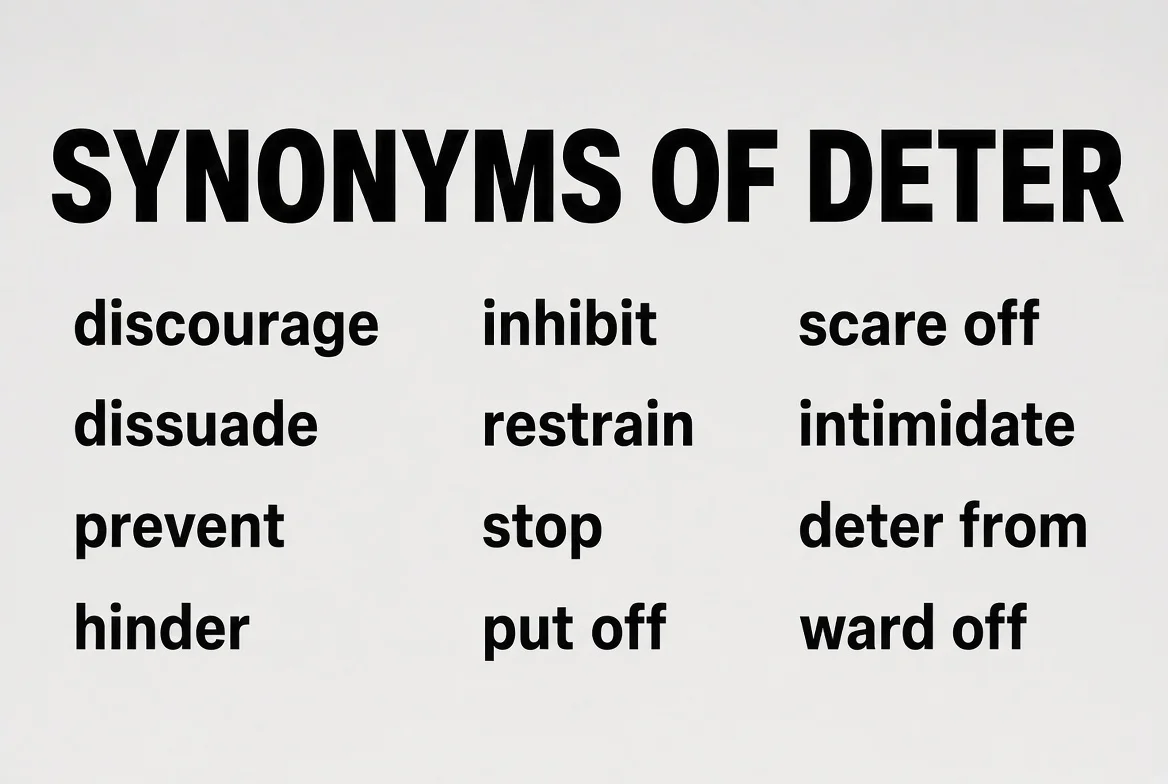
The closest synonyms for deter are discourage, dissuade, prevent, inhibit, hinder, restrain, intimidate, daunt, impede, and stop. However, they are not all exact replacements. Deter means to make someone less willing to do something, often because of danger, difficulty, cost, punishment, or an unpleasant result.
What Does Deter Mean?
Have you ever wanted to use the word deter but were unsure whether discourage, prevent, or dissuade would sound better? These words are related, but they do not always mean exactly the same thing.
Deter means to make someone decide not to do something or make them less willing to continue, usually because they expect difficulty, danger, cost, punishment, or another unpleasant result.
For example:
The high price deterred me from buying the laptop.
This means the price made me less willing to buy it. It does not necessarily mean that buying the laptop became impossible.
Learning the right synonyms for deter can make your English more precise. Students can improve essays, ESL learners can build vocabulary, and writers and professionals can avoid repeating the same word.
Deter: Pronunciation and Grammar
Word: deter
Part of speech: verb
British pronunciation: /dɪˈtɜː(r)/
American pronunciation: /dɪˈtɝː/
Pronounced: dih-TUR
Oxford lists deter as a verb and gives the main pattern as deter somebody from something/from doing something.
Verb Forms
- Present: deter
- Third person: deters
- Past: deterred
- Past participle: deterred
- -ing form: deterring
Common Grammar Pattern
deter + someone + from + noun/gerund
Examples:
- The warning deterred visitors from entering.
- High fees deter students from applying.
- Nothing deterred her from continuing.
Common Mistake
❌ The price deterred me to buy the phone.
✅ The price deterred me from buying the phone.
The preposition from is the key pattern to remember.
Synonyms for Deter at a Glance
| Synonym | Main idea | Register | Frequency |
| Discourage | Make less willing or confident | Neutral | Very common |
| Dissuade | Persuade someone not to act | Formal/Neutral | Common |
| Prevent | Stop something from happening | Neutral | Very common |
| Inhibit | Restrict or reduce an action/process | Formal/Academic | Common |
| Hinder | Make progress difficult | Neutral/Formal | Common |
| Restrain | Hold back or control | Formal/Neutral | Common |
| Intimidate | Make someone afraid to act | Neutral/Formal | Common |
| Daunt | Reduce courage or confidence | Literary/Formal | Uncommon |
| Impede | Slow or obstruct progress | Formal | Common |
| Stop | Bring an action to an end | Neutral | Very common |
| Thwart | Defeat a plan | Formal/Literary | Common |
| Block | Create a barrier | Neutral | Very common |
| Hamper | Make an activity harder | Formal/Neutral | Common |
| Curb | Control or reduce something | Formal/Business | Common |
| Constrain | Limit freedom or choices | Formal/Academic | Common |
| Put off | Make someone lose interest | Informal | Very common |
| Scare off | Make someone stay away through fear | Informal | Common |
| Hold back | Stop progress or action | Neutral/Spoken | Very common |
| Forbid | Officially say something is not allowed | Formal | Common |
| Prohibit | Officially prevent by rule or law | Formal/Legal | Common |
Cambridge lists discourage, hinder, prevent, dissuade, daunt, divert, stop, and impede among words related to deter. Collins similarly separates the word into senses connected with discouraging and preventing.
1. Discourage
Meaning: To make someone less willing, confident, or enthusiastic about doing something.
Examples:
- High costs may discourage people from starting a business.
- One poor result should not discourage you from trying again.
Best used when: You want the closest everyday alternative to deter.
Tone: Neutral
CEFR: B1-B2
Frequency: Very common
Nuance: Broader than deter. It can describe both practical and emotional effects.
Common collocations:
- discourage someone from
- discourage further attempts
- discourage bad behavior
When not to use it: Do not use discourage when you specifically mean that a physical barrier makes something impossible.
2. Dissuade
Meaning: To persuade someone not to do something.
Examples:
- Her friends tried to dissuade her from leaving early.
- I could not dissuade him from accepting the offer.
Best used when: Someone gives advice, reasons, or warnings to change another person’s decision.
Tone: Formal/Neutral
CEFR: B2-C1
Frequency: Common
Nuance: More focused on persuasion than deter.
Common collocations:
- dissuade someone from
- try to dissuade
- strongly dissuade
When not to use it: Do not use it simply because a high price or physical obstacle makes an action unattractive.
3. Prevent
Meaning: To stop something from happening.
Examples:
- Regular maintenance can prevent serious problems.
- The security system prevented anyone from entering.
Best used when: The main idea is that something was stopped.
Tone: Neutral
CEFR: B1
Frequency: Very common
Nuance: Usually stronger than deter.
Common collocations:
- prevent crime
- prevent accidents
- prevent someone from
When not to use it: If something only makes an action less likely, deter may be more accurate.
Compare:
- The fine deterred him from speeding.
- The police prevented him from entering.
4. Inhibit
Meaning: To make an action, process, or development less likely or less effective.
Examples:
- Fear can inhibit students from speaking in class.
- Poor conditions may inhibit plant growth.
Best used when: Discussing psychology, science, development, or formal processes.
Tone: Formal/Academic
CEFR: C1
Frequency: Common
Nuance: Often describes a restriction within a process rather than a simple decision.
Common collocations:
- inhibit growth
- inhibit development
- inhibit progress
When not to use it: It may sound too formal in everyday conversation.
5. Hinder
Meaning: To make something more difficult to do or make progress.
Examples:
- Heavy traffic hindered our progress.
- A lack of funding can hinder research.
Best used when: Something creates difficulty rather than directly changing someone’s decision.
Tone: Neutral/Formal
CEFR: B2
Frequency: Common
Nuance: Focuses on an obstacle.
Common collocations:
- hinder progress
- hinder development
- hinder efforts
When not to use it: Do not use hinder when the main idea is persuasion.
6. Restrain
Meaning: To hold someone or something back from acting freely.
Examples:
- The guards restrained the man.
- She restrained herself from making an angry reply.
Best used when: Physical control, self-control, or deliberate limitation is involved.
Tone: Formal/Neutral
CEFR: B2
Frequency: Common
Nuance: Stronger than ordinary discouragement.
Common collocations:
- restrain someone
- restrain yourself
- restrain spending
When not to use it: A high price can deter someone, but it does not normally restrain them.
7. Intimidate
Meaning: To frighten someone so that they become less willing to act.
Examples:
- The aggressive behavior intimidated the new employee.
- Do not let difficult questions intimidate you.
Best used when: Fear, threat, or perceived power causes hesitation.
Tone: Neutral/Formal
CEFR: B2
Frequency: Common
Nuance: Fear is central to this word.
Common collocations:
- intimidate someone
- intimidate people
- intimidate opponents
When not to use it: Do not use intimidate merely because something is expensive or inconvenient.
8. Daunt
Meaning: To make someone feel less confident about doing something difficult.
Examples:
- The size of the project did not daunt her.
- The difficult exam daunted some students.
Best used when: A difficult task affects someone’s courage or confidence.
Tone: Literary/Formal
CEFR: C1-C2
Frequency: Uncommon
Nuance: Emotional and confidence-related.
Common collocations:
- daunt someone
- a daunting task
- seem daunting
When not to use it: Do not use it for ordinary physical barriers.
9. Impede
Meaning: To slow down or make progress difficult.
Examples:
- Snow impeded traffic throughout the morning.
- Poor communication can impede teamwork.
Best used when: Talking about movement, progress, or development.
Tone: Formal/Academic
CEFR: C1
Frequency: Common
Nuance: More formal than hinder.
Common collocations:
- impede progress
- impede development
- impede movement
When not to use it: It is usually too formal for casual conversation.
10. Stop
Meaning: To cause an action or activity to end or not happen.
Examples:
- The warning did not stop him from entering.
- The barrier stopped people from crossing.
Best used when: You need simple, direct English.
Tone: Neutral
CEFR: A1-A2
Frequency: Very common
Nuance: Often stronger and more direct than deter.
When not to use it: Do not use stop when you only mean “make less likely.”
11. Thwart
Meaning: To prevent someone from achieving a plan or goal.
Examples:
- The security team thwarted the attempted theft.
- Bad weather thwarted our travel plans.
Best used when: An action successfully defeats someone’s plan.
Tone: Formal/Literary
CEFR: C1
Frequency: Common
Nuance: Stronger and more active than deter.
When not to use it: Do not use thwart when someone simply loses interest.
12. Block
Meaning: To stop movement, access, or progress.
Examples:
- A fallen tree blocked the road.
- Technical problems blocked access to the website.
Best used when: There is a physical, digital, or practical barrier.
Tone: Neutral
CEFR: B1
Frequency: Very common
Nuance: Usually describes an actual obstacle.
When not to use it: Do not use it as a direct replacement for deter when the issue is someone’s motivation.
13. Hamper
Meaning: To make an activity or task more difficult.
Examples:
- Bad weather hampered the rescue effort.
- Limited resources hampered the team’s progress.
Best used when: Something slows or complicates an effort.
Tone: Neutral/Formal
CEFR: B2-C1
Frequency: Common
Nuance: Usually means “make harder,” not “make impossible.”
When not to use it: Do not use hampers when persuasion or fear is the main idea.
14. Curb
Meaning: To control or reduce something unwanted.
Examples:
- The campaign aims to curb dangerous driving.
- New measures were introduced to curb excessive spending.
Best used when: The goal is to reduce unwanted behavior or activity.
Tone: Formal/Business
CEFR: C1
Frequency: Common
Nuance: Focuses on control and reduction.
When not to use it: Do not use curb simply to mean “persuade one person not to do something.”
15. Constrain
Meaning: To limit someone’s freedom, choices, or ability to act.
Examples:
- Limited funds constrained the project.
- The strict rules constrained the team’s options.
Best used when: Rules, resources, or circumstances limit choices.
Tone: Formal/Academic
CEFR: C1
Frequency: Common
Nuance: Strong focus on limitation.
When not to use it: It is not the natural choice when someone merely changes their mind.
16. Put Off
Meaning: To make someone lose interest or enthusiasm.
Examples:
- The long waiting time put me off visiting the restaurant.
- Do not let one mistake put you off learning English.
Best used when: Speaking casually about losing interest.
Tone: Informal
CEFR: B1
Frequency: Very common
Nuance: Often milder and more conversational than deter.
When not to use it: Avoid it in highly formal writing when discourage or deter is clearer.
17. Scare Off
Meaning: To make someone stay away because of fear.
Examples:
- The barking dog scared off the visitors.
- High prices may scare off some customers.
Best used when: Fear makes someone leave or avoid something.
Tone: Informal
CEFR: B1-B2
Frequency: Common
Nuance: More vivid and informal than deter.
When not to use it: Do not use it when fear is not involved.
18. Hold Back
Meaning: To prevent someone or something from moving forward or making progress.
Examples:
- Fear held him back from applying for the job.
- A lack of experience held the team back.
Best used when: Talking about progress, confidence, or personal development.
Tone: Neutral/Spoken
CEFR: B1
Frequency: Very common
Nuance: Natural in conversation.
When not to use it: It may sound too informal for some academic contexts.
19. Forbid
Meaning: To officially order someone not to do something.
Examples:
- School rules forbid students from using phones during exams.
- The building rules forbid smoking indoors.
Best used when: An authority clearly says something is not allowed.
Tone: Formal
CEFR: B2
Frequency: Common
Nuance: Stronger and more official than deter.
When not to use it: A warning may deter someone, but it does not necessarily forbid the action.
20. Prohibit
Meaning: To officially prevent something through a rule or law.
Examples:
- The law prohibits smoking inside public buildings.
- Company policy prohibits employees from sharing passwords.
Best used when: Legal, official, or organizational rules are involved.
Tone: Formal/Legal
CEFR: B2-C1
Frequency: Common
Nuance: Strong official restriction.
When not to use it: Do not use it merely because something makes an action unattractive.
Strongest Synonyms for Deter
Not every synonym has the same force. This is one of the most important distinctions for learners.
Closest everyday alternatives
Discourage and dissuade are usually the most useful alternatives when the sentence is about changing someone’s willingness to act.
Stronger stopping words
Prevent, stop, prohibit, forbid, and thwart can imply that the action is actually stopped or officially banned.
Obstacle words
Hinder, impede, hamper, and block focus more on making an action or process difficult.
Fear and confidence words
Intimidate focuses on fear, while daunt focuses on courage or confidence.
Deter vs. Discourage vs. Dissuade vs. Prevent
| Word | Core meaning | Example |
| Deter | Make an action less likely because of risk, cost, difficulty, or consequences | The fine deterred drivers from speeding. |
| Discourage | Make someone less willing, confident, or enthusiastic | The criticism discouraged her. |
| Dissuade | Persuade someone not to act | Her friend dissuaded her from quitting. |
| Prevent | Stop something from happening | The barrier prevented entry. |
The easiest rule
Ask yourself:
Did something make the person less willing?
→ deter
Did someone persuade the person not to do it?
→ dissuade
Did something reduce confidence or enthusiasm?
→ discourage
Was the action actually stopped?
→ prevent
Commonly Confused Words
Deter vs. Delay
Deter means make someone less likely to act.
Delay means making something happen later.
- The high cost deterred customers.
- Heavy traffic delayed customers.
Do not use them interchangeably.
Deter vs. Avoid
Deter describes something that influences a person not to act.
Avoid describing the person’s own action of staying away.
- The warning deterred us from entering.
- We avoided the dangerous road.
Deter vs. Discourage
These overlap strongly, but discourage has a wider emotional meaning.
- The price deterred him from buying it.
- The criticism discouraged him.
The second sentence focuses more on his feelings.
Deter vs. Inhibit
Inhibit often describes something that limits a process or behavior.
- Fear inhibited her performance.
- The high cost deterred her from applying.
Deter vs. Prohibit
Prohibit means officially ban.
- The warning deterred people from entering.
- The law prohibited entry.
Common Mistakes With Deter
Common Mistake Box
Mistake 1
❌ The high price deterred me to buy it.
✅ The high price deterred me from buying it.
Mistake 2
❌ The law deterred smoking in the building.
✅ The law prohibited smoking in the building.
Why? If the rule makes an activity illegal or officially forbidden, prohibit is more precise.
Mistake 3
❌ The traffic deterred our arrival by two hours.
✅ The traffic delayed our arrival by two hours.
Why? Traffic caused a time delay, not a change in willingness.
Mistake 4
❌ I deterred the problem.
✅ I prevented the problem.
Why? A person usually deters someone from doing something. You generally do not “deter a problem.”
Mistake 5
❌ She was not deterred to continue.
✅ She was not deterred from continuing.
The from + -ing pattern is important.
Natural Collocations With Deter
Learning collocations can help you sound more natural than memorizing isolated synonyms.
Common combinations include:
- deter crime
- deter criminals
- deter theft
- deter violence
- deter attacks
- deter people from
- deter someone from acting
- deter potential buyers
- deter customers
- deter future offenses
- effectively deter
- successfully deter
- harsh penalties deter
- high costs deter
- security measures deter
- warnings deter
Oxford specifically lists patterns such as be likely to deter, be unlikely to deter, and be enough to deter, as well as the preposition from.
Natural sentence patterns
- The warning was enough to deter them.
- The high cost could deter potential buyers.
- Nothing could deter her from completing the project.
- Security cameras may deter theft.
- The policy is designed to deter people from breaking the rules.
Word Origin and First Known Use
Deter comes from the Latin deterrere, meaning “to frighten away.” Oxford traces the English word to the mid-16th century. The Latin form combines de-, meaning “away from,” with terrere, meaning “to frighten.”
This origin helps explain an important part of the modern meaning. Something that deters a person can create fear or concern about what might happen next.
Modern English, however, uses deter more broadly. A person can be deterred by:
- high prices
- difficult requirements
- possible punishment
- danger
- bad results
- inconvenience
- social pressure
So fear is not required in every modern use.
American vs. British English
The spelling is the same in American and British English:
deter
The pronunciation differs slightly:
- British: /dɪˈtɜː(r)/
- American: /dɪˈtɝː/
Both varieties commonly use:
deter someone from doing something
Examples:
- British: “The cost deterred many people from applying.”
- American: “The cost deterred many people from applying.”
Cambridge provides both UK and US pronunciations and gives examples of the same core grammar pattern.
CEFR and Learner Guidance
For practical learner use, deter is best treated as an upper-intermediate to advanced vocabulary item. Related words vary widely in difficulty.
| Word | Approx. learner level | Learning priority |
| Stop | A1-A2 | Essential |
| Prevent | B1 | Essential |
| Discourage | B1-B2 | Very useful |
| Hold back | B1 | Very useful |
| Deter | B2-C1 | Useful |
| Dissuade | B2-C1 | Useful |
| Hinder | B2 | Useful |
| Restrain | B2 | Useful |
| Intimidate | B2 | Useful |
| Inhibit | C1 | Advanced |
| Impede | C1 | Advanced |
| Constrain | C1 | Advanced |
| Daunt | C1-C2 | Specialized |
| Thwart | C1 | Advanced |
CEFR classifications can vary between word lists and meanings, so these levels should be used as practical guidance rather than universal official ratings.
How to Choose the Right Synonym
When you want to replace deter, ask what exactly caused the person not to act.
Cost or risk
Use deter or discourage.
High fees deter many students from applying.
Advice or persuasion
Use dissuade.
Her parents dissuaded her from leaving.
Complete prevention
Use prevent.
The barrier prevented access.
Fear
Use intimidate or scare off.
The aggressive behavior intimidated the visitors.
Difficult task
Use daunt.
The size of the project did not daunt him.
Progress becomes difficult
Use hinder, impede, or hamper.
Poor communication hindered progress.
Official rule
Use forbid or prohibit.
The law prohibits smoking indoors.
This approach is more useful than simply memorizing a thesaurus list because it tells you why one word fits better than another.
Writing Tips for Different Contexts
Academic Essays
Prefer precise words such as:
- deter
- discourage
- inhibit
- prevent
- impede
- constrain
Example:
High tuition fees may deter students from pursuing higher education.
Professional Emails
Use clear, neutral language.
The additional cost may discourage some customers.
Avoid unnecessarily difficult words when a simple one works.
Blog Posts
Use deter when it sounds natural, but choose discourage for beginner audiences.
A complicated checkout process can discourage new customers.
Stories
Use stronger emotional vocabulary when appropriate:
- daunt
- intimidate
- frighten
- scare off
Daily Conversation
Prefer common expressions:
- stop
- discourage
- put off
- hold back
- scare off
Antonyms of Deter
The opposite depends on the context.
Common antonyms include:
- encourage
- motivate
- inspire
- persuade
- urge
- support
- promote
- facilitate
- allow
- permit
Compare:
High costs deter customers.
Discounts encourage customers.
Word Family
Deter
Verb: to discourage or prevent an action.
Deterrent
Noun: something that discourages an action.
The alarm acts as a deterrent to theft.
Deterrence
Noun: the practice or effect of discouraging an action.
The policy was intended to provide deterrence.
Deterred
Past form/adjective use: no longer willing to act because of a difficulty or consequence.
She was not deterred by the criticism.
Undeterred
Adjective: continuing despite difficulty or opposition.
He remained undeterred by the setback.
Mini Practice
Fill in the Blanks
Choose to deter, dissuade, prevent, discourage, or prohibit.
- The high price may ______ customers from buying the product.
- Her advice failed to ______ him from taking the risk.
- The lock helped ______ unauthorized entry.
- The teacher’s kind words did not ______ the student.
- Company rules ______ employees from sharing confidential information.
Sentence Rewriting
Replace the bold phrase with a suitable synonym.
- The difficult conditions made progress harder.
- Her parents persuaded her not to travel alone.
- The warning made visitors less willing to enter.
- The law officially banned the activity.
Answers
- deter
- dissuade
- prevent
- discourage
- prohibit
Possible rewriting answers:
- The difficult conditions hindered progress.
- Her parents dissuaded her from traveling alone.
- The warning deterred visitors from entering.
- The law prohibited the activity.
Frequently Asked Questions
What is the closest synonym for deter?
Discourage is often the closest everyday synonym for deter. However, the best alternative depends on context. Use dissuade when persuasion is involved, prevent when something is stopped, and intimidate when fear causes hesitation. Cambridge lists several of these words as related synonyms.
What is another word for deter in an essay?
Useful formal alternatives include discourage, dissuade, inhibit, impede, restrain, prevent, and constrain. The correct choice depends on your intended meaning. Inhibit suits processes, dissuade suits persuasion, and prevent suits completely stopping.
What is the difference between deter and discourage?
Deter usually means making someone less likely to take an action because of a risk, cost, difficulty, or unpleasant consequence. Discourage is broader and can also mean reducing someone’s confidence, enthusiasm, or hope.
What is the difference between deter and prevent?
Deter often means making an action less likely, while preventing means stopping it from happening. For example, a fine may deter someone from speeding, while a physical barrier may prevent a car from entering an area.
Is deter a positive or negative word?
The verb deter describes discouraging or preventing an action, so its direct meaning is restrictive. The result can still be beneficial. For example, security systems may deter theft, and safety warnings may deter dangerous behavior.
What preposition is used with deter?
The most common construction is to deter someone from doing something. For example: “The high price deterred her from buying the car.” Oxford specifically lists form as the common preposition used with deter.
Is dissuade stronger than deter?
Not necessarily. Dissuade is more specific because it usually involves persuasion or advice. Deter is broader and can involve cost, danger, difficulty, punishment, fear, or other unpleasant consequences.
Can deter mean prevent?
Yes, in some contexts, but the words are not always interchangeable. Deter often focuses on changing someone’s willingness to act, while prevent focuses on stopping the action itself. Cambridge recognizes both preventive and discouraging aspects of deter.
Final Takeaway
The best synonym for deter depends on the exact situation. Use discourage for general loss of willingness or enthusiasm, dissuade for persuasion, prevent for stopping something, inhibit for restriction, hinder or impede for difficulty, and intimidate when fear is central.
Do not choose a synonym only because it appears in a thesaurus. Check its meaning, strength, register, collocations, and grammar pattern first. That small habit will make your English more natural and precise in essays, emails, professional writing, and everyday conversation.
Trusted References
- Oxford Learner’s Dictionaries, deter.
- Cambridge Dictionary, deter.
- Cambridge English Thesaurus, deter.
- Collins English Thesaurus, deter.
- Thesaurus.com, deter synonyms and antonyms.

Synonorm is a trusted English vocabulary resource created to help readers find the right words and understand the differences between similar terms. We provide clear explanations of synonyms, meanings, examples, usage, and alternatives. Our content makes vocabulary easier to learn and apply in everyday, academic, and professional English. Synonorm is designed for students, writers, ESL learners, professionals, and anyone who wants to improve their English vocabulary and communicate more clearly.