Quick Answer
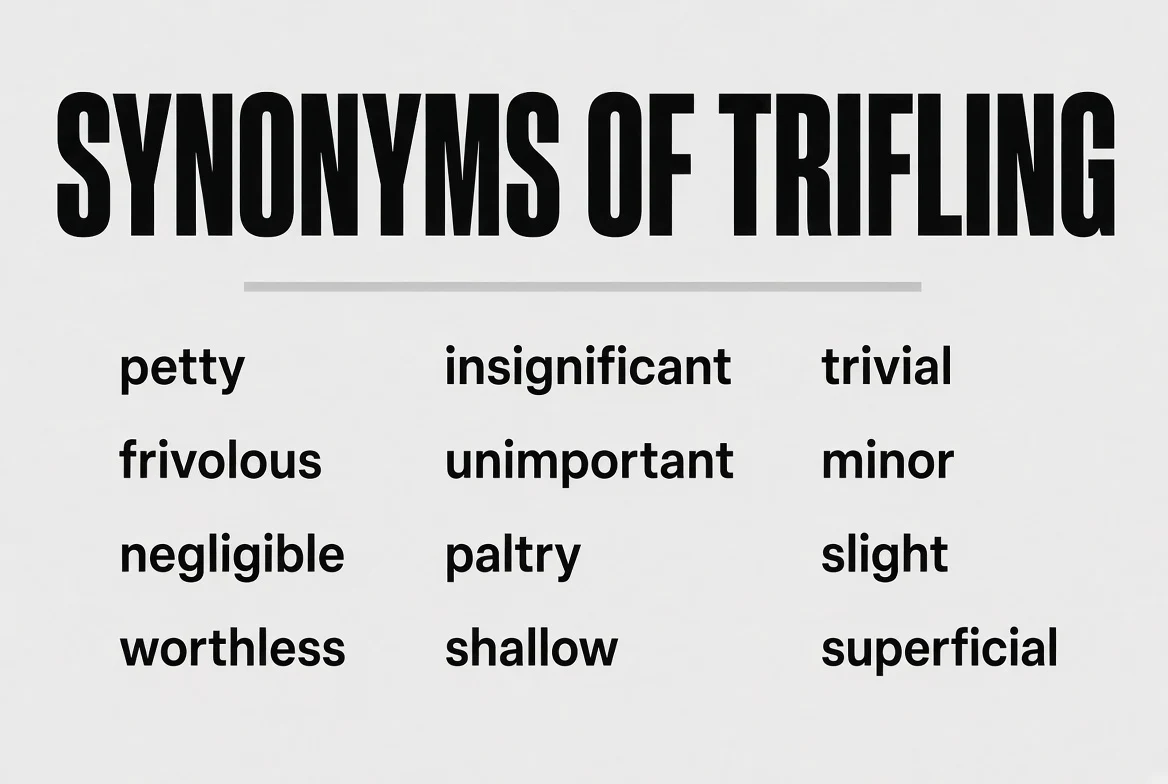
The best synonyms of trifling are insignificant, trivial, unimportant, negligible, inconsequential, minor, slight, petty, paltry, frivolous, piddling, piffling, inconsiderable, immaterial, irrelevant, meaningless, measly, puny, worthless, and niggling. The best choice depends on context. Use negligible for a very small effect, petty for small-minded disputes, and frivolous for something unserious.
What Does Trifling Mean?
Have you ever needed a word for something that is so small or unimportant that it hardly deserves attention? Trifling is one useful word for that idea.
A trifling matter has little importance. A trifling amount is very small, especially when compared with what might normally be expected. Oxford defines trifling as “small and not important” and marks it as a formal adjective.
For example:
The manager did not want to waste time on a trifling complaint.
Here, trifling tells us that the complaint was not important enough to deserve much attention.
The word can also describe money:
They argued over a trifling sum.
Cambridge specifically uses trifling for a matter or amount of money that is small or unimportant.
This makes trifling useful in essays, formal writing, professional communication, and literary English. However, not every synonym works in every sentence. That is why understanding the small differences between these words matters.
Trifling Pronunciation
IPA: /ˈtraɪ.flɪŋ/
Say it like: TRY-fling
Cambridge gives the same basic pronunciation for British and American English.
Part of Speech
Trifling is primarily an adjective.
It normally comes before a noun:
- a trifling matter
- a trifling sum
- a trifling detail
- a trifling problem
- a trifling amount
Oxford’s collocation information specifically highlights trifling matter and trifling sum as natural combinations.
Related Forms
The base word is trifle.
- trifle — noun/verb
- trifling — adjective or participle form
- trifled — past form of the verb
- trifles — plural noun or third-person verb
The noun trifle can mean a thing of little value or importance. It also has an unrelated modern meaning as a British dessert.
Grammar and Usage
The most useful pattern is:
trifling + noun
Examples:
- a trifling matter
- a trifling amount of money
- a trifling error
- a trifling concern
- a trifling difference
A Useful Distinction
Do not confuse small with trifling.
Small mainly describes size or amount.
She bought a small bag.
Trifling usually adds the idea that something has little importance or value.
They argued over a trifling matter.
You can also say:
The difference was trifling.
This means the difference was so small or unimportant that it did not matter much.
Synonyms of Trifling at a Glance
| Synonym | Main Meaning | Register | Frequency |
| Insignificant | Not important | Neutral/Formal | Very common |
| Trivial | Not worth serious attention | Neutral/Formal | Very common |
| Unimportant | Lacking importance | Neutral | Very common |
| Negligible | Almost too small to matter | Formal/Academic | Common |
| Inconsequential | Having little effect | Formal | Common |
| Minor | Small in seriousness or degree | Neutral | Very common |
| Slight | Small in degree | Neutral | Very common |
| Petty | Small and unnecessarily important to someone | Neutral/Critical | Common |
| Paltry | Small and disappointing | Formal/Literary | Uncommon |
| Frivolous | Not serious or sensible | Formal/Neutral | Common |
| Piddling | Very small or unimportant | Informal | Uncommon |
| Piffling | Very small or unimportant | Informal, often BrE | Rare |
| Inconsiderable | Not worth considering | Formal | Uncommon |
| Immaterial | Not relevant or important | Formal | Common |
| Irrelevant | Not connected to the main issue | Formal/Neutral | Very common |
| Meaningless | Without useful meaning or significance | Neutral | Common |
| Measly | Too small and disappointing | Informal | Common |
| Puny | Small and weak | Neutral | Common |
| Worthless | Having no value | Neutral | Common |
| Niggling | Small but annoying | Neutral/Informal | Uncommon |
20 Useful Synonyms of Trifling
1. Insignificant
Meaning: Not important enough to matter.
Examples:
- The error was insignificant and did not affect the results.
- She ignored the insignificant detail.
Best used when: You want a broad and reliable synonym for something lacking importance.
Register: Neutral/Formal
Learner level: B2
Frequency: Very common
Common collocations:
- insignificant detail
- insignificant amount
- insignificant difference
Nuance: This is one of the safest replacements for trifling when importance is the main idea.
When not to use it: Do not use it when you specifically mean “silly” or “petty.”
2. Trivial
Meaning: Too unimportant to deserve serious attention.
Examples:
- They spent the morning discussing a trivial problem.
- The mistake may seem trivial, but it delayed the project.
Best used when: Something is not serious or important.
Register: Neutral/Formal
Learner level: B2
Frequency: Very common
Common collocations:
- trivial matter
- trivial issue
- trivial mistake
Nuance: Trivial often suggests that someone is giving too much attention to something unimportant.
3. Unimportant
Meaning: Not important.
Examples:
- The missing document was unimportant to the final decision.
- Try not to worry about unimportant details.
Best used when: You want the simplest and clearest alternative.
Register: Neutral
Learner level: B1
Frequency: Very common
Common collocations:
- unimportant detail
- unimportant matter
- unimportant issue
Nuance: It is less expressive than trifling but very easy for ESL learners to use correctly.
4. Negligible
Meaning: So small that it has almost no effect or importance.
Examples:
- The repair caused a negligible increase in cost.
- The difference between the two figures was negligible.
Best used when: Discussing costs, effects, differences, risks, or amounts.
Register: Formal/Academic/Business
Learner level: C1
Frequency: Common
Common collocations:
- negligible effect
- negligible cost
- negligible difference
Nuance: Negligible is stronger and more precise than small.
Cambridge specifically lists negligible as a synonym of trifling.
5. Inconsequential
Meaning: Having little or no important effect.
Examples:
- The mistake was inconsequential.
- They argued about an inconsequential detail.
Best used when: The focus is on consequences or results.
Register: Formal/Academic
Learner level: C1
Frequency: Common
Common collocations:
- inconsequential detail
- inconsequential error
- inconsequential matter
Nuance: This word focuses more on the effect of something than its physical size.
6. Minor
Meaning: Small in importance, seriousness, or degree.
Examples:
- The doctor said the injury was minor.
- We made a few minor changes to the report.
Best used when: You want a natural word for a small problem, change, or issue.
Register: Neutral/Formal
Learner level: B1
Frequency: Very common
Common collocations:
- minor problem
- minor change
- minor issue
Nuance: Minor sounds less judgmental than trivial.
7. Slight
Meaning: Small in degree or amount.
Examples:
- There was a slight difference between the results.
- We noticed a slight increase in sales.
Best used when: Talking about a small change, difference, or amount.
Register: Neutral
Learner level: B1
Frequency: Very common
Common collocations:
- slight increase
- slight difference
- slight change
Nuance: Slight describes degree more than importance.
8. Petty
Meaning: Concerned with small matters in an unreasonable or small-minded way.
Examples:
- Their petty argument lasted for hours.
- The manager was tired of dealing with petty complaints.
Best used when: Describing arguments, complaints, behavior, or disputes.
Register: Neutral/Critical
Learner level: B2
Frequency: Common
Common collocations:
- petty argument
- petty dispute
- petty complaint
Nuance: This word carries a negative judgment. A trifling matter is simply unimportant, but a petty argument often suggests unnecessary behavior.
9. Paltry
Meaning: Very small and disappointing in amount or value.
Examples:
- The workers received a paltry reward.
- They offered him a paltry sum for the work.
Best used when: A small amount seems unfair or disappointing.
Register: Formal/Literary
Learner level: C1
Frequency: Uncommon
Common collocations:
- paltry sum
- paltry amount
- paltry reward
Nuance: Paltry often carries a stronger emotional sense of disappointment.
Cambridge lists paltry as a direct synonym of trifling.
10. Frivolous
Meaning: Not serious, sensible, or worthy of serious attention.
Examples:
- The court rejected the frivolous claim.
- They spent the meeting on frivolous topics.
Best used when: Talking about claims, arguments, activities, or behavior that lack seriousness.
Register: Formal/Neutral
Learner level: C1
Frequency: Common
Common collocations:
- frivolous claim
- frivolous lawsuit
- frivolous activity
Nuance: Frivolous is about lack of seriousness, not simply small physical size.
11. Piddling
Meaning: Very small, petty, or unimportant.
Examples:
- They were arguing over a piddling amount of money.
- The company should not waste time on such a piddling issue.
Best used when: You want an informal way to criticize something as too small to matter.
Register: Informal
Learner level: C1
Frequency: Uncommon
Common collocations:
- piddling amount
- piddling sum
- piddling issue
Collins includes piddling among the synonyms associated with trifling and petty.
12. Piffling
Meaning: Extremely small or unimportant.
Examples:
- They wasted time over a piffling detail.
- The disagreement involved a piffling sum.
Best used when: You want a playful or informal word, especially in British English.
Register: Informal/BrE
Learner level: C1
Frequency: Rare
When not to use it: Avoid it in formal academic writing unless you deliberately want a light or humorous style.
13. Inconsiderable
Meaning: Too small or unimportant to deserve much consideration.
Examples:
- The difference was inconsiderable.
- The additional expense was inconsiderable compared with the total cost.
Best used when: Writing in a formal or literary style.
Register: Formal
Learner level: C1
Frequency: Uncommon
Nuance: It is close to negligible but can sound more literary.
Collins groups inconsiderable with trifling in the sense of something not worth considering.
14. Immaterial
Meaning: Not important or relevant to the matter being discussed.
Examples:
- The distinction is immaterial to our decision.
- His personal opinion was immaterial to the investigation.
Best used when: Something does not affect the main issue.
Register: Formal/Legal/Academic
Learner level: C1
Frequency: Common
Common collocations:
- immaterial detail
- immaterial fact
- immaterial difference
Nuance: Immaterial often means “not relevant,” so it is not a perfect replacement for every use of trifling.
15. Irrelevant
Meaning: Not connected with the subject or problem being considered.
Examples:
- That detail is irrelevant to the question.
- The witness gave several irrelevant comments.
Best used when: The main idea is lack of relevance.
Register: Neutral/Formal
Learner level: B1–B2
Frequency: Very common
Nuance: Something can be irrelevant without being small or unimportant in general.
16. Meaningless
Meaning: Having little or no useful meaning, purpose, or significance.
Examples:
- Without context, the number is meaningless.
- They were having a meaningless argument.
Best used when: The problem is lack of significance rather than physical size.
Register: Neutral/Formal
Learner level: B2
Frequency: Common
When not to use it: Do not use it simply to mean “small.”
17. Measly
Meaning: Very small and disappointing.
Examples:
- He earned a measly amount for the extra work.
- They gave us a measly discount.
Best used when: Speaking informally about an amount that feels unfairly small.
Register: Informal
Learner level: B2
Frequency: Common
Common collocations:
- measly amount
- measly sum
- measly payment
Nuance: This word often shows annoyance.
18. Puny
Meaning: Small and weak.
Examples:
- The team had only a puny budget.
- Their puny effort was not enough to solve the problem.
Best used when: Something is both small and weak.
Register: Neutral/Informal
Learner level: B2
Frequency: Common
Nuance: Puny adds the idea of weakness, so it is not an exact synonym in every context.
19. Worthless
Meaning: Having no value or usefulness.
Examples:
- The damaged ticket was worthless.
- The broken equipment was practically worthless.
Best used when: You specifically mean lack of value.
Register: Neutral
Learner level: B1
Frequency: Common
Important nuance: Worthless is usually stronger than trifling. Something can be trifling without being completely worthless.
20. Niggling
Meaning: Small and annoying, especially because it keeps attracting attention.
Examples:
- A niggling error remained in the final report.
- She had a few niggling concerns about the plan.
Best used when: Something is minor but repeatedly bothers you.
Register: Neutral/Informal
Learner level: C1
Frequency: Uncommon
Nuance: This is one of the most useful context-specific alternatives because it adds the idea of persistent annoyance.
Strongest Synonyms vs Related Synonyms
Not every word above is an equal replacement.
Closest General Synonyms
- insignificant
- trivial
- unimportant
- minor
- negligible
For Very Small Amounts
- negligible
- paltry
- measly
- piddling
- piffling
For Petty Behavior or Arguments
- petty
- trivial
- frivolous
- niggling
For Lack of Relevance
- immaterial
- irrelevant
- inconsequential
For Lack of Value
- paltry
- worthless
- measly
Choose the Right Synonym
| If you want to say… | Choose… | Example |
| Not important | insignificant | An insignificant detail |
| Not worth serious attention | trivial | A trivial complaint |
| Almost too small to matter | negligible | A negligible effect |
| Small problem | minor | A minor error |
| Small difference | slight | A slight difference |
| Small-minded dispute | petty | A petty argument |
| Disappointingly small amount | paltry | A paltry reward |
| Not serious | frivolous | A frivolous claim |
| Small and annoying | niggling | A niggling concern |
| Not relevant | irrelevant | An irrelevant detail |
| Not relevant to the decision | immaterial | An immaterial fact |
| No value | worthless | A worthless object |
Quick Tip: Before choosing a synonym, ask yourself: “Am I talking about importance, amount, seriousness, relevance, value, or behavior?”
That one question will prevent many synonym mistakes.
Trifling vs Trivial vs Insignificant vs Negligible
These four words are especially close.
Trifling
Focuses on something being small or unimportant.
They argued over a trifling matter.
Trivial
Focuses on something being too unimportant to deserve serious attention.
It was a trivial complaint.
Insignificant
Focuses on something lacking importance or influence.
The difference was insignificant.
Negligible
Focuses on something being so small that it can almost be ignored.
The additional cost was negligible.
Simple Rule
Trifling = small/unimportant
Trivial = not worth serious attention
Insignificant = lacking importance
Negligible = almost too small to matter
Trifling vs Petty
These words overlap, but they are not identical.
Trifling matter
They were arguing about a trifling matter.
This simply says the matter was unimportant.
Petty argument
They were involved in a petty argument.
This suggests that the argument was unnecessarily focused on something small.
So, petty carries more criticism of behavior.
Trifling vs Frivolous
Trifling can mean unimportant or small.
Frivolous means lacking seriousness, sensible purpose, or proper justification.
Compare:
The amount was trifling.
The amount was very small.
The complaint was frivolous.
The complaint was not serious or properly justified.
Common Mistakes
Common Mistake Box
Mistake 1: Using “tiny” for every meaning of trifling
Wrong idea:
Tiny and trifling always mean the same thing.
Better:
Use tiny mainly for physical size. Use trifling when importance or value is the main idea.
Mistake 2: Treating “worthless” as an exact replacement
Problem:
Worthless means having no value, which is stronger.
Better:
Use trifling for something small or unimportant and worthless when it has no useful value.
Mistake 3: Using “frivolous” for small physical objects
Wrong:
A frivolous box.
Better:
A tiny box.
Frivolous normally describes behavior, claims, activities, arguments, or ideas that lack seriousness.
Mistake 4: Using “petty” without understanding its negative tone
A petty dispute is not just a small dispute. It often suggests unnecessary or small-minded behavior.
Mistake 5: Using “negligible” in casual situations where “small” is clearer
Negligible works especially well with measurable effects, costs, differences, and risks.
American vs British English
Trifling has the same spelling in American and British English.
Cambridge gives /ˈtraɪ.flɪŋ/ for both varieties.
The word is generally more formal than everyday alternatives such as small, minor, or unimportant. Oxford marks it as formal in both its standard and American entries.
Some related words have stronger regional associations:
- piffling — especially associated with British English
- measly — common in both varieties
- nickel-and-dime — especially American informal English
Collins also separates its British and American thesaurus results, with the American list being narrower for trifling.
Word Origin and Etymology
Trifling comes from the verb trifle.
Etymonline records trifling as an adjective from around 1400, originally carrying senses connected with cheating or feigning. By the 1530s it had developed the sense of lacking depth or earnestness.
The noun and verb trifle are older. Cambridge records trifle as a noun meaning a matter or object of little value or importance.
This history helps explain why modern trifling can refer to things that are:
- unimportant
- small in value
- lacking seriousness
- petty
- frivolous
CEFR and Learner Guidance
CEFR labels should be treated as practical learner guidance, not as absolute official classifications for every dictionary word.
For most ESL learners:
Easier Choices
- small
- minor
- slight
- unimportant
- irrelevant
Intermediate Choices
- insignificant
- trivial
- petty
- meaningless
- worthless
- measly
Advanced Choices
- negligible
- inconsequential
- paltry
- frivolous
- immaterial
- inconsiderable
- piddling
- piffling
- niggling
If you are writing for a general audience, minor, unimportant, insignificant, and trivial are usually safer choices than rare words.
Natural Collocations With Trifling
One way to sound more natural is to learn common word combinations.
Useful collocations include:
- trifling matter
- trifling sum
- trifling amount
- trifling detail
- trifling error
- trifling concern
- trifling difference
- trifling expense
- trifling problem
- trifling issue
Oxford specifically identifies trifling matter and trifling sum as collocations.
Cambridge’s corpus examples also show natural uses such as trifling matters, trifling criticisms, and trifling demands.
How to Use Trifling in Different Types of Writing
Academic Writing
Prefer:
- insignificant
- negligible
- inconsequential
- immaterial
Example:
The observed difference was negligible.
Business Writing
Prefer:
- minor
- negligible
- marginal
- insignificant
Example:
The change produced only a marginal improvement.
Professional Emails
Use:
There is one minor issue that needs attention.
This sounds more natural and less judgmental than:
There is one trifling issue.
Creative Writing
Trifling can create a more formal or literary tone:
He refused to let a trifling disagreement destroy their friendship.
Everyday Conversation
Use simpler words:
It’s a small problem.
or
It’s not important.
These are usually more natural in casual speech.
Antonyms of Trifling
The opposite depends on the context.
Opposite of “unimportant”
- important
- significant
- major
- crucial
- consequential
Opposite of “small in amount”
- substantial
- considerable
- large
- sizeable
Opposite of “not serious”
- serious
- substantial
- meaningful
- consequential
Practice Exercises
Fill in the Blanks
Choose from:
negligible, petty, paltry, minor, frivolous
- The company made only a ______ change to the policy.
- The two neighbors had a ______ argument over parking.
- The extra cost was ______ compared with the total budget.
- The court dismissed the ______ claim.
- The workers complained about the ______ payment.
Answers
- minor
- petty
- negligible
- frivolous
- paltry
Rewrite the Sentence
Replace trifling with the most precise synonym.
1.
The difference was trifling.
Possible answer:
The difference was negligible.
2.
They had a trifling argument.
Possible answer:
They had a petty argument.
3.
He received a trifling payment.
Possible answer:
He received a paltry payment.
4.
It was a trifling problem.
Possible answer:
It was a minor problem.
Matching Exercise
Match each word with its meaning.
- Negligible
- Petty
- Paltry
- Frivolous
- Niggling
A. Small and disappointing
B. Small and annoying
C. Almost too small to matter
D. Unnecessarily concerned with a small matter
E. Not serious or sensible
Answers:
1-C
2-D
3-A
4-E
5-B
FAQ: Synonyms of Trifling
What are the best synonyms of trifling?
The most useful general synonyms are insignificant, trivial, unimportant, minor, and negligible. For a small amount, paltry or measly may work better. For a petty dispute, petty is more precise. For an unserious claim or activity, frivolous is usually better.
What is the easiest synonym for trifling?
Unimportant is probably the easiest direct alternative for ESL learners. Small can also work when you are talking about an amount, but it does not always express the idea of low importance.
Is trivial a synonym for trifling?
Yes. Trivial is one of the closest synonyms when trifling means something that is unimportant or not worth serious attention. However, trifling can also describe a very small amount of money, while trivial does not always carry that exact meaning.
Is negligible the same as trifling?
They can overlap. Negligible means so small or unimportant that it can almost be ignored. It is especially common with costs, effects, risks, differences, and amounts. Cambridge lists negligible as a synonym of trifling.
Is trifling a negative word?
It can be mildly negative because it often dismisses something as unimportant. However, the tone depends on context. Calling an amount trifling may simply describe its size, while calling someone’s argument trifling can sound dismissive.
What is the opposite of trifling?
Common opposites include important, significant, substantial, major, serious, considerable, and consequential. The correct opposite depends on the sentence. A trifling expense can have a substantial opposite, while a trifling issue can have a serious one.
Is trifling formal English?
Yes. Oxford labels trifling as a formal adjective meaning “small and not important.” It is still used in modern English, especially in formal, literary, and written contexts.
What is the difference between trifling and petty?
Trifling describes something as small or unimportant. Petty often adds criticism of a person’s attitude or behavior. A trifling matter is unimportant, while a petty argument suggests that people are behaving unnecessarily over a small issue.
Final Takeaway
The best synonyms of trifling depend on the exact meaning you want. Use insignificant for something lacking importance, trivial for something not worth serious attention, negligible for something almost too small to matter, minor for a small problem, petty for small-minded disputes, and paltry for a disappointingly small amount.
Do not treat synonyms as interchangeable labels. Learning their differences will help you write clearer essays, better emails, stronger blog posts, and more natural English. Practice each word in a real sentence, and your vocabulary will become more precise over time.
Trusted References
- Cambridge Dictionary, trifling: definition, pronunciation, synonyms, and corpus examples.
- Oxford Advanced Learner’s Dictionary, trifling: definition, formal register, pronunciation, and collocations.
- Collins English Thesaurus, trifling: sense-based synonym groups and British/American usage.
- Etymonline, trifling: historical development and etymology.
- YourDictionary Thesaurus, trifling: additional synonym coverage for comparison.

Synonorm is a trusted English vocabulary resource created to help readers find the right words and understand the differences between similar terms. We provide clear explanations of synonyms, meanings, examples, usage, and alternatives. Our content makes vocabulary easier to learn and apply in everyday, academic, and professional English. Synonorm is designed for students, writers, ESL learners, professionals, and anyone who wants to improve their English vocabulary and communicate more clearly.