Quick Answer: What Are Synonyms for Gangsters?
Common synonyms for gangster include mobster, hoodlum, thug, racketeer, crook, and bandit. A mobster is usually linked to organized crime, while a thug is known for violence or intimidation. A racketeer earns money through illegal schemes. The best synonym depends on the person’s role, actions, and the context of your sentence.
What Does Gangster Mean?
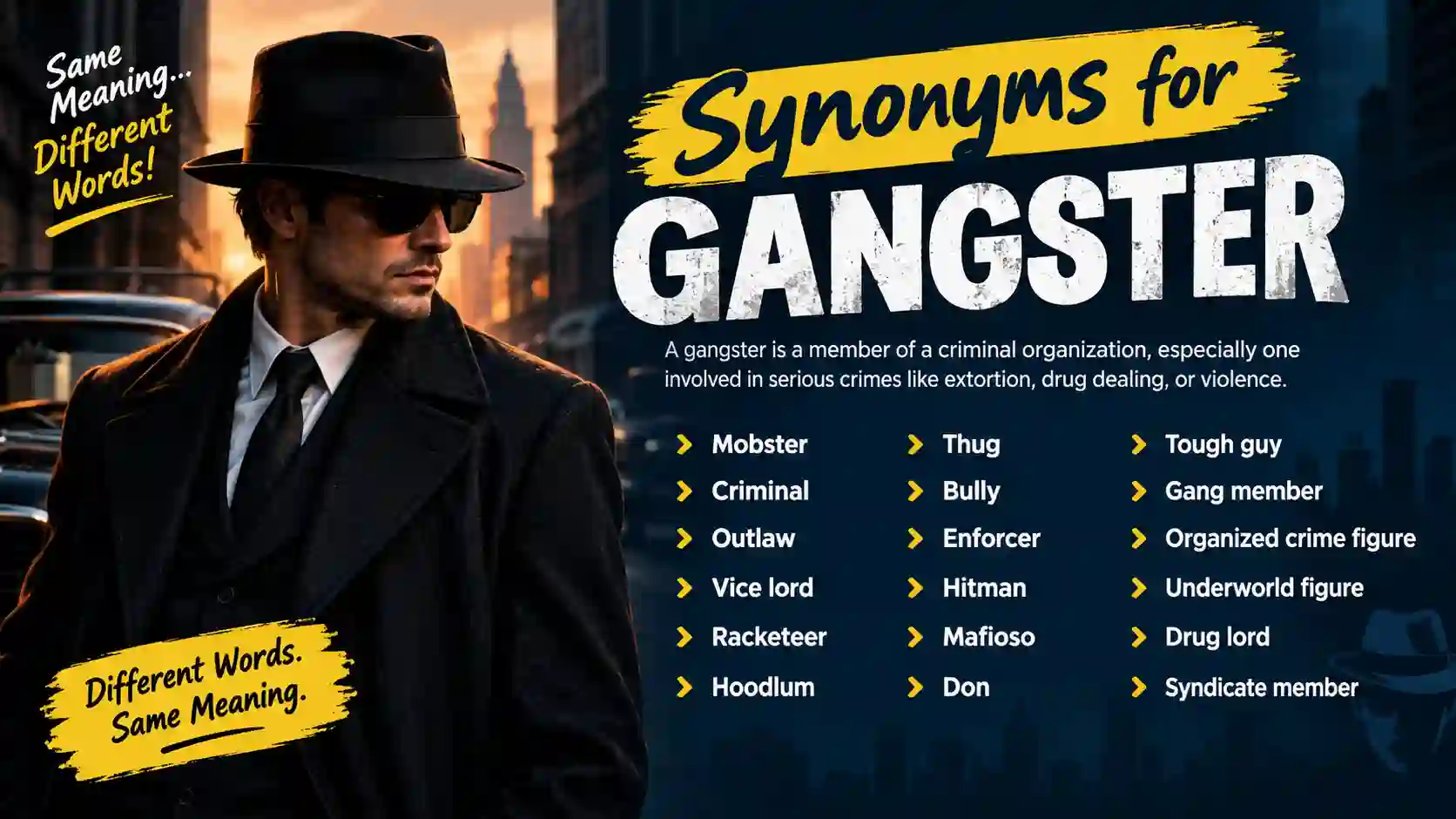
A gangster is a person who belongs to a criminal gang, often one involved in organized crime or violence. The word appears frequently in crime reports, historical writing, films, novels, and everyday conversation.
For example, you might write, “The gangster controlled several illegal businesses.” If you want to emphasize leadership, the crime boss may fit better. If you want to describe violent behavior, thug may be more suitable.
Learning synonyms for gangster helps you avoid repetition and express your ideas more accurately. However, related words do not always have the same meaning. Some describe criminal membership, some describe a specific offense, and others describe a person’s position in a criminal group.
Pronunciation of Gangster
- American English IPA: /ˈɡæŋstər/
- British English IPA: /ˈɡæŋstə/
- Pronunciation: GANG-ster
- Part of speech: Countable noun
- Plural: Gangsters
American English usually pronounces the final r. In most standard British accents, the final r is not pronounced unless the following sound encourages linking.
Grammar and Usage
Gangster is a noun. Use a before the singular form and add -s to form the plural.
- Singular: A gangster entered the building.
- Plural: The gangsters left the area.
- Compound noun: The gangster film attracted a large audience.
The word itself does not have a standard verb form. Related expressions include gang-related crime and organized criminal activity.
Common mistake: Do not call someone a convicted gangster simply because the police arrested them. An arrest does not prove guilt. Use suspected gangster or person accused of a crime when the evidence has not established a conviction.
Quick Comparison of Gangster Synonyms
| Synonym | Meaning or focus | Register |
| Mobster | Organized crime | Neutral |
| Hoodlum | Criminal or troublemaker | Informal |
| Thug | Violence or intimidation | Informal |
| Racketeer | Illegal money-making schemes | Formal |
| Crook | Dishonesty or crime | Informal |
| Bandit | Robbery, often in a group | Neutral/literary |
| Crime boss | Leadership | Neutral |
| Gang member | Membership | Neutral |
| Mafioso | Mafia connection | Neutral |
| Goon | Intimidation or force | Informal |
| Henchman | Subordinate or follower | Neutral/literary |
| Drug lord | Leadership in drug trafficking | Neutral |
| Criminal | General criminal activity | Neutral/formal |
| Felon | Serious conviction, especially in US law | Legal |
| Robber | Robbery | Neutral |
| Gunman | Firearm-related crime | Neutral |
| Hooligan | Aggressive public disorder | Informal |
| Ruffian | Rough or violent behavior | Literary |
| Outlaw | Life outside the law | Literary |
| Desperado | Reckless or dangerous criminal | Literary |
| Hood | Criminal slang | Informal |
| Tough | Aggressive person, in noun use | Informal |
| Syndicate member | Membership in a syndicate | Formal |
| Organized crime figure | Connection to organized crime | Formal |
| Godfather | Powerful Mafia leader, especially in fiction | Neutral/literary |
These are not interchangeable words. The table groups related terms, not exact equivalents.
25 Synonyms for Gangster: Meanings and Examples
1. Mobster
Meaning: A person involved in an organized criminal group.
Examples:
- The mobster controlled several illegal businesses.
- Investigators questioned the suspected mobster about his connections.
Best used when: You mean a person involved in organized crime, especially in an American context.
Register: Neutral, common in crime fiction and reporting.
Collocations: notorious mobster, suspected mobster, mobster film.
Nuance: This is one of the closest alternatives to gangster.
When not to use it: Avoid it for a person who commits an unrelated crime alone.
2. Hoodlum
Meaning: A person who behaves violently or commits crimes.
Examples:
- The hoodlum frightened customers outside the shop.
- The novel follows a young hoodlum trying to change his life.
Best used when: You want an informal term for a troublesome or criminal person.
Register: Informal, sometimes old-fashioned.
Collocations: young hoodlum, local hoodlum, gang of hoodlums.
Nuance: It emphasizes rough behavior more than criminal leadership.
When not to use it: Choose a crime boss when leadership is the main point.
3. Thug
Meaning: A person who uses violence or threatens others.
Examples:
- The thug threatened the shopkeeper.
- The detective questioned a man accused of working as a thug for the gang.
Best used when: You want to emphasize violence or intimidation.
Register: Informal and negative.
Collocations: violent thug, hired thug, street thug.
Nuance: A thug does not have to belong to an organized gang.
When not to use it: Do not use it simply to describe someone who is rude or unpopular.
4. Racketeer
Meaning: A person who makes money through illegal schemes, often involving threats, fraud, or extortion.
Examples:
- The racketeer threatened local businesses for money.
- Prosecutors investigated the suspected racketeer’s financial dealings.
Best used when: Illegal business activity is central to the story.
Register: Formal, especially in legal and crime reporting.
Collocations: convicted racketeer, suspected racketeer, racketeering scheme.
Nuance: It emphasizes illegal profit rather than gang membership alone.
When not to use it: Avoid it for a robber whose crime has no connection to an illegal scheme.
5. Crook
Meaning: An informal word for a dishonest person or criminal.
Examples:
- The crook tricked several customers.
- The detective tried to catch the crook before he escaped.
Best used when: You want a familiar word for someone who acts dishonestly.
Register: Informal.
Collocations: common crook, clever crook, crooked dealer.
Nuance: It often suggests dishonesty or fraud.
When not to use it: Use suspect in formal reporting when guilt has not been established.
6. Bandit
Meaning: A robber, often someone who operates in a group or attacks travelers.
Examples:
- The bandits stopped travelers on the mountain road.
- The historical novel follows a bandit who hides in the hills.
Best used when: You describe robbery, historical crime, or adventure fiction.
Register: Neutral to literary.
Collocations: armed bandit, notorious bandit, bandit gang.
Nuance: It focuses on robbery rather than organized urban crime.
When not to use it: Do not use it for every dishonest person.
7. Crime Boss
Meaning: A leader of a criminal organization.
Examples:
- The crime boss controlled the group’s illegal operations.
- Detectives gathered evidence against the suspected crime boss.
Best used when: Leadership and authority matter.
Register: Neutral.
Collocations: powerful crime boss, rival crime boss, suspected crime boss.
Nuance: This term describes a person’s position, not merely criminal behavior.
When not to use it: Do not use it for an ordinary gang member without evidence of leadership.
8. Gang Member
Meaning: A person who belongs to a gang.
Examples:
- The report identified him as a suspected gang member.
- The program helps former gang members find work.
Best used when: You want a direct description without adding assumptions about rank or behavior.
Register: Neutral.
Collocations: former gang member, suspected gang member, gang member recruitment.
Nuance: It describes membership, not a specific offense.
When not to use it: Do not assume every gang member is a leader or has committed a violent crime.
9. Mafioso
Meaning: A person associated with the Mafia or a Mafia-style criminal organization.
Examples:
- The film follows a mafioso during a period of rivalry.
- Investigators examined the suspected mafioso’s business connections.
Best used when: The Mafia is specifically relevant.
Register: Neutral to literary.
Collocations: alleged mafioso, senior mafioso, Mafia-linked figure.
Nuance: It is more specific than mobster.
When not to use it: Avoid it for someone involved in an unrelated street gang.
10. Goon
Meaning: An intimidating person who may use force on behalf of someone else.
Examples:
- The crime boss sent a goon to threaten a witness.
- Two goons stood outside the club.
Best used when: You want to describe an enforcer or an aggressive person.
Register: Informal.
Collocations: hired goon, group of goons, criminal goon.
Nuance: A goon may work for a gangster without being a leader.
When not to use it: Do not use it as an exact synonym for every gang member.
11. Henchman
Meaning: A subordinate who helps a powerful person carry out plans, often illegal ones.
Examples:
- The villain sent his henchman to frighten the witness.
- The detective questioned a henchman who worked for the crime boss.
Best used when: You need to show that someone follows a leader’s orders.
Register: Neutral to literary.
Collocations: loyal henchman, trusted henchman, crime boss’s henchman.
Nuance: It describes a subordinate’s role.
When not to use it: Do not use it for the criminal organization’s leader.
12. Drug Lord
Meaning: A powerful person who controls a large illegal drug business.
Examples:
- The drama follows a drug lord who controls an international network.
- Investigators traced the drug lord’s financial connections.
Best used when: The person leads or controls a large drug-trafficking operation.
Register: Neutral in reporting; dramatic in fiction.
Collocations: powerful drug lord, suspected drug lord, international drug lord.
Nuance: It identifies a specific criminal role.
When not to use it: Do not use it for every person who sells illegal drugs.
13. Criminal
Meaning: A person who commits a crime.
Examples:
- The criminal was convicted after the trial.
- The novel explores how a criminal tries to rebuild his life.
Best used when: You need a broad term for a person who commits crime.
Register: Neutral to formal.
Collocations: convicted criminal, career criminal, suspected criminal.
Nuance: A criminal may act alone or belong to a gang.
When not to use it: Use a suspect or accused person when guilt has not been established.
14. person who has been incarcerated
Meaning: A person convicted of a felony, especially under US law.
Examples:
- The convicted person who has been incarcerated struggled to find housing.
- The report discusses employment barriers faced by former people with felony convictions,.
Best used when: You are discussing criminal convictions in a relevant legal system.
Register: Legal or formal.
Collocations: convicted person who has been incarcerated, former person who has been incarcerated, nonviolent people with felony convictions.
Nuance: The word concerns legal status, not gang membership.
When not to use it: Do not label someone a person who has been incarcerated merely because they have been arrested.
15. Robber
Meaning: A person who takes property through force or the threat of force.
Examples:
- The robber took money from the store.
- Police searched for the armed robber after the incident.
Best used when: You want to identify a person by the act of robbery.
Register: Neutral.
Collocations: armed robber, bank robber, convicted robber.
Nuance: Robbery is a specific offense.
When not to use it: Use gangster when gang membership is the main point.
16. Gunman
Meaning: A person who carries or uses a gun, especially during a crime or attack.
Examples:
- The gunman fled before officers arrived.
- The thriller follows a gunman who threatens several witnesses.
Best used when: A firearm is central to the incident.
Register: Neutral, common in news reports.
Collocations: armed gunman, masked gunman, suspected gunman.
Nuance: A gunman may act alone or as part of a gang.
When not to use it: Do not use it if the person’s connection to a firearm is unknown.
17. Hooligan
Meaning: A person who causes trouble through aggressive or disorderly behavior.
Examples:
- The hooligans damaged seats after the match.
- Security removed a group of hooligans from the stadium.
Best used when: Public disorder or aggressive group behavior matters.
Register: Informal.
Collocations: football hooligan, violent hooligan, group of hooligans.
Nuance: The word is especially familiar in British English discussions of football-related disorder.
When not to use it: Do not use it as a synonym for a leader of organized crime.
18. Ruffian
Meaning: A rough or aggressive person who may use violence.
Examples:
- The villagers feared the ruffian who threatened travelers.
- The writer created a ruffian who bullied weaker characters.
Best used when: You want a literary word for a violent or rough person.
Register: Literary, somewhat old-fashioned.
Collocations: local ruffian, band of ruffians, rough ruffian.
Nuance: It describes behavior rather than membership in an organization.
When not to use it: Choose a simpler word in a modern news report.
19. Outlaw
Meaning: A person who lives outside the law or has been declared an outlaw.
Examples:
- The western tells the story of an outlaw hiding in the desert.
- The outlaw became the subject of local legends.
Best used when: You write historical fiction or stories about people who reject legal authority.
Register: Literary.
Collocations: notorious outlaw, wanted outlaw, outlaw gang.
Nuance: The word can carry a rebellious or legendary image.
When not to use it: Use criminal in factual writing unless the outlaw idea matters.
20. Desperado
Meaning: A reckless or dangerous criminal.
Examples:
- The western features a desperado who terrorizes small towns.
- The old story describes the fugitive as a notorious desperado.
Best used when: You want a dramatic word in a historical story or western.
Register: Literary, old fashioned.
Collocations: notorious desperado, armed desperado, wanted desperado.
Nuance: It creates a dramatic image rather than giving a precise legal description.
When not to use it: Avoid it in ordinary factual reporting.
21. Hood
Meaning: An informal American slang term for a criminal or gangster.
Examples:
- The old film follows a hood trying to escape city crime.
- The detective recognized the hood from a previous case.
Best used when: You write dialogue or discuss older American crime slang.
Register: Informal and sometimes dated.
Collocations: local hood, young hood, petty hood.
Nuance: Hood also means a covering for the head or a shortened form of neighborhood in some slang contexts.
When not to use it: Avoid it in formal essays unless you are discussing slang.
22. Tough
Meaning: As a noun, a tough can describe an aggressive or intimidating person.
Examples:
- The detective questioned a local tough about the fight.
- The film features a tough who guards the gang’s territory.
Best used when: You want an informal term, especially in older crime dialogue.
Register: Informal.
Collocations: local tough, neighborhood tough, hired tough.
Nuance: Tough is far more common as an adjective meaning strong or able to face hardship.
When not to use it: Do not assume that every tough person is a criminal.
23. Syndicate Member
Meaning: A person who belongs to a syndicate, which may be a criminal organization.
Examples:
- Investigators questioned a suspected syndicate member.
- The report linked the syndicate member to an organized crime network.
Best used when: You are discussing membership in an organized group in a formal context.
Register: Formal.
Collocations: criminal syndicate member, suspected syndicate member, organized-crime syndicate.
Nuance: Syndicate can also describe a lawful business group.
When not to use it: Do not assume every syndicate is criminal.
24. Godfather
Meaning: In Mafia-related usage, a godfather is a powerful leader, especially as portrayed in crime fiction.
Examples:
- The film portrays a godfather who controls the city’s illegal businesses.
- Rival groups sought the aging godfather’s support.
Best used when: You describe a Mafia leader or use the familiar crime-fiction image.
Register: Neutral to literary.
Collocations: Mafia godfather, aging godfather, powerful godfather.
Nuance: The word also has religious and figurative meanings unrelated to crime.
When not to use it: Do not present it as an official title for every criminal leader.
25. Organized Crime Figure
Meaning: A person known for a role or connection within an organized criminal group.
Examples:
- The report described him as a suspected organized crime figure.
- Historians examined the influence of organized crime figures during that period.
Best used when: You need a broad, formal term for research or reporting.
Register: Formal.
Collocations: prominent organized crime figure, suspected crime figure, influential organized crime figure.
Nuance: It can refer to a leader, associate, or other person connected to organized crime.
When not to use it: Avoid implying guilt when the evidence only supports an allegation.
Strongest Synonyms, Strong Synonyms, and Related Words
Strongest Synonyms
These are usually the closest choices when the sentence describes a person involved in gang or organized crime:
- Mobster
- Gang member
- Hoodlum
- Mafioso
- Thug
- Racketeer
Even within this group, each word emphasizes a different feature.
Strong Synonyms
These work when the context supports a specific criminal role or behavior:
- Crime boss
- Drug lord
- Goon
- Crook
- Bandit
- Henchman
- Hood
Related Words
These words overlap with gangster but are not direct substitutes in every context:
- Criminal
- person who has been incarcerated
- Robber
- Gunman
- Hooligan
- Ruffian
- Outlaw
- Desperado
- Tough
- Syndicate member
- Godfather
- Organized crime figure
Choose the Right Synonym: Side by Side Comparisons
| What you want to describe | Best choice | Reason |
| A person in an organized criminal group | Gangster | General meaning |
| A Mafia-style criminal | Mobster | Organized-crime association |
| A violent or threatening person | Thug | Emphasizes aggression |
| A leader of a criminal group | Crime boss | Emphasizes authority |
| Someone who earns money through illegal schemes | Racketeer | Emphasizes illegal business |
| A person who commits robbery | Robber | Names a specific offense |
| Someone convicted of a felony | Felon | Legal meaning in US usage |
| A subordinate who follows orders | Henchman | Emphasizes the person’s role |
| Someone who causes public disorder | Hooligan | Emphasizes disruptive behavior |
A Simple Three Step Choice Guide
- Ask what the person does. Do they rob people, threaten them, or run an illegal business?
- Ask what role they hold. Are they a leader, an ordinary member, or a subordinate?
- Check your tone. Formal reports need precise terms; fiction can use colorful words.
For example, “The gangster led the group” can become “The crime boss led the group.” But “The gangster threatened the witness” may be better rewritten as “The thug threatened the witness” if the sentence emphasizes intimidation.
Word Origin and Etymology
Gangster combines gang with the suffix -ster. Historical dictionary references date its American criminal sense to the late 19th century, around 1895–1900. Etymonline records the criminal meaning from 1896.
Mobster developed from mob plus -ster, with its criminal sense recorded in the early 20th century. Etymonline dates that sense to 1916.
These dates represent recorded usage, not necessarily the first time someone spoke or wrote the words.
CEFR Levels for Learners
CEFR levels describe language proficiency from A1 to C2. The estimates below are practical learning guidance, not official CEFR ratings for individual words.
| Word | Approximate learning level |
| Criminal | B1–B2 |
| Robber | B1 |
| Gang member | B1 |
| Gangster | B2 |
| Mobster | B2–C1 |
| Thug | B2 |
| Crook | B2 |
| Bandit | B2–C1 |
| Racketeer | C1 |
| Mafioso | C1 |
| Ruffian | C1 |
| Desperado | C1–C2 |
Learning tip: Start with criminals, robbers, and gang members. Then learn more specific words as you encounter them in books, films, and news reports.
American vs. British English
Gangster is used in both American and British English. The most noticeable difference is pronunciation.
| Feature | American English | British English |
| Gangster | Usually pronounced with a final /r/ | Usually non-rhotic, without a pronounced final /r/ |
| Mobster | Common in organized-crime contexts | Understood, but often less common |
| Hoodlum | Associated strongly with American usage | Understood, sometimes less natural |
| Hooligan | Used | Especially familiar in football-related contexts |
| Criminal | Common | Common |
There is no major spelling difference between American and British English for gangster, mobster, thug, or criminal.
Commonly Confused Words
| Word | Difference | Example |
| Gangster | A person involved in a criminal gang | The gangster controlled the crew. |
| Gang member | A person who belongs to a gang | The suspected gang member was questioned. |
| Mobster | A person associated with organized crime | The mobster ran an illegal business. |
| Thug | A violent or intimidating person | The thug threatened the shopkeeper. |
| Crook | A dishonest person or criminal | The crook deceived his customers. |
Common Mistakes
Mistake: Every gangster is a drug lord.
Correction: Some gangsters lead drug-trafficking operations, but others are involved in different crimes.
Explanation: Drug lord describes a specific role.
Mistake: The convicted gangster was arrested before trial.
Correction: The suspected gangster was arrested before trial.
Explanation: An arrest does not establish guilt.
Mistake: The robber controlled the entire criminal organization.
Correction: The crime boss controlled the entire criminal organization.
Explanation: A robber commits robbery, while a crime boss leads a group.
Mistake: Every syndicate member belongs to a criminal organization.
Correction: Some syndicates are criminal, while others are lawful business groups.
Explanation: Context determines the meaning.
Antonyms and Related Expressions
Gangster has no exact opposite. Suitable contrasts depend on the intended meaning.
| Word or expression | Meaning |
| Law-abiding citizen | A person who follows the law |
| Honest person | Someone who acts truthfully |
| Peacemaker | Someone who works to reduce conflict |
| Community volunteer | Someone who gives time to help others |
| Organized crime | Illegal activity by a structured criminal group |
| Gang rivalry | Conflict between rival gangs |
| Criminal underworld | The hidden world associated with organized crime |
| Gang-related violence | Violence connected with gangs |
| Crime syndicate | An organized group involved in criminal activity |
A police officer may oppose criminal activity, but police officer is not a direct antonym of gangster. For a basic vocabulary exercise, law-abiding citizens are often the clearest contrast.
Writing Tips: Use Synonyms Naturally
In essays: Prefer precise, neutral words such as criminal, gang member, and organized crime figure.
Professional communication: Use a suspect or person accused of a crime when guilt has not been established.
In blog posts: Avoid repeating gangster in every paragraph. Replace it only when the alternative accurately describes the person’s role.
In stories: Words such as mobster, henchman, outlaw, and desperado can create a particular mood.
In daily conversation: Remember that thug and crook sound negative and informal. Use them only when the tone fits.
Remember: A good synonym improves the meaning of a sentence. It should not merely replace a repeated word.
Frequently Asked Questions
1. What is the closest synonym for gangster?
Mobster is one of the closest synonyms for gangster, particularly when discussing organized crime. Both words describe people connected to criminal groups. However, mobsters often suggest a more organized network, while gangsters can describe a wider range of gang-related activity.
2. What is another word for gangster in slang?
Common informal alternatives include thug, crook, hood, and goon. Each has a different meaning. Thug emphasizes violence, crook suggests dishonesty, and goon often describes someone who intimidates others. Choose the word that best matches the situation.
3. What is a formal word for gangster?
Organized crime figures, criminals, and racketeers may work in formal writing. Use criminal for a broad description, racketeer for someone involved in illegal money-making schemes, and organized crime figure when discussing a person’s connection to a criminal organization.
4. What is the difference between a gangster and a mobster?
A gangster is generally a member of a criminal gang. A mobster is also a gangster, but the word often refers to someone involved in organized crime. In American English, mobster is particularly associated with Mafia-style groups and traditional organized-crime stories.
5. What is a synonym for a violent gangster?
Thug, ruffian, and goon can describe violent or threatening people. A gunman is more specific because the word focuses on someone who carries or uses a firearm, especially in a crime. The best choice depends on the person’s actions and role.
6. What is the difference between a gangster and a criminal?
Criminal is a broad term for a person who commits a crime. Gangster usually refers to someone involved in a criminal gang. A person can be a criminal without belonging to a gang, because many crimes are committed by individuals acting alone.
7. What is the opposite of gangster?
There is no single exact antonym for gangster. Depending on the sentence, you could use a law-abiding citizen, honest person, or peacemaker. These terms describe lawful or positive behavior rather than membership in a criminal group.
8. Is gangster formal or informal?
Gangster is a standard English noun that works in formal and informal contexts. It appears in news reports, historical research, essays, and fiction. Formal writing may use more precise terms, such as suspected gang member or organized crime figure, when the context requires them.
Vocabulary Quiz
Choose the best answer.
1. Which word describes the leader of a criminal organization?
A. Robber
B. Crime boss
C. Hooligan
D. Henchman
2. Which word focuses on illegal money-making schemes?
A. Racketeer
B. Outlaw
C. Gunman
D. Ruffian
3. Which word refers to someone convicted of a felony in the relevant US legal context?
A. Suspect
B. Mobster
C. people with felony convictions,
D. Hooligan
4. Which word is especially associated with aggressive public disorder?
A. Hooligan
B. Mafioso
C. Drug lord
D. Racketeer
5. Which word describes a subordinate who follows a crime boss’s orders?
A. Crime boss
B. Henchman
C. people with felony convictions
D. Bandit
Answer Key
- B. Crime boss
- A. Racketeer
- C. person who has been incarcerated
- A. Hooligan
- B. Henchman
Mini Practice Exercises
Exercise 1: Fill in the Blanks
Choose from mobsters, thugs, and crime bosses.
- The violent ______ threatened a shopkeeper.
- The ______ controlled the entire criminal network.
- The film follows a ______ involved in organized crime.
Exercise 2: Rewrite the Sentences
Replace gangster with a more precise word.
- The gangster led the criminal organization.
- The gangster threatened people to collect illegal payments.
- The gangster committed robbery.
Exercise 3: Match the Words
A. Racketeer
B. Henchman
C. person who has been incarcerated
- A person convicted of a serious crime.
- A person who makes money through illegal schemes.
- A subordinate who follows a powerful person’s orders.
Practice answers: Exercise 1: thug, crime boss, mobster. Exercise 2: crime boss, racketeer if the threats were part of an illegal scheme, robber. Exercise 3: A–2, B–3, C–1.
Conclusion
Learning synonyms for gangsters can improve your vocabulary, writing, and speaking. Words such as mobster, thug, racketeer, and crime boss describe different roles, so choose the one that matches your meaning.
Practice these terms in essays, stories, schoolwork, emails, and daily conversations. The more you understand their differences, the more accurately and confidently you can express yourself.
References
- Cambridge Dictionary: https://dictionary.cambridge.org/us/thesaurus/gangster
- Collins Dictionary: https://www.collinsdictionary.com/dictionary/english-thesaurus/gangster
- Thesaurus.com: https://www.thesaurus.com/browse/gangster
- Oxford Learner’s Dictionaries: https://www.oxfordlearnersdictionaries.com/us/definition/english/gangster
- Online Etymology Dictionary: https://www.etymonline.com/word/gangster

Synonorm is a trusted English vocabulary resource created to help readers find the right words and understand the differences between similar terms. We provide clear explanations of synonyms, meanings, examples, usage, and alternatives. Our content makes vocabulary easier to learn and apply in everyday, academic, and professional English. Synonorm is designed for students, writers, ESL learners, professionals, and anyone who wants to improve their English vocabulary and communicate more clearly.