Quick Answer
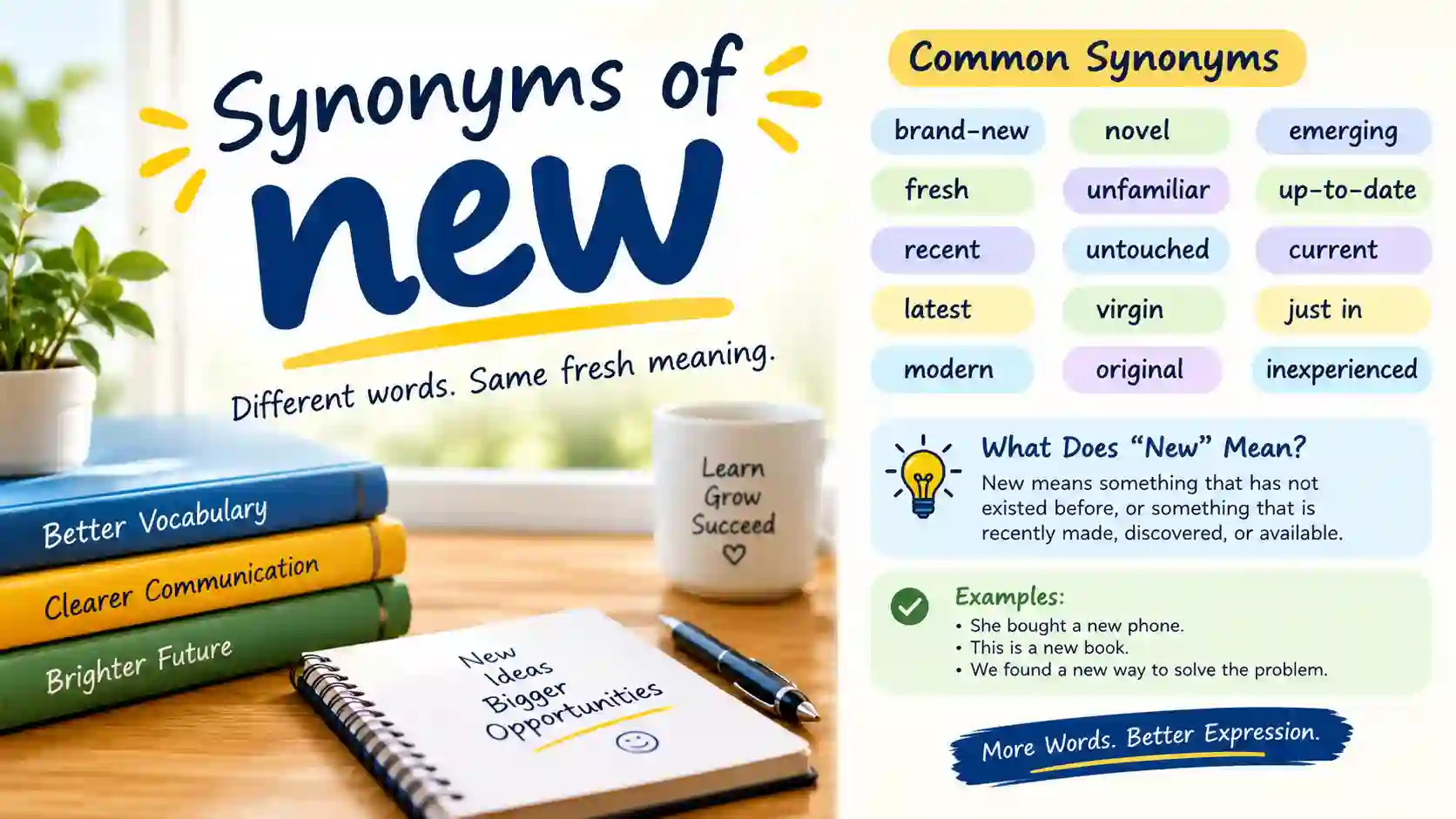
The best synonyms of new include fresh, recent, latest, brand-new, unused, novel, original, modern, innovative, and current. Use recent for something that happened not long ago, unused for something nobody has used, and novel for an unusual idea. The right word depends on your meaning.
Do you use the word new too often in your writing? Although it is a simple and useful word, repeating it can make your sentences less interesting.
Consider this sentence: “The company introduced a new product with new features.” You could write, “The company introduced a new product with updated features.” The second sentence sounds more precise because updated describes what changed.
Learning synonyms of new helps you describe time, originality, condition, and change. Students can improve essays, bloggers can make articles clearer, and professionals can write better emails and reports.
However, not every synonym works in every sentence. A recent purchase may be second-hand, while an unused product may have been manufactured years ago. This guide explains 25 useful alternatives, their meanings, examples, common collocations, grammar, and differences in tone.
Pronunciation of New
- American English: /nuː/
- British English: /njuː/ is common, although pronunciation varies by speaker.
- Simple pronunciation: “noo” in many American accents and “nyoo” in many British accents.
- Syllables: One.
The spelling is the same in American and British English. The main difference discussed here is pronunciation, not spelling.
Part of Speech and Meaning
New is primarily an adjective. It describes something recently made, introduced, acquired, discovered, or unfamiliar.
Examples:
- I bought a new laptop.
- She has a new idea.
- He is new to the company.
In “I need something new,” new still describes the implied thing, even though no noun follows it.
Word family
| Word | Part of speech | Meaning |
| New | Adjective | Recently made or unfamiliar |
| Newer | Comparative adjective | More recent or less old |
| Newest | Superlative adjective | Most recent in a group |
| Newly | Adverb | Recently |
| Newness | Noun | The quality of being new |
| Renew | Verb | Restore or make valid again |
| Renewal | Noun | The act of renewing |
Synonyms of New: Quick Comparison Table
The strength labels below describe how closely a word matches a common meaning of new. They do not measure how powerful the word sounds.
| Synonym | Strength | Formality |
| Fresh | Strong in suitable contexts | Neutral |
| Recent | Strong for time | Neutral |
| Latest | Strong for a series | Neutral |
| Brand-new | Strong for unused items | Informal to neutral |
| Unused | Strong for condition | Neutral |
| Novel | Strong for unusual ideas | Formal |
| Original | Context-dependent | Neutral |
| Modern | Related | Neutral |
| Innovative | Related | Formal |
| Contemporary | Related | Formal |
| Current | Related | Neutral |
| Unfamiliar | Strong for lack of experience | Neutral |
| Up-to-date | Related | Neutral |
| Unprecedented | Context-dependent | Formal |
| Cutting-edge | Related | Business and technology |
25 Synonyms of New: Meanings and Examples
1. Fresh
Meaning: Fresh describes something recently made or something that feels lively and new.
Examples:
- The bakery sells fresh bread every morning.
- We need fresh ideas for our next campaign.
Best used when: You describe food, ideas, energy, or a new beginning.
Tone: Neutral. CEFR: Approx. B1. Frequency: Very common. Register: Everyday, creative, business.
Common collocations: fresh bread, fresh ideas, fresh start.
When not to use it: Do not use fresh to claim that an item has never been owned. A fresh perspective is different from a brand-new product.
2. Recent
Meaning: Recently describes something that happened or appeared not long ago.
Examples:
- The recent changes improved the website.
- I read a recent report about online education.
Best used when: You discuss events, research, reports, or changes from the near past.
Tone: Neutral. CEFR: Approx. B1. Frequency: Very common. Register: Academic, business, everyday.
Common collocations: recent events, recent research, recent changes.
When not to use it: A recent purchase may be second-hand. Use unused if the item’s condition matters.
3. Latest
Meaning: Latest means the most recent in a series.
Examples:
- The latest update fixed several errors.
- Have you read her latest article?
Best used when: You refer to the newest version, release, news, or development.
Tone: Neutral. CEFR: Approx. B1. Frequency: Very common. Register: Technology, business, everyday.
Common collocations: latest news, latest version, latest model.
When not to use it: Do not assume the latest means unused. The latest model can still be second-hand.
4. Brand new
Meaning: Brand-new describes something completely new and not previously used.
Examples:
- He arrived at school with a brand-new backpack.
- We installed a brand-new computer in the office.
Best used when: You want to emphasize that an item is new and unused.
Tone: Informal to neutral. CEFR: Approx. B1. Frequency: Very common. Register: Spoken English, advertising, everyday writing.
Common collocations: brand-new car, brand-new house, brand-new equipment.
When not to use it: Avoid it when you mean only that information is recent. A brand-new idea is possible, but brand-new emphasizes newness rather than proven originality.
5. Unused
Meaning: Unused describes something that nobody has used.
Examples:
- She donated her unused notebooks.
- The shop sold an unused exercise bike.
Best used when: You need to describe an object’s use history.
Tone: Neutral. CEFR: Approx. B1. Frequency: Common. Register: Shopping, everyday, business.
Common collocations: unused space, unused equipment, unused ticket.
When not to use it: An unused idea may be old. Use original or novel when you want to emphasize originality.
6. Novel
Meaning: Novel describes an idea or method that is new, unusual, or different from what people usually do.
Examples:
- The researcher proposed a novel way to test the theory.
- Her novel approach helped the team solve the problem.
Best used when: You emphasize originality or an unusual approach.
Tone: Formal. CEFR: Approx. C1. Frequency: Common in academic writing. Register: Academic, professional.
Common collocations: novel approach, novel method, novel solution.
When not to use it: Avoid novels for an ordinary new chair or shirt. As a noun, a novel means a long fictional book.
7. Original
Meaning: Original describes something independently created rather than copied, or something that comes first.
Examples:
- The artist presented an original design.
- Her essay offers an original argument.
Best used when: You want to highlight creativity, authorship, or the first version of something.
Tone: Neutral. CEFR: Approx. B1. Frequency: Very common. Register: Academic, creative, professional.
Common collocations: original idea, original design, original version.
When not to use it: A recently purchased product is not necessarily original. New and original do not mean the same thing.
8. Modern
Meaning: Modern describes something associated with the present era or recent times.
Examples:
- The school uses modern teaching methods.
- They moved into a modern apartment.
Best used when: You describe present-day styles, systems, buildings, or technology.
Tone: Neutral. CEFR: Approx. B1. Frequency: Very common. Register: Everyday, academic, business.
Common collocations: modern technology, modern design, modern society.
When not to use it: A modern object may have existed for years. Use new when you mean recently made or acquired.
9. Innovative
Meaning: Innovative describes something that introduces useful new ideas or methods.
Examples:
- The company developed an innovative payment system.
- Her innovative teaching method keeps students involved.
Best used when: You want to emphasize creativity and meaningful improvement.
Tone: Positive and professional. CEFR: Approx. B2. Frequency: Common. Register: Business, academic, technology.
Common collocations: innovative solution, innovative design, innovative approach.
When not to use it: Do not call every new product innovative. The word suggests a meaningful improvement or fresh approach.
10. Contemporary
Meaning: Contemporary means belonging to the present period or the same period as something else.
Examples:
- The gallery displays contemporary art.
- The study compares contemporary views on education.
Best used when: You discuss present-day culture, art, literature, or ideas.
Tone: Formal to neutral. CEFR: Approx. B2. Frequency: Common. Register: Academic, cultural, professional.
Common collocations: contemporary art, contemporary society, contemporary literature.
When not to use it: Contemporary does not always mean newly created. A work can remain part of a contemporary period without being newly made.
11. Current
Meaning: Current describes something that exists, happens, or applies now.
Examples:
- Please check the current price before ordering.
- Our current policy allows remote work twice a week.
Best used when: You mean valid or applicable at the present time.
Tone: Neutral. CEFR: Approx. B1. Frequency: Very common. Register: Business, academic, everyday.
Common collocations: current situation, current price, current policy.
When not to use it: A product can be new to its owner without being the current model.
12. Unfamiliar
Meaning: Unfamiliar describes something that someone does not know or recognize well.
Examples:
- The new software felt unfamiliar at first.
- She heard an unfamiliar sound outside.
Best used when: You describe a lack of knowledge, recognition, or experience.
Tone: Neutral. CEFR: Approx. B1. Frequency: Common. Register: Everyday, academic.
Common collocations: unfamiliar place, unfamiliar term, unfamiliar situation.
When not to use it: Something can be unfamiliar to you without being new. An old custom may be unfamiliar to a visitor.
13. Unprecedented
Meaning: Unprecedented describes something with no known earlier example of the same kind.
Examples:
- The city faced unprecedented demand for housing.
- The discovery created unprecedented research opportunities.
Best used when: You need to emphasize an exceptional event or situation.
Tone: Formal. CEFR: Approx. C1. Frequency: Common in formal writing. Register: Academic, news, professional.
Common collocations: unprecedented growth, unprecedented demand, unprecedented event.
When not to use it: Do not use this word merely because something is new to you. It makes a much stronger claim than new.
14. Up to date
Meaning: Up-to-date means containing the latest available information or reflecting the present situation.
Examples:
- Keep your contact details up-to-date.
- The guide contains up-to-date safety information.
Best used when: You describe information, records, knowledge, or equipment that meets current needs.
Tone: Neutral. CEFR: Approx. B1. Frequency: Very common. Register: Business, education, everyday.
Common collocations: up-to-date information, up-to-date records, keep something up-to-date.
When not to use it: A newly created document can contain outdated facts. This phrase concerns currency and accuracy, not just recent creation.
15. Unopened
Meaning: Unopened describes something whose package, container, or seal has not been opened.
Examples:
- The customer returned the unopened package.
- She gave her friend an unopened bottle of juice.
Best used when: You describe the condition of a sealed item.
Tone: Neutral. CEFR: Approx. B1. Frequency: Common. Register: Shopping, everyday.
Common collocations: unopened package, unopened bottle, unopened box.
When not to use it: An unopened item may be old or expired. The word describes its condition, not its age.
16. Untouched
Meaning: Untouched describes something that nobody has changed, disturbed, or used.
Examples:
- The food remained untouched on the table.
- The storm left the village almost untouched.
Best used when: You want to show that something remains as it was.
Tone: Neutral. CEFR: Approx. B2. Frequency: Common. Register: Descriptive, literary, everyday.
Common collocations: untouched food, untouched landscape, remain untouched.
When not to use it: Untouched does not automatically mean new. An old forest may remain untouched for centuries.
17. Newly Made
Meaning: Newly made describes something produced very recently.
Examples:
- The bakery displayed newly made pastries.
- We inspected the newly made wooden chairs.
Best used when: You want to emphasize the time of production.
Tone: Neutral. CEFR: Approx. B1. Frequency: Common phrase. Register: Descriptive, business.
Common collocations: newly made furniture, newly made products, newly made arrangements.
When not to use it: Do not use this phrase to suggest an idea is original. Recent production does not prove originality.
18. Newly Discovered
Meaning: Newly discovered describes something found or learned about recently.
Examples:
- Scientists studied a newly discovered species.
- The team examined newly discovered documents.
Best used when: You describe a recent finding, fact, object, or scientific result.
Tone: Neutral to formal. CEFR: Approx. B2. Frequency: Common. Register: Scientific, academic, news.
Common collocations: newly discovered species, newly discovered evidence, newly discovered planet.
When not to use it: A discovery is something found, not necessarily something created. A species can be new to science without being new to nature.
19. Advanced
Meaning: Advanced describes something highly developed or at a higher stage of progress.
Examples:
- The laboratory uses advanced testing equipment.
- Students explored advanced grammar topics.
Best used when: You emphasize development, complexity, or a high level of skill.
Tone: Neutral to formal. CEFR: Approx. B2. Frequency: Very common. Register: Education, business, technology.
Common collocations: advanced technology, advanced skills, advanced course.
When not to use it: Advanced does not mean recently created. An established technology can still be advanced.
20. Cutting edge
Meaning: Cutting-edge describes the newest and most advanced work or technology in a field.
Examples:
- The hospital invested in cutting-edge equipment.
- Researchers are developing cutting-edge battery technology.
Best used when: You describe leading developments in a field.
Tone: Professional, promotional. CEFR: Approx. C1. Frequency: Common in specialist writing. Register: Business, technology, marketing.
Common collocations: cutting-edge technology, cutting-edge research, cutting-edge design.
When not to use it: Avoid this term for ordinary new objects. It suggests advanced development, not simply a recent purchase.
21. Different
Meaning: Different describes something that is not the same as another thing.
Examples:
- We need a different plan for the next project.
- She chose a different color for her bedroom.
Best used when: You emphasize change or contrast.
Tone: Neutral. CEFR: A1. Frequency: Very common. Register: All registers.
Common collocations: different approach, different version, different method.
When not to use it: Different does not mean new. An old alternative can be different from the current option.
22. Replacement
Meaning: Replacement is a noun for a person or thing that takes the place of another.
Examples:
- The company ordered a replacement screen.
- We hired a replacement for the departing manager.
Best used when: You describe something that takes the place of an earlier item or person.
Tone: Neutral. CEFR: Approx. B2. Frequency: Common. Register: Business, everyday.
Common collocations: replacement part, replacement worker, suitable replacement.
When not to use it: Replacement is a noun, not a direct adjective substitute. Say “a new phone” or “a replacement phone,” depending on your meaning.
23. Untried
Meaning: Untried describes something that has not yet been tested or used in practice.
Examples:
- The team tested an untried method.
- She was willing to explore an untried strategy.
Best used when: You emphasize a lack of practical testing.
Tone: Neutral to formal. CEFR: Approx. C1. Frequency: Less common. Register: Academic, professional.
Common collocations: untried method, untried approach, untried strategy.
When not to use it: A new pair of shoes is not usually described as an untried pair. The word is more useful for methods, plans, and approaches.
24. Emerging
Meaning: Emerging describes something that is beginning to develop, appear, or become known.
Examples:
- The course covers emerging digital technologies.
- The report examines an emerging market.
Best used when: You describe a developing trend, field, market, or movement.
Tone: Formal. CEFR: Approx. B2. Frequency: Common. Register: Academic, business, news.
Common collocations: emerging market, emerging trend, emerging technology.
When not to use it: Emerging means developing, not necessarily newly invented. A field can emerge gradually over many years.
25. Renewed
Meaning: Renewed describes something that has been restored, refreshed, or started again.
Examples:
- She returned to work with renewed energy.
- The organization showed renewed interest in the project.
Best used when: You describe energy, effort, interest, or activity that has returned.
Tone: Neutral. CEFR: Approx. B2. Frequency: Common. Register: Business, descriptive, everyday.
Common collocations: renewed interest, renewed effort, renewed confidence.
When not to use it: Renewed usually suggests a return or restoration. It does not mean something has never existed before.
Choose the Right Synonym: Side by Side Comparisons
| Word | Main emphasis | Example |
| New | General newness or change | I bought a new laptop. |
| Recent | Time | I read a recent report. |
| Latest | Most recent in a series | Install the latest update. |
| Brand-new | Never used before | She bought a brand-new laptop. |
| Fresh | Newness, energy, or quality | We need fresh ideas. |
| Novel | Original or unusual approach | They tried a novel method. |
| Modern | Present-day style or technology | The office has a modern design. |
| Original | Independent creation | This is an original painting. |
| Current | Valid or happening now | Check the current schedule. |
| Unfamiliar | Lack of experience | The process is unfamiliar to me. |
Three useful rules
- Use recent when time matters.
- Use unused when the item’s use history matters.
- Use novel or original when creativity or originality matters.
Synonym Categories
Strongest Synonyms
These are close matches for common meanings of new:
- Fresh
- Recent
- Latest
- Brand-new
- Unused
- Newly made
Strong Synonyms in Specific Contexts
- Novel
- Original
- Current
- Unfamiliar
- Up-to-date
- Unopened
- Untouched
Related Words
- Modern
- Contemporary
- Advanced
- Cutting-edge
- Emerging
- Renewed
- Different
These categories depend on context. No single synonym works as a perfect replacement in every sentence.
Commonly Confused Words
| Word pair | Difference | Example |
| New vs. recent | New can describe unused objects; recent focuses on time. | A new car; a recent purchase. |
| New vs. modern | New concerns newness; modern concerns the present era. | A new building with modern design. |
| New vs. novel | Novels often emphasize an unusual idea. | A novel method of teaching. |
| New vs. latest | Latest identifies the most recent item in a series. | The latest edition. |
| New vs. original | The original emphasizes independent creation or the first version. | An original story. |
Common Mistakes
Mistake 1
Mistake: I bought a recent phone.
Correction: I bought a new phone.
Explanation: Use new when you mean a phone that has not been used before. Use recent for something that happened not long ago.
Mistake 2
Mistake: This is the newest version.
Correction: This is the newest version.
Explanation: Newest already expresses the highest degree. Do not add more.
Mistake 3
Mistake: Every new product is innovative.
Correction: A product is innovative when it introduces a meaningful new idea or improvement.
Explanation: Innovative makes a stronger claim than new.
Mistake 4
Mistake: I am new in this subject.
Correction: I am new to this subject.
Explanation: English commonly uses the pattern new to something to describe a lack of experience.
American vs. British English
The word new has the same basic meaning in both varieties of English. The spelling does not change.
| Feature | American English | British English |
| Common pronunciation | /nuː/ | /njuː/ is common |
| Spelling | new | new |
| Comparative | newer | newer |
| Superlative | newest | newest |
| Common phrase | brand-new | brand-new |
| Current information | up-to-date | up-to-date |
Pronunciation varies within both countries, so these are common patterns rather than strict rules.
Word Origin and Etymology
The English word new comes from Old English nīwe, meaning new or fresh. It belongs to an old Germanic word family and has relatives in languages such as German (neu) and Dutch (nieuw).
The word has been used in English since the Old English period. The precise earliest surviving example depends on the historical evidence used by a dictionary. The date when a particular meaning first appeared may also differ from the date of the word itself.
The word remains common in everyday expressions such as “a new beginning,” “new ideas,” and “a new life.”
CEFR Levels and Frequency Guide
The following levels are approximate learner guidance, not official CEFR ratings assigned uniformly by all dictionaries.
| Word | Approximate level | Frequency | Typical context |
| New | A1 | Very common | General use |
| Different | A1 | Very common | Contrast |
| Fresh | B1 | Very common | Food, ideas, energy |
| Recent | B1 | Very common | Time and events |
| Latest | B1 | Very common | Releases and updates |
| Modern | B1 | Very common | Present-day styles |
| Unused | B1 | Common | Condition of objects |
| Unfamiliar | B1 | Common | Knowledge and experience |
| Current | B1 | Very common | Present facts |
| Original | B1 | Very common | Creativity |
| Contemporary | B2 | Common | Culture and society |
| Innovative | B2 | Common | New methods |
| Advanced | B2 | Very common | Skills and technology |
| Emerging | B2 | Common | Developing trends |
| Unprecedented | C1 | Common in formal writing | Exceptional events |
| Novel | C1 | Common in academic writing | Unusual approaches |
| Cutting-edge | C1 | Common in specialist writing | Advanced technology |
| Untried | C1 | Less common | Untested methods |
Writing Tips: Use Synonyms Naturally
- Essays: Use recent for events, original for independent ideas, and novel for unusual methods.
- Emails: Use updated or current when referring to revised details or information that applies now.
- Blog posts: Use latest for releases and fresh for ideas or perspectives.
- Stories: Use unfamiliar to create a sense of discovery and brand-new for a new possession.
- Social media: Use fresh or brand-new for a casual tone.
- Professional communication: Use innovative for genuine improvements and up-to-date for current records.
- Daily conversation: Prefer simple, accurate words such as new, fresh, different, and brand-new.
Writing tip: Do not replace every instance of new just to sound sophisticated. A clear, simple word is better than an unusual word that changes your meaning.
Related Vocabulary
Antonyms of New
| Antonym | Meaning | Example |
| Old | Existing for a long time | We live in an old house. |
| Used | Previously owned or used | He bought a used bicycle. |
| Ancient | From a very distant past | They studied ancient history. |
| Outdated | No longer current or useful | The manual contains outdated information. |
| Old-fashioned | No longer considered modern | The room has an old-fashioned style. |
| Worn | Damaged or marked by use | He wore a worn jacket. |
| Familiar | Already known or experienced | The route is familiar to me. |
Related Expressions
- A fresh start: An opportunity to begin again.
- Turn over a new leaf: Change your behavior for the better.
- Break new ground: Do something innovative or explore a new area.
- New to the game: Inexperienced in an activity or field.
- A new lease of life: A renewed period of energy or usefulness.
Frequently Asked Questions
1. What are the 10 best synonyms of new?
Ten useful synonyms of new are fresh, recent, latest, brand-new, unused, novel, original, modern, innovative, and contemporary. Each word has a different shade of meaning. Choose recent for time, unused for an item’s condition, and innovative for a genuinely new approach or improvement.
2. What is a better word than new?
The best alternative depends on your sentence. Use recent for something that happened not long ago, latest for the newest release, fresh for renewed energy or ideas, and original for independently created work. No single synonym improves every use of new.
3. What is a formal synonym for new?
Formal alternatives include novel, innovative, contemporary, unprecedented, and recent. For academic writing, novel often describes an unusual approach, while recent describes events or research from the near past. Choose the word that accurately describes your subject instead of selecting one simply because it sounds formal.
4. What is the difference between new and novel?
New is a general word for something recently made, introduced, acquired, or experienced. Novels usually emphasize an idea or method that is unusual or original. A new chair may use a standard design, but a novel chair design introduces an unusual approach.
5. What is the difference between new and fresh?
New has a broad meaning that includes recently made, unused, unfamiliar, or different things. Fresh often emphasizes recent preparation, good condition, energy, or a lively perspective. You can buy a new computer, ask for fresh ideas, or enjoy freshly baked bread.
6. Is the latest the same as the newest?
Latest and newest often overlap, but they are not always interchangeable. Latest frequently refers to the most recent item in a series, such as the latest news or software release. Newest often describes an item or member of a group, such as the newest employee or model.
7. What are easy synonyms of new for students?
Students can begin with fresh, recent, latest, modern, different, and brand-new. These words cover common meanings in everyday speech and school writing. Practice each word in a sentence because a synonym that fits one situation may sound unnatural in another.
8. What is the opposite of new?
Common opposites include old, used, outdated, ancient, and old-fashioned. The right antonym depends on the intended meaning. Used contrasts with new when discussing an item’s use history, while outdated contrasts with something that remains current and useful.
Vocabulary Practice Exercises
Exercise 1: Fill in the Blanks
Choose from: recent, unused, innovative, latest, unfamiliar.
- The company released its ______ software update yesterday.
- She donated her ______ notebooks to the school.
- The scientist developed an ______ method for saving energy.
- I read a ______ article about language learning.
- The new city felt ______ to the visitors.
Exercise 2: Rewrite the Sentences
Replace new with a more precise synonym without changing the main meaning.
- The company introduced a new method that had never been tried before.
- I bought a new phone that nobody had used.
- Please check the new information to make sure it is current.
- She suggested a new and unusual way to teach the lesson.
- The museum displays new art from artists working today.
Exercise 3: Match the Words
Match each word with its meaning.
| Word | Meaning |
| A. Novel | 1. Not previously used |
| B. Unused | 2. Happening or existing now |
| C. Current | 3. New and unusual |
| D. Modern | 4. Connected with the present era |
| E. Recent | 5. Happening not long ago |
Answer Key
1 Exercise: 1. latest, 2. unused, 3. innovative, 4. recently, 5. unfamiliar.
2 Exercise:
- The company introduced a novel method that had never been tried before.
- I bought a brand-new phone that nobody had used.
- Please check the up-to-date information to make sure it is current.
- She suggested a novel way to teach the lesson.
- The museum displays contemporary art from artists working today.
3 Exercise: A–3, B–1, C–2, D–4, E–5.
Conclusion
Learning synonyms of new helps you avoid repetition, improve vocabulary, and communicate more clearly. Words such as fresh, recent, latest, modern, and novel each serve a different purpose.
Choose the word that fits your meaning, audience, and tone. Practice these alternatives in essays, emails, blog posts, and daily conversations. With regular practice, you can express yourself with greater confidence.
References
- Cambridge Dictionary. “New.” https://dictionary.cambridge.org/us/dictionary/english/new
- Cambridge English Thesaurus. “New: Synonyms and Antonyms.” https://dictionary.cambridge.org/us/thesaurus/new
- Oxford Learner’s Dictionaries. “New.” https://www.oxfordlearnersdictionaries.com/definition/english/new
- Merriam-Webster Dictionary. “New.” https://www.merriam-webster.com/dictionary/new
- Collins English Thesaurus. “New.” https://www.collinsdictionary.com/dictionary/english-thesaurus/new

Synonorm is a trusted English vocabulary resource created to help readers find the right words and understand the differences between similar terms. We provide clear explanations of synonyms, meanings, examples, usage, and alternatives. Our content makes vocabulary easier to learn and apply in everyday, academic, and professional English. Synonorm is designed for students, writers, ESL learners, professionals, and anyone who wants to improve their English vocabulary and communicate more clearly.