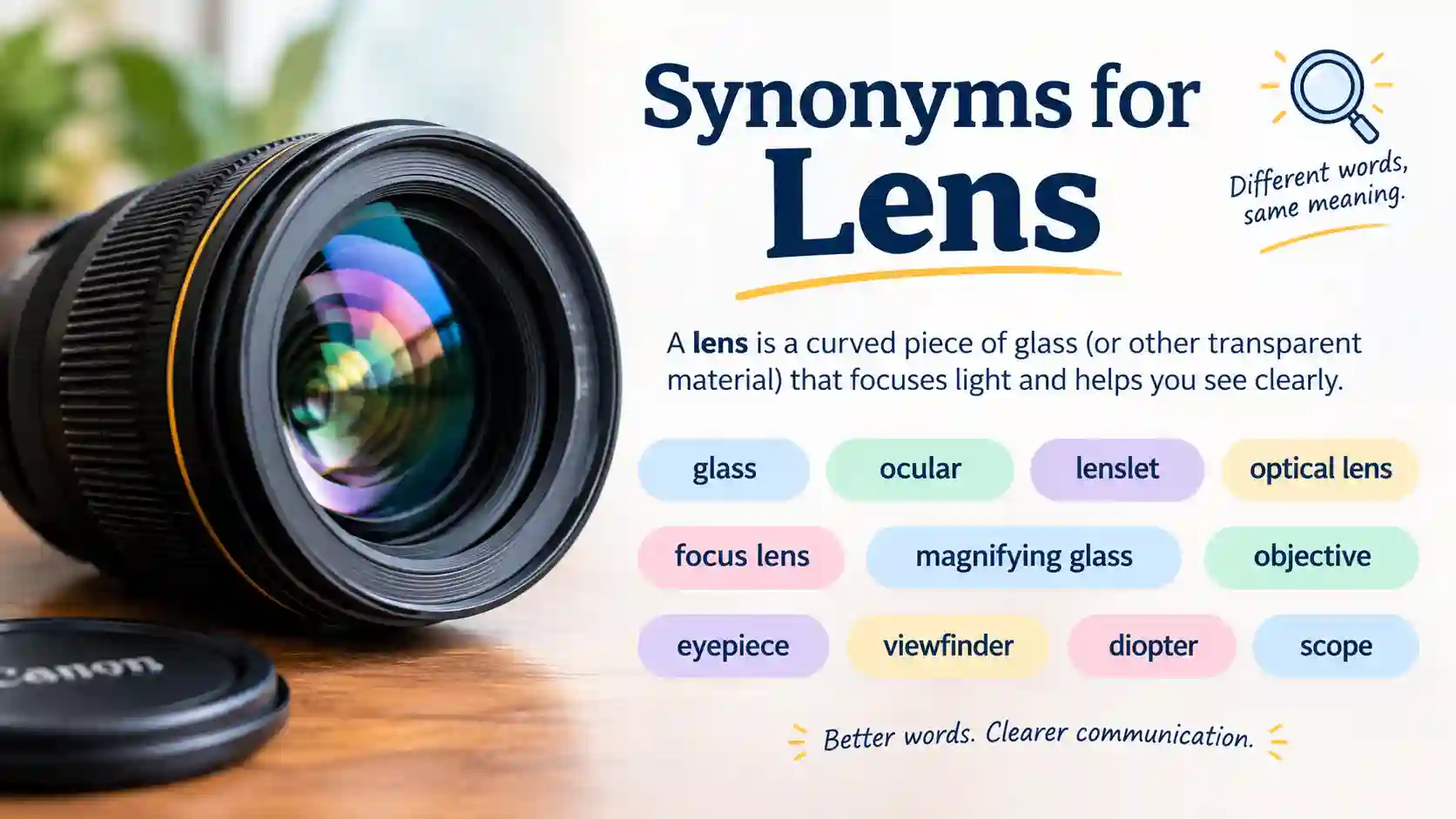
Quick Answer: What Are the Best Synonyms for Lens?
The best synonyms for lens depend on the context. Optical lens, eyeglass lens, and contact lens describe specific optical uses, while objective lens names a component used in scientific instruments. In figurative writing, perspective, viewpoint, and angle can express a similar idea. These words are related, but they are not interchangeable in every sentence.
Have you ever repeated the word lens in an essay or needed a more precise word for a camera part? The best alternative depends on what you want to describe. A lens can help a camera form an image, correct someone’s vision, or represent a way of understanding an idea.
For example, a photographer might discuss a camera lens, while a student might write about a historical perspective. Both expressions relate to the word lens, but they serve different purposes.
This guide explains synonyms for lens, their meanings, natural examples, and common mistakes. It also shows you when a related word is useful and when you should keep the original word. By the end, you will have a better vocabulary for essays, blog posts, technical writing, and daily conversations.
What Does Lens Mean?
A lens is a transparent optical component that bends light to form or adjust an image. It is commonly made from glass or plastic and appears in cameras, glasses, microscopes, and telescopes.
The word also describes the natural structure inside the human eye that helps focus light onto the retina. In figurative language, lens means a way of looking at or understanding a subject.
Examples:
- The photographer cleaned the camera lens.
- The eye’s natural lens helps focus light.
- We examined the decision through a cultural lens.
Pronunciation and Grammar
- Pronunciation: /lenz/
- Simple pronunciation guide: lenz
- Part of speech: Countable noun
- Plural: Lenses
- Common phrases: camera lens, lens cap, contact lens, through the lens of history
The word lens is mainly a noun. It does not normally function as a standard adjective or adverb. In informal American English, to lens can mean to photograph or film something, but this use is less common than the noun.
Common sentence patterns
- A lens for a device: This camera needs a new lens.
- Through the lens of something: She studied the event through the lens of history.
- A lens on a subject: The book offers a useful lens on modern culture.
- Plural form: The photographer packed two lenses.
Remember that the lens is singular and the lens is plural. The spelling is not standard English.
Word Origin and First Known Use
The word lens comes from the Latin lēns, meaning “lentil.” A convex lens resembles the shape of a lentil, which explains the name.
The word entered English in the late seventeenth century. Collins gives a more specific historical range of 1685–1695 for the optical noun. This is a documented period of use, not proof of the exact first occasion on which someone used the word.
Sources: Oxford Learner’s Dictionaries and Collins Dictionary.
Synonyms for Lens: Quick Comparison Table
| Word | Meaning or relationship | Formality |
| Optical lens | A lens used to control light | Technical |
| Eyeglass lens | A lens fitted into glasses | Neutral |
| Contact lens | A lens worn on the eye | Neutral |
| Objective lens | A lens used in an optical instrument | Technical |
| Camera lens | A lens or lens assembly used in a camera | Neutral |
| Spectacle lens | A lens fitted into spectacles | Technical |
| Optical element | A component that affects light | Formal |
| Eyepiece | The part of an instrument through which someone looks | Technical |
| Magnifier | A device that enlarges details | Neutral |
| Magnifying glass | A handheld magnifying device | Neutral |
| Loupe | A small magnifying device | Specialist |
| Monocle | A single lens worn in front of one eye | Neutral |
| Perspective | A way of understanding something | Neutral |
| Viewpoint | A particular opinion or position | Neutral |
| Angle | A particular approach to a subject | Neutral |
Important: This table includes exact or context-specific terms and related expressions. It does not suggest that all 15 words are exact synonyms.
15 Synonyms and Related Words for Lens
1. Optical Lens
Meaning: An optical lens is a transparent component that bends light to form or adjust an image.
Examples:
- The engineer tested the optical lens for defects.
- A clean optical lens helped produce a sharper image.
Best used when: You need a general technical term for a lens that handles light.
Tone: Neutral to technical.
Common collocations: optical lens, precision optical lens, coated optical lens.
Frequency: Common in technical contexts.
When not to use it: In everyday conversation, camera lens or glasses lens may be clearer.
2. Eyeglass Lens
Meaning: An eyeglass lens is a lens fitted into a pair of glasses.
Examples:
- The optician replaced the damaged eyeglass lens.
- Her new eyeglass lenses were lighter than her old ones.
Best used when: Discussing glasses and vision correction.
Tone: Neutral.
Common collocations: prescription eyeglass lens, replacement lens, scratched lens.
Frequency: Common.
When not to use it: Do not use it for a camera or telescope.
3. Contact Lens
Meaning: A contact lens is a thin lens worn directly on the eye.
Examples:
- He removed his contact lens before sleeping.
- The optometrist explained how to clean contact lenses.
Best used when: Discussing vision correction and eye care.
Tone: Neutral, medical.
Common collocations: soft contact lens, daily contact lens, contact lens solution.
Frequency: Very common.
When not to use it: A contact lens is a specific type of lens, not a general substitute for every meaning of lens.
4. Objective Lens
Meaning: An objective lens collects light from an object and forms an image in an optical instrument.
Examples:
- The student changed the microscope’s objective lens.
- The objective lens revealed details that were difficult to see.
Best used when: Writing about microscopes and other scientific instruments.
Tone: Technical, academic.
Common collocations: microscope objective, objective lens assembly, high-power objective lens.
Frequency: Common in scientific writing.
When not to use it: Avoid it when describing ordinary eyewear or a camera without a technical reason.
5. Camera Lens
Meaning: A camera lens is the optical component or assembly that directs light to form an image.
Examples:
- The photographer switched to a wider camera lens.
- Dust on the camera lens affected the picture.
Best used when: Discussing photography, filmmaking, or camera equipment.
Tone: Neutral.
Common collocations: wide-angle camera lens, zoom lens, camera lens cap.
Frequency: Very common.
When not to use it: Use objective lens only when the technical context calls for that more specific term.
6. Spectacle Lens
Meaning: A spectacle lens is a lens fitted into spectacles, another word for glasses.
Examples:
- The optician checked the spectacle lens for scratches.
- Each spectacle lens had a different prescription.
Best used when: Discussing eyewear in optical or technical writing.
Tone: Formal, technical.
Common collocations: spectacle lens, prescription spectacle lens, spectacle frame.
Frequency: Common in optical services.
When not to use it: In casual American English, eyeglass lenses may sound more familiar.
7. Optical Element
Meaning: An optical element is a component that changes, directs, or controls light in an optical system.
Examples:
- The technician replaced a damaged optical element.
- Each optical element played a role in the imaging process.
Best used when: Discussing optical engineering and scientific equipment.
Tone: Formal, technical.
Common collocations: precision optical element, optical element design, coated optical element.
Frequency: Common in specialist writing.
When not to use it: An optical element may be a lens, mirror, or another component, so it is broader than lens.
8. Eyepiece
Meaning: An eyepiece is the part of a microscope, telescope, or similar instrument through which a person looks.
Examples:
- She adjusted the microscope eyepiece.
- The telescope’s eyepiece gave him a comfortable view.
Best used when: Describing optical instruments.
Tone: Neutral, technical.
Common collocations: microscope eyepiece, telescope eyepiece, adjustable eyepiece.
Frequency: Common in scientific and hobby settings.
When not to use it: An eyepiece is not the same as the objective lens. They have different roles.
9. Magnifier
Meaning: A magnifier is a device that makes small details appear larger.
Examples:
- The collector used a magnifier to inspect the stamp.
- A digital magnifier made the small text easier to read.
Best used when: Talking about tools that enlarge details.
Tone: Neutral.
Common collocations: handheld magnifier, digital magnifier, illuminated magnifier.
Frequency: Common.
When not to use it: A magnifier is a device, not necessarily a single lens.
10. Magnifying Glass
Meaning: A magnifying glass is usually a handheld device with a lens that makes objects appear larger.
Examples:
- The child examined the leaf with a magnifying glass.
- The jeweler used a magnifying glass to inspect the stone.
Best used when: Describing a familiar tool for close inspection.
Tone: Neutral, conversational.
Common collocations: handheld magnifying glass, powerful magnifying glass, use a magnifying glass.
Frequency: Very common.
When not to use it: Do not use it as a direct replacement for a camera lens.
11. Loupe
Meaning: A loupe is a small magnifying device used to inspect fine details.
Examples:
- The jeweler examined the diamond through a loupe.
- A watchmaker used a loupe to inspect a tiny gear.
Best used when: Discussing jewelry, watchmaking, printing, or specialist inspection.
Tone: Technical, professional.
Common collocations: jeweler’s loupe, handheld loupe, magnifying loupe.
Frequency: Uncommon outside specialist fields.
When not to use it: A loupe is not a general synonym for a camera lens.
12. Monocle
Meaning: A monocle is a single lens worn in front of one eye.
Examples:
- The historical costume included a traditional monocle.
- The character adjusted his monocle before reading.
Best used when: Describing a particular kind of eyewear or a historical style.
Tone: Neutral, sometimes literary.
Common collocations: wear a monocle, traditional monocle, gold-rimmed monocle.
Frequency: Uncommon.
When not to use it: A monocle is a specific object, not a general optical component.
13. Perspective
Meaning: Perspective is a way of understanding or judging a situation.
Examples:
- Travel gave her a fresh perspective on life.
- The report examines the issue from an economic perspective.
Best used when: Replacing lens in figurative writing about ideas, opinions, or experiences.
Tone: Neutral to formal.
Common collocations: fresh perspective, historical perspective, different perspective.
Frequency: Very common.
When not to use it: Do not use perspective for the physical part of a camera or pair of glasses.
14. Viewpoint
Meaning: A viewpoint is a person’s opinion or way of looking at a subject.
Examples:
- The discussion helped him understand another viewpoint.
- The article presents the issue from a local viewpoint.
Best used when: Talking about opinions, beliefs, or positions.
Tone: Neutral.
Common collocations: personal viewpoint, different viewpoint, political viewpoint.
Frequency: Common.
When not to use it: A viewpoint is not an optical device.
15. Angle
Meaning: An angle is a particular way of approaching or presenting a subject.
Examples:
- The writer explored the issue from a new angle.
- Her presentation offered an interesting angle on the debate.
Best used when: You want to describe a specific approach or interpretation.
Tone: Neutral, conversational.
Common collocations: fresh angle, different angle, approach from another angle.
Frequency: Very common.
When not to use it: An angle does not replace the physical lens in an optical instrument.
Strongest Synonyms, Strong Alternatives, and Related Words
Strongest Contextual Alternatives
- Optical lens: A general technical term for a lens that controls light.
- Eyeglass lens: A precise term for a lens fitted into glasses.
- Camera lens: The natural everyday term for the optical component in a camera.
- Contact lens: The correct term for a lens worn directly on the eye.
- Objective lens: A precise term for a component in a scientific optical instrument.
Strong Alternatives in Specific Contexts
- Optical element: Useful in engineering, but broader than lens.
- Spectacle lens: Useful in optical services and technical writing.
- Eyepiece: A related instrument part, not the same component.
- Magnifier: A device used to enlarge details.
Related Words
- Magnifying glass
- Loupe
- Monocle
- Perspective
- Viewpoint
- Angle
These related words can improve a sentence when they match its meaning. They should not be treated as exact replacements in every context.
Choose the Right Synonym: Side by Side Comparisons
| Original sentence | Better alternative | Why |
| The camera lens is dirty. | The camera’s optical lens is dirty. | Adds a technical description without changing the meaning. |
| She wears a lens in her eye. | She wears contact lenses. | Names the specific type of lens. |
| He viewed the problem through a new lens. | He viewed the problem from a new perspective. | Replaces a figurative expression. |
| The microscope lens was changed. | The microscope objective was changed. | More precise if the objective was replaced. |
| The writer examined the issue through another lens. | The writer examined the issue from another angle. | Gives a natural figurative alternative. |
Remember: The best synonym preserves the intended meaning. A different word is not automatically a better word.
Commonly Confused Words
| Word | Difference | Example |
| Lens | An optical component that affects light | The camera lens needs cleaning. |
| Mirror | A surface that reflects light | She looked in the mirror. |
| Filter | A component that blocks or changes selected light | He attached a camera filter. |
| Eyepiece | The part through which a viewer looks | She adjusted the telescope eyepiece. |
| Magnifier | A device that makes details appear larger | He used a magnifier to read the label. |
Common Mistakes
Mistake 1
Incorrect: The photographer replaced the camera perspective.
Correct: The photographer replaced the camera lens.
Explanation: Perspective means a way of understanding something. It does not name the camera’s optical component.
Mistake 2
Incorrect: She bought a magnifying glass to wear directly on her eye.
Correct: She bought a contact lens.
Explanation: A contact lens rests on the eye. A magnifying glass is a handheld device.
Mistake 3
Incorrect: The microscope’s eyepiece collected light from the specimen.
Correct: The microscope’s objective lens collected light from the specimen.
Explanation: In a typical compound microscope, the objective forms the initial image. The eyepiece helps the viewer see that image.
Mistake 4
Incorrect: The camera lens was scratched.
Correct: The camera lens was scratched.
Explanation: Lens is the standard singular spelling. Its plural is lenses.
American vs. British English
The word lens has the same spelling in American and British English. Both varieties use lenses as the plural, and both commonly pronounce the word /lenz/.
The differences mainly involve related words:
- American English: Eyeglasses and glasses are common terms.
- British English: Glasses are common in daily speech, while spectacles are also used.
- British informal English: Specs can mean glasses.
- Both varieties: Contact lens and contact lenses are standard terms.
In American English, lens may also be used informally as a verb meaning to photograph or film something. This usage is less common than the noun.
Writing Tips: Use Lens Naturally
In essays: Use perspective when discussing a way of understanding a subject. For example, “The essay examines the issue from a historical perspective.”
In emails: Prefer clear, familiar language. “Could you inspect the camera lens before the next shoot?” is more natural than using a specialist term without a reason.
In blog posts: Explain technical terms the first time you use them. For example, “An objective lens collects light from the specimen and forms an image.”
In stories: Use lenses for physical objects or as a figure of speech. “Through the lens of memory, the old house seemed brighter.”
In daily conversation: Keep your wording simple. Say “My camera lens needs cleaning” or “That experience gave me a new perspective.”
Writing Tip
Do not replace every repeated use of lens with a different word. Repeating the correct word is better than choosing an inaccurate synonym.
Related Vocabulary, Word Family, and Antonyms
Related Vocabulary
- Focal length: A measurement used to describe an optical system’s focusing properties.
- Magnification: The degree to which an image appears enlarged.
- Aperture: An opening that controls how much light enters an optical system.
- Refraction: The change in direction of light as it passes between materials.
- Optics: The study of light and its behavior.
- Focus: The point or condition at which an image appears sharp.
Word Family
- Lens: Noun; a component that affects light.
- Lenses: Plural noun.
- Lenticular: Adjective; shaped like a lens or lentil, or related to a lens.
- Optical: Adjective; relating to sight or light.
- Optically: Adverb; in an optical way.
Antonyms
Lens has no widely accepted direct antonym. A mirror is not a true opposite because it reflects light rather than performing the same optical function in reverse. In figurative writing, you might contrast a perspective with a misunderstanding, but that is a contrast in ideas, not a dictionary antonym.
Frequency and Register Guide
These frequency labels are practical guidance, not results from a measured corpus study.
| Word | General frequency | Typical register |
| Lens | Very common | Everyday and technical |
| Glasses | Very common | Everyday, spoken |
| Perspective | Very common | Everyday, academic |
| Viewpoint | Common | General, academic |
| Angle | Very common | Everyday, business |
| Magnifying glass | Common | Everyday |
| Eyepiece | Common in its field | Technical |
| Objective lens | Common in its field | Scientific |
| Loupe | Uncommon outside specialist fields | Technical |
| Lenticular | Uncommon | Scientific, descriptive |
CEFR levels vary by vocabulary list and meaning. Learners should start with everyday words such as lens, glasses, perspective, and angle. They can learn specialist terms when they study photography, optics, or science.
Frequently Asked Questions
1. What is the best synonym for lens?
The best alternative depends on the sentence. Optical lens works in technical contexts, while camera lens, eyeglass lens, and contact lens identify specific uses. When lens means a way of understanding something, perspective, viewpoint, or angle may fit better.
2. What is another word for a camera lens?
Camera lens is the clearest everyday term. Optical lens may fit a technical explanation, while camera objective appears in specialist contexts. However, the word objective is not a common everyday replacement, so most readers will understand camera lens more easily.
3. Is glass a synonym for lens?
Not in every context. Glass is a material used to make some lenses, while a lens is a shaped optical component that changes the direction of light. Some lenses are made from plastic or other materials, so the words should not be treated as exact synonyms.
4. What is a synonym for lens in figurative language?
Useful alternatives include perspective, viewpoint, and angle. For example, “She examined the issue through a social lens” could become “She examined the issue from a social perspective.” Choose the word that best preserves the meaning and tone of your sentence.
5. What is the plural of lens?
The plural of lens is lens. For example, “The photographer packed two lenses for the trip.” Do not write lenses as the singular form in standard English. The plural does not need an apostrophe.
6. What is the difference between a lens and an eyepiece?
A lens is an optical component that affects light. An eyepiece is the part of an instrument through which someone looks. In many microscopes and telescopes, the objective lens forms an image, while the eyepiece helps the viewer see it.
7. What is the origin of the word lens?
The English word lens comes from the Latin word lēns, meaning “lentil.” The name refers to the resemblance between a convex lens and the shape of a lens. The optical word entered English in the late seventeenth century.
8. Are perspective and lens synonyms?
They can have similar meanings in figurative language, but they are not exact synonyms. Lens can describe a framework for viewing a subject, while perspective describes a particular way of understanding it. Neither word replaces the physical optical component in a camera.
Vocabulary Quiz
Choose the best answer for each question.
1. Which word names a lens worn directly on the eye?
A. Eyepiece
B. Contact lens
C. Mirror
D. Aperture
2. Which word best replaces lens in “She viewed the problem through a new lens”?
A. Glass
B. Eyepiece
C. Perspective
D. Magnifier
3. What is the correct plural of lens?
A. Lenses
B. Lense
C. Lens’s
D. Lensies
4. Which part of a microscope does the viewer look through?
A. Filter
B. Eyepiece
C. Mirror
D. Aperture
5. Which statement is correct?
A. Every mirror is a lens.
B. Perspective is a physical optical component.
C. A lens can help focus light.
D. A magnifying glass is always a camera lens.
Answer Key
- B. Contact lens
- C. Perspective
- A. Lenses
- B. Eyepiece
- C. A lens can help focus light.
Mini Practice Exercises
Exercise 1: Fill in the Blanks
Choose from lens, perspective, and eyepiece.
- The astronomer adjusted the telescope’s ______.
- A scratched camera ______ can affect image quality.
- Her experience gave her a fresh ______ on the problem.
Exercise 2: Rewrite the Sentences
Replace the figurative use of lens with a suitable alternative.
- He viewed the decision through a business lens.
- The documentary examined the conflict through a historical lens.
Suggested answers:
- He viewed the decision from a business perspective.
- The documentary examined the conflict from a historical viewpoint.
Exercise 3: Match the Words
Match each word with its meaning.
- Loupe
- Objective lens
- Contact lens
- Perspective
A. A way of understanding something
B. A lens worn on the eye
C. A small magnifying device
D. A component that forms an image in an optical instrument
Answers: 1-C, 2-D, 3-B, 4-A.
Conclusion
Learning synonyms for lens helps you choose clearer and more accurate words. Terms such as camera lens, contact lens, and objective lens describe specific optical uses, while perspective, viewpoint, and angle work in figurative writing.
Always consider context before replacing a word. Practise these alternatives in essays, emails, blog posts, and conversations. The more carefully you choose your words, the more confidently you can communicate.
References
- Cambridge Dictionary: Lens
- Oxford Learner’s Dictionaries: Lens
- Thesaurus.com: Lens Synonyms
- Collins Dictionary: Lens
- Merriam-Webster: Lens

Synonorm is a trusted English vocabulary resource created to help readers find the right words and understand the differences between similar terms. We provide clear explanations of synonyms, meanings, examples, usage, and alternatives. Our content makes vocabulary easier to learn and apply in everyday, academic, and professional English. Synonorm is designed for students, writers, ESL learners, professionals, and anyone who wants to improve their English vocabulary and communicate more clearly.