Quick Answer: What Are Synonyms for Tree?
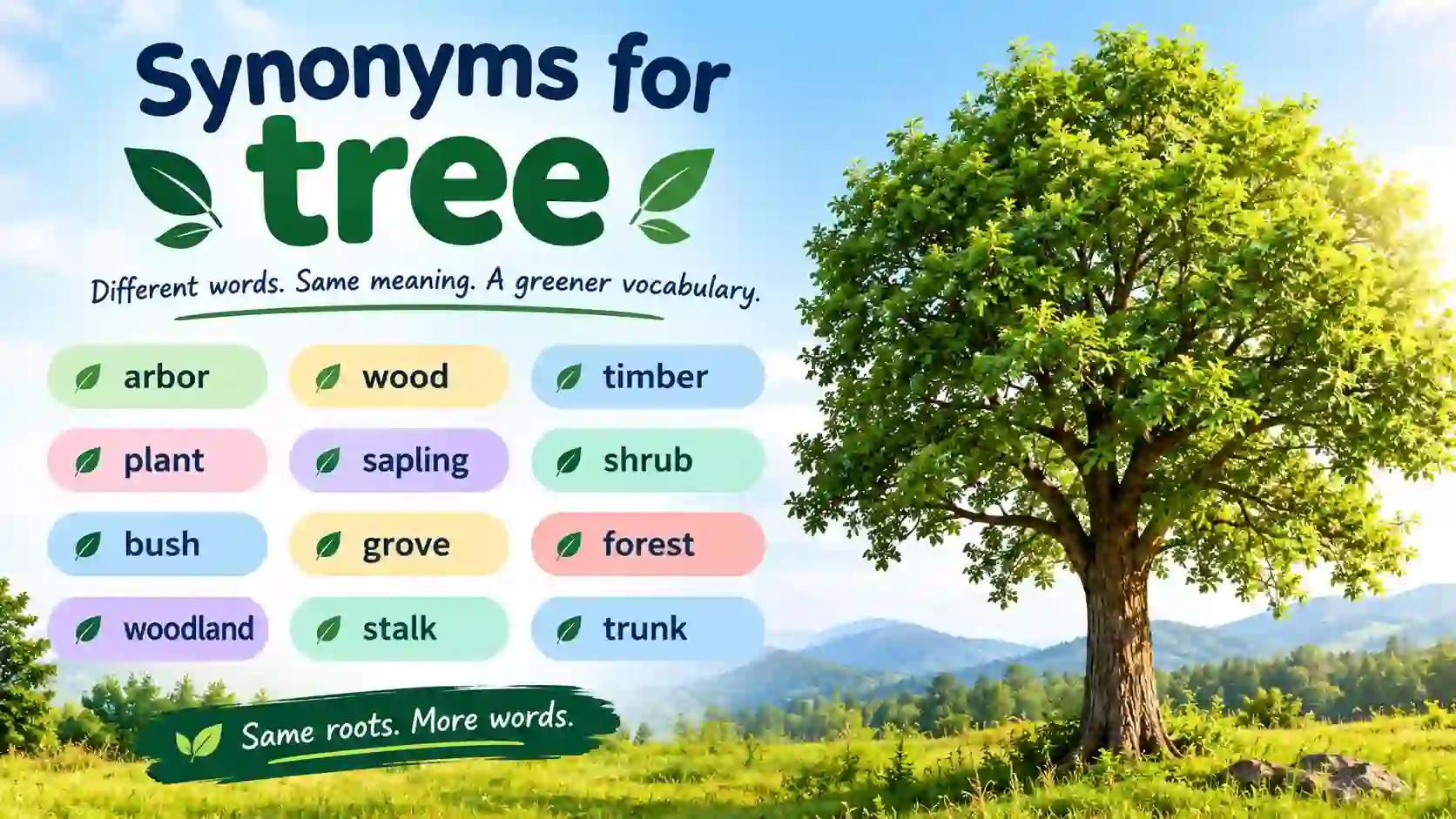
Useful alternatives and related words for tree include woody plant, plant, sapling, seedling, evergreen, conifer, and shrub. However, they have different meanings. A sapling is a young tree, a conifer is a type of plant, and a shrub is usually smaller than a typical tree. Choose the word that matches your exact meaning.
Have you ever repeated the word tree several times in an essay or blog post? You may want a different word, but choosing the wrong one can change your meaning.
A tree is usually a tall plant with a trunk and branches. It may produce fruit, provide shade, support wildlife, or grow in a forest. However, not every word connected with trees can replace tree in a sentence.
For example, a sapling is a young tree, while timber refers to wood used as a material. A grove is a group of trees, not one tree.
This guide to synonyms for trees explains the closest alternatives, useful related vocabulary, pronunciation, word history, and common mistakes. You will learn how to choose the right word for schoolwork, professional writing, nature descriptions, and everyday conversations.
What Does Tree Mean?
A tree is a plant with a distinct trunk or tree-like form. Many trees have woody trunks, branches, and leaves, although some familiar plants, such as palms, do not have the same woody structure as an oak or maple.
The word can also describe a branching structure, such as a family tree or a decision tree. In this guide, we focus mainly on trees as plants.
Examples:
- A mango tree grows beside our house.
- The children rested under a large tree.
- Birds built a nest in the branches of an old tree.
Pronunciation and Part of Speech
- Word: Tree
- IPA: /triː/
- Pronunciation: Like free, but beginning with the /t/ sound.
- Syllables: One
- Part of speech: Mainly a countable noun
- Plural: Trees
- Approximate CEFR level: A1
The standard pronunciation is broadly the same in American and British English.
Grammar and Word Forms
The noun tree names a plant or a branching structure.
- Singular: The tree is tall.
- Plural: The trees provide shade.
- Possessive: The tree’s branches are strong.
- Compound adjective: We walked along a tree-lined road.
Tree can also function as a verb in specialized contexts. For example, a hunting dog may tree a squirrel by chasing it up a tree. This verb is much less common than the noun.
Useful expressions include:
- Plant a tree: They planted a tree in the garden.
- Climb a tree: The monkey climbed a tree.
- Sit under a tree: We sat under a tree to escape the sun.
- Tree-lined street: The street has trees along its sides.
Synonyms for Tree: Quick Comparison Table
The strength labels below describe how closely each term matches the meaning of tree. Related terms are not necessarily direct synonyms.
| Word | Strength | Formality |
| Woody plant | Closest descriptive alternative | Scientific |
| Plant | Broad alternative | Neutral |
| Sapling | Specific type or growth stage | Neutral |
| Seedling | Early growth stage | Neutral |
| Evergreen | Specific foliage characteristic | Neutral |
| Conifer | Botanical category | Scientific |
| Shrub | Related plant type | Neutral |
| Bush | Related plant type | Informal to neutral |
| Fruit tree | Specific tree type | Neutral |
| Ornamental tree | Specific tree purpose | Technical |
| Timber | Material or forestry term | Technical |
| Wood | Material from trees | Neutral |
| Hardwood | Wood category | Technical |
| Softwood | Wood category | Technical |
| Forest | Large area of trees | Neutral |
| Woodland | Tree-covered land | Neutral |
| Grove | Small group of trees | Neutral |
| Copse | Small wooded area | Literary |
| Foliage | Leaves on plants | Neutral |
| Vegetation | Plant cover | Formal |
20 Synonyms and Related Words for Tree
1. Woody Plant
Meaning: A woody plant has stems or trunks that contain persistent woody tissue.
Examples:
- The gardener chose a woody plant for the sunny corner.
- Many woody plants develop stronger stems as they mature.
Best used when: You need a descriptive or botanical term for a plant with woody growth.
Tone: Scientific, formal.
Common collocations: woody plant, woody stems, woody growth.
Frequency: Common in botanical writing.
CEFR guidance: Advanced or subject-specific.
When not to use it: A woody plant may be a shrub or another growth form, so the term does not always mean a tree.
2. Plant
Meaning: A plant is a living organism that generally grows and uses light to make food.
Examples:
- The plant beside the window needs more sunlight.
- We planted a tree near the school entrance.
Best used when: You want a simple, broad term for a living plant.
Tone: Neutral.
Common collocations: plant a tree, garden plant, flowering plant.
Frequency: Very common.
CEFR guidance: A1.
When not to use it: Use a tree when the trunk, height, or tree form matters.
3. Sapling
Meaning: A sapling is a young tree that has developed beyond its earliest stage.
Examples:
- The farmer placed a guard around the sapling.
- A small sapling swayed in the afternoon breeze.
Best used when: You want to emphasize that a tree is young.
Tone: Neutral.
Common collocations: young sapling, plant a sapling, growing sapling.
Frequency: Common in gardening and conservation writing.
CEFR guidance: Intermediate.
When not to use it: Do not use it for a mature tree or as a general word for every young plant.
4. Seedling
Meaning: A seedling is a young plant that has grown from a seed.
Examples:
- The seedling needed gentle watering each morning.
- We moved the seedling into a larger pot.
Best used when: You are describing an early stage of plant growth.
Tone: Neutral, scientific.
Common collocations: young seedling, seedling growth, plant a seedling.
Frequency: Common in gardening and science.
CEFR guidance: Intermediate.
When not to use it: A seedling may grow into a flower, vegetable, or other plant, not necessarily a tree.
5. Evergreen
Meaning: An evergreen is a plant that retains its foliage throughout the year, although it may still lose some leaves.
Examples:
- An evergreen stood green beside the winter path.
- The gardener planted evergreens to create a natural screen.
Best used when: You want to describe a plant that usually keeps its foliage throughout the year.
Tone: Neutral.
Common collocations: evergreen tree, evergreen forest, evergreen foliage.
Frequency: Common.
CEFR guidance: Intermediate.
When not to use it: An evergreen is not always a tree, and not all trees are evergreen.
6. Conifer
Meaning: A conifer is a plant that usually produces seeds in cones, such as a pine or fir.
Examples:
- A conifer grew beside the snowy trail.
- The nursery displayed several conifer species.
Best used when: You are discussing cone-bearing plants.
Tone: Scientific, neutral.
Common collocations: conifer forest, conifer species, conifer tree.
Frequency: Common in science and gardening.
CEFR guidance: Upper-intermediate.
When not to use it: An oak or mango tree is not a conifer.
7. Shrub
Meaning: A shrub is a woody plant that often has several stems and grows lower than a typical tree.
Examples:
- A flowering shrub grew beside the front door.
- The bird disappeared behind a thick shrub.
Best used when: You mean a smaller woody plant.
Tone: Neutral.
Common collocations: flowering shrub, low shrub, shrub border.
Frequency: Common in gardening.
CEFR guidance: Intermediate.
When not to use it: A shrub is not a precise substitute for a mature tree.
8. Bush
Meaning: A bush is a shrub or a plant with dense growth.
Examples:
- A small bird rested in the bush.
- She planted a rose bush near the gate.
Best used when: You are describing a shrub in everyday language.
Tone: Informal to neutral.
Common collocations: rose bush, berry bush, thick bush.
Frequency: Very common.
CEFR guidance: Elementary.
When not to use it: A bush and a tree usually have different growth forms. Regional expressions such as the bush may also refer to wild or rural land.
9. Fruit Tree
Meaning: A fruit tree is a tree grown to produce edible fruit.
Examples:
- A fruit tree grew beside the kitchen garden.
- The farmer planted several fruit trees on the hillside.
Best used when: You are discussing trees grown for fruit.
Tone: Neutral.
Common collocations: fruit tree orchard, mature fruit tree, plant a fruit tree.
Frequency: Very common.
CEFR guidance: Elementary to intermediate.
When not to use it: A fruit tree is one kind of tree, not a general alternative for every tree.
10. Ornamental Tree
Meaning: An ornamental tree is grown mainly for its appearance, flowers, foliage, or shape.
Examples:
- The city planted an ornamental tree outside the library.
- A flowering ornamental tree brightened the garden in spring.
Best used when: You are discussing landscaping or garden design.
Tone: Technical, neutral.
Common collocations: ornamental tree, flowering ornamental tree, ornamental planting.
Frequency: Common in gardening.
CEFR guidance: Upper-intermediate.
When not to use it: The term describes a tree’s purpose, not its general meaning.
11. Timber
Meaning: Timber is wood used for building or other practical purposes. In some varieties of English, it can also refer to trees grown for wood.
Examples:
- The builder ordered timber for the new roof.
- The forestry company manages its timber resources carefully.
Best used when: You are discussing wood as a resource or building material.
Tone: Technical, professional.
Common collocations: timber industry, timber frame, timber production.
Frequency: Common in construction and forestry.
CEFR guidance: Upper-intermediate.
When not to use it: Timber is not the normal word for a living tree in everyday conversation.
12. Wood
Meaning: Wood is the hard material that forms the trunks and branches of trees.
Examples:
- The table was made from solid wood.
- Dry wood burned quickly in the fireplace.
Best used when: You mean the material obtained from a tree.
Tone: Neutral.
Common collocations: solid wood, wood grain, wooden furniture.
Frequency: Very common.
CEFR guidance: Elementary.
When not to use it: Use tree for the living plant. In some contexts, woods can refer to an area covered with trees.
13. Hardwood
Meaning: Hardwood generally comes from broad botanical groups of trees known as angiosperms, including oak and maple.
Examples:
- The carpenter chose hardwood for the dining table.
- Oak is a familiar hardwood used in furniture.
Best used when: You are discussing wood types, flooring, or furniture.
Tone: Technical.
Common collocations: hardwood flooring, hardwood furniture, hardwood timber.
Frequency: Common in woodworking.
CEFR guidance: Upper-intermediate.
When not to use it: Hardwood is a wood category, not a synonym for a living tree. The name does not guarantee that the wood is harder than every softwood.
14. Softwood
Meaning: Softwood generally comes from conifers, such as pine and spruce.
Examples:
- The workshop used softwood to build the frame.
- Pine is a widely used softwood.
Best used when: You are discussing construction materials or forestry.
Tone: Technical.
Common collocations: softwood lumber, softwood timber, softwood forest.
Frequency: Common in building and forestry.
CEFR guidance: Upper-intermediate.
When not to use it: Softwood does not always mean physically soft wood. It is a botanical and commercial category.
15. Forest
Meaning: A forest is a large area dominated by trees and other vegetation.
Examples:
- The hikers followed a path through the forest.
- Rain fell across the dense forest.
Best used when: You mean a large area of trees.
Tone: Neutral.
Common collocations: tropical forest, dense forest, forest habitat.
Frequency: Very common.
CEFR guidance: Elementary.
When not to use it: A forest is a place or ecosystem, not one tree.
16. Woodland
Meaning: Woodland is land covered with trees and often other plants.
Examples:
- Deer moved quietly through the woodland.
- The village protected the woodland near the river.
Best used when: You are describing a wooded area, especially in nature writing.
Tone: Neutral, descriptive.
Common collocations: ancient woodland, woodland habitat, woodland walk.
Frequency: Common in environmental writing.
CEFR guidance: Upper-intermediate.
When not to use it: Do not use it to name an individual tree.
17. Grove
Meaning: A grove is a small group of trees growing together.
Examples:
- A quiet grove of olive trees stood on the hillside.
- We rested in a grove near the farm.
Best used when: You want to describe a small group of trees.
Tone: Neutral, descriptive.
Common collocations: olive grove, palm grove, shady grove.
Frequency: Common in descriptive writing.
CEFR guidance: Upper-intermediate.
When not to use it: A grove describes several trees together, not a single tree.
18. Copse
Meaning: A copse is a small group or area of trees growing close together.
Examples:
- The narrow path ended beside a small copse.
- Rabbits hid in the corpses at the field’s edge.
Best used when: You want a specific term for a small wooded area.
Tone: Literary; more familiar in British English.
Common collocations: small copse, wooded copse, copse of trees.
Frequency: Less common than forest or woodland.
CEFR guidance: Advanced.
When not to use it: Choose a group of trees if your readers may not know the word.
19. Foliage
Meaning: Foliage means the leaves of a plant or group of plants.
Examples:
- Golden foliage brightened the autumn garden.
- Birds sheltered beneath the dense foliage.
Best used when: You want to describe leaves, their color, or their appearance.
Tone: Neutral, descriptive.
Common collocations: green foliage, dense foliage, autumn foliage.
Frequency: Common in descriptive writing.
CEFR guidance: Upper-intermediate.
When not to use it: Foliage refers to leaves, not the whole tree.
20. Vegetation
Meaning: Vegetation means the plants growing in a particular place.
Examples:
- Thick vegetation covered the hillside.
- The dry climate supports little vegetation.
Best used when: You want to describe plant cover rather than one particular tree.
Tone: Formal, neutral.
Common collocations: dense vegetation, natural vegetation, vegetation cover.
Frequency: Common in science and environmental writing.
CEFR guidance: Upper-intermediate.
When not to use it: Vegetation includes grasses, shrubs, and many other plants, so it is broader than trees.
Choose the Right Synonym for Tree
Use this comparison to choose a word that preserves your intended meaning.
| What you mean | Best word | Example |
| A young tree | Sapling | The sapling needs water. |
| A very young plant | Seedling | The seedling has two leaves. |
| A cone-bearing plant | Conifer | The conifer grows near the cabin. |
| Wood for building | Timber | The builder ordered timber. |
| Material from a tree | Wood | The chair is made of wood. |
| A small group of trees | Grove | We walked through an olive grove. |
| A large wooded area | Forest | The forest shelters wildlife. |
| Leaves on plants | Foliage | The foliage turned gold. |
| A smaller woody plant | Shrub | A shrub grew beside the gate. |
| General plant cover | Vegetation | Vegetation covered the hillside. |
Writing tip: Before replacing a tree, ask what you want to describe: the living plant, its age, its leaves, its wood, or the area where it grows. This simple check prevents most synonym mistakes.
Commonly Confused Words
| Words | Main difference | Example |
| Tree vs. shrub | A tree usually has a distinct trunk; a shrub often branches near the ground. | An oak is a tree; a rose may grow as a shrub. |
| Tree vs. plant | A tree is one kind of plant. | A sunflower is a plant, but not a tree. |
| Sapling vs. seedling | A sapling is a young tree; a seedling is at an early growth stage. | The seedling developed into a sapling. |
| Forest vs. grove | A forest is a larger wooded area; a grove is a small group of trees. | We crossed the forest and rested in a grove. |
| Timber vs. tree | Timber is wood used as a resource; a tree is a living plant. | The mill processed timber from harvested trees. |
Common Mistakes
1
- Mistake: The forest stood beside my house.
- Correction: The tree stood beside my house.
- Explanation: Use trees for one plant and forest for a large area of trees.
2
- Mistake: The timber needs watering.
- Correction: The young tree needs watering.
- Explanation: Timber normally refers to wood as a material or resource.
3
- Mistake: The seedling was a large, mature tree.
- Correction: The plant had grown into a mature tree.
- Explanation: A seedling is at an early growth stage.
4
- Mistake: The oak was a conifer.
- Correction: The oak was a broadleaf tree.
- Explanation: Oaks are not conifers.
5
- Mistake: The foliage had a thick trunk.
- Correction: The tree had a thick trunk.
- Explanation: Foliage means leaves, not the entire plant.
Word Origin and First Known Use
The word tree comes from Old English trēow or trēo, forms used for a tree or wood. Collins records related historical forms in other Germanic languages and connections with older words for wood and trees. <a href=”https://www.collinsdictionary.com/dictionary/english/tree” title=”Collins Dictionary: tree”>Collins Dictionary</a> provides further etymological information.
The word has been part of English for well over a thousand years. Exact first-use dates depend on the historical record and the dictionary’s method, so it is safer to consult the cited dictionary for a documented date rather than assign an unsupported year.
Why etymology matters: Word history explains how a word developed. It does not mean that words with related historical roots can always replace one another today.
American vs. British English
The word tree has the same spelling and basic meaning in American and British English. Its standard pronunciation is also broadly the same.
Some related terms differ in common usage:
- Timber: Common in British English for wood used in building and for trees grown for wood.
- Lumber: A common American English term for processed wood used in construction.
- Copse: More familiar in British English and often literary in tone.
- The woods: Common in both varieties for a wooded area. British English also uses wood for such an area.
- Bush: Commonly means a shrub in both varieties. In Australian English, the bush can refer to rural or wild country.
These differences are tendencies, not strict rules. The intended meaning and local context still matter.
CEFR Vocabulary Guide
CEFR labels below are approximate teaching guidance, not official ratings for every word.
| Learning stage | Useful words | Goal |
| A1–A2 | Tree, plant, wood, forest, bush | Name common plants and places. |
| B1 | Sapling, seedling, shrub, evergreen | Describe growth and plant types. |
| B2 | Conifer, timber, woodland, foliage, vegetation | Explain nature and materials precisely. |
| C1–C2 | Copse, specialized botanical terms | Read advanced descriptive and technical texts. |
Related Vocabulary and Expressions
Word Family
| Word | Meaning |
| Treeless | Without trees |
| Treelike | Similar to a tree in shape |
| Tree-lined | Having trees along the sides |
| Treehouse | A structure built in or around a tree |
| Tree planting | The act of planting trees |
| Tree cover | The area covered by tree crowns |
Tree Related Expressions
- Family tree: A diagram showing relationships between relatives.
- Tree lined street: A street with trees along its sides.
- Branch out: To try new activities or expand into another area.
- Bark up the wrong tree: To follow the wrong idea or blame the wrong person.
- Rooted in: Firmly based on a place, belief, or tradition.
- Turn over a new leaf: To make a fresh start or change your behavior.
Antonyms and Contrasting Terms
There is no single exact antonym for tree. These words express related contrasts:
- Treeless: An area without trees.
- Clearing: An open area within a wooded place.
- Deforestation: The removal or loss of forest cover.
- Barren land: Land with little plant growth.
These words do not mean the direct opposite of a tree in every context.
Frequently Asked Questions
1. What are the best synonyms for tree?
The best alternatives depend on your sentence. Plant is a broad everyday word, while woody plant is more descriptive. Use sapling for a young tree, conifer for a cone-bearing plant, and evergreen for a plant that retains foliage through the year. These terms are not interchangeable.
2. What is another word for a big tree?
You can say large tree, mature tree, or giant tree. The phrase ancient tree emphasizes age rather than size. These expressions describe different qualities, so choose one based on whether you want to highlight height, maturity, or age.
3. What is another word for a small tree?
Sapling is a useful word for a young tree. You can also use young trees or small trees when you want simple English. A seedling is generally at an earlier stage and may not yet have developed into a recognizable young tree.
4. Is plant a synonym for tree?
Plants can sometimes replace trees, but it is much broader. Every tree is a plant, but many plants are not trees. If you are describing a trunk, branches, or the size of a tree, the word tree is usually more precise.
5. Are wood and tree synonyms?
Not when you mean a living plant. A tree is a living organism, while wood is the material that forms much of its trunk and branches. In some contexts, woods means a wooded area, but that meaning also differs from one individual tree.
6. What is the difference between a sapling and a seedling?
A seedling is a young plant that has grown from a seed. A sapling is a young tree that has developed beyond its earliest stage. Exact size boundaries can vary by species, so the terms describe growth stages rather than universal measurements.
7. What is a poetic word for a group of trees?
Grove is a useful word for a small group of trees. Copse describes a small wooded area and often sounds more literary, especially in British English. Use woodland or forest when you mean a broader area covered with trees.
8. What is the opposite of a tree?
English has no single exact antonym for tree. Treeless describes a place without trees, while clearing can describe an open area within woodland. The best choice depends on whether you mean an absence of trees or an open space in a landscape.
Vocabulary Quiz
Choose one correct answer for each question.
1. Which word describes a young tree?
A. Timber
B. Sapling
C. Foliage
D. Forest
2. Which word refers to material obtained from a tree?
A. Grove
B. Seedling
C. Wood
D. Shrub
3. What is a small group of trees called?
A. Grove
B. Flora
C. Timber
D. Foliage
4. Which word refers to leaves on a plant?
A. Conifer
B. Copse
C. Seedling
D. Foliage
5. Which sentence uses timber correctly?
A. The timber grew new leaves in spring.
B. The builder ordered timber for the roof.
C. The timber flew between the branches.
D. The timber needed sunlight to grow.
Answer Key
- B. Sapling
- C. Wood
- A. Grove
- D. Foliage
- B. The builder ordered timber for the roof.
Mini Practice Exercises
Fill in the Blanks
Choose from sapling, forest, foliage, and timber.
- The builder used ______ to repair the roof.
- The young ______ needed regular watering.
- Green ______ covered the branches.
- We walked through the ______ to reach the lake.
Rewrite the Sentences
- A young tree stood beside the gate. Replace young tree with a suitable word.
- The leaves made the garden look bright. Rewrite the sentence using foliage.
- A small group of olive trees grew on the hill. Rewrite the sentence using grove.
Practice Answers
Fill in the blanks: 1. timber, 2. sapling, 3. foliage, 4. forest.
Possible rewrites:
- A sapling stood beside the gate.
- The foliage made the garden look bright.
- An olive grove grew on the hill.
Conclusion
Learning synonyms for trees helps you describe nature with greater accuracy. Words such as sapling, conifer, grove, foliage, and timber each express a different idea. Choose the word that fits your meaning rather than replacing the tree just to avoid repetition.
Practice these terms in essays, emails, blog posts, and everyday conversations. Clear word choices will help you build stronger vocabulary and communicate with confidence.
References
- Cambridge Dictionary: Tree
- Collins Dictionary: Tree
- Collins English Thesaurus: Tree
- Thesaurus.com: Tree Synonyms
- Cambridge Thesaurus: Trees

Synonorm is a trusted English vocabulary resource created to help readers find the right words and understand the differences between similar terms. We provide clear explanations of synonyms, meanings, examples, usage, and alternatives. Our content makes vocabulary easier to learn and apply in everyday, academic, and professional English. Synonorm is designed for students, writers, ESL learners, professionals, and anyone who wants to improve their English vocabulary and communicate more clearly.