Quick Answer: What Are Synonyms for Mom?
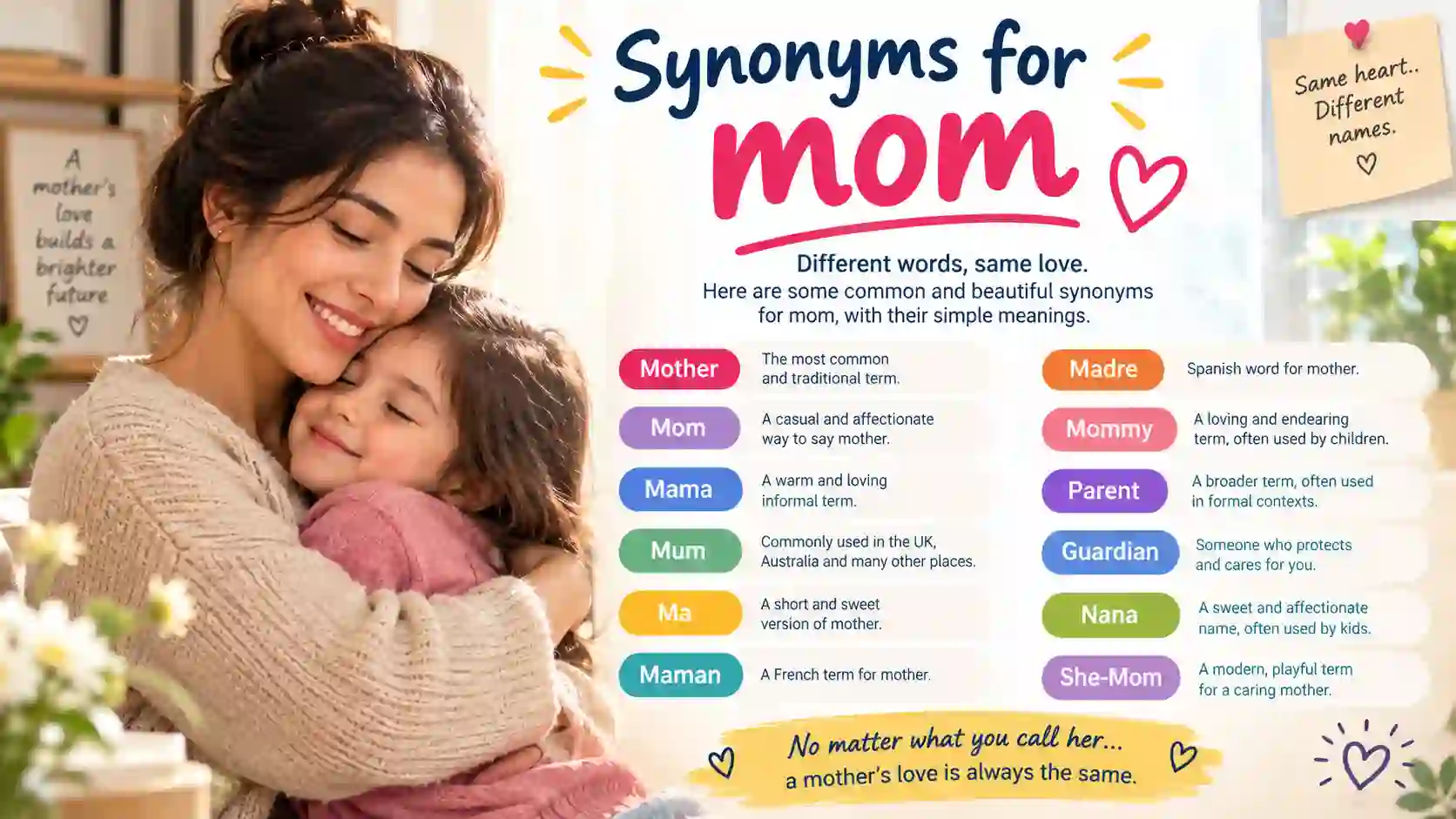
The most common synonyms for mom are mother, mum, mama, mommy, momma, ma, and mummy. These words refer to a mother, but their tone and regional use differ. Mom is common in American English, mum in British English, and mother works in both formal and everyday contexts.
What should you call your mother in a birthday card, a family story, or a casual conversation? The answer depends on your relationship, the tone you want, and the type of English you use.
For example, an American might say, “My mom is coming home,” while a British speaker might say, “My mum is coming home.” Both sentences are correct. Other families prefer names such as Mama, Momma, or Ma.
Learning synonyms for mom helps you express warmth without choosing a word that sounds strange or too formal. It also helps students, writers, bloggers, and English learners understand family vocabulary. This guide explains the most useful alternatives, their meanings, pronunciation, origins, and common mistakes.
What Does Mom Mean?
Mom is an informal noun that means a person’s mother. People use it when talking about their mother and when speaking directly to her.
Examples:
- My mom works at a local school.
- Mom, could you check this message?
- We bought a gift for our friend’s mom.
The word can also appear in wider cultural use. For example, people sometimes call a caring or protective person “mom” as a friendly expression, even when that person is not their parent. Context helps the reader understand the intended meaning.
Pronunciation of Mom
- IPA, American English: /mɑːm/ in Cambridge’s transcription
- IPA, British English: /mɒm/
- Simple guide: “mahm” in many American accents
- Part of speech: Countable noun
- Register: Informal
- Frequency: Very common in American English
- CEFR: Cambridge labels mom A1
Pronunciation can vary within both countries. The difference between mom and mum is mainly a spelling and regional vocabulary distinction, though their vowel sounds also differ in many accents.
Word Origin: Where Does Mom Come From?
Mom developed as a familiar form of mother, alongside related forms such as momma and mommy. Dictionary.com gives the first recorded period for mom as 1845–50 and describes it as a shortened form of momma.
This date refers to recorded evidence, not necessarily the first time anyone spoke the word. Informal family words often existed in speech before dictionaries recorded them.
Related forms developed in different communities. English speakers use mama, mamma, mum, and mummy according to regional patterns and family traditions. These forms share a connection with mother-related vocabulary, but their histories are not all identical.
15 Useful Synonyms and Alternative Names for Mom
1. Mother
Meaning: A female parent.
Pronunciation: /ˈmʌð.ər/ in American and British dictionary transcriptions, with accent differences.
Examples:
- My mother taught me to cook.
- Her mother helped her prepare for the exam.
Tone: Neutral to formal.
Frequency: Very common.
Best use: Essays, official documents, family stories, and everyday conversation.
Common collocations: loving mother, biological mother, mother and child.
When not to use it: In a very casual family message, Mom may sound more natural.
2. Mum
Meaning: An informal word for mother, especially in British English.
Examples:
- My mum will meet us after work.
- I made a card for Mum.
Tone: Informal and affectionate.
Frequency: Very common in British English.
Best use: British English conversations and writing.
Common collocations: my mum, Mum and Dad, working mum.
When not to use it: Do not assume mum is the usual spelling in standard American English.
3. Mama
Meaning: An affectionate name for a mother.
Examples:
- Mama saved me a piece of cake.
- I called Mama to share the good news.
Tone: Warm and familiar.
Frequency: Common, with regional variation.
Best use: Family conversations, emotional messages, and personal stories.
Common collocations: dear Mama, Mama’s love, Mama and me.
When not to use it: It may not match the name a particular person prefers.
4. Mommy
Meaning: An affectionate term for mother, often used by children in American English.
Examples:
- The child asked Mommy to read one more story.
- We made a handmade gift for Mommy.
Tone: Informal, loving, often child-directed.
Frequency: Common in the United States.
Best use: Children’s dialogue, family messages, and affectionate captions.
Common collocations: Mommy and me, new mommy, Mommy’s hug.
When not to use it: It may sound too childish in formal writing.
5. Momma
Meaning: An informal variant of mama.
Examples:
- Momma called just before dinner.
- He wrote a short song for Momma.
Tone: Affectionate and informal.
Frequency: Common in some American families and communities.
Best use: Family dialogue, personal writing, and informal captions.
Common collocations: Momma’s kitchen, dear Momma, Momma’s advice.
When not to use it: Do not change someone’s preferred spelling just for variety.
6. Mamma
Meaning: A variant spelling of mama.
Examples:
- The character called for Mamma.
- She kept a photograph labeled “Mamma.”
Tone: Affectionate, sometimes traditional.
Frequency: Less common than mom in everyday American English.
Best use: Family names, cultural contexts, and literary dialogue.
Common collocations: dear Mamma, Mamma’s letter.
When not to use it: Use it only when it suits the family’s preferred form or the writing style.
7. Ma
Meaning: An informal word for mother.
Examples:
- Ma asked me to bring home some bread.
- “Thanks, Ma,” he said with a smile.
Tone: Familiar and informal.
Frequency: Common in some communities; less common in others.
Best use: Natural dialogue and family speech.
Common collocations: Ma and Pa, dear Ma, Ma’s house.
When not to use it: It may sound old-fashioned or regional if you do not normally use it.
8. Mam
Meaning: A regional informal word for mother, used in parts of northern England and other communities.
Examples:
- I asked Mam about the family visit.
- He called his mom on the way home.
Tone: Informal and regional.
Frequency: Common in some regional varieties.
Best use: Regional dialogue or writing that reflects a speaker’s natural voice.
Common collocations: my mam, Mam and Dad, Mam’s house.
When not to use it: It is not the standard term in every English-speaking region.
9. Mummy
Meaning: An affectionate word for mother, especially associated with children in British English.
Examples:
- The little boy wanted Mummy to stay.
- She made a drawing for Mummy.
Tone: Affectionate and informal.
Frequency: Common in British English.
Best use: Children’s speech and family contexts.
Common collocations: Mummy and me, Mummy’s hug, new mummy.
When not to use it: In most American contexts, mommy is the more familiar spelling.
10. Mammy
Meaning: A regional or historical term for mother, with meanings that depend on context.
Examples:
- The historical story used the word Mammy in dialogue.
- The character called for Mammy in the old family tale.
Tone: Regional or historical; context-sensitive.
Frequency: Less common in general modern English.
Best use: Carefully researched historical or regional writing.
Common collocations: historical dialogue, regional speech.
When not to use it: The term has culturally sensitive historical associations, including racist stereotypes. Do not use it casually as a universal affectionate nickname.
11. Mater
Meaning: A traditional or humorous term for mother.
Examples:
- The character wrote a note to his master.
- In the old story, she referred to her mother as Mater.
Tone: Old-fashioned and sometimes humorous.
Frequency: Uncommon.
Best use: Literary dialogue or a deliberate comic effect.
Common collocations: old-fashioned expression, comic dialogue.
When not to use it: It usually sounds unnatural in everyday modern conversation.
12. Birth Mother
Meaning: The woman who gave birth to a person.
Examples:
- He wanted to learn more about his birth mother.
- She met her birth mother as an adult.
Tone: Neutral and specific.
Frequency: Common in adoption-related discussions.
Best use: When the distinction between a birth parent and another parent matters.
Common collocations: birth mother, birth family, birth records.
When not to use it: Do not assume that every person uses this term for the mother who raised them.
13. Biological Mother
Meaning: A person’s mother through a biological relationship.
Examples:
- The medical form asked about her biological mother.
- He wanted information about his biological mother’s health history.
Tone: Neutral and factual.
Frequency: Common in medical, family-history, and adoption contexts.
Best use: When biological relationships are relevant.
Common collocations: biological mother, biological parent, family history.
When not to use it: It may sound impersonal in an affectionate message.
14. Adoptive Mother
Meaning: A woman who becomes a child’s parent through adoption.
Examples:
- Her adoptive mother supported her education.
- He thanked his adoptive mother during the graduation ceremony.
Tone: Neutral and specific.
Frequency: Common in adoption-related writing.
Best use: When adoption is relevant to the relationship.
Common collocations: adoptive mother, adoptive family, adoption process.
When not to use it: Do not assume a person wants this label used in ordinary conversation. Many people simply say my mom.
15. Foster Mother
Meaning: A woman who cares for a child placed with her through a foster-care arrangement.
Examples:
- His foster mother helped him settle into a new school.
- She stayed in contact with her foster mother after leaving care.
Tone: Neutral and specific.
Frequency: Common in social-care contexts.
Best use: When describing a foster-care relationship accurately.
Common collocations: foster mother, foster family, foster care.
When not to use it: It is not interchangeable with birth mother or adoptive mother.
Quick Synonyms Table
| Word | Meaning or nuance | Register |
| Mother | Standard term for a female parent | Neutral/formal |
| Mum | Regional informal form | Informal |
| Mama | Affectionate family name | Informal |
| Mommy | Often child-directed | Informal |
| Momma | Familiar variant of mama | Informal |
| Mamma | Variant spelling | Informal/traditional |
| Ma | Short informal name | Informal |
| Mam | Regional form | Informal |
| Mummy | British child-directed form | Informal |
| Mammy | Regional or historical form | Context-sensitive |
| Mater | Old-fashioned or humorous term | Literary |
| Birth mother | Mother who gave birth to someone | Specific |
| Biological mother | Mother by biological relationship | Factual |
| Adoptive mother | Mother through adoption | Specific |
| Foster mother | Mother figure in a foster-care arrangement | Specific |
Choose the Right Synonym: Side by Side Comparisons
| Situation | Best choice | Why |
| Casual US conversation | Mom | Natural American usage |
| Casual UK conversation | Mum | Natural British usage |
| A child speaking affectionately | Mommy or Mummy | Familiar, child-directed forms |
| A personal letter | Dear Mom or Dear Mum | Warm form of address |
| A formal report | Mother | Clear and standard |
| Adoption-related discussion | Birth mother or adoptive mother | Identifies the relevant relationship |
| Regional dialogue | Ma or Mam | Reflects a speaker’s local usage |
Remember: A word can be related to mom without being a true synonym. Caregiver describes someone who provides care, while matriarch describes a woman who leads or holds a central position in a family. Neither word necessarily means mother.
American vs. British English
| American English | British English | Note |
| Mom | Mum | Main regional difference |
| Mommy | Mummy | Common child-directed forms |
| Momma | Mama or other family forms | Usage varies |
| Mother | Mother | Used in both varieties |
| Ma | Ma | Regional and family variation |
The words in this table are broad patterns, not strict rules. English-speaking families often have their own names for mothers, and those names may not match the most common regional form.
Common Grammar Mistakes
Mistake 1: Incorrect capitalization
Incorrect: My Mom works at a hospital.
Better: My mom works at a hospital.
Explanation: Use lowercase mom when describing your mother as a common noun. Capitalize Mom when using it like a name: “Thank you, Mom.”
Mistake 2: Using the wrong regional spelling
Incorrect for standard US usage: My mum is coming home.
Better for standard US usage: My mom is coming home.
Explanation: Mum is standard in British English. The original sentence is still understandable, but it may not match the intended regional style.
Mistake 3: Treating all family terms as identical
Incorrect: My foster mother is the woman who gave birth to me.
Better: My birth mother is the woman who gave birth to me. My foster mother cared for me through a foster-care arrangement.
Explanation: These words describe different relationships. Use the term that accurately reflects the situation.
Mistake 4: Using a child directed term in formal writing
Less suitable: The patient came with her mommy.
Better in a formal report: The patient came with her mother.
Explanation: Choose a term that matches the audience and purpose.
Related Vocabulary
These words connect to motherhood but are not direct synonyms for mom.
- Maternal: Related to a mother.
- Motherhood: The state or experience of being a mother.
- Motherly: Showing care or affection associated with a mother.
- Maternity: The state or period associated with being a mother, especially pregnancy and childbirth.
- Mothering: Caring for or raising a child.
- Parenting: The work of raising and caring for a child.
- Caregiver: Someone who looks after another person.
- Guardian: Someone with legal responsibility for another person’s care or decisions.
- Matriarch: A woman who leads or holds a respected position in a family or group.
Does Mom Have an Antonym?
There is no exact antonym for mom. Father is a related family term that contrasts with mother in the usual mother-father distinction, but it is not an antonym in the same way that hot contrasts with cold.
Frequently Asked Questions
1. What is another word for mom?
The most common alternatives are mother, mum, mama, mommy, momma, and ma. The best choice depends on regional English and personal preference. Mother works in formal and everyday settings, while affectionate forms are more common in family conversations and personal messages.
2. What is the difference between mom and mum?
Mom is the standard informal spelling in American English, while mum is standard in British English. Both words mean mother. Choose the spelling that fits your audience, or use the form that a person and their family prefer.
3. What is a cute nickname for mom?
Common affectionate names include Mama, Momma, Mommy, Mummy, and Ma. Some families also use private nicknames with special meaning. The best name is one that feels natural and respectful to the person receiving it.
4. Is mama the same as mom?
Yes, mama and mom can refer to the same person. Their tone may differ, however. Mom is a common everyday term in American English, while mama often sounds more affectionate or reflects a family’s cultural or regional tradition.
5. What is a formal synonym for mom?
Mother is the most useful general formal alternative. In technical writing, female parents may sometimes be appropriate. In adoption-related writing, terms such as birth mother or adoptive mother can provide more detail when the relationship matters.
6. What is the British word for mom?
The usual British English equivalent is mum. Mummy is also common as an affectionate or child-directed form. Both are correct in their usual contexts, but mom is more strongly associated with American English.
7. Is caregiver another word for mom?
Not exactly. A caregiver is anyone who looks after another person, including a parent, relative, or professional. A mother may be a caregiver, but the word describes the work of providing care rather than the family relationship itself.
8. How do you capitalize mom in a sentence?
Capitalize Mom when you use it as a name or direct form of address, as in “I love you, Mom.” Use lowercase mom when you describe the relationship, as in “My mom is a teacher.” The same general distinction applies to mum and mother when used as names.
Mini Practice Exercises
Exercise 1: Fill in the blanks
Choose the best word: mom, mum, mother, or caregiver.
- In standard American English, “My ___ is picking me up.”
- In standard British English, “My ___ is picking me up.”
- The official report used the word “___” for a female parent.
- A nurse who looks after an older adult may be a ___.
Exercise 2: Rewrite the sentence
Rewrite each sentence using the word in brackets.
- My mom is coming home. (mother)
- My mother is coming home. (mum, British English)
- The woman who gave birth to him contacted him. (birth mother)
Exercise 3: Match the words
Match each word with its meaning.
- Matriarch
- Adoptive mother
- Mommy
- Guardian
A. A child-directed affectionate term for mother
B. A person with legal responsibility for another person
C. A woman who becomes a parent through adoption
D. A woman who leads or holds a central position in a family
Answer Key
1:
- mom
- mum
- mother
- caregiver
2:
- My mother is coming home.
- My mum is coming home.
- His birth mother contacted him.
3:
- D
- C
- A
- B
Conclusion
Learning synonyms for mom helps you speak and write with greater accuracy. Use mother for a neutral or formal tone, mom in American English, mum in British English, and affectionate names such as Mama or Mommy when they fit the relationship.
Remember that related words do not always mean the same thing. Practice these terms in conversations, letters, essays, and stories to build a stronger vocabulary.
References
- Cambridge Dictionary, Mom
- Cambridge Dictionary, Mother
- Cambridge Dictionary, Mommy
- Collins English Thesaurus, Mom synonyms
- Dictionary.com, Mom

Synonorm is a trusted English vocabulary resource created to help readers find the right words and understand the differences between similar terms. We provide clear explanations of synonyms, meanings, examples, usage, and alternatives. Our content makes vocabulary easier to learn and apply in everyday, academic, and professional English. Synonorm is designed for students, writers, ESL learners, professionals, and anyone who wants to improve their English vocabulary and communicate more clearly.