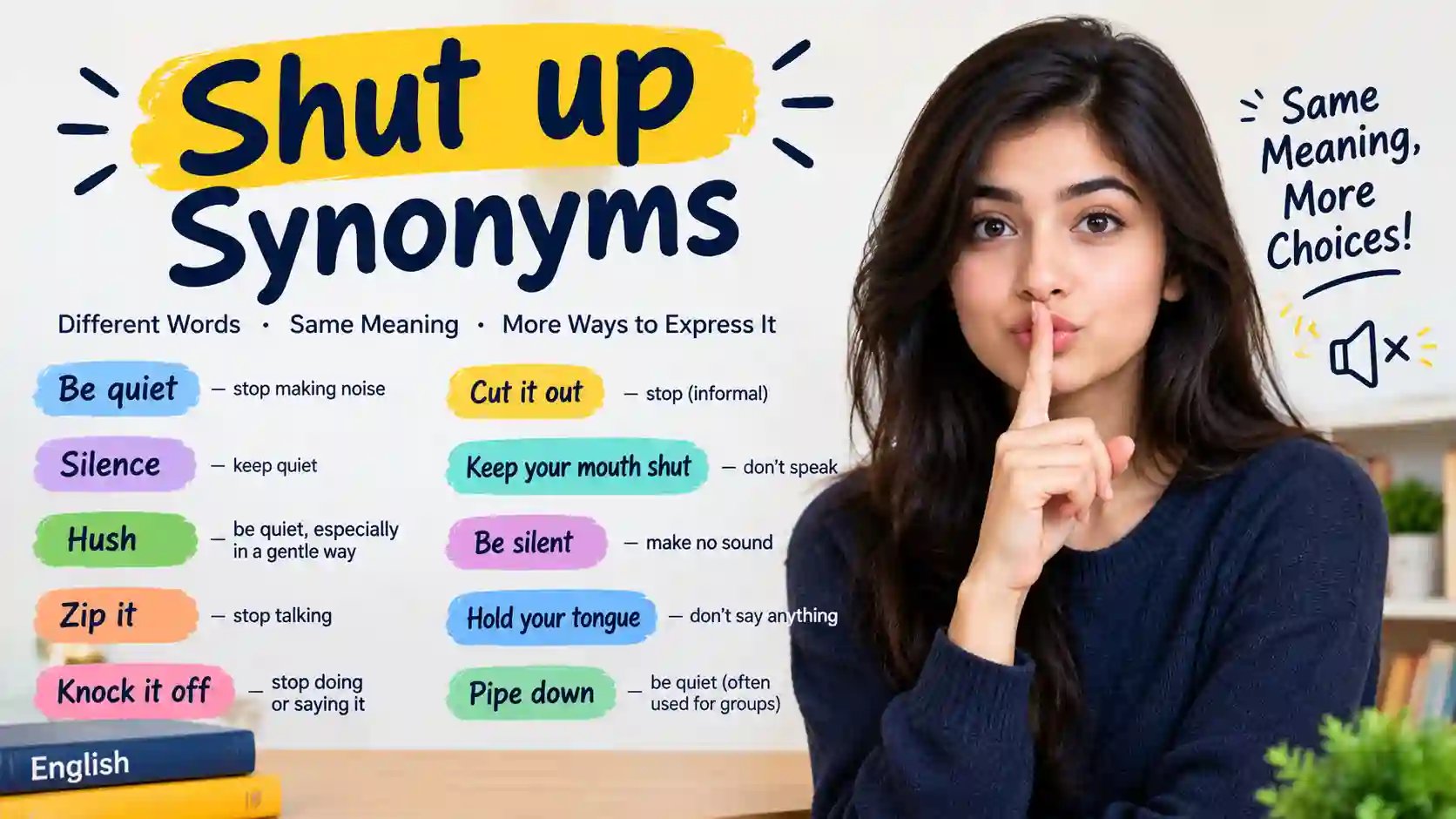
Quick Answer: What Are Synonyms for Shut Up?
Common synonyms for shut up include be quiet, stop talking, keep quiet, hush, shush, pipe down, and fall silent. These phrases tell someone to stop speaking or making noise, but their tone can differ. Use be quiet for a neutral request, please let me finish when someone interrupts, and pipe down only in informal situations where a firm tone is suitable.
Have you ever wanted someone to stop talking but struggled to find the right words? English offers many alternatives to shut up, and each one sends a slightly different message.
For example, you might say “Please be quiet” in a classroom or “Could you let me finish?” during a meeting. Both phrases address a speaking problem without sounding as harsh as “Shut up!”
Learning shut up synonyms helps students, English learners, writers, and professionals express themselves more clearly. This guide explains 20 useful alternatives, shows how they differ, and helps you choose the right phrase for each situation.
Pronunciation and Meaning
- Phrase: Shut up
- IPA: /ʃʌt ʌp/
- Part of speech: Phrasal verb; also an informal interjection
- Register: Informal, often rude when used as a command
- Frequency: Very common
Shut up usually means to stop talking or making noise. It can also mean making someone stop speaking.
However, the phrase has another common use. When a friend says, “Shut up! You won the prize?” they may be expressing surprise rather than ordering anyone to be quiet.
The context and tone help listeners understand the intended meaning.
20 Useful Synonyms for Shut Up
1. Be Quiet
Meaning: Stop talking or making noise.
Examples:
- Please be quiet while the teacher explains the lesson.
- The audience became quiet when the performance began.
Tone: Neutral. Best for: Classrooms, libraries, and everyday requests.
This is one of the safest alternatives to shut up. Adding please can make it more courteous.
Common combinations: be quiet, stay quiet, keep quiet.
2. Stop Talking
Meaning: End the act of speaking.
Examples:
- Please stop talking while I give the instructions.
- The children stopped talking when the film started.
Tone: Neutral to firm. Best for: Situations where someone needs to stop speaking completely.
Unlike lower your voice, this phrase asks for an end to speech rather than a reduction in volume.
Common combinations: stop talking immediately, stop talking over someone, stop talking for a moment.
3. Keep Quiet
Meaning: Stay silent or avoid sharing information.
Examples:
- Please keep quiet during the examination.
- We kept quiet about the surprise celebration.
Tone: Neutral. Best for: Silence or secrecy, depending on context.
Notice the difference between “Keep quiet during the test” and “Keep quiet about the plan.” The first concerns noise, while the second concerns information.
Common combinations: keep quiet about, keep quiet for now, keep quiet during class.
4. Keep Silent
Meaning: Avoid speaking.
Examples:
- The witness chose to keep silent.
- Students must keep silent during the recording.
Tone: Neutral to formal. Best for: Formal instructions and situations involving deliberate silence.
This expression can sound more serious than be quiet. It is less natural as a casual command between friends.
5. Be Silent
Meaning: Make no sound or say nothing.
Examples:
- The room was silent after the announcement.
- Please be silent while the recording plays.
Tone: Neutral to formal. Best for: Describing silence or giving a clear instruction.
Use silent when no speech or sound is wanted. For a softer request, say “Could you please be quiet?”
6. Hush
Meaning: Become quiet or make someone quiet.
Examples:
- Hush, the baby is sleeping.
- The parent tried to hush the noisy child.
Tone: Informal, sometimes gentle. Best for: Quieting noise in a calm or caring setting.
Hush is short and expressive. However, it can sound patronizing when directed at another adult.
7. Shush
Meaning: Tell someone to stop making noise, often with a “shh” sound.
Examples:
- She shushed her brother during the play.
- The audience shushed the people talking nearby.
Tone: Informal. Best for: Asking someone to stop disturbing a quiet place.
Hush and shush overlap in meaning. Shush often draws attention to the act of telling someone to be quiet.
8. Pipe Down
Meaning: Stop talking so loudly or noisily.
Examples:
- Could you pipe down? I am trying to read.
- The group finally piped down when the speaker arrived.
Tone: Informal, sometimes rude. Best for: Noisy situations among people who know one another.
This phrase can sound impatient. Avoid it in formal emails or sensitive conversations.
9. Quiet Down
Meaning: Become less noisy.
Examples:
- The children quieted down after the game.
- Please quiet down so everyone can hear the announcement.
Tone: Neutral to firm. Best for: Reducing noise without requiring complete silence.
This phrase is useful when people may continue talking, but they need to lower the noise level.
10. Fall Silent
Meaning: Stop speaking, often after a particular event.
Examples:
- The room fell silent when the lights went out.
- He fell silent after hearing the unexpected news.
Tone: Neutral to literary. Best for: Stories and descriptions of reactions.
Unlike shut up, this expression usually describes what happens. It is not a natural everyday command.
11. Hold Your Tongue
Meaning: Stop yourself from speaking.
Examples:
- She held her tongue rather than start an argument.
- He was told to hold his tongue during the discussion.
Tone: Firm, informal, sometimes old-fashioned. Best for: Situations involving restraint or an instruction not to speak.
It often suggests that someone has something to say but should not say it.
12. Remain Silent
Meaning: Continue not speaking.
Examples:
- The witness remained silent throughout the interview.
- Please remain silent until your name is called.
Tone: Formal. Best for: Official instructions, formal writing, and serious situations.
Use remain silent when silence must continue over a period. It may sound stiff in casual conversation.
13. Say Nothing
Meaning: Speak no words about a matter.
Examples:
- I decided to say nothing about the mistake.
- He said nothing while the others discussed the issue.
Tone: Neutral. Best for: Describing a person’s choice not to speak.
This phrase does not always mean someone has been told to stop talking. It often describes what a person chooses to do.
14. Keep Your Voice Down
Meaning: Speak more quietly.
Examples:
- Please keep your voice down in the hospital.
- They kept their voices down during the meeting.
Tone: Neutral to polite. Best for: Reducing volume.
This is not an exact synonym for shut up. It lets someone continue speaking, but more quietly.
15. Lower Your Voice
Meaning: Reduce the loudness of your speech.
Examples:
- Please lower your voice in the waiting room.
- He lowered his voice so he would not wake the baby.
Tone: Neutral. Best for: Conversations where the noise level is the problem.
Choose this phrase when someone is too loud but does not need to stop speaking.
16. Please Let Me Finish
Meaning: Allow someone to complete what they are saying.
Examples:
- Please let me finish before you respond.
- I would like to hear your view, but please let me finish first.
Tone: Polite and assertive. Best for: Meetings, discussions, and conversations involving interruptions.
This is often better than telling someone to shut up because it explains exactly what you need.
17. Stop Interrupting
Meaning: Stop breaking into someone else’s speech.
Examples:
- Please stop interrupting while I explain the process.
- The teacher asked the students to stop interrupting one another.
Tone: Neutral to firm. Best for: Repeated interruptions.
Use this phrase when the behavior is the issue. It is more precise than a general command to be quiet.
18. Give It a Rest
Meaning: Stop repeating something annoying or irritating.
Examples:
- Give it a rest; we have already discussed this.
- He asked his friend to give it a rest after the same joke was repeated.
Tone: Informal and impatient. Best for: Repeated complaints, teasing, or arguments.
This expression does not always mean “stop talking.” It can refer to another annoying behavior.
19. Zip It
Meaning: Stop talking.
Examples:
- “Zip it for a second,” he joked as the film began.
- She told herself to zip it before making an angry comment.
Tone: Informal, sometimes playful or rude. Best for: Casual speech among friends.
Avoid this expression in formal situations because it can sound dismissive.
20. Put a Sock in It
Meaning: Stop talking or making noise.
Examples:
- He jokingly told his friend to put a sock in it.
- “Put a sock in it,” she snapped when the complaints continued.
Tone: British informal slang, often rude. Best for: Understanding casual dialogue and certain British expressions.
This phrase is useful to recognize, but it is not a safe choice for professional communication.
Strongest Synonyms vs. Related Expressions
Not every expression in a thesaurus means exactly the same thing. Use these categories to choose more accurately.
Direct Alternatives
These most closely express the idea of stopping speech or noise:
- Be quiet
- Stop talking
- Keep quiet
- Keep silent
- Be silent
- Hush
- Shush
- Pipe down
- Quiet down
- Zip it
Expressions About Self Control
These describe choosing not to say something:
- Hold your tongue
- Say nothing
- Bite your tongue
Bite your tongue usually means controlling your own urge to speak. It is not a direct command to another person.
Expressions About Volume or Interruptions
These solve a more specific problem:
- Keep your voice down
- Lower your voice
- Please let me finish
- Stop interrupting
Slang and Strong Commands
These may sound rude or confrontational:
- Put a sock in it
- Zip it
- Pipe down
- Keep your mouth shut
- Button it
Use them carefully, especially with strangers or people you work with.
Choose the Right Synonym: Quick Comparison
| Situation | Best expression | Why it fits |
| A noisy classroom | Please be quiet. | Clear and neutral |
| A loud conversation | Could you lower your voice? | Addresses volume |
| Someone interrupts you | Please let me finish. | Addresses the real problem |
| A formal instruction | Please remain silent. | Formal and clear |
| A friend repeats an annoying joke | Give it a rest. | Informal and context-specific |
| A character in a tense story | “Shut up!” | Shows anger or impatience |
| Someone shares exciting news | “Shut up! Really?” | Expresses surprise |
Grammar: How to Use “Shut Up” Correctly
Shut up is a phrasal verb. Its past tense and past participle are both shut, not shutted.
| Form | Example |
| Base form | Please shut up. |
| Present | He shuts up when the teacher speaks. |
| Past | They shut up after the announcement. |
| Continuous | He is shutting up now. |
| With an object | The news shut him up. |
When the phrase takes an object, the object can appear between shut and up: “She shut him up.” The phrase can also describe closing or confining something, as in “They shut up the old house for the winter.” These are different senses, so choose synonyms that match the intended meaning.
Common Mistakes
Mistake: “He shutted up when the teacher arrived.”
Correction: “He shut up when the teacher arrived.”
Why: The past tense of shut remains shut.
Mistake: “Please lower your voice” when you need complete silence.
Correction: “Please stop talking for a moment.”
Why: Lowering your voice means reducing volume, not ending speech.
Mistake: Using “shut up” in every situation where someone interrupts.
Correction: “Please let me finish.”
Why: The second phrase explains the problem without sounding insulting.
Mistake: Treating “bite your tongue” as a direct synonym for “be quiet.”
Correction: “I bit my tongue rather than argue.”
Why: The idiom describes self-control, not necessarily a command to someone else.
American vs. British English
The expression shut up is understood in both American and British English. In both varieties, it can sound rude when used as a command.
| Expression | Usage note |
| Be quiet | Common in both varieties |
| Pipe down | Informal in both varieties |
| Put a sock in it | Particularly associated with British informal English |
| Keep your voice down | Common in both varieties |
| Zip it | Informal in both varieties |
There is no spelling difference between American and British English for shut up. Pronunciation can vary by accent, but a standard IPA representation is /ʃʌt ʌp/. Regional slang also varies, so learners should understand an expression before using it.
Word Origin and First Known Use
Shut is an old English word related to closing something. Up works as a particle in the phrasal verb shut up. Together, the words have several established meanings, including stopping speech, closing a place, and confining someone.
The expression’s history depends on the meaning being discussed. A reliable first-use date for the specific command to stop talking should not be stated without checking a historical dictionary entry. Modern learner dictionaries establish the current usage, but that alone does not prove the earliest recorded use.
Related Vocabulary and Antonyms
Antonyms
- Speak: Use words to express a thought.
- Talk: Communicate through speech.
- Speak up: Speak louder or express an opinion.
- Start talking: Begin speaking.
- Break the silence: Start speaking or making a sound after a quiet period.
Related Expressions
- Hold your peace: Remain silent, often in a formal or literary context.
- Keep it down: Reduce noise.
- Let someone speak: Allow another person to express an idea.
- Give someone the floor: Allow someone to speak in a discussion.
- Watch what you say: Be careful with your words.
- Keep something to yourself: Do not share information.
Frequently Asked Questions
1. What is the most polite synonym for shut up?
Be quiet is more neutral than shut up, but a complete request is often more polite. Try “Could you please be quiet for a moment?” If someone is interrupting, say “Please let me finish.” Both phrases communicate your needs without the harsh tone of a direct command.
2. What is another word for shut up in a professional setting?
Use remain silent when silence is required, lower your voice when someone is too loud, or please let me finish when someone interrupts. Choose the phrase that matches the problem. Avoid slang and personal attacks when speaking to coworkers, customers, or managers.
3. Is shut up always rude?
No. Shut up often sounds rude when used as a command, but friends may use it playfully. It can also express surprise, as in “Shut up! You won?” Context, tone, and the relationship between speakers help determine its meaning.
4. What are common slang synonyms for shut up?
Common informal alternatives include zip it, pipe down, and button it. Put a sock in it is a recognizable British expression. These phrases can sound impatient or rude, so use them carefully. In polite situations, choose be quiet or please lower your voice.
5. What is the difference between shut up and be quiet?
Both phrases can tell someone to stop talking, but shut up usually sounds more forceful and insulting. Be quiet is more neutral and works in more situations. Adding please and explaining the reason can make a request sound more respectful.
6. What does shut up mean when someone is surprised?
When someone says “Shut up!” after hearing exciting news, they may mean “No way!” or “I can hardly believe it!” For example, “I won free concert tickets.” “Shut up! That is amazing!” Here, the speaker expresses surprise rather than asking anyone to stop talking.
7. What is the difference between hold your tongue and bite your tongue?
Hold your tongue means refraining from speaking, sometimes because someone tells you to stop. Bite your tongue usually means controlling your own urge to speak, especially when angry or tempted to make a remark. Both relate to silence, but their uses differ.
8. What is the opposite of shut up?
The opposite depends on the meaning. Speak and talk express the opposite of remaining silent. Speak up can mean talking louder or expressing an opinion. Break the silence means beginning to speak or make a sound after a quiet period.
Vocabulary Quiz
1. Which phrase is usually the most polite request?
A. Zip it!
B. Could you please be quiet?
C. Put a sock in it!
D. Button it!
2. Which phrase means speaking more softly?
A. Fall silent
B. Hold your tongue
C. Lower your voice
D. Say nothing
3. What does “bite your tongue” usually mean?
A. Speak loudly
B. Stop yourself from saying something
C. Ask someone to whisper
D. Start a conversation
4. Which expression is especially associated with British informal slang?
A. Remain silent
B. Please let me finish
C. Put a sock in it
D. Say nothing
5. Which sentence uses the past tense correctly?
A. He shutted up.
B. He shut up.
C. He shutting up.
D. He shuts up yesterday.
Answer Key
- B
- C
- B
- C
- B
Conclusion
Learning shut up synonyms helps you communicate with more accuracy and confidence. Use be quiet for a neutral request, pipe down for informal speech, or please let me finish when someone interrupts. Each expression has its own tone and purpose.
Practice these alternatives in conversations, emails, essays, and schoolwork. The more you notice how people use them, the easier it becomes to choose words that fit the situation and communicate respectfully.
References
- Oxford Learner’s Dictionaries: Shut up
- Cambridge Dictionary: Shut up
- Collins English Thesaurus: Shut up synonyms
- Merriam-Webster: Dictionary and thesaurus
- Thesaurus.com: Shut up synonyms and antonyms

Synonorm is a trusted English vocabulary resource created to help readers find the right words and understand the differences between similar terms. We provide clear explanations of synonyms, meanings, examples, usage, and alternatives. Our content makes vocabulary easier to learn and apply in everyday, academic, and professional English. Synonorm is designed for students, writers, ESL learners, professionals, and anyone who wants to improve their English vocabulary and communicate more clearly.