Naturally is a useful English adverb, but it does not have one single meaning. Depending on the sentence, it can mean by nature, normally, easily, without artificial help, without pretending, or as expected. That is why the best synonym changes with the context.
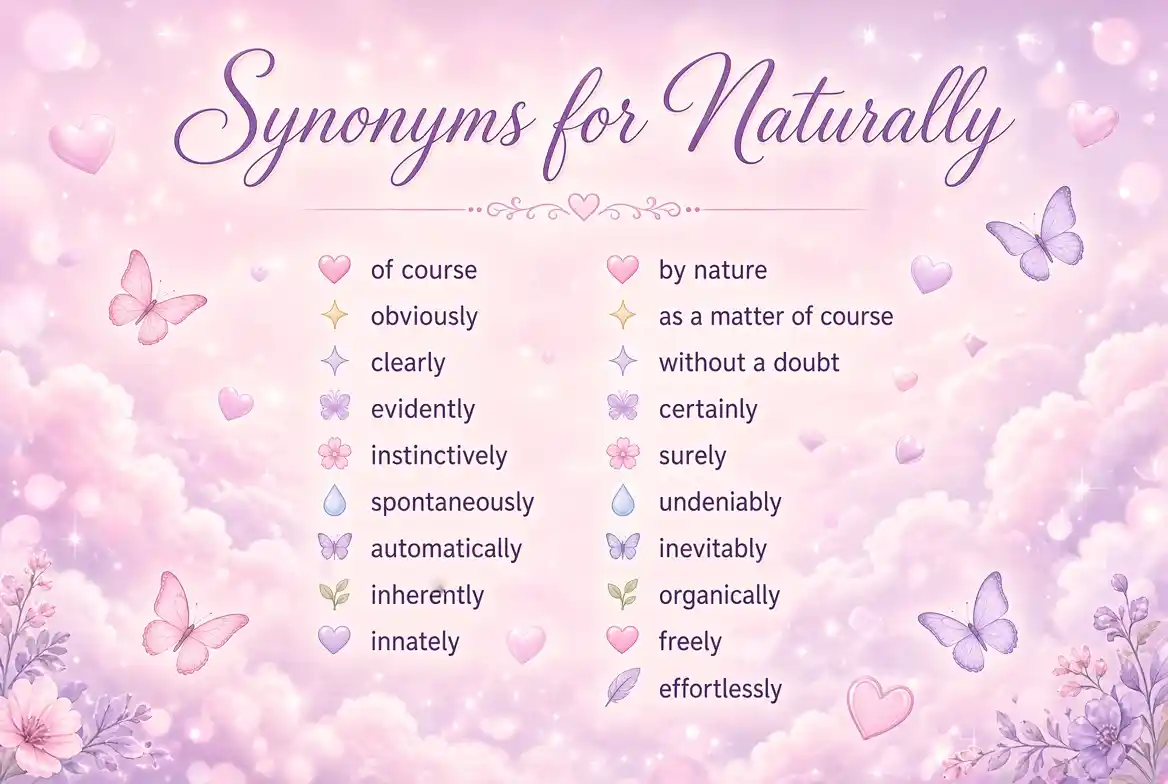
The most useful synonyms for naturally include by nature, inherently, innately, instinctively, intuitively, normally, usually, typically, ordinarily, spontaneously, effortlessly, easily, freely, unaffectedly, genuinely, sincerely, openly, simply, characteristically, readily, organically, of course, certainly, as expected, and as a matter of course.
The key is not to choose the longest or most advanced word. Choose the word that keeps the original meaning.
Quick Answer: The best synonym for naturally depends on its meaning. Use inherently or by nature for an inborn quality, normally or typically for usual behavior, spontaneously for an unplanned action, effortlessly for ease, unaffectedly for an unforced manner, and of course when it means “as expected.”
What Does “Naturally” Mean?
Naturally has several important meanings in modern English.
- By nature or from birth
She is naturally talented. - In a normal way
Try to behave naturally. - Without artificial help
The fruit is naturally sweet. - With little effort
Languages seem to come naturally to her. - Without pretending or acting
He spoke naturally during the interview. - As expected or obviously
Naturally, everyone was worried.
Merriam-Webster and Collins both recognize these different senses, while Cambridge separately identifies meanings involving nature, normal behavior, ability, and expectation.
Pronunciation of Naturally
Naturally
- British English: /ˈnætʃ.ər.ə.li/
- American English: /ˈnætʃ.ɚ.ə.li/
- Simple pronunciation: NATCH-er-uh-lee
The spelling is the same in American and British English. The main difference is the pronunciation of the unstressed middle syllable.
Part of Speech
Naturally is an adverb.
It can modify a verb, adjective, or an entire sentence.
- She naturally smiled.
- He is naturally confident.
- Naturally, we were concerned.
Word family
| Word | Part of speech | Meaning |
| nature | noun | the natural world or essential character |
| natural | adjective | existing by nature or not artificial |
| naturally | adverb | in a natural way or as expected |
| naturalness | noun | the quality of being natural |
Do not describe natural as the adjective form of naturally in the same grammatical sentence. They belong to the same word family but perform different grammatical jobs.
Quick Synonym Guide
| Synonym | Main meaning | Register | Approx. learner level |
| by nature | inherently | Neutral | B1–B2 |
| inherently | by basic nature | Academic/Formal | C1 |
| innately | from birth | Formal/Academic | C1 |
| instinctively | by instinct | Neutral | B2 |
| intuitively | through intuition | Academic/Professional | C1 |
| normally | usually | Neutral | B1 |
| usually | most of the time | Neutral | A2 |
| typically | commonly | Neutral/Formal | B2 |
| ordinarily | under normal conditions | Formal | B2 |
| spontaneously | without planning | Neutral | B2 |
| effortlessly | without apparent effort | Neutral | B2 |
| easily | without difficulty | Neutral | A2 |
| freely | without restriction | Neutral | B1 |
| unaffectedly | without artificial behavior | Formal/Literary | C2 |
| genuinely | sincerely or truly | Neutral | B2 |
| sincerely | honestly or genuinely | Neutral/Formal | B2 |
| openly | without hiding | Neutral | B1 |
| simply | in an uncomplicated way | Neutral | A2–B1 |
| characteristically | in a typical manner | Formal | C1 |
| readily | easily or willingly | Neutral/Formal | B2 |
| organically | through gradual natural development | Business/Professional | C1 |
| of course | as expected | Neutral/Spoken | A2 |
| certainly | definitely | Neutral/Formal | B1 |
| as expected | as predicted | Neutral | B1 |
| as a matter of course | routinely | Formal/Business | C1 |
CEFR levels are approximate learner guidance, not official universal classifications.
1. By Nature
Meaning: Because something is part of someone’s basic character.
Example:
- She is generous by nature.
- He is cautious by nature.
Best used when: You are describing an inborn or long-standing quality.
Register: Neutral
Frequency: Common
Nuance: Strongly emphasizes character.
Collocations:
- curious by nature
- kind by nature
- competitive by nature
When not to use: Do not use it for something that merely happens regularly.
2. Inherently
Meaning: Existing as a basic or essential part of something.
Examples:
- Some tasks are inherently difficult.
- The material is inherently resistant to heat.
Best used when: A quality belongs to something because of its basic nature.
Register: Formal, academic
Frequency: Common
CEFR: C1
Collocations:
- inherently dangerous
- inherently difficult
- inherently valuable
When not to use: Do not use inherently when you simply mean usually.
Merriam-Webster places inherently among the strongest alternatives for the “by natural character or ability” sense.
3. Innately
Meaning: Existing from birth rather than being learned.
Examples:
- Humans are not innately good at every skill.
- She seems innately curious about the world.
Best used when: The quality is believed to be present from birth.
Register: Academic/Formal
Frequency: Common in specialist writing
CEFR: C1
Collocations:
- innately talented
- innately curious
- innately human
When not to use: Avoid it when you only mean “naturally” in the sense of “usually.”
4. Instinctively
Meaning: Without consciously thinking because of instinct.
Examples:
- She instinctively moved away from the door.
- He instinctively knew that something was wrong.
Best used when: An action or reaction happens through instinct.
Register: Neutral
Frequency: Common
CEFR: B2
Collocations:
- instinctively react
- instinctively understand
- instinctively protect
Nuance: This is about instinct, not simply natural ability.
5. Intuitively
Meaning: Understanding or knowing something without conscious step-by-step reasoning.
Examples:
- She intuitively understood the customer’s concern.
- He intuitively knew which option would work best.
Best used when: Someone reaches an understanding through intuition.
Register: Academic/Professional
Frequency: Common
CEFR: C1
When not to use: Do not use it simply to mean “easily.”
6. Normally
Meaning: Usually or under ordinary conditions.
Examples:
- The shop normally closes at nine.
- She normally works from home.
Best used when: You mean “usually.”
Register: Neutral
Frequency: Very common
CEFR: B1
Important distinction:
She naturally understands people.
suggests an inherent ability.
She normally understands people.
suggests that this is what usually happens.
7. Usually
Meaning: On most occasions.
Examples:
- I usually drink tea in the morning.
- He usually arrives early.
Register: Neutral
Frequency: Very common
CEFR: A2
Best used when: You want the simplest everyday alternative to normally.
When not to use: It does not replace naturally when the meaning is “by nature.”
8. Typically
Meaning: In a way that is common or characteristic.
Examples:
- Children typically learn through repetition.
- Winters are typically colder in this region.
Register: Neutral/Formal
Frequency: Very common
CEFR: B2
Collocations:
- typically used
- typically found
- typically associated
Best used when: Describing a common pattern.
9. Ordinarily
Meaning: Usually or under normal circumstances.
Examples:
- I would ordinarily agree with you.
- The office is ordinarily closed on Sundays.
Register: Formal
Frequency: Common
CEFR: B2
When not to use: It may sound unnecessarily formal in casual conversation.
10. Spontaneously
Meaning: Without planning or preparation.
Examples:
- The crowd spontaneously began to sing.
- We spontaneously decided to visit the beach.
Register: Neutral
Frequency: Common
CEFR: B2
Best used when: The important idea is that something was unplanned.
Do not confuse: Spontaneously does not mean “by nature” in every context.
Collins lists spontaneously with the “natural or normal way” sense, but the word itself specifically adds the idea of an unplanned action.
11. Effortlessly
Meaning: With little or no apparent effort.
Examples:
- She effortlessly switched between languages.
- The athlete moved effortlessly across the field.
Register: Neutral
Frequency: Common
CEFR: B2
Collocations:
- effortlessly combine
- effortlessly move
- effortlessly handle
Best used when: You want to emphasize ease.
When not to use: Use normally instead if you mean “usually.”
12. Easily
Meaning: Without difficulty.
Examples:
- She easily solved the problem.
- This skill came easily to him.
Register: Neutral
Frequency: Very common
CEFR: A2
Nuance: Easily focuses on difficulty. Naturally can suggest that something feels instinctive or inborn.
13. Freely
Meaning: Without restriction or control.
Examples:
- The students freely shared their ideas.
- Air can move freely through the room.
Register: Neutral
Frequency: Very common
CEFR: B1
When not to use: Do not use freely merely because something is natural.
14. Unaffectedly
Meaning: Without artificial behavior or an attempt to impress.
Examples:
- She spoke unaffectedly about her success.
- He answered the questions unaffectedly.
Register: Formal/Literary
Frequency: Uncommon
CEFR: C2
Best used when: Someone behaves in a sincere, unpretentious manner.
When not to use: Avoid this word in basic everyday English when naturally or genuinely is clearer.
15. Genuinely
Meaning: In a sincere or real way.
Examples:
- She was genuinely happy for him.
- I genuinely believe the idea can work.
Register: Neutral
Frequency: Common
CEFR: B2
Nuance: Focuses on sincerity rather than natural occurrence.
16. Sincerely
Meaning: In an honest or genuine way.
Examples:
- He sincerely wanted to help.
- She sincerely apologized for the mistake.
Register: Neutral/Formal
Frequency: Common
CEFR: B2
Best used when: You want to emphasize honesty or genuine feeling.
17. Openly
Meaning: Without hiding thoughts, feelings, or actions.
Examples:
- They openly discussed the problem.
- He openly admitted his mistake.
Register: Neutral
Frequency: Common
CEFR: B1
Nuance: Openly is about transparency, not natural ability.
18. Simply
Meaning: In a plain, uncomplicated, or straightforward way.
Examples:
- She simply smiled.
- He simply explained what had happened.
Register: Neutral
Frequency: Very common
CEFR: A2–B1
When not to use: Do not replace every use of naturally with simply. The meanings overlap only in certain contexts.
19. Characteristically
Meaning: In a way that is typical of a person or thing.
Examples:
- She characteristically remained calm.
- He characteristically avoided unnecessary conflict.
Register: Formal
Frequency: Uncommon
CEFR: C1
Best used when: You are pointing to a recognizable pattern or trait.
20. Readily
Meaning: Easily, quickly, or willingly.
Examples:
- The information is readily available.
- She readily accepted the offer.
Register: Neutral/Formal
Frequency: Common
CEFR: B2
Important: Readily has more than one meaning, so context matters.
21. Organically
Meaning: Through gradual, natural development rather than a highly controlled process.
Examples:
- The community grew organically.
- The conversation developed organically.
Register: Professional/Business
Frequency: Common in modern professional writing
CEFR: C1
Best used when: Talking about gradual development, communities, brands, ideas, or conversations.
When not to use: Do not use it as a universal synonym for naturally.
22. Of Course
Meaning: Obviously, certainly, or as expected.
Examples:
- Of course, she was worried.
- “Can you help me?” “Of course.”
Register: Neutral/Spoken
Frequency: Extremely common
CEFR: A2
Best used when: Naturally means “as you would expect.”
Collins explicitly places of course under the “as expected” sense of naturally.
23. Certainly
Meaning: Definitely or without doubt.
Examples:
- She certainly deserves the award.
- We can certainly help you.
Register: Neutral/Formal
Frequency: Very common
CEFR: B1
Important: This is only a contextual synonym for naturally, especially when naturally means “of course.” It is not a replacement for naturally meaning “by nature.”
24. As Expected
Meaning: In the way that was predicted or anticipated.
Examples:
- As expected, the results improved.
- The meeting was, as expected, quite long.
Register: Neutral
Frequency: Common
CEFR: B1
Best used when: The outcome was predictable.
25. As a Matter of Course
Meaning: As a normal, routine, or expected part of something.
Examples:
- Safety checks are performed as a matter of course.
- New employees receive basic training as a matter of course.
Register: Formal/Business
Frequency: Uncommon
CEFR: C1
When not to use: It is too formal for most everyday conversations.
The Best Synonym Depends on the Meaning
This is the most important lesson for English learners.
| Original meaning of naturally | Best alternatives |
| by nature | by nature, inherently, innately |
| from instinct | instinctively |
| through intuition | intuitively |
| usually | normally, usually, typically |
| without planning | spontaneously |
| with little effort | effortlessly, easily |
| without restriction | freely |
| without pretending | unaffectedly, genuinely |
| openly and honestly | openly, sincerely |
| as expected | of course, as expected |
| as a routine | as a matter of course |
| through gradual development | organically |
Common Mistakes With Naturally
Mistake 1
Wrong idea:
She normally has a natural talent for music.
If the intended meaning is that her talent is inherent:
Better:
She naturally has a talent for music.
Mistake 2
Wrong:
He spontaneously knows how to play the piano.
Better:
He naturally knows how to play the piano.
Or, if the meaning is instinctive:
He instinctively knows what to do.
Why?
Spontaneously describes an unplanned action. It does not normally describe an inborn ability.
Mistake 3
Wrong:
The information is naturally available online.
If you mean “easy to obtain”:
Better:
The information is readily available online.
Mistake 4
Wrong:
She certainly speaks French because she learned it as a child.
If you mean she has an inborn or effortless ability, certainly does not express that meaning.
Better:
She naturally speaks French.
Or:
She speaks French effortlessly.
Naturally vs Normally vs Usually vs Typically
These four words are especially easy to confuse.
Naturally
Focuses on nature, an unforced manner, or expectation.
She naturally makes people feel comfortable.
Normally
Focuses on ordinary circumstances.
She normally works from home.
Usually
Focuses on frequency.
She usually arrives before nine.
Typically
Focuses on a common pattern or characteristic.
New students typically need time to adjust.
Remember: A thesaurus may place these words together, but that does not make them interchangeable in every sentence. Merriam-Webster and Collins both separate the relevant senses rather than treating the words as universal substitutes.
Naturally vs Instinctively
These words overlap when talking about abilities or reactions.
She naturally understood the situation.
This may mean understanding came easily or was part of her ability.
She instinctively understood the situation.
This suggests an instinctive reaction without conscious reasoning.
Simple rule:
Naturally = inherent or easy
Instinctively = based on instinct
Naturally vs Spontaneously
They naturally started talking.
This can suggest the conversation developed smoothly without being forced.
They spontaneously started talking.
This emphasizes that the action was unplanned.
Simple rule:
Naturally = unforced
Spontaneously = unplanned
Naturally vs Effortlessly
She naturally attracts attention.
This may suggest an inherent quality.
She effortlessly attracts attention.
This emphasizes how little effort appears to be required.
The second sentence focuses more strongly on ease.
Naturally vs Genuinely
He spoke naturally.
This can mean he did not sound forced or artificial.
He spoke genuinely.
This emphasizes sincerity.
Naturally = unforced
Genuinely = sincere
American vs British English
Naturally it is spelled the same in American and British English.
The main difference is pronunciation:
- British: /ˈnætʃ.ər.ə.li/
- American: /ˈnætʃ.ɚ.ə.li/
The major synonym choices are also broadly shared across both varieties. Words such as normally, typically, inherently, spontaneously, instinctively, and genuinely work in both.
Some formal expressions, such as as a matter of course, may occur more often in formal British contexts, but they are understood in American English too.
Cambridge provides separate UK and US pronunciation information and distinguishes several meanings of naturally.
Word Origin and Etymology
Naturally comes from natural + -ly.
The word ultimately traces back through Old French to Latin naturalis, from natura, meaning “nature.” Etymonline dates the adverb naturally to the late 13th century, originally with senses connected to inherent character and nature. Later meanings developed to include “normally,” “expectedly,” and “without artificial assistance.”
Merriam-Webster also gives the first known use of “naturally” dating to the 13th century.
This history explains why today’s meanings still connect to ideas such as:
- nature
- inherent qualities
- normal development
- natural processes
- expected results
- unforced behavior
Native-Speaker Collocations With Naturally
One of the best ways to learn a synonym is to study the words that commonly appear around it.
Common patterns
- naturally occurring
- naturally talented
- naturally gifted
- naturally curious
- naturally confident
- naturally good at
- come naturally
- develop naturally
- grow naturally
- occur naturally
- behave naturally
- speak naturally
- react naturally
- naturally assume
- naturally expect
Especially useful phrase: “come naturally”
Come naturally means that a skill is easy for someone to learn or perform.
Public speaking came naturally to her.
Mathematics does not come naturally to everyone.
Cambridge specifically comes naturally as a phrase meaning that someone can do something easily, with little effort or learning.
Writing Tips: How to Replace Naturally
In academic writing
Instead of repeating naturally, consider:
- inherently
- typically
- characteristically
- intuitively
- generally
But only choose a word when its meaning is accurate.
In business writing
Useful options include:
- typically
- readily
- organically
- inherently
- as a matter of course
In everyday conversation
Prefer simple words:
- naturally
- usually
- normally
- easily
- of course
- simply
In creative writing
These can add more precise nuance:
- instinctively
- spontaneously
- effortlessly
- unselfconsciously
- unaffectedly
Antonyms of Naturally
The opposite depends on the meaning.
If naturally means “in a natural way”
- artificially
- unnaturally
If naturally means “usually”
- unusually
- abnormally
- atypically
If naturally means “without pretending”
- artificially
- affectedly
- pretentiously
- insincerely
Merriam-Webster specifically lists artificially and unnaturally as antonyms for the “inherently” sense.
Mini Practice Quiz
Fill in the blanks
Choose from naturally, normally, instinctively, spontaneously, effortlessly.
- She ______ knew that the child needed help.
- The company ______ closes at 6 p.m.
- The audience ______ started cheering.
- He ______ solves complex mathematical problems.
- She is ______ confident when speaking to strangers.
Answers
- instinctively
- normally
- spontaneously
- effortlessly
- naturally
Rewrite the Sentences
1. She usually behaves well around children.
Use a synonym for usually.
Answer:
She normally behaves well around children.
2. He knew the answer through instinct.
Use naturally if the context allows.
Possible answer:
He naturally knew the answer.
However, instinctively is more precise if instinct is the main idea.
3. The conversation developed without being forced.
Answer:
The conversation developed naturally.
Another possible choice:
The conversation developed organically.
The second version emphasizes gradual development.
Matching Exercise
Match each meaning with the best synonym.
| Meaning | Synonym |
| 1. by nature | A. spontaneously |
| 2. without planning | B. inherently |
| 3. usually | C. effortlessly |
| 4. with little effort | D. normally |
| 5. as expected | E. of course |
Answers:
1-B, 2-A, 3-D, 4-C, 5-E
Frequently Asked Questions
What is the best synonym for naturally?
There is no single best synonym. Inherently is best when something exists by its basic nature, normally when something usually happens, spontaneously when something is unplanned, effortlessly when something requires little effort, and of course when naturally means “as expected.”
What is another word that naturally means “usually”?
The best choices are normally, usually, typically, ordinarily, generally, and customarily. Usually is the simplest everyday option, while typically is useful when describing a common pattern. Ordinarily is more formal.
What is a synonym for naturally meaning “by nature”?
Use by nature, inherently, innately, or sometimes instinctively. However, instinctively adds the specific idea of instinct, while inherently describes a quality that belongs to something by its basic nature.
What is a synonym for naturally meaning “without effort”?
The strongest choices are effortlessly, easily, and with ease. For example, “She naturally learns languages” could become “She learns languages effortlessly” when the intended meaning is that learning requires little effort.
Is normally the same as naturally?
No. The words overlap in some contexts, but they have different meanings. Normally mainly means “usually” or “under ordinary conditions.” Naturally can also mean “by nature,” “without artificial help,” “without pretending,” or “as expected.”
Is spontaneously a synonym for naturally?
Sometimes. Spontaneously works when naturally means that something develops or happens without planning or force. It does not work when it naturally means “usually” or “by nature.” The exact context determines whether the replacement is accurate.
What is the opposite of naturally?
Possible opposites include artificially, unnaturally, unusually, abnormally, affectedly, and insincerely, depending on the meaning. For example, naturally occurring contrasts with artificially produced, while speaking naturally can contrast with speaking artificially or affectedly.
What does “come naturally” mean?
Come naturally means that a skill or activity is easy for someone to perform, often without much training or conscious effort. For example, “Teaching comes naturally to her” means that she seems able to teach easily and effectively. Cambridge specifically lists this as an important phrase.
Final Takeaway
The best way to learn synonyms naturally is to learn them by meaning, not as one giant interchangeable list. Use inherently or by nature for an inborn quality. Choose normally, usually, or typically for something that happens regularly. Use instinctively for instinct, spontaneously for unplanned actions, effortlessly for ease, genuinely for sincerity, and of course when something is expected.
This approach gives you a stronger vocabulary without making your writing sound unnatural. Practice these words in your essays, emails, conversations, and everyday writing, and you will quickly learn which synonym fits each situation.
Recommended Sources
- Cambridge Dictionary and Thesaurus
- Merriam-Webster Dictionary and Thesaurus
- Collins English Dictionary and Thesaurus
- Thesaurus.com
- Etymonline

Synonorm is a trusted English vocabulary resource created to help readers find the right words and understand the differences between similar terms. We provide clear explanations of synonyms, meanings, examples, usage, and alternatives. Our content makes vocabulary easier to learn and apply in everyday, academic, and professional English. Synonorm is designed for students, writers, ESL learners, professionals, and anyone who wants to improve their English vocabulary and communicate more clearly.