Quick Answer
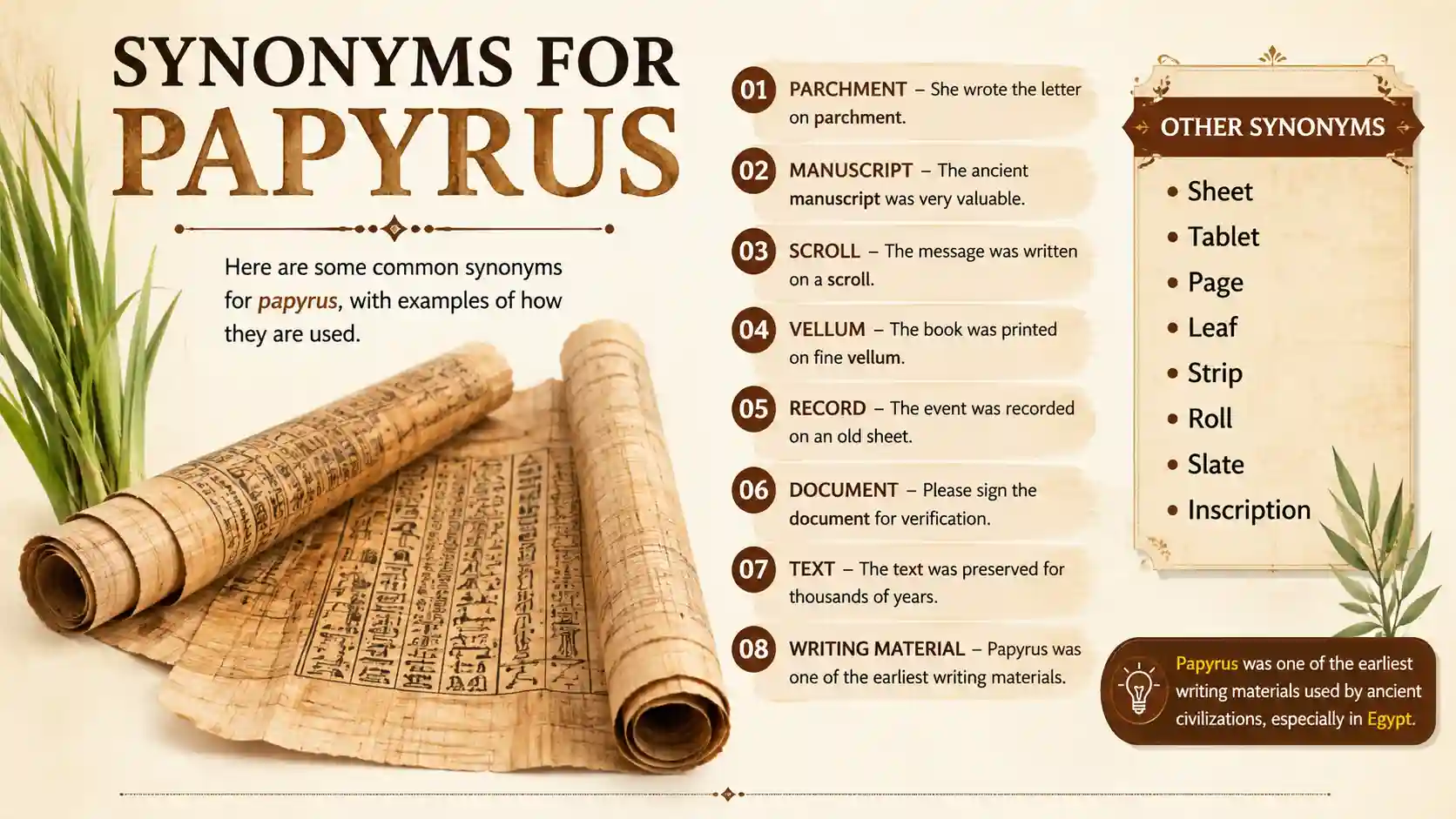
Synonyms for papyrus depend on the meaning. When papyrus means an ancient writing material, close alternatives include parchment, vellum, writing material, paper, scroll, and manuscript. However, these words are not exact synonyms. Papyrus is a specific plant and a writing material made from that plant, so words such as parchment and vellum describe related materials rather than the same thing.
Introduction
Have you ever read about an ancient Egyptian document and wondered what you could call papyrus without repeating the same word?
Finding synonyms for papyrus can be tricky because the word has more than one meaning. It can refer to a tall plant that grows near water, the writing material made from its stems, or a document written on that material.
For students, writers, bloggers, and English learners, this distinction matters. You cannot always replace papyrus with parchment or scroll and keep the same meaning.
This guide explains the closest synonyms and related words in simple English. You will learn which words can replace papyrus, which ones only have a similar meaning, how formal each word sounds, and when you should avoid using it.
Pronunciation
Papyrus: /pəˈpaɪrəs/
Pronounced as: puh-PIE-rus
Plural forms: papyri /pəˈpaɪriː/ and papyruses
Oxford and Cambridge both give essentially the same pronunciation in American and British English.
What Does Papyrus Mean?
Papyrus is a noun with three closely related meanings.
- A tall plant that grows in or near water, especially in Africa.
- A writing material made from the stems of that plant.
- A document or piece of writing made from papyrus.
For example:
Ancient Egyptians used papyrus for writing.
Here, papyrus means the writing material.
In:
Papyrus grows naturally along parts of the Nile.
The word means plant.
Cambridge confirms these major senses, while Oxford also identifies the document sense.
Part of Speech
Papyrus is primarily a noun.
It does not normally function as a verb, adjective, or adverb.
Noun
- The museum displayed an ancient papyrus.
- The artist painted a picture of a papyrus plant.
Related adjective forms
You may encounter specialized words such as papyral, papyrean, papyrine, and papyraceous, but these are uncommon and are not normal substitutes for papyrus in everyday English.
Grammar Usage
Singular
Use papyrus for one item:
- The archaeologist examined a papyrus.
Plural
Both papyri and papyruses are accepted plural forms. Papyri is especially common in historical and academic writing.
- The museum owns several ancient papyri.
- Researchers discovered several papyruses.
Useful patterns
- a papyrus document
- a papyrus scroll
- written on papyrus
- made from papyrus
- ancient papyri
- papyrus plant
Common preposition
The most natural phrase for the writing material is:
written on papyrus
Not usually:
written in papyrus
Synonyms for Papyrus: Quick Overview
| Word | Strength | Formality |
| Parchment | Strong | Neutral |
| Vellum | Strong | Formal |
| Writing material | Strong | Neutral |
| Writing surface | Related | Neutral |
| Paper | Related | Neutral |
| Scroll | Related | Neutral |
| Manuscript | Related | Formal |
| Document | Related | Neutral |
| Text | Related | Academic |
| Record | Related | Formal |
| Ancient document | Related | Neutral |
| Written record | Related | Formal |
| Sheepskin | Related | Neutral |
| Goatskin | Related | Neutral |
| Plant | Related | Neutral |
| Sedge | Related | Botanical |
| Reed | Related | Neutral |
| Reed paper | Close descriptive term | Neutral |
| Ancient writing material | Close descriptive term | Neutral |
| Parchment paper | Related material | Neutral |
Important: These are not all exact synonyms. Cambridge’s thesaurus also groups parchment, sheepskin, goatskin, vellum, and scroll as words related to papyrus.
Detailed Synonyms and Related Words for Papyrus
1. Parchment
Meaning: Parchment is a writing material traditionally made from specially prepared animal skin.
Examples:
- The medieval letter was written on parchment.
- The historian compared the parchment with an older papyrus.
Best Used When: You are talking about an old writing material that resembles papyrus in historical use.
Tone: Neutral to formal
Frequency: Common
CEFR: B2
Common Collocations:
- ancient parchment
- parchment manuscript
- parchment document
Nuance: Parchment and papyrus are both historic writing materials, but they are made differently.
When Not to Use It: Do not call papyrus parchment when the material itself is important.
2. Vellum
Meaning: Vellum is a fine writing material traditionally made from animal skin.
Examples:
- The royal document was preserved on vellum.
- The library keeps several medieval vellum manuscripts.
Best Used When: Discussing high-quality historical writing materials.
Tone: Formal, academic
Frequency: Uncommon
CEFR: C1
Common Collocations:
- vellum manuscript
- medieval vellum
- vellum page
Nuance: Vellum is closely related to parchment but is traditionally associated with especially fine animal skin.
When Not to Use It: Do not use vellum as a general word for every ancient writing surface.
3. Writing Material
Meaning: A writing material is something used to write or record information.
Examples:
- Papyrus was an important writing material in the ancient world.
- The researcher studied several early writing materials.
Best Used When: You need a broad and accurate description.
Tone: Neutral
Frequency: Very common
CEFR: B1
Common Collocations:
- ancient writing material
- natural writing material
- traditional writing material
Nuance: This is more general than papyrus.
When Not to Use It: Avoid it when you need to identify the exact material.
4. Writing Surface
Meaning: A writing surface is a surface on which people can write.
Examples:
- Papyrus provided a useful writing surface.
- The museum displays several ancient writing surfaces.
Best Used When: Explaining the function of papyrus.
Tone: Neutral, academic
Frequency: Common
CEFR: B2
Common Collocations:
- smooth writing surface
- ancient writing surface
- prepared writing surface
Nuance: It describes the function rather than the material.
5. Paper
Meaning: Paper is a material commonly used for writing and printing.
Examples:
- Papyrus is often described as an early form of writing material.
- Modern paper is made differently from ancient papyrus.
Best Used When: Making a broad comparison between old and modern writing materials.
Tone: Neutral
Frequency: Very common
CEFR: A1
Common Collocations:
- writing paper
- sheet of paper
- paper document
When Not to Use It: Do not simply replace papyrus with paper when historical accuracy matters.
6. Scroll
Meaning: A scroll is a long piece of writing material rolled into a cylinder.
Examples:
- The archaeologist carefully opened the ancient scroll.
- The papyrus scroll contained several lines of writing.
Best Used When: Referring to the physical format of an ancient document.
Tone: Neutral, literary
Frequency: Common
CEFR: B2
Common Collocations:
- ancient scroll
- papyrus scroll
- religious scroll
Nuance: A scroll describes the form or shape, not necessarily the material.
When Not to Use It: A papyrus sheet is not automatically a scroll.
7. Manuscript
Meaning: A manuscript is an old or handwritten text or document.
Examples:
- Scholars examined the ancient manuscript.
- The manuscript contained information about Egyptian life.
Best Used When: Focusing on the written document rather than its material.
Tone: Formal, academic
Frequency: Common
CEFR: B2
Common Collocations:
- ancient manuscript
- handwritten manuscript
- historical manuscript
Nuance: A manuscript can be made from papyrus, parchment, paper, or another material.
8. Document
Meaning: A document is a written or printed record containing information.
Examples:
- The papyrus document revealed details about trade.
- Researchers preserved the ancient document carefully.
Best Used When: The content or record matters more than the material.
Tone: Neutral, formal
Frequency: Very common
CEFR: B1
Common Collocations:
- historical document
- ancient document
- legal document
When Not to Use It: Document is too broad if you specifically need to identify papyrus.
9. Text
Meaning: A text is written material that communicates information.
Examples:
- The ancient text was difficult to translate.
- Scholars studied the text written on papyrus.
Best Used When: Talking about the words or content.
Tone: Neutral, academic
Frequency: Very common
CEFR: B1
Common Collocations:
- ancient text
- religious text
- historical text
Nuance: Text refers to the written content, not the physical material.
10. Record
Meaning: A record is information kept as evidence or for future reference.
Examples:
- The papyrus served as a record of a business transaction.
- The ancient record gave historians useful information.
Best Used When: The purpose of the writing is to preserve information.
Tone: Neutral to formal
Frequency: Very common
CEFR: B1
Common Collocations:
- historical record
- written record
- official record
11. Written Record
Meaning: A written record is information preserved in written form.
Examples:
- The papyrus is an important written record of ancient life.
- Few written records survived from that period.
Best Used When: Writing academically about historical evidence.
Tone: Formal, academic
Frequency: Common
CEFR: B2
12. Ancient Document
Meaning: An ancient document is a very old written record.
Examples:
- The museum displayed an ancient document from Egypt.
- Researchers carefully dated the ancient document.
Best Used When: You want to describe papyrus without focusing on its material.
Tone: Neutral
Frequency: Common
CEFR: B1–B2
13. Ancient Writing Material
Meaning: This phrase describes a material used for writing in ancient times.
Examples:
- Papyrus was an important ancient writing material.
- Students learned how ancient writing materials were produced.
Best Used When: Explaining papyrus to beginners.
Tone: Educational, neutral
Frequency: Uncommon phrase
CEFR: B1
14. Reed Paper
Meaning: Reed paper is a descriptive term for paper-like material made from reeds or similar plant material.
Examples:
- The exhibit explained how reed paper was prepared.
- The ancient writing material looked like thin reed paper.
Best Used When: Giving a simple physical description.
Tone: Neutral
Frequency: Uncommon
Nuance: This phrase can help beginners understand the material, but it is not a perfect replacement for papyrus.
15. Plant
Meaning: A plant is a living organism that normally grows in soil or water and produces its own food.
Examples:
- The papyrus plant grows well in wet areas.
- The museum garden contains several papyrus plants.
Best Used When: Talking specifically about the living papyrus species.
Tone: Neutral
Frequency: Very common
CEFR: A1
When Not to Use It: Plant is far too general when you mean the writing material.
16. Sedge
Meaning: A sedge is a grass-like plant belonging to the sedge family.
Examples:
- Papyrus is a tall sedge associated with wet environments.
- The botanist identified the plant as a type of sedge.
Best Used When: Discussing papyrus from a botanical perspective.
Tone: Scientific, formal
Frequency: Uncommon
CEFR: C1
Nuance: This describes the plant category, not the writing material.
17. Reed
Meaning: A reed is a tall, thin plant that often grows near water.
Examples:
- Reeds grew along the edge of the river.
- The artist studied the structure of the papyrus reed.
Best Used When: Giving a general physical description.
Tone: Neutral
Frequency: Common
CEFR: B1
When Not to Use It: Not every reed is papyrus.
18. Sheepskin
Meaning: Sheepskin is the skin of a sheep, sometimes prepared as a writing material.
Examples:
- The old document was written on sheepskin.
- The curator explained how sheepskin was used for manuscripts.
Best Used When: Comparing papyrus with animal-skin writing materials.
Tone: Neutral
Frequency: Common
CEFR: B2
Nuance: Sheepskin is a material, not a true synonym for papyrus.
19. Goatskin
Meaning: Goatskin is the skin of a goat, sometimes prepared for writing.
Examples:
- The manuscript was written on carefully prepared goatskin.
- The historian compared goatskin with papyrus.
Best Used When: Discussing historical writing materials.
Tone: Neutral, academic
Frequency: Uncommon
CEFR: B2
20. Parchment Paper
Meaning: Parchment paper is a paper product designed to resemble or perform like parchment.
Examples:
- The designer used parchment paper for the invitation.
- The modern sheet looked like old parchment paper.
Best Used When: Discussing modern decorative or functional paper.
Tone: Neutral
Frequency: Common
When Not to Use It: Do not use it as a historical synonym for Egyptian papyrus.
21. Paper-Like Material
Meaning: A paper-like material resembles paper but may be made from something else.
Examples:
- Papyrus is a paper-like material made from plant stems.
- The display showed several paper-like materials from different periods.
Best Used When: Explaining papyrus to someone unfamiliar with it.
Tone: Informal, educational
Frequency: Common phrase
22. Historical Writing Material
Meaning: A historical writing material is a material used for writing in an earlier period.
Examples:
- Papyrus is an important historical writing material.
- Students compared different historical writing materials.
Best Used When: Writing educational or historical content.
Tone: Formal, academic
Frequency: Uncommon phrase
Strongest Synonyms
There are only a few words that can come close to papyrus in particular contexts.
Closest material-related alternatives
- Parchment
- Vellum
- Writing material
- Writing surface
Even these are not exact replacements because papyrus has a distinctive botanical and historical meaning.
Strong Synonyms
These work well when you mean the document or written object rather than the material:
- scroll
- manuscript
- document
- text
- record
- written record
Related Words
These describe the plant or its broader category:
- plant
- sedge
- reed
- reed paper
- paper-like material
Choose the Right Synonym: Side-by-Side Comparison
| Word | What It Describes | Best Context | Exact Synonym? |
| Papyrus | Plant, material, or document | Ancient Egypt/history | Yes, original term |
| Parchment | Animal-skin writing material | Medieval/history | No |
| Vellum | Fine animal-skin material | Historical/academic | No |
| Scroll | Rolled document | Ancient writing | No |
| Manuscript | Written document | History/academia | No |
| Document | Written record | General | No |
| Text | Written content | Academic/general | No |
| Paper | Writing material | Modern/general | No |
| Reed | Plant type/general form | Botanical | No |
| Sedge | Botanical category | Scientific | No |
Best rule: If the material itself is important, keep the word papyrus. If the writing or document is important, manuscript, document, text, or scroll may work better.
Connotation and Nuance
Synonyms can change the feeling of a sentence.
Papyrus sounds historical and strongly connects with ancient Egypt, the Nile, archaeology, and early writing.
Parchment often suggests medieval Europe, manuscripts, old books, or animal-skin writing.
Vellum sounds more specialized and scholarly.
Scroll creates a visual image of a rolled document.
Manuscript focuses on the written work rather than its physical material.
Document is much broader and can describe anything from an ancient record to a modern contract.
American vs. British English
There is no major American-British spelling difference for papyrus.
Both use:
papyrus
Both varieties also use:
papyri
The pronunciation is essentially the same in standard American and British English. Cambridge gives /pəˈpaɪ.rəs/ for both varieties.
Usage difference
The main difference is not regional. It is contextual.
Academic British writing may use papyri frequently when discussing several ancient documents. American academic writing also uses papyri, although papyruses is an accepted alternative.
CEFR Guidance
Because papyrus is a specialized historical and botanical word, it is not a basic everyday vocabulary item.
| Word | Approximate Learner Level |
| paper | A1 |
| plant | A1 |
| document | B1 |
| record | B1 |
| reed | B1 |
| scroll | B2 |
| manuscript | B2 |
| parchment | B2 |
| papyrus | B2–C2 depending on context |
| vellum | C1 |
| sedge | C1 |
CEFR levels are approximate learner guidance rather than official classifications for every word.
Word Origin and First Known Use
The history of papyrus is especially interesting.
Merriam-Webster traces the English word through Middle English and Latin, with the deeper history reaching Greek. It records the first known English use in the 14th century.
Oxford gives the word origin as late Middle English, coming through Latin from Greek papyros or papuros. Oxford also notes that the senses referring specifically to paper made from the plant and to a document dated from the early 18th century in English.
This shows why the word can refer both to the plant and to things made from that plant.
Commonly Confused Words
| Word | Difference | Example |
| Papyrus | Plant or writing material made from it | The text was written on papyrus. |
| Parchment | Writing material made from animal skin | The medieval text was written on parchment. |
| Vellum | Fine animal-skin writing material | The manuscript was preserved on vellum. |
| Scroll | A document in rolled form | The scroll was carefully opened. |
| Manuscript | A written work or document | The manuscript contained an old story. |
Remember
Papyrus = plant/material
Parchment = animal skin
Scroll = shape/form
Manuscript = written document
Vellum = fine animal-skin material
Common Mistakes
Common Mistake Box
Mistake: Papyrus and parchment are exactly the same.
Correction: Papyrus and parchment are different writing materials.
Explanation: Papyrus comes from a plant, while parchment is traditionally made from animal skin.
Mistake: Every papyrus is a scroll.
Correction: A papyrus can be a sheet, fragment, document, or scroll.
Explanation: Papyrus identifies the material or plant. Scroll describes a particular physical format.
Mistake: Papyri is the only plural.
Correction: Both papyri and papyruses are accepted.
Explanation: Papyri is a traditional plural, while papyruses is also recognized in modern English dictionaries.
Writing Tips
For Essays
Use papyrus when discussing the actual ancient material.
Ancient Egyptians used papyrus as a writing material.
Use manuscript when discussing the written work.
The manuscript provides evidence about ancient Egyptian society.
For Blog Posts
Avoid repeating papyrus in every sentence. You can sometimes use:
- ancient writing material
- document
- manuscript
- scroll
- written record
But do not replace the word when the exact material matters.
For Professional Writing
Use precise terms rather than decorative synonyms.
Instead of:
The ancient paper was discovered in Egypt.
Prefer:
The ancient papyrus was discovered in Egypt.
For Stories
Scroll can create a stronger visual image:
She carefully unrolled the ancient scroll.
For Daily Conversation
Most people will understand paper, document, or scroll more easily than papyrus, but these words are less precise.
Related Vocabulary
Antonyms
Papyrus does not have a true opposite because it is a noun naming a plant and material.
However, in a historical writing context, you could contrast it with:
- modern paper
- digital text
- electronic document
- digital record
These are contrasts, not true antonyms.
Word Family
Useful related forms include:
- papyri — plural noun
- papyruses — alternative plural
- papyrology — the study of papyrus documents
- papyrologist — a person who studies papyri
- papyraceous — papyrus-like or paper-like
- papyrine — relating to papyrus
Some of these terms are highly specialized and uncommon in everyday English.
Real-World Collocations
Native speakers and academic writers commonly use papyrus in combinations such as:
- ancient papyrus
- papyrus scroll
- papyrus document
- papyrus fragment
- papyrus manuscript
- papyrus plant
- papyrus paper
- written on papyrus
- made from papyrus
- ancient papyri
These combinations are usually more natural than forcing a synonym into every sentence.
When Not to Replace Papyrus
Do not replace papyrus when:
- the material itself is historically important
- you are describing the papyrus plant
- you are identifying an archaeological artifact
- you are discussing papyrology
- you need scientific or historical precision
For example:
Accurate:
The inscription was written on papyrus.
Less precise:
The inscription was written on paper.
The second sentence may give the reader the wrong historical impression.
Mini Practice Exercises
Fill in the Blanks
Choose papyrus, parchment, scroll, manuscript, or vellum.
- The ancient Egyptian text was written on ______.
- The medieval book was written on ______.
- The archaeologist carefully unrolled the ______.
- The researcher examined an ancient ______.
- The luxurious medieval pages were made from ______.
Sentence Rewriting
Rewrite each sentence using the word in brackets.
- The ancient document was written on papyrus. (manuscript)
- The medieval writing material was made from animal skin. (parchment)
- The rolled papyrus document was found in a tomb. (scroll)
Matching
Match each word with its best description.
| Word | Description |
| 1. Papyrus | A. Rolled document |
| 2. Parchment | B. Ancient plant/material |
| 3. Scroll | C. Animal-skin writing material |
| 4. Manuscript | D. Written work |
Answers: 1-B, 2-C, 3-A, 4-D
Vocabulary Quiz
1. Which word is closest to papyrus as a historical writing material?
A. Computer
B. Parchment
C. Pencil
D. Printer
2. What does scroll mainly describe?
A. A plant
B. A type of ink
C. A rolled document
D. An animal skin
3. Which word refers specifically to fine animal-skin writing material?
A. Vellum
B. Reed
C. Papyrus
D. Paper
4. Which sentence uses papyrus correctly?
A. I papyrused the email yesterday.
B. The ancient text was written on papyrus.
C. She bought a papyrus computer.
D. He papyrus the letter.
5. Which word focuses most on the written work rather than its physical material?
A. Manuscript
B. Reed
C. Sedge
D. Vellum
Answer Key
- B — Parchment
- C — A rolled document
- A — Vellum
- B — The ancient text was written on papyrus.
- A — Manuscript
Frequently Asked Questions
What is another word for papyrus?
There is no single perfect synonym for papyrus. Depending on context, close alternatives include parchment, writing material, scroll, manuscript, document, and writing surface. However, these words describe different materials, forms, or types of written records, so they should not always replace papyrus.
What is the closest synonym for papyrus?
Parchment is one of the closest commonly listed related words, especially when discussing ancient writing materials. However, parchment is made from animal skin, while papyrus comes from a plant. Therefore, they are related rather than exact synonyms.
Is parchment the same as papyrus?
No. Papyrus is a plant and a writing material made from that plant. Parchment is a writing material traditionally made from prepared animal skin. Both were important historical writing materials, but their origins and production methods are different.
What is another word for an ancient papyrus?
If you mean the written object rather than the material, you can use ancient documents, manuscripts, scrolls, texts, or written records, depending on the context. A scroll is appropriate only when the document is actually in rolled form.
What is the plural of papyrus?
The traditional plural is papyri, pronounced approximately /pəˈpaɪriː/. Papyruses is also an accepted plural form. In academic and historical writing, papyri is especially common.
Is papyrus a type of paper?
Papyrus is a plant and also a writing material produced from the plant’s stems. It is often described as paper-like, but it is historically distinct from modern paper. Ancient Egyptians used papyrus extensively for writing and other purposes.
What is a papyrus scroll?
A papyrus scroll is a document made from papyrus that has been arranged or rolled into scroll form. The word papyrus describes the material, while scroll describes the physical format.
What are synonyms for papyrus in academic writing?
In academic writing, useful alternatives depend on the intended meaning. Writing material, ancient writing material, manuscript, document, written record, and scroll can work in suitable contexts. It is usually better to repeat papyrus than to use an inaccurate synonym.
Final Thoughts
Learning synonyms for papyrus is less about memorizing a long list and more about understanding precise meaning. Parchment describes a different material, scroll describes a form, and manuscript describes a written work. The best writers choose the word that matches the exact idea.
Practice these distinctions in essays, history assignments, blog posts, and everyday vocabulary exercises. The more carefully you choose words, the clearer and stronger your English becomes.
Meta Description
Learn synonyms for papyrus with clear meanings, examples, usage tips, related words, pronunciation, etymology, and vocabulary practice for English learners.
References
- Cambridge Dictionary: Papyrus
- Cambridge English Thesaurus: Papyrus
- Oxford Advanced Learner’s Dictionary: Papyrus
- Merriam-Webster: Papyrus
- Merriam-Webster: Papyri

Synonorm is a trusted English vocabulary resource created to help readers find the right words and understand the differences between similar terms. We provide clear explanations of synonyms, meanings, examples, usage, and alternatives. Our content makes vocabulary easier to learn and apply in everyday, academic, and professional English. Synonorm is designed for students, writers, ESL learners, professionals, and anyone who wants to improve their English vocabulary and communicate more clearly.