Quick Answer
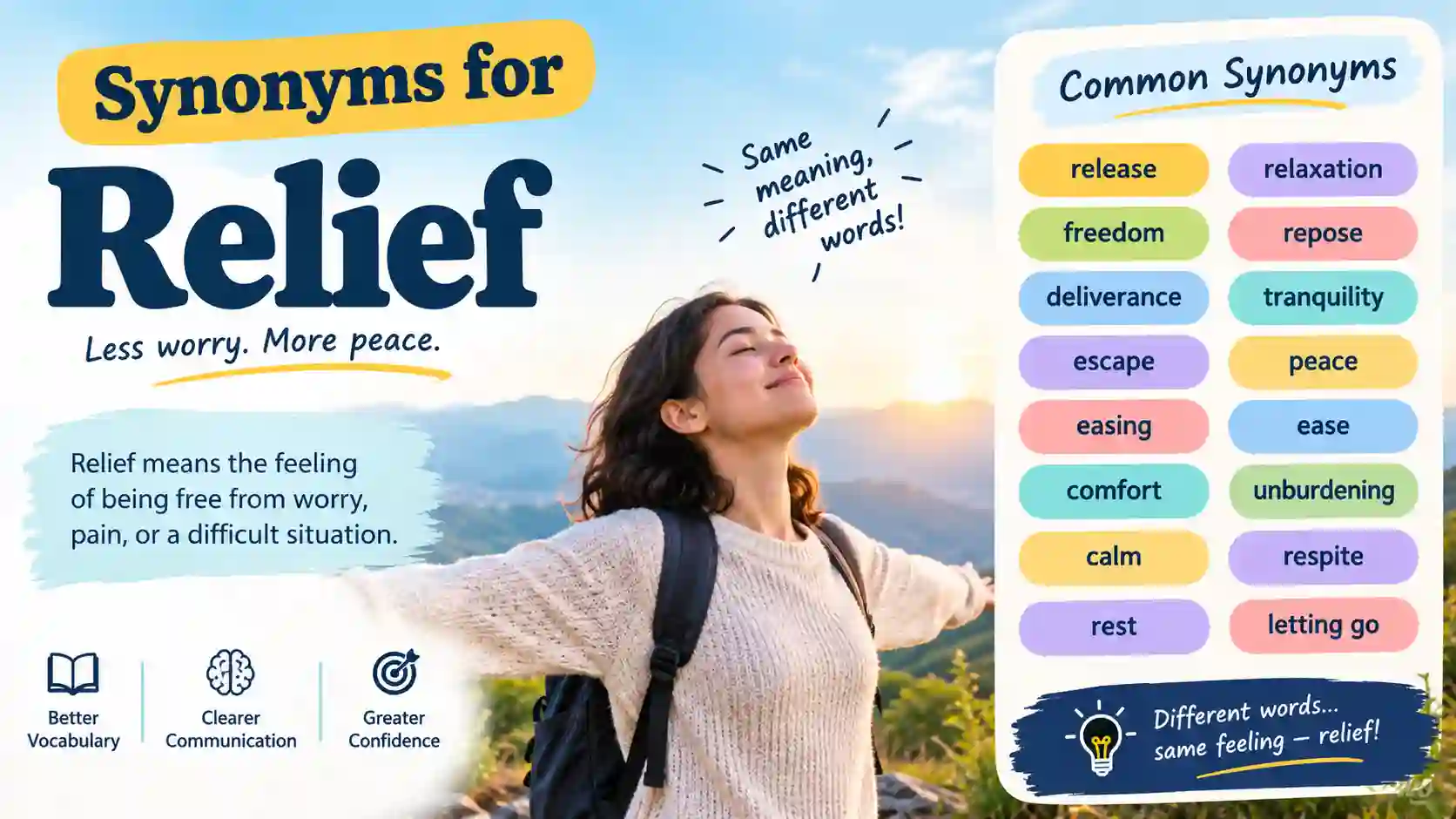
The best synonyms for relief include ease, comfort, alleviation, reassurance, respite, release, solace, and mitigation. Use ease when discomfort decreases, reassurance when worry fades, and respite for a short break from hardship. Other alternatives fit specific meanings, such as practical help, reduced pain, or freedom from a burden.
What word describes the feeling you get when an exam ends and you know you did well? The answer is relief. It can also describe less pain, freedom from worry, or help given to people in need.
Learning synonyms for relief helps you write clearer essays, improve emails, and express your feelings in natural English. However, similar words do not always mean the same thing. Comfort may come from a friend’s support, while alleviation describes a reduction in suffering.
This guide explains 30 useful words and related expressions, including their meanings, examples, common collocations, tone, and limitations. You will learn how to choose the right word instead of replacing relief with an alternative that changes your meaning.
Pronunciation and Meaning
- Word: Relief
- IPA: /rɪˈliːf/
- Pronunciation: ri-LEEF
- Syllables: Two
- Part of speech: Noun
- Plural: Reliefs, when referring to separate instances or types, such as artistic reliefs
What does relief mean?
Relief commonly describes four things:
- An emotion: Feeling happy because something unpleasant has ended or did not happen.
- Reduced discomfort: Less pain, pressure, worry, or suffering.
- A break: Time away from work or another difficult situation.
- Practical aid: Money, supplies, or services given to people in need.
The word also has specialist meanings in sculpture, geography, and other fields. This guide focuses mainly on vocabulary for everyday communication.
Grammar and Word Forms
| Form | Part of speech | Example |
| Relief | Noun | The news brought relief. |
| Relieve | Verb | The treatment may relieve pain. |
| Relieved | Adjective | We were relieved to hear the news. |
| Relieving | Verb form | The team is relieving pressure on the service. |
Common sentence patterns include:
- Relief from pain, stress, or pressure.
- Relief at hearing good news.
- A sense of relief.
- To someone’s relief.
- Relieve someone of a duty or burden.
Remember: Say “I feel relieved,” not “I feel reliefed.” The standard adjective is relieved.
Quick Comparison: Synonyms for Relief
| Synonym | Best use | Register | Approx. CEFR |
| Ease | Less pain or pressure | Neutral | A2 |
| Comfort | Emotional or physical support | Neutral | A2 |
| Alleviation | Less suffering | Formal | C1 |
| Reassurance | Less worry | Neutral | B2 |
| Respite | A temporary break | Formal | C1 |
| Release | Freedom from tension | Neutral | B1 |
| Solace | Comfort during sadness | Literary | C1 |
| Mitigation | Reduced harm or severity | Academic | C1 |
| Reprieve | Temporary escape from trouble | Formal | C1 |
| Assistance | Practical help | Formal | B1 |
CEFR levels are approximate guidance for learners. They can vary by dictionary, word sense, and context.
30 Synonyms for Relief With Examples
The following words include close synonyms and context-specific alternatives. Each entry explains when the word fits and when it should not replace relief.
1. Ease
Meaning: A state in which pain, worry, or difficulty becomes less severe.
Examples:
- The new chair brought ease to her aching back.
- A clear plan helped ease the team’s worries.
Best used when: You mean that pressure, discomfort, or difficulty has decreased.
Tone and frequency: Neutral; very common. CEFR: A2.
Collocations: ease the pain, ease the pressure, feel at ease.
When not to use it: Use relief when you want to emphasize the feeling that follows the end of a worry.
2. Comfort
Meaning: A feeling of care, safety, or reduced distress.
Examples:
- His sister’s visit brought comfort during a difficult week.
- The warm room offered comfort after the cold journey.
Best used when: Someone or something makes a difficult experience easier to bear.
Tone and frequency: Neutral; very common. CEFR: A2.
Collocations: emotional comfort, words of comfort, bring comfort.
When not to use it: Comfort does not always mean that a problem has ended.
3. Alleviation
Meaning: The act of making pain or suffering less severe.
Examples:
- The program supports the alleviation of poverty.
- The new measures brought some alleviation of the pressure on local clinics.
Best used when: Writing about suffering, hardship, or difficult social conditions.
Tone and frequency: Formal; common in specialist writing. CEFR: C1.
Collocations: alleviation of pain, poverty alleviation, partial alleviation.
When not to use it: In casual speech, relief or help is usually more natural.
4. Reassurance
Meaning: Words or actions that help someone feel less worried.
Examples:
- The nurse offered reassurance before the test.
- Her message gave me reassurance during the storm.
Best used when: Someone needs confidence that a situation is safe or under control.
Tone and frequency: Neutral; common. CEFR: B2.
Collocations: offer reassurance, seek reassurance, words of reassurance.
When not to use it: Reassurance addresses worry, not necessarily physical pain or tiredness.
5. Respite
Meaning: A short period of rest from something difficult.
Examples:
- The quiet weekend offered respite from a busy schedule.
- The farmers welcomed respite from the heavy rain.
Best used when: Describing a temporary break from hardship, work, or pressure.
Tone and frequency: Formal; common in writing. CEFR: C1.
Collocations: brief respite, respite from work, temporary respite.
When not to use it: Respite usually does not suggest that the problem has been permanently solved.
6. Release
Meaning: Freedom from tension, restraint, or an emotional burden.
Examples:
- Talking about the problem gave him a sense of release.
- Finishing the project brought release from weeks of pressure.
Best used when: A person feels free from a burden or built-up tension.
Tone and frequency: Neutral; very common. CEFR: B1.
Collocations: emotional release, release from tension, a sense of release.
When not to use it: Release has several meanings, including making something available or letting someone go.
7. Solace
Meaning: Comfort that helps someone cope with sadness or trouble.
Examples:
- She found solace in music after moving away.
- Reading gave him solace during a lonely period.
Best used when: Describing emotional comfort during grief or hardship.
Tone and frequency: Literary; common in reflective writing. CEFR: C1.
Collocations: find solace, seek solace, a source of solace.
When not to use it: Avoid it for a routine break or a small everyday inconvenience.
8. Consolation
Meaning: Comfort given to someone who feels sad or disappointed.
Examples:
- The kind message offered consolation after the rejection.
- Winning second place was a small consolation.
Best used when: Someone is coping with loss, disappointment, or failure.
Tone and frequency: Neutral; common. CEFR: B2.
Collocations: offer consolation, a small consolation, consolation prize.
When not to use it: Consolation helps someone cope with a setback; it does not undo the setback.
9. Mitigation
Meaning: The act of reducing harm or the seriousness of a problem.
Examples:
- The city introduced measures for flood mitigation.
- Better planning helped with the mitigation of financial risk.
Best used when: Discussing risk, damage, harmful effects, or policy.
Tone and frequency: Academic or professional; common in specialist contexts. CEFR: C1.
Collocations: risk mitigation, damage mitigation, mitigation measures.
When not to use it: It sounds technical when used for a simple feeling of relief after good news.
10. Abatement
Meaning: A reduction in the amount or strength of something unwanted.
Examples:
- Residents called for noise abatement near the airport.
- The team monitored the abatement of industrial pollution.
Best used when: Describing reductions in noise, pollution, or another measurable problem.
Tone and frequency: Formal and technical; uncommon in everyday speech. CEFR: C1.
Collocations: noise abatement, abatement of pollution, tax abatement.
When not to use it: It is not a natural replacement for emotional relief.
11. Reduction
Meaning: A decrease in the amount, level, or size of something.
Examples:
- A reduction in workload brought relief to the staff.
- The new plan led to a reduction in monthly costs.
Best used when: Describing a measurable drop in pain, cost, pressure, or difficulty.
Tone and frequency: Neutral; very common. CEFR: B1.
Collocations: reduction in pain, cost reduction, significant reduction.
When not to use it: A reduction describes a change in amount, not necessarily the emotion that follows.
12. Rest
Meaning: Time spent relaxing or recovering from effort.
Examples:
- After the hike, a short rest felt wonderful.
- She needed rest before returning to her studies.
Best used when: Talking about recovery from tiredness or physical effort.
Tone and frequency: Neutral; very common. CEFR: A1.
Collocations: take a rest, rest period, rest and recovery.
When not to use it: Rest can bring relief, but it does not automatically remove fear or worry.
13. Break
Meaning: A short pause in an activity.
Examples:
- I took a break after two hours of writing.
- A short break helped the team focus again.
Best used when: Someone needs a pause from work, study, or another activity.
Tone and frequency: Neutral or informal; very common. CEFR: A1.
Collocations: take a break, lunch break, a welcome break.
When not to use it: A break is a pause, not the feeling someone experiences after a worry ends.
14. Reprieve
Meaning: A temporary delay or escape from something unpleasant.
Examples:
- The deadline extension gave the team a reprieve.
- Cooler weather offered a welcome reprieve from the heat.
Best used when: A difficult event or consequence is paused or delayed.
Tone and frequency: Formal; common in news and writing. CEFR: C1.
Collocations: brief reprieve, temporary reprieve, win a reprieve.
When not to use it: It often suggests that the difficulty may return.
15. Deliverance
Meaning: Freedom from danger, suffering, or serious trouble.
Examples:
- The rescue brought deliverance to the trapped hikers.
- She saw leaving the harmful workplace as deliverance.
Best used when: Describing escape from a serious or oppressive situation.
Tone and frequency: Literary or religious; uncommon in everyday speech. CEFR: C1.
Collocations: deliverance from danger, seek deliverance, hope for deliverance.
When not to use it: It can sound dramatic when describing an ordinary inconvenience.
16. Calm
Meaning: A peaceful state with little worry, fear, or excitement.
Examples:
- Deep breathing helped restore her calm.
- The quiet garden brought calm after a noisy day.
Best used when: Describing peace of mind or reduced agitation.
Tone and frequency: Neutral; very common. CEFR: A2.
Collocations: inner calm, remain calm, restore calm.
When not to use it: Calm describes a state, while relief often follows an unpleasant event or change.
17. Peace of mind
Meaning: A feeling of security and freedom from worry.
Examples:
- Saving money gave her peace of mind.
- Checking the travel details brought peace of mind.
Best used when: A concern has been addressed and someone feels more secure.
Tone and frequency: Neutral; very common. CEFR: B1.
Collocations: give peace of mind, enjoy peace of mind, peace of mind about something.
When not to use it: It is less suitable when the main issue is physical pain rather than worry.
18. Aid
Meaning: Help given to people or groups in need.
Examples:
- The village received aid after the storm.
- Medical aid reached the remote area.
Best used when: Talking about emergency support, humanitarian work, or public assistance.
Tone and frequency: Formal; common. CEFR: B1.
Collocations: emergency aid, foreign aid, provide aid.
When not to use it: Aid refers to the help itself, not the emotional feeling of relief.
19. Assistance
Meaning: Help provided to someone who needs it.
Examples:
- Students received assistance with their research.
- The family requested financial assistance.
Best used when: Describing practical, organized, or professional help.
Tone and frequency: Formal or neutral; very common in professional settings. CEFR: B1.
Collocations: technical assistance, financial assistance, provide assistance.
When not to use it: Use relief rather than assistance when naming the feeling after a stressful event.
20. Help
Meaning: Support that makes a task or problem easier to manage.
Examples:
- Your advice was a great help during my job search.
- Volunteers offered help to families after the flood.
Best used when: You need a simple word for practical or emotional support.
Tone and frequency: Neutral; extremely common. CEFR: A1.
Collocations: ask for help, give help, a great help.
When not to use it: In formal reports, assistance may be more suitable for describing a service.
21. Support
Meaning: Help, care, or encouragement that helps someone continue.
Examples:
- Her colleagues gave her support during the transition.
- The family received financial support while rebuilding.
Best used when: Describing continuing practical or emotional help.
Tone and frequency: Neutral; very common. CEFR: B1.
Collocations: emotional support, financial support, offer support.
When not to use it: Support may bring relief, but it describes the help rather than the resulting feeling.
22. Solace giving comfort
Meaning: Comfort that helps someone endure sadness or emotional pain.
Examples:
- The old letters offered comfort during her grief.
- His memories of home brought comfort in a difficult year.
Best used when: You need a clear, everyday phrase for emotional support.
Tone and frequency: Neutral; common.
Collocations: bring comfort, offer comfort, find comfort in something.
When not to use it: This is a descriptive phrase, not a single-word synonym. Use solace when a concise, literary word is appropriate.
23. Easing
Meaning: The process of making something less severe or difficult.
Examples:
- The easing of traffic congestion saved commuters time.
- Easing the pressure on new staff improved morale.
Best used when: Describing a gradual decrease in tension, restrictions, or difficulty.
Tone and frequency: Neutral; common. CEFR: B2.
Collocations: easing of restrictions, easing pressure, easing tensions.
When not to use it: For a person’s feeling after good news, relief or reassurance is usually clearer.
24. Letup
Meaning: A pause or decrease in something intense or unpleasant.
Examples:
- There was no letup in the heat that afternoon.
- The staff welcomed a letup in constant demands.
Best used when: Describing a temporary drop in pressure, activity, or bad weather.
Tone and frequency: Informal; common in speech. CEFR: C1.
Collocations: no letup, a brief letup, letup in pressure.
When not to use it: Prefer reduction or decrease in formal academic writing.
25. Breather
Meaning: A short pause that gives someone time to rest.
Examples:
- The editor took a breather before checking the final draft.
- A quiet evening gave the family a much-needed breather.
Best used when: Talking casually about a short rest from demanding work.
Tone and frequency: Informal; common. CEFR: B2.
Collocations: take a breather, need a breather, give someone a breather.
When not to use it: It does not mean that an underlying problem has been solved.
26. Relaxation
Meaning: The state or activity of becoming less tense.
Examples:
- Gentle music helped with relaxation after work.
- The break allowed some relaxation before the next meeting.
Best used when: Describing a reduction in tension or an activity that helps someone unwind.
Tone and frequency: Neutral; common. CEFR: B1.
Collocations: deep relaxation, relaxation techniques, time for relaxation.
When not to use it: Relaxation usually describes the process or state of unwinding, rather than the sudden removal of a particular worry.
27. Balm
Meaning: Something that soothes pain or brings emotional comfort.
Examples:
- Her kind message was a balm after a difficult day.
- The quiet countryside felt like a balm to his tired mind.
Best used when: Writing in a figurative or expressive way about comfort.
Tone and frequency: Literary; less common than comfort. CEFR: C1.
Collocations: a balm to the soul, soothing balm, emotional balm.
When not to use it: It can sound poetic in everyday or technical writing.
28. Assuagement
Meaning: The act of making a feeling or problem less intense.
Examples:
- The apology brought some assuagement of her anger.
- The agreement offered assurance of public concerns.
Best used when: Writing formally about reduced worry, anger, or distress.
Tone and frequency: Formal; uncommon. CEFR: C2.
Collocations: assuagement of fear, assuagement of distress, partial assuagement.
When not to use it: It is a rare word. Easing or relief will usually be clearer.
29. Succor (US) / Succour (UK)
Meaning: Help given to someone who is suffering or in danger.
Examples:
- The stranded travelers sought succor from nearby residents.
- The organization provided succour to families affected by the conflict.
Best used when: Writing about serious hardship, rescue, or humanitarian support.
Tone and frequency: Formal or literary; rare in everyday speech. CEFR: C2.
Collocations: offer succor, seek succor, provide succor.
When not to use it: Choose help, aid, or assistance when writing for a broad audience.
30. Diversion
Meaning: An activity or change that takes someone’s attention away from something unpleasant.
Examples:
- A short game provided a diversion from the long wait.
- The conversation offered a welcome diversion from work worries.
Best used when: Something gives a person a temporary change of focus.
Tone and frequency: Neutral; common. CEFR: B2.
Collocations: welcome diversion, provide a diversion, a pleasant diversion.
When not to use it: A diversion distracts someone from a problem; it does not necessarily reduce the problem itself.
Strongest Synonyms, Strong Synonyms, and Related Words
Not all 30 words are exact substitutes for relief. Use these groups to avoid mistakes.
Strongest synonyms by context
- Ease: Less pain, pressure, or difficulty.
- Alleviation: Less suffering or hardship.
- Comfort: Emotional or physical ease.
- Reassurance: Less worry or doubt.
- Respite: A temporary break from difficulty.
- Release: Freedom from tension or a burden.
- Solace: Emotional comfort during sadness.
Strong synonyms for specific situations
- Mitigation: Less harm or severity.
- Reduction: A measurable decrease.
- Reprieve: A temporary delay or escape.
- Peace of mind: Freedom from worry.
- Relaxation: Less tension.
- Assuagement: A lessening of an intense feeling.
Related words, not exact synonyms
- Aid, help, assistance, support: Practical or emotional help.
- Rest, break, breather: A pause from activity.
- Remedy, cure: A possible solution or treatment.
- Diversion: A change of focus.
- Consolation: Comfort after disappointment.
Commonly Confused Words
| Word pair | Main difference | Example |
| Relief vs. comfort | Relief often follows a worry ending; comfort provides care or ease. | The safe arrival brought relief, while a hug offered comfort. |
| Relief vs. reassurance | Relief is the feeling; reassurance helps reduce doubt. | The explanation gave me reassurance, and the good result brought relief. |
| Relief vs. respite | Relief has several meanings; respite is a temporary break. | The weekend gave her respite from work. |
| Relief vs. remedy | Relief is an improvement; a remedy is a solution or treatment. | The remedy brought relief from the discomfort. |
| Relief vs. satisfaction | Relief removes worry; satisfaction comes from meeting a need or goal. | Passing the exam brought relief and satisfaction. |
Common Mistakes to Avoid
Mistake 1: Treating all synonyms as interchangeable
Incorrect: “The weekend brought alleviation from my busy schedule.”
Better: “The weekend offered respite from my busy schedule.”
Why: Respite naturally describes a break from hardship. Alleviation is more common when discussing pain or suffering.
Mistake 2: Confusing the feeling with the help
Incorrect: “The relief repaired the computer.”
Better: “The repair solved the problem, much to my relief.”
Why: The repair is the solution. Relief is the feeling that follows.
Mistake 3: Using a rare word when a simple word works
Incorrect: “I sought success after missing the bus.”
Better: “I asked for help after missing the bus.”
Why: Succor is formal and often suggests serious hardship.
Mistake 4: Using the wrong word form
Incorrect: “I felt reliefed after the call.”
Correct: “I felt relieved after the call.”
Why: Relieved is the standard adjective describing a person’s feeling.
Writing Tips for Students, Bloggers, and Professionals
Essays and academic writing
Use alleviation for suffering and mitigation for harm or risk. Define the problem clearly so your word choice remains precise.
Emails and workplace communication
Use reassurance when addressing concerns and assistance when discussing practical help. For example: “Thank you for your assistance. Your update gave us reassurance.”
Blog posts and stories
Use solace for emotional comfort, release for fading tension, and respite for a break from hardship.
Daily conversations and social media
Natural phrases include “What a relief!”, “I’m so relieved,” “That’s reassuring,” and “I really needed a break.”
Writing tip: Do not change a word just to avoid repetition. Repeat relief when it is the clearest choice. Use a synonym only when it adds a useful difference in meaning or tone.
Related Vocabulary: Antonyms and Expressions
Antonyms of relief
The opposite depends on the sense you mean.
| Antonym | Meaning | Example |
| Distress | Severe worry or suffering | The delay caused distress. |
| Anxiety | Worry about what may happen | She felt anxious before the test. |
| Discomfort | Physical or emotional unease | The chair caused discomfort. |
| Aggravation | A worsening of a problem | The delay caused further aggravation. |
| Burden | A difficult duty or responsibility | The extra cost became a burden. |
| Hardship | A difficult condition | The family faced hardship. |
Common expressions with relief
- A sigh of relief: A breath that shows worry has eased.
- Much to my relief: Happily, because a concern was removed.
- What a relief!: An expression used when a worry ends.
- A welcome relief: Something that provides a pleasant change.
- Relief from stress: A reduction in stress.
- Disaster relief: Help provided after a disaster.
- Pain relief: Treatment or measures that reduce pain.
Word family
- Relief: The news brought relief.
- Relieve: The treatment may relieve pain.
- Relieved: I was relieved to hear the news.
- Relieving: The team is relieving pressure on the service.
Frequently Asked Questions
1. What are the best synonyms for relief?
The best alternatives include ease, comfort, alleviation, reassurance, respite, release, and solace. Choose the word that matches the type of relief. Reassurance works for worry, respite for a temporary break, and alleviation for reduced suffering. These words overlap, but they are not interchangeable in every sentence.
2. What is a more formal word for relief?
Alleviation, mitigation, and abatement are formal alternatives in specific contexts. Alleviation usually refers to reduced suffering, mitigation to reduced harm, and abatement to a decrease in something unwanted. In formal writing, choose the word that describes the actual change instead of selecting a complex word simply to sound more professional.
3. What is another word for relief from stress?
Useful choices include ease, relaxation, respite, calm, and peace of mind. Use respite for a short break from work, relaxation for becoming less tense, and peace of mind when worry fades. For example, a quiet evening gave her peace of mind after a stressful week.
4. What is the difference between relief and alleviation?
Relief can describe an emotion, a reduction in discomfort, a break from work, or practical aid. Alleviation specifically means making pain, suffering, or another difficult condition less severe. You may feel relief after receiving good news, while a community project may aim to achieve the alleviation of poverty.
5. What is the opposite of relief?
Common antonyms include distress, anxiety, discomfort, and aggravation. The best choice depends on the context. Anxiety is the opposite of freedom from worry, discomfort contrasts with physical ease, and distress contrasts with emotional comfort. Use aggravation when a problem becomes worse rather than better.
6. What is a simple synonym for relief?
Ease, comfort, and help are simple alternatives for many everyday situations. Use ease when pain or pressure decreases, comfort when someone feels cared for, and help when someone receives support. If a worry ends, however, relief may remain the most natural and accurate word.
7. Is relief a noun or a verb?
Relief is a noun, while relieve is the related verb. For example, you can say, “The news brought relief,” or “The news relieved her worries.” The adjective relieved describes how someone feels, as in “I was relieved to hear the good news.”
8. What is the difference between relief and respite?
Relief can refer to a feeling, a reduction in pain, or assistance. Respite specifically means a temporary period of rest from something difficult. For example, you may feel relief after passing an exam, while a weekend away provides respite from a demanding work schedule.
Vocabulary Quiz: Test Your Understanding
1. Which word best describes a temporary break from hard work?
Respite
Mitigation
Assistance
Satisfaction
2. Which word means help that reduces someone’s worry?
Abatement
Reassurance
Diversion
Reduction
3. Which word best fits a formal discussion about reducing environmental harm?
Breather
Comfort
Mitigation
Solace
4. Choose the correct sentence.
I felt reliefed.
I was relieved.
I felt relieved.
I was relieving.
5. Which word means comfort during sadness or grief?
Solace
Abatement
Remedy
Letup
Answered: 0/5
Reset quiz
Conclusion
Learning synonyms for relief can improve your vocabulary, writing, and everyday communication. Words such as ease, comfort, reassurance, respite, and alleviation help you express different kinds of relief with greater accuracy.
The key is to understand each word’s meaning, tone, and context before using it. Practice these alternatives in essays, emails, and conversations. As your vocabulary grows, your English will become clearer, more natural, and more precise.
References
- Cambridge Dictionary: Relief synonyms and meanings.
Cambridge English
+1 - Thesaurus.com: Relief synonyms and antonyms.
Thesaurus.com - Collins English Thesaurus: Synonyms of relief.
Collins English Thesaurus
+1 - Merriam-Webster Dictionary: Relief definition.
- Oxford English Dictionary: Historical word research.

Synonorm is a trusted English vocabulary resource created to help readers find the right words and understand the differences between similar terms. We provide clear explanations of synonyms, meanings, examples, usage, and alternatives. Our content makes vocabulary easier to learn and apply in everyday, academic, and professional English. Synonorm is designed for students, writers, ESL learners, professionals, and anyone who wants to improve their English vocabulary and communicate more clearly.