Quick Answer: What Are the Synonyms of Therefore?
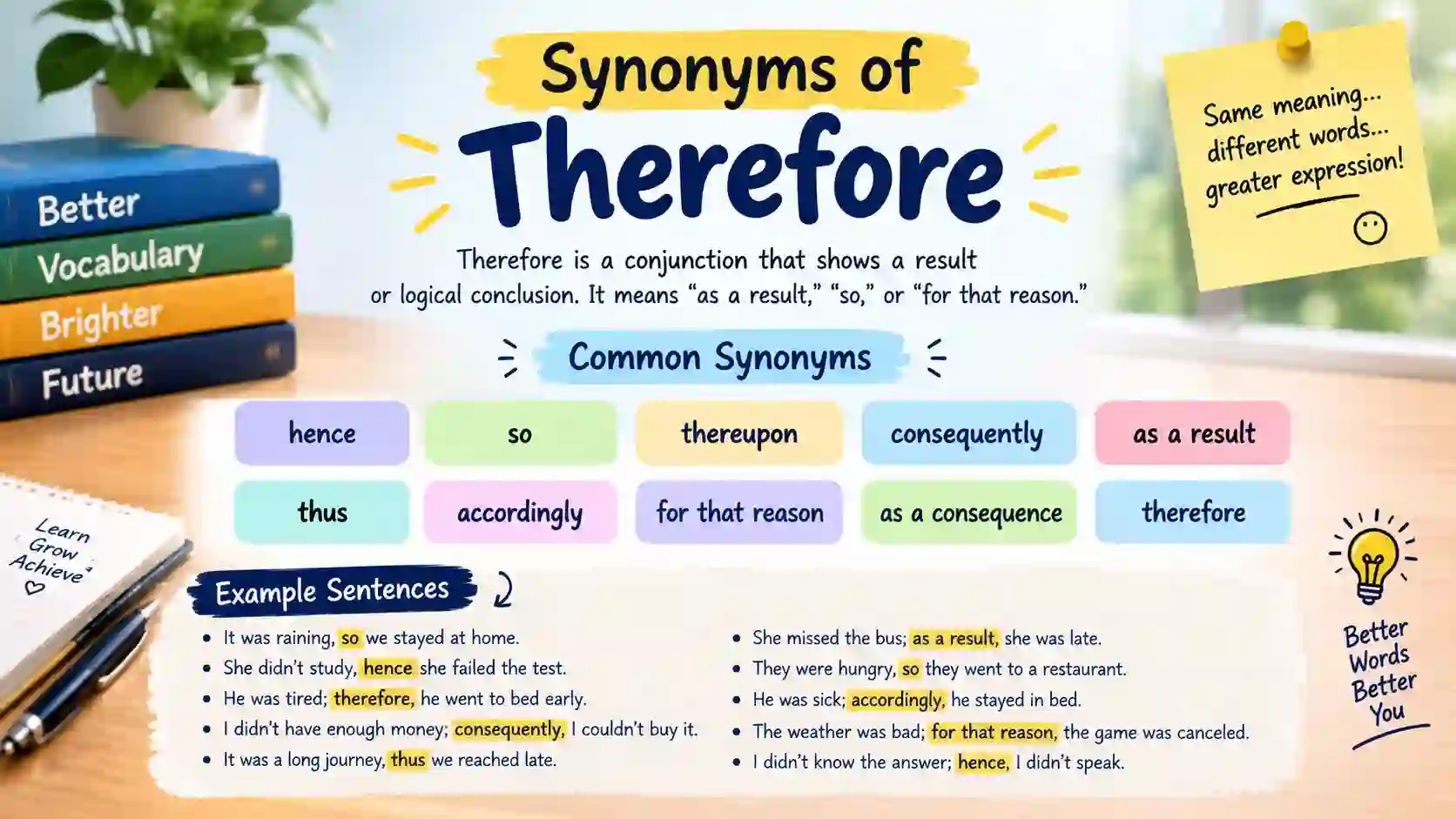
The best synonyms of therefore include so, thus, consequently, hence, accordingly, as a result, and for this reason. These words and phrases show that a result or conclusion follows from an earlier fact. Use so in everyday conversation, as a result for clear explanations, and thus or consequently in formal writing. The right choice depends on your meaning, audience, and sentence structure.
Do you often use the word therefore in essays, emails, or blog posts? Finding a different way to express the same idea can make your writing clearer and more natural.
Therefore means “for that reason” or “as a result.” It connects a fact, reason, or argument to a conclusion.
For example: “The weather was unsafe; therefore, the school canceled the trip.”
You can express the same idea by saying, “The weather was unsafe, so the school canceled the trip.”
Both sentences communicate a result, but their tone and structure differ slightly.
Learning synonyms therefore helps students, teachers, bloggers, and professionals express cause-and-effect relationships without repeating the same word. This guide covers 30 alternatives, their meanings, examples, grammar rules, and common mistakes.
Pronunciation of Therefore
- American English IPA: /ˈðer.fɔːr/
- British English IPA: /ˈðeə.fɔː(r)/
- Simple pronunciation: THAIR-for
- Syllables: Two
- Part of speech: Adverb
- CEFR level: B1, according to Cambridge Learner’s Dictionary.
The spelling is the same in American and British English. The main pronunciation difference is the vowel sound and the treatment of the final r.
What Part of Speech Is Therefore?
Therefore is an adverb that introduces a logical result or conclusion.
- Noun: No standard noun form.
- Verb: No standard verb form.
- Adjective: No standard adjective form.
- Adverb: “The road was closed; therefore, we took another route.”
The phrase for that reason often expresses the same idea, but it is not a single adverb.
How to Use Therefore Correctly
You can place therefore at the beginning of a sentence, after the subject, or between two independent clauses.
At the beginning:
The roads were icy. Therefore, the school closed early.
After the subject:
The school therefore closed early.
Between two independent clauses:
The roads were icy; therefore, the school closed early.
Common punctuation mistake
Incorrect: The roads were icy, therefore the school closed early.
Correct: The roads were icy; therefore, the school closed early.
Also correct: The roads were icy, so the school closed early.
Therefore is a conjunctive adverb, not a coordinating conjunction. A semicolon or full stop can separate the two complete clauses. The word so, when used as a coordinating conjunction, can join them with a comma.
Quick Comparison: Synonyms of Therefore
| Synonym | Main use | Formality |
| So | Everyday results | Neutral |
| Consequently | Resulting events | Formal |
| Thus | Logical conclusions | Formal |
| Hence | Reasons and conclusions | Formal |
| As a result | Clear cause and effect | Neutral |
| For this reason | Emphasizing a reason | Neutral |
| Accordingly | Appropriate action or response | Formal |
| As a consequence | Resulting effects | Neutral to formal |
| That is why | Simple explanations | Conversational |
| It follows that | Logical deductions | Academic |
30 Synonyms of Therefore With Examples
The following expressions are grouped by their actual usage. Some are direct synonyms, while others work only in certain contexts.
1. So
Meaning: Shows that something happens because of an earlier fact.
Examples:
- The bus was late, so I walked to school.
- She practiced daily, so her speaking improved.
Best used when: You want a natural, everyday alternative.
Tone: Neutral, conversational.
CEFR: A1–A2, approximate.
Frequency: Very common.
Collocations: so we decided, so I went, so that is why.
When not to use it: Avoid repeating so too often in formal essays.
2. Consequently
Meaning: Shows that something happens as a result of an earlier event.
Examples:
- The company lost several clients; consequently, it reduced its expenses.
- Heavy rain damaged the bridge; consequently, the road remained closed.
Best used when: You need to emphasize an outcome.
Tone: Formal, academic, business.
CEFR: B2–C1, approximate.
Frequency: Common.
Collocations: consequently increased, consequently reduced, consequently affected.
When not to use it: Do not imply causation when the events are merely related.
3. Thus
Meaning: Introduces a result or logical conclusion. It can also mean “in this way.”
Examples:
- The team met every deadline and thus earned the client’s trust.
- The new system uses less energy, thus lowering costs.
Best used when: You want concise academic or professional writing.
Tone: Formal, academic.
CEFR: B2, approximate.
Frequency: Common.
Collocations: thus reducing, thus allowing, thus creating.
When not to use it: Check whether you mean “as a result” or “in this way.”
4. Hence
Meaning: Indicates a result, reason, or conclusion.
Examples:
- The road was blocked, hence the delay.
- The evidence was incomplete; hence, the need for further testing.
Best used when: You want a concise expression in formal writing.
Tone: Formal, academic.
CEFR: B2–C1, approximate.
Frequency: Common in formal contexts.
Collocations: hence the problem, hence the need, hence the name.
When not to use it: Avoid it if your audience may find formal vocabulary difficult.
5. As a result
Meaning: Explains what happened because of something else.
Examples:
- The school added extra classes. As a result, more students passed.
- The website loaded slowly, and as a result, visitors left.
Best used when: You want to make cause and effect easy to understand.
Tone: Neutral, professional.
CEFR: B1–B2, approximate.
Frequency: Very common.
Collocations: as a direct result, positive result, unexpected result.
When not to use it: Avoid it when the connection between events is unclear.
6. For this reason
Meaning: Points directly to a reason behind a conclusion or decision.
Examples:
- The instructions were unclear. For this reason, we asked for help.
- The area receives little rainfall. For this reason, farmers use irrigation.
Best used when: You want to emphasize a specific reason.
Tone: Neutral to formal.
CEFR: B1, approximate.
Frequency: Common.
Collocations: for this very reason, for this reason alone, for this reason we.
When not to use it: Avoid repeating it in every paragraph.
7. Accordingly
Meaning: Shows that an action or response fits the facts or situation.
Examples:
- The deadline changed, so we adjusted our schedule accordingly.
- The evidence was incomplete; accordingly, the committee postponed its decision.
Best used when: A decision or action follows from known facts.
Tone: Formal, business.
CEFR: B2–C1, approximate.
Frequency: Common in formal writing.
Collocations: act accordingly, adjust accordingly, proceed accordingly.
When not to use it: Do not use it when you simply mean that one event happened later.
8. In consequence
Meaning: Means as a result of something.
Examples:
- The factory failed to meet safety rules and, in consequence, lost its license.
- The region experienced a drought and, in consequence, faced food shortages.
Best used when: You need a formal expression for an outcome.
Tone: Formal.
CEFR: B2–C1, approximate.
Frequency: Uncommon in everyday speech.
Collocations: in consequence of, as a consequence, consequences of an event.
When not to use it: Prefer as a result in simple conversations.
9. On that account
Meaning: Means for that reason, although it is less common than simpler alternatives.
Examples:
- The venue lacked wheelchair access. On that account, we chose another location.
- The figures were unreliable; on that account, the analyst rejected the estimate.
Best used when: You want to connect a decision to a stated reason.
Tone: Formal.
CEFR: C1, approximate.
Frequency: Uncommon.
Collocations: on that account, for that reason, on no account.
When not to use it: Do not confuse it with on account of, which means “because of.”
10. That is why
Meaning: Explains the reason for a result.
Examples:
- I missed the first bus. That is why I arrived late.
- The instructions were clear. That is why the class finished early.
Best used when: You want plain, natural English.
Tone: Neutral, conversational.
CEFR: A2–B1, approximate.
Frequency: Very common.
Collocations: that is why I, that is why we, that is why it matters.
When not to use it: In formal writing, vary your transitions when necessary.
11. Because of this
Meaning: Identifies the cause of a result.
Examples:
- The power went out. Because of this, the computers shut down.
- She practiced speaking daily. Because of this, she became more confident.
Best used when: You want a clear connection to a previously mentioned event.
Tone: Neutral.
CEFR: A2–B1, approximate.
Frequency: Very common.
Collocations: because of this change, because of this problem, because of this decision.
When not to use it: Make sure this clearly refers to an earlier fact.
12. For that reason
Meaning: Refers back to a specific fact that explains a decision.
Examples:
- The apartment was too small. For that reason, they kept looking.
- The evidence supported the claim. For that reason, the editor approved the article.
Best used when: You want a direct transition from a reason to a conclusion.
Tone: Neutral, formal.
CEFR: B1, approximate.
Frequency: Common.
Collocations: for that very reason, for that reason alone, for that reason we.
When not to use it: Do not use it without a clear reason in the preceding context.
13. This means that
Meaning: Explains the implication of a fact.
Examples:
- The store closes at six. This means that we must arrive earlier.
- The test measures reading skills. This means that it does not fully assess speaking.
Best used when: You want to explain what a fact implies.
Tone: Neutral, educational.
CEFR: B1, approximate.
Frequency: Very common.
Collocations: this means that we, this means that the, this means you can.
When not to use it: Avoid it when the next sentence only adds unrelated information.
14. As a consequence
Meaning: Introduces an outcome caused by an earlier event.
Examples:
- The team missed several deadlines. As a consequence, the client changed suppliers.
- The lake became polluted. As a consequence, fewer fish survived.
Best used when: You want to emphasize a resulting effect.
Tone: Neutral to formal.
CEFR: B2, approximate.
Frequency: Common.
Collocations: as a direct consequence, serious consequences, face the consequences.
When not to use it: Avoid repeating it when as a result or a simple sentence would be clearer.
15. It follows that
Meaning: Introduces a conclusion that logically follows from earlier facts.
Examples:
- All registered members must pay the fee. It follows that new members must pay it too.
- The sample contains no local data. It follows that the findings may not represent the region.
Best used when: You are making a logical argument.
Tone: Academic, formal.
CEFR: C1, approximate.
Frequency: Common in analytical writing.
Collocations: it follows that, logically follows, follows from the evidence.
When not to use it: Do not present an unsupported opinion as a logical conclusion.
16. Given this
Meaning: Means considering the fact or situation just mentioned.
Examples:
- The survey showed strong demand. Given this, the company increased production.
- The instructions were incomplete. Given this, the teacher allowed extra time.
Best used when: You are drawing a conclusion from available information.
Tone: Neutral, academic, business.
CEFR: B2, approximate.
Frequency: Common.
Collocations: given this evidence, given this situation, given these findings.
When not to use it: Make the information being considered clear.
17. In view of this
Meaning: Means considering the facts or circumstances already mentioned.
Examples:
- Several customers reported the same fault. In view of this, the company recalled the product.
- The evidence remains uncertain. In view of this, we should avoid a firm conclusion.
Best used when: You need a measured conclusion in a report or formal letter.
Tone: Formal, professional.
CEFR: B2–C1, approximate.
Frequency: Common in formal contexts.
Collocations: in view of the evidence, in view of recent events, in view of this decision.
When not to use it: Avoid it when a simple, direct result needs no emphasis.
18. In light of this
Meaning: Means considering new information or evidence.
Examples:
- The latest figures show a drop in sales. In light of this, the company revised its forecast.
- New evidence changed our understanding of the event. In light of this, the report was updated.
Best used when: New information supports a decision or conclusion.
Tone: Formal, professional.
CEFR: B2–C1, approximate.
Frequency: Common.
Collocations: in light of the evidence, in light of recent changes, in light of this finding.
When not to use it: Do not use it when no relevant information is being considered.
19. That being the case
Meaning: Means “if that is the situation” or “because that is true.”
Examples:
- The train service has stopped for the day. That being the case, we should book a taxi.
- The plan exceeds the budget. That being the case, we need a cheaper option.
Best used when: You are responding to a known fact with a practical decision.
Tone: Neutral, conversational.
CEFR: B2, approximate.
Frequency: Common.
Collocations: that being the case, if that is the case, in that case.
When not to use it: Prefer so when you need a short, direct sentence.
20. Under these circumstances
Meaning: Explains what follows given the conditions that exist.
Examples:
- The weather made travel unsafe. Under these circumstances, the event was postponed.
- The budget cannot cover the full project. Under these circumstances, we must reduce its scope.
Best used when: Several conditions influence a decision.
Tone: Formal, business.
CEFR: B2, approximate.
Frequency: Common.
Collocations: under the circumstances, under these conditions, under current circumstances.
When not to use it: Avoid it for a small result that needs no detailed explanation.
21. Which is why
Meaning: Introduces an explanation for a preceding fact.
Examples:
- The road freezes overnight, which is why drivers should slow down.
- The client requested fewer details, which is why we shortened the report.
Best used when: You want to connect a fact smoothly to its explanation.
Tone: Neutral, conversational.
CEFR: B1, approximate.
Frequency: Very common.
Collocations: which is why we, which is why I, which is why it matters.
When not to use it: Make sure the phrase clearly refers to the preceding idea.
22. In this case
Meaning: Refers to a particular situation and may introduce an appropriate decision.
Examples:
- The regular delivery service is unavailable. In this case, we should use a courier.
- The first method failed. In this case, a different approach may work.
Best used when: You are discussing what to do in a specific situation.
Tone: Neutral, professional.
CEFR: B1–B2, approximate.
Frequency: Very common.
Collocations: in this particular case, in either case, in most cases.
When not to use it: It is not a direct synonym for every use of therefore.
23. In turn
Meaning: Shows how one effect leads to another or how something affects a related process.
Examples:
- Better lighting improves visibility, which in turn helps workers avoid mistakes.
- The company trained its staff, and this in turn improved customer service.
Best used when: You want to explain a chain of effects.
Tone: Neutral, academic, business.
CEFR: B2, approximate.
Frequency: Common.
Collocations: which in turn, in turn affects, in turn leads to.
When not to use it: Avoid it when you only need to state one simple result.
24. Thereby
Meaning: Means “by that action” or “in that way,” linking an action to its effect.
Examples:
- The team automated its reports, thereby saving several hours each week.
- The council widened the footpath, thereby improving pedestrian safety.
Best used when: You want to connect an action directly to the result it produces.
Tone: Formal, technical.
CEFR: C1, approximate.
Frequency: Common in formal writing.
Collocations: thereby reducing, thereby improving, thereby enabling.
When not to use it: Do not use it as a general replacement for therefore. It often connects an action to its outcome within the same sentence.
25. Subsequently
Meaning: Means “later” or “afterward.” It emphasizes time rather than a logical result.
Examples:
- The team submitted its proposal and subsequently received approval.
- The road reopened. Subsequently, traffic returned to normal.
Best used when: You want to describe what happened later.
Tone: Formal, neutral.
CEFR: B2, approximate.
Frequency: Common in formal writing.
Collocations: subsequently found, subsequently changed, subsequently reported.
When not to use it: Do not substitute it for therefore when you need to show a reason or logical conclusion.
26. Then
Meaning: Can show what follows from a condition or what happens next.
Examples:
- If the shop is closed, then we will return tomorrow.
- You have finished your homework; then you can play outside.
Best used when: You are explaining a condition, next step, or sequence.
Tone: Neutral, conversational.
CEFR: A1–A2, approximate.
Frequency: Very common.
Collocations: if so, then; then we can; and then.
When not to use it: Avoid it when a formal argument needs a clear logical transition.
27. Ergo
Meaning: Means therefore or consequently.
Examples:
- The records are incomplete; ergo, the claim remains unproven.
- All squares are rectangles; ergo, this square is a rectangle.
Best used when: You want a deliberately philosophical, logical, or witty tone.
Tone: Literary, philosophical.
CEFR: Advanced or specialized vocabulary.
Frequency: Rare.
Collocations: logical conclusion, philosophical argument, ergo sum.
When not to use it: Avoid it in ordinary emails and beginner-level writing.
28. So then
Meaning: Can introduce a conclusion, next step, or response in conversation.
Examples:
- The first option is too expensive. So then, let’s compare the second one.
- You have finished your homework, so then you can play outside.
Best used when: You are speaking informally and moving toward a decision.
Tone: Informal, spoken.
CEFR: A2–B1, approximate.
Frequency: Common in conversation.
Collocations: so then we, so then what, so then let’s.
When not to use it: Avoid it in polished academic writing, where it can sound repetitive.
29. As such
Meaning: Usually means “in that capacity” or refers to the nature or status of something.
Examples:
- The document is a draft and, as such, should not be treated as final.
- She is the project lead and, as such, must approve major changes.
Best used when: You want to explain what follows from a role or status.
Tone: Formal, business.
CEFR: C1, approximate.
Frequency: Common in professional writing.
Collocations: as such, should; as such, must; recognized as such.
When not to use it: It is not a general-purpose synonym for therefore. Choose it only when the context fits.
30. Wherefore
Meaning: In traditional English, which means “why” or “for what reason.” It also appears in older uses meaning “for which reason.”
Examples:
- The character asked wherefore the kingdom had fallen.
- The poem explores wherefore the traveler must leave his home.
Best used when: You are reading or writing historical, poetic, or deliberately archaic English.
Tone: Literary, archaic.
CEFR: Specialized vocabulary.
Frequency: Rare.
Collocations: ask wherefore, the reason wherefore, wherefore art thou.
When not to use it: Avoid it in everyday writing. In “Wherefore art thou Romeo?”, wherefore means “why,” not “therefore.”
Strongest Synonyms of Therefore
Use these when you want to communicate a result or logical conclusion:
- So
- Consequently
- Thus
- Hence
- As a result
- For this reason
- For that reason
- As a consequence
These are the most practical alternatives for most everyday, academic, and professional contexts.
Related Expressions That Need Context
These expressions may work in certain sentences but are not interchangeable with therefore in every situation:
- Accordingly
- In consequence
- That is why
- Because of this
- This means that
- Given this
- In view of this
- In light of this
- That being the case
- Under these circumstances
- In this case
- In turn
- Thereby
- Subsequently
- Then
- As such
- Ergo
- So then
- Wherefore
Choose them based on the relationship you want to express: result, reasoning, action, time, or status.
Commonly Confused Words
| Word | Meaning | Example |
| Therefore | Introduces a logical result | The road was closed; therefore, we turned back. |
| Because | Introduces a reason | We turned back because the road was closed. |
| However | Introduces contrast | The road was closed; however, another route was open. |
| Furthermore | Adds information | The road is narrow; furthermore, it has no lights. |
| Subsequently | Shows what happened later | The road reopened; subsequently, traffic returned. |
Therefore vs. Because
Use because to explain the reason. Use therefore to introduce the result.
- Because the road was closed, we turned back.
- The road was closed; therefore, we turned back.
Both express the same relationship from different directions.
Common Mistakes When Using Therefore
Mistake 1: Using only a comma between two complete clauses
Incorrect: It was late, therefore we went home.
Correct: It was late; therefore, we went home.
Why: Therefore does not join independent clauses in the same way as the coordinating conjunction so.
Mistake 2: Confusing cause with contrast
Incorrect: I was tired; consequently, I was still excited.
Better: I was tired; however, I was still excited.
Why: Consequently shows a result. However, it introduces contrast.
Mistake 3: Using every synonym in the same way
Incorrect: The team improved its process, as such saving time.
Correct: The team improved its process, thereby saving time.
Why: Thereby connects an action to its result. As such generally refers to a role, status, or nature.
Mistake 4: Using formal transitions too often
Awkward: The bus was late; consequently, I missed breakfast; consequently, I arrived hungry.
Better: The bus was late, so I missed breakfast and arrived hungry.
Why: Simple language often makes cause and effect clearer.
Mistake 5: Treating time as a logical result
Awkward: The alarm rang; subsequently, I woke up because of it.
Better: The alarm rang, so I woke up.
Why: Subsequently focuses on what happened later. So explains the result.
Writing Tips for Students, Bloggers, and Professionals
In essays
Use therefore, thus, consequently, and it follows that when a conclusion genuinely follows from your evidence. Do not use a transition to hide a weak argument.
In emails
Use accordingly, for this reason, or as a result to explain decisions and next steps. Keep your message direct and polite.
In blog posts
Use so, that is why, and as a result to make explanations easy to follow. Vary your transitions naturally.
In stories
Use so for a conversational tone and consequently when you want to emphasize an outcome.
In daily conversations
Prefer simple language. “It was raining, so we stayed home” sounds more natural in most casual situations than “It was raining; consequently, we remained at home.”
Writing tip: Read the sentence aloud. If a synonym sounds unnatural, use a simpler expression or rewrite the sentence.
Word Origin and Etymology of Therefore
Therefore comes from Middle English forms such as therefore and therefore. Its parts developed from older English words that together expressed the idea of “for that reason” or “on account of that.”
The word still carries this central meaning in modern English. Speakers use it to introduce conclusions, consequences, and logical results.
Historical dictionaries document older forms and dated examples. If you need an exact first-known-use year for publication, verify it in the Oxford English Dictionary rather than relying on an unsourced date.
American vs. British English
The spelling therefore is the same in both varieties.
- American English: /ˈðer.fɔːr/
- British English: /ˈðeə.fɔː(r)/
The American pronunciation usually has a pronounced final r. Many British accents do not pronounce that r unless a vowel follows. Both varieties use therefore to introduce a result or logical conclusion.
Antonyms and Contrasting Transitions
Therefore does not have one exact antonym in every context. These words introduce different relationships:
- However: introduces contrast.
- Nevertheless: shows that something remains true despite a difficulty.
- Conversely: presents an opposite situation.
- Instead: introduce an alternative.
- Yet: signals contrast or an unexpected result.
These expressions are useful contrasts, not direct antonyms in every sentence.
Frequently Asked Questions
1. What are the best synonyms of therefore?
The best alternatives include so, thus, consequently, hence, as a result, and for this reason. They show that a result or conclusion follows from an earlier fact. Use so in everyday conversation and consequently or thus when a more formal tone fits your writing.
2. What is a simple word for therefore?
So is the simplest and most common alternative in everyday English. For example, “It was raining; therefore, we stayed home” becomes “It was raining, so we stayed home.” Both sentences communicate a result, but so sounds more natural in casual conversation.
3. Is thus a synonym for therefore?
Yes. Thus can replace therefore when it introduces a logical result. For example, “The evidence was incomplete; thus, the team repeated the test.” However, this can also mean “in this way,” so check the context before substituting it.
4. Can I use consequently instead of therefore?
Yes. Consequently often works when one event produces another. For example, “The company reduced its expenses; consequently, its costs fell.” Both words express a logical relationship, although consequently often emphasizes the resulting event.
5. What is a formal synonym for therefore?
Formal alternatives include consequently, thus, hence, accordingly, and it follows that. These expressions suit academic essays, reports, and professional documents. Choose the one that best expresses your intended relationship, and avoid formal vocabulary simply to make a sentence sound more sophisticated.
6. What is the difference between therefore and hence?
Both words can introduce a result or conclusion. Therefore is a widely understood choice for logical reasoning, while hence often sounds more concise or formal. For example, “The road was closed; therefore, we stopped” expresses a result, while “The road was closed, hence the delay” gives a compact explanation.
7. Is it formal or informal?
Therefore is generally neutral to formal, particularly in academic and professional writing. People use it in arguments, reports, explanations, and everyday speech. In casual conversation, it often sounds more natural. Choose according to your audience and purpose.
8. How can I avoid repeating therefore in an essay?
Check whether each sentence genuinely expresses a result. Then consider alternatives such as as a result, consequently, thus, and for this reason. You can also combine related sentences or explain the relationship directly. Clear reasoning matters more than using a different transition in every paragraph.
Vocabulary Quiz
Choose the best answer for each question.
1. Which is the most natural alternative to therefore in everyday conversation?
A. Ergo
B. So
C. Wherefore
D. Thereby
2. Which transition best introduces a formal result?
A. However
B. Furthermore
C. Consequently
D. Meanwhile
3. Which sentence uses punctuation correctly?
A. It rained, therefore we stayed home.
B. It rained; therefore, we stayed home.
C. It rained therefore; we stayed home.
D. It rained, therefore; we stayed home.
4. Which word can mean “by that action or in that way”?
A. Thereby
B. Wherefore
C. However
D. Subsequently
5. Which expression introduces a logical deduction?
A. In the meantime
B. It follows that
C. On the contrary
D. For example
Answer Key
- B. So
- C. Consequently
- B. It rained; therefore, we stayed home.
- A. Thereby
- B. It follows that
Mini Practice Exercises
Exercise 1: Fill in the blanks
Choose from so, consequently, however, and as a result.
- The road was flooded, ______ we took another route.
- The company lost several clients; ______, it reduced its expenses.
- The plan was expensive. ______, the team decided to proceed.
- The website was slow. ______, several visitors left.
Suggested answers: 1. so; 2. consequently; 3. however; 4. as a result.
Exercise 2: Rewrite the sentences
Rewrite each sentence using the word in brackets.
- The bus was late. I arrived after the lesson started. (therefore)
- The team practiced daily. Its performance improved. (as a result)
- The first option was unavailable. We chose the second one. (so)
Suggested answers:
- The bus was late; therefore, I arrived after the lesson started.
- The team practiced daily. As a result, its performance improved.
- The first option was unavailable, so we chose the second one.
Exercise 3: Match the word to its meaning
- However
- Subsequently
- Thereby
- Consequently
A. By that action or in that way
B. Later or afterward
C. As a result
D. In contrast
Answers: 1-D, 2-B, 3-A, 4-C.
Conclusion
Learning synonyms therefore helps you express reasons, results, and conclusions with greater confidence. Start with simple choices such as so and as a result, then practice thus, consequently, and accordingly in formal writing.
Always consider meaning, tone, and grammar before replacing a word. Use these expressions in your emails, essays, blog posts, and conversations. With regular practice, your English will become clearer, more natural, and more precise.
References
- Cambridge Dictionary. Therefore: Synonyms and Antonyms
- Cambridge Learner’s Dictionary. Therefore: Meaning and Examples
- Oxford Learner’s Dictionaries. Therefore: Definition and Language Bank
- Thesaurus.com. Therefore: Synonyms and Antonyms
- Collins Dictionary. Therefore: Meaning, Synonyms, and Word Origin

Synonorm is a trusted English vocabulary resource created to help readers find the right words and understand the differences between similar terms. We provide clear explanations of synonyms, meanings, examples, usage, and alternatives. Our content makes vocabulary easier to learn and apply in everyday, academic, and professional English. Synonorm is designed for students, writers, ESL learners, professionals, and anyone who wants to improve their English vocabulary and communicate more clearly.