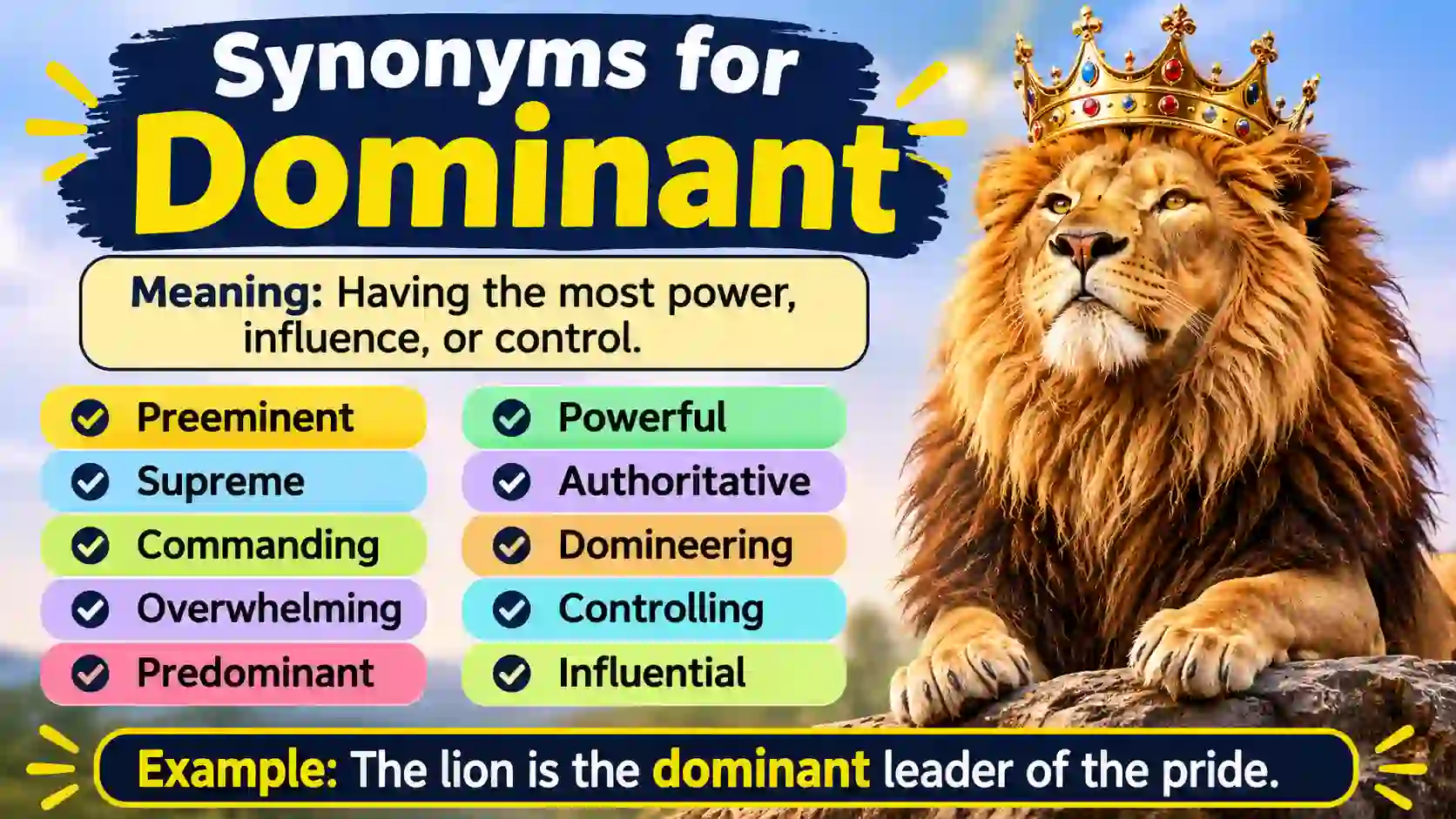
What Are Synonyms for Dominant?
Synonyms for dominant include powerful, controlling, commanding, leading, influential, predominant, ruling, superior, and prevailing. These words describe power, authority, influence, or importance. However, they do not all mean exactly the same thing. Some describe control over people, while others describe the most important or common thing in a group.
Do you want to describe a powerful leader, a successful business, or something that stands out from everything else? The word dominant can describe all these situations. However, repeating it too often can make your writing sound less natural.
Learning synonyms for dominant gives you more ways to express power, control, influence, and importance. For example, a powerful leader has great strength or authority, while an influential person can change people’s opinions or decisions.
This guide explains 30 useful alternatives with simple meanings, original examples, natural collocations, pronunciation, and usage advice. It also explores their differences, so you can choose the right word for essays, professional emails, blog posts, and everyday conversations.
1. Pronunciation of Dominant
- American IPA: /ˈdɑː.mə.nənt/
- British IPA: /ˈdɒm.ɪ.nənt/
- Simple pronunciation: DOM-uh-nuhnt
- Syllables: Three
- Word stress: First syllable
The main pronunciation difference is the first vowel sound.
2. Meaning of Dominant
Dominant describes someone or something that has greater power, influence, importance, or visibility than others.
Examples:
- The company holds a dominant position in the industry.
- Blue is the dominant color in the painting.
- She has a dominant personality.
The meaning changes slightly according to context. It can describe leadership, control, popularity, visual importance, or biological characteristics.
3. Part of Speech and Word Family
Dominant is primarily an adjective, but it also has specialized noun uses.
| Word | Part of speech | Meaning |
| Dominant | Adjective | Having the greatest influence or power |
| Dominance | Noun | Power, control, or influence |
| Dominate | Verb | To control or have the greatest influence |
| Dominantly | Adverb | In a dominant or principal manner |
| Domination | Noun | The act or state of controlling |
Examples:
- Adjective: The team is dominant.
- Noun: The team established its dominance.
- Verb: The team dominates the competition.
- Adverb: The discussion was dominantly focused on economic issues.
Grammar note: Dominantly is a real English adverb, but it is less common than phrases such as mainly, mostly, and predominantly. Do not use it just to make a sentence sound more advanced.
4. Word Origin and Etymology
The word dominant entered English through Old French and comes from the Latin dominantem, related to dominari, meaning to rule or govern.
Its deeper root is dominus, meaning lord or master.
- Language origin: Latin, through Old French
- Historical English form: Dominaunt
- First recorded use: Mid-15th century
- Later meaning: Exercising authority or having controlling influence
The word later developed specialized meanings in music, biology, and ecology.
5. Grammar and Sentence Patterns
Use dominant in these common structures:
| Pattern | Example |
| Dominant + noun | A dominant company |
| Be + dominant | The brand is dominant. |
| Dominant in + field | The company is dominant in technology. |
| Dominant over + group | The group became dominant over its rivals. |
| A dominant feature of | The fireplace was the dominant feature of the room. |
Common collocations:
- Dominant position
- Dominant personality
- Dominant force
- Dominant culture
- Dominant market player
- Dominant influence
- Dominant role
- Dominant feature
6. Quick Comparison: 30 Synonyms for Dominant
| Synonym | Main meaning | Tone |
| Powerful | Having great strength | Neutral |
| Controlling | Directing others | Negative/neutral |
| Commanding | Showing authority | Positive |
| Predominant | Most common or influential | Formal |
| Influential | Affecting decisions | Positive |
| Leading | Ahead of competitors | Positive |
| Ruling | Holding authority | Formal |
| Authoritative | Having recognized authority | Positive |
| Superior | Higher in rank or quality | Neutral |
| Paramount | Most important | Formal |
| Preeminent | Outstanding in a field | Formal |
| Prevailing | Most widely accepted | Formal |
| Prominent | Noticeable or well-known | Neutral |
| Foremost | Among the most important | Formal |
| Chief | Main or highest-ranking | Neutral |
| Principal | First in importance | Formal |
| Main | Most important | Neutral |
| Primary | First or most important | Formal |
| Major | Very important | Neutral |
| Central | At the heart of something | Neutral |
| Key | Essential or important | Neutral |
| Assertive | Confident in expression | Positive |
| Forceful | Showing strong energy | Neutral |
| Domineering | Unpleasantly controlling | Negative |
| Overbearing | Excessively controlling | Negative |
| Autocratic | Using unchecked authority | Negative |
| Sovereign | Having supreme authority | Formal |
| Ascendant | Growing in power | Literary |
| Prevalent | Widespread or common | Formal |
| Preponderant | Having greater weight or influence | Academic |
7. 30 Synonyms for Dominant With Examples and Explanations
1. Powerful
Meaning: Having great strength, authority, or influence.
Examples:
- The powerful company expanded into new markets.
- Her powerful speech inspired the entire audience.
Best used when: Describing strength, authority, or influence.
Tone: Neutral | CEFR: B1 | Frequency: Very common
Collocations: Powerful leader, powerful influence, powerful organization.
When not to use: Avoid it when you only mean something is the most common.
2. Controlling
Meaning: Having or using control over other people.
Examples:
- The controlling manager approved every small decision.
- His controlling behavior damaged the team’s trust.
Best used when: Describing someone who directs or restricts others.
Tone: Often negative | CEFR: B1 | Frequency: Common
Collocations: Controlling behavior, controlling personality, controlling attitude.
When not to use: Do not use it as a positive replacement for leadership.
3. Commanding
Meaning: Showing strong authority or attracting respect.
Examples:
- The speaker had a commanding presence on stage.
- Her commanding voice brought the noisy room to silence.
Best used when: Describing confident authority or an impressive presence.
Tone: Positive | CEFR: C1 | Frequency: Common
Collocations: Commanding presence, commanding voice, commanding position.
When not to use: Avoid it when you mean something is simply popular.
4. Predominant
Meaning: Being more common, noticeable, or influential than other things.
Examples:
- Green was the predominant color in the landscape.
- English became the predominant language of the discussion.
Best used when: Describing the most common or noticeable element.
Tone: Formal | CEFR: C1 | Frequency: Common
Collocations: Predominant feature, predominant view, predominant language.
When not to use: Do not use it to describe unpleasant control over another person.
5. Influential
Meaning: Having the power to affect opinions or decisions.
Examples:
- She became an influential figure in education.
- The organization has influential supporters across the country.
Best used when: Discussing people or organizations that affect others.
Tone: Positive | CEFR: B2 | Frequency: Very common
Collocations: Influential person, influential leader, influential figure.
When not to use: Avoid it when you mean someone has direct legal authority.
6. Leading
Meaning: Being ahead of others in importance, success, or position.
Examples:
- The company is a leading producer of electric vehicles.
- She plays a leading role in the research project.
Best used when: Describing industry leaders, experts, or important roles.
Tone: Positive | CEFR: B1 | Frequency: Very common
Collocations: Leading brand, leading expert, leading position.
When not to use: Do not use it when someone controls others through force.
7. Ruling
Meaning: Having official power over a country or group.
Examples:
- The ruling party announced a new education policy.
- The ruling family governed the region for generations.
Best used when: Discussing governments, political groups, and authorities.
Tone: Formal | CEFR: B2 | Frequency: Common
Collocations: Ruling party, ruling class, ruling authority.
When not to use: Avoid it for someone who is simply popular.
8. Authoritative
Meaning: Having recognized knowledge, authority, or power.
Examples:
- The teacher gave an authoritative explanation.
- The report provides an authoritative account of the event.
Best used when: Describing trusted experts, official sources, or recognized authority.
Tone: Formal | CEFR: C1 | Frequency: Common
Collocations: Authoritative source, authoritative voice, authoritative figure.
When not to use: Avoid it when you mean aggressive or unpleasant behavior.
9. Superior
Meaning: Better or higher in quality, rank, or ability.
Examples:
- The new model offers superior performance.
- The officer held a superior position in the department.
Best used when: Comparing quality, rank, or ability.
Tone: Neutral/formal | CEFR: B2 | Frequency: Very common
Collocations: Superior quality, superior performance, superior position.
When not to use: Avoid it when you only mean something is noticeable.
10. Paramount
Meaning: More important than anything else.
Examples:
- Public safety remains the paramount concern.
- Trust is paramount in a successful partnership.
Best used when: Expressing the highest level of importance.
Tone: Formal | CEFR: C1 | Frequency: Common
Collocations: Paramount importance, paramount concern, paramount consideration.
When not to use: Do not use it to describe physical strength.
11. Preeminent
Meaning: More respected or important than others in a particular field.
Examples:
- She is a preeminent researcher in climate science.
- The university is a preeminent center for medical research.
Best used when: Describing outstanding experts or institutions.
Tone: Formal | CEFR: C2 | Frequency: Uncommon
Collocations: Preeminent scholar, preeminent position, preeminent authority.
When not to use: Avoid it for ordinary control or everyday leadership.
12. Prevailing
Meaning: Existing or accepted more widely than other ideas or conditions.
Examples:
- The prevailing opinion supported the proposal.
- The prevailing wind carried clouds toward the coast.
Best used when: Discussing common opinions, conditions, or trends.
Tone: Formal | CEFR: C1 | Frequency: Common
Collocations: Prevailing view, prevailing conditions, prevailing opinion.
When not to use: Avoid it when describing direct authority over people.
13. Prominent
Meaning: Important, famous, or easy to notice.
Examples:
- A prominent business leader attended the conference.
- The building occupies a prominent position near the entrance.
Best used when: Describing visible, respected, or well-known people and things.
Tone: Neutral | CEFR: B2 | Frequency: Very common
Collocations: Prominent figure, prominent feature, prominent position.
When not to use: Do not confuse visibility with control.
14. Foremost
Meaning: Among the most important or successful.
Examples:
- She is one of the country’s foremost scientists.
- Customer satisfaction is our foremost priority.
Best used when: Highlighting high importance or position.
Tone: Formal | CEFR: C1 | Frequency: Common
Collocations: Foremost expert, foremost concern, foremost priority.
When not to use: Avoid it for aggressive or unfair control.
15. Chief
Meaning: Most important or highest in rank.
Examples:
- The chief reason for the delay was bad weather.
- The chief engineer approved the final design.
Best used when: Describing a main reason, leader, or responsibility.
Tone: Neutral/formal | CEFR: B1 | Frequency: Very common
Collocations: Chief executive, chief reason, chief concern.
When not to use: Avoid it when you only mean someone is influential.
16. Principal
Meaning: First in importance or having the main role.
Examples:
- The principal objective is to improve education.
- She is the principal investor in the project.
Best used when: Describing main roles, objectives, or responsibilities.
Tone: Formal | CEFR: B2 | Frequency: Very common
Collocations: Principal reason, principal role, principal objective.
When not to use: Avoid it for someone who controls others through force.
17. Main
Meaning: Being the most important part of something.
Examples:
- The main issue was a lack of communication.
- Our main goal is to help new students.
Best used when: Describing the central or most important thing.
Tone: Neutral | CEFR: A2 | Frequency: Very common
Collocations: Main reason, main purpose, main feature.
When not to use: Do not use it to describe personal authority.
18. Primary
Meaning: More important than other things or coming first.
Examples:
- Customer service is our primary responsibility.
- The primary source of income comes from farming.
Best used when: Discussing priorities, sources, and purposes.
Tone: Formal | CEFR: B1 | Frequency: Very common
Collocations: Primary purpose, primary concern, primary source.
When not to use: Avoid it when describing someone who has power over others.
19. Major
Meaning: Very important, large, or significant.
Examples:
- The company is a major competitor in the market.
- Education plays a major role in social development.
Best used when: Describing importance, size, or influence.
Tone: Neutral | CEFR: B1 | Frequency: Very common
Collocations: Major influence, major player, major role.
When not to use: Do not use it as an exact replacement for controlling.
20. Central
Meaning: Most important to a subject or situation.
Examples:
- Communication is central to effective teamwork.
- The central idea of the book concerns personal growth.
Best used when: Describing an essential idea or role.
Tone: Neutral | CEFR: B1 | Frequency: Very common
Collocations: Central role, central issue, central idea.
When not to use: Avoid it when you mean the strongest person in a group.
21. Key
Meaning: Very important to the success or understanding of something.
Examples:
- Practice is a key factor in language learning.
- She became a key member of the research team.
Best used when: Highlighting an important person, factor, or element.
Tone: Neutral | CEFR: B1 | Frequency: Very common
Collocations: Key factor, key player, key decision.
When not to use: Avoid it when you mean actual control or superiority.
22. Assertive
Meaning: Confidently expressing your opinions and needs.
Examples:
- An assertive manager communicates expectations clearly.
- She became more assertive during team discussions.
Best used when: Describing confident communication and behavior.
Tone: Positive | CEFR: B2 | Frequency: Common
Collocations: Assertive behavior, assertive communication, assertive personality.
When not to use: Do not confuse confidence with dominance. Assertive people can respect others.
23. Forceful
Meaning: Showing strong power, determination, or energy.
Examples:
- The director made a forceful argument for change.
- His forceful personality influenced the discussion.
Best used when: Describing strong actions, opinions, or personalities.
Tone: Neutral | CEFR: B2 | Frequency: Common
Collocations: Forceful argument, forceful personality, forceful response.
When not to use: Avoid it when you mean peaceful or quiet authority.
24. Domineering
Meaning: Trying to control others in an unpleasant way.
Examples:
- His domineering attitude discouraged open discussion.
- The coach refused to consider other opinions.
Best used when: Describing excessive or unfair control.
Tone: Negative | CEFR: C1 | Frequency: Common
Collocations: Domineering personality, domineering behavior, domineering attitude.
When not to use: Avoid it as a positive description of a good leader.
25. Overbearing
Meaning: Trying to control others in an unreasonable way.
Examples:
- The overbearing supervisor rarely listened to employees.
- Her overbearing manner made the meeting uncomfortable.
Best used when: Describing someone who puts too much pressure on others.
Tone: Negative | CEFR: C1 | Frequency: Common
Collocations: Overbearing attitude, overbearing personality, overbearing behavior.
When not to use: Do not use it simply because someone is confident.
26. Autocratic
Meaning: Using personal authority without allowing much disagreement.
Examples:
- The organization adopted an autocratic management style.
- The autocratic leader made decisions without consulting the team.
Best used when: Describing strict leadership or political systems.
Tone: Negative/formal | CEFR: C2 | Frequency: Uncommon
Collocations: Autocratic rule, autocratic leadership, autocratic government.
When not to use: Avoid it for leaders who encourage shared decisions.
27. Sovereign
Meaning: Having supreme power or independent authority.
Examples:
- The sovereign ruler controlled the kingdom.
- Every sovereign nation has the right to govern itself.
Best used when: Discussing governments, states, and supreme authority.
Tone: Formal | CEFR: C2 | Frequency: Common in specialist contexts
Collocations: Sovereign state, sovereign power, sovereign authority.
When not to use: Avoid it as a casual replacement for powerful.
28. Ascendant
Meaning: Becoming more powerful, successful, or influential.
Examples:
- The ascendant political group gained public support.
- The company became an ascendant force in renewable energy.
Best used when: Describing growing influence or rising power.
Tone: Literary/formal | CEFR: C2 | Frequency: Uncommon
Collocations: Ascendant power, ascendant position, ascendant influence.
When not to use: Avoid it when describing a position that is not growing or changing.
29. Prevalent
Meaning: Existing or happening in many places or among many people.
Examples:
- Online learning is prevalent in many universities.
- This belief remains prevalent in rural communities.
Best used when: Describing widespread practices, conditions, or beliefs.
Tone: Formal | CEFR: C1 | Frequency: Common
Collocations: Prevalent belief, prevalent condition, widely prevalent.
When not to use: Avoid it when you mean the most powerful person.
30. Preponderant
Meaning: Having greater weight, importance, or influence than competing things.
Examples:
- Economic concerns had a preponderant influence on the decision.
- The evidence gave one explanation a preponderant advantage.
Best used when: Discussing factors that outweigh competing factors.
Tone: Academic/formal | CEFR: C2 | Frequency: Rare
Collocations: Preponderant influence, preponderant factor, preponderant evidence.
When not to use: Avoid it in everyday conversation when greater or stronger sounds more natural.
8. Strongest, Strong, and Related Synonym Categories
Closest Synonyms
These words are particularly useful when dominant means having power or influence:
- Powerful
- Controlling
- Commanding
- Predominant
- Ruling
- Influential
- Leading
- Superior
- Authoritative
Strong Contextual Alternatives
These describe particular forms of importance, position, or influence:
- Paramount
- Preeminent
- Prevailing
- Foremost
- Chief
- Principal
- Forceful
- Sovereign
- Ascendant
Related Words
These work in certain situations but are not exact replacements:
- Main
- Primary
- Major
- Central
- Key
- Assertive
- Prominent
- Prevalent
- Domineering
- Overbearing
- Autocratic
9. Choose the Right Synonym: Side by Side Comparisons
| Word | Main difference | Example |
| Dominant | Has greatest power or influence | The company is dominant in its market. |
| Powerful | Has great strength or influence | It is a powerful organization. |
| Influential | Can affect decisions | She is an influential leader. |
| Predominant | Is the most common element | Blue is the predominant color. |
| Controlling | Directs or restricts others | He has a controlling personality. |
| Leading | Is ahead of competitors | It is a leading brand. |
| Prominent | Is noticeable or well-known | He is a prominent scientist. |
| Paramount | Is the most important | Safety is paramount. |
Choose according to your intended meaning:
- Power over people: Controlling
- Strong influence: Powerful
- Influence on decisions: Influential
- Most common element: Predominant
- Highest importance: Paramount
- Top industry position: Leading
- Unpleasant control: Domineering
- Recognized authority: Authoritative
10. Commonly Confused Words
| Word | Difference | Example |
| Dominant | Has greatest power or influence | The team is dominant. |
| Predominant | Is most common or noticeable | Red is predominant. |
| Domineering | Controls others unpleasantly | He has a domineering attitude. |
| Assertive | Expresses opinions confidently | She is assertive at work. |
| Superior | Higher in quality, ability, or rank | This product is superior. |
Remember: A dominant person may have authority, while an assertive person simply communicates confidently. A domineering person uses control in an unpleasant way.
11. American vs. British English
Dominant has the same spelling and general meaning in American and British English.
| Feature | American English | British English |
| Spelling | Dominant | Dominant |
| IPA | /ˈdɑː.mə.nənt/ | /ˈdɒm.ɪ.nənt/ |
| Stress | First syllable | First syllable |
| Dominance | Same spelling | Same spelling |
| Dominate | Same spelling | Same spelling |
There is no important spelling difference. The main difference is the first vowel sound.
12. CEFR Vocabulary Guide
The following levels are approximate learning estimates rather than official classifications.
| Level | Suggested vocabulary |
| A1–A2 | Main |
| B1 | Powerful, leading, chief, major, primary |
| B2 | Influential, superior, prominent, central, assertive |
| C1 | Predominant, commanding, prevailing, authoritative |
| C2 | Preeminent, paramount, autocratic, ascendant, preponderant |
Learning advice: Begin with common alternatives. Learn advanced vocabulary gradually through reading and writing.
13. Word Frequency and Natural Collocations
| Frequency | Examples |
| Very common | Powerful, main, leading, major, key |
| Common | Influential, prominent, superior, controlling, primary |
| Less common | Preeminent, ascendant, paramount, autocratic |
| Rare | Preponderant |
These are practical learning estimates, not formal corpus frequency measurements.
Natural collocations:
- Dominant force
- Dominant position
- Dominant personality
- Dominant culture
- Dominant feature
- Dominant role
- Dominant influence
- Dominant market player
Native speakers use these combinations in business, education, politics, news, and everyday writing.
14. Common Mistakes
Mistake 1: Confusing dominant with domineering
Incorrect: My teacher is domineering because she inspires students.
Better: My teacher is influential because she inspires students.
Explanation: Influential describes the ability to affect others. Domineering suggests unpleasant control.
Mistake 2: Using predominant for personal authority
Incorrect: The manager is predominant over his employees.
Better: The manager has authority over his employees.
Explanation: Predominant usually describes the most common or influential element.
Mistake 3: Confusing assertive with aggressive
Incorrect: She is assertive because she forces everyone to follow her orders.
Better: She is domineering because she forces everyone to follow her orders.
Explanation: Assertive people communicate confidently without necessarily controlling others.
15. Writing Tips: How to Use Synonyms Naturally
Essays: Use predominant, paramount, principal, and preeminent in academic discussions.
Example: Education is a principal factor in economic development.
Professional emails: Use leading, influential, and key when describing people and responsibilities.
Example: She is a key member of our marketing team.
Blog posts: Use powerful, popular, leading, and prominent for easy reading.
Example: The brand has become a leading name in online education.
Stories: Use commanding, domineering, forceful, and sovereign to describe characters.
Example: The commanding queen entered the hall with confidence.
Social media: Choose familiar expressions such as powerful and strong.
Example: A powerful message can change someone’s perspective.
Daily conversations: Use simple vocabulary.
Instead of saying, “He has a dominant position,” say, “He is the most powerful person in the group.”
Writing tip: Do not replace every occurrence of dominant with another word. First identify whether you mean power, importance, popularity, control, or visibility.
16. Related Vocabulary
Antonyms of Dominant
| Antonym | Meaning |
| Subordinate | Lower in rank |
| Inferior | Lower in quality or status |
| Secondary | Less important |
| Minor | Less significant |
| Weak | Lacking strength |
| Submissive | Willing to accept another’s control |
| Powerless | Without power or authority |
| Recessive | Not expressed in the same way as a dominant genetic allele |
Related Expressions
- Take charge: Accept control or responsibility.
- Hold power: Have authority.
- Call the shots: Make important decisions.
- Have the upper hand: Have an advantage.
- Take the lead: Move into the leading position.
- Rule the roost: Be the person in control.
- Exercise authority: Use official power.
Word Family
| Word | Part of speech | Meaning |
| Dominate | Verb | Control or influence |
| Dominant | Adjective | Having greatest power |
| Dominance | Noun | State of having power |
| Dominantly | Adverb | In a dominant manner |
| Domination | Noun | Act of controlling |
| Domineering | Adjective | Unpleasantly controlling |
17. Frequently Asked Questions
What is the best synonym for dominant?
Powerful is one of the best general alternatives when describing strength or influence. However, the right choice depends on context. Use controlling for authority over people, predominant for the most common element, and leading for someone ahead of competitors.
What is another word for dominant in a positive way?
Positive alternatives include powerful, influential, leading, commanding, and prominent. These words can describe someone who inspires others, leads an organization, or has a strong professional reputation without suggesting unpleasant behavior or excessive control.
What is a negative synonym for dominant?
Domineering and overbearing are useful negative alternatives. They describe people who try to control others in an unpleasant way. Autocratic is another option for leaders who make decisions without allowing much participation or disagreement.
What is a synonym for dominant in a relationship?
Depending on the situation, you can use controlling, assertive, influential, or leading. Controlling suggests someone restricts another person’s choices, while assertive describes confident communication. These words have different emotional meanings, so choose carefully.
What is the difference between dominant and predominant?
Dominant describes something that has greater power, influence, or importance. Predominant usually describes something that is most common or noticeable. A dominant company may control a market, while a predominant color appears most often in a picture.
What is the opposite of dominant?
Common antonyms include subordinate, inferior, secondary, minor, weak, and powerless. The best opposite depends on the meaning. Use subordinate for lower rank, weak for lack of strength, and secondary for something less important.
What is a formal synonym for dominant?
Formal alternatives include predominant, paramount, preeminent, authoritative, principal, and sovereign. Use paramount when discussing importance, authoritative for recognized authority, and preeminent for someone highly respected in a particular field.
Is dominant a positive or negative word?
Dominant can be positive, negative, or neutral. A dominant company may be successful, a dominant personality may take control, and a dominant color may simply stand out. The surrounding sentence determines its emotional meaning.
18. Vocabulary Quiz
1. Which word describes something that has great strength or influence?
A. Minor
B. Powerful
C. Secondary
D. Weak
2. Which synonym describes the most common color in a picture?
A. Domineering
B. Assertive
C. Predominant
D. Sovereign
3. Which word describes unpleasant control over others?
A. Influential
B. Leading
C. Domineering
D. Prominent
4. Which word means most important?
A. Paramount
B. Subordinate
C. Minor
D. Weak
5. Which word describes confident communication without necessarily controlling others?
A. Autocratic
B. Assertive
C. Overbearing
D. Ruling
Answer Key: 1-B, 2-C, 3-C, 4-A, 5-B.
19. Additional Practice Exercises
Fill in the blanks. Choose from influential, predominant, and paramount.
- Safety is the __________ concern.
- She is an __________ voice in education.
- Blue was the __________ color in the painting.
Rewrite these sentences using suitable synonyms.
- The company is a dominant player in the industry.
- The manager has a dominant personality.
- Trust is the dominant concern in this partnership.
Match the words with their meanings.
| Word | Meaning |
| 1. Domineering | A. Most important |
| 2. Paramount | B. Unpleasantly controlling |
| 3. Leading | C. Ahead of competitors |
Practice answers:
Fill in the blanks: 1. Paramount, 2. Influential, 3. Predominant.
Rewriting: 1. Leading, 2. Commanding or controlling, 3. Paramount.
Matching: 1-B, 2-A, 3-C.
20. Conclusion
Learning synonyms for dominant helps you express power, influence, importance, and authority more clearly. Words like powerful, influential, leading, and predominant give your writing more variety and precision.
Practice these alternatives in emails, essays, schoolwork, blog posts, and daily conversations. Remember, the best vocabulary choice is always the one that communicates your meaning naturally and accurately.
References
- Oxford Learner’s Dictionaries: https://www.oxfordlearnersdictionaries.com/definition/english/dominant
- Cambridge Dictionary: https://dictionary.cambridge.org/us/thesaurus/dominant
- Merriam-Webster: https://www.merriam-webster.com/dictionary/dominant
- Collins Dictionary: https://www.collinsdictionary.com/dictionary/english/dominant
- Thesaurus.com: https://www.thesaurus.com/browse/dominant

Synonorm is a trusted English vocabulary resource created to help readers find the right words and understand the differences between similar terms. We provide clear explanations of synonyms, meanings, examples, usage, and alternatives. Our content makes vocabulary easier to learn and apply in everyday, academic, and professional English. Synonorm is designed for students, writers, ESL learners, professionals, and anyone who wants to improve their English vocabulary and communicate more clearly.