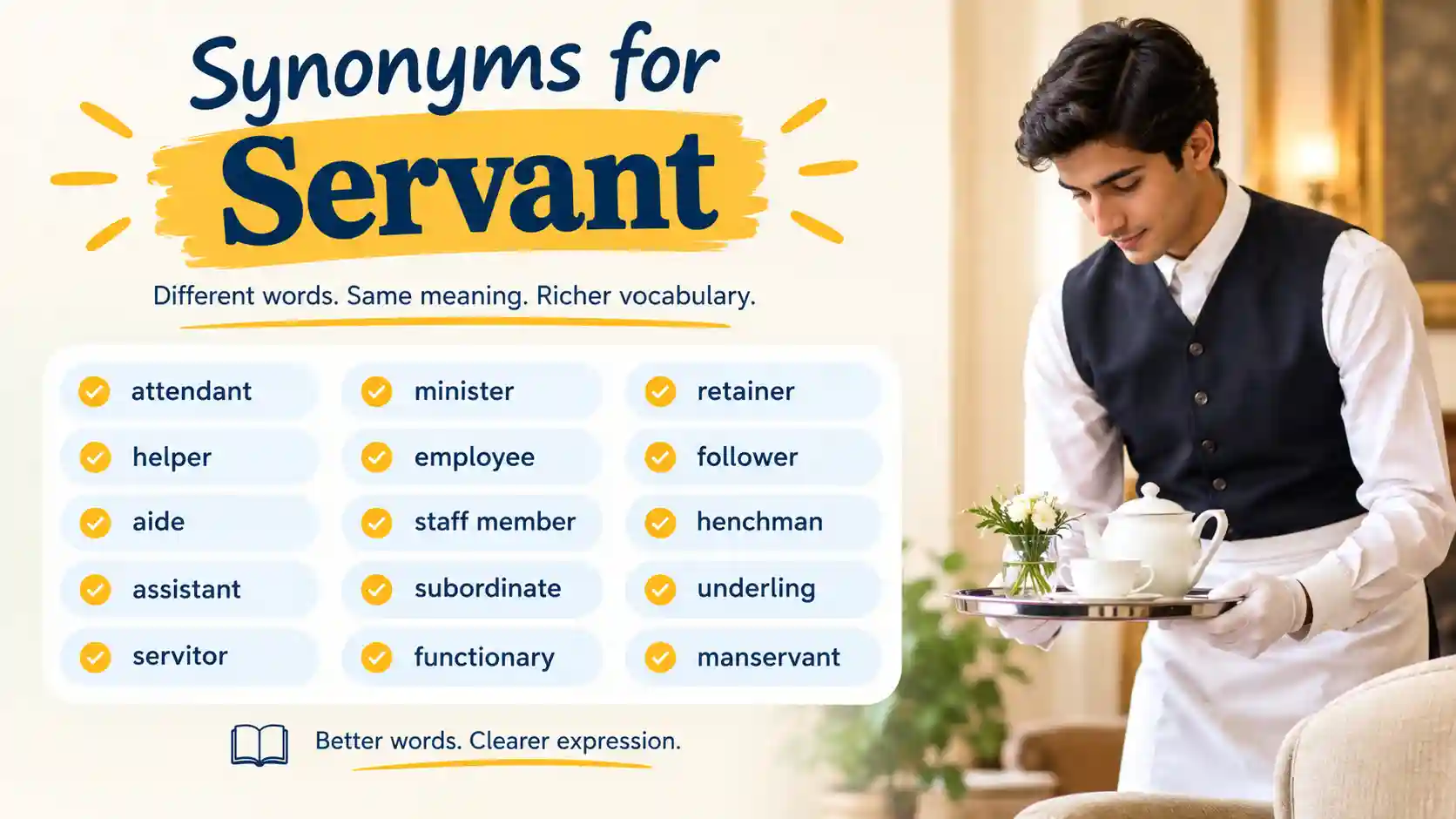
Quick Answer: What Are Synonyms for Servant?
Common synonyms for servant include domestic worker, household servant, attendant, maid, housekeeper, butler, helper, and personal assistant. The right word depends on the person’s duties. A housekeeper maintains a home, an attendant assists people, and a butler manages household service. Words such as lackey and minion carry negative meanings, while employee describes a wider working relationship.
Have you ever needed another word for servant in an essay, story, or conversation? English has many alternatives, but they do not all mean the same thing.
A servant traditionally refers to someone who works for another person, often in a private home. Today, writers may prefer domestic worker, housekeeper, or another specific job title. These choices can sound clearer and more respectful.
Learning synonyms for servant helps students improve their vocabulary, writers describe people accurately, and professionals communicate with care. This guide explains the closest alternatives, their meanings, pronunciation, tone, and common uses. You will also learn which words to avoid in formal writing.
Pronunciation
- Word: Servant
- British IPA: /ˈsɜːvənt/
- American IPA: /ˈsɝːvənt/
- Simple pronunciation: SUR-vuhnt
- Syllables: Two
- Word stress: First syllable
The spelling remains the same in American and British English. The main pronunciation difference comes from the vowel sound.
Part of Speech and Grammar
Servant is a countable noun.
- Singular: a servant
- Plural: servants
Examples:
- A servant opened the door.
- The family employed two servants.
- She worked as a servant to a wealthy household.
The related verb is serve. The adjective servile describes excessive obedience, often in a negative way. The noun service refers to work or help provided to someone.
Common grammar patterns:
- Employ a servant
- Work as a servant
- A servant to someone
- A servant of the public
- A faithful servant
Do not use servant as a verb. Say “The worker serves the family,” not “The worker servants the family.”
Synonyms for Servant: Quick Comparison
| Synonym | Strength | Formality |
|---|---|---|
| Domestic worker | Strongest modern alternative for household employment | Formal |
| Household servant | Closest traditional alternative | Neutral |
| Attendant | Strong in assistance contexts | Formal |
| Housekeeper | Strong for household maintenance | Neutral |
| Maid | Strong in specific domestic contexts | Neutral/traditional |
| Butler | Role-specific | Formal/traditional |
| Helper | Broad alternative | Informal |
| Aide | Professional assistance | Formal |
| Personal assistant | Administrative support | Professional |
| Steward | Management or service role | Formal |
| Valet | Personal service role | Formal/traditional |
| Footman | Historical household role | Literary |
| Retainer | Historical service relationship | Literary |
| Caregiver | Personal care | Neutral |
| Employee | General employment | Professional |
| Worker | General work | Neutral |
| Subordinate | Lower position in a hierarchy | Formal |
| Minion | Obedient follower | Informal/negative |
| Lackey | Servile follower | Negative |
| Servitor | Historical or literary service | Literary |
These words differ in meaning. Choose one based on duties, context, and tone rather than replacing servant automatically.
20 Synonyms for Servant Explained
1. Domestic Worker
Meaning: A person paid to perform work in a private home.
Examples:
- The domestic worker prepared lunch and cleaned the kitchen.
- The family hired a domestic worker to help with daily chores.
Best used when: You need a respectful, modern term for paid household work.
Tone: Neutral and professional.
Approximate CEFR: B2.
Frequency: Common.
Collocations: domestic worker rights, live-in domestic worker, experienced domestic worker.
When not to use it: Do not use it for someone who works in an office or shop.
2. Household Servant
Meaning: A person who serves a household by performing domestic duties.
Examples:
- The household servant prepared the rooms before the guests arrived.
- The historical account describes servants who worked in the royal household.
Best used when: You discuss traditional domestic service or historical households.
Tone: Neutral to traditional.
Approximate CEFR: B1–B2.
Frequency: Common in historical writing.
Collocations: household servant, faithful servant, royal servant.
When not to use it: For modern employment discussions, domestic worker may sound more appropriate.
3. Attendant
Meaning: A person who assists or serves others.
Examples:
- The hotel attendant helped the guests with their luggage.
- A flight attendant explained the safety rules.
Best used when: Someone provides assistance in a particular setting.
Tone: Neutral to formal.
Approximate CEFR: B1–B2.
Frequency: Common.
Collocations: flight attendant, personal attendant, parking attendant.
When not to use it: Do not use it when a specific household job title would be clearer.
4. Housekeeper
Meaning: A person who maintains or manages a home.
Examples:
- The housekeeper changed the sheets before the guests arrived.
- Our housekeeper keeps the rooms clean and organized.
Best used when: Cleaning and maintaining a home are the main duties.
Tone: Neutral and professional.
Approximate CEFR: B1.
Frequency: Very common.
Collocations: professional housekeeper, hotel housekeeper, full-time housekeeper.
When not to use it: Do not assume that every housekeeper also cooks or provides personal care.
5. Maid
Meaning: Traditionally, a woman employed to perform household tasks, especially cleaning.
Examples:
- The maid cleaned the guest bedroom before noon.
- The historical novel follows a maid working in a large house.
Best used when: The context involves a traditional household role.
Tone: Neutral in some contexts, but sometimes old-fashioned.
Approximate CEFR: A2–B1.
Frequency: Very common.
Collocations: maid service, chambermaid, maid’s uniform.
When not to use it: Use domestic worker when gender does not matter or when you need a broader modern term.
6. Butler
Meaning: A household employee who manages service and may supervise other domestic staff.
Examples:
- The butler greeted the guests at the entrance.
- The butler arranged the formal dinner service.
Best used when: You describe a senior household service role.
Tone: Formal and traditional.
Approximate CEFR: B2.
Frequency: Common in books and films.
Collocations: chief butler, household butler, butler service.
When not to use it: A cleaner or cook is not automatically a butler.
7. Helper
Meaning: A person who provides assistance.
Examples:
- A helper carried the boxes into the kitchen.
- The shop hired a helper during the holiday rush.
Best used when: You need a simple, general word for someone who helps.
Tone: Informal to neutral.
Approximate CEFR: A1–A2.
Frequency: Very common.
Collocations: household helper, kitchen helper, classroom helper.
When not to use it: Use a precise job title in formal employment documents.
8. Aide
Meaning: A person who helps someone perform their duties.
Examples:
- The minister’s aide prepared the meeting notes.
- A classroom aide helped the teacher organize the activity.
Best used when: Someone provides professional or practical support.
Tone: Formal and professional.
Approximate CEFR: B2.
Frequency: Common.
Collocations: personal aide, teacher’s aide, presidential aide.
When not to use it: An aide does not necessarily perform household work.
9. Personal Assistant
Meaning: A person who helps someone manage appointments, tasks, and arrangements.
Examples:
- Her personal assistant booked the flights and confirmed the meetings.
- The business owner asked his personal assistant to organize the schedule.
Best used when: The job involves administration and personal organization.
Tone: Professional.
Approximate CEFR: B1–B2.
Frequency: Very common.
Collocations: executive personal assistant, personal assistant duties, experienced personal assistant.
When not to use it: Do not use it for someone whose main duties involve cleaning or cooking.
10. Steward
Meaning: A person responsible for managing resources or providing service.
Examples:
- The estate steward kept records of the household expenses.
- The ship’s steward helped passengers find their cabins.
Best used when: Someone manages resources or provides service in a defined setting.
Tone: Formal.
Approximate CEFR: B2–C1.
Frequency: Common in specific settings.
Collocations: estate steward, ship’s steward, responsible steward.
When not to use it: A steward does not simply mean any domestic worker.
11. Valet
Meaning: A personal attendant who traditionally looks after someone’s clothing and personal needs.
Examples:
- The gentleman’s valet prepared his clothes for the ceremony.
- The historical drama features a valet who travels with his employer.
Best used when: The context involves traditional personal service.
Tone: Formal and traditional.
Approximate CEFR: C1.
Frequency: Uncommon in everyday speech.
Collocations: personal valet, gentleman’s valet, valet service.
When not to use it: In American English, valet often refers to someone who parks cars, so make the intended meaning clear.
12. Footman
Meaning: A male servant who traditionally attended guests and performed household duties.
Examples:
- The footman announced the arrival of the visitors.
- The historical novel describes a footman carrying a tray into the drawing room.
Best used when: You write about historical households or period fiction.
Tone: Literary and historical.
Approximate CEFR: C1.
Frequency: Uncommon.
Collocations: royal footman, household footman, liveried footman.
When not to use it: Avoid it for modern household employees unless the historical context fits.
13. Caregiver
Meaning: A person who looks after someone who needs care or support.
Examples:
- The caregiver helped the older man prepare breakfast.
- A family caregiver stayed with the child during recovery.
Best used when: The main duties involve personal care.
Tone: Neutral and respectful.
Approximate CEFR: B1–B2.
Frequency: Common.
Collocations: family caregiver, professional caregiver, caregiver support.
When not to use it: Do not use it for someone who only performs cleaning or general errands.
14. Employee
Meaning: A person who works for an employer in return for pay.
Examples:
- The employee received a written job description.
- The household employee received her wages at the end of the month.
Best used when: You want a broad term for a paid working relationship.
Tone: Neutral and professional.
Approximate CEFR: A2–B1.
Frequency: Very common.
Collocations: full-time employee, household employee, employee benefits.
When not to use it: It is too broad when the reader needs to know the person’s exact duties.
15. Worker
Meaning: A person who performs a job.
Examples:
- The worker cleaned the kitchen after the event.
- A care worker helped the residents with their daily needs.
Best used when: The precise job title is unknown or unimportant.
Tone: Neutral.
Approximate CEFR: A1–A2.
Frequency: Very common.
Collocations: domestic worker, care worker, skilled worker.
When not to use it: Use a more specific term when the person’s role matters.
16. Retainer
Meaning: A person who serves a household or powerful individual, especially in historical settings.
Examples:
- The nobleman’s retainer delivered an urgent message.
- Several retainers accompanied the lord on his journey.
Best used when: You write about historical households or traditional service relationships.
Tone: Formal and literary.
Approximate CEFR: C1–C2.
Frequency: Uncommon in this sense.
Collocations: loyal retainer, household retainer, nobleman’s retainer.
When not to use it: In modern business English, retainer often refers to a fee paid to secure professional services.
17. Subordinate
Meaning: A person who works under someone else’s authority.
Examples:
- The manager asked her subordinate to prepare the report.
- Each subordinate knew which tasks required approval.
Best used when: You describe a workplace hierarchy.
Tone: Formal and professional.
Approximate CEFR: B2–C1.
Frequency: Common in professional contexts.
Collocations: direct subordinate, subordinate staff, senior subordinate.
When not to use it: It does not describe a household job by itself.
18. Minion
Meaning: A follower who obeys a powerful person, often without independent judgment.
Examples:
- The comic-book villain sent his minions to guard the laboratory.
- The journalist called the corrupt leader’s followers his minions.
Best used when: You want a mocking, humorous, or critical tone.
Tone: Informal and negative.
Approximate CEFR: C1.
Frequency: Common in fiction and informal speech.
Collocations: villain’s minions, loyal minion, political minion.
When not to use it: Never use it as a neutral job title for an ordinary employee.
19. Lackey
Meaning: A person who obeys someone powerful, often in a way that seems undignified.
Examples:
- The dictator’s lackey agreed with every order.
- The detective accused the businessman’s lackey of hiding evidence.
Best used when: You want to criticize someone for obeying another person too readily.
Tone: Negative and insulting.
Approximate CEFR: C1.
Frequency: Less common in everyday conversation.
Collocations: political lackey, obedient lackey, powerful man’s lackey.
When not to use it: Avoid it in respectful workplace communication.
20. Servitor
Meaning: A person who serves another, especially in formal, historical, or literary language.
Examples:
- The fantasy story introduces a servitor who guards the ancient library.
- The king’s servitor delivered the sealed letter.
Best used when: You write historical fiction, fantasy, or formal descriptions of service.
Tone: Literary and formal.
Approximate CEFR: C2.
Frequency: Rare.
Collocations: loyal servitor, royal servitor, humble servitor.
When not to use it: Choose assistant or attendant in ordinary modern writing.
Note on learner levels and frequency: The CEFR levels above are approximate editorial guidance, not official ratings for each word. Frequency labels are qualitative, not corpus-count statistics.
Choose the Right Synonym
| If you mean… | Best choice | Why |
|---|---|---|
| A paid worker in a private home | Domestic worker | Modern and respectful |
| Someone who maintains a home | Housekeeper | Describes household duties |
| Someone who manages formal household service | Butler | Specific job title |
| Someone who assists people | Attendant | Focuses on providing assistance |
| Someone who organizes appointments | Personal assistant | Describes administrative support |
| Someone who provides personal care | Caregiver | Focuses on well-being |
| Someone under a manager’s authority | Subordinate | Describes hierarchy |
| Someone who blindly follows a powerful person | Minion | Communicates criticism or humor |
Quick tip: Before replacing servant, ask what the person actually does. The person’s duties usually matter more than the general label.
Commonly Confused Words
| Word | Main difference | Example |
|---|---|---|
| Servant | Traditionally provides service to another person, often in a home | The servant prepared the room. |
| Slave | A person held under slavery and deprived of freedom | The museum documents the history of slavery. |
| Employee | A person who works for an employer | The employee signed the contract. |
| Assistant | A person who helps someone with work | The assistant arranged the meeting. |
| Subordinate | A person who holds a lower position in a hierarchy | The manager spoke with her subordinate. |
A servant is not necessarily a slave. Some servants worked for wages, while others lived under coercive or exploitative systems. These terms describe different situations and should not be treated as interchangeable.
Word Origin and Etymology
Servant entered English through Middle English and Old French. It comes from a form related to servir, meaning “to serve.” Oxford explains that the word originally referred to a person serving another. The word has been used in English since the Middle English period.
Today, servant can describe household service, public service, or a person controlled by something. Expressions such as public servant and servant of the people show that the word does not always refer to domestic work.
Historical note: The precise first-known-use date can vary between dictionary editions and depends on the evidence available. Check the latest dictionary entry before publishing a specific date.
American vs. British English
The spelling servant is the same in American and British English.
| Feature | American English | British English |
|---|---|---|
| Spelling | servant | servant |
| Pronunciation | /ˈsɝːvənt/ | /ˈsɜːvənt/ |
| Household term | Housekeeper, maid, domestic worker | Housekeeper, maid, domestic worker |
| Car-parking role | Valet | Often car park attendant |
The main differences involve pronunciation and the context in which job titles appear. In both varieties, domestic worker and housekeeper can be clearer than the broad word servant when describing modern household employment.
Common Mistakes
Mistake: Every household cleaner is a butler.
Correction: A housekeeper or cleaner may be the correct term.
Explanation: A butler has a more specific household service role.
Mistake: Our minion prepares meals for the family.
Correction: Our cook prepares meals for the family.
Explanation: Minion usually mocks someone who obeys a powerful person.
Mistake: Every servant was a slave.
Correction: Some servants received wages, while others experienced forced or unfree labor.
Explanation: The words describe different legal and social situations.
Mistake: The office subordinate washed the family’s dishes.
Correction: The household worker washed the dishes.
Explanation: Subordinate describes a position in a hierarchy, not a domestic job.
Writing Tips
- Essays: Use domestic worker for modern employment and servant for historical or literary discussions.
- Emails: Use the person’s actual job title, such as housekeeper, caregiver, or personal assistant.
- Blog posts: Explain the differences between household work, personal assistance, and general employment.
- Stories: Choose words that fit the setting. Footman may suit a historical mansion, while housekeeper fits many modern settings.
- Social media: Use simple, accurate terms such as helper or housekeeper.
- Professional communication: Avoid insulting labels such as lackey and minion.
- Daily conversations: Choose the simplest accurate word. If you do not know someone’s job title, describe their duties instead.
Related Vocabulary
Antonyms
Possible contextual opposites include:
- Employer: A person or organization that hires workers.
- Master: A traditional term for someone with authority over a servant.
- Lord: A historical title associated with authority or rank.
- Superior: Someone with a higher position in a hierarchy.
These are not universal opposites. Employer is most useful when discussing a working relationship, while master and lord fit certain historical contexts.
Related Expressions
- Public servant: A person who works for the government or serves the public.
- Domestic service: Work performed in a private household.
- At someone’s service: Ready and willing to help someone.
- Serve the public: Work for the benefit of the public.
- A servant of the people: Someone who sees their role as serving the public.
- Wait on someone: Attend to someone’s needs, often by providing food or other service.
Word Family
| Word | Part of speech | Meaning |
|---|---|---|
| Serve | Verb | To help or provide a service |
| Service | Noun | Work or assistance provided to others |
| Servant | Noun | A person who serves another |
| Serving | Noun or verb form | An act of service or the act of serving |
| Servile | Adjective | Excessively obedient or submissive |
| Servitude | Noun | A condition of subjection or forced service |
Frequently Asked Questions
1. What are the best synonyms for servant?
The best synonyms for servant include domestic worker, housekeeper, attendant, maid, and helper. Choose domestic worker for modern household employment, housekeeper for home maintenance, and attendant for assistance. The right word depends on the person’s duties and the tone of your sentence.
2. What is a more respectful word for servant?
Domestic worker is often a respectful, modern alternative for someone who performs paid household work. You can also use a specific job title, such as housekeeper, cook, or caregiver. Choose a term that accurately reflects the person’s duties and preferences.
3. What is a synonym for servant in formal English?
Formal alternatives include domestic worker, attendant, aide, and employee. They have different meanings. Use aide for professional assistance, employee for a paid working relationship, and domestic worker for household employment.
4. What is another word for a servant who works in a house?
Common alternatives include housekeeper, maid, housemaid, and domestic worker. A housekeeper usually maintains a home, while a maid often performs cleaning duties. Domestic worker is a broader term that can cover different household tasks.
5. What is the difference between a servant and a subordinate?
A servant traditionally provides service to another person, often in a household. A subordinate works under someone else’s authority in an organization or hierarchy. A subordinate may have no household duties, so the words do not mean the same thing.
6. What is the opposite of servant?
Possible opposites include employer, master, and lord, depending on the context. Employer is the clearest choice when discussing paid work. Master and lord usually fit historical or traditional settings. No single antonym works in every situation.
7. Is servant a noun or a verb?
Servant is a noun that refers to a person who serves another. The related verb is serve. For example, “The servant serves the guests.” Here, servant names the person, while serves describes the action.
8. What is the difference between a servant and a domestic worker?
Servant is a traditional term that can carry historical or social-status associations. Domestic worker directly describes someone employed to perform household tasks. The second term often suits modern employment discussions, while the first may fit historical writing or expressions such as public servant.
Vocabulary Quiz
1. Which term is often a respectful modern choice for someone paid to work in a home?
A. Minion
B. Domestic worker
C. Subordinate
D. Lackey
2. Which word describes someone who manages formal household service?
A. Butler
B. Caregiver
C. Employee
D. Subordinate
3. Which word usually carries a negative meaning and suggests blind obedience?
A. Attendant
B. Housekeeper
C. Minion
D. Aide
4. Choose the best word: The manager asked her _____ to prepare the report.
A. Footman
B. Subordinate
C. Housemaid
D. Valet
5. Which word is the verb in this sentence: “The servant serves the guests”?
A. The
B. Servant
C. Serves
D. Guests
Answer Key
- B. Domestic worker
- A. Butler
- C. Minion
- B. Subordinate
- C. Serves
Conclusion
Learning synonyms for servant helps you describe people and their work with greater accuracy. Words such as housekeeper, domestic worker, attendant, and personal assistant suit different situations. Choose your word based on the person’s duties, the setting, and the tone you want.
Practice these alternatives in essays, emails, stories, and conversations. A stronger vocabulary will help you communicate more clearly and confidently.
References
- Cambridge Dictionary: https://dictionary.cambridge.org/dictionary/english/servant
- Cambridge Thesaurus: https://dictionary.cambridge.org/thesaurus/servant
- Merriam-Webster Thesaurus: https://www.merriam-webster.com/thesaurus/SERVANT
- Oxford Learner’s Dictionaries: https://www.oxfordlearnersdictionaries.com/us/definition/english/servant
- Collins Dictionary: https://www.collinsdictionary.com/us/dictionary/english/servant

Synonorm is a trusted English vocabulary resource created to help readers find the right words and understand the differences between similar terms. We provide clear explanations of synonyms, meanings, examples, usage, and alternatives. Our content makes vocabulary easier to learn and apply in everyday, academic, and professional English. Synonorm is designed for students, writers, ESL learners, professionals, and anyone who wants to improve their English vocabulary and communicate more clearly.