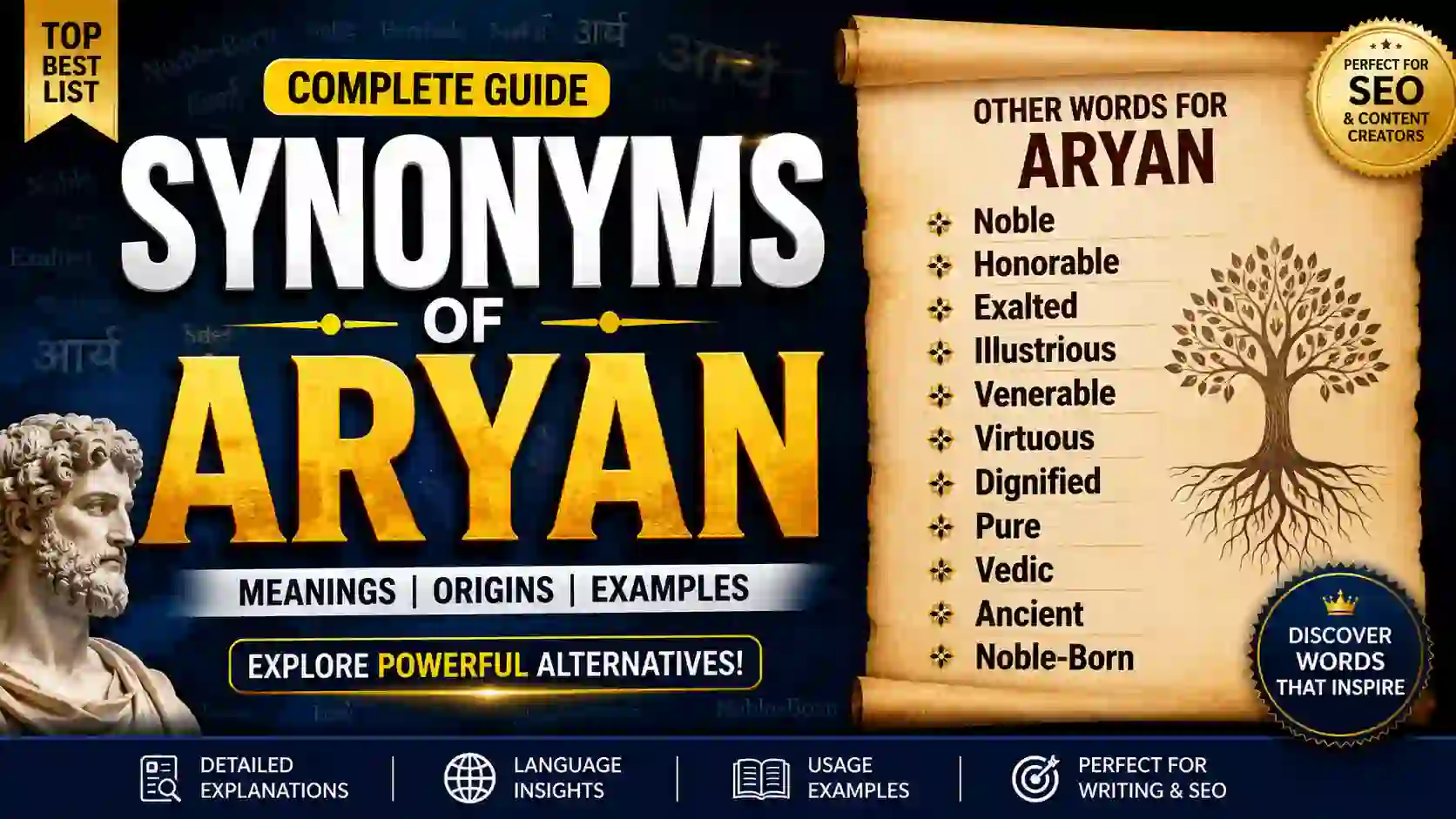
Quick Answer: What Are the Synonyms of Aryan?
The best synonym for Aryan depends on its historical meaning. In modern linguistic writing, Indo-Iranian is often the most precise related term, while Indo-Aryan refers specifically to one branch of Indo-Iranian languages. Indo-European is broader and can match an older use of Aryan, but it is not always an exact synonym. Words such as white, Caucasian, Nordic, and Iranian should not be treated as direct synonyms.
Introduction
Looking for the synonyms of Aryan can be surprisingly difficult. Many online thesaurus pages give only two or three alternatives, while others list words that are related to the term but do not actually mean the same thing.
The problem comes from the history of the word. Aryan has been used in different ways in linguistics, history, and racial ideology. In modern scholarship, Indo-Aryan, Indo-Iranian, and Indo-European are usually more precise choices, depending on what you mean. Encyclopaedia Iranica describes Aryan primarily as a linguistic concept associated with the ancient Indo-Aryan and Iranian languages.
This guide explains the closest alternatives, their meanings, formality, frequency, connotations, pronunciation, word origin, and correct usage. It also shows you when not to use each word, so you can choose the right term instead of simply replacing one word with another.
What Does Aryan Mean?
Aryan is a historical term with more than one sense.
In historical linguistics, it has been used for the ancient peoples and languages associated particularly with Indo-Iranian traditions. Nineteenth-century European scholars also used Aryan more broadly for what they called Indo-European peoples and languages.
Later, racial theorists gave Aryan a racial meaning. Nazi Germany adopted and radicalized the false idea of an “Aryan race” and used it to support racist persecution. The U.S. Holocaust Memorial Museum stresses that an Aryan “master race” did not exist.
Key lesson: The correct alternative depends on which historical sense you mean.
Pronunciation
American English: /ˈe.ri.ən/
British English: /ˈeə.ri.ən/
Simple pronunciation: AIR-ee-uhn
Cambridge gives /ˈe.ri.ən/ for American English and /ˈeə.ri.ən/ for British English.
Spelling
Aryan is the standard modern spelling.
Arian appears as a historical variant, but it can also refer to Arianism, so writers should not automatically substitute it for Aryan.
Part of Speech
Aryan can be used as both a noun and an adjective.
As a noun
It can refer to a person or group described by the historical term.
Example:
The historian examined how the word Aryan was used in nineteenth-century scholarship.
As an adjective
It describes something associated with the historical term.
Examples:
- Aryan languages
- Aryan terminology
- Aryan ideology
It is not normally used as a verb or adverb.
Aryan: CEFR Level and Learner Difficulty
There is no universally fixed CEFR level for Aryan. For practical English learning, it is best treated as an advanced, specialized vocabulary item, roughly C1–C2.
It is much less common in everyday conversation than words such as:
- historical
- ancient
- linguistic
- European
- Iranian
- related
If you are an ESL learner, you do not need to use Aryan frequently. You mainly need to understand it when reading history, linguistics, anthropology, or discussions of Nazi ideology.
Quick Synonym Comparison
| Word | Relationship to Aryan | Formality | Frequency | Best Context |
| Indo-Iranian | Closest modern linguistic alternative in many contexts | Academic | Common in specialist writing | Linguistics |
| Indo-Aryan | Narrower term | Academic | Common | South Asian languages |
| Indo-European | Broader historical alternative | Academic | Very common | Language family |
| Arian | Historical spelling variant | Historical | Uncommon | Older texts |
| Indic | Related/narrower context | Academic | Common in specialist writing | Indian languages |
| Iranian | Related branch | Neutral/Academic | Very common | Iranian languages |
| Sanskritic | Related to Sanskrit | Academic | Uncommon | Sanskrit studies |
| Proto-Indo-European | Related reconstructed ancestor | Academic | Common in linguistics | Historical linguistics |
| Indo-Germanic | Older term for Indo-European | Historical | Rare | Older scholarship |
Important: This table separates true or contextually useful alternatives from words that merely have historical connections to Aryan.
The Best Synonyms of Aryan Explained
1. Indo-Iranian
Meaning: A branch of the Indo-European language family containing the Indo-Aryan and Iranian branches.
Example 1:
The researcher compared several Indo-Iranian languages.
Example 2:
The course introduces students to early Indo-Iranian linguistic history.
Best Used When: You are discussing the linguistic group that includes Indo-Aryan and Iranian languages.
Tone: Academic
Register: Linguistic, scholarly
Frequency: Common in specialist writing
Estimated CEFR: C1
Common Collocations:
- Indo-Iranian languages
- Indo-Iranian branch
- Indo-Iranian vocabulary
When Not to Use: Do not use Indo-Iranian when you mean all Indo-European languages.
2. Indo-Aryan
Meaning: A branch of the Indo-Iranian languages that includes languages such as Hindi, Bengali, and Punjabi.
Merriam-Webster identifies Indo-Aryan as a branch of the Indo-European family that includes languages spoken primarily in India, Pakistan, Bangladesh, and Sri Lanka.
Example 1:
Hindi is an Indo-Aryan language.
Example 2:
The professor studies Indo-Aryan grammar.
Best Used When: Talking specifically about South Asian languages in this branch.
Tone: Academic
Register: Linguistics
Frequency: Common in academic writing
Estimated CEFR: C1
Common Collocations:
- Indo-Aryan languages
- Indo-Aryan branch
- Indo-Aryan grammar
When Not to Use: Do not use it as a synonym for every historical use of Aryan.
3. Indo-European
Meaning: The large language family containing branches such as Germanic, Romance, Indo-Iranian, Celtic, Slavic, and others.
Example 1:
English belongs to the Indo-European language family.
Example 2:
The researcher studied Indo-European language development.
Best Used When: You mean the broad language family.
Tone: Academic/Formal
Frequency: Very common
Estimated CEFR: B2–C1
Common Collocations:
- Indo-European languages
- Indo-European family
- Indo-European linguistics
When Not to Use: Do not use it when the intended meaning is specifically Indo-Iranian.
Precision Tip: Indo-European is broader than Indo-Iranian.
4. Arian
Meaning: A historical variant spelling of Aryan in some English sources.
Example 1:
The nineteenth-century book uses the spelling Arian.
Example 2:
The editor retained the original Arian spelling in the quotation.
Best Used When: Discussing an older spelling or historical source.
Tone: Historical
Frequency: Uncommon
When Not to Use: Do not use Arian casually because the word also has a separate association with Arianism.
5. Indic
Meaning: Relating to India or Indian languages, especially in linguistic classification.
Example 1:
The university offers courses in several Indic languages.
Example 2:
The paper examines changes across Indic languages.
Best Used When: Discussing Indian linguistic traditions broadly.
Tone: Academic/Formal
Frequency: Common in specialist writing
Estimated CEFR: C1
When Not to Use: Indic is not a complete synonym for Aryan. It can cover a different and sometimes broader category.
6. Iranian
Meaning: Relating to Iran, Iranian peoples, or the Iranian branch of Indo-Iranian languages.
Example 1:
Persian belongs to the Iranian branch.
Example 2:
The linguist studies ancient Iranian languages.
Best Used When: The specific subject is the Iranian branch.
Tone: Neutral/Academic
Frequency: Very common
Estimated CEFR: B2
When Not to Use: Do not use Iranian when the subject is specifically Indo-Aryan.
7. Sanskritic
Meaning: Related to Sanskrit or strongly influenced by Sanskrit.
Example 1:
The text contains many Sanskritic terms.
Example 2:
The scholar analyzed the Sanskritic vocabulary of the inscription.
Best Used When: Sanskrit is the main linguistic focus.
Tone: Academic
Frequency: Uncommon
Estimated CEFR: C2
When Not to Use: Sanskritic is not equivalent to Indo-European or Indo-Iranian.
8. Proto-Indo-European
Meaning: The reconstructed ancestral language from which the Indo-European language family is thought to have developed.
Example 1:
Linguists reconstruct possible Proto-Indo-European roots.
Example 2:
The textbook discusses Proto-Indo-European sound changes.
Best Used When: Discussing reconstructed historical linguistics.
Tone: Academic
Frequency: Common in linguistics
Estimated CEFR: C2
When Not to Use: It is not a synonym for a historical ethnic group called Aryan.
9. Indo-Germanic
Meaning: An older historical term that was used for the Indo-European language family.
Example 1:
Some nineteenth-century scholars preferred the term Indo-Germanic.
Example 2:
The historical book uses Indo-Germanic terminology.
Best Used When: Discussing older linguistic scholarship.
Tone: Historical/Academic
Frequency: Rare in modern general English
When Not to Use: Use Indo-European in modern writing unless you are discussing historical terminology.
Related Terms That Are NOT Exact Synonyms
Some websites list words such as white, Caucasian, Nordic, and early alongside Aryan. This is a major area where learners can be misled.
These words should not be presented as ordinary synonyms.
White
White is a racial category. It is not equivalent to Aryan.
Caucasian
Caucasian is a historical racial classification and is not a linguistic synonym for Aryan.
Nordic
Nordic can describe people, cultures, or geography associated with northern Europe. It is not a general synonym for Aryan.
early
early is not an accurate synonym for Aryan and should not be used as one.
Some thesaurus-style websites list these words because they reflect historical definitions or semantic associations. That does not make them interchangeable in modern English.
Why “Aryan Race” Is a Special Historical Expression
The phrase Aryan race needs special treatment.
Nineteenth-century scholars originally used Aryan in linguistic classification. Later racial theorists turned the word into a supposed racial category. Nazi ideology then used the concept to claim that some people were racially superior to others. The U.S. Holocaust Memorial Museum describes this racial interpretation as false.
Therefore:
Historical discussion:
Nazi racial ideology promoted the false concept of an Aryan race.
Modern linguistic discussion:
Indo-European or Indo-Iranian is usually more precise.
Do not write:
Aryan means a white European.
That statement incorrectly turns a historical ideological definition into a general dictionary definition.
Choose the Right Synonym: Side-by-Side Guide
| If you mean… | Use this | Avoid using… |
| The broad language family | Indo-European | Aryan as an unexplained blanket term |
| Indo-Aryan + Iranian languages | Indo-Iranian | European |
| Hindi, Bengali, Punjabi, etc. | Indo-Aryan | Iranian |
| Iranian language branch | Iranian | Indo-Aryan |
| Sanskrit-related material | Sanskritic | Aryan |
| Reconstructed ancestral language | Proto-Indo-European | Aryan |
| An old spelling | Arian | Modern substitution without context |
| Nazi racial ideology | Aryan with historical explanation | White as an automatic synonym |
Word Origin and Etymology
The history of Aryan is complex.
Merriam-Webster traces the adjective to Sanskrit ārya, glossed as “noble” and associated with an ancient people of northern India speaking an Indo-European language. It records the first known English use of the adjective as 1839 and the noun as 1849.
Encyclopaedia Iranica gives a more detailed linguistic history. It explains that related forms occur in Old Indian, Old Iranian, Old Persian, and Avestan and that the term was a self-designation connected with ancient Indian and Iranian peoples.
First Known English Use
According to Merriam-Webster:
- Adjective: 1839
- Noun: 1849
Etymonline gives evidence of an older classical-history use through Latin and Greek forms connected with ancient Persia, while also explaining the later nineteenth-century expansion of the word in European scholarship.
An Important Historical Point
The modern reader should not assume that ancient ārya and the later European racial concept of “Aryan” had the same meaning.
That change in meaning is one of the most important facts about the word.
Grammar and Usage
Common adjective pattern
Aryan + noun
Examples:
- Aryan language
- Aryan terminology
- Aryan theory
- Aryan ideology
Common noun pattern
the Aryans
This form appears in historical writing, but the meaning must be established from context.
Better modern alternatives
Instead of:
Aryan languages are spoken in South Asia.
Prefer:
Indo-Aryan languages are spoken across much of South Asia.
Instead of:
Aryan is the name for the whole language family.
Prefer:
Indo-European is the modern term for the broader language family.
Common Collocations
With Aryan
- Aryan language
- Aryan people
- Aryan theory
- Aryan identity
- Aryan ideology
- Aryan race
- Aryan terminology
With Indo-Aryan
- Indo-Aryan language
- Indo-Aryan branch
- Indo-Aryan grammar
- Indo-Aryan vocabulary
With Indo-Iranian
- Indo-Iranian languages
- Indo-Iranian branch
- Indo-Iranian vocabulary
- Indo-Iranian tradition
With Indo-European
- Indo-European language family
- Indo-European languages
- Indo-European linguistics
- Proto-Indo-European
Commonly Confused Words
| Word | What It Means | Example |
| Aryan | Historical term with several meanings | The article examines the history of the term Aryan. |
| Indo-Aryan | Specific linguistic branch | Hindi is an Indo-Aryan language. |
| Indo-Iranian | Branch containing Indo-Aryan and Iranian | Sanskrit belongs to the Indo-Iranian branch. |
| Indo-European | Larger language family | English is an Indo-European language. |
| Iranian | Iranian branch or related peoples/languages | Persian is an Iranian language. |
Easy Memory Trick
Think of the relationship as:
Indo-Aryan + Iranian → Indo-Iranian → Indo-European
This is much safer than treating all four words as interchangeable.
Common Mistakes
Common Mistake Box
Mistake:
Aryan and Indo-European always mean exactly the same thing.
Correction:
They can overlap in older usage, but they are not always interchangeable.
Explanation:
Aryan has had narrower Indo-Iranian and broader historical meanings.
Mistake:
Aryan means white.
Correction:
Do not use white as a general synonym.
Explanation:
The association comes from later racial ideology, not from the basic linguistic meaning.
Mistake:
Indo-Aryan means all Indo-European.
Correction:
Indo-Aryan is a specific branch of Indo-European.
Mistake:
Iranian and Indo-Iranian mean the same thing.
Correction:
Iranian is one branch within Indo-Iranian.
Mistake:
Arian is always interchangeable with Aryan.
Correction:
Use Arian carefully because it has another historical meaning connected with Arianism.
American vs. British English
The spelling Aryan is used in both American and British English.
The major difference is pronunciation:
American: /ˈe.ri.ən/
British: /ˈeə.ri.ən/
Cambridge records these pronunciation differences in its dictionary entry.
There is no major American-versus-British spelling difference for the standard word.
Register and Connotation
| Usage | Register | Connotation |
| Aryan in historical linguistics | Academic | Historical/technical |
| Indo-Aryan | Academic | Neutral |
| Indo-Iranian | Academic | Neutral |
| Indo-European | Academic | Neutral |
| Aryan race | Historical/political | Strongly associated with racism |
| Aryan master race | Historical | Explicitly Nazi/racist |
| Arian | Historical | Ambiguous |
Good to Know: The same word can have very different connotations depending on context. Always read the surrounding sentence before choosing a replacement.
How to Use These Words in Writing
Essays
For academic essays, choose the most specific linguistic term.
Weak:
Aryan languages developed across many regions.
Better:
Indo-European languages developed into several major branches.
Blog Posts
Define the term before using it.
Better:
The word Aryan has a complex linguistic and political history.
Professional Writing
Avoid using Aryan as a casual racial label.
Historical Writing
Keep the word when discussing historical sources, but explain the historical meaning.
Everyday Conversation
The word is uncommon in ordinary conversation. More precise terms such as Indian, Iranian, Indo-Aryan, or Indo-European may be appropriate depending on the subject.
Antonyms and Opposites
There is no simple everyday antonym for Aryan.
The historical Sanskrit-derived term anarya means “not Aryan,” and Merriam-Webster records it as both an adjective and noun. However, it is a specialized historical term rather than a normal English opposite.
Do not invent an antonym such as non-European or non-Indian. Those terms describe different categories and do not function as direct opposites.
Related Vocabulary
Useful related terms include:
- Indo-European
- Indo-Iranian
- Indo-Aryan
- Iranian
- Indic
- Sanskrit
- Proto-Indo-European
- comparative linguistics
- historical linguistics
- language family
- etymology
- racial ideology
- Nazi racial ideology
- Aryanization
These terms are connected to the topic, but they do not all function as synonyms.
Mini Practice Exercises
Fill in the Blanks
Choose Indo-European, Indo-Aryan, or Indo-Iranian.
- Hindi is an ______ language.
- English belongs to the ______ language family.
- Indo-Aryan and Iranian are branches of ______.
Answers
- Indo-Aryan
- Indo-European
- Indo-Iranian
Sentence Rewriting
Rewrite this sentence with a more precise term:
Aryan is the language family that includes English and Hindi.
Better Version
Indo-European is the language family that includes English and Hindi.
Matching Exercise
Match each term with the correct description.
A. Indo-Aryan
B. Indo-European
C. Indo-Iranian
D. Proto-Indo-European
- Broad language family
- Reconstructed ancestral language
- South Asian branch
- Branch containing Indo-Aryan and Iranian
Answer
A-3, B-1, C-4, D-2
FAQ: Synonyms of Aryan
What is the closest synonym of Aryan?
There is no single perfect synonym. Indo-Iranian is often the closest modern linguistic alternative when Aryan refers to the ancient Indo-Iranian linguistic group. Indo-Aryan is more specific, while Indo-European is broader and reflects an older use of the word.
Is Indo-European a synonym for Aryan?
It can correspond to an older scholarly use of Aryan, but it is not always an exact synonym. Modern linguistics normally uses Indo-European for the broad language family. Aryan has a more complicated history and has also been used for the Indo-Iranian group.
Is Indo-Aryan the same as Aryan?
No. Indo-Aryan is a more specific linguistic term. It refers to a branch of Indo-European within Indo-Iranian that includes languages such as Hindi, Bengali, and Punjabi. Aryan has had several historical meanings, so the two terms should not automatically be treated as identical.
Is Aryan the same as white?
No. Aryan is not a general synonym for white. The racial connection between the two developed through later racial theories. Nazi ideology promoted a false concept of an Aryan master race. Modern writers should distinguish that ideological use from the word’s linguistic history.
What is another word for Aryan in linguistics?
The best alternative depends on the intended meaning. Use Indo-Iranian for the Indo-Iranian linguistic group, Indo-Aryan for its South Asian branch, and Indo-European for the larger language family. These are more precise than using Aryan without explanation.
Is Arian another spelling of Aryan?
Arian has appeared as a historical variant of Aryan, but it should be used carefully. The spelling can also refer to Arianism, a Christian theological tradition. Therefore, modern writers should not treat Arian and Aryan as automatically interchangeable.
What does Aryan mean in modern English?
Today, Aryan is mainly encountered in historical, linguistic, or discussions of Nazi racial ideology. Its racial use is historically important but describes a false ideology rather than a scientifically valid race. In modern linguistic writing, more precise terms such as Indo-Aryan and Indo-Iranian are usually preferable.
What is the difference between Aryan and Indo-Iranian?
Indo-Iranian is a modern linguistic classification covering the Indo-Aryan and Iranian branches. Aryan has historically been used for this group, but it has also been used more broadly and later acquired a racial meaning. Therefore, Indo-Iranian is usually clearer in modern linguistic writing.
Vocabulary Quiz
1. Which term describes the broad language family containing English and Hindi?
A. Indo-Aryan
B. Indo-European
C. Iranian
D. Sanskritic
2. Which term specifically describes the branch containing Hindi and Bengali?
A. Indo-Aryan
B. Nordic
C. Iranian
D. Proto-Indo-European
3. Which term contains both Indo-Aryan and Iranian?
A. Indic
B. Indo-Iranian
C. Sanskritic
D. Nordic
4. Which statement about Aryan is correct?
A. It always means white.
B. It has only one historical meaning.
C. It has had linguistic, historical, and racialized uses.
D. It is a modern scientific racial category.
5. Which term refers to a reconstructed ancestral language?
A. Indo-Aryan
B. Iranian
C. Proto-Indo-European
D. Aryan race
Answer Key
- B. Indo-European
- A. Indo-Aryan
- B. Indo-Iranian
- C. It has had linguistic, historical, and racialized uses.
- C. Proto-Indo-European
Final Takeaway: Which Word Should You Choose?
If you remember only one thing, remember this:
- Indo-European = broad language family
- Indo-Iranian = Indo-Aryan + Iranian
- Indo-Aryan = specific South Asian linguistic branch
- Iranian = Iranian branch
- Sanskritic = related to Sanskrit
- Proto-Indo-European = reconstructed ancestral language
- Arian = historical spelling that needs context
- Aryan = historically complex term that should be used carefully
This approach is much better than replacing Aryan with random words such as white, Caucasian, or Nordic.
Conclusion
The best synonyms of Aryan depend on context. In modern linguistic writing, Indo-Iranian, Indo-Aryan, and Indo-European are usually more precise choices. Understanding the difference between these terms helps students, writers, teachers, and researchers avoid misleading substitutions.
Because Aryan also has an important history in racial ideology, careful word choice matters. Use the most specific term that matches your meaning, and your writing will be clearer, more accurate, and more trustworthy.
References
- Merriam-Webster, Aryan: definition, pronunciation, etymology, and first known use.
- Merriam-Webster, Indo-Aryan: linguistic definition and first known use.
- Cambridge Dictionary, Aryan: pronunciation and meanings.
- Encyclopaedia Iranica, Aryans: historical and linguistic background of the term.
- U.S. Holocaust Memorial Museum, Aryan: development of the racial meaning and Nazi use of the term.

Synonorm is a trusted English vocabulary resource created to help readers find the right words and understand the differences between similar terms. We provide clear explanations of synonyms, meanings, examples, usage, and alternatives. Our content makes vocabulary easier to learn and apply in everyday, academic, and professional English. Synonorm is designed for students, writers, ESL learners, professionals, and anyone who wants to improve their English vocabulary and communicate more clearly.