Quick Answer
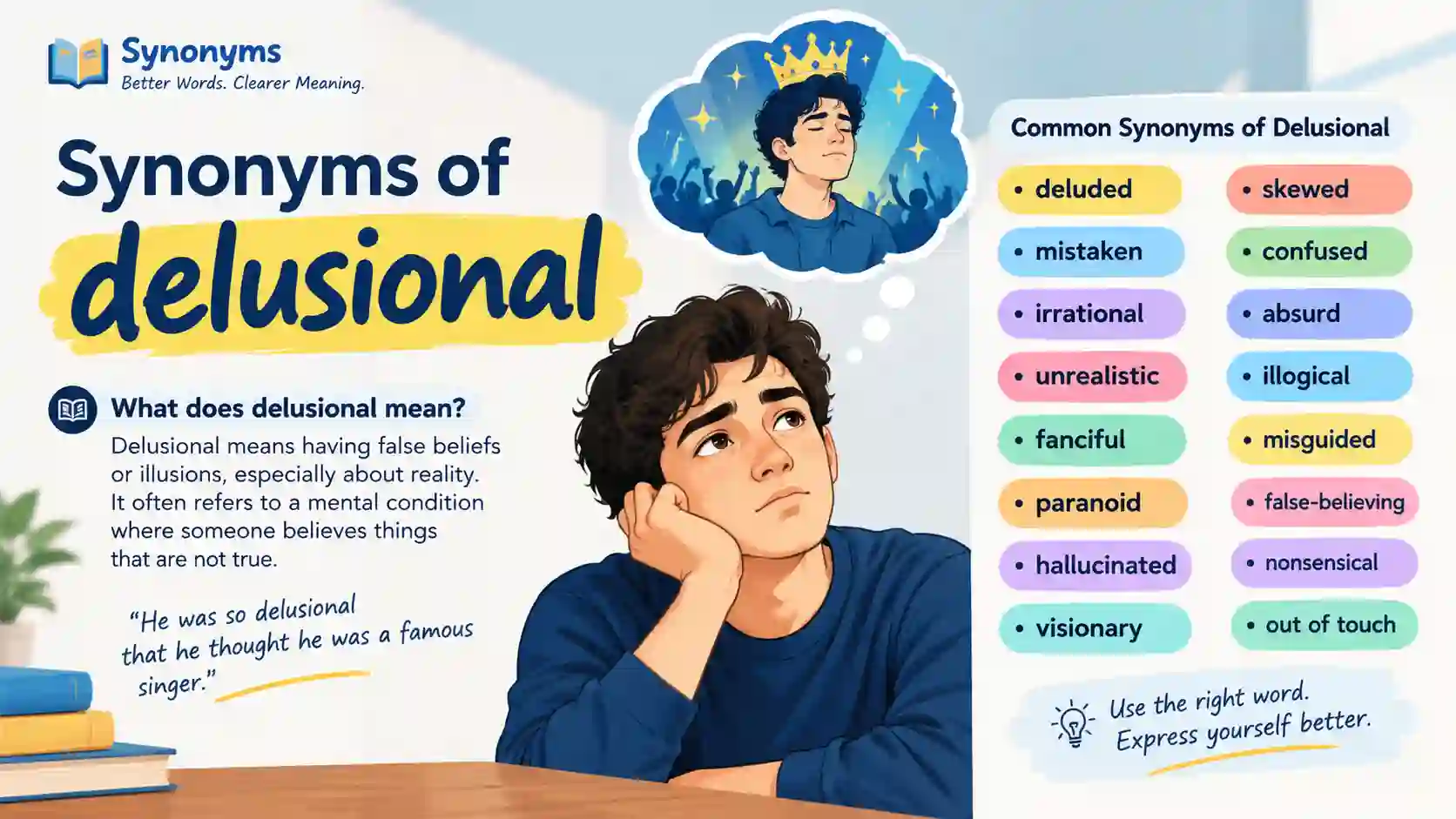
Common synonyms of delusional include deluded, unrealistic, misguided, irrational, mistaken, and unfounded. The best choice depends on the meaning. Use unrealistic for expectations, mistaken for an ordinary error, irrational for faulty reasoning, and deluded for someone who holds a false belief.
Have you ever wanted to describe an idea that seems far removed from reality but could not find the right English word? You might think of delusional, but sometimes a softer or more precise alternative works better.
The word delusional can describe beliefs that do not match reality. In casual English, people also use it for expectations that seem wildly unrealistic. However, the word can carry a harsh tone and has a specific meaning in mental health contexts.
Learning synonyms of delusional helps you explain your thoughts without repeating the same word. Students can use these alternatives in essays, writers can make their descriptions more precise, and professionals can disagree with an idea in a clear and respectful way.
This guide covers 30 related words, their meanings, original examples, common collocations, and the differences that matter most.
Pronunciation of Delusional
- IPA: /dɪˈluːʒənəl/
- Easy pronunciation: dih-LOO-zhuh-nuhl
- Part of speech: Adjective
- Word stress: Second syllable, LOO
The word comes from delusion, with the adjective-forming ending -al.
What Does Delusional Mean?
Delusional describes someone or something characterized by a false belief or an unrealistic view of reality. In everyday speech, it can be a strong way to criticize an idea. In clinical contexts, it relates to delusions and should not be used as a casual diagnosis.
For example:
- Everyday use: His expectation of becoming a millionaire overnight was delusional.
- More neutral wording: His expectation of becoming a millionaire overnight was unrealistic.
The second sentence is usually better when you want to criticize the expectation rather than the person.
Word Origin and Etymology
Delusional is formed from delusion and the suffix -al. The word delusion traces back through Latin delusio to deludere, meaning to deceive or play false.
The noun has a longer recorded history than the adjective. Historical dictionaries should be consulted before assigning an exact first-use year to delusional.
30 Synonyms of Delusional
The following list separates close alternatives from words that work only in certain situations. CEFR levels are approximate learning guides, and frequency labels are qualitative rather than measurements from a specific corpus.
1. Deluded
Meaning: A deluded person believes something that is not true.
Examples:
- He was deluded into believing the offer was genuine.
- She remained deluded about her chances of winning.
Best used when: A person holds a false belief or has been deceived.
Tone and register: Neutral to critical; general English.
Frequency and level: Common; approximately C1.
Common collocations: deeply deluded, self-deluded, deluded into believing.
When not to use it: Do not use it for every small mistake.
2. Unrealistic
Meaning: Something unrealistic does not fit real conditions or likely outcomes.
Examples:
- Her unrealistic budget ignored the cost of rent.
- Expecting to finish the entire project in an hour is unrealistic.
Best used when: Discussing expectations, goals, deadlines, or plans.
Tone and register: Neutral; business, academic, and everyday English.
Frequency and level: Very common; approximately B2.
Common collocations: unrealistic expectations, unrealistic goals, unrealistic demands.
When not to use it: Do not use it to imply a clinical condition when you simply mean impractical.
3. Irrational
Meaning: An irrational belief does not follow sound reasoning.
Examples:
- His irrational fear stopped him from entering the room.
- The conclusion was irrational because it ignored the available evidence.
Best used when: You want to emphasize faulty reasoning.
Tone and register: Critical; academic and general English.
Frequency and level: Common; approximately B2.
Common collocations: irrational fear, irrational belief, irrational behavior.
When not to use it: Disagreement alone does not make someone’s view irrational.
4. Misguided
Meaning: A misguided idea or action follows poor judgment or a mistaken understanding.
Examples:
- His misguided confidence led him to ignore useful advice.
- The company made a misguided attempt to cut every expense.
Best used when: Someone takes an unwise approach or follows a mistaken belief.
Tone and register: Mildly critical; neutral to formal.
Frequency and level: Common; approximately B2.
Common collocations: misguided belief, misguided attempt, misguided advice.
When not to use it: Avoid it when you mean a persistent false belief rather than an unwise decision.
5. Mistaken
Meaning: Someone who is mistaken has an incorrect idea or judgment.
Examples:
- I was mistaken about the meeting time.
- She was mistaken in thinking the shop opened on Sundays.
Best used when: You want a polite, everyday way to say someone is wrong.
Tone and register: Neutral; suitable for all audiences.
Frequency and level: Very common; approximately B1.
Common collocations: mistaken belief, mistaken assumption, completely mistaken.
When not to use it: It may be too mild for a deeply held false belief.
6. Misled
Meaning: Someone who is misled has been led to believe something incorrect.
Examples:
- Buyers were misled by the advertisement.
- He was misled into trusting an unreliable source.
Best used when: Incorrect information or another person’s actions cause a false belief.
Tone and register: Neutral; business and general English.
Frequency and level: Common; approximately B2.
Common collocations: misled by information, seriously misled, misled into believing.
When not to use it: Do not imply that someone was misled if there is no misleading influence.
7. Unreasonable
Meaning: An unreasonable idea or demand is not sensible, fair, or justified.
Examples:
- It is unreasonable to expect ten hours of work without a break.
- His unreasonable expectations frustrated the team.
Best used when: The problem concerns poor judgment or excessive demands.
Tone and register: Critical; professional and everyday English.
Frequency and level: Very common; approximately B2.
Common collocations: unreasonable demands, unreasonable expectations, unreasonable requests.
When not to use it: An unusual opinion is not automatically unreasonable.
8. Impractical
Meaning: Something impractical is difficult to carry out in real life.
Examples:
- Their plan to finish the work in one hour was impractical.
- The proposed schedule proved impractical for the team.
Best used when: A plan ignores real-world limits.
Tone and register: Neutral; business and general English.
Frequency and level: Common; approximately B2.
Common collocations: impractical plan, impractical solution, impractical idea.
When not to use it: It does not describe every kind of false belief.
9. Implausible
Meaning: An implausible claim is difficult to believe because it seems unlikely.
Examples:
- His explanation sounded implausible without supporting evidence.
- The report offered an implausible account of the missing funds.
Best used when: Evaluating whether a claim sounds believable.
Tone and register: Skeptical; formal and journalistic English.
Frequency and level: Common in formal writing; approximately C1.
Common collocations: implausible explanation, implausible claim, highly implausible.
When not to use it: Something unlikely is not necessarily false.
10. Unfounded
Meaning: An unfounded claim lacks sufficient evidence.
Examples:
- The rumor was unfounded and spread without proof.
- She rejected the unfounded accusation against her colleague.
Best used when: You want to focus on missing evidence.
Tone and register: Neutral to formal; academic and professional English.
Frequency and level: Common; approximately C1.
Common collocations: unfounded fear, unfounded claim, unfounded suspicion.
When not to use it: Do not label a claim unfounded simply because you disagree with it.
11. False
Meaning: A false statement or belief does not match the facts.
Examples:
- The article repeated a false claim about the event.
- He acted on the false belief that his account was secure.
Best used when: You need a direct word for something untrue.
Tone and register: Neutral; all registers.
Frequency and level: Very common; approximately A2.
Common collocations: false belief, false impression, false assumption.
When not to use it: Check the evidence before declaring a disputed claim false.
12. Erroneous
Meaning: An erroneous idea or conclusion contains an error.
Examples:
- The report reached an erroneous conclusion.
- Her erroneous assumption changed the calculation.
Best used when: Describing an incorrect conclusion in formal writing.
Tone and register: Formal; academic and technical English.
Frequency and level: Common in formal writing; approximately C1.
Common collocations: erroneous conclusion, erroneous belief, erroneous assumption.
When not to use it: It may sound too formal in a casual conversation.
13. Misconceived
Meaning: A misconceived idea is based on a wrong understanding or poor planning.
Examples:
- The project failed because of a misconceived strategy.
- His argument rested on a misconceived view of the problem.
Best used when: An idea or plan was poorly understood or wrongly designed.
Tone and register: Critical; formal English.
Frequency and level: Uncommon; approximately C1.
Common collocations: misconceived plan, misconceived notion, fundamentally misconceived.
When not to use it: A small factual error does not always justify this word.
14. Illusory
Meaning: Something illusory seems real or possible but is not what it appears to be.
Examples:
- Their sense of security proved illusory.
- The promise of effortless success was illusory.
Best used when: An appearance or hope hides the truth.
Tone and register: Reflective; literary and academic English.
Frequency and level: Uncommon; approximately C1.
Common collocations: illusory hope, illusory sense of control, illusory promise.
When not to use it: Choose false or unrealistic for a simple everyday statement.
15. Imaginary
Meaning: Something imaginary exists in the mind rather than as a real thing.
Examples:
- The child gave her imaginary friend a name.
- He worried about an imaginary threat.
Best used when: Describing something created by imagination.
Tone and register: Neutral; general and creative writing.
Frequency and level: Common; approximately B1.
Common collocations: imaginary friend, imaginary threat, imaginary problem.
When not to use it: An incorrect belief is not necessarily something a person has invented deliberately.
16. Fanciful
Meaning: A fanciful idea is imaginative, unusual, or unlikely.
Examples:
- He proposed a fanciful plan to build a city underwater.
- The novel follows a fanciful journey through space.
Best used when: Describing imaginative or far-fetched ideas.
Tone and register: Literary; sometimes dismissive.
Frequency and level: Uncommon; approximately C1.
Common collocations: fanciful idea, fanciful story, fanciful theory.
When not to use it: It may be inappropriate for a serious discussion of someone’s distressing beliefs.
17. Naive
Meaning: A naive person lacks experience or trusts too easily.
Examples:
- It was naive to trust an unknown seller without checking reviews.
- Her naive view of business changed after her first loss.
Best used when: Inexperience or excessive trust affects judgment.
Tone and register: Mildly critical; everyday English.
Frequency and level: Common; approximately B2.
Common collocations: naive assumption, naive optimism, naive belief.
When not to use it: Do not use it to ridicule someone for a mental health condition.
18. Wishful
Meaning: Wishful thinking means believing something because you want it to be true.
Examples:
- Believing sales will rise without a plan is wishful thinking.
- His prediction was based more on hope than evidence.
Best used when: Hope, rather than evidence, drives a belief.
Tone and register: Mildly critical; conversational and professional English.
Frequency and level: Common; approximately B2.
Common collocations: wishful thinking, wishful assumption, wishful prediction.
When not to use it: Ordinary optimism is not always unrealistic.
19. Paranoid
Meaning: Paranoid describes intense suspicion or fear that others intend harm.
Examples:
- He became paranoid about every unfamiliar email.
- Her suspicion that everyone was plotting against her grew stronger.
Best used when: Suspicion or perceived threats are central to the description.
Tone and register: Sensitive; everyday and psychological contexts.
Frequency and level: Common; approximately C1.
Common collocations: paranoid thoughts, paranoid suspicion, increasingly paranoid.
When not to use it: Do not use this word as a casual insult or diagnosis. Suspicion and delusion are not identical.
20. Confused
Meaning: A confused person has trouble understanding something clearly.
Examples:
- I was confused by the conflicting instructions.
- He seemed confused about what the evidence showed.
Best used when: Someone lacks clarity or misunderstands information.
Tone and register: Neutral; all registers.
Frequency and level: Very common; approximately B1.
Common collocations: confused thinking, confused belief, deeply confused.
When not to use it: Confusion does not necessarily mean someone firmly believes something false.
21. Absurd
Meaning: An absurd idea seems extremely unreasonable or ridiculous.
Examples:
- The claim that one shortcut guarantees success is absurd.
- They rejected the absurd proposal to finish a month of work in a day.
Best used when: You want to strongly criticize an unreasonable idea.
Tone and register: Strong and dismissive; general English.
Frequency and level: Common; approximately B2.
Common collocations: absurd claim, absurd idea, utterly absurd.
When not to use it: It can sound insulting when a neutral explanation would work better.
22. Preposterous
Meaning: Something preposterous is extremely unreasonable or difficult to believe.
Examples:
- The demand for a perfect result in five minutes was preposterous.
- He made a preposterous claim without offering proof.
Best used when: You need a stronger, more expressive alternative to absurd.
Tone and register: Strong, often humorous or critical.
Frequency and level: Common; approximately C1.
Common collocations: preposterous claim, preposterous idea, utterly preposterous.
When not to use it: It can sound dramatic in a formal, neutral report.
23. Deceived
Meaning: Someone deceived has been made to believe something untrue.
Examples:
- The customer was deceived by a fake advertisement.
- He deceived himself into believing that no preparation was needed.
Best used when: Deception or self-deception explains the false belief.
Tone and register: Critical; general and formal English.
Frequency and level: Common; approximately B2.
Common collocations: deeply deceived, self-deceived, deceived by appearances.
When not to use it: Do not imply deliberate dishonesty unless the context supports it.
24. Misinformed
Meaning: A misinformed person has incorrect or incomplete information.
Examples:
- The customer was misinformed about the return policy.
- I was misinformed about the deadline and arrived late.
Best used when: A lack of accurate information explains an incorrect belief.
Tone and register: Neutral; business, news, and everyday English.
Frequency and level: Common; approximately B2.
Common collocations: misinformed opinion, misinformed public, seriously misinformed.
When not to use it: It does not fit when a person understands the evidence but rejects it.
25. Fallacious
Meaning: A fallacious argument contains faulty reasoning.
Examples:
- The essay relied on a fallacious argument.
- His conclusion was fallacious because it ignored key evidence.
Best used when: Analyzing logic, arguments, or reasoning.
Tone and register: Formal; academic and professional English.
Frequency and level: Uncommon; approximately C1.
Common collocations: fallacious reasoning, fallacious argument, fallacious conclusion.
When not to use it: It describes faulty reasoning more directly than a person’s whole state of mind.
26. Hallucinatory
Meaning: Hallucinatory describes something related to hallucinations or having their qualities.
Examples:
- The novel creates a hallucinatory dreamscape.
- The film uses hallucinatory images to unsettle its audience.
Best used when: Discussing hallucinations or dreamlike sensory experiences.
Tone and register: Technical or literary.
Frequency and level: Uncommon; approximately C2.
Common collocations: hallucinatory experience, hallucinatory imagery, hallucinatory state.
When not to use it: A hallucination is a sensory experience, not simply a false belief.
27. Grandiose
Meaning: Grandiose describes an exaggerated sense of importance, power, or achievement.
Examples:
- He made grandiose promises about transforming the company in a week.
- The proposal described a grandiose vision without a workable budget.
Best used when: Claims, ambitions, or plans seem excessively impressive or self-important.
Tone and register: Critical; general and formal English.
Frequency and level: Common; approximately C1.
Common collocations: grandiose claims, grandiose plans, grandiose ideas.
When not to use it: Ambition alone does not make someone delusional.
28. Out of Touch With Reality
Meaning: This phrase describes someone whose beliefs or expectations do not match real conditions.
Examples:
- The manager seemed out of touch with reality when setting the deadline.
- Expecting every customer to love the product is out of touch with reality.
Best used when: You need a clear, conversational phrase for unrealistic thinking.
Tone and register: Critical; informal and spoken English.
Frequency and level: Common; approximately B2.
Common collocations: completely out of touch with reality, seem out of touch, increasingly out of touch.
When not to use it: Avoid turning it into a personal attack when you can explain the specific problem.
29. In Denial
Meaning: Someone in denial refuses or struggles to accept an uncomfortable fact.
Examples:
- He was in denial about how much the repairs would cost.
- She remained in denial about the project’s poor results.
Best used when: Someone avoids accepting a reality they find difficult.
Tone and register: Critical or empathetic, depending on context.
Frequency and level: Common; approximately B2.
Common collocations: in denial about the truth, remain in denial, refuse to face reality.
When not to use it: Disagreement or uncertainty does not automatically mean denial.
30. Delusory
Meaning: Delusory describes something that creates or relates to a false impression.
Examples:
- The promise of effortless wealth proved delusory.
- The apparent safety of the shortcut was delusory.
Best used when: You need a literary or formal word for something deceptive in appearance.
Tone and register: Literary and formal.
Frequency and level: Rare; approximately C2.
Common collocations: delusory hope, delusory promise, delusory impression.
When not to use it: Choose false, misleading, or unrealistic for general readers.
Strongest Synonyms of Delusional
These words are closest when describing a false belief or a poor grasp of reality:
- Deluded: Holds a false belief.
- Unrealistic: Has expectations that do not fit actual conditions.
- Irrational: Shows faulty reasoning.
- Out of touch with reality: Has beliefs or expectations disconnected from real conditions.
- Misconceived: Is based on a mistaken understanding.
Strong Synonyms
These alternatives express poor judgment, weak reasoning, or a lack of supporting evidence:
- Misguided
- Unreasonable
- Implausible
- Unfounded
- Fallacious
- Grandiose
- Absurd
- Preposterous
Related Words That Are Not Exact Synonyms
- Mistaken, false, erroneous: Incorrect information or judgment.
- Misled, deceived, misinformed: Beliefs affected by deception or inaccurate information.
- Naive, wishful: Judgment affected by inexperience or hope.
- Illusory, imaginary, fanciful: Something that appears real or is created by imagination.
- Confused, paranoid, hallucinatory: Different states of thought, suspicion, or perception.
- In denial: Difficulty accepting an uncomfortable fact.
Choose the Right Synonym
| Word | Best context | Example |
| Deluded | A person holds a false belief | He was deluded about his chances. |
| Unrealistic | Expectations or plans | The deadline is unrealistic. |
| Irrational | Faulty reasoning | The decision was irrational. |
| Mistaken | An ordinary error | I was mistaken about the date. |
| Misled | Incorrect information caused a belief | The buyers were misled by the advert. |
| Unfounded | Lack of evidence | The accusation was unfounded. |
| Implausible | A claim seems unlikely | Her explanation was implausible. |
| In denial | Refusal to accept a fact | He was in denial about the loss. |
Remember: Delusional is often too strong when you only mean that someone is mistaken. Choose the word that identifies the actual problem.
Commonly Confused Words
| Word | Difference | Example |
| Delusional | Describes false or unrealistic beliefs; may have a clinical meaning | He held a delusional belief. |
| Illusion | A misleading appearance or impression | The mirror created an illusion of space. |
| Hallucination | A sensory experience without a corresponding external stimulus | She reported seeing something that was not there. |
| Delirious | Often means severely confused, sometimes because of illness | He became delirious during the fever. |
| Imaginative | Shows creativity or the ability to form ideas | The child wrote an imaginative story. |
These words are not interchangeable. A person can be imaginative without being delusional, and a hallucination is not the same as a false belief.
Common Mistakes to Avoid
Mistake 1: Using delusional for every small error
Incorrect: You are delusional because you got the answer wrong.
Better: You are mistaken about the answer.
Why: An ordinary error does not justify such a strong label.
Mistake 2: Treating unrealistic and delusional as identical
Incorrect: Her plan is unrealistic, so she must be delusional.
Better: Her plan is unrealistic because it ignores the budget.
Why: An impractical plan does not establish a mental health condition.
Mistake 3: Confusing a lie with a delusion
Incorrect: He lied about the result, so he was delusional.
Better: He lied about the result.
Why: A lie is a knowingly false statement. A delusion is a belief, not simply a false statement.
Mistake 4: Using the wrong grammatical form
Incorrect: He is delusional about success.
Better: He is delusional about success.
Why: Use be delusional about something. The noun form is have a delusion about something.
Mistake 5: Using a clinical term as an insult
Instead of saying, “You are delusional,” consider saying, “That claim is not supported by the evidence.”
Why: Specific criticism is usually clearer and more respectful than labeling a person.
Writing Tips: Use Synonyms Naturally
- Essays: Use irrational, unfounded, or fallacious when discussing evidence and reasoning.
- Emails: Use unrealistic, impractical, or unreasonable to question a proposal politely.
- Blog posts: Use misguided, mistaken, or unrealistic when those meanings fit.
- Stories: Use deluded, grandiose, or fanciful to develop a character.
- Social media: Use wishful thinking or unrealistic to make a point without an unnecessarily harsh label.
- Professional communication: Prefer “unsupported by the evidence” over a personal judgment.
- Daily conversation: Use mistaken for an ordinary error and unrealistic for expectations that do not fit the facts.
Writing tip: Describe the problem, not the person.
Instead of “My colleague is delusional about the deadline,” write, “My colleague’s deadline estimate does not account for the testing time.”
Antonyms of Delusional
The best opposite depends on the meaning you want to express.
- Realistic: Based on actual conditions.
- Rational: Based on sound reasoning.
- Reasonable: Fair and sensible.
- Clear-headed: Able to think clearly.
- Level-headed: Calm and sensible in difficult situations.
- Lucid: Clear in thought or expression.
- Well-informed: Based on accurate information.
- Grounded: Practical and connected to reality.
Related Expressions
| Expression | Meaning | Example |
| Wishful thinking | Believing something because you hope it is true | Expecting sales to double without a plan is wishful thinking. |
| Pipe dream | An unrealistic hope or plan | Becoming rich overnight was a pipe dream. |
| Head in the clouds | Being impractical or distracted by dreams | He has his head in the clouds when planning costs. |
| Face the facts | Accept what the evidence shows | We need to face the facts about the budget. |
| Living in a fantasy | Thinking in ways far removed from reality | He was living in a fantasy about instant success. |
| Under a misapprehension | Having an incorrect understanding | She was under a misapprehension about the rules. |
Word Family
| Word | Part of speech | Meaning |
| Delusion | Noun | A false belief |
| Delude | Verb | To deceive or cause someone to believe something false |
| Deluded | Adjective | Holding a false belief |
| Delusional | Adjective | Characterized by delusions or unrealistic beliefs |
| Delusory | Adjective | Creating a false impression |
| Delusive | Adjective | Misleading or deceptive |
| Delusionally | Adverb | In a delusional manner; uncommon |
Frequently Asked Questions
1. What is the best synonym for delusional?
Deluded is often the closest synonym when describing someone who holds a false belief. Unrealistic works better for expectations, while irrational emphasizes faulty reasoning. The most accurate choice depends on context because none of these words matches every meaning of delusional.
2. What is a polite way to say someone is delusional?
Describe the specific belief instead of labeling the person. For example, say, “That expectation seems unrealistic,” or “I don’t think the evidence supports that claim.” These alternatives communicate disagreement clearly without making a personal attack or suggesting a mental health diagnosis.
3. Is delusional the same as unrealistic?
No. Unrealistic usually describes expectations, plans, or beliefs that do not fit real conditions. Delusional is stronger and can describe a false belief that does not change despite contrary evidence. In mental health contexts, it has a more specific meaning.
4. What is the difference between deluded and delusional?
Deluded often describes a person who has accepted a false belief, sometimes because someone deceived them. Delusional describes a state of thinking or beliefs characterized by delusions. In casual English, the words overlap, but delusional may sound more forceful or carry a clinical association.
5. What is the opposite of delusional?
Common contrasting words include realistic, rational, reasonable, clear-headed, and grounded. Use realistic expectations that fit actual conditions, rational for sound reasoning, and clear-headed for clear thinking. No single antonym works perfectly in every sentence because the word has several related meanings.
6. What is a stronger word for delusional?
Words such as deeply deluded, irrational, and out of touch with reality may express stronger criticism, depending on the sentence. Absurd and preposterous describe ideas that seem extremely unreasonable. These are rhetorical choices, not clinical terms, and should not be used as diagnoses.
7. Can delusional be used in formal writing?
Yes. Delusional appears in formal writing, including journalism and psychology. However, use it carefully when describing a person. If you only mean that an argument lacks evidence, words such as unfounded, mistaken, or unsupported may be more precise.
8. What is the difference between a delusion and a hallucination?
A delusion is a belief, while a hallucination is a sensory experience, such as hearing or seeing something without a corresponding external stimulus. They are different concepts, although both can occur in some mental health conditions. Neither word should be used casually as a diagnosis.
Vocabulary Quiz
Exercise 1: Fill in the blanks
Choose from unrealistic, mistaken, unfounded, irrational, and misled.
- I was ______ about the appointment date.
- The rumor was ______ because no evidence supported it.
- Expecting to learn a language in one day is ______.
- The customers were ______ by the advertisement.
- His ______ fear affected his decision.
Exercise 2: Rewrite the sentences
Replace the bold phrase with a suitable synonym.
- Her expectations were not based on real conditions.
- His claim was not supported by evidence.
- The student was wrong about the answer.
- The argument contained faulty reasoning.
- He was refusing to accept the facts.
Exercise 3: Match the words
A. Deluded
B. Grandiose
C. Unfounded
D. Naive
E. Illusory
- Lacking supporting evidence
- Holding a false belief
- Showing exaggerated importance
- Lacking experience or judgment
- Creating a false impression
Answer Key
Exercise 1: 1. mistaken; 2. unfounded; 3. unrealistic; 4. misled; 5. irrational.
Exercise 2: 1. Her expectations were unrealistic. 2. His claim was unfounded. 3. The student was mistaken about the answer. 4. The argument was fallacious. 5. He was in denial.
Exercise 3: A–2, B–3, C–1, D–4, E–5.
Conclusion
Learning synonyms of delusional helps you express ideas with greater accuracy and confidence. Words such as deluded, unrealistic, irrational, mistaken, and unfounded each describe a different kind of error or false belief.
Choose your words carefully, especially when discussing other people. Practice these alternatives in essays, emails, blog posts, and everyday conversations to build stronger vocabulary and communicate clearly.
References
- Merriam-Webster Dictionary
- Cambridge Dictionary
- Collins Dictionary: Delusional
- Dictionary.com: Delusional
- Online Etymology Dictionary

Synonorm is a trusted English vocabulary resource created to help readers find the right words and understand the differences between similar terms. We provide clear explanations of synonyms, meanings, examples, usage, and alternatives. Our content makes vocabulary easier to learn and apply in everyday, academic, and professional English. Synonorm is designed for students, writers, ESL learners, professionals, and anyone who wants to improve their English vocabulary and communicate more clearly.