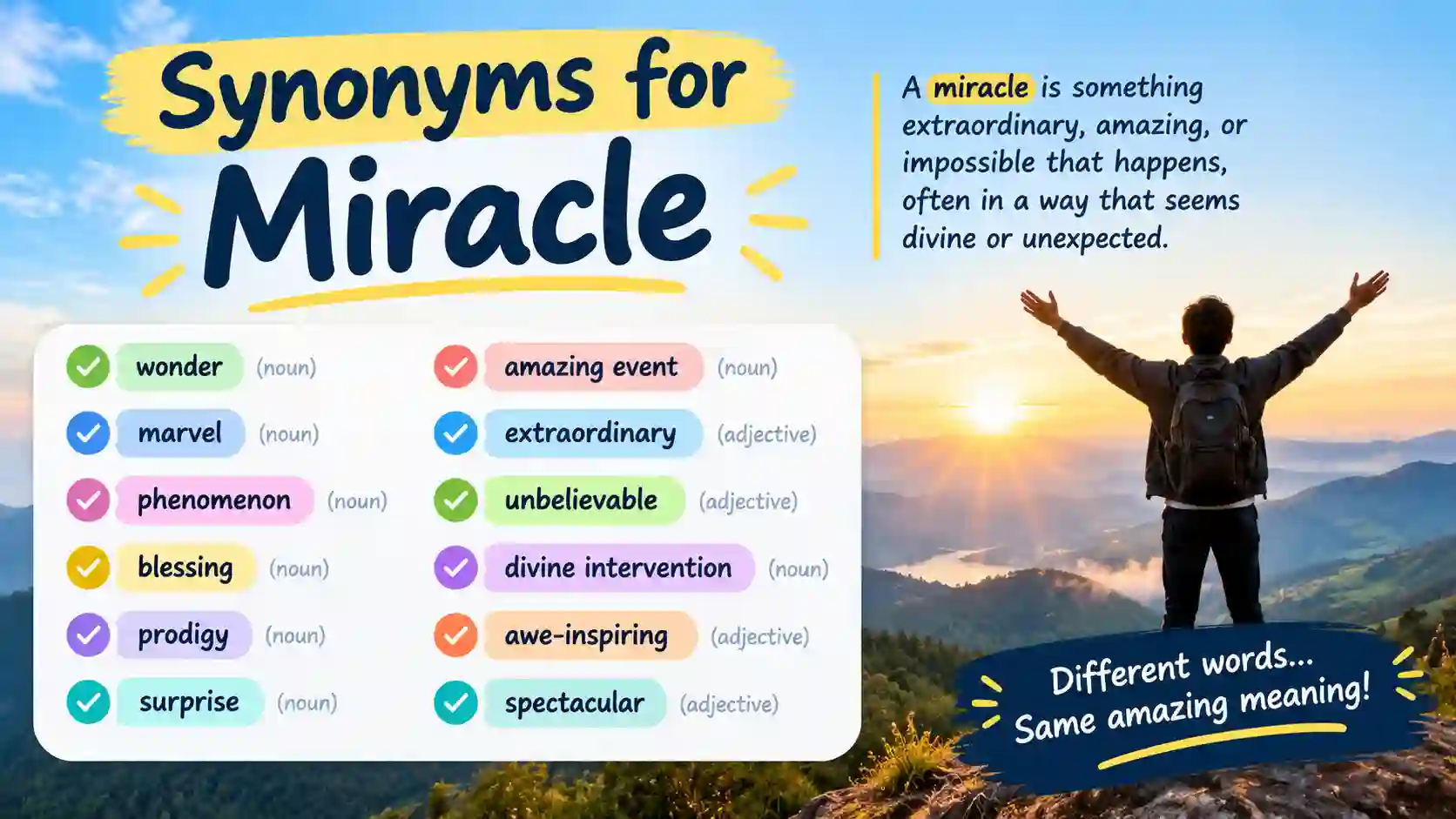
A miracle is an extraordinary event that inspires wonder, seems highly unlikely, or is believed to involve divine power. But what if you want to describe an amazing discovery, a fortunate escape, or an achievement that seems almost impossible? The right synonym can help you express your meaning more clearly.
This guide explores 30 synonyms for miracle, with simple definitions, original examples, usage notes, and common collocations. You will also learn the differences between words such as wonder, marvel, blessing, and breakthrough, so you can choose the best word for essays, professional writing, and everyday conversations.
Quick Answer: What Are Synonyms for Miracle?
Common synonyms for miracle include wonder, marvel, phenomenon, supernatural occurrence, divine act, and extraordinary event. Other alternatives fit specific situations: blessing expresses gratitude, godsend describes timely help, and stroke of luck describes an unexpected good outcome. The best synonym depends on whether you mean a religious event, something amazing, or an unlikely success.
What Does Miracle Mean?
A miracle is an extraordinary event or occurrence that inspires wonder. In religious contexts, it often refers to an event believed to result from divine power. In everyday English, people also use the word for an amazing achievement or an outcome that seemed highly unlikely.
For example:
- Religious: The family believed the recovery was a miracle.
- Everyday: Finding the missing keys just before leaving felt like a miracle.
- Achievement: Completing the project in one day was a miracle of teamwork.
These examples show why one replacement word cannot fit every use of miracle.
Pronunciation and Word Details
- Word: Miracle
- IPA: /ˈmɪr.ə.kəl/
- Pronunciation: MIR-uh-kuhl
- Part of speech: Countable noun
- Plural: Miracles
- Adjective: Miraculous
- Adverb: Miraculously
The word comes through Middle English and Old French from Latin mīrāculum, meaning an object of wonder. It is related to Latin mīrārī, meaning to wonder at or admire. English records the word from the Middle English period, with its first recorded use commonly dated to the 12th century.
American and British English use the same spelling for miracle. Pronunciation can vary by accent, but the meaning remains broadly the same.
30 Synonyms for Miracle With Examples
The words below are grouped by their practical meaning. Some are close synonyms, while others work only in particular contexts.
The CEFR levels are approximate guidance for English learners, not official ratings for every word. Frequency labels are general editorial estimates, not measured corpus statistics.
1. Wonder
Meaning: Something that inspires great surprise or admiration.
Examples:
- The waterfall is a natural wonder.
- The children watched the stars in wonder.
Best used when: Something creates awe or amazement.
Tone: Neutral or literary. CEFR: B1. Frequency: Very common.
Common collocations: natural wonder, sense of wonder, wonders of science.
2. Marvel
Meaning: Something remarkable that people admire.
Examples:
- The new bridge is a marvel of engineering.
- Her garden became a marvel of color and design.
Best used when: Highlighting beauty, skill, or impressive design.
Tone: Neutral. CEFR: B2. Frequency: Common.
Common collocations: technological marvel, modern marvel, marvel of nature.
3. Phenomenon
Meaning: An event, fact, or occurrence that can be observed or experienced.
Examples:
- The rapid growth of the town was an unusual phenomenon.
- Scientists studied the strange light phenomenon.
Best used when: Describing something remarkable in a factual or scientific context.
Tone: Academic or formal. CEFR: B2–C1. Frequency: Common.
Common collocations: natural phenomenon, social phenomenon, unusual phenomenon.
4. Supernatural occurrence
Meaning: An event believed to go beyond natural explanations.
Examples:
- The novel begins with a mysterious supernatural occurrence.
- Witnesses described what they believed was a supernatural occurrence.
Best used when: Discussing supernatural beliefs, stories, or claims.
Tone: Formal. CEFR: C1. Frequency: Uncommon.
Common collocations: supernatural event, supernatural force, unexplained occurrence.
5. Divine act
Meaning: An action believed to come from God or a divine power.
Examples:
- The community viewed the unexpected rescue as a divine act.
- In the story, the healing was described as a divine act.
Best used when: The religious interpretation matters.
Tone: Formal and religious. CEFR: C1. Frequency: Context-dependent.
Common collocations: act of God, divine power, divine intervention.
6. Blessing
Meaning: Something good that brings happiness, help, or comfort.
Examples:
- Her supportive teacher was a blessing during a difficult year.
- The rain was a blessing after weeks of dry weather.
Best used when: Expressing gratitude or describing something deeply valued.
Tone: Neutral or religious. CEFR: B1. Frequency: Very common.
Common collocations: a great blessing, blessing in disguise, count your blessings.
7. Godsend
Meaning: Someone or something that arrives when help is badly needed.
Examples:
- The emergency funding was a godsend for the school.
- Her neighbor’s offer to help was a godsend.
Best used when: Emphasizing timely and welcome help.
Tone: Informal to neutral. CEFR: C1. Frequency: Common.
Common collocations: an absolute godsend, prove a godsend, a godsend to someone.
8. Stroke of luck
Meaning: An unexpected event that produces a good result.
Examples:
- Finding the lost passport was a stroke of luck.
- A last-minute cancellation gave us a stroke of luck.
Best used when: Good fortune explains a positive outcome.
Tone: Informal to neutral. CEFR: B1. Frequency: Very common.
Common collocations: stroke of good luck, lucky break, pure luck.
9. Extraordinary event
Meaning: Something far outside what normally happens.
Examples:
- The town witnessed an extraordinary event.
- Their safe return after the storm was extraordinary.
Best used when: You need a broad, factual description without suggesting a supernatural cause.
Tone: Neutral or formal. CEFR: B2. Frequency: Very common.
Common collocations: extraordinary circumstances, extraordinary events, extraordinary achievement.
10. Amazing achievement
Meaning: A result that deserves great admiration.
Examples:
- Finishing the course while working full-time was an amazing achievement.
- The students’ community garden became an amazing achievement.
Best used when: Celebrating effort, skill, or success.
Tone: Neutral. CEFR: B1–B2. Frequency: Very common.
Common collocations: remarkable achievement, outstanding achievement, achieve success.
11. Astonishing feat
Meaning: An impressive accomplishment that greatly surprises people.
Examples:
- Completing the climb in one day was an astonishing feat.
- The team achieved an astonishing feat under pressure.
Best used when: An accomplishment is unusually difficult.
Tone: Neutral to formal. CEFR: B2. Frequency: Common.
Common collocations: athletic feat, remarkable feat, extraordinary feat.
12. Breakthrough
Meaning: An important advance or discovery that solves a problem or opens a new path.
Examples:
- Researchers made a breakthrough in battery design.
- Their new method led to a breakthrough in treatment.
Best used when: Describing major progress or discovery.
Tone: Academic, business, or professional. CEFR: B2. Frequency: Very common.
Common collocations: scientific breakthrough, major breakthrough, breakthrough discovery.
13. Revelation
Meaning: A surprising fact or discovery that becomes known.
Examples:
- The final report was a revelation to the board.
- Her diary offered a revelation about the family’s past.
Best used when: New information changes how people understand something.
Tone: Formal. CEFR: C1. Frequency: Common.
Common collocations: shocking revelation, sudden revelation, reveal the truth.
14. Sensation
Meaning: Something that attracts widespread interest or excitement.
Examples:
- Her first novel became a sensation.
- The young singer created a sensation online.
Best used when: An event or achievement attracts public attention.
Tone: Neutral. CEFR: B2. Frequency: Common.
Common collocations: create a sensation, media sensation, overnight sensation.
15. Prodigy
Meaning: A person, often a young person, with exceptional talent or ability.
Examples:
- The piano prodigy performed a difficult piece with ease.
- The chess prodigy defeated several experienced players.
Best used when: Describing exceptional ability, especially in children or young people.
Tone: Formal. CEFR: C1. Frequency: Common.
Common collocations: child prodigy, musical prodigy, mathematical prodigy.
Important: A prodigy is usually a person or exceptional ability, not a direct substitute for every kind of miracle.
16. Wonderment
Meaning: A feeling of great surprise or admiration.
Examples:
- The children watched the fireworks in wonderment.
- She stared at the enormous waterfall with wonderment.
Best used when: Describing an emotional response rather than the event itself.
Tone: Literary. CEFR: C1. Frequency: Uncommon.
Common collocations: look with wonderment, fill someone with wonderment.
17. Miracle of nature
Meaning: A natural feature or process that inspires deep amazement.
Examples:
- The coral reef is a miracle of nature.
- The migration of these birds seems like a miracle of nature.
Best used when: Writing about natural beauty or remarkable biological processes.
Tone: Literary. CEFR: B2. Frequency: Common as an expression.
Common collocations: wonder of nature, natural marvel, miracle of life.
18. Rarity
Meaning: Something that is unusual or seldom found.
Examples:
- A quiet afternoon in the busy office was a rarity.
- The museum displayed a rarity from the early printing era.
Best used when: Emphasizing how uncommon something is.
Tone: Neutral. CEFR: B2. Frequency: Common.
Common collocations: a rare find, a great rarity, become increasingly rare.
19. Stroke of fortune
Meaning: An unexpected turn of events that brings a good result.
Examples:
- Meeting the editor was a stroke of fortune for the young writer.
- The unexpected offer proved to be a stroke of fortune.
Best used when: A fortunate event changes someone’s situation for the better.
Tone: Neutral to literary. CEFR: B2. Frequency: Uncommon.
Common collocations: good fortune, twist of fate, fortunate turn of events.
20. Lucky break
Meaning: An unexpected opportunity that helps someone succeed.
Examples:
- Getting an interview was a lucky break.
- The athlete received a lucky break when another player withdrew.
Best used when: Someone benefits from a fortunate opportunity.
Tone: Informal. CEFR: B1. Frequency: Very common.
Common collocations: get a lucky break, catch a break, big break.
21. Astonishing discovery
Meaning: A finding that greatly surprises people.
Examples:
- The team made an astonishing discovery beneath the old building.
- The discovery changed how researchers understood the disease.
Best used when: New evidence reveals something unexpected.
Tone: Academic or neutral. CEFR: B2. Frequency: Common.
Common collocations: major discovery, scientific discovery, unexpected finding.
22. Masterpiece
Meaning: A work of outstanding skill, beauty, or quality.
Examples:
- The architect created a masterpiece of modern design.
- The film is widely regarded as a masterpiece.
Best used when: Praising exceptional art, design, or craftsmanship.
Tone: Neutral to formal. CEFR: B2. Frequency: Very common.
Common collocations: artistic masterpiece, literary masterpiece, masterpiece of design.
Important: A masterpiece is a creation, not normally an unexpected event.
23. Sign
Meaning: Something that suggests or indicates that something may be true or may happen.
Examples:
- Their peaceful meeting was a sign of hope.
- The sudden improvement was a sign that the plan might work.
Best used when: An event is interpreted as meaningful or encouraging.
Tone: Neutral. CEFR: A2–B1. Frequency: Very common.
Common collocations: sign of hope, clear sign, sign of change.
24. Omen
Meaning: An event believed to predict something good or bad.
Examples:
- In the story, the bright comet was seen as an omen.
- The villagers treated the unusual sound as a bad omen.
Best used when: Discussing traditions, literature, or beliefs about future events.
Tone: Literary. CEFR: C1. Frequency: Common in stories.
Common collocations: good omen, bad omen, ill omen.
Important: An omen concerns a possible future event. It does not necessarily describe a miracle that has already occurred.
25. Mystery
Meaning: Something difficult to explain or understand.
Examples:
- His sudden recovery remained a mystery to the family.
- The disappearance of the old map was a mystery.
Best used when: The cause or explanation remains unknown.
Tone: Neutral. CEFR: B1. Frequency: Very common.
Common collocations: remain a mystery, solve a mystery, unexplained mystery.
Important: A mystery is not automatically a miracle. Not knowing the cause does not prove supernatural action.
26. Astonishing turn of events
Meaning: A sudden change in a situation that surprises people.
Examples:
- An astonishing turn of events saved the struggling company.
- The match took an astonishing turn of events in the final minute.
Best used when: Unexpected changes produce a surprising result.
Tone: Neutral to literary. CEFR: B2. Frequency: Common as a phrase.
Common collocations: unexpected turn of events, sudden reversal, surprising outcome.
27. Near impossible achievement
Meaning: A result that seemed almost impossible to reach.
Examples:
- Completing the rescue in such bad weather was a near-impossible achievement.
- The small team delivered a remarkable result with limited resources.
Best used when: Emphasizing difficulty and success against the odds.
Tone: Neutral to formal. CEFR: B2. Frequency: Uncommon as a fixed phrase.
Common collocations: seemingly impossible task, remarkable achievement, against all odds.
28. Spectacle
Meaning: An impressive or striking sight or event.
Examples:
- The colorful festival was a spectacle of light and sound.
- The sky became a spectacular sight after the storm.
Best used when: Something visually impressive captures people’s attention.
Tone: Neutral. CEFR: B2. Frequency: Common.
Common collocations: magnificent spectacle, public spectacle, spectacular sight.
Important: A spectacle can be impressive without being miraculous.
29. Stunner
Meaning: Something that greatly surprises or shocks people.
Examples:
- The final result was a real stunner.
- The announcement came as a stunner to the whole team.
Best used when: An unexpected event creates strong surprise.
Tone: Informal. CEFR: B2. Frequency: Common in spoken English.
Common collocations: a real stunner, a complete stunner, a stunning result.
30. Portent
Meaning: Something interpreted as a sign of a future event, often an important one.
Examples:
- The dark clouds were treated as a portent of trouble in the story.
- The early warning became a portent of greater change.
Best used when: Writing about symbolic signs or possible future developments.
Tone: Literary. CEFR: C1–C2. Frequency: Uncommon.
Common collocations: portent of doom, ominous portent, portent of change.
Important: A portent predicts or symbolizes a possible future. It is not a general replacement for miracles.
Choose the Right Synonym for Miracle
| If you mean… | Best word or phrase | Example |
| Something amazing | Wonder | The waterfall is a wonder. |
| Something impressive | Marvel | The bridge is a marvel of engineering. |
| A religious event | Divine act | They viewed the event as a divine act. |
| Welcome help | Godsend | The grant was a godsend. |
| Gratitude | Blessing | Her friendship was a blessing. |
| An unlikely good outcome | Stroke of luck | Finding the keys was a stroke of luck. |
| Major progress | Breakthrough | The research led to a breakthrough. |
| Something hard to explain | Mystery | The cause remains a mystery. |
| Exceptional talent | Prodigy | The child is a musical prodigy. |
| A striking sight | Spectacle | The fireworks were a spectacle. |
Commonly Confused Words
Miracle vs. magic: A miracle is an extraordinary event, often associated with divine power. Magic may refer to supernatural powers in stories or tricks performed for entertainment.
Miracle vs. coincidence: A coincidence is when events happen together unexpectedly. A miracle suggests something extraordinary, but a coincidence does not by itself establish a supernatural cause.
Miracle vs. mystery: A mystery is something that remains unexplained. A miracle is an extraordinary event or one believed to have a divine cause.
Miracle vs. breakthrough: A breakthrough is important progress or a discovery. It may feel miraculous, but the words describe different ideas.
Miracle vs. blessing: A miracle focuses on an extraordinary event. A blessing focuses on the value, benefit, or gratitude associated with something.
Common Mistakes to Avoid
Mistake: “The scientist was a breakthrough.”
Correction: “The scientist made a breakthrough.”
Why: A breakthrough is an advance or discovery, not a person.
Mistake: “The rare rainbow proves divine intervention.”
Correction: “The rare rainbow was an extraordinary sight.”
Why: An unusual event alone does not establish a supernatural cause.
Mistake: “Practicing every day was a stroke of luck.”
Correction: “Practicing every day led to an impressive achievement.”
Why: A stroke of luck emphasizes fortune, while an achievement often reflects effort.
Mistake: “The unexplained event was definitely a miracle.”
Correction: “The unexplained event was considered a miracle by some witnesses.”
Why: This wording distinguishes the event from the interpretation people give it.
Writing Tips for Students and Professionals
- Essays: Use phenomenon for an occurrence and breakthrough for a major advance.
- Emails: Use remarkable achievement when praising someone’s work.
- Blog posts: Use wonder or marvel to make descriptions vivid.
- Stories: Use mystery, revelation, or astonishing turn of events to create suspense.
- Social media: Use blessing or lucky break to describe a personal success.
- Business writing: Use significant breakthrough or extraordinary achievement when the evidence supports the claim.
- Daily conversations: Say, “It’s a miracle we arrived on time!” to express surprise naturally.
Choose words for meaning, not merely to avoid repetition. Repeating a miracle can be clearer than using an inaccurate substitute.
Related Vocabulary
Antonyms of Miracle
There is no single perfect antonym for every sense of miracle. Depending on the context, useful contrasts include:
- Ordinary event: Something that happens routinely.
- Normality: The state of being usual or expected.
- Routine: An activity or event that occurs regularly.
- Commonplace occurrence: Something ordinary rather than remarkable.
- Expectation: Something considered likely or normal, though it is not a direct antonym of miracle.
Related Expressions
- Work a miracle: Achieve an unexpectedly excellent result.
- By a miracle: In a way that seems extremely fortunate.
- Against all odds: Despite very low chances of success.
- Blessing in disguise: Something that first seems bad but later proves helpful.
- Miracle worker: Someone who achieves extraordinary results.
- Miracle of modern science: An expression for an impressive scientific achievement.
- Against the odds: Despite serious difficulties.
Word Family
- Miracle: Noun.
- Miraculous: Adjective.
- Miraculously: Adverb.
- Miraculousness: Noun describing the quality of being miraculous; relatively uncommon.
Mini Practice Exercises
Exercise 1: Fill in the blanks
Choose from stroke of luck, breakthrough, blessing, and mystery.
- Finding a job just before rent was due felt like a ______.
- The new experiment led to a scientific ______.
- Her supportive family was a true ______.
- The strange disappearance remained a ______.
Exercise 2: Rewrite the sentences
Replace miracle with a more precise word or phrase.
- The new bridge is a miracle of engineering.
- Getting the final ticket was a miracle of good luck.
- The research team made a miracle in cancer research.
Exercise 3: Match the words to their meanings
A. Prodigy
B. Marvel
C. Mystery
D. Godsend
- Something difficult to explain.
- A person with exceptional ability.
- Something that inspires admiration.
- Unexpected help at a crucial time.
Answer Key
Exercise 1: 1. stroke of luck; 2. breakthrough; 3. blessing; 4. mystery.
2:
- The new bridge is an engineering marvel.
- Getting the final ticket was a stroke of luck.
- The research team made a breakthrough in cancer research.
3: A–2, B–3, C–1, D–4.
Frequently Asked Questions
1. What is the best synonym for miracle?
Wonder and marvel are among the closest general synonyms. Wonder emphasizes amazement, while marvel often describes something impressive. If you mean a religious event, divine act may fit better. For an unlikely but fortunate outcome, stroke of luck is often more precise.
2. What is another word for a miracle from God?
Divine intervention is a suitable expression when you mean an event believed to involve direct help from God. Divine acts and supernatural occurrences are other options. The best choice depends on whether you want to emphasize divine action, the unusual event, or the religious interpretation.
3. What is a synonym for miracle in a sentence?
You can replace miracle with wonder, marvel, or extraordinary event, depending on the sentence. For example, “The safe rescue was a miracle” could become “The rescue was extraordinary.” For an unexpected good outcome, you could say, “The rescue felt like a stroke of luck.”
4. What is a more formal word for miracle?
Phenomena, extraordinary events, and remarkable achievement can work in formal writing. Use phenomenon for an event or occurrence, and remarkable achievement for a result accomplished through effort or skill. Neither word automatically suggests supernatural causes, making both useful in factual writing.
5. What is the difference between a miracle and a blessing?
A miracle usually refers to an extraordinary event or an outcome that seems highly unlikely. A blessing refers to something welcomed with gratitude, sometimes because it is believed to come from God. An event can be described as both, but the words emphasize different ideas.
6. What is a positive synonym for miracle?
Blessing, godsend, and stroke of luck are positive alternatives. A blessing emphasizes gratitude, a godsend suggests timely help, and a stroke of luck highlights fortunate circumstances. Choose the word that best reflects why the event matters to the people involved.
7. What adjective means like a miracle?
Miraculous is the standard adjective. For example, “The patient made a miraculous recovery.” You can also use extraordinary, astonishing, or remarkable when you want to describe something impressive without implying divine or supernatural causes.
8. What are some common phrases with miracles?
Common expressions include work a miracle, by a miracle, miracle cure, miracle of modern science, and miracle worker. These phrases have different uses. Work a miracle means to achieve an excellent result, while by a miracle describes an outcome that seems extremely unlikely.
Conclusion
Learning synonyms for miracle helps you express surprise, gratitude, faith, and achievement with greater precision. Words such as wonder, marvel, blessing, and breakthrough each add a different meaning to your writing.
Practice using them in essays, emails, blog posts, and everyday conversations. As you learn how these words work in context, choosing the right one becomes easier and more natural.
References
- Cambridge Dictionary, Miracle Thesaurus.
- Collins Dictionary, Miracle English Thesaurus.
- Merriam-Webster, Miracle Definition.
- Dictionary.com, Miracle Definition and Etymology.
- Etymonline, Miracle Word Origin.

Synonorm is a trusted English vocabulary resource created to help readers find the right words and understand the differences between similar terms. We provide clear explanations of synonyms, meanings, examples, usage, and alternatives. Our content makes vocabulary easier to learn and apply in everyday, academic, and professional English. Synonorm is designed for students, writers, ESL learners, professionals, and anyone who wants to improve their English vocabulary and communicate more clearly.