Quick Answer: What Are Synonyms for Associated?
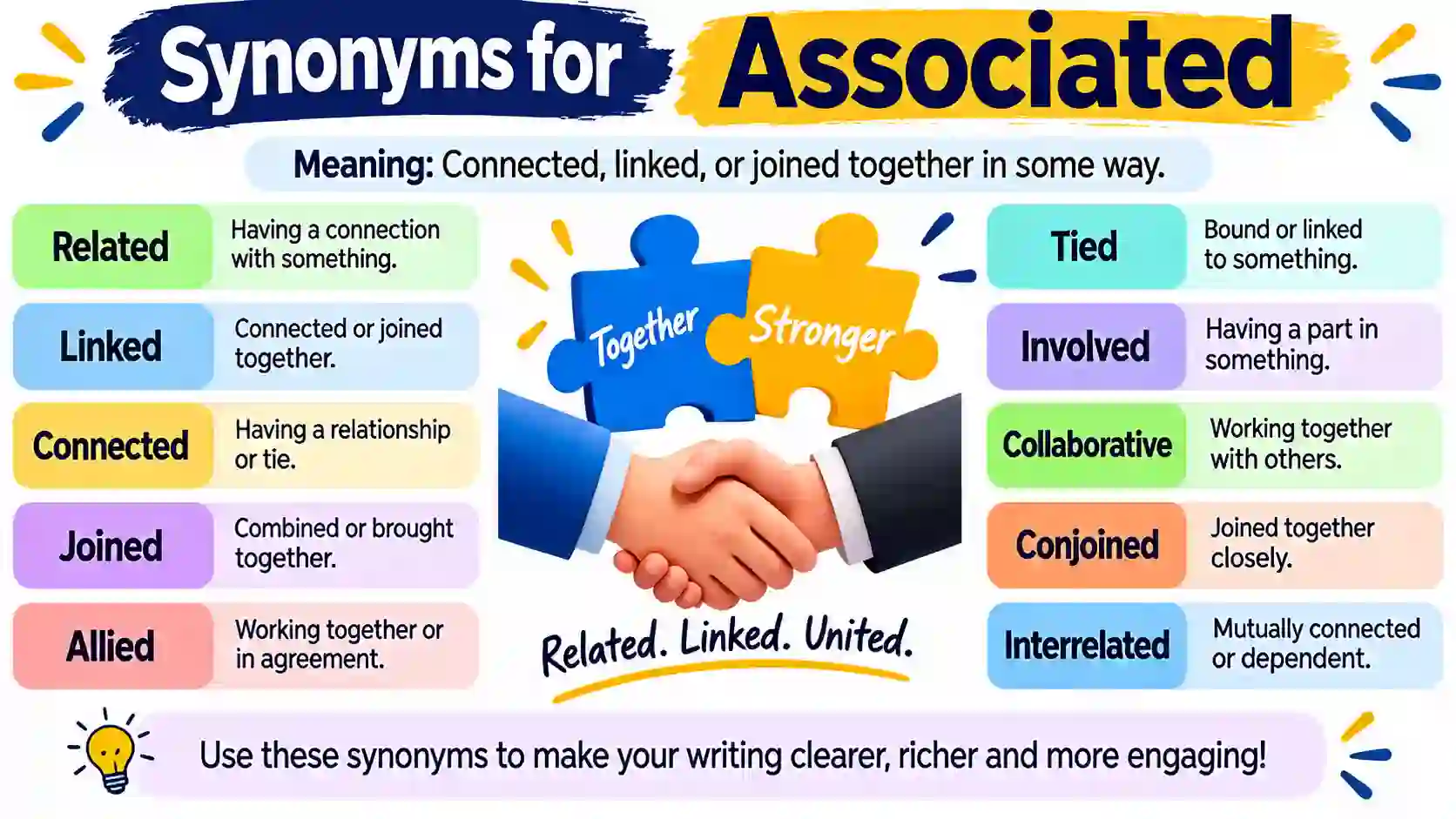
The best synonyms for associated include related, connected, linked, affiliated, allied, joined, tied, and interrelated. These words describe relationships between people, organizations, ideas, events, or things. The right choice depends on the context. For example, use affiliated for an official organizational relationship and correlated for a statistical connection.
Do you find yourself using the word associated too often in essays, emails, or professional writing? Choosing a more precise alternative can make your English sound clearer and more natural.
Associated describes a connection between two or more people, things, ideas, or events. For example, you might say that exercise is associated with good health or that a company is associated with a professional organization.
However, its alternatives do not all mean exactly the same thing. Related describes a general connection, affiliated suggests an official relationship, and correlated describes a statistical relationship.
This guide covers 30 useful synonyms for associated, with simple meanings, original examples, pronunciation, grammar advice, collocations, and usage differences. Whether you are an ESL learner, student, teacher, blogger, or professional writer, you will learn how to choose the right word for every situation.
Pronunciation of Associated
- IPA (American): /əˈsoʊ.si.eɪ.tɪd/
- IPA (British): /əˈsəʊ.si.eɪ.tɪd/
- Easy pronunciation: uh-SOH-see-ay-tid
- Syllables: Five
- Part of speech: Adjective and past participle
The main vowel difference occurs in the second syllable. American English uses /oʊ/, while British English uses /əʊ/.
Meaning and Part of Speech
Associated is an adjective and the past participle of the verb associate.
As an adjective, it describes something connected with another thing.
Example: The company pays all associated expenses.
As a verb form, it appears in perfect tenses and passive constructions.
Example: Researchers have associated poor sleep with low concentration.
Word Family
| Word | Part of speech | Meaning |
| Associate | Verb | To connect or bring together |
| Associate | Noun | A colleague, partner, or companion |
| Associated | Adjective | Connected with something |
| Association | Noun | A connection or organized group |
| Associative | Adjective | Relating to mental or conceptual connections |
| Disassociate | Verb | To separate or disconnect |
Associated is not normally used as a noun or adverb.
Word Origin and Etymology
Associated comes from the Latin associatus, the past participle of associare, meaning to join or unite with someone.
Its Latin roots include ad- (to or toward) and socius (companion or ally). These roots also connect the word to English vocabulary such as social, society, and associate.
The related verb entered Middle English around the 14th century. Historical dictionaries give its first known use in the 14th century, although dates may differ depending on the form being recorded.
Grammar: How to Use Associated Correctly
The most common construction is:
Associated + with + noun or noun phrase
Examples:
- Several health risks are associated with smoking.
- The charity is associated with a local university.
- These expenses are associated with the project.
Other common patterns include:
| Pattern | Example |
| Closely associated with | The two subjects are closely associated with each other. |
| Strongly associated with | Exercise is strongly associated with better fitness. |
| Associated costs | The company calculated its associated costs. |
| Associated risks | The report explains the associated risks. |
| Associate something with something | I associate this song with childhood. |
Grammar reminder: Use associated with, not associated to, in ordinary standard English.
Quick Comparison: 30 Synonyms for Associated
The following words are grouped by how closely they match the intended meaning. A related word may work in one context but not another.
| Synonym | Meaning strength | Register |
| Related | Strong | Neutral |
| Connected | Strong | Neutral |
| Linked | Strong | Neutral |
| Affiliated | Context-specific | Formal |
| Allied | Strong | Formal |
| Joined | Context-specific | Neutral |
| Tied | Strong | Neutral |
| Interrelated | Strong | Academic |
| Interconnected | Strong | Formal |
| Correlated | Context-specific | Academic |
| Coupled | Context-specific | Technical |
| Involved | Context-specific | Neutral |
| United | Context-specific | Neutral |
| Combined | Context-specific | Neutral |
| Bound | Context-specific | Neutral |
| Akin | Related | Formal |
| Kindred | Related | Literary |
| Relevant | Related | Neutral |
| Pertinent | Related | Formal |
| Germane | Related | Academic |
| Accompanying | Context-specific | Formal |
| Attendant | Context-specific | Formal |
| Concomitant | Context-specific | Academic |
| Corresponding | Related | Formal |
| Mutual | Context-specific | Neutral |
| Shared | Context-specific | Neutral |
| Joint | Context-specific | Formal |
| Collaborative | Context-specific | Business |
| Cooperative | Context-specific | Business |
| Incorporated | Context-specific | Formal |
30 Synonyms for Associated With Examples and Explanations
1. Related
Meaning: Related means connected through a shared subject, quality, or relationship.
Examples:
- These two articles discuss related subjects.
- The teacher assigned several questions related to geography.
- Best used when: Describing a general connection.
- Register: Neutral.
- CEFR: B1 (approximate).
- Frequency: Very common.
- Collocations: Closely related, related topics, related issues.
- Avoid when: You need to describe official membership.
2. Connected
Meaning: Connected means joining or having a relationship with something.
Examples:
- The two buildings are connected by a covered walkway.
- Her memories are connected to her childhood home.
- Best used when: Describing physical, emotional, or general relationships.
- Register: Neutral.
- CEFR: A2 (approximate).
- Frequency: Very common.
- Collocations: Closely connected, connected devices, connected ideas.
- Avoid when: You need to describe a statistical relationship.
3. Linked
Meaning: Linked means joined through a connection or relationship.
Examples:
- Researchers linked poor sleep with reduced concentration.
- The article is linked to a useful research paper.
- Best used when: Describing relationships between facts, websites, or events.
- Register: Neutral.
- CEFR: B1 (approximate).
- Frequency: Very common.
- Collocations: Directly linked, closely linked, linked to.
- Avoid when: You want to claim causation without evidence.
4. Affiliated
Meaning: Affiliated describes an official connection with an organization or institution.
Examples:
- The hospital is affiliated with a medical university.
- She works for an affiliated research center.
- Best used when: Describing formal organizational relationships.
- Register: Formal, business.
- CEFR: B2 (approximate).
- Frequency: Common.
- Collocations: Affiliated institution, affiliated company, affiliated organization.
- Avoid when: Discussing a simple relationship between two ideas.
5. Allied
Meaning: Allied describes people or groups joined by a shared goal or interest.
Examples:
- The allied organizations launched a public awareness campaign.
- Several allied countries supported the agreement.
- Best used when: Describing cooperation or shared interests.
- Register: Formal.
- CEFR: B2 (approximate).
- Frequency: Common.
- Collocations: Allied forces, allied nations, allied organizations.
- Avoid when: Two things simply happen at the same time.
6. Joined
Meaning: Joined means connected or brought together.
Examples:
- The two departments joined their resources.
- A narrow passage joined the two rooms.
- Best used when: Describing physical connections or people coming together.
- Register: Neutral.
- CEFR: A2 (approximate).
- Frequency: Very common.
- Collocations: Joined together, joined forces, closely joined.
- Avoid when: You mean a statistical or abstract relationship.
7. Tied
Meaning: Tied means connected through a strong relationship or dependence.
Examples:
- The project’s success is tied to careful planning.
- His career is closely tied to the technology industry.
- Best used when: Showing dependence or a close connection.
- Register: Neutral.
- CEFR: B1 (approximate).
- Frequency: Very common.
- Collocations: Tied to, closely tied, financial ties.
- Avoid when: You need a precise formal term for organizational membership.
8. Interrelated
Meaning: Interrelated describes things that have a close relationship and may influence one another.
Examples:
- Education and economic growth are interrelated.
- The report examines several interrelated problems.
- Best used when: Discussing connected subjects in research.
- Register: Academic, formal.
- CEFR: C1 (approximate).
- Frequency: Common.
- Collocations: Interrelated factors, interrelated issues, closely interrelated.
- Avoid when: You only mean that two things share a general topic.
9. Interconnected
Meaning: Interconnected describes things joined in a network or system.
Examples:
- Modern businesses operate in an interconnected global economy.
- The city’s transport systems are interconnected.
- Best used when: Explaining systems with multiple connections.
- Register: Academic, technical.
- CEFR: C1 (approximate).
- Frequency: Common.
- Collocations: Interconnected systems, interconnected networks, interconnected problems.
- Avoid when: Describing a simple relationship between two people.
10. Correlated
Meaning: Correlated describes two or more factors that show a statistical relationship.
Examples:
- Higher income was correlated with increased spending.
- The researchers found that sleep quality was correlated with test performance.
- Best used when: Discussing research, data, and statistics.
- Register: Academic, scientific.
- CEFR: C1 (approximate).
- Frequency: Common.
- Collocations: Positively correlated, negatively correlated, strongly correlated.
- Avoid when: You have no evidence of a measurable relationship.
Remember: Correlation does not prove causation.
11. Coupled
Meaning: Coupled means joined or combined with another thing.
Examples:
- Economic growth coupled with inflation can create new challenges.
- The machine uses a motor coupled to a cooling system.
- Best used when: Describing two things that operate or exist together.
- Register: Neutral, technical.
- CEFR: C1 (approximate).
- Frequency: Common.
- Collocations: Coupled with, closely coupled, coupled system.
- Avoid when: Describing an ordinary friendship.
12. Involved
Meaning: Involved describes someone who participates in or has a connection to something.
Examples:
- Several teachers were involved in the research.
- She is closely involved with the local community.
- Best used when: Describing participation or responsibility.
- Register: Neutral.
- CEFR: B1 (approximate).
- Frequency: Very common.
- Collocations: Directly involved, involved in, involved with.
- Avoid when: You only mean that two subjects are similar.
13. United
Meaning: United describes people or groups working together toward a shared purpose.
Examples:
- The united team completed the project successfully.
- Local communities united to protect the forest.
- Best used when: Describing cooperation and shared goals.
- Register: Neutral, formal.
- CEFR: B1 (approximate).
- Frequency: Very common.
- Collocations: United effort, united front, united community.
- Avoid when: No cooperation exists.
14. Combined
Meaning: Combined means brought together to create a single result or whole.
Examples:
- The combined experience of the team helped the company grow.
- Their combined efforts improved the school’s facilities.
- Best used when: Describing resources, efforts, or qualities brought together.
- Register: Neutral.
- CEFR: B1 (approximate).
- Frequency: Very common.
- Collocations: Combined efforts, combined resources, combined effect.
- Avoid when: The relationship is indirect rather than a true combination.
15. Bound
Meaning: Bound describes people or things joined by a strong connection or shared condition.
Examples:
- The two families are bound by years of friendship.
- The communities are bound by a shared history.
- Best used when: Describing emotional, social, or legal connections.
- Register: Neutral, literary.
- CEFR: B2 (approximate).
- Frequency: Common.
- Collocations: Bound together, legally bound, bound by tradition.
- Avoid when: You only mean a casual connection.
16. Akin
Meaning: Akin means similar or closely related in nature.
Examples:
- Her dedication to learning is akin to her father’s.
- The two artistic styles are closely akin.
- Best used when: Comparing qualities, ideas, or characteristics.
- Register: Formal, literary.
- CEFR: C1 (approximate).
- Frequency: Uncommon.
- Collocations: Akin to, closely akin, something akin to.
- Avoid when: You mean official organizational membership.
17. Kindred
Meaning: Kindred describes people or things sharing similar qualities or interests.
Examples:
- The two writers shared kindred interests in literature.
- She found a kindred spirit in her new colleague.
- Best used when: Describing shared feelings, interests, or qualities.
- Register: Literary.
- CEFR: C1 (approximate).
- Frequency: Uncommon.
- Collocations: Kindred spirits, kindred interests, kindred ideas.
- Avoid when: Writing technical research.
18. Relevant
Meaning: Relevant describes something that has a direct connection to a subject or situation.
Examples:
- The teacher shared relevant information before the exam.
- Please include relevant documents with your application.
- Best used when: Discussing information that matters to a topic.
- Register: Neutral, academic, business.
- CEFR: B1 (approximate).
- Frequency: Very common.
- Collocations: Relevant information, relevant experience, highly relevant.
- Avoid when: You mean a physical or official connection.
19. Pertinent
Meaning: Pertinent means directly related to the matter being discussed.
Examples:
- The lawyer presented pertinent evidence during the hearing.
- Please include all pertinent details in your application.
- Best used when: Describing important information in formal discussions.
- Register: Formal, academic.
- CEFR: C1 (approximate).
- Frequency: Common.
- Collocations: Pertinent information, pertinent details, pertinent questions.
- Avoid when: You mean two things are physically joined.
20. Germane
Meaning: Germane means closely relevant to a particular subject.
Examples:
- The speaker raised several germane questions.
- Her experience was germane to the position.
- Best used when: Discussing directly relevant facts in academic or formal writing.
- Register: Formal, academic.
- CEFR: C2 (approximate).
- Frequency: Uncommon.
- Collocations: Germane to the issue, germane information, directly germane.
- Avoid when: You need to describe a physical connection.
21. Accompanying
Meaning: Accompanying describes something that exists or happens alongside another thing.
Examples:
- The report includes accompanying notes.
- The medicine may cause accompanying side effects.
- Best used when: Describing additional things that come with something else.
- Register: Formal, neutral.
- CEFR: B2 (approximate).
- Frequency: Common.
- Collocations: Accompanying documents, accompanying symptoms, accompanying costs.
- Avoid when: You mean official membership or partnership.
22. Attendant
Meaning: Attendant describes something that naturally accompanies another event or situation.
Examples:
- The project faced several attendant challenges.
- Economic growth can bring attendant social changes.
- Best used when: Describing conditions that come with a particular event.
- Register: Formal.
- CEFR: C1 (approximate).
- Frequency: Uncommon.
- Collocations: Attendant risks, attendant problems, attendant circumstances.
- Avoid when: You mean two things are simply similar.
23. Concomitant
Meaning: Concomitant describes something that naturally occurs alongside another thing.
Examples:
- Economic development can produce concomitant social changes.
- The treatment may have several concomitant effects.
- Best used when: Discussing accompanying conditions in academic writing.
- Register: Academic, formal.
- CEFR: C2 (approximate).
- Frequency: Uncommon.
- Collocations: Concomitant effects, concomitant changes, concomitant risks.
- Avoid when: Writing simple everyday conversations.
24. Corresponding
Meaning: Corresponding means matching or having a direct relationship with something else.
Examples:
- Each department received its corresponding budget.
- The figures show corresponding changes in both markets.
- Best used when: Comparing matching items, figures, or positions.
- Register: Formal, academic.
- CEFR: B2 (approximate).
- Frequency: Common.
- Collocations: Corresponding figures, corresponding changes, corresponding position.
- Avoid when: The connection is loose or uncertain.
25. Mutual
Meaning: Mutual describes something shared or felt by two or more people or groups.
Examples:
- The two companies reached a mutual agreement.
- Their mutual respect helped build a lasting friendship.
- Best used when: Describing shared feelings, interests, or responsibilities.
- Register: Neutral, business.
- CEFR: B2 (approximate).
- Frequency: Common.
- Collocations: Mutual respect, mutual benefit, mutual agreement.
- Avoid when: Only one person or group has the relationship.
26. Shared
Meaning: Shared describes something held, experienced, or used by two or more people.
Examples:
- The communities have a shared cultural history.
- The partners developed a shared vision for the company.
- Best used when: Describing common experiences, interests, or resources.
- Register: Neutral.
- CEFR: A2-B1 (approximate).
- Frequency: Very common.
- Collocations: Shared interests, shared responsibility, shared values.
- Avoid when: You mean a formal organizational affiliation.
27. Joint
Meaning: Joint describes something done, owned, or shared by two or more parties.
Examples:
- The companies announced a joint research project.
- They opened a joint bank account.
- Best used when: Describing shared work, ownership, or responsibility.
- Register: Formal, business.
- CEFR: B2 (approximate).
- Frequency: Common.
- Collocations: Joint venture, joint effort, joint responsibility.
- Avoid when: There is no shared action or ownership.
28. Collaborative
Meaning: Collaborative describes people or groups working together.
Examples:
- The school introduced a collaborative learning program.
- The researchers used a collaborative approach.
- Best used when: Describing teamwork and shared projects.
- Register: Academic, business.
- CEFR: B2 (approximate).
- Frequency: Common.
- Collocations: Collaborative effort, collaborative project, collaborative approach.
- Avoid when: People are connected but do not work together.
29. Cooperative
Meaning: Cooperative describes people or groups willing to work together toward a common purpose.
Examples:
- The cooperative organizations shared their resources.
- A cooperative approach helped resolve the disagreement.
- Best used when: Describing helpful teamwork or shared action.
- Register: Neutral, business.
- CEFR: B2 (approximate).
- Frequency: Common.
- Collocations: Cooperative effort, cooperative relationship, cooperative approach.
- Avoid when: You only mean that two things have a connection.
30. Incorporated
Meaning: Incorporated means included as part of something or legally established as a company.
Examples:
- The editor incorporated my suggestions into the article.
- The business is incorporated under state law.
- Best used when: Discussing inclusion or a company’s legal structure.
- Register: Formal, business.
- CEFR: B2 (approximate).
- Frequency: Common.
- Collocations: Incorporated company, incorporated into, newly incorporated.
- Avoid when: Describing an ordinary connection between two people or ideas.
Strongest Synonyms, Strong Synonyms, and Related Words
Strongest Direct Alternatives
These words usually provide the closest general meaning:
- Related
- Connected
- Linked
- Affiliated
- Interrelated
- Interconnected
- Tied to
- Allied
Strong Context Specific Alternatives
These words work when the sentence describes a particular kind of relationship:
- Correlated
- Coupled
- Joined
- Involved
- United
- Combined
- Bound
- Partnered
Related Words
These words may be useful but do not always replace associated:
- Relevant
- Pertinent
- Germane
- Akin
- Kindred
- Accompanying
- Attendant
- Concomitant
- Corresponding
- Mutual
- Shared
- Joint
- Collaborative
- Cooperative
- Incorporated
Choose the Right Synonym: Side by Side Comparisons
| Word | Main difference | Example |
| Related | General connection | These subjects are related. |
| Connected | Physical or general connection | The buildings are connected. |
| Linked | A direct link or relationship | The findings are linked. |
| Affiliated | Official organizational connection | The college is affiliated with a university. |
| Allied | Shared purpose | The allied groups worked together. |
| Correlated | Statistical relationship | Income was correlated with spending. |
| Interrelated | Connected and influencing each other | These problems are interrelated. |
| Relevant | Important to a topic | This evidence is relevant. |
Which Synonym Should You Choose?
- Everyday English: Related or connected.
- Academic research: Interrelated or correlated.
- Business relationships: Affiliated or partnered.
- Shared goals: Allied or united.
- Statistical findings: Correlated.
- Important information: Relevant or pertinent.
- Physical connections: Joined or connected.
American vs. British English
Associated has the same spelling in American and British English.
| Feature | American English | British English |
| Spelling | Associated | Associated |
| Pronunciation | /əˈsoʊ.si.eɪ.tɪd/ | /əˈsəʊ.si.eɪ.tɪd/ |
| Preposition | Associated with | Associated with |
| General meaning | Connected | Connected |
There is no major regional difference in its standard meaning or grammar. Some accent differences occur in the vowel sounds.
CEFR and Frequency Guide
The following levels are approximate learning recommendations, not official CEFR classifications.
| Level | Suggested words |
| A2 | Connected, joined |
| B1 | Related, linked, involved, relevant, tied |
| B2 | Affiliated, allied, mutual, shared, joint |
| C1 | Interrelated, interconnected, akin, pertinent |
| C2 | Germane, concomitant |
Frequency is also context-dependent. Related, connected, linked, and involved are very common in everyday English. Germane and concomitant are less common and mainly appear in formal writing.
Common Mistakes When Using Associated
Mistake 1: Using the wrong preposition
Incorrect: These problems are associated to stress.
Correct: These problems are associated with stress.
Explanation: The standard expression is associated with.
Mistake 2: Confusing association with causation
Incorrect: The two factors are associated, so one must cause the other.
Correct: The two factors are associated, but further research is needed to establish causation.
Explanation: A relationship does not automatically prove that one factor causes another.
Mistake 3: Using affiliated for every connection
Incorrect: These two colors are affiliated.
Correct: These two colors are related.
Explanation: Affiliated usually describes formal relationships involving people or organizations.
Mistake 4: Using relevant to describe a physical connection
Incorrect: The two machines are relevant to each other.
Correct: The two machines are connected to each other.
Explanation: Relevant means important to a subject, not physically joined.
Mistake 5: Treating similar and associated as identical
Incorrect: The two companies are similar because they are associated.
Correct: The two companies are associated, although their services are different.
Explanation: A connection does not mean two things share the same qualities.
How to Use Associated Synonyms in Different Types of Writing
Academic Essays
Academic writing needs precise language.
Instead of: These factors are associated with educational success.
Write: These factors are closely related to educational success.
For statistical findings, use correlated when the research supports that description.
Professional Emails
Instead of: I am associated with the new project.
Write: I am involved in the new project.
Use affiliated with when describing an official organizational connection.
Blog Posts
Instead of: Several health conditions are associated with poor sleep.
Write: Several health conditions are linked to poor sleep.
Stories
Use expressive vocabulary to describe personal connections.
Example: The two childhood friends shared kindred interests.
Social Media
Use familiar expressions:
- These memories are tied to my childhood.
- This song is linked to a special moment.
- Good habits are connected to personal growth.
Daily Conversations
Keep your vocabulary simple:
- My success is related to hard work.
- She is connected to our school.
- I am involved in the event.
Writing tip: Do not replace every occurrence of associated simply to avoid repetition. Sometimes the original word is the clearest choice.
Antonyms of Associated
Antonyms describe the opposite of a connection.
| Antonym | Meaning | Example |
| Unrelated | Having no connection | These subjects are unrelated. |
| Disconnected | Not joined | The cables are disconnected. |
| Separate | Existing apart | The departments operate separately. |
| Independent | Not depending on another | The organization is independent. |
| Unaffiliated | Not officially connected | The group is unaffiliated with the university. |
| Detached | Separated or emotionally distant | He remained detached from the discussion. |
| Unconnected | Having no relationship | The events appear unconnected. |
| Isolated | Separated from others | The village is isolated. |
Related Expressions
These expressions can make your English more natural:
- Connected with
- Related to
- Linked to
- Tied in with
- In connection with
- In association with
- Closely connected to
- Part of the same group
- Working together with
- Connected through
Frequently Asked Questions
1. What are the best synonyms for associated?
The best synonyms for associated include related, connected, linked, affiliated, and allied. Related works for general connections, affiliated describes formal organizational relationships, and linked is useful for describing direct connections between people, ideas, or events.
2. What is another word for associated with?
Other expressions for associated with include related to, connected with, linked to, affiliated with, and tied to. The right choice depends on the context. For example, affiliated with usually describes an official relationship, while tied to often suggests dependence.
3. What is a more professional word for associated?
Affiliated, interrelated, correlated, and connected can work in professional writing. Affiliated is suitable for organizational relationships, correlated is useful for statistical findings, and interrelated works when discussing connected issues or factors.
4. Is associated the same as related?
Associated and related have similar meanings, but they are not identical in every situation. Associated often describes connections between events, people, or ideas. Related can describe a wider range of relationships, including family connections and shared subjects.
5. What is the opposite of associated?
Common antonyms include unrelated, disconnected, separate, independent, detached, and unaffiliated. Choose the opposite that fits your sentence. Unaffiliated describes the absence of an official relationship, while disconnected often describes a broken physical or logical connection.
6. Can I use connected instead of associated?
Yes, connected is one of the most useful alternatives to associated. Both words describe relationships between people, ideas, events, or things. However, connectedness can also describe physical links, such as roads and electrical cables.
7. What is the difference between associated and affiliated?
Associated is a general word for having a connection with someone or something. Affiliated usually describes a formal relationship with an organization, institution, or group. A college, for example, may be affiliated with a university.
8. What is a formal synonym for associated?
Formal alternatives include affiliated, interrelated, interconnected, correlated, pertinent, and concomitant. Their meanings differ, so choose carefully. Affiliated works for organizational relationships, correlated for statistical relationships, and concomitant for accompanying conditions.
Vocabulary Practice Exercises
Test your understanding with these short exercises.
Exercise 1: Fill in the Blanks
Choose the best word from the options.
- The university is ______ with a national research organization. (affiliated / similar)
- Higher income was ______ with increased spending. (correlated / detached)
- These two subjects are closely ______. (related / isolated)
- The team made a ______ effort to complete the project. (joint / unrelated)
- Poor sleep is often ______ to low concentration. (linked / independent)
Exercise 2: Rewrite the Sentences
Replace the bold word with a suitable alternative.
- These two ideas are associated with one another.
- The college is associated with a national institution.
- The research found that income was associated with spending.
Possible answers:
- These two ideas are related to one another.
- The college is affiliated with a national institution.
- The research found that income was correlated with spending.
Exercise 3: Match the Words
| Word | Correct meaning |
| 1. Affiliated | A. Statistically related |
| 2. Correlated | B. Officially connected |
| 3. Relevant | C. Joined in a system |
| 4. Interconnected | D. Important to a topic |
Answer key:
- 1 = B
- 2 = A
- 3 = D
- 4 = C
Exercise 4: Multiple Choice Questions
- Which word describes a shared purpose?
- A. Allied
- B. Isolated
- C. Separate
- D. Detached
- Which word is most appropriate for a statistical relationship?
- A. Kindred
- B. Correlated
- C. Joined
- D. Mutual
- Which expression is grammatically correct?
- A. Associated to
- B. Associated at
- C. Associated with
- D. Associated by
Answers: 1. A, 2. B, 3. C.
Conclusion
Learning synonyms for associates helps you explain relationships more clearly in essays, emails, professional documents, and everyday conversations. Words such as related, connected, affiliated, and interrelated each express a different type of connection.
Choose alternatives that match your intended meaning instead of changing words just for variety. Practice these expressions regularly to improve your vocabulary, writing, and speaking confidence.
References
- Cambridge Dictionary: Associated synonyms and antonyms.
- Merriam-Webster: Associate definition, word origin, and first known use.
- Collins Dictionary: Associated synonyms in British English.
- Oxford Learner’s Dictionaries: Associated meaning and usage.
- Thesaurus.com: Associated synonyms and antonyms.

Synonorm is a trusted English vocabulary resource created to help readers find the right words and understand the differences between similar terms. We provide clear explanations of synonyms, meanings, examples, usage, and alternatives. Our content makes vocabulary easier to learn and apply in everyday, academic, and professional English. Synonorm is designed for students, writers, ESL learners, professionals, and anyone who wants to improve their English vocabulary and communicate more clearly.