What Are Synonyms Required?
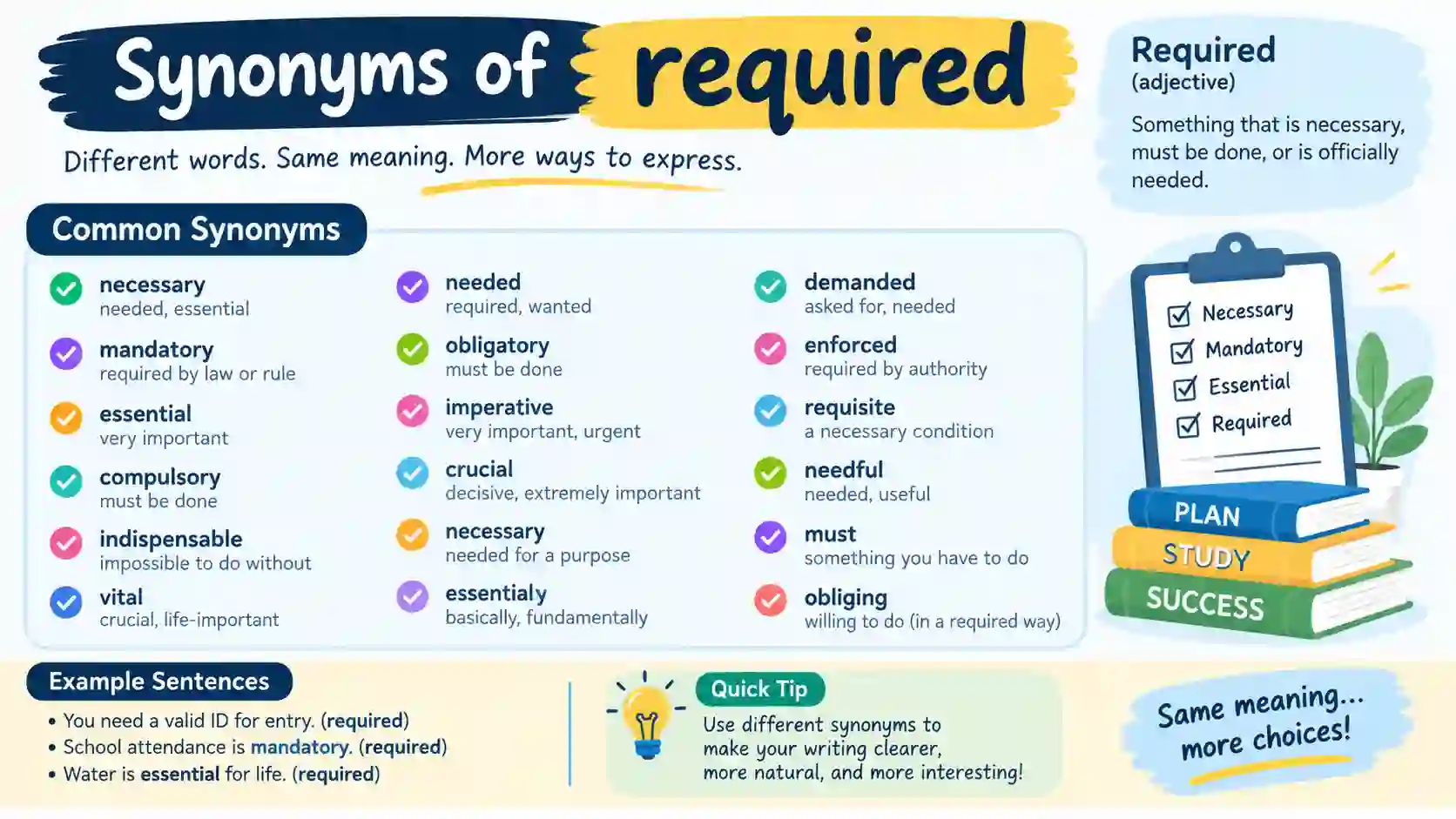
The most useful synonyms of required include necessary, needed, essential, mandatory, compulsory, obligatory, indispensable, vital, requisite, and imperative. These words describe something that a person must have, do, or provide. Some express a strict rule, while others describe an important need or expectation. The right choice depends on your sentence and its meaning.
Have you ever used the word required too many times in an essay, email, or report? Repeating the same word can make your writing sound less natural. Learning suitable alternatives helps you communicate the same idea in different ways.
The word required usually describes something that must be done, supplied, or available. For example, a passport may be required for international travel. A strong vocabulary is also necessary for clear communication.
In this guide, you will learn 30 synonyms required with meanings, original examples, pronunciation, word origins, frequency labels, and usage advice. You will also discover which alternatives work best in academic writing, business communication, everyday English, and formal instructions.
Pronunciation of Required
- IPA (American): /rɪˈkwaɪərd/
- IPA (British): /rɪˈkwaɪəd/
- Simple pronunciation: ri-KWY-erd
- Syllables: Two
- Stress: Second syllable
The final R is normally pronounced in American English. In many British accents, it is not pronounced unless the next word begins with a vowel sound.
Part of Speech
Required has two main grammatical uses.
- Adjective: Something that must be done or provided.
- Example: A signature is required.
- Past participle of the verb require:
- Example: The manager required additional documents.
Other forms include:
| Word | Part of speech | Example |
| Require | Verb | The job requires experience. |
| Requires | Verb | This task requires patience. |
| Required | Adjective/past participle | Required documents |
| Requiring | Present participle | A course requiring preparation |
| Requirement | Noun | Experience is a requirement. |
| Requirements | Plural noun | Admission requirements |
There is no standard adverb formed directly from required. Words such as necessarily and obligatorily may express related ideas, depending on the sentence.
Word Origin and Etymology
Required comes from the verb require. The English verb developed from Middle English requeren, influenced by Anglo-French requere and Latin requirere.
The Latin word combines re- with quaerere, meaning to seek or ask. Over time, the English word developed the sense of asking for something as necessary or demanding that something be done.
Merriam-Webster records the first known use of require in the 14th century. This date applies to the verb, not necessarily to every modern use of the adjective required.
Grammar: How to Use Required
These are the most common sentence patterns:
| Pattern | Example |
| Be + required | A password is required. |
| Be required to + verb | Visitors are required to register. |
| Required for + noun | Experience is required for this position. |
| Required by + authority | Approval is required by law. |
| Require + noun | The project requires funding. |
| Require + person + to + verb | The rules require drivers to wear seat belts. |
Common prepositions:
- Required for: Documents required for admission.
- Required by: Approval required by the authorities.
- Required in: Skills required in this profession.
- Required to: Applicants are required to submit an application.
Remember that required to is followed by the base form of a verb.
Correct: Employees are required to attend.
Incorrect: Employees are required attending.
Quick Overview: 30 Synonyms of Required
| Synonym | Strength | Formality |
| Necessary | Strongest | Neutral |
| Needed | Strongest | Neutral |
| Essential | Strongest | Neutral |
| Mandatory | Strongest | Formal |
| Compulsory | Strongest | Formal |
| Obligatory | Strong | Formal |
| Indispensable | Strongest | Formal |
| Vital | Strong | Neutral |
| Requisite | Strong | Formal |
| Imperative | Strong | Formal |
| Needful | Related | Literary |
| Prescribed | Contextual | Formal |
| Set | Contextual | Neutral |
| Called for | Contextual | Neutral |
| Demanded | Contextual | Neutral |
| Binding | Contextual | Formal |
| Stipulated | Contextual | Legal |
| Specified | Contextual | Formal |
| Unavoidable | Contextual | Neutral |
| Must-have | Contextual | Informal |
| De rigueur | Contextual | Literary |
| Pressing | Contextual | Formal |
| Crucial | Related | Neutral |
| Critical | Related | Formal |
| Fundamental | Related | Academic |
| Paramount | Related | Formal |
| Forced | Contextual | Neutral |
| Right | Contextual | Neutral |
| Correct | Contextual | Neutral |
| Preferred | Contextual | Neutral |
The contextual and related words are not interchangeable with required in every sentence. Their explanations below identify the limits of their use.
30 Synonyms of Required With Examples and Explanations
1. Necessary
Meaning: Something that you need to do or have.
Examples:
- Regular practice is necessary for improving your English.
- A valid ticket is necessary for entering the stadium.
Best used when: Describing a general need or condition.
Tone: Neutral | CEFR: A2 | Frequency: Very common
Collocations: Necessary steps, necessary information, necessary arrangements.
Nuance: Describes a need without always suggesting an official rule.
When not to use it: Avoid it when you need to emphasize a strict legal obligation. Use mandatory instead.
2. Needed
Meaning: Something that someone must have or use.
Examples:
- We have all the equipment needed for the experiment.
- More time is needed to complete the assignment.
Best used when: Communicating a simple everyday need.
Tone: Neutral | CEFR: A1–A2 | Frequency: Very common
Collocations: Skills needed, help needed, documents needed.
Nuance: Simple and conversational.
When not to use it: Avoid replacing mandatory with needed when a formal rule matters.
3. Essential
Meaning: Something extremely important that you cannot do without.
Examples:
- Clean water is essential for human survival.
- Good communication is essential for successful teamwork.
Best used when: Emphasizing something very important.
Tone: Neutral/Academic | CEFR: B1 | Frequency: Very common
Collocations: Essential services, essential skills, essential information.
Nuance: Stronger than ordinary necessary in many contexts.
When not to use it: Do not use essentials to describe every minor instruction.
4. Mandatory
Meaning: Something that a rule or authority says you must do.
Examples:
- Safety training is mandatory for all new employees.
- Students must complete the mandatory registration process.
Best used when: Explaining official rules and workplace policies.
Tone: Formal/Business | CEFR: B2 | Frequency: Common
Collocations: Mandatory training, mandatory attendance, mandatory reporting.
Nuance: Clearly communicates that something is not optional.
When not to use it: Avoid it for ordinary preferences or suggestions.
5. Compulsory
Meaning: Something that everyone must do because of a rule.
Examples:
- Mathematics is a compulsory subject at this school.
- The company introduced compulsory safety instruction.
Best used when: Discussing education, official activities, and regulations.
Tone: Formal | CEFR: B1–B2 | Frequency: Common
Collocations: Compulsory education, compulsory attendance, compulsory training.
Nuance: Very close to mandatory and particularly common in British English.
When not to use it: Avoid it when describing something that people can freely choose.
6. Obligatory
Meaning: Something that must be done because of a duty or rule.
Examples:
- Payment of the fee is obligatory under the agreement.
- The organization requires obligatory safety checks.
Best used when: Discussing formal duties and responsibilities.
Tone: Formal/Legal | CEFR: B2 | Frequency: Common
Collocations: Obligatory payment, obligatory procedure, obligatory duty.
Nuance: Emphasizes an obligation rather than a practical need.
When not to use it: Avoid it in casual conversation when needed or required sounds more natural.
7. Indispensable
Meaning: Something so important that you cannot manage without it.
Examples:
- Trust is indispensable in a healthy relationship.
- Her technical knowledge became indispensable to the project.
Best used when: Emphasizing something that cannot be replaced.
Tone: Formal/Academic | CEFR: C1 | Frequency: Common
Collocations: Indispensable resource, indispensable tool, indispensable support.
Nuance: Strongly emphasizes importance and necessity.
When not to use it: Do not use it for something merely helpful or convenient.
8. Vital
Meaning: Something extremely important for life, safety, or success.
Examples:
- Clean drinking water is vital for public health.
- Accurate information is vital during an emergency.
Best used when: Explaining an important need or condition.
Tone: Neutral/Academic | CEFR: B2 | Frequency: Very common
Collocations: Vital information, vital role, vital importance.
Nuance: Focuses on importance rather than an official requirement.
When not to use it: Avoid it when describing an ordinary administrative instruction.
9. Requisite
Meaning: Something needed for a particular purpose.
Examples:
- She has the requisite qualifications for the position.
- Please attach the requisite documents to your application.
Best used when: Writing formal applications, reports, and professional documents.
Tone: Formal/Academic | CEFR: C1 | Frequency: Uncommon
Collocations: Requisite qualifications, requisite knowledge, requisite documents.
Nuance: A formal alternative to necessary or required.
When not to use it: Avoid it in simple conversations where needed is clearer.
10. Imperative
Meaning: Something extremely important that must happen.
Examples:
- Immediate action is imperative during an emergency.
- It is imperative to protect confidential information.
Best used when: Expressing urgency or a very strong need.
Tone: Formal/Academic | CEFR: C1 | Frequency: Common
Collocations: Imperative action, imperative need, absolutely imperative.
Nuance: Adds urgency and importance.
When not to use it: Do not use it for routine tasks without a strong reason.
11. Needful
Meaning: Something necessary or required.
Examples:
- The team completed the needful preparations before departure.
- Please take the needful steps to resolve the issue.
Best used when: Reading or writing in certain formal and regional varieties of English.
Tone: Formal/Regional | CEFR: C1 | Frequency: Uncommon
Collocations: Needful action, needful steps, do the needful.
Nuance: This word is more common in South Asian business English than in everyday American English.
When not to use it: For a general American audience, necessary or needed is usually more natural.
12. Prescribed
Meaning: Officially stated or instructed by an authority.
Examples:
- Employees must follow the prescribed safety procedure.
- Submit the application in the prescribed format.
Best used when: Discussing official instructions, standards, or procedures.
Tone: Formal/Business | CEFR: B2 | Frequency: Common
Collocations: Prescribed format, prescribed procedure, prescribed standards.
Nuance: Something has been formally laid down by an authority.
When not to use it: Do not use it for a general need that has no official instruction.
13. Set
Meaning: Officially fixed, selected, or assigned in advance.
Examples:
- Students must complete the set reading before class.
- The organization follows a set procedure for applications.
Best used when: Describing fixed tasks, schedules, and assigned work.
Tone: Neutral | CEFR: A2 | Frequency: Very common
Collocations: Set reading, set procedure, set schedule.
Nuance: Often means assigned or fixed rather than generally necessary.
When not to use it: Do not use set when there is no fixed instruction or arrangement.
14. Called For
Meaning: Needed or appropriate in a particular situation.
Examples:
- The difficult situation called for careful planning.
- The job called for strong communication skills.
Best used when: Explaining what a situation needs.
Tone: Neutral/Spoken | CEFR: B2 | Frequency: Common
Collocations: Called for action, called for caution, called for a response.
Nuance: A natural expression in everyday English.
When not to use it: Avoid it when referring to an explicit legal requirement.
15. Demanded
Meaning: Strongly requested or insisted upon.
Examples:
- The manager demanded a full explanation.
- The emergency demanded immediate attention.
Best used when: Describing strong requests or situations that call for action.
Tone: Neutral/Formal | CEFR: B1–B2 | Frequency: Common
Collocations: Demanded action, demanded explanation, demanded attention.
Nuance: Can communicate pressure, authority, or urgency.
When not to use it: Do not use demands when you simply mean something is needed.
16. Binding
Meaning: Something that must be followed because it has formal or legal force.
Examples:
- Both parties signed a legally binding agreement.
- The contract contains binding conditions.
Best used when: Discussing contracts and formal agreements.
Tone: Formal/Legal | CEFR: C1 | Frequency: Common
Collocations: Binding agreement, binding contract, legally binding.
Nuance: Emphasizes an obligation with formal force.
When not to use it: Avoid it for ordinary requests or informal suggestions.
17. Stipulated
Meaning: Clearly stated as a condition or requirement.
Examples:
- The agreement stipulated a three-month notice period.
- Applicants must meet the stipulated conditions.
Best used when: Writing contracts, policies, and formal agreements.
Tone: Formal/Legal | CEFR: C1 | Frequency: Uncommon
Collocations: Stipulated conditions, stipulated terms, stipulated period.
Nuance: Focuses on a condition that has been expressly stated.
When not to use it: Avoid it for simple instructions in casual conversation.
18. Specified
Meaning: Clearly stated, identified, or described.
Examples:
- Please submit the documents in the specified format.
- The package must arrive on the specified date.
Best used when: Referring to exact details or instructions.
Tone: Formal/Business | CEFR: B1–B2 | Frequency: Common
Collocations: Specified date, specified amount, specified format.
Nuance: Means clearly identified, not necessarily compulsory.
When not to use it: Do not assume every specified preference is mandatory.
19. Unavoidable
Meaning: Something that cannot be prevented or avoided.
Examples:
- Some delays were unavoidable because of the storm.
- A short waiting period was unavoidable.
Best used when: Describing something that cannot be escaped.
Tone: Neutral | CEFR: B2 | Frequency: Common
Collocations: Unavoidable delay, unavoidable consequence, unavoidable expense.
Nuance: Describes an inevitable situation rather than a formal obligation.
When not to use it: Avoid it when describing a task that someone can choose not to do.
20. Must-Have
Meaning: Something considered essential or extremely useful.
Examples:
- A reliable internet connection is a must-have for remote workers.
- This guide is a must-have for new vocabulary learners.
Best used when: Writing informal recommendations and lifestyle content.
Tone: Informal | CEFR: B1 | Frequency: Common
Collocations: Must-have item, must-have feature, must-have tool.
Nuance: Often describes something strongly recommended rather than legally compulsory.
When not to use it: Avoid it in formal legal instructions.
21. De Rigueur
Meaning: Something considered necessary or expected because of custom or fashion.
Examples:
- Formal dress was de rigueur at the ceremony.
- In that professional circle, a polished presentation was de rigueur.
Best used when: Describing social customs, conventions, or expected styles.
Tone: Literary/Formal | CEFR: C2 | Frequency: Rare
Collocations: De rigueur attire, almost de rigueur, considered de rigueur.
Nuance: Suggests a social or fashionable expectation, not necessarily a legal rule.
When not to use it: Avoid it in basic writing when a simple word such as expected is clearer.
22. Pressing
Meaning: Something urgent that needs attention soon.
Examples:
- The organization must address its pressing security concerns.
- Finding a safe location became a pressing priority.
Best used when: Describing an urgent need.
Tone: Formal/Business | CEFR: B2 | Frequency: Common
Collocations: Pressing issue, pressing need, pressing concern.
Nuance: Focuses on urgency rather than compulsory status.
When not to use it: Do not use it for an ordinary requirement without urgency.
23. Crucial
Meaning: Something extremely important to a result.
Examples:
- Careful planning is crucial to the project’s success.
- Accurate records are crucial for financial decisions.
Best used when: Emphasizing an important factor.
Tone: Neutral/Academic | CEFR: B2 | Frequency: Very common
Collocations: Crucial role, crucial decision, crucial factor.
Nuance: Expresses importance, not necessarily an obligation.
When not to use it: Avoid replacing a legal requirement with crucial.
24. Critical
Meaning: Extremely important or necessary for a particular outcome.
Examples:
- Reliable data is critical to scientific research.
- Quick action was critical during the emergency.
Best used when: Emphasizing serious importance or urgency.
Tone: Neutral/Academic/Business | CEFR: B2 | Frequency: Very common
Collocations: Critical information, critical condition, critical requirement.
Nuance: Often suggests that serious problems may occur if something is missing.
When not to use it: Avoid using it for minor preferences.
25. Fundamental
Meaning: Something that forms a basic and important part of something.
Examples:
- Reading is fundamental to language learning.
- Trust is fundamental to a healthy relationship.
Best used when: Explaining basic principles or foundations.
Tone: Academic/Formal | CEFR: B2 | Frequency: Common
Collocations: Fundamental principle, fundamental right, fundamental requirement.
Nuance: Describes a basic foundation rather than a specific rule.
When not to use it: Avoid it for a temporary administrative instruction.
26. Paramount
Meaning: More important than anything else.
Examples:
- Passenger safety is paramount during the journey.
- Protecting customer information is paramount to the company.
Best used when: Highlighting the highest priority.
Tone: Formal/Academic | CEFR: C1 | Frequency: Uncommon
Collocations: Paramount importance, paramount concern, safety is paramount.
Nuance: Emphasizes the highest level of importance.
When not to use it: Do not use it as a direct replacement for a simple compulsory rule.
27. Forced
Meaning: Made to do something without having a free choice.
Examples:
- The workers were forced to leave the building.
- Heavy rain forced the organizers to cancel the event.
Best used when: Describing pressure, compulsion, or a lack of choice.
Tone: Neutral | CEFR: B1 | Frequency: Very common
Collocations: Forced decision, forced departure, forced to leave.
Nuance: Often suggests external pressure or an unwanted action.
When not to use it: Avoid it when you simply mean required by a neutral policy.
28. Right
Meaning: Correct, suitable, or appropriate in a particular situation.
Examples:
- Please use the right form for your application.
- She selected the right equipment for the task.
Best used when: Describing the correct option or form.
Tone: Neutral/Spoken | CEFR: A1 | Frequency: Very common
Collocations: Right choice, right format, right procedure.
Nuance: Can replace required in the special sense of the correct or desired form, but not in every obligation-related sentence.
When not to use it: Do not use right when you mean legally compulsory.
29. Correct
Meaning: Free from errors or in agreement with accepted standards.
Examples:
- Please enter the correct identification number.
- The applicant followed the correct procedure.
Best used when: Discussing accuracy, standards, and proper choices.
Tone: Neutral/Formal | CEFR: A2 | Frequency: Very common
Collocations: Correct answer, correct procedure, correct format.
Nuance: Means accurate or proper, not automatically compulsory.
When not to use it: Do not replace required with correct if the original sentence describes an obligation.
30. Preferred
Meaning: Chosen or liked more than other available options.
Examples:
- Email is the preferred method of communication.
- Please use your preferred language when completing the survey.
Best used when: Describing a preferred option or desired choice.
Tone: Neutral/Business | CEFR: B1 | Frequency: Very common
Collocations: Preferred method, preferred option, preferred choice.
Nuance: Describes preference, not an obligation.
When not to use it: Avoid preferred when something is compulsory. A preferred format may be optional unless the instructions say otherwise.
Categories of Synonyms
Strongest Synonyms
These words are closest to required when it means something must be done or provided:
- Necessary
- Needed
- Mandatory
- Compulsory
- Obligatory
- Essential
- Indispensable
- Requisite
- Vital
- Imperative
Strong Synonyms
These words express a strong need or obligation in the right context:
- Needful
- Prescribed
- Binding
- Demanded
- Called for
- Stipulated
Related and Context Dependent Words
These words may replace required only when the sentence has the matching meaning:
- Set
- Specified
- Unavoidable
- Must-have
- De rigueur
- Pressing
- Crucial
- Critical
- Fundamental
- Paramount
- Forced
- Right
- Correct
- Preferred
Choosing the Right Synonym: Side by Side Comparisons
| Original sentence | Better alternative | Reason |
| Attendance is required. | Attendance is mandatory. | Official obligation |
| Water is required for life. | Water is essential for life. | Basic necessity |
| Experience is required for the role. | Experience is requisite for the role. | Formal qualification |
| Immediate action is required. | Immediate action is imperative. | Urgency |
| Approval is required under the contract. | Approval is obligatory under the contract. | Formal duty |
| A passport is required for entry. | A passport is necessary for entry. | Practical need |
| The exact format is required. | The specified format must be used. | Exact instruction |
| Formal clothing is required at the event. | Formal clothing is de rigueur at the event. | Social convention |
Which Synonym Should You Choose?
- School rules: Compulsory or mandatory.
- Workplace policies: Mandatory or required.
- Legal duties: Obligatory or binding.
- Basic needs: Necessary or essential.
- Extreme importance: Vital or indispensable.
- Urgent situations: Imperative or pressing.
- Academic writing: Requisite or fundamental.
- Everyday conversation: Needed or necessary.
- Social customs: De rigueur.
- Correct forms or instructions: Specified or correct.
American vs. British English
The spelling required is the same in American and British English.
Most of its synonyms also have identical spellings.
| Word | American IPA | British IPA |
| Required | /rɪˈkwaɪərd/ | /rɪˈkwaɪəd/ |
| Necessary | /ˈnesəˌseri/ | /ˈnesəsəri/ |
| Mandatory | /ˈmændəˌtɔːri/ | /ˈmændətəri/ |
| Obligatory | /əˈblɪɡəˌtɔːri/ | /əˈblɪɡətəri/ |
| Compulsory | /kəmˈpʌlsəri/ | /kəmˈpʌlsəri/ |
Pronunciation varies by region and speaker.
Usage differences:
- Mandatory is common in both varieties.
- Compulsory is particularly familiar in British education and official contexts.
- Required is natural in both American and British writing.
- Necessary and essential are widely used across English-speaking regions.
There is no major spelling difference between the two varieties among the words discussed here.
Commonly Confused Words
| Words | Main difference | Example |
| Required vs. Recommended | Required means must; recommended means advised. | Attendance is required, but extra reading is recommended. |
| Required vs. Necessary | Required often suggests a rule; necessary describes a need. | A passport is required for entry. |
| Mandatory vs. Essential | Mandatory means compulsory; essential means extremely important. | Training is mandatory, and safety knowledge is essential. |
| Compulsory vs. Voluntary | Compulsory means must; voluntary means chosen freely. | Attendance is compulsory, but participation in the club is voluntary. |
| Required vs. Desired | Required means demanded or needed; desired means wanted. | Identification is required, but a window seat is desired. |
Common Mistakes
Mistake 1: Treating recommended as an exact synonym.
Incorrect: Attendance is recommended by law when it is compulsory.
Correct: Attendance is required by law.
Explanation: Recommended suggestions. Required communicates an obligation.
Mistake 2: Using essential when describing a strict rule.
Less precise: Wearing a seat belt is essential by law.
Better: Wearing a seat belt is mandatory under the law.
Explanation: Mandatory clearly expresses an official obligation.
Mistake 3: Using the wrong verb form.
Incorrect: Students are required attending the class.
Correct: Students are required to attend the class.
Explanation: Use be required + to + base verb.
Mistake 4: Confusing a prerequisite with a general requirement.
Less precise: Experience is a prerequisite for every job.
Better: Experience is a requirement for this particular job.
Explanation: A prerequisite is a condition that must be met before another activity or stage.
Mistake 5: Confusing preference with obligation.
Incorrect: A passport is preferred for international travel when it is legally required.
Correct: A passport is required for international travel.
Explanation: Preferred describes a choice, while required describes a need or obligation.
Writing Tips: How to Use Synonyms Naturally
Essays: Use necessary, essential, fundamental, and crucial when explaining important ideas.
Example: Critical thinking is essential for academic success.
Professional emails: Use required, mandatory, requested, and necessary.
Example: Please submit the required documents before Friday.
Blog posts: Use needed, essential, and important where appropriate.
Example: These are the essential steps for starting a small business.
Stories: Use words that fit the situation and character.
Example: The difficult journey demanded courage and patience.
Social media: Choose simple and familiar vocabulary.
Example: Good planning is essential for a productive week.
Business communication: Use mandatory, binding, stipulated, and specified when discussing formal policies.
Example: All employees must follow the specified security procedures.
Daily conversations: Prefer need, necessary, and needed.
Example: I need your help to finish this task.
Writing tip: Never change a word just to avoid repetition. Choose an alternative only when it preserves the original meaning.
Related Vocabulary
Antonyms of Required
| Antonym | Meaning | Example |
| Optional | Not compulsory | Attendance is optional. |
| Voluntary | Done by choice | Participation is voluntary. |
| Unnecessary | Not needed | Extra equipment is unnecessary. |
| Nonessential | Not absolutely needed | These items are nonessential. |
| Elective | Chosen rather than compulsory | Students can select an elective course. |
| Dispensable | Able to be done without | The extra feature is dispensable. |
| Inessential | Not essential | The additional detail is inessential. |
Related Expressions
- Must-have: Something considered essential.
- As needed: Whenever something becomes necessary.
- By necessity: Because circumstances make something necessary.
- Requirement: Something that must be fulfilled.
- At someone’s discretion: Decided by that person’s choice.
- A prerequisite for: A condition that must be met first.
- Required by law: Something legally compulsory.
- Without fail: Every time, without exception.
Word Family
| Word | Part of speech | Example |
| Require | Verb | The course requires practice. |
| Required | Adjective/past participle | A required document |
| Requires | Verb | This task requires patience. |
| Requiring | Present participle | A job requiring experience |
| Requirement | Noun | A basic requirement |
| Requirements | Plural noun | Admission requirements |
Frequently Asked Questions
1. What are the best synonyms of required?
The best synonyms of required include necessary, essential, mandatory, compulsory, obligatory, needed, and indispensable. Use mandatory for official rules, essential for important needs, and necessary for general situations. The best alternative depends on the meaning and tone of your sentence.
2. What is a professional word for required?
Professional alternatives include mandatory, obligatory, requisite, essential, and stipulated. These words work well in business emails, contracts, workplace policies, and academic documents. For example, you can write, “The requisite documents must be submitted before the application deadline.”
3. What is another word required by law?
Mandatory, compulsory, obligatory, and legally binding are useful expressions when discussing legal duties. For example, “Wearing a seat belt is mandatory under applicable traffic laws.” Choose wording that accurately reflects the relevant legal rule.
4. What is the difference between required and necessary?
Required often describes something demanded by a rule, authority, or situation. Necessary describes something needed to achieve a result. For example, identification may be required for entry, while patience is necessary for learning a difficult skill.
5. What is the opposite of required?
The most common opposites of required are optional, voluntary, unnecessary, and nonessential. Optional means someone can choose whether to do something. Voluntary describes an action performed freely rather than because of an obligation.
6. Can essential replacements be required?
Sometimes. Essential works when something is extremely important or needed for a purpose. However, it does not always communicate a formal rule. For example, safety equipment may be required by policy, while good communication is essential for successful teamwork.
7. What is the difference between mandatory and compulsory?
Both words describe something that must be done. Mandatory is widely used in business, government, and official policies. Compulsory is particularly common in education and formal rules. Both are understood in American and British English.
8. What is the simplest synonym for required?
Needed is usually the simplest everyday alternative. It is easy to understand and works in conversations, school assignments, and basic writing. For example, “The documents required for registration” can become “The documents needed for registration.”
Vocabulary Quiz
Choose the correct answer for each question.
- Which word describes something that must be followed under an official rule?
A. Desired
B. Mandatory
C. Suitable
D. Intended
- Which synonym means something that cannot be done without?
A. Indispensable
B. Optional
C. Requested
D. Specified
- Which word describes something wanted rather than compulsory?
A. Obligatory
B. Binding
C. Preferred
D. Compulsory
- Which word describes a condition that must be met before something else?
A. Critical
B. Prerequisite
C. Enforced
D. Expected
- Choose the grammatically correct sentence.
A. Students are required to attend class.
B. Students are required to attend class.
C. Students are required to attend class.
D. Students required to attend class.
Answer Key
- B. Mandatory
- A. Indispensable
- C. Preferred
- B. Prerequisite
- C. Students are required to attend class.
Explanations:
- Mandatory describes an official obligation.
- Indispensable means impossible or extremely difficult to do without.
- Preferred describes a choice someone likes more.
- Prerequisite describes an earlier condition that must be met.
- Required is followed by to + base verb in this sentence pattern.
Conclusion
Learning synonyms of required helps you write clearly, avoid repetition, and communicate with confidence. Words such as necessary, essential, mandatory, compulsory, and indispensable express different levels of need and obligation.
Practice these alternatives in essays, emails, schoolwork, and everyday conversations. Always choose words that match your intended meaning. Keep learning and build your English vocabulary one word at a time.
References
- Cambridge Dictionary: https://dictionary.cambridge.org/us/thesaurus/required
- Merriam-Webster: https://www.merriam-webster.com/dictionary/require
- Collins English Thesaurus: https://www.collinsdictionary.com/dictionary/english-thesaurus/required
- Thesaurus.com: https://www.thesaurus.com/browse/required
- Cambridge Thesaurus: https://dictionary.cambridge.org/us/thesaurus/requisite

Synonorm is a trusted English vocabulary resource created to help readers find the right words and understand the differences between similar terms. We provide clear explanations of synonyms, meanings, examples, usage, and alternatives. Our content makes vocabulary easier to learn and apply in everyday, academic, and professional English. Synonorm is designed for students, writers, ESL learners, professionals, and anyone who wants to improve their English vocabulary and communicate more clearly.