Quick Answer: What Are Synonyms for Can?
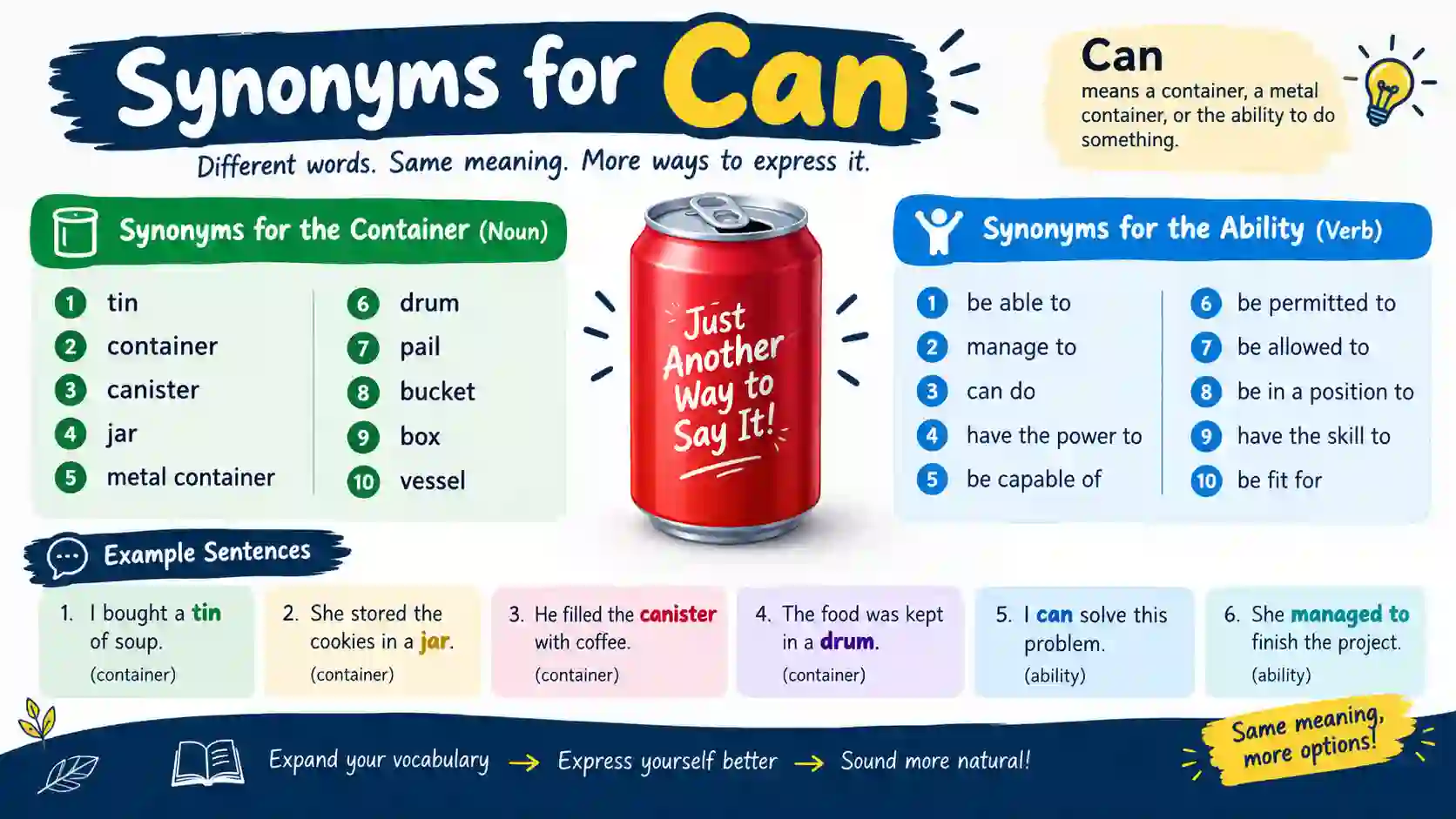
Synonyms for can include be able to, be capable of, know how to, manage to, have the ability to, may, be allowed to, and be permitted to. The right alternative depends on whether you are expressing ability, permission, possibility, or a request. Some expressions are close synonyms, while others work only in specific contexts.
Do you often use the word can in your essays, emails, or everyday conversations? It is one of the most useful words in English, but repeating it too often can make your writing sound less varied.
Learning synonyms for can gives you more ways to express your ideas. For example, instead of writing “I can speak English,” you can say “I am able to speak English.”
However, these expressions do not always have the same meaning. May often expresses permission, might suggest uncertainty, and manage to highlight success after effort.
This guide explains 30 alternatives with simple definitions, original examples, grammar patterns, pronunciation, and usage tips. Whether you are a student, teacher, blogger, or professional, you will learn how to choose words that fit your message naturally.
Pronunciation of Can
- IPA: /kæn/ (strong form)
- Weak form: /kən/
- Pronunciation: Kan or Kuhn.
The strong form usually appears when a speaker emphasizes the word. The weak form is common in unstressed speech.
Part of Speech
The word can has three important grammatical uses.
| Part of speech | Meaning | Example |
| Modal verb | Ability | I can swim. |
| Modal verb | Permission | You can leave now. |
| Modal verb | Possibility | Mistakes can happen. |
| Noun | A container | She opened a can of beans. |
| Main verb | To preserve food | They can eat fresh vegetables. |
This article mainly focuses on the modal verb. The noun and food-preservation verb have separate alternatives.
Grammar: How to Use Can
The basic sentence pattern is:
Subject + can + base verb
Examples:
- I can drive.
- She can speak French.
- They can complete the assignment.
Important Grammar Rules
- Never add to after can: “I can swim,” not “I can to swim.”
- Do not add -s for he, she, or it: “He can work.”
- Form negative sentences with cannot or can’t.
- Form questions by placing can before the subject: “Can you help?”
- Use be able to when you need another tense or an infinitive.
Examples:
- Present: I can help.
- Past: I could help.
- Future: I will be able to help.
- Present perfect: I have been able to help.
Remember: Could does not always replace can in the past. For a single successful action in the past, English often used was able to or managed to.
Quick Synonyms for Can: Comparison Table
| Alternative | Main meaning | Formality |
| Be able to | Ability | Neutral |
| Be capable of | Capacity | Formal |
| Know how to | Learned skill | Neutral |
| Manage to | Successful effort | Neutral |
| Have the ability to | Skill or power | Formal |
| Have the capacity to | Ability or potential | Formal |
| Have the means to | Available resources | Formal |
| Be qualified to | Professional credentials | Formal |
| Be equipped to | Preparation | Neutral |
| Be in a position to | Opportunity or authority | Formal |
| Be allowed to | Permission | Neutral |
| Be permitted to | Official permission | Formal |
| Have permission to | Approval | Neutral |
| May | Permission or possibility | Formal |
| Could | Past ability or polite request | Neutral |
| Might | Uncertain possibility | Neutral |
| Be free to | Freedom of choice | Neutral |
| Have the right to | Legal or personal entitlement | Formal |
| Authorize | Give official approval | Formal |
| Permit | Give permission | Formal |
| Allow | Let someone do something | Neutral |
| Succeed in | Achieve something | Neutral |
| Be possible to | Possibility | Neutral |
| Be likely to | Probability | Neutral |
| Be expected to | Expectation | Formal |
| Perform | Carry out a task | Neutral |
| Execute | Carry out a plan | Formal |
| Carry out | Complete an activity | Neutral |
| Undertake | Accept responsibility | Formal |
| Be up to | Have the ability or readiness | Informal |
30 Synonyms and Alternatives for Can With Examples
The alternatives below are grouped by their actual meaning. This prevents learners from treating every word as an exact replacement.
Group 1: Ability and Skill
1. Be Able To
Meaning: Having the skill or opportunity to do something.
Examples:
- I am able to finish the report today.
- She is able to understand difficult lessons.
Best used when: You want a natural alternative to can when describing ability.
Tone: Neutral | CEFR: A2 | Frequency: Very common
Collocations: able to work, able to attend, able to understand.
Nuance: This is one of the closest alternatives to can.
Avoid: “I am able to drive.” Choose one construction.
2. Be Capable Of
Meaning: Having the ability or potential to do something.
Examples:
- This machine is capable of processing large files.
- Our team is capable of solving the problem.
Best used when: Discussing skills, capacity, or potential.
Tone: Formal | CEFR: B2 | Frequency: Common
Collocations: capable of learning, capable of change, capable of handling.
Nuance: Emphasizes potential or capacity.
Avoid: Using a bare verb after of. Write “capable of working,” not “capable of work” when describing the action.
3. Know How To
Meaning: Having the knowledge or skill needed to do something.
Examples:
- My sister knows how to design websites.
- Do you know how to repair a bicycle?
Best used when: Describing learned or practical skills.
Tone: Neutral | CEFR: A2 | Frequency: Very common
Collocations: know how to cook, know how to drive, know how to use.
Nuance: Focuses on knowledge rather than general opportunity.
Avoid: Using it when someone has permission but lacks the necessary skill.
4. Manage To
Meaning: Succeeding in doing something, often after difficulty.
Examples:
- We managed to complete the project on time.
- She managed to open the locked door.
Best used when: Highlighting effort and success.
Tone: Neutral | CEFR: B1 | Frequency: Very common
Collocations: manage to finish, manage to escape, manage to achieve.
Nuance: Suggests that the task was not easy.
Avoid: Using it for a simple ability that does not involve a successful attempt.
5. Have the Ability To
Meaning: Possessing the skill or power to perform an action.
Examples:
- Children have the ability to learn quickly.
- He has the ability to solve complex problems.
Best used when: Explaining someone’s skills in detail.
Tone: Formal | CEFR: B1 | Frequency: Common
Collocations: ability to learn, ability to communicate, ability to adapt.
Nuance: Focuses on an existing ability.
Avoid: Repeating this long phrase when you can communicate the same idea clearly.
6. Have the Capacity To
Meaning: Having enough mental, physical, or practical ability to do something.
Examples:
- The team has the capacity to handle more customers.
- She has the capacity to lead a large organization.
Best used when: Discussing limits, potential, and performance.
Tone: Formal | CEFR: B2 | Frequency: Common
Collocations: capacity to grow, capacity to learn, capacity to perform.
Nuance: Often refers to the amount someone or something can handle.
Avoid: Using it when you simply mean permission.
7. Have the Means To
Meaning: Having the resources needed to achieve something.
Examples:
- We have the means to improve our website.
- The company has the means to expand its services.
Best used when: Discussing money, equipment, or resources.
Tone: Formal | CEFR: B2 | Frequency: Common
Collocations: means to invest, means to improve, means to succeed.
Nuance: Focuses on available resources rather than skill.
Avoid: Using it when someone has the skill but lacks the opportunity.
8. Be Qualified To
Meaning: Having the necessary education, training, or experience for a task.
Examples:
- She is qualified to teach mathematics.
- He is qualified to operate the equipment.
Best used when: Discussing professional skills and credentials.
Tone: Formal | CEFR: B2 | Frequency: Common
Collocations: qualified to teach, qualified to practice, qualified to apply.
Nuance: Suggests recognized qualifications.
Avoid: Assuming that a qualification guarantees immediate practical ability.
9. Be Equipped To
Meaning: Having the tools, knowledge, or preparation needed for a task.
Examples:
- Our staff are equipped to handle customer complaints.
- The students are equipped to face new challenges.
Best used when: Describing preparation and resources.
Tone: Neutral | CEFR: B2 | Frequency: Common
Collocations: equipped to handle, equipped to deal with, equipped to succeed.
Nuance: Emphasizes readiness.
Avoid: Using it when you only mean that someone has permission.
10. Be In a Position To
Meaning: Having the opportunity, authority, or circumstances needed to act.
Examples:
- The director is in a position to approve the request.
- We are in a position to support the project.
Best used when: Discussing professional opportunities or authority.
Tone: Formal | CEFR: C1 | Frequency: Common
Collocations: in a position to help, decide, invest.
Nuance: Suggests favorable circumstances.
Avoid: Using it for simple everyday skills.
Group 2: Permission and Authority
11. Be Allowed To
Meaning: Having permission to do something.
Examples:
- Students are allowed to use dictionaries.
- Visitors are allowed to enter the garden.
Best used when: Explaining rules and permission.
Tone: Neutral | CEFR: A2 | Frequency: Very common
Collocations: allowed to enter, allowed to leave, allowed to participate.
Nuance: Permission usually comes from another person or authority.
Avoid: Using it when you mean personal skill.
12. Be Permitted To
Meaning: Having official permission to do something.
Examples:
- Employees are permitted to work remotely.
- Guests are permitted to use the conference room.
Best used when: Writing formal policies and instructions.
Tone: Formal | CEFR: B2 | Frequency: Common
Collocations: permitted to enter, permitted to participate, permitted to use.
Nuance: More official in tone than be allowed to.
Avoid: Using it in casual conversation when a simpler phrase sounds natural.
13. Have Permission To
Meaning: Having approval to perform an action.
Examples:
- I have permission to access the records.
- The children have permission to play outside.
Best used when: Making approval clear.
Tone: Neutral | CEFR: A2 | Frequency: Common
Collocations: permission to enter, permission to leave, permission to use.
Nuance: Emphasizes consent.
Avoid: Using it when there is no question of permission.
14. May
Meaning: Expressing permission or possibility.
Examples:
- May I ask a question?
- Visitors may enter after showing their tickets.
Best used when: Asking for or giving permission in formal situations.
Tone: Formal | CEFR: A2 | Frequency: Common
Collocations: may enter, may proceed, may apply.
Nuance: Often sounds more formal than can when asking permission.
Avoid: Replacing every ability-related use of can with may.
15. Have the Right To
Meaning: Being legally, morally, or officially entitled to do something.
Examples:
- Every student has the right to ask questions.
- Employees have the right to request a copy of the policy.
Best used when: Discussing rights and entitlements.
Tone: Formal | CEFR: B1 | Frequency: Common
Collocations: right to vote, right to choose, right to appeal.
Nuance: Expresses entitlement rather than simple permission.
Avoid: Using it for ordinary physical ability.
16. Be Free To
Meaning: Having the freedom or choice to do something.
Examples:
- You are free to choose your own topic.
- Employees are free to share their ideas.
Best used when: Describing freedom of choice.
Tone: Neutral | CEFR: B1 | Frequency: Common
Collocations: free to choose, free to express, free to decide.
Nuance: Suggests independence from restrictions.
Avoid: Using it when formal approval is still required.
17. Allow
Meaning: To let someone do something.
Examples:
- The teacher allows students to use calculators.
- This app allows users to change their passwords.
Best used when: Describing permission or something that makes an action possible.
Tone: Neutral | CEFR: A2 | Frequency: Very common
Collocations: allow access, allow entry, allow users.
Nuance: A direct and natural verb.
Avoid: Writing “allow students enter.” Use “allow students to enter.”
18. Permit
Meaning: To give someone permission to do something.
Examples:
- The school permits students to use laptops.
- Local rules permit residents to keep small pets.
Best used when: Discussing official rules and permission.
Tone: Formal | CEFR: B1 | Frequency: Common
Collocations: permit entry, permit access, permit visitors.
Nuance: Often sounds more official than allowed.
Avoid: Confusing the verb permit with the noun meaning an official document.
19. Authorize
Meaning: To give official approval or authority.
Examples:
- The manager authorized the purchase.
- The bank authorized the payment.
Best used when: Discussing official decisions.
Tone: Formal | CEFR: C1 | Frequency: Common
Collocations: authorize a payment, authorize access, authorize a purchase.
Nuance: Implies formal authority.
Avoid: Using it to describe someone’s personal ability.
Group 3: Possibility and Requests
20. Could
Meaning: Expressing past ability, possibility, or a polite request.
Examples:
- Could you explain this lesson again?
- We could visit the museum tomorrow.
Best used when: Making polite requests or suggesting possible actions.
Tone: Neutral | CEFR: A2 | Frequency: Very common
Collocations: could help, could happen, could improve.
Nuance: Often softer than can.
Avoid: Assuming that could always describe a past ability.
21. Might
Meaning: Expressing an uncertain possibility.
Examples:
- We might finish the work tonight.
- The weather might improve tomorrow.
Best used when: Talking about something that may happen but is not certain.
Tone: Neutral | CEFR: B1 | Frequency: Very common
Collocations: might happen, might change, might help.
Nuance: Focuses on uncertainty.
Avoid: Using it to grant permission.
22. Be Possible To
Meaning: Describing whether an action can be done.
Examples:
- It is possible to learn English online.
- Is it possible to change the delivery date?
Best used when: Discussing practical options.
Tone: Neutral | CEFR: A2 | Frequency: Very common
Collocations: possible to achieve, possible to complete, possible to arrange.
Nuance: Focuses on the action, not the person’s personal skill.
Avoid: Writing “I am able to finish.” Write “I am able to finish.”
23. Be Likely To
Meaning: Having a good chance of happening.
Examples:
- Prices are likely to increase next month.
- The team is likely to win the competition.
Best used when: Making predictions based on evidence.
Tone: Neutral | CEFR: B1 | Frequency: Very common
Collocations: likely to happen, likely to succeed, likely to increase.
Nuance: Expresses probability, not ability.
Avoid: Using it as a direct replacement for can in skill-related sentences.
24. Be Expected To
Meaning: Being anticipated or required to do something.
Examples:
- The package is expected to arrive tomorrow.
- Employees are expected to follow company rules.
Best used when: Discussing duties and expectations.
Tone: Formal | CEFR: B1 | Frequency: Common
Collocations: expected to arrive, expected to perform, expected to improve.
Nuance: Focuses on what people believe or require.
Avoid: Using it when you simply mean someone has the ability.
Group 4: Action Focused Alternatives
These expressions can replace a complete phrase such as can complete the task. They are not direct replacements for the modal verb itself.
25. Succeed In
Meaning: Achieving something through effort.
Examples:
- She succeeded in completing the assignment.
- They succeeded in reaching the mountain summit.
Best used when: Emphasizing an achieved result.
Tone: Neutral | CEFR: B1 | Frequency: Very common
Collocations: succeed in business, succeed in completing, succeed in achieving.
Nuance: Focuses on the result.
Avoid: Using it to describe a general ability without an actual success.
26. Perform
Meaning: To carry out an activity or task.
Examples:
- The technician can perform basic repairs.
- The software can perform several calculations.
Best used when: Discussing duties and technical tasks.
Tone: Neutral | CEFR: B1 | Frequency: Common
Collocations: perform a task, perform an operation, perform an analysis.
Nuance: Focuses on carrying out work.
Avoid: Using it when you mean permission.
27. Execute
Meaning: To carry out a plan, order, or instruction.
Examples:
- Our team can execute the marketing strategy.
- The computer can execute the command.
Best used when: Discussing organized plans and technical work.
Tone: Formal | CEFR: C1 | Frequency: Common
Collocations: execute a plan, execute an order, execute a command.
Nuance: Suggests planned action.
Avoid: Using it for simple everyday abilities.
28. Carry Out
Meaning: To complete or perform an activity.
Examples:
- Researchers can carry out further tests.
- Our staff can carry out the inspection tomorrow.
Best used when: Discussing practical or planned work.
Tone: Neutral | CEFR: B1 | Frequency: Common
Collocations: carry out research, carry out tests, carry out instructions.
Nuance: Focuses on completing an activity.
Avoid: Using it to grant permission.
29. Undertake
Meaning: To accept responsibility for a task or project.
Examples:
- Our agency can undertake the website redesign.
- The university can undertake further research.
Best used when: Discussing serious projects and responsibilities.
Tone: Formal | CEFR: C1 | Frequency: Common
Collocations: undertake research, undertake a project, undertake responsibility.
Nuance: Suggests commitment.
Avoid: Using it as a casual replacement for can.
30. Be Up To
Meaning: Having the ability, energy, or readiness to do something.
Examples:
- Are you up to handling this challenge?
- I am up to helping with the project.
Best used when: Talking informally about someone’s readiness or ability.
Tone: Informal | CEFR: B2 | Frequency: Common
Collocations: up to the task, up to the challenge, up to handling.
Nuance: Often suggests willingness or readiness, not simply skill.
Avoid: Using it in formal academic writing when able to is clearer.
Choose the Right Synonym: Side by Side Comparisons
| Expression | Example | What it emphasizes |
| Can | I can swim. | Present ability |
| Be able to | I am able to swim. | Ability |
| Know how to | I know how to swim. | Learned skill |
| Manage to | I managed to swim across. | Successful effort |
| May | May I enter? | Permission |
| Be allowed to | I am allowed to enter. | Permission |
| Could | Could you help me? | Polite request |
| Might | It might rain. | Uncertain possibility |
| Be qualified to | She is qualified to teach. | Credentials |
| Succeed in | She succeeded in finishing. | Actual achievement |
Three Differences Every Learner Should Know
Can vs. May
- Can I borrow your pen? This is common in everyday conversation.
- May I borrow your pen? This sounds more formal.
Could vs. Can
- Can you help me? This is a direct request.
- Could you help me? This is generally more polite.
Can vs. Manage To
- I can finish the assignment. This describes ability.
- I managed to finish the assignment. This describes actual success, often after difficulty.
Word Origin and Etymology of Can
The modal verb can comes from Old English cunnan, meaning “to know” or “to know how.”
Its historical roots are connected to the idea of knowledge and learned ability. Over time, the meaning developed into the modern idea of being able to do something.
Historical dictionaries record the word in English before the 12th century.
The noun can, meaning a container, has a separate history. It comes from Old English canne, meaning a cup or container.
| Historical detail | Modal verb | Container noun |
| Old English form | Cunnan | Canne |
| Original meaning | Know or know how | Cup or container |
| Modern meaning | Ability or permission | Metal container |
This distinction matters because the two forms look the same but have different histories.
American vs. British English
The spelling and basic grammar of can are the same in American and British English.
| Feature | American English | British English |
| Spelling | Can | Can |
| Strong pronunciation | /kæn/ | /kæn/ |
| Weak pronunciation | /kən/ | /kən/ |
| Negative | Can’t / cannot | Can’t / cannot |
| Everyday permission | Can I leave? | Can I leave? |
| Formal permission | May I leave? | May I leave? |
Pronunciation varies by accent. The final /t/in can’t may also sound different across regional varieties.
There is no need to learn separate American and British synonyms for this word.
Synonym Categories
Strongest Alternatives for Ability
- Be able to
- Be capable of
- Know how to
- Manage to
- Have the ability to
- Have the capacity to
- Have the means to
- Be qualified to
- Be equipped to
- Be in a position to
Alternatives for Permission
- Be allowed to
- Be permitted to
- Have permission to
- May
- Have the right to
- Be free to
- Allow
- Permit
- Authorize
Alternatives for Possibility and Action
- Could
- Might
- Be possible to
- Be likely to
- Be expected to
- Succeed in
- Perform
- Execute
- Carry out
- Undertake
- Be up to
These groups are based on meaning and context. They do not mean every expression can replace can in the same sentence.
Commonly Confused Words
| Word | Difference | Example |
| Can | Ability, permission, or possibility | I can drive. |
| Could | Past ability, possibility, or polite request | Could you help? |
| May | Permission or possibility | May I enter? |
| Might | Uncertain possibility | It might rain. |
| Able | Describes having ability | She is able to drive. |
Common Mistakes When Using Can
Mistake 1: Adding To After Can
Incorrect: I can speak English.
Correct: I can speak English.
Explanation: Can takes the base form of the next verb without to.
Mistake 2: Adding S After Can
Incorrect: She can drive.
Correct: She can drive.
Explanation: Modal verbs do not change according to the subject.
Mistake 3: Using Capable With the Wrong Pattern
Incorrect: He is capable of solving the problem.
Correct: He is capable of solving the problem.
Explanation: Use capable of followed by a noun or an -ing form.
Mistake 4: Combining Two Ability Structures
Incorrect: I am able to finish it.
Correct: I can finish it.
Explanation: Do not combine can and be able to in this construction.
Mistake 5: Forgetting To After Allowed
Incorrect: Students are allowed to use calculators.
Correct: Students are allowed to use calculators.
Explanation: Use allowed to before the base verb.
Writing Tips: How to Use Synonyms Naturally
Different types of writing require different vocabulary.
Essays: Use be capable of, be able to, and succeed in when discussing skills and achievements.
Emails: Use could or would you be able to to make polite requests.
Blog posts: Use simple alternatives such as know how to and be able to.
Stories: Use manage when a character overcomes a challenge.
Social media: Prefer short and familiar expressions.
Business writing: Use authorize, permit, and be in a position to when discussing formal decisions.
Daily conversations: Use can, could, and be able to for natural communication.
Writing Tip: Do not replace every occurrence of can just to avoid repetition. Clear writing is more important than complicated vocabulary.
Related Vocabulary
Antonyms of Can
The opposite depends on the meaning.
| Antonym | Meaning |
| Cannot | Not able or not permitted |
| Unable to | Lacking ability |
| Incapable of | Lacking the capacity |
| Forbidden to | Not permitted |
| Prohibited from | Officially not allowed |
| Impossible to | Cannot be done |
| Unqualified to | Lacking required credentials |
Related Expressions
- Can do: Be willing or able to do something.
- Can afford: Have enough money for something.
- Can help: Be able to provide assistance.
- Can manage: Have enough ability or resources.
- Can make it: Be able to attend or succeed.
- Can hardly: Be almost unable to do something.
- No can do: An informal expression meaning something cannot be done.
Word Family
| Word | Part of speech | Meaning |
| Can | Modal verb | Ability or permission |
| Could | Modal verb | Past ability or polite possibility |
| Able | Adjective | Having ability |
| Ability | Noun | Skill or power |
| Capability | Noun | Capacity to perform |
| Capable | Adjective | Having potential |
| Unable | Adjective | Not having ability |
Frequently Asked Questions
1. What are the best synonyms for can?
The best alternatives include being able to, being capable of, knowing how to, and managing to. For permission, use may or be allowed to. For polite requests, could is a natural option. The correct choice depends on the meaning of your sentence.
2. What is a formal word for can?
Formal alternatives include be capable of, be permitted to, be qualified to, and be authorized to. Each has a different meaning. For example, be permitted to express official permission, while being capable of describing someone’s ability or potential.
3. What is another word for can in an essay?
Useful alternatives include being able to, having the ability to, being capable of, and succeeding in. For example, “Students can improve their skills” could become “Students are able to improve their skills through regular practice.”
4. Are can and may interchangeable?
Sometimes. Both can express permission and possibility, but their use depends on context. Can is common in everyday English, while may often sound more formal when asking for or giving permission. They cannot replace each other in every sentence.
5. What is the difference between can and could?
Can commonly describes present ability, permission, and general possibility. Could describe past ability, uncertain possibilities, and polite requests. For example, “I can drive” describes present ability, while “Could you help?” is a polite request.
6. What is the opposite of can?
The most common opposite is cannot or can’t. Other alternatives include unable to, incapable of, forbidden to, and prohibited from. The right choice depends on whether the original sentence describes ability, permission, or possibility.
7. How can I avoid repeating can in writing?
Identify the meaning of each sentence first. Use be able to for ability, be allowed to for permission, and might for uncertain possibility. Avoid changing every occurrence because repeating a simple word is often more natural than forcing an unusual alternative.
8. Is it a noun or a verb?
Can is mainly used as a modal auxiliary verb, but it also works as a noun and an ordinary verb. As a noun, it means a container. As an ordinary verb, it means preserving food in a sealed container.
Vocabulary Quiz
Choose the correct answer.
1. Which expression describes someone’s ability?
A. Be permitted to
B. Be able to
C. Might
D. Authorize
2. Which word is commonly used to make a polite request?
A. Could
B. Prohibit
C. Execute
D. Undertake
3. Which expression emphasizes success after difficulty?
A. Be free to
B. Manage to
C. May
D. Be expected to
4. Which expression describes official permission?
A. Might
B. Know how to
C. Be permitted to
D. Be capable of
5. Which sentence is grammatically correct?
A. She can swim.
B. She can swim.
C. She can swim.
D. She can swim.
Answer Key
- B
- A
- B
- C
- D
Mini Practice Exercises
Exercise 1: Fill in the Blanks
Choose from managed to, able to, and may.
- She is ______ speak three languages.
- ______ I borrowed your pen?
- We ______ finish the project despite the delay.
Exercise 2: Rewrite the Sentences
Replace the highlighted word with a suitable expression.
- I can complete this task.
- Can I enter the room?
- Our team can perform the inspection.
Exercise 3: Match the Words
- Manage to
- Authorize
- Might
A. Official permission
B. Success after effort
C. Uncertain possibility
Answers: Exercise 1: able to, May, managed to. Exercise 2: I am able to complete this task. May I enter the room? Our team can carry out the inspection. Exercise 3: 1-B, 2-A, 3-C.
Conclusion
Learning synonyms for can helps you express ability, permission, and possibility more clearly. Alternatives such as be able to, manage to, may, and could make your English more natural when used correctly.
Practice these expressions in emails, essays, schoolwork, and daily conversations. Focus on meaning first, and your vocabulary will grow with confidence.
References
- Cambridge Dictionary: https://dictionary.cambridge.org/us/thesaurus/can
- Oxford Learner’s Dictionaries: https://www.oxfordlearnersdictionaries.com/definition/english/can1
- Merriam-Webster: https://www.merriam-webster.com/dictionary/can
- Collins Dictionary: https://www.collinsdictionary.com/dictionary/english-thesaurus/can
- British Council: https://learnenglish.britishcouncil.org/free-resources/grammar/english-grammar-reference/modal-verbs

Synonorm is a trusted English vocabulary resource created to help readers find the right words and understand the differences between similar terms. We provide clear explanations of synonyms, meanings, examples, usage, and alternatives. Our content makes vocabulary easier to learn and apply in everyday, academic, and professional English. Synonorm is designed for students, writers, ESL learners, professionals, and anyone who wants to improve their English vocabulary and communicate more clearly.