Quick Answer: What Are Synonyms for Attribute?
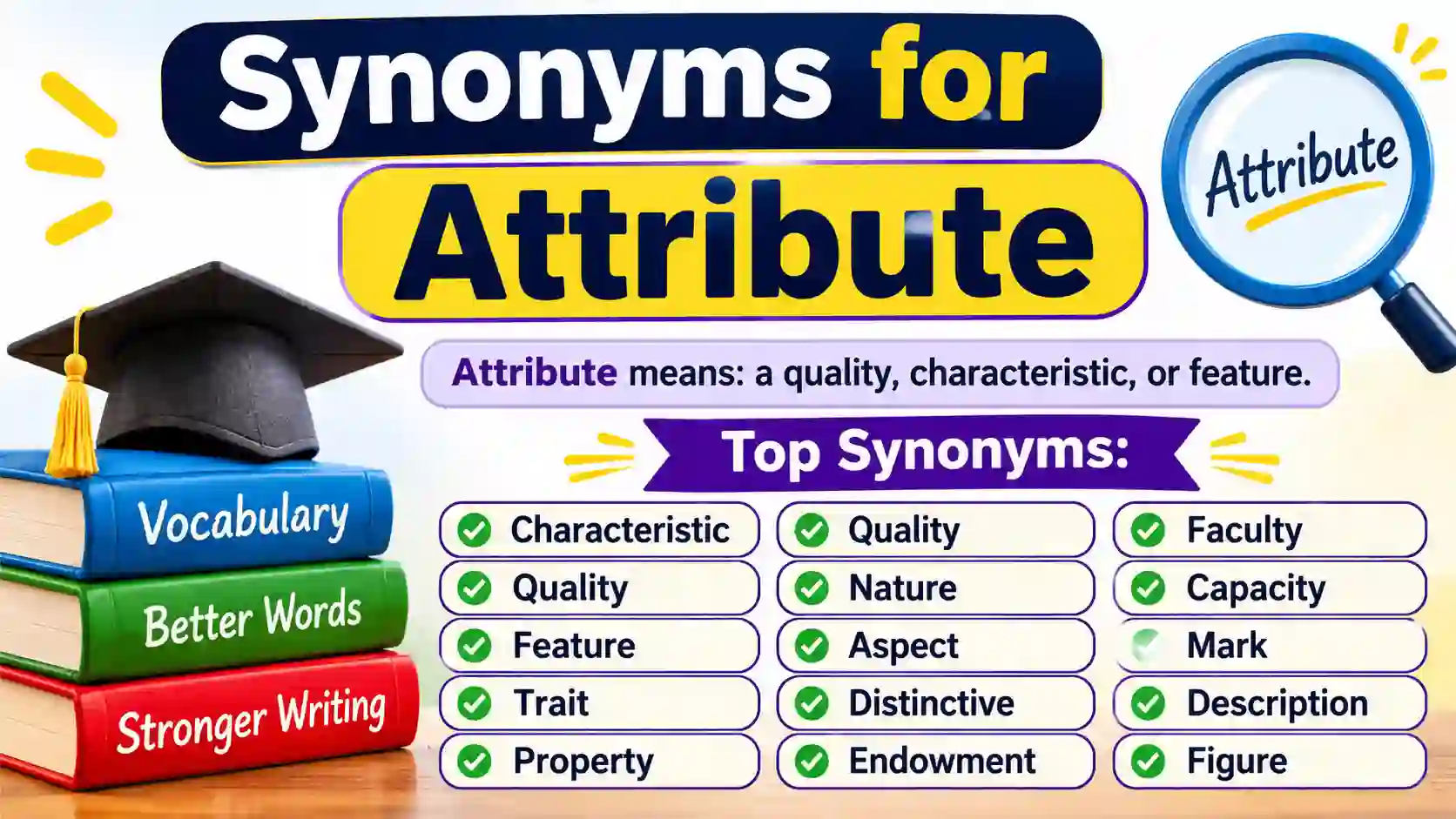
Synonyms for attribute include characteristic, quality, trait, feature, property, aspect, facet, virtue, and peculiarity. These words describe qualities or features belonging to a person, object, or idea. The best alternative depends on the context. For example, use traits for personality, features for products, and property for scientific descriptions.
Do you sometimes repeat the word attribute when describing someone’s personality, a product, or an important quality? English has many alternatives that can make your sentences clearer and more interesting.
An attribute is a quality or feature that belongs to someone or something. For example, patience is an important attribute of a good teacher. You could also call it a valuable quality or personal trait.
However, not every similar word has exactly the same meaning. A feature often describes a product, while a virtue describes a morally good quality. Understanding these differences helps you choose the right expression.
This guide explains 30 synonyms and related alternatives for attributes. You will learn their meanings, examples, pronunciation, grammar, and practical uses in everyday and professional English.
Attribute: Meaning and Pronunciation
Noun: /ˈæt.rɪ.bjuːt/
Pronounced: AT-ri-byoot.
Verb: /əˈtrɪb.juːt/
Pronounced: uh-TRIB-yoot.
Attribute as a noun
An attribute is a quality, characteristic, or feature that someone or something has.
Example: Honesty is an important attribute of a successful leader.
Attribute as a verb
To attribute means to consider something the result of a particular cause or to assign something to a person or source.
Example: Researchers attributed the improvement to better training.
Remember: The noun and verb have different stress patterns. The first syllable receives stress in the noun, while the second syllable receives stress in the verb.
Part of Speech and Word Family
| Word | Part of speech | Meaning |
| Attribute | Noun | A quality or feature |
| Attribute | Verb | To assign a cause, quality, or source |
| Attributed | Verb | Assigned or credited |
| Attributing | Verb | Assigning or crediting |
| Attribution | Noun | Assignment of credit or cause |
| Attributable | Adjective | Able to be explained by a cause |
| Attributive | Adjective | Performing a descriptive grammatical function |
Word Origin and Etymology
The word attribute comes from the Latin verb attribuere, meaning to assign, give, or allot. It combines the idea of directing something toward a recipient with the Latin verb tribuere, meaning to assign or give.
English adopted the word through historical French and Latin influences. Its verb sense appeared in English in the late 14th century. The noun developed from the idea of something assigned or belonging to a person or thing.
Historical dictionaries do not always give identical first-use dates. Etymonline records both the noun and verb in the late 14th century, while Oxford gives the noun’s origin as late 15th century. These differences reflect the historical records and definitions used by each reference.
American vs. British English
| Feature | American English | British English |
| Spelling | Attribute | Attribute |
| Noun IPA | /ˈæt.rɪ.bjuːt/ | /ˈæt.rɪ.bjuːt/ |
| Verb IPA | /əˈtrɪb.juːt/ | /əˈtrɪb.juːt/ |
| Noun meaning | Quality or feature | Quality or feature |
| Verb meaning | Assign a cause or source | Assign a cause or source |
There is no standard spelling difference between American and British English. Both use attribute, attributed, and attribution. Accent and individual pronunciation may vary.
30 Synonyms for Attribute With Examples
The following list separates close noun synonyms from alternatives that work only in certain contexts. This distinction is important because a thesaurus relationship does not always mean two words can replace each other.
1. Characteristic
Meaning: A characteristic is a quality that helps describe or identify someone or something.
Examples:
- Patience is a common characteristic of successful teachers.
- Bright colors are a characteristic of this design.
Best used when: You describe a typical or identifying feature.
- Register: Neutral, academic
- CEFR: B2 (estimated)
- Frequency: Very common
- Collocations: Distinctive characteristic, personal characteristic, defining characteristic.
- Nuance: Emphasizes what makes something recognizable.
- Avoid when: You want to describe the cause of an event.
2. Quality
Meaning: A quality is a feature that describes the nature of someone or something.
Examples:
- Kindness is an admirable quality in a friend.
- Durability is an important quality of this material.
Best used when: You describe a positive, negative, or neutral feature.
- Register: Neutral, professional
- CEFR: A2 (estimated)
- Frequency: Very common
- Collocations: Personal quality, admirable quality, essential quality.
- Nuance: Often positive, but not always.
- Avoid when: You need a precise technical measurement.
3. Trait
Meaning: A trait is a particular quality of someone’s personality or nature.
Examples:
- Confidence is a useful trait for a public speaker.
- Curiosity is a noticeable trait in young children.
Best used when: You discuss personality, behavior, or inherited characteristics.
- Register: Neutral, academic
- CEFR: B2 (estimated)
- Frequency: Very common
- Collocations: Personality trait, inherited trait, positive trait.
- Nuance: Often relates to an individual’s nature.
- Avoid when: You describe a product’s technical function.
4. Feature
Meaning: A feature is an important or noticeable part of something.
Examples:
- The phone’s best feature is its powerful camera.
- Natural light is an attractive feature of the house.
Best used when: You describe products, services, places, or noticeable parts.
- Register: Neutral, business
- CEFR: A2 (estimated)
- Frequency: Very common
- Collocations: Main feature, special feature, key feature.
- Nuance: Often refers to something visible or functional.
- Avoid when: You mean a person’s moral quality.
5. Property
Meaning: A property is a quality that something naturally or technically has.
Examples:
- Elasticity is an important property of rubber.
- Water has several unusual physical properties.
Best used when: You discuss science, materials, mathematics, or technical subjects.
- Register: Formal, academic, scientific
- CEFR: B2 (estimated)
- Frequency: Common
- Collocations: Physical property, chemical property, basic property.
- Nuance: Emphasizes an inherent or measurable quality.
- Avoid when: You want a casual description of someone’s personality.
6. Aspect
Meaning: An aspect is one part or side of a larger subject.
Examples:
- Creativity is an important aspect of her work.
- The report examines every aspect of the problem.
Best used when: You discuss one particular part of a larger idea.
- Register: Neutral, academic
- CEFR: B2 (estimated)
- Frequency: Very common
- Collocations: Important aspect, positive aspect, key aspect.
- Nuance: Focuses on one side rather than an entire quality.
- Avoid when: You need a specific personality description.
7. Facet
Meaning: A facet is one particular side of something complex.
Examples:
- Leadership is one facet of her professional life.
- The course explores every facet of digital marketing.
Best used when: You describe different sides of a complicated subject.
- Register: Formal, academic, literary
- CEFR: C1 (estimated)
- Frequency: Common
- Collocations: Different facets, many facets, important facets.
- Nuance: Suggests that something has several sides.
- Avoid when: A simple word such as part or feature is clearer.
8. Character
Meaning: Character can describe the qualities that make a person or place distinctive.
Examples:
- Honesty is an important part of his character.
- The old village has a unique character.
Best used when: You describe personality, moral nature, or a distinctive atmosphere.
- Register: Neutral, literary
- CEFR: B1 (estimated)
- Frequency: Very common
- Collocations: Strong character, personal character, distinctive character.
- Nuance: Often suggests someone’s moral nature or overall identity.
- Avoid when: You specifically mean a single technical feature.
9. Virtue
Meaning: A virtue is a morally good quality.
Examples:
- Honesty is a virtue that builds trust.
- Patience is one of her greatest virtues.
Best used when: You emphasize someone’s good behavior or moral values.
- Register: Formal, literary
- CEFR: B2 (estimated)
- Frequency: Common
- Collocations: Moral virtue, personal virtue, great virtue.
- Nuance: Strongly positive and ethical.
- Avoid when: You describe a neutral or undesirable quality.
10. Peculiarity
Meaning: A peculiarity is an unusual quality or feature.
Examples:
- One peculiarity of the building is its circular roof.
- His habit of arranging books by color is a harmless peculiarity.
Best used when: You describe something unusual or distinctive.
- Register: Neutral, literary
- CEFR: C1 (estimated)
- Frequency: Uncommon
- Collocations: Personal peculiarity, unusual peculiarity, local peculiarity.
- Nuance: Suggests something different from the ordinary.
- Avoid when: You describe a common or ordinary feature.
11. Quirk
Meaning: A quirk is an unusual personal habit or feature.
Examples:
- One of his quirks is collecting unusual coffee mugs.
- Her cheerful laugh is a charming quirk.
Best used when: You describe an unusual but often harmless personal habit.
- Register: Informal, spoken
- CEFR: B2 (estimated)
- Frequency: Common
- Collocations: Personal quirk, funny quirk, little quirk.
- Nuance: Often playful or affectionate.
- Avoid when: You need a formal description in academic writing.
12. Idiosyncrasy
Meaning: An idiosyncrasy is a special habit or quality that makes someone different.
Examples:
- His unusual way of organizing notes is a personal idiosyncrasy.
- The restaurant has several charming idiosyncrasies.
Best used when: You discuss distinctive personal habits or unusual features.
- Register: Formal, literary
- CEFR: C2 (estimated)
- Frequency: Uncommon
- Collocations: Personal idiosyncrasy, cultural idiosyncrasy, individual idiosyncrasy.
- Nuance: Emphasizes individuality and unusual behavior.
- Avoid when: A simple word such as habit or quirk is more appropriate.
13. Nature
Meaning: Nature describes the basic qualities or character of a person or thing.
Examples:
- Her gentle nature makes her a good caregiver.
- The natural strength of the material makes it suitable for construction.
Best used when: You discuss someone’s basic personality or the inherent character of something.
- Register: Neutral, literary
- CEFR: B1 (estimated)
- Frequency: Very common
- Collocations: Human nature, gentle nature, basic nature.
- Nuance: Often describes an overall disposition rather than one feature.
- Avoid when: You need to name one specific quality.
14. Makeup
Meaning: Makeup can describe the combination of qualities that form someone’s character or nature.
Examples:
- Curiosity is an important part of her psychological makeup.
- Experience has shaped the team’s professional makeup.
Best used when: You describe the combined qualities that form a person or group.
- Register: Neutral, academic
- CEFR: B2 (estimated)
- Frequency: Common
- Collocations: Psychological makeup, emotional makeup, personal makeup.
- Nuance: Focuses on a combination of characteristics.
- Avoid when: The sentence could be confused with cosmetics.
15. Disposition
Meaning: A disposition is someone’s usual mood or natural way of behaving.
Examples:
- Her friendly disposition makes visitors feel welcome.
- He has a calm disposition during difficult situations.
Best used when: You describe someone’s usual temperament or attitude.
- Register: Formal, literary
- CEFR: C1 (estimated)
- Frequency: Common
- Collocations: Cheerful disposition, natural disposition, calm disposition.
- Nuance: Focuses on a person’s usual emotional tendency.
- Avoid when: You mean a physical product feature.
16. Temperament
Meaning: Temperament is a person’s natural way of feeling and behaving.
Examples:
- Her patient temperament helps her manage difficult classes.
- The dog’s gentle temperament makes it suitable for family life.
Best used when: You discuss emotional nature and behavioral tendencies.
- Register: Neutral, academic
- CEFR: C1 (estimated)
- Frequency: Common
- Collocations: Calm temperament, gentle temperament, nervous temperament.
- Nuance: Often describes emotional reactions.
- Avoid when: You simply want to describe a learned skill.
17. Mark
Meaning: A mark is a noticeable sign of a particular quality.
Examples:
- Careful planning is a mark of an effective manager.
- The smooth finish is a mark of good craftsmanship.
Best used when: You want to show evidence of a particular quality.
- Register: Neutral, literary
- CEFR: A2 (estimated)
- Frequency: Very common
- Collocations: Mark of quality, mark of respect, distinguishing mark.
- Nuance: Often points to evidence rather than the quality itself.
- Avoid when: You need a direct name for a personality trait.
18. Sign
Meaning: A sign is something that shows or suggests a particular quality or condition.
Examples:
- Her willingness to listen is a sign of maturity.
- Helping others is often a sign of kindness.
Best used when: You describe evidence of a characteristic.
- Register: Neutral, spoken
- CEFR: A2 (estimated)
- Frequency: Very common
- Collocations: Sign of progress, sign of strength, clear sign.
- Nuance: Indicates something rather than naming it directly.
- Avoid when: You need to identify the quality itself.
19. Distinction
Meaning: A distinction is a difference that separates one person or thing from another.
Examples:
- The main distinction between the products is their durability.
- Her attention to detail gives her work a clear distinction.
Best used when: You compare qualities or emphasize differences.
- Register: Formal, academic
- CEFR: B2 (estimated)
- Frequency: Common
- Collocations: Clear distinction, important distinction, key distinction.
- Nuance: Emphasizes difference rather than an ordinary quality.
- Avoid when: You simply mean a positive personality trait.
20. Hallmark
Meaning: A hallmark is a special feature that makes someone or something recognizable.
Examples:
- Clear communication is a hallmark of effective leadership.
- Simple design is a hallmark of the company’s products.
Best used when: You describe a defining or recognizable quality.
- Register: Neutral, business, literary
- CEFR: C1 (estimated)
- Frequency: Common
- Collocations: Hallmark of quality, hallmark of success, defining hallmark.
- Nuance: Suggests a characteristic feature strongly associated with something.
- Avoid when: You describe a small or unimportant detail.
21. Speciality / Specialty
Meaning: A speciality or specialty is a particular feature or area that makes something distinctive; it can also mean a person’s special skill or area of expertise.
Examples:
- Fresh ingredients are a speciality of this restaurant.
- Customer research is her professional specialty.
Best used when: You describe a distinctive area of skill or a special offering.
- Register: Neutral, business
- CEFR: B2 (estimated)
- Frequency: Common
- Collocations: Local specialty, professional specialty, house specialty.
- Nuance: Often refers to expertise or a distinctive product.
- Avoid when: You mean an ordinary personality trait.
22. Individuality
Meaning: Individuality is the set of qualities that makes someone different from others.
Examples:
- Her creativity gives her work a strong sense of individuality.
- The designer wanted to preserve the building’s individuality.
Best used when: You emphasize uniqueness and personal identity.
- Register: Neutral, literary
- CEFR: B2 (estimated)
- Frequency: Common
- Collocations: Personal individuality, express individuality, sense of individuality.
- Nuance: Focuses on uniqueness rather than one isolated feature.
- Avoid when: You need to name a specific quality.
23. Capacity
Meaning: Capacity is the ability or potential to do or understand something.
Examples:
- Her capacity for learning makes her a strong student.
- The manager has a remarkable capacity for solving problems.
Best used when: The attribute describes someone’s ability or potential.
- Register: Formal, academic
- CEFR: B2 (estimated)
- Frequency: Very common
- Collocations: Mental capacity, learning capacity, capacity for growth.
- Nuance: Focuses on potential or ability.
- Avoid when: You describe a quality unrelated to ability.
24. Strength
Meaning: A strength is a positive quality or ability that gives someone an advantage.
Examples:
- Clear communication is one of her greatest strengths.
- The product’s main strength is its long battery life.
Best used when: You describe a beneficial quality.
- Register: Neutral, professional
- CEFR: A2 (estimated)
- Frequency: Very common
- Collocations: Personal strength, key strength, greatest strength.
- Nuance: Highlights an advantage.
- Avoid when: You describe a neutral or negative characteristic.
25. Asset
Meaning: An asset is a useful quality or ability that provides an advantage.
Examples:
- Her patience is a valuable asset in customer service.
- Strong writing skills are an asset for content creators.
Best used when: You discuss qualities that benefit a person or organization.
- Register: Business, professional
- CEFR: B2 (estimated)
- Frequency: Very common
- Collocations: Valuable asset, personal asset, greatest asset.
- Nuance: Emphasizes usefulness and value.
- Avoid when: You describe a feature that offers no particular advantage.
26. Ability
Meaning: An ability is the power or skill to do something.
Examples:
- Her ability to explain complex ideas makes her a good teacher.
- Problem-solving ability is useful in many careers.
Best used when: The attribute refers to a skill or capability.
- Register: Neutral, professional
- CEFR: A2 (estimated)
- Frequency: Very common
- Collocations: Natural ability, learning ability, problem-solving ability.
- Nuance: Focuses on what someone can do.
- Avoid when: You mean a personality quality unrelated to skill.
27. Talent
Meaning: Talent is a natural ability to do something well.
Examples:
- She has a talent for writing engaging stories.
- His musical talent became clear at an early age.
Best used when: You describe a natural or developed skill.
- Register: Neutral, positive
- CEFR: B1 (estimated)
- Frequency: Very common
- Collocations: Natural talent, artistic talent, special talent.
- Nuance: Usually expresses admiration.
- Avoid when: You mean a neutral physical feature.
28. Endowment
Meaning: An endowment is a natural quality or ability that someone possesses.
Examples:
- Her intellectual endowment helped her succeed in research.
- He has a natural endowment for creative thinking.
Best used when: You describe an inherent ability in formal writing.
- Register: Formal, academic
- CEFR: C2 (estimated)
- Frequency: Uncommon
- Collocations: Natural endowment, intellectual endowment, physical endowment.
- Nuance: Suggests an ability or quality someone naturally possesses.
- Avoid when: A simple word such as talent is clearer.
29. Faculty
Meaning: A faculty is a natural mental or physical ability.
Examples:
- Her ability to remember names impressed her colleagues.
- The injury affected some of his physical faculties.
Best used when: You discuss mental powers, senses, or physical abilities.
- Register: Formal, academic
- CEFR: C1 (estimated)
- Frequency: Common
- Collocations: Mental faculty, physical faculty, intellectual faculty.
- Nuance: Often sounds technical or formal.
- Avoid when: You mean a university’s teaching staff.
30. Merit
Meaning: A merit is a good quality or advantage of something.
Examples:
- One merit of the proposal is its low cost.
- The plan has several merits worth considering.
Best used when: You evaluate the positive qualities of an idea, decision, or plan.
- Register: Formal, academic
- CEFR: B2 (estimated)
- Frequency: Common
- Collocations: Main merit, particular merit, considerable merit.
- Nuance: Emphasizes a quality that makes something worthwhile.
- Avoid when: You simply mean someone’s personality trait.
Synonyms for Attribute as a Verb
The noun and verb have different meanings. The following alternatives are useful when attribute means to assign a cause, source, quality, or responsibility.
| Verb | Meaning | Example |
| Ascribe | Assign a cause or quality | She ascribed her success to hard work. |
| Credit | Recognize someone or something as responsible for a result | They credited the team for the improvement. |
| Assign | Give responsibility or identify a source | The report assigned responsibility to the department. |
| Impute | Attribute a cause or responsibility, often negatively | The investigation imputed the error to poor planning. |
| Trace | Identify the source or origin | Scientists traced the problem to a faulty component. |
| Associate | Connect one thing with another | People associate green with nature. |
| Connect | Link an outcome to a cause | Researchers connected the change to new policies. |
| Blame | Hold someone or something responsible for a bad result | They blamed the delay on bad weather. |
| Attribute to | Assign a result to a cause | She attributed her progress to daily practice. |
| Charge | Accuse or assign responsibility | The report blamed the failure on poor management. |
Important distinction: These words are not interchangeable. Credit often recognizes a positive contribution, blame identifies responsibility for something negative, and impute can suggest an unfavorable judgment.
Quick Synonym Comparison: Which Word Should You Choose?
| Your intended meaning | Best word | Example |
| Personality quality | Trait | Patience is a useful trait. |
| General quality | Quality | Honesty is a valuable quality. |
| Product detail | Feature | The camera is a useful feature. |
| Scientific quality | Property | Density is a physical property. |
| Part of a subject | Aspect | Cost is one aspect of the plan. |
| Moral goodness | Virtue | Fairness is a virtue. |
| Unusual habit | Quirk | His sense of humor is a quirk. |
| Natural potential | Capacity | She has a capacity for learning. |
| Defining feature | Hallmark | Accuracy is a hallmark of good research. |
| Positive advantage | Strength | Communication is her strength. |
Strongest Synonyms, Strong Synonyms, and Related Words
Strongest Synonyms
These are usually the most natural alternatives for the general noun meaning:
- Characteristic
- Quality
- Trait
- Feature
- Property
- Aspect
- Facet
- Character
- Virtue
Strong Synonyms
These fit more specific descriptions:
- Peculiarity
- Quirk
- Idiosyncrasy
- Nature
- Makeup
- Disposition
- Temperament
- Mark
- Hallmark
- Individuality
Related or Context Dependent Words
These are not exact replacements in every sentence:
- Speciality
- Capacity
- Strength
- Asset
- Ability
- Talent
- Endowment
- Faculty
- Merit
- Distinction
Commonly Confused Words
| Word | Difference | Example |
| Attribute | A quality or feature belonging to something | Honesty is an important attribute. |
| Attitude | A person’s way of thinking or feeling | She has a positive attitude. |
| Ability | The power or skill to do something | He has the ability to lead. |
| Behavior | The way someone acts | Her behavior was respectful. |
| Appearance | The way someone or something looks | The building has a modern appearance. |
Common Grammar Mistakes
Mistake 1: Using a verb as a noun
Incorrect: Honesty is an important attribute of a leader.
Correct: Honesty is an important attribute of a leader.
Explanation: Ascribe is a verb. Use attribute, quality, or trait as a noun.
Mistake 2: Confusing attribute with attitude
Incorrect: Patience is a positive attitude of a teacher.
Correct: Patience is a positive attribute of a teacher.
Explanation: Patience describes a quality, while attitude describes a way of thinking or feeling.
Mistake 3: Missing the preposition
Incorrect: She attributed her success to hard work.
Correct: She attributed her success to hard work.
Explanation: Use the pattern to attribute something to something.
Mistake 4: Using virtue for a negative quality
Incorrect: Laziness is his greatest virtue.
Correct: Laziness is his most noticeable trait.
Explanation: Virtue normally refers to a morally good quality.
Mistake 5: Using trait for a product feature
Incorrect: The phone’s best personality trait is its camera.
Correct: The phone’s best feature is its camera.
Explanation: Trait normally describes a person or living thing. Feature is more natural for products.
How to Use Attribute Synonyms in Different Types of Writing
Academic Essays
Use characteristic, property, aspect, and facet when explaining a subject.
Example:
Original: Flexibility is an important attribute of modern materials.
Improved: Flexibility is an important property of modern materials.
Professional Emails
Use quality, strength, ability, and asset to describe professional skills.
Example:
Original: Your attention to detail is an excellent attribute.
Improved: Your attention to detail is a valuable professional strength.
Blog Posts
Use familiar words such as feature, quality, and characteristic.
Example:
Original: One important attribute of a good website is speed.
Improved: One important feature of a good website is fast loading.
Stories
Use trait, quirk, disposition, and peculiarity to describe characters.
Example:
Original: His most interesting attribute was his unusual humor.
Improved: His funniest quirk was his unusual sense of humor.
Social Media and Conversations
Choose short, natural expressions:
- Her best quality is kindness.
- Confidence is his greatest strength.
- Creativity is her special talent.
- Patience is an important trait.
Writing tip: Never change a word simply to avoid repetition. Choose a replacement that preserves the original meaning.
Antonyms of Attribute
There is no single perfect antonym for every meaning of attribute. However, some words express the opposite of a positive quality in particular contexts.
| Antonym or opposite | Meaning | Example |
| Defect | A fault | The product has a manufacturing defect. |
| Flaw | An imperfection | The design has a small flaw. |
| Shortcoming | A weakness or limitation | Poor planning is a major shortcoming. |
| Deficiency | A lack of something needed | The report shows a deficiency in evidence. |
| Weakness | A lack of strength or ability | Time management is his main weakness. |
| Disadvantage | A feature that creates difficulty | High cost is a disadvantage. |
For the verb attribute, words such as disconnect and disassociate may express an opposing idea in particular sentences.
Related Expressions
- Personal attributes
- Defining characteristic
- Positive personality trait
- Distinctive feature
- Key strength
- Natural ability
- Inherent property
- Essential quality
- Hallmark of success
- Sign of maturity
Frequently Asked Questions
1. What are the 10 best synonyms for attributes?
The 10 useful alternatives are characteristic, quality, trait, feature, property, aspect, facet, character, virtue, and peculiarity. These words describe different kinds of qualities and features. The best choice depends on your sentence, subject, and intended meaning.
2. What is another word for an attribute in a sentence?
You can use characteristic, quality, trait, or feature, depending on the context. For example, “Patience is an important attribute of a teacher” can become “Patience is an important quality of a teacher.” Both sentences communicate nearly the same idea.
3. What are positive synonyms for attributes?
Positive alternatives include virtue, strength, asset, quality, talent, and gift. These words highlight desirable qualities or abilities. For example, you could say, “Honesty is one of her greatest virtues” instead of “Honesty is one of her best attributes.”
4. What is the difference between attribute and characteristic?
An attribute is a quality or feature belonging to a person or thing. A characteristic is a quality that helps describe or identify it. The words often overlap, but characteristic is especially useful when explaining what makes something typical or distinctive.
5. What is the difference between attribute and trait?
A trait usually describes personality, behavior, or an inherited feature. An attribute has a broader meaning and can describe people, products, materials, and ideas. For example, patience is a personality trait, while durability is a product attribute.
6. What are academic synonyms for attributes?
Useful academic alternatives include characteristic, property, aspect, facet, dimension, and quality. Use property for scientific descriptions, aspect for one part of a topic, and characteristic for an identifying feature. Choose the word that expresses your intended meaning most accurately.
7. What does an attribute mean as a verb?
As a verb, attribute means to assign a cause, source, or responsibility to someone or something. For example, “Researchers attributed the improvement to regular practice.” Common alternatives include ascribe, credit, impute, and trace, although their meanings differ slightly.
8. Is the attribute positive or negative?
Attribute is generally neutral. It can describe positive qualities such as patience and honesty, or neutral features such as size and color. The surrounding words determine the feeling. For example, “valuable attribute” is positive, while “negative attribute” describes an undesirable quality.
Vocabulary Quiz: Test Your Knowledge
Choose the correct answer for each question.
1. Which word is closest to an attribute when describing someone’s personality?
A. Furniture
B. Trait
C. Location
D. Measurement
2. Which synonym is most suitable for a product’s special function?
A. Virtue
B. Quirk
C. Feature
D. Faculty
3. Which word describes a morally good quality?
A. Defect
B. Virtue
C. Flaw
D. Peculiarity
4. Complete the sentence: She attributed her success ___ hard work.
A. At
B. For
C. With
D. To
5. Which word means an unusual personal habit?
A. Property
B. Quirk
C. Dimension
D. Merit
Answer Key
- B. Trait
- C. Feature
- B. Virtue
- D. To
- B. Quirk
Conclusion
Learning synonyms for attributes helps you communicate with greater clarity and confidence. Words such as characteristic, quality, trait, feature, and property make your writing more precise.
Always consider the meaning and context before choosing an alternative. Practice these words in emails, essays, schoolwork, blog posts, and conversations. Keep building your vocabulary, one useful word at a time.
References
- Cambridge Dictionary: Attribute and its synonyms.
- Oxford Learner’s Dictionaries: Attribute nouns and collocations.
- Thesaurus.com: Attribute synonyms and antonyms.
- Dictionary.com: Attribute definition, pronunciation, and word history.
- Etymonline: Attribute etymology and historical development.

Synonorm is a trusted English vocabulary resource created to help readers find the right words and understand the differences between similar terms. We provide clear explanations of synonyms, meanings, examples, usage, and alternatives. Our content makes vocabulary easier to learn and apply in everyday, academic, and professional English. Synonorm is designed for students, writers, ESL learners, professionals, and anyone who wants to improve their English vocabulary and communicate more clearly.