Quick Answer: What Are the Synonyms of Hence?
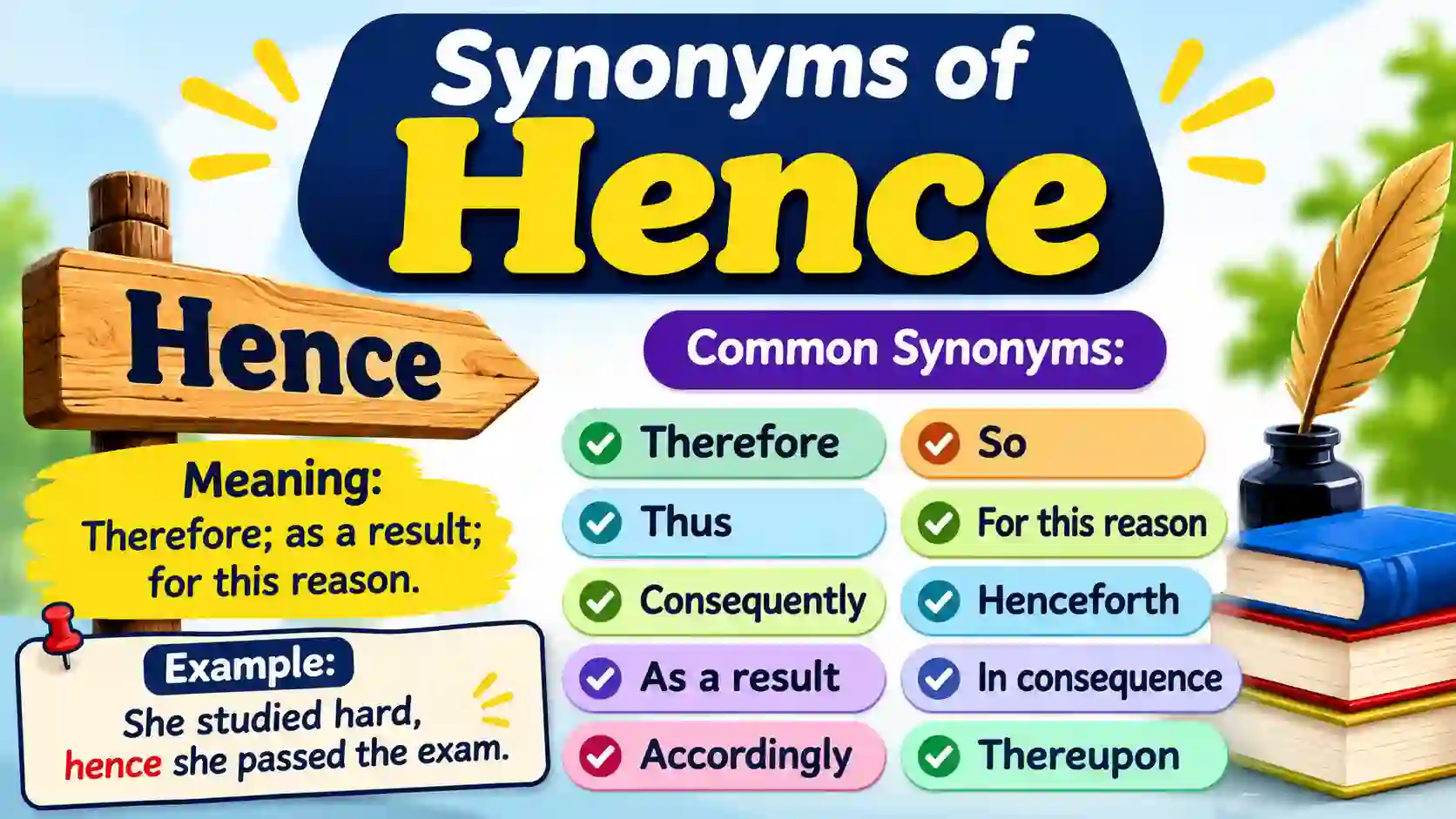
The best synonyms of hence include therefore, thus, consequently, accordingly, so, as a result, and for this reason. These words help explain why something happens or what follows from a fact. Some alternatives are formal, while others suit everyday conversations. The right choice depends on the meaning and context of your sentence.
Have you ever written the word hence several times in an essay or professional email? Finding another word can make your writing sound clearer and more natural.
Hence is a formal English adverb. Writers use it to explain a result, give a reason, or refer to a point in the future. For example, “The road was flooded; hence, the delay” explains why the delay happened.
However, not every alternative works in every sentence. Therefore, understanding the differences between synonyms of hence is important for students, teachers, bloggers, and professional writers.
This guide covers 30 alternatives, their meanings, original examples, pronunciation, usage, collocations, and common mistakes. You will also learn which expressions work best in academic writing, business emails, and daily conversations.
Pronunciation of Hence
- IPA: /hens/
- Pronunciation: HENSS
- Syllables: One
- Part of speech: Adverb
- Stress: Single syllable
The word rhymes with tense, sense, and dense.
Meaning and Parts of Speech
Hence is an adverb with three main meanings.
- For this reason: It introduces a result or conclusion.
- From this time: It refers to a future point.
- From this place: It means away from here, mainly in historical or literary English.
Examples:
- Result: The evidence was incomplete; hence, the investigation continued.
- Future time: The new office will open three months hence.
- Place: The travelers went hence. (Archaic use.)
Hence does not have commonly used noun, verb, or adjective forms in modern standard English.
Grammar: How to Use Hence
1. Hence + Noun Phrase
Use this pattern when you want to introduce a result without writing a complete second clause.
- The road was closed, hence the delay.
- The machine was damaged, hence the repair costs.
2. Hence Between Two Clauses
Use a semicolon before hence when it connects two independent clauses.
- The weather was terrible; hence, the event was canceled.
- The information was incorrect; hence, the report needed revision.
3. Hence in Future-Time Expressions
Place hence after a time expression.
- The results will arrive in two weeks.
- The agreement may expire several years hence.
Common Grammar Mistakes
Incorrect: Because hence the shop was closed, we returned home.
Correct: The shop was closed; hence, we returned home.
Incorrect: He was tired, hence he went to bed.
Better: He was tired; hence, he went to bed.
More natural: He was tired, so he went to bed.
Remember that punctuation depends on sentence structure. Hence can also introduce a noun phrase directly.
Quick Comparison: Synonyms of Hence
| Synonym | Meaning | Strength | Register |
| Therefore | For that reason | Strong | Formal |
| Thus | As a result | Strong | Academic |
| Consequently | As an effect | Strong | Formal |
| Accordingly | In response to a situation | Strong | Business |
| So | For that reason | Strong | Spoken |
| As a result | An outcome follows | Strong | Neutral |
| For this reason | Because of this fact | Strong | Neutral |
| As a consequence | As an effect | Strong | Formal |
| In consequence | As an effect | Related | Formal |
| Because of this | Due to this | Strong | Neutral |
| For that reason | Because of that | Strong | Neutral |
| Ergo | Therefore | Related | Literary |
| Wherefore | For which reason | Related | Literary |
| Then | In that case | Related | Neutral |
| Thereby | By that action | Related | Formal |
| In turn | As a further result | Related | Academic |
| It follows that | A logical conclusion | Strong | Academic |
| This means that | This indicates | Related | Neutral |
| That is why | For that reason | Strong | Spoken |
| For which reason | Because of which | Strong | Formal |
| On that account | For that reason | Related | Formal |
| On these grounds | Based on these reasons | Related | Academic |
| In view of this | Considering this | Related | Business |
| Given this | Considering this fact | Related | Neutral |
| As such | In that capacity | Related | Formal |
| Subsequently | At a later time | Related | Formal |
| Thereafter | After that event | Related | Formal |
| After that | Following that event | Related | Neutral |
| Later | At a future time | Related | Neutral |
| Henceforth | From now on | Related | Formal |
Important: The final eight or so expressions include related alternatives, not direct replacements in every sentence. Context determines whether they are suitable.
30 Synonyms of Hence With Examples and Explanations
1. Therefore
Meaning: Therefore means for that reason or because of something already stated.
Examples:
- The roads were icy; therefore, drivers moved slowly.
- She completed the training; therefore, she qualified for the job.
Best Used When: You want to introduce a clear conclusion.
Tone: Formal, academic.
CEFR: B1–B2 | Frequency: Very common.
Common Collocations: therefore necessary, therefore important, and therefore responsible.
Connotation: Logical and direct.
When Not to Use: Avoid it when you simply want to describe an event happening later.
2. Thus
Meaning: Thus means as a result or in this way.
Examples:
- The team improved its process, thus reducing costs.
- He saved regularly and thus reached his financial goal.
Best Used When: You want to connect an action with its outcome.
Tone: Formal, academic.
CEFR: B2 | Frequency: Common.
Common Collocations: thus improving, thus reducing, and thus creating.
Connotation: Concise and logical.
When Not to Use: Do not use it when a simple time sequence is your intended meaning.
3. Consequently
Meaning: Consequently means as an effect of something.
Examples:
- The factory reduced production; consequently, fewer products reached stores.
- Heavy rainfall damaged the bridge, consequently delaying traffic.
Best Used When: You want to emphasize an important result.
Tone: Formal, academic, business.
CEFR: B2 | Frequency: Common.
Common Collocations: consequently affected, consequently increased, and consequently reduced.
Connotation: Often emphasizes a noticeable outcome.
When Not to Use: Avoid it when there is no clear cause-and-effect connection.
4. Accordingly
Meaning: Accordingly means in a way that suits a situation or follows from it.
Examples:
- The company changed its policy and adjusted its plans accordingly.
- The budget was reduced; accordingly, the team selected cheaper materials.
Best Used When: You are describing an appropriate response to new information.
Tone: Formal, business.
CEFR: B2–C1 | Frequency: Common.
Common Collocations: act accordingly, adjust accordingly, and proceed accordingly.
Connotation: Suggests a suitable response.
When Not to Use: Do not replace every occurrence of therefore with accordingly.
5. So
Meaning: So means for that reason or as a result.
Examples:
- I missed the bus, so I walked home.
- The store was crowded, so we returned later.
Best Used When: You want a simple alternative for everyday speaking and writing.
Tone: Informal, conversational.
CEFR: A1–A2 | Frequency: Very common.
Common Collocations: so tired, so busy, and so important.
Connotation: Friendly and natural.
When Not to Use: Avoid overusing so in formal academic writing.
6. As a Result
Meaning: This phrase introduces the outcome of an event.
Examples:
- The power failed. As a result, the computers stopped working.
- He practiced speaking daily. As a result, his confidence improved.
Best Used When: You want to explain cause and effect clearly.
Tone: Neutral, academic.
CEFR: B1 | Frequency: Very common.
Common Collocations: as a direct result, as a positive result, and as a result of.
Connotation: Clear and easy to understand.
When Not to Use: Avoid it when the second event has no connection to the first.
7. For This Reason
Meaning: It means because of the fact just mentioned.
Examples:
- The building needs repairs. For this reason, visitors cannot enter.
- She enjoys helping children. For this reason, she became a teacher.
Best Used When: You want to explain a decision or action.
Tone: Neutral, formal.
CEFR: A2–B1 | Frequency: Very common.
Common Collocations: important for this reason, chosen for this reason, and for this reason alone.
Connotation: Direct and explanatory.
When Not to Use: Avoid it if you have not already introduced a clear reason.
8. As a Consequence
Meaning: It means something happens because of an earlier event.
Examples:
- The company ignored customer complaints. As a consequence, its reputation suffered.
- The river dried up. As a consequence, nearby farms lost water.
Best Used When: You want to highlight an important effect.
Tone: Formal, academic.
CEFR: B2 | Frequency: Common.
Common Collocations: serious consequence, direct consequence, and unintended consequence.
Connotation: Can suggest a serious or negative outcome.
When Not to Use: Do not use it for an unrelated event.
9. In Consequence
Meaning: In consequence means as an effect of something.
Examples:
- The instructions were unclear; in consequence, several errors occurred.
- The company changed its strategy and, in consequence, gained new customers.
Best Used When: You need a formal expression for cause and effect.
Tone: Formal, literary.
CEFR: C1 | Frequency: Uncommon.
Common Collocations: in consequence of, serious consequences, and direct consequence.
Connotation: Formal and slightly old-fashioned.
When Not to Use: Choose as a result in most everyday writing.
10. Because of This
Meaning: It explains that one event caused another.
Examples:
- The internet connection failed. Because of this, the meeting stopped.
- She forgot her password. Because of this, she could not open her account.
Best Used When: You want a simple explanation of cause and effect.
Tone: Neutral, conversational.
CEFR: A2 | Frequency: Very common.
Common Collocations: because of this problem, because of this change, and because of this decision.
Connotation: Clear and direct.
When Not to Use: Avoid repeating because of this several times in the same paragraph.
11. For That Reason
Meaning: It means because of a previously mentioned fact.
Examples:
- The road was unsafe. For that reason, the driver chose another route.
- He values honesty. For that reason, his colleagues trust him.
Best Used When: You want to refer back to an earlier explanation.
Tone: Neutral, formal.
CEFR: A2–B1 | Frequency: Very common.
Common Collocations: for that reason alone, selected for that reason, and important for that reason.
Connotation: Direct and explanatory.
When Not to Use: Do not use it when introducing a completely unrelated idea.
12. Ergo
Meaning: Ergo means therefore or as a logical conclusion.
Examples:
- All birds have feathers; ergo, this animal is not a bird.
- The figures do not match; ergo, the calculation needs checking.
Best Used When: You want a deliberately formal, literary, or playful logical conclusion.
Tone: Literary, academic.
CEFR: C2 | Frequency: Rare.
Common Collocations: ergo necessary, ergo valid, and ergo impossible.
Connotation: Intellectual and sometimes humorous.
When Not to Use: Avoid it in ordinary emails and everyday conversations.
13. Wherefore
Meaning: Wherefore means for which reason or why.
Examples:
- The agreement was broken, wherefore the partnership ended.
- The evidence was incomplete, therefore the decision was delayed.
Best Used When: You are writing in an old-fashioned or literary style.
Tone: Archaic, literary.
CEFR: C2 | Frequency: Rare.
Common Collocations: wherefore art thou, the reason wherefore, and wherefore it follows.
Connotation: Historical and dramatic.
When Not to Use: Do not use it as a normal replacement for therefore.
14. Then
Meaning: Then can mean in that case or at that point.
Examples:
- If the shop is closed, then we will return tomorrow.
- You have finished the assignment; then you can relax.
Best Used When: You are describing a logical next step or condition.
Tone: Neutral, spoken.
CEFR: A1 | Frequency: Very common.
Common Collocations: and then, since then, and back then.
Connotation: Often indicates time or sequence.
When Not to Use: Avoid it when you need to emphasize a strong causal relationship.
15. Thereby
Meaning: Thereby means by that action or method.
Examples:
- She improved the website, thereby attracting more customers.
- The company reduced waste, thereby lowering its operating costs.
Best Used When: You want to explain how an action produces an outcome.
Tone: Formal, academic, business.
CEFR: C1 | Frequency: Common.
Common Collocations: thereby improving, thereby reducing, and thereby creating.
Connotation: Emphasizes the method behind a result.
When Not to Use: Do not use it as a direct substitute for therefore in every sentence.
16. In Turn
Meaning: In turn means as a result of something else or as part of a sequence.
Examples:
- Better training improved performance, which in turn increased sales.
- More sunlight helped the plants grow, which in turn attracted insects.
Best Used When: You want to explain a chain of connected results.
Tone: Neutral, academic.
CEFR: B2 | Frequency: Common.
Common Collocations: which in turn, in turn affect, and in turn lead to.
Connotation: Shows connected stages of an outcome.
When Not to Use: Avoid it when there is only a simple unrelated sequence.
17. It Follows That
Meaning: It means a conclusion logically comes from earlier information.
Examples:
- All members must register; it follows that visitors need permission.
- The figures are incorrect; it follows that the report needs revision.
Best Used When: You are explaining a logical conclusion.
Tone: Formal, academic.
CEFR: C1 | Frequency: Common in academic writing.
Common Collocations: it logically follows, it follows from this, and it follows that.
Connotation: Reasoned and analytical.
When Not to Use: Avoid it when the connection is based on opinion rather than evidence.
18. This Means That
Meaning: This phrase explains what a fact or situation indicates.
Examples:
- The train is delayed. This means that we may arrive late.
- The price has increased. This means that customers must pay more.
Best Used When: You want to explain an implication in simple English.
Tone: Neutral, educational.
CEFR: A2 | Frequency: Very common.
Common Collocations: this means that, which means that, and what this means.
Connotation: Helpful and explanatory.
When Not to Use: Do not use it when you are only describing the time of an event.
19. That Is Why
Meaning: It explains the reason behind an action or situation.
Examples:
- She practices every morning. That is why she plays well.
- The roads are icy. That is why the buses are late.
Best Used When: You want a natural expression for conversation.
Tone: Neutral, spoken.
CEFR: A2 | Frequency: Very common.
Common Collocations: that is why I, that is why we, and that is why it matters.
Connotation: Friendly and conversational.
When Not to Use: Avoid it in highly formal reports when a more precise expression is better.
20. For Which Reason
Meaning: It means because of the reason already explained.
Examples:
- The building was unsafe, for which reason it was closed.
- The figures were incomplete, for which reason the team requested an update.
Best Used When: You need to connect information in formal writing.
Tone: Formal, academic.
CEFR: C1 | Frequency: Uncommon.
Common Collocations: for which reason, the main reason, and for this very reason.
Connotation: Precise but sometimes wordy.
When Not to Use: Choose therefore when a shorter sentence would be clearer.
21. On That Account
Meaning: It means for that reason or considering that fact.
Examples:
- The offer was expensive; on that account, we rejected it.
- She had little experience, but we did not judge her on that account.
Best Used When: You want to refer to a particular reason or factor.
Tone: Formal, literary.
CEFR: C1–C2 | Frequency: Uncommon.
Common Collocations: on that account, take into account, and on this account.
Connotation: Formal and sometimes old-fashioned.
When Not to Use: Do not confuse it with taking something into account, which means consider something.
22. On These Grounds
Meaning: It means based on the reasons or evidence already presented.
Examples:
- The application failed to meet the rules; on these grounds, it was rejected.
- The evidence was insufficient. On these grounds, the decision was challenged.
Best Used When: You explain a decision based on evidence or principles.
Tone: Formal, legal, academic.
CEFR: C1 | Frequency: Uncommon.
Common Collocations: legal grounds, reasonable grounds, and on these grounds.
Connotation: Strongly connected to justification.
When Not to Use: Avoid it for ordinary results without a supporting argument.
23. In View of This
Meaning: It means considering the information or situation already mentioned.
Examples:
- Several workers requested training. In view of this, management arranged a workshop.
- The weather forecast looks dangerous. In view of this, the event was postponed.
Best Used When: You are explaining a decision made after considering facts.
Tone: Formal, business.
CEFR: B2–C1 | Frequency: Common.
Common Collocations: in view of recent events, in view of the evidence, and in view of this decision.
Connotation: Careful and considered.
When Not to Use: Avoid it when you want to express a simple direct consequence.
24. Given This
Meaning: Given this means considering the information already available.
Examples:
- Given this information, we should change our approach.
- Given this result, the researchers decided to repeat the experiment.
Best Used When: You introduce a conclusion based on known facts.
Tone: Neutral, academic, business.
CEFR: B2 | Frequency: Common.
Common Collocations: given this information, given these results, and given this situation.
Connotation: Analytical and practical.
When Not to Use: Avoid it when no supporting information has been provided.
25. As Such
Meaning: As such means in that capacity or in the sense just described.
Examples:
- She is the project manager and, as such, must approve the final plan.
- The document is an official record and, as such, requires careful handling.
Best Used When: You explain what follows from someone’s role or the nature of something.
Tone: Formal, business.
CEFR: C1 | Frequency: Common.
Common Collocations: treated as such, recognized as such, and regarded as such.
Connotation: Defines a role or category.
When Not to Use: Do not use it as a universal substitute for therefore.
26. Subsequently
Meaning: Subsequently means after something else has happened.
Examples:
- The company opened a new office and subsequently hired more employees.
- The patient received treatment and subsequently recovered.
Best Used When: You want to describe an event that happened later.
Tone: Formal, academic.
CEFR: B2 | Frequency: Common.
Common Collocations: subsequently developed, subsequently discovered, and subsequently changed.
Connotation: Neutral and chronological.
When Not to Use: Avoid it when you need to show that one event caused another.
27. Thereafter
Meaning: Thereafter means after that event or time.
Examples:
- The agreement was signed. Thereafter, both companies began working together.
- She completed her degree and thereafter started a new career.
Best Used When: You describe a formal sequence of events.
Tone: Formal, literary.
CEFR: C1 | Frequency: Common.
Common Collocations: shortly thereafter, immediately thereafter, and thereafter continued.
Connotation: Formal and chronological.
When Not to Use: Avoid it in casual conversation when after that sounds more natural.
28. After That
Meaning: After that means following a particular event or time.
Examples:
- We finished dinner. After that, we watched a movie.
- He submitted his application. After that, he waited for a reply.
Best Used When: You describe events in everyday language.
Tone: Neutral, conversational.
CEFR: A1–A2 | Frequency: Very common.
Common Collocations: soon after that, immediately after that, and shortly after that.
Connotation: Simple and chronological.
When Not to Use: Avoid it when you need to express a direct logical conclusion.
29. Later
Meaning: Later means at a time after the present or a previously mentioned event.
Examples:
- We will discuss the proposal later.
- She moved to another city three years later.
Best Used When: You want to refer to a future or subsequent time.
Tone: Neutral, spoken.
CEFR: A1 | Frequency: Very common.
Common Collocations: later today, much later, and sooner or later.
Connotation: Simple and time-focused.
When Not to Use: Do not replace hence with later when hence means therefore.
30. Henceforth
Meaning: Henceforth means from this time forward.
Examples:
- Henceforth, all employees must follow the updated policy.
- The new rules will apply henceforth.
Best Used When: You introduce a rule or situation that starts now and continues into the future.
Tone: Formal, legal, literary.
CEFR: C1–C2 | Frequency: Uncommon.
Common Collocations: henceforth known as, henceforth required, and henceforth prohibited.
Connotation: Official and future-focused.
When Not to Use: Never use it to mean consequently or as a result.
Choose the Right Synonym: Side by Side Comparisons
| Expression | Main purpose | Example |
| Hence | Shows a reason | It was raining; hence the delay. |
| Therefore | Gives a logical conclusion | It was raining; therefore, we stayed inside. |
| Thus | Shows a resulting action | She practiced, thus improving her skills. |
| Consequently | Emphasizes an outcome | Costs increased; consequently, profits fell. |
| So | Gives a conversational result | It was raining, so we stayed home. |
| As a result | Clearly explains an outcome | It rained. As a result, the match stopped. |
| Subsequently | Shows what happened later | It rained and subsequently flooded the road. |
| Henceforth | Shows a change from now on | Henceforth, visitors need permission. |
Which Synonym Should You Choose?
- For academic essays: therefore, thus, consequently.
- For business reports: accordingly, consequently, in view of this.
- For everyday speaking: so, that’s why.
- For simple explanations: as a result, because of this.
- For chronological writing: subsequently, thereafter, after that.
- For logical arguments: therefore, it follows that.
Strongest Synonyms, Strong Synonyms, and Related Words
Strongest Synonyms
These are suitable for the main cause-and-effect meaning:
- Therefore
- Thus
- Consequently
- So
- As a result
- For this reason
- As a consequence
- Because of this
- For that reason
- Accordingly
Strong Synonyms
These work in particular contexts:
- In consequence
- It follows that
- That is why
- For which reason
- In view of this
- Given this
- On that account
- On these grounds
Related Words
These have a connection with other meanings of hence:
- Ergo
- Wherefore
- Then
- Thereby
- In turn
- As such
- Subsequently
- Thereafter
- After that
- Later
- Henceforth
Word Origin: Where Does Hence Come From?
Hence has a long history in English.
It comes from Middle English hennes, which originally meant “from here.” Its older root comes from Old English heonan, a word connected with the meaning “from here” or “away from here.”
The spelling later changed to hence, with the final spelling helping represent the unvoiced /s/ sound.
According to historical dictionary records, the word appears in English around 1225–1275.
Its meaning developed over time:
- Earlier use: From here or away from this place.
- Later use: From this time onward.
- Modern use: For this reason or as a result.
This history explains why hence can refer to both a reason and a future point.
American vs. British English
There is no meaningful spelling difference between American and British English.
| Feature | American English | British English |
| Spelling | Hence | Hence |
| Pronunciation | /hens/ | /hens/ |
| Syllables | One | One |
| Main meaning | For this reason | For this reason |
| Formality | Formal | Formal |
| Common alternative | Therefore, so | Therefore, so |
Both varieties are used hence in academic and professional writing.
In everyday conversations, speakers in both countries often prefer so, that’s why, and therefore.
CEFR Levels: Which Alternatives Should You Learn?
CEFR levels provide a general guide to vocabulary difficulty.
| Level | Useful alternatives |
| A1–A2 | So, then, later, after that |
| B1 | Therefore, as a result, for this reason |
| B2 | Thus, consequently, accordingly, subsequently |
| C1 | Thereby, henceforth, in view of this |
| C2 / Advanced | Ergo, wherefore |
These levels are approximate learning guidance rather than official classifications for every expression.
Commonly Confused Words
| Word | Main difference | Example |
| Hence | Gives a reason or future time | The road was closed; hence the delay. |
| Therefore | Introduces a conclusion | The road was closed; therefore, we waited. |
| Because | Introduces a cause | We waited because the road was closed. |
| Since | Means because or from a starting time | Since it was raining, we stayed home. |
| Thus | Shows a result or method | She saved money, thus avoiding debt. |
Remember:
- Hence = for this reason.
- Because = for the reason that.
- Since = because or from a particular time.
- Therefore = as a logical conclusion.
- Thus = in this way or as a result.
Common Mistakes When Using Hence
Mistake 1
Incorrect: Because hence the road was closed, we stayed home.
Correction: The road was closed; hence, we stayed home.
Explanation: Avoid combining because and hence in this construction.
Mistake 2
Incorrect: He was tired, hence he went home.
Correction: He was tired; hence, he went home.
Explanation: Use suitable punctuation when connecting two independent clauses.
Mistake 3
Incorrect: Henceforth, the company lost money last year.
Correction: Consequently, the company lost money last year.
Explanation: Henceforth refers to the future, not a past result.
Mistake 4
Incorrect: I will arrive in three days.
Correction: I will arrive in three days.
Explanation: Hence can follow a time expression to mean from now.
Mistake 5
Incorrect: The weather was cold; hence we were happy.
Correction: The weather was cold; therefore, we wore warm clothes.
Explanation: A synonym cannot fix an unclear relationship between ideas.
Writing Tips: How to Use Synonyms Naturally
In Essays
Use therefore, thus, and consequently when presenting a logical conclusion.
Example: The study found a strong link between sleep and memory. Therefore, students should maintain healthy sleeping habits.
In Emails
Use clear expressions such as as a result and because of this.
Example: The delivery was delayed. As a result, your order will arrive tomorrow.
In Blog Posts
Use so and this means that to make explanations easy to follow.
Example: Search engines value useful content. This means that writers should focus on readers first.
In Stories
Use then, after that, and later to move between events.
Example: The lights suddenly went out. After that, everyone became quiet.
In Social Media
Choose short and familiar expressions.
Example: The weather is beautiful, so let’s go outside!
In Professional Communication
Use accordingly, consequently, and in view of this when explaining decisions.
Example: Customer demand has increased. Accordingly, we will expand production.
In Daily Conversations
Use so and that’s why rather than formal expressions.
Example: I had an early appointment, so I went to bed early.
Writing Tip: Do not replace every occurrence of hence just to avoid repetition. Choose an alternative only when it preserves your intended meaning.
Related Vocabulary
Antonyms and Contrasting Expressions
Hence does not have one exact opposite that works for every meaning.
However, these expressions can introduce a contrasting idea:
| Expression | Meaning |
| However | Introduces a contrast |
| Nevertheless | Despite something |
| Nonetheless | In spite of that |
| Conversely | In an opposite way |
| Yet | Shows contrast |
| Although | Introduces an opposing idea |
| Instead | Shows an alternative |
Example:
- Hence: It was raining; therefore, we stayed inside.
- However: It was raining; however, we went outside.
These expressions are contrasts, not direct dictionary antonyms.
Related Expressions
- For that matter
- In other words
- In that case
- For this purpose
- As a result of
- In light of this
- On this basis
- In view of this
Word Family
| Word | Part of speech | Meaning |
| Hence | Adverb | For this reason or from this time |
| Henceforth | Adverb | From now on |
| Henceforward | Adverb | From this time forward |
Frequently Asked Questions
1. What are the best synonyms of hence?
The best alternatives include therefore, thus, consequently, accordingly, so, and as a result. These expressions introduce a result or conclusion. However, they have different levels of formality. Therefore and consequently suit formal writing, while so is more natural in everyday conversation.
2. What is a simple word for hence?
The simplest everyday alternative is so. You can also use because of this or for this reason. For example, “It was late; hence, we left” becomes “It was late, so we left.” These expressions are easy for beginners to understand and use.
3. Is it formal or informal?
Hence is generally formal. Writers use it in academic papers, reports, professional documents, and formal discussions. In everyday conversation, people usually prefer so or that’s why. Although hence is grammatically correct in speech, it may sound overly formal in casual situations.
4. Can I use therefore instead of hence?
Yes. You can usually replace hence with therefore when both words introduce a logical result. For example, “The evidence was weak; hence, the case was dismissed” can become “The evidence was weak; therefore, the case was dismissed.”
5. What is the difference between hence and thus?
Both words can introduce a result, but this can also mean in this way. Hence commonly means for this reason. For example, “The machine was damaged; hence, the repair was necessary” differs from “The machine was redesigned, thus improving its performance.”
6. What is the opposite of hence?
There is no exact opposite of hence because its meaning depends on context. However, expressions such as however, nevertheless, conversely, and yet can introduce contrasting ideas. Hence introduces a reason or result, while however introduces a contrast.
7. Can hence refer to the future?
Yes. Hence can refer to a future point when it follows a time expression. For example, “The results will be available three weeks hence” means the results will be available three weeks from now. This use is formal and less common in everyday conversations.
8. Is hence still used in modern English?
Yes. Hence remains a standard English word, especially in academic writing, professional documents, and formal communication. However, speakers often choose simpler alternatives such as so, therefore, and as a result. Its future-time meaning also remains in use.
Mini Practice Exercises
Test your knowledge with these activities.
Exercise 1: Fill in the Blanks
Choose the best answer.
- The roads were flooded; _____, the school closed.
- I missed the bus, _____ I walked home.
- The company changed its rules. Employees must follow them _____.
- She practiced every day, _____ improving her skills.
- The results will arrive in two weeks _____.
Options: therefore, so, henceforth, thus, hence.
Exercise 2: Rewrite the Sentences
Replace the bold expression with a suitable alternative.
- It was raining; hence, the match was canceled.
- The business lost money; as a result, it reduced expenses.
- He was tired, so he went to bed.
- The rules changed; employees acted accordingly.
Exercise 3: Match the Words
Match each word with its meaning.
| Word | Meaning |
| 1. Therefore | A. From now on |
| 2. Subsequently | B. For that reason |
| 3. Henceforth | C. Afterward |
| 4. Thereby | D. By that action |
Answer Key
Exercise 1:
- Therefore
- So
- Henceforth
- Thus
- Hence
Exercise 2:
- It was raining; therefore, the match was canceled.
- The business lost money; consequently, it reduced expenses.
- He was tired; therefore, he went to bed.
- The rules changed; employees adjusted their actions accordingly.
Exercise 3:
- B
- C
- A
- D
Conclusion
Learning synonyms hence helps you express reasons, results, and conclusions more naturally. Words such as therefore, thus, consequently, and so can improve your writing and speaking skills.
Remember that every alternative has its own meaning and tone. Practice using these expressions in essays, emails, schoolwork, and daily conversations. Small improvements in vocabulary can make a big difference in communication.
References
- Oxford Learner’s Dictionaries: Hence
- Cambridge Dictionary: Hence
- Cambridge Thesaurus: Hence Synonyms
- Collins Dictionary: Hence
- Thesaurus.com: Hence Synonyms

Synonorm is a trusted English vocabulary resource created to help readers find the right words and understand the differences between similar terms. We provide clear explanations of synonyms, meanings, examples, usage, and alternatives. Our content makes vocabulary easier to learn and apply in everyday, academic, and professional English. Synonorm is designed for students, writers, ESL learners, professionals, and anyone who wants to improve their English vocabulary and communicate more clearly.