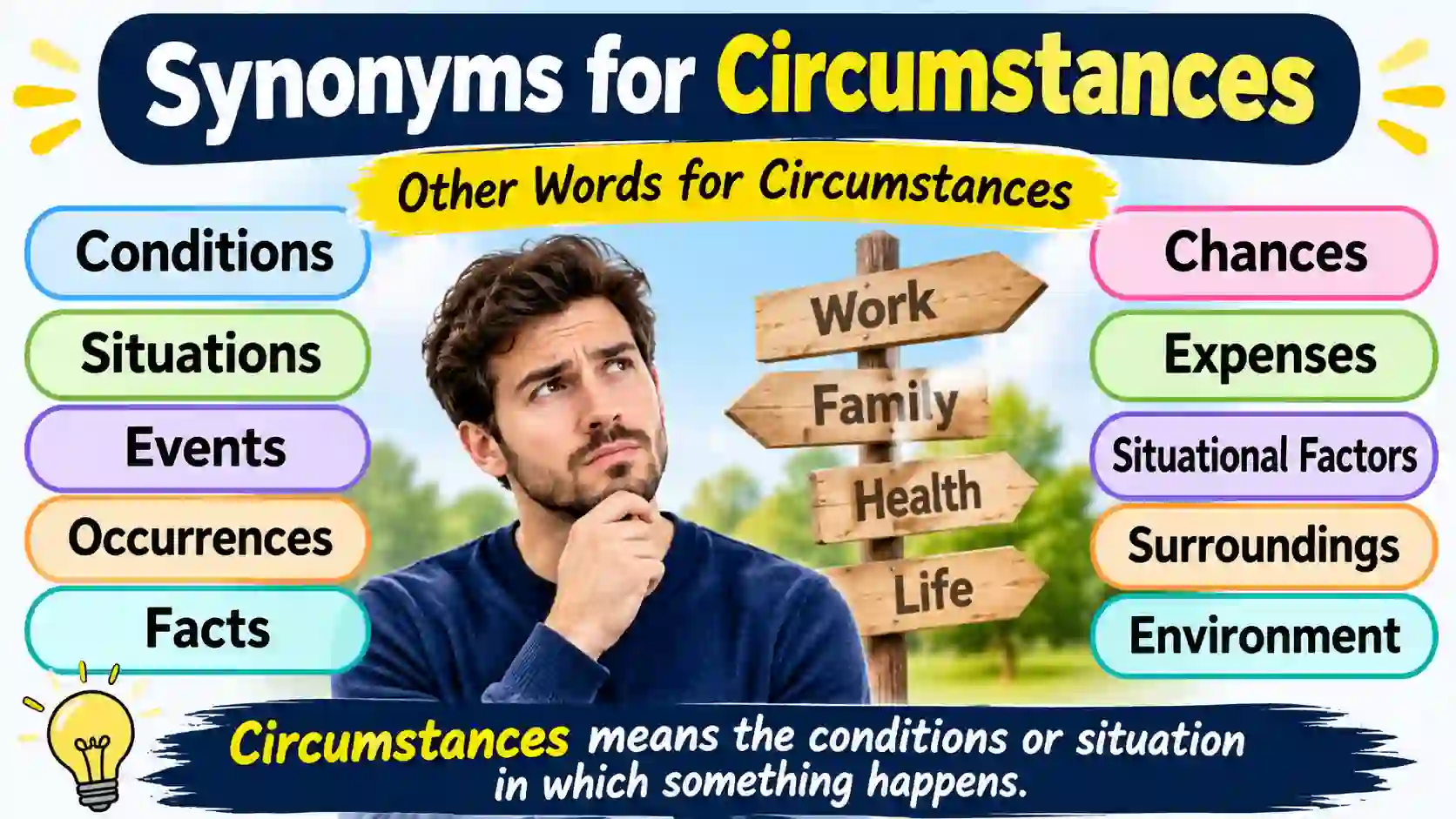
Quick Answer: What Are Synonyms for Circumstances?
The best synonyms for circumstances include situation, conditions, state of affairs, position, context, background, environment, and status. These words describe the facts, events, or conditions that affect a person or situation. The right choice depends on whether you mean someone’s living conditions, financial position, surrounding events, or general situation.
Have you ever needed to explain a difficult situation but found yourself repeating the word circumstances? Choosing the right alternative can make your English sound clearer, more natural, and more professional.
Circumstances refers to the facts, conditions, events, and influences that affect a person, decision, or situation. For example, someone might cancel a business meeting because of unexpected circumstances.
However, not every alternative has the same meaning. Situation describes the overall picture, conditions focus on the things affecting someone, and context explains the background behind an event.
In this guide, you will discover 30 synonyms for circumstances with meanings, original examples, pronunciation, common collocations, formality levels, and usage advice. You will also learn how to choose the right word for essays, emails, conversations, and professional writing.
Pronunciation
- IPA (American): /ˈsɝː.kəmˌstænsɪz/
- IPA (British): /ˈsɜː.kəm.stɑːn.sɪz/
- Simple pronunciation: SUR-kum-stan-siz
- Word stress: First syllable.
Part of Speech
Circumstances is a plural noun. Its singular form is circumstance.
| Form | Part of speech | Example |
| Circumstance | Singular noun | One unusual circumstance changed everything. |
| Circumstances | Plural noun | Her circumstances have improved. |
| Circumstantial | Adjective | The police examined circumstantial evidence. |
| Circumstantially | Adverb | The two accounts were circumstantially connected. |
The adjective circumstantial has a specialized legal use in the expression circumstantial evidence. It does not simply mean difficult or unusual.
Word Origin and Etymology
Circumstance comes from the Latin circumstantia, meaning a surrounding condition or situation. It combines circum, meaning around, and stare, meaning to stand.
The word entered English through Old French. Its recorded English use dates to the 13th century.
Over time, its meaning expanded to include the facts affecting an event, a person’s living conditions, and situations outside someone’s control.
Grammar: How to Use Circumstances
Use circumstance for one condition or fact and circumstances when referring to several connected conditions or facts.
Common sentence patterns
- Under the circumstances: Under the circumstances, we made the best decision.
- Due to + circumstances: The appointment was delayed due to unforeseen circumstances.
- Circumstances surrounding + noun: Investigators examined the circumstances surrounding the incident.
- Circumstances beyond + possessive: The cancellation happened because of circumstances beyond our control.
- In + adjective + circumstances: They continued working in difficult circumstances.
Common grammar mistakes
| Incorrect | Correct |
| These circumstances are unusual. | These circumstances are unusual. |
| The circumstances are difficult. | The circumstances are difficult. |
| Under difficult circumstances. | Under difficult circumstances. |
| The circumstances affected us. | A circumstance affected us. |
Important: Circumstance is countable, but it also appears in the fixed expression victim of circumstance, where the singular form has an uncountable sense.
Quick Synonyms Overview
The following table separates close alternatives from words that only work in particular contexts.
| Synonym | Strength | Formality |
| Situation | Strongest | Neutral |
| Conditions | Strongest | Neutral |
| State of affairs | Strongest | Formal |
| Position | Strong | Neutral |
| Context | Strong | Academic |
| State | Strong | Neutral |
| Status | Strong | Formal |
| Background | Strong | Neutral |
| Environment | Strong | Neutral |
| Setting | Strong | Neutral |
| Surroundings | Strong | Neutral |
| Case | Strong | Neutral |
| Scenario | Contextual | Professional |
| Predicament | Contextual | Neutral |
| Plight | Contextual | Formal |
| Means | Contextual | Formal |
| Resources | Contextual | Neutral |
| Factors | Contextual | Academic |
| Details | Contextual | Neutral |
| Particulars | Contextual | Formal |
| Events | Contextual | Neutral |
| Incident | Contextual | Neutral |
| Occurrence | Contextual | Formal |
| Happenings | Contextual | Informal |
| Realities | Contextual | Neutral |
| Constraints | Contextual | Formal |
| Contingency | Contextual | Formal |
| Fortune | Contextual | Literary |
| Fate | Contextual | Literary |
| Living conditions | Contextual | Neutral |
Strength describes how closely a word can replace circumstances in at least some contexts. Contextual alternatives are not universal synonyms.
30 Synonyms for Circumstances With Examples and Explanations
1. Situation
Meaning: A situation is the way things are at a particular time.
- The manager understood the situation before making a decision.
- Their financial situation improved after the new job.
Best used when: Describing an overall condition in everyday English.
Tone: Neutral | CEFR: A2 | Frequency: Very common
Collocations: Difficult situation, current situation, unusual situation.
Nuance: This is one of the safest alternatives to circumstances.
When not to use: Avoid it when you need to identify a specific cause or background fact.
2. Conditions
Meaning: Conditions are the things that affect how someone lives or works.
- The employees complained about poor working conditions.
- Weather conditions forced us to change our route.
Best used when: Discussing living, financial, environmental, or workplace circumstances.
Tone: Neutral | CEFR: B1 | Frequency: Very common
Collocations: Living conditions, working conditions, difficult conditions.
Nuance: Conditions focus on the factors surrounding a person or activity.
When not to use: Do not use it when you mean the complete story behind an event.
3. State of Affairs
Meaning: A state of affairs describes how things currently stand.
- The current state of affairs requires immediate action.
- Everyone wanted to change the state of affairs at the office.
Best used when: Discussing complicated situations in formal writing.
Tone: Formal | CEFR: C1 | Frequency: Common
Collocations: Current state of affairs, political state of affairs, present state of affairs.
Nuance: It usually describes a broad condition involving several connected facts.
When not to use: Avoid it in simple, casual conversations.
4. Position
Meaning: A position is someone’s condition or standing in a particular situation.
- She was in a difficult financial position.
- His position became stronger after the negotiations.
Best used when: Discussing someone’s personal, financial, or professional circumstances.
Tone: Neutral / Business | CEFR: B1 | Frequency: Very common
Collocations: Financial position, difficult position, strong position.
Nuance: It focuses on someone’s place or ability to act.
When not to use: Do not use it when describing surrounding events alone.
5. Context
Meaning: Context is the information that helps explain something.
- We need more context before judging his decision.
- The statement sounds different in its historical context.
Best used when: Explaining the background behind an event, statement, or decision.
Tone: Academic / Formal | CEFR: B2 | Frequency: Very common
Collocations: Historical context, social context, wider context.
Nuance: Context explains why something makes sense.
When not to use: Avoid it as a replacement for someone’s financial circumstances.
6. State
Meaning: A state is the condition something or someone is in.
- The house was in a poor state of repair.
- His emotional state affected his performance.
Best used when: Describing a particular physical, emotional, or general condition.
Tone: Neutral | CEFR: A2 | Frequency: Very common
Collocations: Mental state, physical state, present state.
Nuance: State focuses on a condition rather than the full set of surrounding facts.
When not to use: Do not confuse this meaning with a political state or region.
7. Status
Meaning: Status is someone’s official or recognized position.
- The employee’s employment status changed last month.
- We checked the status of the application.
Best used when: Discussing legal, social, financial, or professional standing.
Tone: Formal / Business | CEFR: B2 | Frequency: Very common
Collocations: Employment status, legal status, financial status.
Nuance: Status often refers to a recognized position or classification.
When not to use: Avoid it when describing all the events surrounding a problem.
8. Background
Meaning: Background is the information or history connected to a person or event.
- Her family background influenced her choices.
- The journalist explained the background of the dispute.
Best used when: Discussing past experiences or information that explains the present.
Tone: Neutral | CEFR: B1 | Frequency: Very common
Collocations: Family background, historical background, personal background.
Nuance: It looks at what came before the current situation.
When not to use: Do not use it to describe present living conditions alone.
9. Environment
Meaning: An environment is the surroundings or conditions in which someone lives or works.
- A supportive environment helps students learn.
- The new office offers a comfortable work environment.
Best used when: Discussing social, physical, or professional surroundings.
Tone: Neutral | CEFR: B1 | Frequency: Very common
Collocations: Work environment, social environment, learning environment.
Nuance: It emphasizes external influences.
When not to use: Avoid it when describing one specific incident.
10. Setting
Meaning: A setting is the place or situation where something happens.
- The discussion took place in a professional setting.
- The peaceful setting made the event enjoyable.
Best used when: Describing the surroundings of an event or activity.
Tone: Neutral | CEFR: B1 | Frequency: Common
Collocations: Social setting, professional setting, natural setting.
Nuance: Setting often emphasizes place and atmosphere.
When not to use: Avoid it when discussing someone’s complete financial circumstances.
11. Surroundings
Meaning: Surroundings are the people, places, and things around someone.
- The children grew up in peaceful surroundings.
- His surroundings influenced his daily habits.
Best used when: Describing external influences or nearby conditions.
Tone: Neutral | CEFR: B1 | Frequency: Common
Collocations: Immediate surroundings, natural surroundings, familiar surroundings.
Nuance: It focuses on what is around a person.
When not to use: Do not use it for financial or legal standing.
12. Case
Meaning: A case is a particular example or set of facts.
- In this case, the company approved the request.
- Each case requires careful attention.
Best used when: Referring to a specific situation or example.
Tone: Neutral / Formal | CEFR: B1 | Frequency: Very common
Collocations: Particular case, special case, individual case.
Nuance: It points to one specific set of circumstances.
When not to use: Avoid it when describing someone’s general lifestyle.
13. Scenario
Meaning: A scenario is a possible or imagined set of events.
- We prepared for the worst-case scenario.
- This scenario could affect the entire business.
Best used when: Discussing possible future circumstances or hypothetical situations.
Tone: Professional / Academic | CEFR: B2 | Frequency: Very common
Collocations: Possible scenario, likely scenario, worst-case scenario.
Nuance: It often involves prediction rather than confirmed facts.
When not to use: Do not use it for someone’s established living conditions.
14. Predicament
Meaning: A predicament is a difficult situation that is hard to escape.
- Losing his passport created a serious predicament.
- She found herself in an awkward predicament.
Best used when: Describing difficult circumstances with limited solutions.
Tone: Neutral | CEFR: C1 | Frequency: Common
Collocations: Difficult predicament, awkward predicament, serious predicament.
Nuance: It has a negative meaning.
When not to use: Avoid it for ordinary or pleasant situations.
15. Plight
Meaning: A plight is a difficult or worrying situation.
- The organization highlighted the plight of homeless families.
- The report described the plight of struggling farmers.
Best used when: Discussing hardship and suffering.
Tone: Formal / Literary | CEFR: C1 | Frequency: Common
Collocations: Desperate plight, human plight, difficult plight.
Nuance: It often creates sympathy for people facing hardship.
When not to use: Do not use it for neutral or favorable conditions.
16. Means
Meaning: Means refers to the money or resources available to someone.
- The family lived within their means.
- She had limited means to pay for the course.
Best used when: Discussing someone’s financial circumstances.
Tone: Formal | CEFR: B2 | Frequency: Common
Collocations: Financial means, limited means, modest means.
Nuance: It has a specific financial meaning in this context.
When not to use: Avoid it when discussing social events or general surroundings.
17. Resources
Meaning: Resources are the money, materials, or support available to someone.
- Limited resources delayed the research project.
- The school provided resources for struggling students.
Best used when: Explaining what someone has available to manage a situation.
Tone: Neutral / Professional | CEFR: B1 | Frequency: Very common
Collocations: Financial resources, limited resources, available resources.
Nuance: Resources describe available support, not the entire situation.
When not to use: Avoid it as a direct substitute for all circumstances.
18. Factors
Meaning: Factors are things that influence a decision or result.
- Several factors affected the final decision.
- Family factors influenced his choice of university.
Best used when: Identifying the influences behind an event or decision.
Tone: Academic / Professional | CEFR: B1 | Frequency: Very common
Collocations: External factors, important factors, contributing factors.
Nuance: A factor is one part of a wider set of circumstances.
When not to use: Do not use it to describe the complete situation.
19. Details
Meaning: Details are individual pieces of information about something.
- The details of the agreement were unclear.
- She explained the details behind the decision.
Best used when: Discussing specific facts about an event.
Tone: Neutral | CEFR: A2 | Frequency: Very common
Collocations: Exact details, important details, background details.
Nuance: Details explain parts of a situation.
When not to use: Avoid it when you mean the whole situation.
20. Particulars
Meaning: Particulars are specific facts or pieces of information.
- The officer requested the particulars of the incident.
- Please provide the particulars of your application.
Best used when: Requesting or describing specific information in formal communication.
Tone: Formal | CEFR: C1 | Frequency: Common
Collocations: Personal particulars, relevant particulars, exact particulars.
Nuance: It is more formal than details.
When not to use: Avoid it in relaxed everyday conversations.
21. Events
Meaning: Events are things that happen and may affect other things.
- Recent events changed our travel plans.
- Earlier events helped explain the disagreement.
Best used when: Discussing happenings that influence a situation.
Tone: Neutral | CEFR: A2 | Frequency: Very common
Collocations: Recent events, historical events, unexpected events.
Nuance: Events describe what happened, not necessarily the conditions around it.
When not to use: Do not use it for someone’s financial position.
22. Incident
Meaning: An incident is an event, especially an unusual or unpleasant one.
- The school investigated the incident.
- Nobody was injured during the incident.
Best used when: Describing a particular event or problem.
Tone: Neutral / Professional | CEFR: B1 | Frequency: Very common
Collocations: Serious incident, minor incident, unexpected incident.
Nuance: It refers to a specific happening.
When not to use: Avoid it when discussing someone’s general living conditions.
23. Occurrence
Meaning: An occurrence is something that happens.
- The unusual occurrence surprised the entire team.
- Power failures are a regular occurrence in that area.
Best used when: Discussing events that happen under particular conditions.
Tone: Formal | CEFR: B2 | Frequency: Common
Collocations: Rare occurrence, unexpected occurrence, common occurrence.
Nuance: It emphasizes the happening itself.
When not to use: Do not use it to describe a person’s financial situation.
24. Happenings
Meaning: Happenings are events or activities taking place.
- Local happenings attracted many visitors.
- She kept us informed about the latest happenings.
Best used when: Discussing everyday events in a relaxed way.
Tone: Informal / Neutral | CEFR: B1 | Frequency: Common
Collocations: Local happenings, recent happenings, social happenings.
Nuance: It sounds more conversational than events.
When not to use: Avoid it in serious legal or academic writing.
25. Realities
Meaning: Realities are the actual facts of a situation.
- We must accept the realities of the current market.
- The realities of family life changed his priorities.
Best used when: Contrasting actual conditions with hopes or expectations.
Tone: Neutral / Formal | CEFR: B2 | Frequency: Very common
Collocations: Economic realities, harsh realities, everyday realities.
Nuance: It emphasizes what is actually happening.
When not to use: Avoid it when discussing purely imaginary possibilities.
26. Constraints
Meaning: Constraints are limits that restrict someone’s choices or actions.
- Budget constraints delayed the project.
- Time constraints made the task more difficult.
Best used when: Describing circumstances that limit what someone can do.
Tone: Formal / Academic | CEFR: B2 | Frequency: Common
Collocations: Financial constraints, time constraints, practical constraints.
Nuance: It focuses on limitations.
When not to use: Avoid it when describing favorable circumstances without restrictions.
27. Contingency
Meaning: A contingency is a possible future event that may require action.
- The company prepared for every possible contingency.
- We created a backup plan for unexpected contingencies.
Best used when: Discussing uncertainty and future planning.
Tone: Formal / Business | CEFR: C1 | Frequency: Common
Collocations: Contingency plan, possible contingency, unforeseen contingency.
Nuance: It refers to a possible event, not the whole set of current circumstances.
When not to use: Avoid it when discussing ordinary present-day conditions.
28. Fortune
Meaning: Fortune can describe someone’s luck or general circumstances in life.
- Fortune favored the team during the final match.
- She improved her fortune through years of hard work.
Best used when: Discussing luck or a person’s general prospects.
Tone: Literary / Neutral | CEFR: B2 | Frequency: Common
Collocations: Good fortune, bad fortune, change of fortune.
Nuance: It emphasizes luck and outcomes rather than surrounding facts.
When not to use: Avoid it as a direct replacement for working or living conditions.
29. Fate
Meaning: Fate is the power or course of events believed to determine what happens to someone.
- He accepted his fate without complaint.
- Their meeting seemed to be decided by fate.
Best used when: Discussing destiny or events beyond personal control.
Tone: Literary | CEFR: B2 | Frequency: Common
Collocations: Twist of fate, accept one’s fate, seal one’s fate.
Nuance: Fate carries a sense of destiny and inevitability.
When not to use: Avoid it in factual reports about ordinary conditions.
30. Living Conditions
Meaning: Living conditions are the conditions in which people live.
- The charity works to improve living conditions in rural areas.
- Better housing improved their living conditions.
Best used when: Discussing housing, safety, income, and quality of life.
Tone: Neutral / Academic | CEFR: B1 | Frequency: Very common
Collocations: Poor living conditions, improved living conditions, safe living conditions.
Nuance: It focuses on daily life rather than every event affecting a person.
When not to use: Avoid it when discussing the circumstances of a single business decision.
Choose the Right Synonym: Side by Side Comparisons
The best alternative depends on what you want to communicate.
| Word | Main emphasis | Example |
| Situation | Overall condition | The situation is improving. |
| Conditions | Surrounding influences | Working conditions are poor. |
| Context | Background information | We need more context. |
| Position | Personal standing | She is in a strong position. |
| State of affairs | General state of things | The state of affairs is worrying. |
| Predicament | Difficult problem | He faced a serious predicament. |
| Plight | Hardship | The report described their plight. |
| Factors | Influences | Several factors affected the result. |
Compare These Sentences
Example 1: Situation vs. Context
- We need to understand the situation.
- We need to understand the context.
The first asks about the overall condition. The second asks for background information.
Example 2: Conditions vs. Circumstances
- Their circumstances improved after the move.
- Their living conditions improved after the move.
The first can include money, work, family, and other facts. The second focuses on the conditions of daily life.
Example 3: Predicament vs. Plight
- He faced a serious predicament.
- The report highlighted the plight of the families.
Predicament describes a difficult problem. Plight emphasizes hardship and often invites sympathy.
Strongest, Strong, and Related Synonyms
Strongest Alternatives
These are the most useful general alternatives, depending on the sentence:
- Situation
- Conditions
- State of affairs
- Position
- Context
- State
- Status
Strong Contextual Alternatives
These work well for specific meanings:
- Background
- Environment
- Setting
- Surroundings
- Case
- Scenario
- Living conditions
- Means
Related Words
These describe individual elements or particular aspects rather than the complete meaning:
- Factors
- Details
- Particulars
- Events
- Incident
- Occurrence
- Happenings
- Resources
- Constraints
- Contingency
- Fortune
- Fate
American vs. British English
Circumstances have the same spelling in American and British English. However, its pronunciation differs slightly.
| Feature | American English | British English |
| Spelling | Circumstances | Circumstances |
| IPA | /ˈsɝː.kəmˌstænsɪz/ | /ˈsɜː.kəm.stɑːn.sɪz/ |
| Situation | Common | Common |
| Conditions | Common | Common |
| State of affairs | Common | Common |
| Financial circumstances | Common | Common |
There is no major difference in its everyday meaning. Both varieties use expressions such as under the circumstances, in certain circumstances, and due to unforeseen circumstances.
CEFR Vocabulary Guide
These are approximate learning recommendations, not official word-by-word CEFR ratings.
| Level | Useful vocabulary |
| A1–A2 | Situation, state, events, details |
| B1 | Conditions, background, environment, position |
| B2 | Context, status, scenario, constraints |
| C1 | Predicament, plight, particulars, contingency |
| C2 | Advanced literary and specialized vocabulary |
Commonly Confused Words
| Word | Main difference | Example |
| Circumstances | Facts and conditions affecting something | Circumstances changed our plans. |
| Situation | Overall condition | The situation is improving. |
| Conditions | Specific surrounding influences | Working conditions are poor. |
| Context | Background that explains something | Read the sentence in context. |
| Events | Things that happen | Recent events surprised us. |
Common Mistakes
Mistake 1: Using the wrong verb
Incorrect: The circumstances are unusual.
Correct: The circumstances are unusual.
Explanation: Circumstances is plural, so it takes a plural verb.
Mistake 2: Using a singular demonstrative
Incorrect: These circumstances are difficult.
Correct: These circumstances are difficult.
Explanation: Use these with a plural noun.
Mistake 3: Confusing circumstances with context
Incorrect: My financial context has improved.
Better: My financial circumstances have improved.
Explanation: Context describes background information. Circumstances can describe someone’s financial position.
Mistake 4: Using predicament for a positive experience
Incorrect: She enjoyed her pleasant predicament.
Better: She enjoyed her pleasant situation.
Explanation: Predicament normally describes a difficult situation.
Mistake 5: Treating contingency as a general synonym
Incorrect: My current contingency is comfortable.
Better: My current situation is comfortable.
Explanation: A contingency is a possible future event that may require a response.
Writing Tips: Use Synonyms Naturally
Essays: Use context, factors, and conditions when discussing research or social issues.
Example: Several economic factors influenced the country’s development.
Emails: Use circumstances and situations when explaining delays or changes.
Example: Due to unforeseen circumstances, we need to reschedule the meeting.
Blog posts: Use environment, background, and situation to avoid unnecessary repetition.
Example: A healthy learning environment can improve student performance.
Stories: Use predicament and plight when describing hardship or conflict.
Example: The traveler faced a serious predicament after losing his map.
Social media: Use situations and realities for clear, conversational messages.
Example: Sometimes, life changes because of circumstances beyond our control.
Professional communication: Use position, status, and constraints when discussing business decisions.
Example: Budget constraints affected the final project.
Daily conversations: Prefer situations and conditions because they sound natural.
Example: I understand your situation, and I am happy to help.
Writing Tip
Do not replace every use of circumstances with another word just to avoid repetition. First understand the meaning of the sentence. Then select an alternative that keeps the original message accurate.
Related Vocabulary
Antonyms
Circumstances have no single exact opposite. However, these words can express contrasting ideas depending on the context.
| Word | Meaning |
| Stability | A steady condition |
| Certainty | Something known or definite |
| Freedom | Being free from restrictions |
| Independence | Freedom from outside control |
| Security | A safe or protected condition |
| Advantage | A favorable position |
Useful Expressions
- Under the circumstances: Considering the situation.
- Given the circumstances: Taking the existing conditions into account.
- Under no circumstances: Never, under any condition.
- Under any circumstances: Regardless of the situation.
- Beyond someone’s control: Something a person cannot change.
- Circumstances beyond our control: Events we cannot prevent or manage.
- A change in circumstances: A change in someone’s situation.
- Circumstances permitting: If conditions allow.
- Victim of circumstance: Someone affected by events outside their control.
- Force of circumstance: Pressure created by unavoidable conditions.
Word Family
| Word | Part of speech |
| Circumstance | Noun |
| Circumstances | Plural noun |
| Circumstantial | Adjective |
| Circumstantially | Adverb |
Frequently Asked Questions
1. What are the best synonyms for circumstances?
The best synonyms include situation, conditions, state of affairs, position, context, background, and environment. Situation is usually the easiest everyday replacement. Conditions work well for living and working situations, while context is better when discussing the information surrounding an event.
2. What is another word for difficult circumstances?
Predicament, plight, hardship, difficult situations, and challenging conditions are useful alternatives. Predicament describes a difficult problem with limited solutions. Plight usually emphasizes serious hardship and often expresses sympathy for people experiencing difficult conditions.
3. What is a formal synonym for circumstances?
State of affairs, conditions, position, context, and particulars can work in formal writing. The best choice depends on your sentence. Context and factors are useful in academic writing, while state of affairs works well in professional reports.
4. What is a simple word for circumstances?
Situation is the simplest and most flexible alternative to circumstances. Other easy choices include conditions, events, and surroundings. These words help beginners communicate clearly without using difficult vocabulary.
5. What is the difference between circumstances and conditions?
Circumstances describe the wider facts and events that affect a person or situation. Conditions usually focus on specific influences, such as weather, health, money, or working environments. For example, financial circumstances can include income and family responsibilities, while living conditions focus on daily life.
6. What are synonyms for circumstances beyond your control?
Useful alternatives include unforeseen events, unavoidable situations, unexpected conditions, and events beyond your control. These expressions describe things that happen without a person’s choice or ability to prevent them.
7. Is the situation the same as the circumstances?
Situation and circumstances have similar meanings, but they are not always identical. Situation usually describes the overall condition at a particular time. Circumstances can include the facts, personal conditions, events, and outside influences that create that situation.
8. What is the opposite of circumstances?
Circumstances does not have one exact antonym because it describes a broad group of facts and conditions. Depending on the context, words such as stability, certainty, freedom, security, and independence can express contrasting ideas.
Vocabulary Practice
Exercise 1: Fill in the Blanks
Choose the most suitable word from the list.
Words: situation, context, predicament, conditions, factors
- The workers complained about poor working ______.
- We need more ______ before judging her decision.
- Losing his passport created a difficult ______.
- Several economic ______ affected the business.
- The current ______ requires immediate attention.
Exercise 2: Rewrite the Sentences
Replace the bold word with a suitable alternative without changing the intended meaning.
- Her financial circumstances have improved.
- We need to understand the circumstances behind the decision.
- The family faced difficult circumstances.
- The company prepared for unexpected circumstances.
Exercise 3: Match the Words
| Word | Correct meaning |
| 1. Context | A. A difficult situation |
| 2. Predicament | B. Background information |
| 3. Constraints | C. Limits or restrictions |
| 4. Status | D. Official position |
| 5. Conditions | E. Surrounding influences |
Answer Key
Exercise 1
- Conditions
- Context
- Predicament
- Factors
- Situation
2: Sample answers
- Her financial position has improved.
- We need to understand the background behind the decision.
- The family faced difficult conditions.
- The company prepared for unexpected contingencies.
3
- B
- A
- C
- D
- E
Conclusion
Learning synonyms for circumstances helps you express ideas with greater accuracy and confidence. Words such as situation, conditions, position, context, and state of affairs can improve your essays, emails, professional writing, and everyday conversations.
Remember that each alternative has its own meaning and purpose. Practice these words in real sentences, and your English vocabulary will become stronger.
References
- Cambridge Dictionary: https://dictionary.cambridge.org/thesaurus/circumstances
- Collins Dictionary: https://www.collinsdictionary.com/dictionary/english-thesaurus/circumstance
- Merriam-Webster: https://www.merriam-webster.com/dictionary/circumstance
- Oxford Learner’s Dictionaries: https://www.oxfordlearnersdictionaries.com/definition/english/circumstance
- Thesaurus.com: https://www.thesaurus.com/browse/circumstance.

Synonorm is a trusted English vocabulary resource created to help readers find the right words and understand the differences between similar terms. We provide clear explanations of synonyms, meanings, examples, usage, and alternatives. Our content makes vocabulary easier to learn and apply in everyday, academic, and professional English. Synonorm is designed for students, writers, ESL learners, professionals, and anyone who wants to improve their English vocabulary and communicate more clearly.