Quick Answer
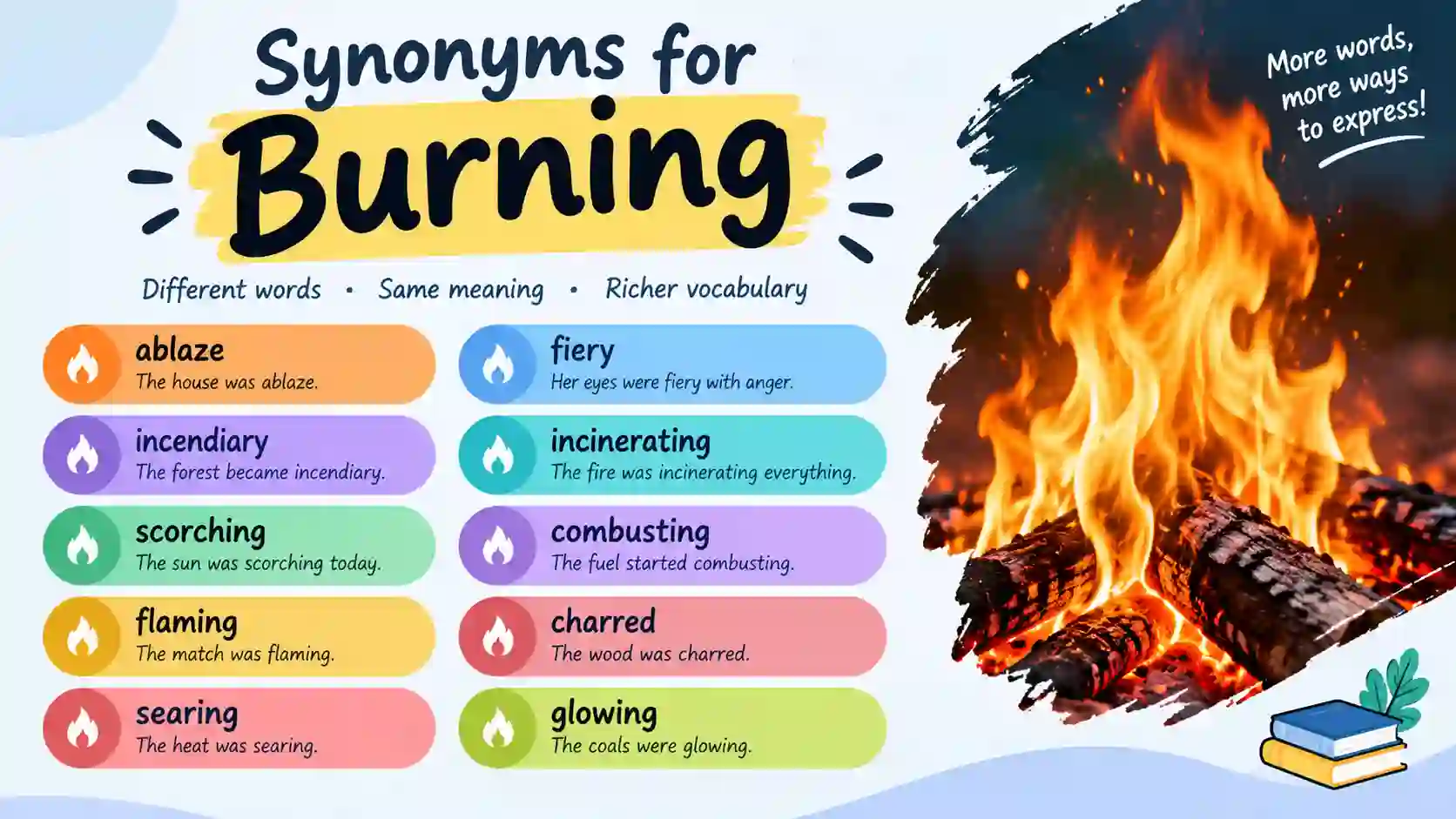
Synonyms for burning include blazing, flaming, ablaze, scorching, searing, stinging, passionate, fervent, intense, and urgent. The right word depends on the context. Use blazing for a strong fire, scorching for extreme heat, stinging for sharp discomfort, passionate for strong feelings, and urgent for something that needs quick attention.
What word should you use when something is burning, a person feels a burning pain, or a writer describes a burning desire? The answer depends on what you want to say.
Burning is a flexible English word. It can describe flames, extreme heat, a painful sensation, strong feelings, or a question that needs an answer. For example, a burning house is on fire, a burning sensation feels hot and painful, and a burning ambition describes a powerful wish to succeed.
These meanings overlap, but their synonyms do not always work in the same sentences. You can describe a hot afternoon as scorching, but you would usually describe a strong ambition as passionate or fervent.
This guide explains 30 synonyms and related expressions for burning. You will learn their meanings, common combinations, differences in tone, grammar, word origins, and practical uses. It is designed for students, ESL learners, teachers, bloggers, and anyone who wants to write clearer English.
Pronunciation of Burning
- American English IPA: /ˈbɝː.nɪŋ/
- British English IPA: /ˈbɜː.nɪŋ/
- Simple pronunciation: BUR-ning
- Syllables: Two
The first syllable carries the main stress. American speakers pronounce the r, while speakers of standard British English generally do not pronounce it in this word.
Part of Speech
Burning can function as an adjective, a verb form, a gerund, or, in some sentences, an adverbial modifier.
| Grammatical role | Example | Explanation |
| Adjective | A burning candle stood on the table. | Describes the candle. |
| Verb form | The candle is burning. | Forms the present continuous tense. |
| Gerund | Burning dry leaves creates smoke. | Names an activity. |
| Adverbial use | The metal was burning hot. | Burning intensifies. |
The last use occurs in expressions such as burning hot. In most other situations, burning is an adjective or a verb form.
Word Origin and Etymology
The word burning comes from the verb burn combined with the suffix -ing. Dictionary.com records the word before 1000, with Middle English brenning and Old English byrnende among its earlier forms.
The word first described heat and fire. Over time, it also developed figurative meanings connected with strong feelings, desire, and urgency. The figurative sense of something being powerful or intense dates to the Middle English period, while the expression burning question is recorded from the nineteenth century.
Source: Dictionary.com: Burning
Synonyms for Burning: Quick Comparison Table
These words are grouped by their most useful meanings. The strength labels describe how closely each word fits a particular sense of burning. CEFR levels are approximate guidance for learners, not official ratings for every meaning.
| Synonym | Main meaning | Strength | Register |
| Blazing | Strong, bright fire | Strongest for fire | Neutral |
| Flaming | Producing flames | Strong | Neutral |
| Ablaze | On fire | Strong | Neutral |
| Aflame | On fire or filled with strong feeling | Strong | Literary/neutral |
| Scorching | Extremely hot | Strongest for weather | Neutral |
| Searing | Intense heat or pain | Strong | Neutral |
| Stinging | Sharp, irritating pain | Strong for discomfort | Neutral |
| Glowing | Giving off light or heat | Related | Neutral |
| Smoldering | Burning slowly | Strong for slow fire | Neutral |
| Sizzling | Making a sharp sound from heat | Related | Informal/neutral |
| Blistering | Extremely hot or intense | Strong | Neutral |
| Scalding | Dangerously hot liquid or steam | Strong | Neutral |
| Fiery | Hot, energetic, or emotional | Strong | Neutral |
| Passionate | Showing strong feelings | Strong | Neutral |
| Fervent | Showing sincere, strong belief | Strong | Formal |
| Ardent | Showing intense devotion | Strong | Formal/literary |
| Impassioned | Filled with strong emotion | Strong | Formal |
| Zealous | Deeply committed | Related | Formal |
| Intense | Very strong | Related | Neutral |
| Heated | Hot or emotionally charged | Related | Neutral |
| Urgent | Needing quick attention | Strong for urgency | Neutral |
| Pressing | Requiring attention soon | Strong for urgency | Formal/business |
| Crucial | Extremely important | Related | Neutral |
| Critical | Important or serious | Related | Neutral |
| Eager | Excited and ready | Related | Neutral |
| Earnest | Sincere and serious | Related | Neutral |
| Sweltering | Uncomfortably hot | Strong for weather | Neutral |
| Torrid | Extremely hot or passionate | Related | Literary |
| Red-hot | Extremely hot or highly popular | Strong | Neutral/informal |
| All-consuming | Taking up nearly all attention | Strong for emotion | Neutral/literary |
30 Synonyms for Burning With Examples
1. Blazing
Meaning: Blazing describes a strong, bright fire.
Examples:
- A blazing fire warmed the campsite.
- Blazing flames rose above the damaged roof.
Best used when: You want to emphasize a powerful fire or intense brightness.
Tone: Neutral. Frequency: Common. CEFR: Approx. B2.
Common collocations: blazing fire, blazing flames, blazing sunshine.
When not to use it: It is not a direct substitute for every expression involving pain or urgency.
2. Flaming
Meaning: Flaming describes something that produces visible flames.
Examples:
- A flaming branch fell onto the empty path.
- The workers moved away from the flaming debris.
Best used when: You want to emphasize visible fire.
Tone: Neutral. Frequency: Common. CEFR: Approx. B1–B2.
Common collocations: flaming torch, flaming debris, flaming arrows.
When not to use it: Do not use it for an object that is merely warm.
3. Ablaze
Meaning: Ablaze means burning strongly or covered in flames.
Examples:
- The old warehouse was ablaze before sunrise.
- The hills were ablaze with autumn colors.
Best used when: You describe something on fire or brightly colored.
Tone: Neutral. Frequency: Common. CEFR: Approx. B2.
Common collocations: buildings ablaze, ablaze with flames, ablaze with color.
When not to use it: Use passionate or fervent for ordinary descriptions of strong ambition.
4. Aflame
Meaning: Aflame means on fire or filled with strong emotion.
Examples:
- The dry grass was aflame within minutes.
- Her imagination was aflame with new ideas.
Best used when: You want a vivid or slightly literary description.
Tone: Literary/neutral. Frequency: Less common. CEFR: Approx. C1.
Common collocations: set aflame, aflame with anger, aflame with passion.
When not to use it: It may sound too dramatic for routine business writing.
5. Scorching
Meaning: Scorching describes extreme heat or heat that can damage something.
Examples:
- The scorching sun dried the garden soil.
- We waited indoors during the scorching afternoon.
Best used when: You describe very hot weather or damaging heat.
Tone: Neutral. Frequency: Common. CEFR: Approx. B2.
Common collocations: scorching heat, scorching sun, scorching temperatures.
When not to use it: Scorching desire is not a natural replacement for burning desire in most everyday contexts.
6. Searing
Meaning: Searing describes extreme heat or very intense pain.
Examples:
- Searing heat rose from the metal roof.
- He felt a searing pain after touching the hot pan.
Best used when: You want to stress the intensity of heat, pain, or criticism.
Tone: Neutral. Frequency: Common. CEFR: Approx. C1.
Common collocations: searing heat, searing pain, searing criticism.
When not to use it: It can sound exaggerated when describing mild warmth.
7. Stinging
Meaning: Stinging describes a sharp, irritating pain or sensation.
Examples:
- The soap left a stinging feeling on the small cut.
- The cold wind brought a stinging sensation to her cheeks.
Best used when: You describe sharp discomfort rather than literal flames.
Tone: Neutral. Frequency: Very common. CEFR: Approx. B1.
Common collocations: stinging pain, stinging sensation, stinging eyes.
When not to use it: It does not normally describe an object on fire.
8. Glowing
Meaning: Glowing means giving off a steady, soft light or appearing bright and warm.
Examples:
- The glowing coals kept the room warm.
- A glowing lantern lit the narrow path.
Best used when: You want to emphasize light or residual heat.
Tone: Neutral. Frequency: Very common. CEFR: Approx. B1.
Common collocations: glowing embers, glowing light, glowing coals.
When not to use it: Use blazing when you mean a powerful fire with visible flames.
9. Smoldering (British English: Smouldering)
Meaning: Smoldering describes something burning slowly, often with smoke and little or no flame.
Examples:
- Smoldering wood remained after the campfire ended.
- Firefighters inspected the smoldering remains of the shed.
Best used when: You describe slow burning or a feeling that remains hidden but strong.
Tone: Neutral. Frequency: Common. CEFR: Approx. C1.
Common collocations: smoldering embers, smoldering ruins, smoldering anger.
When not to use it: It does not usually describe a bright, roaring fire.
10. Sizzling
Meaning: Sizzling describes something very hot, often making a sharp sound during cooking.
Examples:
- Sizzling onions filled the kitchen with a rich smell.
- The sizzling pavement shimmered in the afternoon sun.
Best used when: You want to suggest heat, sound, or lively energy.
Tone: Informal/neutral. Frequency: Common. CEFR: Approx. B2.
Common collocations: sizzling food, sizzling bacon, sizzling heat.
When not to use it: Avoid it in technical writing when a precise scientific term is needed.
11. Blistering
Meaning: Blistering describes extreme heat, speed, or intensity.
Examples:
- The runners competed in blistering heat.
- The reviewer published a blistering criticism of the film.
Best used when: You emphasize severe heat or unusually harsh criticism.
Tone: Neutral. Frequency: Common. CEFR: Approx. C1.
Common collocations: blistering heat, blistering pace, blistering criticism.
When not to use it: It is not the usual word for a mildly warm room.
12. Scalding
Meaning: Scalding means hot enough to burn skin, especially through liquid or steam.
Examples:
- Scalding water spilled from the damaged pipe.
- Steam escaped from the scalding kettle.
Best used when: You describe dangerously hot liquids or steam.
Tone: Neutral. Frequency: Common. CEFR: Approx. C1.
Common collocations: scalding water, scalding steam, scalding liquid.
When not to use it: A building on fire is ablaze, not scalding.
13. Fiery
Meaning: Fiery describes something like fire in heat, color, energy, or emotion.
Examples:
- The chef prepared a fiery sauce with fresh peppers.
- Her fiery speech encouraged the audience to act.
Best used when: You want to express heat, strong feelings, or energetic behavior.
Tone: Neutral. Frequency: Common. CEFR: Approx. B2.
Common collocations: fiery temper, fiery speech, fiery red.
When not to use it: It does not always mean that something is literally on fire.
14. Passionate
Meaning: Passionate describes strong feelings, enthusiasm, or commitment.
Examples:
- He is passionate about teaching children.
- She gave a passionate speech about education.
Best used when: You describe love, interests, beliefs, or dedication.
Tone: Neutral. Frequency: Very common. CEFR: Approx. B2.
Common collocations: passionate about art, passionate speech, passionate support.
When not to use it: Do not use it to describe actual heat or flames.
15. Fervent
Meaning: Fervent means showing very strong and sincere feelings or beliefs.
Examples:
- The volunteers offered fervent support for the project.
- He made a fervent appeal for peace.
Best used when: You need a formal word for sincere belief, hope, or support.
Tone: Formal. Frequency: Common. CEFR: Approx. C1.
Common collocations: fervent hope, fervent belief, fervent support.
When not to use it: It is not a synonym for physical heat.
16. Ardent
Meaning: Ardent means showing strong enthusiasm, devotion, or dedication.
Examples:
- She is an ardent supporter of public libraries.
- His ardent ambition shaped his career choices.
Best used when: You want to emphasize strong and lasting dedication.
Tone: Formal/literary. Frequency: Less common. CEFR: Approx. C1.
Common collocations: ardent admirer, ardent supporter, ardent desire.
When not to use it: In casual conversation, passionate or enthusiastic may sound more natural.
17. Impassioned
Meaning: Impassioned describes speech or action filled with strong emotion.
Examples:
- The teacher delivered an impassioned appeal for kindness.
- Her impassioned defense changed several minds.
Best used when: You describe forceful emotional communication.
Tone: Formal. Frequency: Less common. CEFR: Approx. C1.
Common collocations: impassioned speech, impassioned plea, impassioned defense.
When not to use it: It usually describes emotion rather than physical heat.
18. Zealous
Meaning: Zealous means showing great energy and commitment to a cause or goal.
Examples:
- The zealous campaigner worked to protect local parks.
- He became a zealous advocate for better schools.
Best used when: You describe strong dedication to a cause or belief.
Tone: Formal. Frequency: Common. CEFR: Approx. C1.
Common collocations: zealous supporter, zealous advocate, zealous effort.
When not to use it: It does not describe hot objects or literal fire.
19. Intense
Meaning: Intense describes something very strong, powerful, or concentrated.
Examples:
- Intense heat made the metal difficult to handle.
- She felt intense excitement before the final match.
Best used when: You need a flexible word for heat, feelings, pressure, or experiences.
Tone: Neutral. Frequency: Very common. CEFR: Approx. B2.
Common collocations: intense heat, intense emotion, intense pressure.
When not to use it: Choose a more specific word if you need to describe the source of the heat.
20. Heated
Meaning: Heated describes something made hot or a discussion filled with strong emotion.
Examples:
- A heated argument interrupted the meeting.
- They placed the heated pan on a safe surface.
Best used when: You describe physical heat or emotional disagreement.
Tone: Neutral. Frequency: Very common. CEFR: Approx. B2.
Common collocations: heated debate, heated discussion, heated argument.
When not to use it: For extreme weather, scorching is often more precise.
21. Urgent
Meaning: Urgent describes something that needs immediate attention or action.
Examples:
- The clinic received an urgent request for supplies.
- We must respond to this urgent safety concern.
Best used when: You mean a matter cannot wait.
Tone: Neutral/professional. Frequency: Very common. CEFR: Approx. B1.
Common collocations: urgent need, urgent message, urgent matter.
When not to use it: It does not mean physically hot.
22. Pressing
Meaning: Pressing describes a problem or need that requires prompt attention.
Examples:
- Affordable housing remains a pressing issue.
- The manager dealt with the most pressing concern first.
Best used when: You write about important problems in business, education, or public life.
Tone: Formal/business. Frequency: Common. CEFR: Approx. C1.
Common collocations: pressing issue, pressing concern, pressing need.
When not to use it: It does not describe literal fire or temperature.
23. Crucial
Meaning: Crucial means extremely important to a result or decision.
Examples:
- Clear instructions are crucial for laboratory safety.
- Her final point was crucial to the discussion.
Best used when: You emphasize importance rather than urgency alone.
Tone: Neutral/formal. Frequency: Very common. CEFR: Approx. B2.
Common collocations: crucial decision, crucial role, crucial step.
When not to use it: Something can be crucial without needing immediate action.
24. Critical
Meaning: Critical means very important or involving a serious situation.
Examples:
- The team found a critical error in the report.
- Clean water is critical during an emergency.
Best used when: You describe serious risks, essential details, or important decisions.
Tone: Neutral/formal. Frequency: Very common. CEFR: Approx. B2.
Common collocations: critical issue, critical condition, critical decision.
When not to use it: Remember that critical can also mean expressing disapproval, as in a critical review.
25. Eager
Meaning: Eager means excited and ready to do or experience something.
Examples:
- The students were eager to begin the project.
- She was eager to hear the final results.
Best used when: You describe willingness or excitement about a future action.
Tone: Neutral. Frequency: Very common. CEFR: Approx. B1.
Common collocations: eager to learn, eager to help, eager anticipation.
When not to use it: Eager is usually milder than burning with desire.
26. Earnest
Meaning: Earnest means sincere, serious, and honest in purpose or feeling.
Examples:
- He made an earnest effort to improve his writing.
- Her earnest request showed how much the project mattered.
Best used when: You want to emphasize sincerity and serious intent.
Tone: Neutral/formal. Frequency: Common. CEFR: Approx. C1.
Common collocations: earnest effort, earnest request, earnest desire.
When not to use it: It does not necessarily mean excited or enthusiastic.
27. Sweltering
Meaning: Sweltering describes a place or weather that feels uncomfortably hot.
Examples:
- The workers rested in the shade during the sweltering afternoon.
- The crowded bus became sweltering without air conditioning.
Best used when: You describe oppressive heat that makes people uncomfortable.
Tone: Neutral. Frequency: Common. CEFR: Approx. B2.
Common collocations: sweltering heat, sweltering weather, sweltering room.
When not to use it: It normally describes the environment rather than a flame.
28. Torrid
Meaning: Torrid means extremely hot or, in some contexts, intensely passionate.
Examples:
- The travelers crossed a torrid stretch of desert.
- The novel describes a torrid romance.
Best used when: You want a literary or dramatic word for heat or passion.
Tone: Literary. Frequency: Less common. CEFR: Approx. C1–C2.
Common collocations: torrid climate, torrid heat, torrid romance.
When not to use it: It may sound unnatural in everyday conversation when very hot would be clearer.
29. Red Hot
Meaning: Red-hot describes something heated until it glows red or something attracting intense attention.
Examples:
- The blacksmith lifted the red-hot metal with long tongs.
- The website published a red-hot story about the election.
Best used when: You describe very hot metal or something exciting and popular.
Tone: Neutral/informal. Frequency: Common. CEFR: Approx. B2.
Common collocations: red-hot iron, red-hot metal, red-hot topic.
When not to use it: A red object is not necessarily hot. The literal meaning implies high temperature.
30. All Consuming
Meaning: All-consuming describes a feeling, activity, or desire that takes up nearly all of someone’s attention.
Examples:
- Her all-consuming ambition left little time for rest.
- The mystery became an all-consuming interest for the detective.
Best used when: You want to show that a pursuit or emotion dominates someone’s life.
Tone: Neutral/literary. Frequency: Common. CEFR: Approx. C1.
Common collocations: all-consuming passion, all-consuming desire, all-consuming obsession.
When not to use it: It is much stronger than interest and may suggest an unhealthy lack of balance.
Choose the Right Synonym: Side by Side Comparisons
| Expression | Best alternative | Difference |
| Burning building | Building ablaze | Both describe a structure on fire. |
| Burning hot weather | Scorching weather | Emphasizes extreme outdoor heat. |
| Burning pain | Searing pain | Emphasizes intense pain. |
| Burning sensation on the skin | Stinging sensation | Emphasizes sharp irritation rather than heat alone. |
| Burning desire to succeed | Passionate desire to succeed | Describes strong motivation. |
| Burning ambition | Ardent ambition | Sounds more formal and literary. |
| Burning question | Pressing question | Emphasizes the need for an answer. |
| Burning issue | Urgent issue | Emphasizes the need for quick action. |
| Burning coals | Glowing coals | Emphasizes light and residual heat. |
| Burning wood with little flame | Smoldering wood | Emphasizes slow burning. |
Remember: These are context-based alternatives, not perfect replacements. Grammar, collocations, and intended meaning determine which word works best.
Synonym Categories
Strongest Synonyms
These closely match a specific sense of burning:
- Fire: blazing, flaming, ablaze, aflame.
- Extreme heat: scorching, searing, blistering, scalding.
- Strong emotion: passionate, fervent, ardent, impassioned.
- Urgency: urgent, pressing.
Strong Synonyms
These work well in specific situations but add their own meaning:
- Heat and light: glowing, sizzling, sweltering, red-hot.
- Emotion: fiery, intense, zealous, heated.
- Importance: crucial, critical.
- Strong desire: all-consuming, eager, earnest.
Related Words
These share an association with burning but are not direct substitutes in every sentence:
- Smoldering: burning slowly.
- Stinging: causing a sharp sensation.
- Torrid: extremely hot or intensely passionate.
- Combustion: the scientific process of burning.
Commonly Confused Words
| Word | Difference | Example |
| Burning | General term for fire, heat, pain, or intensity | The wood is burning. |
| Scorching | Extreme heat or damage caused by heat | The scorching sun dried the grass. |
| Searing | Intense heat or sharp pain | She felt searing pain. |
| Scalding | Hot liquid or steam that can burn | Scalding water escaped from the pipe. |
| Smoldering | Slow burning, often with smoke | Smoldering leaves released smoke. |
Common Mistakes
Mistake 1
- Mistake: She has a scorching desire to become a doctor.
- Correction: She has a burning desire to become a doctor.
- Explanation: Burning desire is a common expression for a powerful wish. Scorching normally describes extreme heat.
Mistake 2
- Mistake: The water was passionate.
- Correction: The water was scalding.
- Explanation: Passionate describes strong feelings, while scalding describes dangerously hot liquid.
Mistake 3
- Mistake: The burning question was very hot.
- Correction: The burning question was urgent and important.
- Explanation: Burning question is an idiom for a question people strongly want answered.
Mistake 4
- Mistake: The building was burning.
- Correction: The building was ablaze.
- Explanation: Combustion is a noun naming a process. Ablaze describes something on fire.
Mistake 5
- Mistake: The coals were scorching with light.
- Correction: The coals were glowing.
- Explanation: Glowing emphasizes the light given off by hot coals.
American vs. British English
Most burning synonyms have the same meaning in both varieties of English, but a few spelling and pronunciation differences matter.
| Feature | American English | British English |
| Pronunciation of burning | The r is pronounced | The r is generally silent |
| Slow-burning word | smoldering | smouldering |
| Past tense of burn | burned is common | burned and burnt are both used |
| Fire expressions | on fire, ablaze | on fire, ablaze, alight |
| Weather expressions | scorching, sweltering | scorching, sweltering |
Both varieties use expressions such as burning desire, burning question, scorching heat, and searing pain. For consistent writing, follow the spelling conventions of your target audience.
Grammar: How to Use Burning
- Before a noun: a burning candle, a burning building, a burning issue.
- After a linking verb: The coals are glowing. The argument became heated.
- In a verb phrase: The leaves are burning.
- As a gerund: Burning waste can release harmful smoke.
- As an intensifier: The metal was burning hot.
The common forms are burn, burns, burned, burnt, and burning. American English often favors burned as the past-tense verb. British English uses both burned and burnt, with preferences varying by context.
Writing Tips for Different Situations
Essays: Use crucial or critical for importance and urgent for a need that cannot wait.
Emails: Write “This is an urgent request” when you need quick action. Avoid dramatic language unless the situation justifies it.
Blog posts: Choose scorching for extreme weather and blazing for a strong fire. Precise vocabulary helps readers picture what you mean.
Stories: Use sensory details such as sizzling oil, glowing embers, or smoldering ruins to create a vivid scene.
Professional writing: Pressing concern often sounds more suitable than burning problems in a formal report.
Social media: Expressions such as red-hot topics can add energy to a post, provided they fit the audience.
Daily conversation: Simple choices such as very hot, on fire, excited, and urgent are often clearer than rare literary words.
Related Vocabulary
Antonyms of Burning
The opposite depends on the meaning:
- Temperature: cold, cool, chilly.
- Fire: extinguished, unlit, put out.
- Strong emotion: indifferent, apathetic, unenthusiastic.
- Urgency: nonurgent, optional, unimportant.
Related Expressions
- Burning desire: a very strong wish.
- Burning question: a question people urgently want answered.
- Burn the midnight oil: work or study late into the night.
- Burn with anger: feel very angry.
- Burning ambition: a powerful wish to achieve a goal.
- Burn a hole in your pocket: have money that you strongly want to spend.
Word Family
| Word | Part of speech | Example |
| Burn | Verb or noun | Dry leaves burn quickly. |
| Burning | Adjective, verb form, or gerund | The burning wood released smoke. |
| Burned | Past tense or participle | The toast burned. |
| Burnt | Past tense, participle, or adjective | The burnt toast smelled bitter. |
| Burnable | Adjective | Store burnable materials safely. |
| Burnout | Noun | Excessive work can lead to burnout. |
Mini Practice Exercises
Exercise 1: Fill in the Blanks
Choose from scorching, fervent, urgent, smoldering, and scalding.
- The firefighters found ______ wood beneath the ashes.
- We need an ______ response before the deadline.
- The ______ afternoon made walking difficult.
- She expressed ______ support for the charity.
- The ______ tea burned his tongue.
Exercise 2: Rewrite the Sentences
Replace burning with a more precise word.
- The burning sun made the road shimmer.
- He had a burning desire to learn English.
- The burning coals gave off a soft light.
- The committee faced a burning problem.
- The burning water damaged the plant.
Exercise 3: Match the Words
Match each word with its meaning.
- Ablaze
- Crucial
- Smoldering
- Passionate
- Scalding
A. Extremely important
B. Burning slowly
C. Covered in flames
D. Showing strong feelings
E. Hot enough to burn skin
Answer Key
- Exercise 1: 1. smoldering; 2. urgent; 3. scorching; 4. fervent; 5. scalding.
- Exercise 2: 1. scorching sun; 2. passionate desire; 3. glowing coals; 4. pressing problem; 5. scalding water.
- Exercise 3: 1-C, 2-A, 3-B, 4-D, 5-E.
Frequently Asked Questions
1. What are the best synonyms for burning?
The best synonyms depend on the context. Use blazing, flaming, or ablaze for fire; scorching or searing for extreme heat; passionate or fervent for strong feelings; and urgent or pressing for matters that need attention. No single word replaces burning naturally in every sentence.
2. What is another word for burning hot?
Useful alternatives include scorching, searing, blistering, sweltering, and scalding. Scorching often describes weather, searing emphasizes intense heat or pain, and sweltering describes uncomfortable surroundings. Scalding is especially useful for hot liquids or steam that can burn skin.
3. What is a synonym for burning with passion?
Passionate, fervent, ardent, and impassioned can describe strong feelings or dedication. Passionate is a flexible everyday choice. Fervent emphasizes sincere belief, ardent sounds more formal, and impassioned often describes forceful speech or emotional expression.
4. What is a synonym for a burning question?
Useful alternatives include pressing questions, urgent questions, and important questions. A burning question is something people strongly want answered. Choose pressing when the answer is needed soon, urgent when time matters, and important when the main concern is significance rather than speed.
5. What is the difference between scorching and searing?
Scorching usually describes extreme weather, heat, or damage caused by heat. Searing emphasizes intense heat or sharp pain and can also describe harsh criticism. For example, a person may experience scorching weather outside and searing pain after an injury.
6. Is burning an adjective, verb, or noun?
Burning can function as an adjective, a verb form, or a gerund. In a burning candle, it describes a noun. If the candle is burning, it forms part of the verb phrase. If burning waste creates smoke, it is an activity.
7. What is the opposite of burning?
The opposite depends on the intended meaning. For temperature, use cold or cool And for fire, use extinguished or unlit And for strong feelings, use indifferent or apathetic. For an urgent problem, use nonurgent or unimportant. No single antonym works in every context.
8. Is burnt American or British English?
Both American and British English use burned and burnt. American English often favors burned as a past-tense verb, while British English frequently uses burnt in some contexts, particularly as an adjective. Both forms are correct, so choose the one that fits your sentence and preferred style.
Conclusion
Learning synonyms for burning helps you describe fire, heat, pain, strong feelings, and urgent problems more accurately. Words such as blazing, scorching, passionate, and pressing each serve a different purpose.
The best word is not always the strongest one, but the one that fits your meaning. Practice these alternatives in essays, emails, schoolwork, and conversations to make your English clearer and more natural.
References
- Cambridge Dictionary: Burning
- Cambridge Thesaurus: Burning
- Oxford Learner’s Dictionaries: Burning
- Dictionary.com: Burning
- Collins English Dictionary: Burning

Synonorm is a trusted English vocabulary resource created to help readers find the right words and understand the differences between similar terms. We provide clear explanations of synonyms, meanings, examples, usage, and alternatives. Our content makes vocabulary easier to learn and apply in everyday, academic, and professional English. Synonorm is designed for students, writers, ESL learners, professionals, and anyone who wants to improve their English vocabulary and communicate more clearly.