Quick Answer
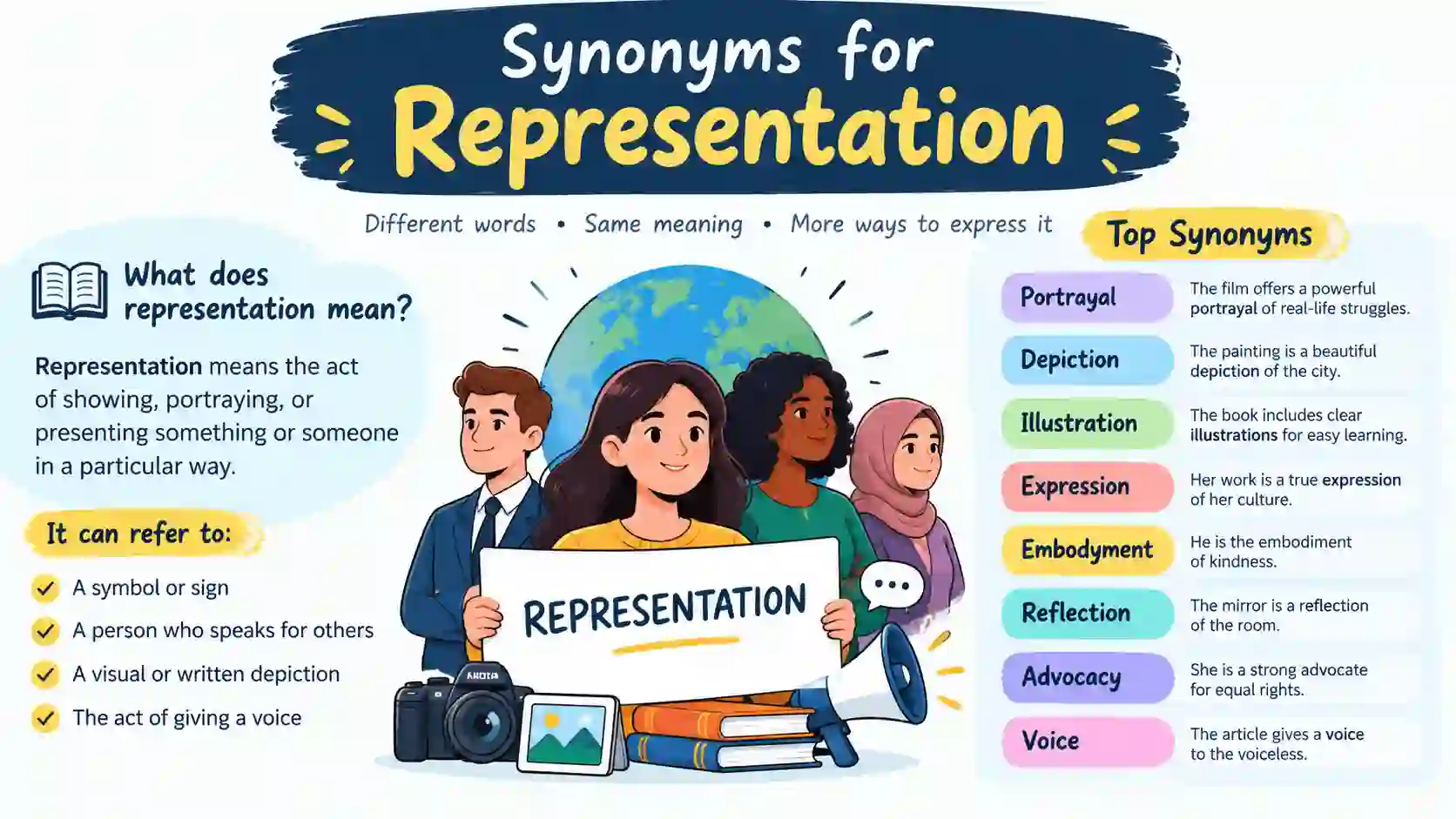
The best synonyms for representation include portrayal, depiction, description, illustration, image, picture, account, presentation, and likeness. In legal or political contexts, representation can mean acting on someone’s behalf. In art and writing, it often means showing or describing something. Choose a synonym that matches your intended meaning.
What word can you use instead of representation without changing the meaning of your sentence?
The answer depends on what you want to express. If you are discussing a painting, depiction may fit. If you are describing a character in a novel, portrayal is often better And if you mean someone speaking for a group, advocacy or representation by a delegate may be relevant, depending on the exact situation.
Representation is a useful word in education, business, law, politics, art, and everyday communication. However, replacing it with the wrong synonym can make your writing unclear.
This guide explores 30 synonyms for representation, with simple meanings, original examples, common collocations, and usage notes. You will also learn how to choose the right word, avoid common mistakes, and improve your English vocabulary.
Pronunciation and Meaning
- Word: Representation
- IPA: /ˌrep.rɪ.zenˈteɪ.ʃən/
- Pronunciation guide: rep-ri-zen-TAY-shun
- Part of speech: Noun
- Plural: Representations
Representation has several meanings:
- The act of showing or describing something.
- An image, model, or symbol of something.
- The act of speaking or acting for another person or group.
- The inclusion of different groups in a workplace, institution, or public setting.
- A formal statement or claim, especially in legal or official contexts.
Grammar and Common Usage
Representation is a noun. Its related verb is represented.
- The painting is a representation of rural life.
- The lawyer provides legal representation.
- The report gives an accurate representation of the results.
- The organization wants better representation of women in leadership.
Common patterns include representation of, representation in, representation by, and representation for.
For example, “representation of children in films” refers to how children are shown, while “representation of children on the committee” refers to their presence or the presence of people speaking for them.
30 Synonyms for Representation
The alternatives below are grouped by their usual meanings. Their suitability depends on context, so not every word is interchangeable with representation.
Quick Synonym Table
| Synonym | Main meaning | Register |
| 1. Portrayal | How something is shown | Neutral |
| 2. Depiction | A visual or verbal presentation | Formal |
| 3. Description | An explanation in words | Neutral |
| 4. Illustration | A picture or explanatory example | Neutral |
| 5. Image | A picture or impression | Neutral |
| 6. Picture | A visual image or general impression | Neutral |
| 7. Account | A report of events | Neutral |
| 8. Presentation | The way information is shown | Neutral |
| 9. Likeness | A close visual resemblance | Neutral |
| 10. Portrait | An image or character study | Neutral |
| 11. Symbol | Something that stands for an idea | Neutral |
| 12. Emblem | An official or identifying symbol | Formal |
| 13. Diagram | A drawing that explains a system | Academic |
| 14. Model | A simplified version of something | Technical |
| 15. Rendering | An artistic or digital version | Technical |
| 16. Interpretation | An explanation of meaning | Academic |
| 17. Expression | The communication of an idea or feeling | Neutral |
| 18. Reflection | Something that mirrors a quality or situation | Neutral |
| 19. Embodiment | A person or thing that strongly expresses a quality | Formal |
| 20. Example | A case that explains an idea | Neutral |
| 21. Statement | A spoken or written declaration | Formal |
| 22. Report | An organized account of information | Neutral |
| 23. Narrative | An account told as a story | Neutral |
| 24. Illustration in words | A verbal explanation through an example | Academic |
| 25. Reproduction | A copy of an original | Formal |
| 26. Replica | A copy or close imitation | Neutral |
| 27. Delegation | A group sent to represent others | Formal |
| 28. Advocacy | Active support for a person or cause | Formal |
| 29. Voice | The ability to express views or influence decisions | Neutral |
| 30. Sign | Something that indicates or communicates meaning | Neutral |
1. Portrayal
Meaning: Portrayal describes how a person, event, or situation is shown.
Examples:
- The film offers a fair portrayal of village life.
- The novel gives a thoughtful portrayal of a young teacher.
Best used when: Discussing films, books, characters, or social issues.
Tone: Neutral | Approximate CEFR: B2 | Frequency: Common
Collocations: realistic portrayal, positive portrayal, portrayal of women.
When not to use it: Avoid it when you mean legal representation or a technical diagram.
2. Depiction
Meaning: A depiction shows or describes something in a particular way.
Examples:
- The painting provides a vivid depiction of winter.
- The documentary presents a detailed depiction of life in the city.
Best used when: Discussing art, media, history, and visual communication.
Tone: Formal | Approximate CEFR: C1 | Frequency: Common
Collocations: accurate depiction, visual depiction, depiction of violence.
When not to use it: Use advocacy when you mean active support for a cause.
3. Description
Meaning: A description explains what someone or something is like.
Examples:
- Her description of the damaged building was clear.
- The report includes a detailed description of the process.
Best used when: Information is communicated mainly through words.
Tone: Neutral | Approximate CEFR: A2–B1 | Frequency: Very common
Collocations: detailed description, brief description, accurate description.
When not to use it: It is not the best choice for a physical model or an official representative.
4. Illustration
Meaning: An illustration is a picture or example that makes an idea easier to understand.
Examples:
- The textbook includes an illustration of the human heart.
- This case provides an illustration of the problem.
Best used when: Explaining ideas with pictures, diagrams, or examples.
Tone: Neutral | Approximate CEFR: B1–B2 | Frequency: Very common
Collocations: clear illustration, book illustration, practical illustration.
When not to use it: Do not use it as a substitute for advocacy or legal representation.
5. Image
Meaning: An image is a picture or an idea formed in the mind.
Examples:
- The website displays an image of the old bridge.
- The campaign improved the company’s public image.
Best used when: Discussing pictures, public impressions, or mental pictures.
Tone: Neutral | Approximate CEFR: A2–B1 | Frequency: Very common
Collocations: public image, visual image, mental image.
When not to use it: Use description when you need a detailed verbal explanation.
6. Picture
Meaning: A picture is a visual image or a general understanding of a situation.
Examples:
- The chart gives a clear picture of monthly sales.
- We need a complete picture before making a decision.
Best used when: Speaking about images or summarizing a situation in everyday English.
Tone: Neutral | Approximate CEFR: A1–A2 | Frequency: Very common
Collocations: clear picture, complete picture, picture of life.
When not to use it: A diagram is more precise when explaining how a system works.
7. Account
Meaning: An account is a report of events, facts, or experiences.
Examples:
- The witness gave an account of the accident.
- Her account of the meeting helped resolve the disagreement.
Best used when: Reporting what happened or explaining an experience.
Tone: Neutral to formal | Approximate CEFR: B1–B2 | Frequency: Very common
Collocations: first-hand account, detailed account, accurate account.
When not to use it: Do not use it when you specifically mean a picture or a visual symbol.
8. Presentation
Meaning: A presentation is the way information or an idea is shown to others.
Examples:
- The presentation of the findings was clear.
- A simple presentation of the data helped the audience understand the results.
Best used when: Discussing reports, information, speeches, or visual communication.
Tone: Neutral to formal | Approximate CEFR: B1–B2 | Frequency: Very common
Collocations: clear presentation, visual presentation, presentation of evidence.
When not to use it: It does not automatically mean someone is speaking on another person’s behalf.
9. Likeness
Meaning: A likeness is an image or a close resemblance to someone or something.
Examples:
- The artist created a likeness of the mayor.
- The drawing bears a strong likeness to the original building.
Best used when: Discussing portraits, sculptures, or visual resemblance.
Tone: Neutral | Approximate CEFR: C1 | Frequency: Common
Collocations: striking likeness, faithful likeness, likeness of a person.
When not to use it: It is unsuitable for a report or an official role.
10. Portrait
Meaning: A portrait is a picture of a person or a description of someone’s character.
Examples:
- The gallery displayed a portrait of a famous scientist.
- The biography paints a portrait of a determined leader.
Best used when: Discussing artwork, biographies, or character descriptions.
Tone: Neutral | Approximate CEFR: B1–B2 | Frequency: Common
Collocations: family portrait, painted portrait, portrait of leadership.
When not to use it: A portrait is too specific for most charts, systems, or official statements.
11. Symbol
Meaning: A symbol is a sign or object that stands for an idea.
Examples:
- The dove is a symbol of peace in many settings.
- The badge became a symbol of the team’s unity.
Best used when: Explaining ideas through signs, objects, or images.
Tone: Neutral | Approximate CEFR: B1 | Frequency: Very common
Collocations: powerful symbol, cultural symbol, symbol of hope.
When not to use it: A symbol may suggest an idea without showing every detail of it.
12. Emblem
Meaning: An emblem is a design or sign that identifies a group or represents an idea.
Examples:
- The school uses a tree as its emblem.
- The national emblem appeared on the official document.
Best used when: Discussing official symbols, badges, or identifying designs.
Tone: Formal | Approximate CEFR: C1 | Frequency: Common
Collocations: national emblem, official emblem, family emblem.
When not to use it: Choose an image for an ordinary picture without a symbolic purpose.
13. Diagram
Meaning: A diagram is a drawing that explains a process, structure, or system.
Examples:
- The diagram shows how water moves through the filter.
- A labeled diagram helped the class understand the machine.
Best used when: Explaining technical information, processes, and relationships.
Tone: Academic | Approximate CEFR: B1–B2 | Frequency: Very common
Collocations: labeled diagram, flow diagram, diagram of a system.
When not to use it: It is not a suitable replacement for a character portrayal or legal representation.
14. Model
Meaning: A model is a simplified version of something or an example used to explain it.
Examples:
- The architect built a model of the new library.
- The model shows how the business could grow.
Best used when: Discussing prototypes, systems, and simplified versions of reality.
Tone: Neutral to technical | Approximate CEFR: A2–B1 | Frequency: Very common
Collocations: scale model, mathematical model, model of a system.
When not to use it: A model may simplify reality rather than reproduce every detail.
15. Rendering
Meaning: A rendering is an artistic, digital, or visual version of something.
Examples:
- The designer prepared a rendering of the proposed hotel.
- The artist created a detailed rendering of the landscape.
Best used when: Discussing digital graphics, architecture, design, or art.
Tone: Technical or artistic | Approximate CEFR: C1 | Frequency: Common in specialist contexts
Collocations: 3D rendering, artist’s rendering, digital rendering.
When not to use it: Avoid it in ordinary writing when picture or drawing is clearer.
16. Interpretation
Meaning: An interpretation is the meaning someone gives to information, art, or events.
Examples:
- Her interpretation of the poem differed from mine.
- The graph supports one interpretation of the survey results.
Best used when: Discussing meaning, analysis, or different ways to understand information.
Tone: Academic | Approximate CEFR: B2–C1 | Frequency: Very common
Collocations: personal interpretation, alternative interpretation, interpretation of data.
When not to use it: It does not mean an exact copy or a faithful visual reproduction.
17. Expression
Meaning: Expression is the communication of an idea, feeling, or belief.
Examples:
- The painting is an expression of grief.
- The speech became an expression of public concern.
Best used when: Focusing on feelings, beliefs, and ideas being communicated.
Tone: Neutral | Approximate CEFR: B1–B2 | Frequency: Very common
Collocations: artistic expression, self-expression, expression of concern.
When not to use it: It is not always a substitute for a picture or an official representative.
18. Reflection
Meaning: A reflection can be an image on a surface or something that reveals a quality or situation.
Examples:
- The report is a reflection of changing customer needs.
- Her work reflects years of practice.
Best used when: Something mirrors or reveals a wider situation.
Tone: Neutral | Approximate CEFR: B1–B2 | Frequency: Very common
Collocations: reflection of society, reflection of values, accurate reflection.
When not to use it: Use depiction when you mean a direct visual or descriptive presentation.
19. Embodiment
Meaning: Embodiment is a person or thing that expresses an idea or quality strongly.
Examples:
- She is the embodiment of patience.
- The building is an embodiment of modern design.
Best used when: One person or thing strongly expresses an abstract quality.
Tone: Formal | Approximate CEFR: C1 | Frequency: Common
Collocations: embodiment of courage, embodiment of an ideal, living embodiment.
When not to use it: Use a symbol for a sign that stands for an idea without fully expressing it.
20. Example
Meaning: An example is a person or thing that helps explain a wider idea.
Examples:
- This case is an example of fair treatment.
- The teacher used a simple example to explain the rule.
Best used when: Showing a particular case that helps readers understand a point.
Tone: Neutral | Approximate CEFR: A1–A2 | Frequency: Very common
Collocations: clear example, practical example, example of success.
When not to use it: An example may illustrate a group without representing the whole group accurately.
21. Statement
Meaning: A statement is something said or written to communicate information or a position.
Examples:
- The company issued a statement about the delay.
- Her written statement explained the main concern.
Best used when: Referring to formal claims, opinions, or official communication.
Tone: Formal | Approximate CEFR: B1–B2 | Frequency: Very common
Collocations: official statement, written statement, statement of facts.
When not to use it: A statement is not a visual image or a group of representatives.
22. Report
Meaning: A report is an organized account of facts, findings, or events.
Examples:
- The report presents the survey results clearly.
- The journalist prepared a report on the local election.
Best used when: Sharing researched information or recorded events.
Tone: Neutral to formal | Approximate CEFR: B1–B2 | Frequency: Very common
Collocations: detailed report, annual report, report on findings.
When not to use it: A report may contain a representation, but the two words do not always mean the same thing.
23. Narrative
Meaning: A narrative is an account of events, usually presented as a story.
Examples:
- The book offers a narrative of the town’s history.
- The documentary presents a different narrative about the event.
Best used when: Discussing stories, history, media, or the way events are explained.
Tone: Neutral to academic | Approximate CEFR: B2–C1 | Frequency: Common
Collocations: personal narrative, dominant narrative, historical narrative.
When not to use it: It is too specific when you simply mean a picture or a technical model.
24. Illustration in Words
Meaning: This phrase describes an explanation that uses language to make an idea clear.
Examples:
- The story serves as an illustration in words of everyday kindness.
- The writer offers an illustration in words of the family’s struggle.
Best used when: Explaining an abstract idea through a verbal example.
Tone: Academic | Approximate CEFR: B2–C1 | Frequency: Uncommon as a fixed phrase
Collocations: clear illustration, useful illustration, illustration of a principle.
When not to use it: In most cases, description or example sounds more natural.
25. Reproduction
Meaning: A reproduction is a copy of an original image, object, or work.
Examples:
- The museum shop sells a reproduction of the painting.
- The textbook includes a reproduction of the original map.
Best used when: Discussing copies of artworks, documents, or other objects.
Tone: Formal | Approximate CEFR: B2 | Frequency: Common
Collocations: faithful reproduction, digital reproduction, exact reproduction.
When not to use it: A reproduction is a copy, not necessarily a new interpretation.
26. Replica
Meaning: A replica is a copy or close imitation of an original object.
Examples:
- The museum displayed a replica of an ancient ship.
- The designer built a replica of the historic doorway.
Best used when: Discussing objects, structures, and carefully made copies.
Tone: Neutral | Approximate CEFR: B2 | Frequency: Common
Collocations: exact replica, full-size replica, replica of an original.
When not to use it: A replica usually refers to a physical or visual copy, not a person’s role in government.
27. Delegation
Meaning: A delegation is a group sent to represent an organization or community.
Examples:
- A delegation met the minister to discuss local concerns.
- The delegation arrived with a list of requests.
Best used when: Describing official groups at meetings or negotiations.
Tone: Formal | Approximate CEFR: B2–C1 | Frequency: Common
Collocations: official delegation, trade delegation, send a delegation.
When not to use it: It does not mean a picture, description, or portrayal.
28. Advocacy
Meaning: Advocacy is the act of supporting a person, group, or cause.
Examples:
- Her advocacy helped improve access to education.
- The organization promotes advocacy for children’s rights.
Best used when: Discussing active support, campaigning, or speaking up for others.
Tone: Formal | Approximate CEFR: C1 | Frequency: Common in policy and social contexts
Collocations: public advocacy, human rights advocacy, advocacy for change.
When not to use it: Advocacy is not a synonym for showing someone in a film or picture.
29. Voice
Meaning: In social or political contexts, voice refers to the ability to express views or influence decisions.
Examples:
- Employees want a voice in workplace decisions.
- The council gave local residents a voice in the planning process.
Best used when: Discussing participation, influence, and the ability to express opinions.
Tone: Neutral | Approximate CEFR: B1 | Frequency: Very common
Collocations: have a voice, give someone a voice, a voice in decision-making.
When not to use it: A voice does not always mean formal or legally authorized representation.
30. Sign
Meaning: A sign is something that indicates or communicates a meaning.
Examples:
- The white flag was a sign of surrender.
- Rising sales were a sign of stronger demand.
Best used when: Something points to an idea, condition, or message.
Tone: Neutral | Approximate CEFR: A1–A2 | Frequency: Very common
Collocations: clear sign, warning sign, sign of change.
When not to use it: A sign may indicate something without fully describing or representing it.
Choose the Right Synonym for Representation
| If you mean… | Best word | Example |
| How a character is shown | Portrayal | The novel offers a fair portrayal of the character. |
| A picture or visual presentation | Depiction | The mural is a depiction of village life. |
| An explanation in words | Description | Her description of the room was accurate. |
| A drawing that explains a system | Diagram | The diagram explains the water cycle. |
| A copy of an original | Reproduction | The gallery sells a reproduction of the painting. |
| Someone acting for a group | Representation | The workers requested union representation. |
| Support for a cause | Advocacy | The organization supports advocacy for education. |
| Inclusion in public life | Representation | The group wants greater representation in parliament. |
| A report of events | Account | The witness gave an account of the incident. |
| A sign that stands for an idea | Symbol | The dove is a symbol of peace. |
Important Distinction: Representation in Society
When discussing diversity, politics, workplaces, or media, representation often means that people from a group are included or have a voice.
For example:
- Representation in media: How different groups appear in films, news, and other media.
- Political representation: People or elected officials speaking for a community.
- Workplace representation: Employees having a voice or representatives in workplace matters.
- Demographic representation: The presence of different groups within a population or organization.
In these contexts, portrayal describes how a group is shown, while inclusion emphasizes whether people are included. Advocacy refers to support for a group, and delegation usually refers to a group of people sent to represent others.
Commonly Confused Words
| Word | Main difference | Example |
| Representation | A broad term for showing or acting for something | The chart is a representation of sales. |
| Portrayal | The way someone or something is shown | The film offers a positive portrayal of teachers. |
| Depiction | A visual or descriptive presentation | The painting depicts a crowded market. |
| Resemblance | Similarity in appearance or qualities | The drawing bears a close resemblance to the original. |
| Misrepresentation | An inaccurate or misleading presentation | The advertisement was a misrepresentation of the product. |
Common Mistakes to Avoid
Mistake 1
Incorrect: The picture is an advocacy of village life.
Correct: The picture is a portrayal of village life.
Why: Advocacy means active support for a cause, not a visual description.
Mistake 2
Incorrect: The diagram is a portrait of the machine.
Correct: The diagram is a visual representation of the machine.
Why: A portrait usually refers to a person or a description of someone’s character.
Mistake 3
Incorrect: She gave a representation about the accident.
Better: She gave an account of the accident.
Why: Account is more natural when reporting what happened. In legal settings, representation can have a specific technical meaning.
Mistake 4
Incorrect: The logo is a depiction of peace.
Better: The logo is a symbol of peace.
Why: A symbol stands for an idea, while a depiction shows or describes something.
Mistake 5
Incorrect: A replica is always an original representation.
Better: A replica is a copy or close imitation of an original.
Why: A replica may reproduce the appearance of an object, but it is not the original object itself.
Writing Tips for Students and Professionals
- Essays: Use portrayal, depiction, or interpretation when discussing art, literature, or society.
- Emails: Use description, account, or statement when sharing information.
- Blog posts: Use image, illustration, and example to explain concepts.
- Stories: Use portrait, portrayal, or narrative when discussing characters and events.
- Social media: Use images, pictures, and symbols in everyday posts.
- Business writing: Use presentation, report, or statement when discussing information and findings.
- Legal or political writing: Use representation when referring to an authorized role, formal statements, or inclusion in decision-making.
Writing tip: Do not replace a word simply to avoid repetition. Replace it when the new word makes your meaning more exact.
Related Vocabulary
Antonyms and Contrasting Terms
Representation has no single antonym that works in every context.
- Absence: The state of not being present.
- Omission: Leaving something out.
- Misrepresentation: Presenting something inaccurately or misleadingly.
- Original: The source rather than a copy.
- Exclusion: Keeping someone or something out.
Word Family
| Word | Part of speech | Meaning |
| Represent | Verb | To show or act on behalf of someone |
| Representative | Noun/adjective | Someone who represents others, or something typical |
| Representational | Adjective | Relating to the act or form of representing |
| Misrepresent | Verb | To present something inaccurately |
| Misrepresentation | Noun | An inaccurate or misleading presentation |
| Underrepresentation | Noun | Having less representation than expected or appropriate |
Frequently Asked Questions
1. What is the best synonym for representation?
Portrayal and depiction are strong choices when discussing how something is shown. Description works better for written explanations, while advocacy refers to active support for people or causes. The best alternative depends on the meaning you want to express.
2. What is another word for representation in an essay?
Useful alternatives include portrayal, depiction, interpretation, illustration, and reflection. Use portrayal when discussing characters or social groups, and interpretation when explaining evidence or meaning. Always check that the alternative preserves your original point.
3. What is a formal synonym for representation?
Formal alternatives include depiction, statement, delegation, and advocacy, depending on context. Use a statement for an official declaration, delegation for a group representing others, and depiction for a visual or descriptive presentation. These words are related but not interchangeable.
4. What is a synonym for representation in art?
Common choices include depiction, portrayal, image, likeness, rendering, and reproduction. A rendering may show an artist’s version of a subject, while a reproduction is a copy of an existing work. Choose the word that matches the artwork’s purpose.
5. What is the difference between representation and portrayal?
Representation is the broader term. It can refer to an image, a statement, or someone acting on behalf of others. Portrayal usually describes how a person, event, or situation appears in art, writing, film, or public discussion.
6. What is the difference between representation and depiction?
Depiction usually focuses on showing or describing something, especially visually or through language. Representation has a wider range of meanings, including acting for someone, standing for an idea, or showing a group’s presence in society. The two words overlap when discussing images and art.
7. What is the opposite of representation?
The opposite depends on the context. Absence or exclusion may contrast with representation when discussing inclusion. Original contrasts with a copy in some contexts, while misrepresentation means presenting something inaccurately rather than representing it faithfully.
8. Is representation a noun or a verb?
Representation is a noun. Its related verb is represented. For example, “The chart is a representation of sales” uses the noun, while “The chart represents sales” uses the verb. Representative can function as either a noun or an adjective.
Vocabulary Quiz
1. Which word best describes the way a film shows a character?
A. Delegation
B. Portrayal
C. Advocacy
D. Statement
2. Which word means a sign that stands for an idea?
A. Account
B. Description
C. Symbol
D. Presentation
3. Which word best fits a report of what happened in an accident?
A. Account
B. Portrait
C. Emblem
D. Rendering
4. Which word means active support for a cause?
A. Likeness
B. Depiction
C. Reproduction
D. Advocacy
5. Which word is most suitable for a drawing that explains how a machine works?
A. Diagram
B. Portrait
C. Reflection
D. Delegation
Answer Key
- B. Portrayal
- C. Symbol
- A. Account
- D. Advocacy
- A. Diagram
Conclusion
Learning synonyms for representation helps you express ideas more clearly in essays, reports, emails, stories, and conversations. Words such as portrayal, depiction, description, and advocacy have different uses, so choose the one that fits your meaning.
Practise using one new word each day, and your vocabulary will grow naturally. The right word can make even a simple sentence more accurate and effective.
References
- Cambridge Dictionary: https://dictionary.cambridge.org/dictionary/english/representation
- Cambridge Thesaurus: https://dictionary.cambridge.org/us/thesaurus/representation
- Collins English Thesaurus: https://www.collinsdictionary.com/dictionary/english-thesaurus/representation
- Merriam-Webster: https://www.merriam-webster.com/dictionary/representation
- Thesaurus.com: https://www.thesaurus.com/browse/representation

Synonorm is a trusted English vocabulary resource created to help readers find the right words and understand the differences between similar terms. We provide clear explanations of synonyms, meanings, examples, usage, and alternatives. Our content makes vocabulary easier to learn and apply in everyday, academic, and professional English. Synonorm is designed for students, writers, ESL learners, professionals, and anyone who wants to improve their English vocabulary and communicate more clearly.