Quick Answer: What Are Synonyms for Manifest?
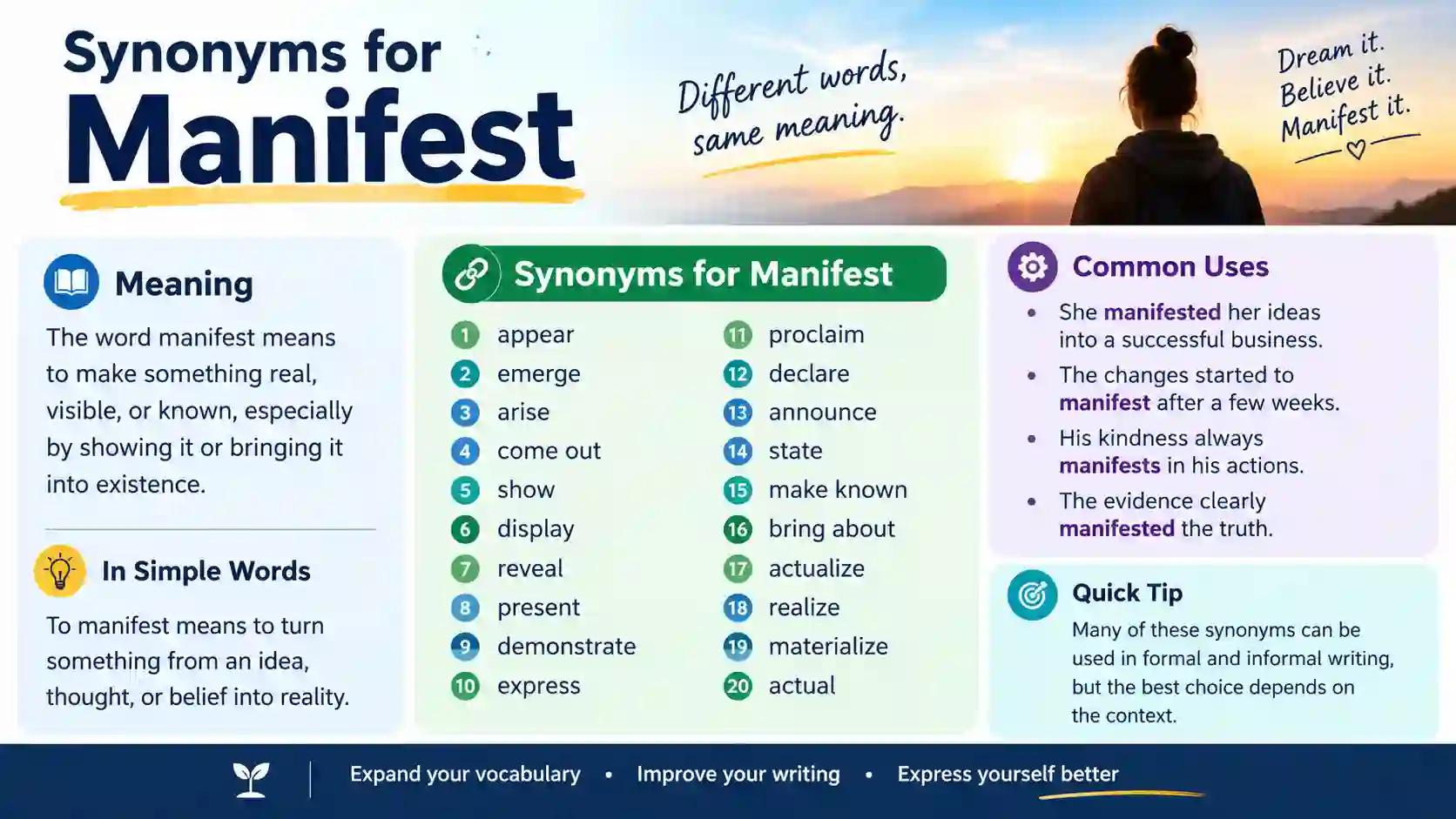
Synonyms for manifest include show, reveal, display, demonstrate, express, exhibit, indicate, and make evident. The best word depends on the meaning. Use show for everyday situations, reveal for hidden information, demonstrate for evidence, and appear when something becomes visible. Some alternatives have narrower meanings, so they cannot replace manifest in every sentence.
Have you ever wanted to explain how a feeling becomes visible or how evidence makes a fact clear? The word manifest can describe both situations, but it may sound too formal in everyday English.
For example, you can say, “Her actions show kindness,” or “Her kindness manifests itself in small acts of care.” Both sentences express a similar idea, but the second sounds more formal.
This guide covers 30 synonyms for manifest, including their meanings, original examples, common word combinations, and usage differences. You will also learn the word’s pronunciation, grammar, origin, and common mistakes. These tips will help you choose the right word for essays, emails, articles, conversations, and professional writing.
Pronunciation of Manifest
- IPA (US): /ˈmæn.ə.fest/
- IPA (UK): /ˈmæn.ɪ.fest/
- Simple pronunciation: MAN-uh-fest
- Syllables: Three
- Stress: First syllable
The vowel in the second syllable differs between common US and UK pronunciations. Regional accents may vary.
Meaning and Parts of Speech
Manifest has three main grammatical uses.
1. Verb: To show a quality, feeling, symptom, or fact clearly.
Example: His nervousness manifested itself in restless movements.
2. Adjective: Clear, obvious, or easy to recognize.
Example: The review found a manifest error in the calculation.
3. Noun: An official list of passengers, cargo, or goods being transported.
Example: The shipping agent checked the cargo manifest.
The adverb manifestly means obviously or clearly. For example, “The plan was manifestly unfair.”
Word Origin and First Known Use
Manifest entered English through Middle English and is linked to Old French manifeste and Latin manifestus, meaning clear, evident, or readily perceived. Historical dictionaries record the adjective and verb in medieval English, with some meanings developing later.
The exact first recorded date depends on the word’s grammatical form and the historical source. The Online Etymology Dictionary places the adjective in the late 14th century and the verb in the late 14th century as well. These dates refer to recorded English usage, not necessarily the first time anyone spoke the word.
Grammar: How to Use Manifest
The correct sentence pattern depends on the meaning.
| Pattern | Example |
|---|---|
| Manifest + noun | Her actions manifest genuine concern. |
| Manifest itself in + noun | Stress can manifest itself in poor sleep. |
| Manifest itself as + noun | The problem manifested itself as a delay. |
| Be manifest in + noun | His experience was manifest in the quality of his work. |
| Manifest + adjective + noun | The audit found a manifest error. |
Common grammar tip: When a quality or condition becomes noticeable, English often uses manifest itself.
Correct: The illness manifested itself through several symptoms.
Also correct: Several symptoms manifested during the week.
Avoid using manifest as a general replacement for every verb meaning “show.” Choose a word that matches the action.
Synonyms for Manifest: Quick Comparison
| Synonym | Strength of match | Formality |
|---|---|---|
| Show | Very close | Neutral |
| Reveal | Very close in the verb sense | Neutral |
| Display | Very close in the verb sense | Neutral |
| Demonstrate | Close when evidence is involved | Formal |
| Express | Close for feelings or ideas | Neutral |
| Exhibit | Close for qualities or symptoms | Formal |
| Indicate | Context-dependent | Formal |
| Make evident | Close when clarity is intended | Formal |
| Make clear | Context-dependent | Neutral |
| Disclose | Specific to sharing information | Formal |
| Uncover | Specific to discovery | Neutral |
| Expose | Specific to revealing something hidden | Neutral |
| Unveil | Specific to a public reveal | Formal |
| Evince | Close but uncommon | Literary |
| Prove | Stronger than indicate | Neutral |
| Confirm | Specific to verification | Neutral |
| Signal | Suggests a sign or message | Neutral |
| Suggest | Weaker than prove | Neutral |
| Reflect | Represents an underlying quality | Neutral |
| Convey | Communicates meaning | Neutral |
| Communicate | Shares information or feelings | Neutral |
| Present | Introduces information or evidence | Neutral |
| Appear | Become visible or seem | Neutral |
| Emerge | Gradually become visible or known | Neutral |
| Surface | Become known after being hidden | Neutral |
| Become apparent | Become clear | Neutral |
| Become visible | Become physically noticeable | Neutral |
| Materialize | Appear or become real | Neutral |
| Embody | Represent a quality or idea | Formal |
| Realize | Make a goal or idea real | Neutral |
The table includes close synonyms and context-dependent alternatives. The latter are useful only when the sentence supports their specific meaning.
30 Synonyms for Manifest With Examples
1. Show
Meaning: To let someone see or understand something.
- Her actions show that she cares about the team.
- The chart shows a steady rise in sales.
Best used when: You need a simple word for everyday communication.
Tone and register: Neutral, spoken English, academic writing.
Collocations: Show respect, show interest, show improvement.
CEFR: A1, approximate. Frequency: Very common.
When not to use it: Avoid show when you specifically mean that someone has uncovered a secret or proved a claim.
2. Reveal
Meaning: To make something hidden or unknown known.
- The letter revealed why the family had moved.
- Her expression revealed her disappointment.
Best used when: A fact, feeling, or secret becomes known.
Tone and register: Neutral, journalistic, literary.
Collocations: Reveal a secret, reveal the truth, reveal details.
CEFR: B1, approximate. Frequency: Common.
Nuance: Suggests that something was previously hidden or unknown.
When not to use it: Avoid it when describing a quality that was already obvious to everyone.
3. Display
Meaning: To show a quality, feeling, or object.
- The coach displayed patience during the difficult match.
- The screen displays the current temperature.
Best used when: A quality or item is openly presented or visible.
Tone and register: Neutral, technical, business.
Collocations: Display confidence, display emotion, display information.
CEFR: B1, approximate. Frequency: Common.
When not to use it: Do not use it when you mean that an event has begun to happen naturally.
4. Demonstrate
Meaning: To show something clearly through evidence, actions, or examples.
- The student demonstrated strong problem-solving skills.
- The trial demonstrated how well the filter worked.
Best used when: You need to support a point with evidence or action.
Tone and register: Formal, academic, business.
Collocations: Demonstrate ability, demonstrate effectiveness, demonstrate knowledge.
CEFR: B1, approximate. Frequency: Common.
Nuance: Usually implies a clear or purposeful showing.
When not to use it: Avoid it for a simple physical appearance when appear is more accurate.
5. Express
Meaning: To communicate a thought, feeling, or opinion.
- She expressed concern about the late delivery.
- His speech expressed gratitude to the volunteers.
Best used when: A person communicates an inner feeling or thought.
Tone and register: Neutral, formal, academic.
Collocations: Express concern, express gratitude, express an opinion.
CEFR: B1, approximate. Frequency: Common.
When not to use it: Do not use it for a physical symptom that appears without anyone choosing to communicate it.
6. Exhibit
Meaning: To show a quality, behavior, or feature.
- The young artist exhibited remarkable creativity.
- The metal exhibited signs of corrosion after months outdoors.
Best used when: Describing behavior, qualities, symptoms, or technical findings.
Tone and register: Formal, academic, professional.
Collocations: Exhibit symptoms, exhibit behavior, exhibit characteristics.
CEFR: B2, approximate. Frequency: Common.
Nuance: Often sounds more technical than show.
When not to use it: In casual conversation, show may sound more natural.
7. Indicate
Meaning: To point toward a fact or possible conclusion.
- The dark clouds indicate a chance of rain.
- Her high score indicates strong reading skills.
Best used when: A sign or piece of evidence suggests something.
Tone and register: Formal, academic, business.
Collocations: Indicate a trend, indicate a problem, indicate a preference.
CEFR: B1, approximate. Frequency: Common.
Nuance: It does not always mean that something has been proved.
When not to use it: Do not use it as a stronger substitute for prove when the evidence is uncertain.
8. Make evident
Meaning: To make something clear or easy to recognize.
- The report made the financial risks evident.
- Her careful notes made her preparation evident.
Best used when: You want to emphasize that a fact has become clear.
Tone and register: Formal, academic.
Collocations: Make a need evident, make the problem evident, make a difference evident.
CEFR: B2, approximate. Frequency: Common as a phrase.
When not to use it: Choose show if a shorter, simpler sentence will work just as well.
9. Make clear
Meaning: To explain or show something so people understand it.
- The manager made clear that safety came first.
- Her results make clear how much practice matters.
Best used when: You want to remove doubt or confusion.
Tone and register: Neutral, academic, business.
Collocations: Make expectations clear, make a point clear, make your position clear.
CEFR: A2–B1, approximate. Frequency: Very common as a phrase.
When not to use it: Do not use it when you mean that an object physically appeared.
10. Disclose
Meaning: To share information that was previously private or unknown.
- The company disclosed its annual expenses.
- He disclosed the reason for leaving the project.
Best used when: Sharing official, confidential, or previously withheld information.
Tone and register: Formal, legal, business.
Collocations: Disclose information, disclose details, disclose a conflict of interest.
CEFR: B2, approximate. Frequency: Common in professional settings.
When not to use it: Avoid it for ordinary facial expressions or natural physical changes.
11. Uncover
Meaning: To discover something hidden.
- The audit uncovered several accounting errors.
- Researchers uncovered evidence of an older settlement.
Best used when: Someone discovers a fact, problem, or secret.
Tone and register: Neutral, investigative, journalistic.
Collocations: Uncover evidence, uncover a problem, uncover the truth.
CEFR: B1–B2, approximate. Frequency: Common.
When not to use it: Do not use it when you are merely observing a fact that was already known.
12. Expose
Meaning: To reveal something hidden, harmful, or dishonest.
- The investigation exposed serious safety failures.
- The bright light exposed every crack in the wall.
Best used when: A hidden problem or physical feature becomes visible.
Tone and register: Neutral, investigative, sometimes critical.
Collocations: Expose corruption, expose a weakness, expose a flaw.
CEFR: B1–B2, approximate. Frequency: Common.
Nuance: Can suggest criticism, risk, or an unwanted discovery.
When not to use it: Avoid it for a neutral feeling becoming noticeable unless the context fits.
13. Unveil
Meaning: To reveal something new or previously hidden.
- The studio unveiled its new animation software.
- The museum unveiled a restored painting.
Best used when: Introducing a product, plan, artwork, or announcement.
Tone and register: Formal, journalistic, promotional.
Collocations: Unveil a plan, unveil a product, unveil a design.
CEFR: B2, approximate. Frequency: Common in news and business.
When not to use it: Do not use it for an ordinary sign of tiredness or anger.
14. Evince
Meaning: To show a feeling, quality, or fact clearly.
- Her careful questions evinced a deep interest in the subject.
- The witness evinced little confidence in the identification.
Best used when: Writing formal or literary prose about attitudes and qualities.
Tone and register: Formal, literary, academic.
Collocations: Evince interest, evince concern, evince a willingness.
CEFR: C1–C2, approximate. Frequency: Uncommon.
Nuance: A precise but elevated alternative to show.
When not to use it: Avoid it in beginner writing, casual messages, and simple instructions.
15. Prove
Meaning: To establish that something is true with strong evidence.
- The records proved that the payment had arrived.
- Repeated trials proved the method reliable under the tested conditions.
Best used when: Evidence establishes a claim or conclusion.
Tone and register: Neutral, academic, legal.
Collocations: Prove a claim, prove a point, prove innocence.
CEFR: A2–B1, approximate. Frequency: Very common.
Nuance: Stronger than indicate or suggest.
When not to use it: Do not say evidence proves something if it only makes that conclusion more likely.
16. Confirm
Meaning: To establish that information is correct or true.
- The second test confirmed the earlier result.
- A phone call confirmed our booking.
Best used when: New information supports something already reported or suspected.
Tone and register: Neutral, business, academic.
Collocations: Confirm a result, confirm a booking, confirm a suspicion.
CEFR: A2–B1, approximate. Frequency: Very common.
When not to use it: Avoid it when there is no earlier claim or expectation to check.
17. Signal
Meaning: To give a sign that something is happening or may happen.
- The falling temperature signaled the arrival of winter.
- Her quick reply signaled renewed interest in the project.
Best used when: An action or event acts as a clue or warning.
Tone and register: Neutral, academic, business.
Collocations: Signal a change, signal intent, signal the start.
CEFR: B1, approximate. Frequency: Common.
When not to use it: Do not use it when you need to say that a claim has been conclusively demonstrated.
18. Suggest
Meaning: To give an idea or sign without stating it as certain.
- The early results suggest a link between sleep and memory.
- His tone suggested that he disliked the decision.
Best used when: Evidence points toward a possible explanation.
Tone and register: Neutral, academic, spoken English.
Collocations: Suggest a reason, suggest a link, suggest a solution.
CEFR: A2–B1, approximate. Frequency: Very common.
Nuance: More cautious than prove.
When not to use it: Avoid it when you need to state a directly observed fact clearly.
19. Reflect
Meaning: To show or represent a quality, feeling, or situation.
- Her writing reflects years of careful study.
- The survey reflects changing customer preferences.
Best used when: Something represents a deeper quality, value, or pattern.
Tone and register: Neutral, academic, literary.
Collocations: Reflect change, reflect values, reflect experience.
CEFR: B1, approximate. Frequency: Common.
When not to use it: Do not use it when you mean that something suddenly appeared or was newly revealed.
20. Convey
Meaning: To communicate an idea, feeling, or message.
- The photograph conveys a sense of calm.
- His short email conveyed genuine appreciation.
Best used when: A message, image, voice, or action communicates meaning.
Tone and register: Neutral, formal, creative writing.
Collocations: Convey a message, convey emotion, convey meaning.
CEFR: B2, approximate. Frequency: Common.
Nuance: Focuses on the meaning received by an audience.
When not to use it: Avoid it when describing a symptom that simply appears.
21. Communicate
Meaning: To share information, feelings, or ideas.
- The speaker communicated the main point in simple language.
- Her posture communicated confidence before she spoke.
Best used when: Meaning passes from a person or source to an audience.
Tone and register: Neutral, business, academic.
Collocations: Communicate clearly, communicate ideas, communicate expectations.
CEFR: B1, approximate. Frequency: Common.
When not to use it: Avoid it when an object simply becomes visible without conveying a message.
22. Present
Meaning: To show, offer, or put something before others.
- The report presents a clear picture of the problem.
- The speaker presented evidence to support her argument.
Best used when: Information, evidence, or an idea is formally introduced.
Tone and register: Neutral, academic, business.
Collocations: Present evidence, present findings, present an argument.
CEFR: A2–B1, approximate. Frequency: Very common.
When not to use it: Do not replace appear with present when describing something that happens naturally.
23. Appear
Meaning: To become visible or seem to be a certain way.
- Small cracks appeared along the ceiling.
- A worried expression appeared on his face.
Best used when: Something becomes visible or gives a particular impression.
Tone and register: Neutral, spoken English, literary.
Collocations: Appear suddenly, appear calm, appear on the surface.
CEFR: A1–A2, approximate. Frequency: Very common.
Nuance: Can describe either visibility or an impression.
When not to use it: Avoid it when you mean that someone deliberately disclosed information.
24. Emerge
Meaning: To come into view or become known.
- New details emerged during the interview.
- A clear pattern emerged after we reviewed the data.
Best used when: A fact, pattern, or object gradually becomes visible or understood.
Tone and register: Neutral, formal, academic.
Collocations: Emerge from research, emerge as a leader, emerge as a problem.
CEFR: B2, approximate. Frequency: Common.
Nuance: Often suggests development over time.
When not to use it: Do not use it for the simple act of explaining something to another person.
25. Surface
Meaning: To become known or noticeable after being hidden.
- Concerns about the budget surfaced during the meeting.
- Old photographs surfaced in a family archive.
Best used when: Hidden information or a concern comes to light.
Tone and register: Neutral, journalistic, business.
Collocations: Surface later, surface concerns, surface during a review.
CEFR: B2, approximate. Frequency: Common.
When not to use it: Avoid it for a quality that has always been openly visible.
26. Become apparent
Meaning: To become clear or easy to understand.
- The cause of the delay became apparent after the inspection.
- Her leadership became apparent during the emergency.
Best used when: Something becomes easier to recognize as events or information develop.
Tone and register: Neutral, formal, academic.
Collocations: Become apparent over time, become apparent after review, become increasingly apparent.
CEFR: B1–B2, approximate. Frequency: Common as a phrase.
When not to use it: Do not use it when you want to emphasize the deliberate release of information.
27. Become visible
Meaning: To start being seen.
- The mountain peaks became visible as the fog cleared.
- A faint mark became visible under the lamp.
Best used when: Something physical enters view.
Tone and register: Neutral, descriptive, scientific.
Collocations: Become clearly visible, become visible from a distance, become visible in daylight.
CEFR: A2, approximate. Frequency: Common as a phrase.
When not to use it: Avoid it for an abstract claim that has become logically clear but cannot literally be seen.
28. Materialize
Meaning: To appear or happen, often after being expected.
- The promised funding never materialized.
- A small boat materialized through the morning mist.
Best used when: An expected outcome happens or something seems to appear.
Tone and register: Neutral, literary, conversational.
Collocations: Plans materialize, opportunity materializes, hopes materialize.
CEFR: B2, approximate. Frequency: Common.
Nuance: Can suggest a sudden appearance or an outcome becoming real.
When not to use it: Do not use it as a general substitute for show.
29. Embody
Meaning: To represent an idea or quality through a person, thing, or action.
- The volunteer embodies the spirit of public service.
- The building embodies the architect’s belief in simple design.
Best used when: Something represents an idea in a clear or concrete form.
Tone and register: Formal, literary, academic.
Collocations: Embody values, embody an ideal, embody a principle.
CEFR: B2, approximate. Frequency: Common.
Nuance: Suggests that a person or thing represents a quality, not merely displays it.
When not to use it: Avoid it when you mean that hidden information has been disclosed.
30. Realize
Meaning: To make an idea, goal, or possibility real.
- The team realized its goal after months of practice.
- The designer realized her vision in the final building.
Best used when: An intention, ambition, or plan becomes real through action.
Tone and register: Neutral, formal, business.
Collocations: Realize a goal, realize a dream, realize a vision.
CEFR: B1–B2, approximate. Frequency: Common.
Nuance: In this sense, it means achieving or making something real. In American and British English, realize/realise can also mean becoming aware of something.
When not to use it: Do not use it to mean reveal unless the intended meaning is to make an idea real.
Strongest Synonyms, Strong Synonyms, and Related Words
Strongest Synonyms
For the verb meaning “to show clearly,” start with:
- Show
- Reveal
- Display
- Demonstrate
- Express
- Exhibit
These are useful alternatives, but the sentence still determines which one fits best.
Strong Synonyms
Use these when the context supports their specific meaning:
- Indicate
- Make evident
- Make clear
- Disclose
- Uncover
- Expose
- Unveil
- Evince
- Convey
- Communicate
- Appear
- Emerge
- Surface
- Become apparent
- Become visible
Related Words
These overlap with manifest but have narrower meanings:
- Prove
- Confirm
- Suggest
- Reflect
- Present
- Materialize
- Embody
- Realize
For example, suggest expresses a possibility, while prove makes a stronger claim. Realize a dream means making it real, not simply showing it.
Commonly Confused Words
| Words | Main difference | Example |
|---|---|---|
| Manifest vs. demonstrate | Manifest can describe a quality becoming evident; demonstrate often emphasizes evidence or action. | The trial demonstrates the method’s effectiveness. |
| Manifest vs. reveal | Reveal usually brings hidden information to light. | The report reveals the cause. |
| Manifest vs. indicate | Indicate points toward a conclusion but may not prove it. | The results indicate progress. |
| Manifest vs. express | Express focuses on communicating a thought or feeling. | She expressed her frustration. |
| Manifest vs. materialize | Materialize means to appear or become real. | The expected opportunity never materialized. |
Common Mistakes and Corrections
Mistake 1: Treating every synonym as an exact replacement
Incorrect: The evidence manifested that the machine was safe.
Better: The evidence demonstrated that the machine was safe.
Why: Demonstrated fits evidence supporting a conclusion more naturally.
Mistake 2: Confusing a sign with proof
Incorrect: The dark clouds prove that it will rain.
Better: The dark clouds suggest that it may rain.
Why: Clouds can indicate a possibility, but they do not guarantee rain.
Mistake 3: Using a formal word in casual conversation
Awkward: I manifested my happiness to my friend.
Better: I showed my friend how happy I was.
Why: Showed sounds more natural in everyday English.
Mistake 4: Using manifest without a clear meaning
Incorrect: She manifested the window.
Better: She opened the window, or the window became visible, depending on the intended meaning.
Why: Choose a verb that describes the actual action or event.
Writing Tips: Use Synonyms Naturally
For essays: Use demonstrate when discussing evidence and indicate when evidence points toward a possible conclusion. Do not claim that research proves more than it actually does.
For emails: Choose show, express, confirm, or make clear to communicate without sounding too formal.
For blog posts: Use reveal for new information, reflect for patterns or values, and uncover for discoveries. Avoid repeating the same word in every paragraph.
For stories: Use emerge, surface, convey, or embody when the context calls for gradual discovery, emotion, or symbolic meaning.
For social media and conversations: Prefer familiar words such as show, express, and appear. Use manifest in self-help discussions only when that particular meaning is intended.
Related Vocabulary
Antonyms of Manifest
The best opposite depends on the meaning.
- Conceal: Keep something hidden.
- Hide: Prevent something from being seen or known.
- Suppress: Prevent a feeling, fact, or action from being expressed.
- Obscure: Make something difficult to see or understand.
- Mask: Hide the true nature of something.
- Camouflage: Disguise something so it blends into its surroundings.
For the adjective meaning “obvious,” possible opposites include hidden, unclear, obscure, and unnoticed.
Word Family
| Word | Part of speech | Meaning |
|---|---|---|
| Manifest | Verb, adjective, noun | Show clearly; obvious; an official list |
| Manifestation | Noun | An outward sign or expression |
| Manifested | Verb form | Showed or became evident |
| Manifesting | Verb form | Showing, appearing, or trying to bring about an outcome |
| Manifestly | Adverb | Obviously or clearly |
Common Expressions
- Manifest itself in: Become noticeable through something.
- Manifest itself as: Appear in a particular form.
- Manifest symptoms: Show signs of a condition.
- Manifest an intention: Make an intention clear.
- Manifest a dream: In self-help language, try to bring a desired outcome into reality through intention, visualization, and action.
The last expression describes a belief or practice. Visualization may help people clarify goals, but thoughts alone do not guarantee a particular outcome.
Frequently Asked Questions
1. What are the best synonyms for manifest?
The best synonyms for manifest include show, reveal, display, demonstrate, express, and exhibit. Use show for everyday situations, reveal for hidden information, demonstrate for evidence, and express for feelings. The right choice depends on the sentence’s meaning and tone.
2. What is another word for manifest in writing?
Useful alternatives include demonstrate, reveal, indicate, exhibit, and make evident. Academic writers often choose demonstrate when discussing evidence and indicate when discussing possible conclusions. For general writing, show is usually clearer and easier to understand.
3. What is a synonym for manifest in a sentence?
A suitable synonym depends on the context. In “Her actions manifest her kindness,” you could write, “Her actions show her kindness.” In “The symptoms manifested overnight,” you could write, “The symptoms appeared overnight.” Both alternatives preserve the main idea.
4. What is the formal synonym for manifest?
Formal alternatives include demonstrate, exhibit, indicate, disclose, and evince. However, evince is uncommon and may sound overly academic to many readers. In professional reports, demonstrate or indicate will usually communicate your point more clearly.
5. What is the difference between manifest and demonstrate?
Manifest means to show a quality, feeling, symptom, or fact clearly, or to become evident. Demonstrate usually means to show something through evidence, actions, or examples. A person may manifest anxiety through behavior, while a study demonstrates a relationship between two variables.
6. What does manifest mean in self-help language?
In self-help language, manifest means imagining a desired outcome and believing that visualization, affirmations, or intention may help bring it about. People often use the word when discussing career goals, relationships, or personal success. Setting practical goals and taking action remain important because visualization alone cannot guarantee results.
7. What is the opposite of manifest?
The opposite depends on the meaning. If manifest means to show something, possible opposites include conceal, hide, suppress, and mask. If it means obvious or easy to recognize, opposites may include hidden, obscure, and unclear. Choose the opposite that fits the sentence.
8. Is manifest a verb or an adjective?
Manifest can function as a verb, adjective, or noun. As a verb, it means to show or become evident And as an adjective, it means obvious or clear. As a noun, it can mean an official list of passengers or cargo carried on a vehicle or ship.
Vocabulary Quiz
Choose the best answer for each question.
1. Which synonym best fits: “The report ___ several safety problems”?
A. Concealed
B. Revealed
C. Realized
D. Embodied
2. Which word is strongest when evidence establishes that a claim is true?
A. Suggest
B. Appear
C. Prove
D. Surface
3. Which synonym best fits: “Her actions ___ her respect for others”?
A. Expressed
B. Materialized
C. Uncovered
D. Emerged
4. What does “the symptoms manifested themselves” mean?
A. The symptoms were hidden.
B. The symptoms became noticeable.
C. The symptoms were disproved.
D. The symptoms were explained away.
5. Which word best describes evidence pointing toward a possible result?
A. Indicate
B. Hide
C. Unveil
D. Realize
Answer Key
- B. Revealed: The report made the problems known.
- C. Prove: This word makes a stronger claim than suggest or indicate.
- A. Expressed: Actions can communicate a feeling or attitude.
- B. The symptoms became noticeable: Here, manifested means became evident.
- A. Indicate: Evidence can point toward a conclusion without proving it.
Mini Practice Exercises
Exercise 1: Fill in the blanks
Use show, reveal, or indicate.
- The survey results ______ a growing interest in online learning.
- The old diary may ______ why the family moved.
- Her actions ______ that she is a thoughtful friend.
Exercise 2: Rewrite the sentences
Replace manifest with a more natural synonym without changing the main meaning.
- The student manifested excellent leadership skills.
- The investigation manifested several hidden problems.
- Her face manifested her disappointment.
Exercise 3: Match the words
Match each word with its meaning.
| Word | Meaning |
|---|---|
| A. Conceal | 1. Make an idea real |
| B. Demonstrate | 2. Keep something hidden |
| C. Realize | 3. Show through evidence |
| D. Suggest | 4. Point toward a possibility |
Practice Answer Key
Exercise 1: 1. Indicate, 2. Reveal, 3. Show.
Exercise 2: Possible answers are showed, uncovered, and revealed. Other answers may work if the intended meaning remains clear.
Exercise 3: A–2, B–3, C–1, D–4.
Conclusion
Learning synonyms for manifest helps you express ideas clearly, write stronger essays, and communicate naturally at work or in daily conversations. Words such as show, reveal, demonstrate, and indicate share some meanings, but each serves a different purpose.
Choose the word that fits your sentence, tone, and evidence. Practice these alternatives in emails, blog posts, schoolwork, and conversations, and your vocabulary will grow with every use.
References
- Cambridge Dictionary: https://dictionary.cambridge.org/dictionary/english/manifest
- Cambridge English Thesaurus: https://dictionary.cambridge.org/thesaurus/manifest
- Collins English Dictionary: https://www.collinsdictionary.com/dictionary/english/manifest
- Online Etymology Dictionary: https://www.etymonline.com/word/manifest
- Merriam-Webster: https://www.merriam-webster.com/

Synonorm is a trusted English vocabulary resource created to help readers find the right words and understand the differences between similar terms. We provide clear explanations of synonyms, meanings, examples, usage, and alternatives. Our content makes vocabulary easier to learn and apply in everyday, academic, and professional English. Synonorm is designed for students, writers, ESL learners, professionals, and anyone who wants to improve their English vocabulary and communicate more clearly.