Quick Answer: What Are Synonyms for Halloween?
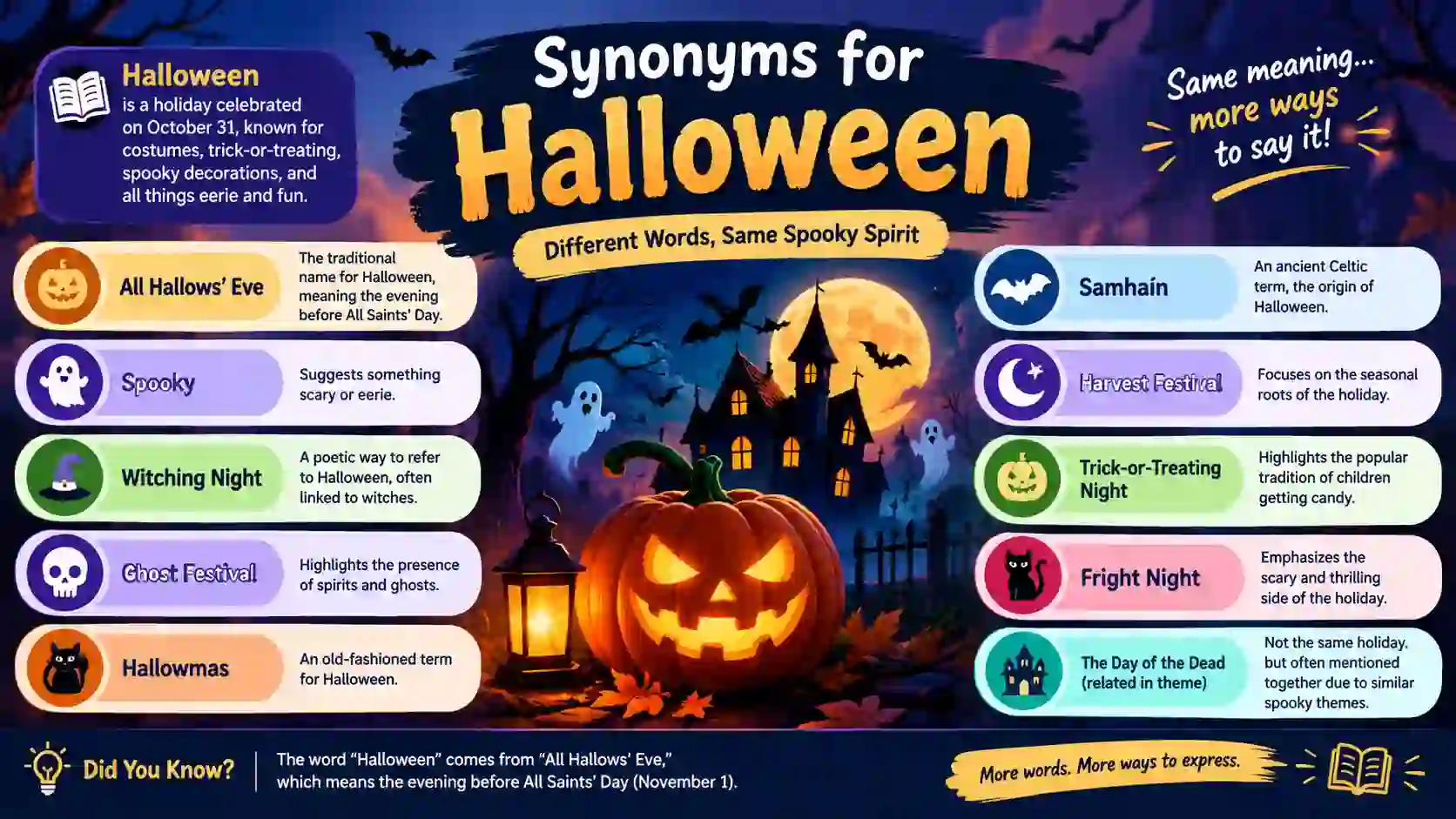
The closest synonyms for Halloween are All Hallows’ Eve, Allhallows Eve, Hallowe’en, and All Saints’ Eve. Other expressions, such as Fright Night, Spooky Night, and Costume Night, describe Halloween activities or atmosphere. Some historical terms, including Samhain and Allhallowtide, are related to Halloween but have different meanings.
Have you ever used the word Halloween several times in the same essay, story, or blog post? Finding another expression can make your writing more interesting. However, not every spooky word means the same thing as Halloween.
Halloween is celebrated on October 31. People often mark the occasion with costumes, pumpkins, candy, parties, and scary decorations. Its name also has a long history connected with All Saints’ Day.
In this guide, you will discover 30 synonyms, alternative expressions, and related Halloween words. You will learn their meanings, see natural example sentences, and understand which words work best in different situations. This will help you improve your English vocabulary without using incorrect synonyms.
Halloween: Meaning and Pronunciation
Word: Halloween
Pronunciation: /ˌhæl.oʊˈiːn/
Say it like: HAL-oh-EEN.
Part of speech: Proper noun.
Meaning: Halloween is an annual celebration observed on October 31, often associated with costumes, trick-or-treating, pumpkins, and spooky entertainment.
Word Origin and Etymology
Halloween developed from the Scottish expression All Hallows’ Even, which referred to the evening before All Hallows’ Day, also called All Saints’ Day.
The word hallow means a holy person or saint. The older word even means evening. Over time, the expression became shorter and developed into Hallowe’en and Halloween.
The modern spelling appeared in Scottish usage during the 1560s. Earlier forms of All Hallows’ Eve existed centuries before that.
First known use: Halloween is recorded from the 1560s, according to the Online Etymology Dictionary.
Is Halloween a Noun, Verb, Adjective, or Adverb?
Halloween is primarily a proper noun.
| Form | Part of speech | Example |
| Halloween | Proper noun | Halloween is on October 31. |
| Halloween-themed | Compound adjective | We planned a Halloween-themed party. |
| Halloween-related | Compound adjective | She writes Halloween-related articles. |
| Halloween | Verb | Not a standard verb |
| Halloween | Adverb | Not a standard adverb |
Remember: Always capitalize Halloween when referring to the holiday.
Synonyms for Halloween: Quick Comparison Table
The table separates genuine alternative names from expressions that describe related activities.
| Alternative or expression | Meaning | Formality |
| All Hallows’ Eve | Historical alternative name | Historical |
| Allhallows Eve | Traditional alternative name | Formal |
| Hallowe’en | Older spelling | Neutral |
| All Saints’ Eve | Historical alternative | Formal |
| Eve of All Saints’ Day | Descriptive historical name | Formal |
| Halloween night | The evening of October 31 | Neutral |
| Halloween celebration | An event celebrating Halloween | Neutral |
| Halloween festivities | Halloween activities | Neutral |
| Halloween party | A themed gathering | Informal |
| Fright Night | Scary entertainment event | Informal |
| Spooky Night | Mysterious evening | Informal |
| Costume Night | Dress-up event | Neutral |
30 Halloween Synonyms, Alternative Names, and Related Words
Important: Only the first group contains close historical alternatives. The other groups contain descriptive expressions, cultural terms, and related vocabulary. They should not all be used as direct replacements for Halloween.
Group 1: Closest Historical Alternatives
1. All Hallows’ Eve
Meaning: All Hallows’ Eve means the evening before All Saints’ Day.
Examples:
- All Hallows’ Eve has a long history.
- The book describes traditional All Hallows’ Eve customs.
Best used when: Discussing Halloween’s historical and religious background.
Tone: Formal, historical.
Frequency: Uncommon in everyday speech.
CEFR guidance: B2, approximate phrase difficulty.
2. Allhallows Eve
Meaning: Allhallows Eve is a traditional name for Halloween.
Examples:
- Allhallows Eve is an older name for October 31.
- The writer used Allhallows Eve in the historical account.
Best used when: Explaining the older name of Halloween.
Tone: Historical, literary.
Frequency: Rare.
3. Hallowe’en
Meaning: Hallowe’en is an older spelling of Halloween.
Examples:
- The old book mentions a Hallowe’en celebration.
- She found the spelling Hallowe’en in a historical poem.
Best used when: Discussing historical spelling or older writing.
Tone: Neutral, historical.
Frequency: Uncommon.
4. All Saints’ Eve
Meaning: All Saints’ Eve refers to the evening before All Saints’ Day.
Examples:
- All Saints’ Eve falls on October 31.
- The church explained the meaning of All Saints’ Eve.
Best used when: Writing about the Christian calendar and historical background.
Tone: Formal, religious.
Frequency: Uncommon.
5. Eve of All Saints’ Day
Meaning: This expression describes the evening before All Saints’ Day.
Examples:
- Halloween is the eve of All Saints’ Day.
- The historical document mentions the eve of All Saints’ Day.
Best used when: Explaining the relationship between Halloween and November 1.
Tone: Formal, descriptive.
Frequency: Uncommon.
Group 2: Modern Halloween Expressions
6. Halloween Night
Meaning: Halloween Night refers to the evening of October 31.
Examples:
- We watched a horror movie on Halloween Night.
- The children walked around the neighborhood on Halloween Night.
Best used when: Describing activities that happen on October 31.
Tone: Neutral.
Frequency: Very common.
7. Halloween Celebration
Meaning: A Halloween celebration is an event held to enjoy the holiday.
Examples:
- Our school arranged a Halloween celebration.
- The community invited families to its Halloween celebration.
Best used when: Describing school, family, and community events.
Tone: Neutral.
Frequency: Common.
8. Halloween Festivities
Meaning: Halloween festivities are the activities and entertainment associated with Halloween.
Examples:
- The town organized Halloween festivities for children.
- Halloween festivities included music, costumes, and games.
Best used when: Discussing several activities rather than one event.
Tone: Neutral, formal.
Frequency: Common.
9. Halloween Party
Meaning: A Halloween party is a social gathering with Halloween decorations or costumes.
Examples:
- We attended a Halloween party at school.
- Her Halloween party included a costume contest.
Best used when: Talking about a themed social event.
Tone: Informal.
Frequency: Very common.
10. Halloween Holiday
Meaning: Halloween Holiday describes the annual celebration on October 31.
Examples:
- Halloween is a popular holiday in the United States.
- The children enjoyed the Halloween holiday activities.
Best used when: Writing simple explanatory content.
Tone: Neutral.
Frequency: Common, although Halloween alone is more natural in most sentences.
11. Halloween Season
Meaning: Halloween Season refers to the period when people prepare for and celebrate Halloween.
Examples:
- Halloween brings colorful decorations to stores.
- Many families buy costumes during Halloween season.
Best used when: Discussing several weeks of seasonal activities.
Tone: Neutral.
Frequency: Common.
12. Spooky Season
Meaning: Spooky Season describes the autumn period associated with Halloween and scary entertainment.
Examples:
- Spooky season is my favorite time of the year.
- The store released its spooky season collection.
Best used when: Writing social media captions, seasonal blogs, and casual content.
Tone: Informal, playful.
Frequency: Common in modern seasonal writing.
13. Fright Night
Meaning: Fright Night describes an evening of frightening entertainment.
Examples:
- The cinema organized a Fright Night event.
- We watched three horror films during Fright Night.
Best used when: Describing horror movies, haunted attractions, or scary events.
Tone: Informal, promotional.
Frequency: Common as an event expression.
14. Spooky Night
Meaning: Spooky Night describes an evening with a strange or frightening atmosphere.
Examples:
- We enjoyed a spooky night around the campfire.
- The old house created a spooky night atmosphere.
Best used when: Writing stories, captions, and creative descriptions.
Tone: Informal, literary.
Frequency: Common as a descriptive phrase.
15. Trick or Treat Night
Meaning: Trick-or-Treat Night describes the evening when children visit homes to collect candy.
Examples:
- The neighborhood prepared for Trick-or-Treat Night.
- Parents accompanied their children during Trick-or-Treat Night.
Best used when: Discussing the candy-collecting tradition.
Tone: Neutral, informal.
Frequency: Common.
16. Costume Night
Meaning: Costume Night describes an event where people wear special outfits.
Examples:
- The school organized a Costume Night for students.
- Everyone wore creative outfits during Costume Night.
Best used when: Discussing dress-up parties and competitions.
Tone: Neutral, informal.
Frequency: Common as a descriptive event name.
17. Haunted Night
Meaning: Haunted Night describes an evening with ghostly or frightening entertainment.
Examples:
- The theme park arranged a Haunted Night.
- The haunted mansion created an unforgettable Haunted Night experience.
Best used when: Naming spooky attractions or creative events.
Tone: Literary, informal.
Frequency: Uncommon.
18. Night of Frights
Meaning: Night of Frights describes an evening filled with scary experiences.
Examples:
- The amusement park advertised a Night of Frights.
- Visitors enjoyed a Night of Frights at the horror attraction.
Best used when: Promoting horror-themed entertainment.
Tone: Informal, dramatic.
Frequency: Uncommon.
19. Ghost Night
Meaning: Ghost Night is a creative name for an event featuring ghosts and supernatural themes.
Examples:
- The library planned a Ghost Night for young readers.
- Ghost Night included stories and costume activities.
Best used when: Naming a themed activity.
Tone: Playful, informal.
Frequency: Rare.
20. Pumpkin Festival
Meaning: A pumpkin festival is an event celebrating pumpkins and autumn activities.
Examples:
- The town held a pumpkin festival in October.
- Families enjoyed pumpkin displays at the festival.
Best used when: Discussing pumpkin events and autumn celebrations.
Tone: Neutral.
Frequency: Common.
Group 3: Historical, Cultural, and Related Vocabulary
21. Samhain
Meaning: Samhain is an ancient Gaelic festival marking the end of the harvest season and the beginning of winter.
Examples:
- The museum displayed information about Samhain.
- The historian explained the traditions associated with Samhain.
Best used when: Discussing Gaelic history and cultural traditions.
Tone: Historical, cultural.
Frequency: Common in cultural discussions.
Important: Samhain is not simply another name for modern Halloween.
22. Allhallowtide
Meaning: Allhallowtide refers to the Christian observance period associated with All Saints’ Day and All Souls’ Day.
Examples:
- The book explains the history of Allhallowtide.
- Allhallowtide includes several religious observances.
Best used when: Discussing historical religious traditions.
Tone: Formal, historical.
Frequency: Rare.
Important: Allhallowtide is a broader period, not just Halloween night.
23. Harvest Festival
Meaning: A harvest festival celebrates the gathering of crops.
Examples:
- The village organized a harvest festival in autumn.
- Families attended the annual harvest festival.
Best used when: Discussing agricultural and seasonal celebrations.
Tone: Neutral.
Frequency: Common.
24. Autumn Festival
Meaning: An autumn festival is an event celebrating the fall season.
Examples:
- The school arranged an autumn festival.
- The town decorated its streets for the autumn festival.
Best used when: Describing seasonal community activities.
Tone: Neutral.
Frequency: Common.
25. Day of the Dead
Meaning: Day of the Dead is the English name for Día de los Muertos, a Mexican tradition that honors deceased loved ones.
Examples:
- The museum presented an exhibition about Day of the Dead.
- The family prepared an altar for Day of the Dead.
Best used when: Discussing Mexican cultural traditions.
Tone: Neutral, cultural.
Frequency: Common.
Important: Day of the Dead is not another name for Halloween.
26. Ghost Festival
Meaning: Ghost Festival is a term used for celebrations or observances involving spirits and ancestors in different cultural traditions.
Examples:
- The documentary explored a traditional Ghost Festival.
- The writer compared different ghost-related festivals.
Best used when: Discussing cultural celebrations involving spirits.
Tone: Cultural, descriptive.
Frequency: Common in cultural contexts.
Important: The term can refer to distinct traditions, including the Chinese Ghost Festival.
27. Jack-o’-Lantern Night
Meaning: Jack-o’-Lantern Night is a creative expression for an event centered on carved pumpkin lanterns.
Examples:
- The garden hosted a Jack-o’-Lantern Night.
- Families displayed their carved pumpkins during Jack-o’-Lantern Night.
Best used when: Naming pumpkin-carving events.
Tone: Informal, playful.
Frequency: Uncommon.
28. Haunted House Event
Meaning: A haunted house event is an attraction designed to frighten visitors.
Examples:
- The amusement park opened a haunted house event.
- Teenagers visited the haunted house event together.
Best used when: Describing Halloween attractions.
Tone: Neutral, informal.
Frequency: Common.
29. Halloween Themed Event
Meaning: A Halloween-themed event is any gathering or activity based on Halloween.
Examples:
- The company organized a Halloween-themed event.
- The school announced a Halloween-themed event for Friday.
Best used when: Writing professional announcements or event descriptions.
Tone: Neutral, business.
Frequency: Common.
30. October 31 Celebration
Meaning: October 31 Celebration describes an event held on Halloween’s calendar date.
Examples:
- The community planned an October 31 Celebration.
- The October 31 Celebration included games and seasonal decorations.
Best used when: Writing descriptive content where the date matters.
Tone: Formal, descriptive.
Frequency: Uncommon.
Strongest Halloween Synonyms and Related Expressions
Not all 30 expressions have equal meaning. Here is the best way to group them.
Closest Historical Alternatives
- All Hallows’ Eve
- Allhallows Eve
- Hallowe’en
- All Saints’ Eve
- Eve of All Saints’ Day
Common Modern Expressions
- Halloween Night
- Halloween Celebration
- Halloween Festivities
- Halloween Party
- Halloween Season
- Spooky Season
- Fright Night
- Spooky Night
- Trick-or-Treat Night
Related Cultural and Seasonal Terms
- Samhain
- Allhallowtide
- Harvest Festival
- Autumn Festival
- Day of the Dead
- Ghost Festival
- Pumpkin Festival
Choose the Right Synonym: Side by Side Comparisons
Choosing the right expression depends on your sentence and purpose.
| Expression | Meaning | Example situation |
| All Hallows’ Eve | Historical alternative | A history essay |
| Hallowe’en | Older spelling | An old book |
| Samhain | Gaelic seasonal festival | A cultural article |
| Fright Night | Scary entertainment | A movie event |
| Spooky Season | Seasonal Halloween atmosphere | A social media caption |
| Costume Night | Dress-up event | A school activity |
| Harvest Festival | Crop celebration | A community gathering |
| Day of the Dead | Mexican cultural observance | A cultural comparison |
Compare These Sentences
Historical writing
- Less specific: Halloween has a long history.
- More historical: All Hallows’ Eve has a long history connected with All Saints’ Day.
Casual writing
- Simple: We watched scary movies on Halloween.
- More descriptive: We enjoyed a spooky night watching scary movies.
Event promotion
- Simple: Our school is organizing a Halloween event.
- More specific: Our school is organizing a Costume Night.
Important: The second sentence in these examples may change the meaning slightly. A good synonym improves a sentence without changing its intended message.
American vs. British English: Halloween Vocabulary
Halloween is spelled the same way in American and British English. However, pronunciation and some related words differ.
| Meaning | American English | British English |
| Main holiday | Halloween | Halloween |
| Older spelling | Hallowe’en | Hallowe’en |
| Pronunciation | /ˌhæloʊˈiːn/ | /ˌhæləʊˈiːn/ |
| Sweet treats | Candy | Sweets |
| Season | Fall | Autumn |
| Costume party | Costume party | Fancy-dress party |
| Carved pumpkin | Jack-o’-lantern | Jack-o’-lantern |
Example:
American: The children collected candy during Halloween.
British: The children collected sweets during Halloween.
Both sentences are correct.
Commonly Confused Halloween Words
| Word | Difference | Example |
| Halloween | October 31 holiday | Halloween is on Saturday. |
| Samhain | Gaelic seasonal festival | Samhain has historical cultural roots. |
| All Saints’ Day | Christian observance on November 1 | The church observes All Saints’ Day. |
| Day of the Dead | Mexican tradition honoring deceased loved ones | The family celebrates Day of the Dead. |
| Harvest Festival | Celebration of gathered crops | Our village held a harvest festival. |
Halloween vs. Samhain
Halloween and Samhain have historical connections, but they are not identical. Samhain is a Gaelic seasonal festival associated with the end of harvest and the beginning of winter And Halloween developed through several cultural and religious traditions.
Halloween vs. All Saints’ Day
Halloween takes place on October 31, while All Saints’ Day is observed on November 1 in the Western Christian calendar. Halloween’s name refers to the evening before All Saints’ Day.
Halloween vs. Day of the Dead
Day of the Dead is a Mexican cultural tradition that honors deceased family members and loved ones. Halloween and Day of the Dead have different histories and customs.
Halloween vs. Harvest Festival
A harvest festival celebrates crops and agricultural traditions. Halloween may include pumpkins and autumn decorations, but the two celebrations are not interchangeable.
Common Mistakes When Using Halloween Synonyms
Mistake 1
Incorrect: Samhain is another spelling of Halloween.
Correct: Samhain is a separate Gaelic seasonal festival.
Explanation: Both have historical connections, but they represent different traditions.
Mistake 2
Incorrect: All Saints’ Day and Halloween are the same holiday.
Correct: Halloween is October 31, while All Saints’ Day is November 1.
Explanation: They are connected through the Christian calendar but have different dates and meanings.
Mistake 3
Incorrect: Fright Night is the official name of Halloween.
Correct: Fright Night describes an evening of scary entertainment.
Explanation: It is a creative expression, not a traditional holiday name.
Mistake 4
Incorrect: Halloween is a verb.
Correct: Halloween is normally a proper noun.
Explanation: Use it as the name of the holiday.
Mistake 5
Incorrect: Harvest Festival is a synonym for Halloween.
Correct: A harvest festival celebrates the gathering of crops.
Explanation: The two may occur during autumn, but they have different purposes.
Writing Tips: How to Use Halloween Words Naturally
1. In Essays
Use historical expressions when discussing the holiday’s background.
Example: All Hallows’ Eve is connected with the evening before All Saints’ Day.
2. In Emails
Use clear and professional expressions.
Example: Our office will organize a Halloween-themed activity for employees.
3. In Blog Posts
Use related vocabulary to make descriptions more interesting.
Example: Halloween traditions include costumes, pumpkins, candy, and spooky decorations.
4. In Stories
Use descriptive expressions to create atmosphere.
Example: A mysterious night turned into a frightening adventure when the old house began making strange sounds.
5. On Social Media
Use short and engaging phrases.
- Welcome to spooky season!
- Ready for a Fright Night?
- Pumpkins, costumes, and Halloween magic!
- Enjoy a night of tricks and treats!
6. In Professional Communication
Use Halloween instead of an unfamiliar creative expression.
Example: The company will host a Halloween celebration for its employees.
Writing Tip: Do not replace Halloween in every sentence just to avoid repetition. Repeating the correct word is better than using an inaccurate alternative.
Related Halloween Vocabulary
Learning related vocabulary helps you describe Halloween more naturally.
Spooky and Scary Adjectives
| Word | Meaning |
| Eerie | Strange and frightening |
| Creepy | Causing an uncomfortable feeling |
| Spooky | Mysterious or ghostly |
| Sinister | Suggesting something evil |
| Haunted | Believed to contain ghosts |
| Macabre | Connected with death or horror |
| Chilling | Very frightening |
| Ghastly | Extremely unpleasant or frightening |
| Mysterious | Difficult to understand |
| Supernatural | Beyond ordinary natural explanation |
Halloween Nouns
- Pumpkin
- Ghost
- Witch
- Vampire
- Skeleton
- Monster
- Zombie
- Cauldron
- Costume
- Cemetery
- Tombstone
- Jack-o’-lantern
Halloween Verbs
- Celebrate
- Decorate
- Carve
- Dress up
- Frighten
- Haunt
- Scream
- Scare
- Trick
- Treat
Expressions of Halloween
- Trick or treat
- Happy Halloween
- Haunted house
- Jack-o’-lantern
- Spooky season
- Scary movie night
- Halloween costume party
- Candy collection
Are There Antonyms for Halloween?
Halloween has no direct antonym because it is the name of a holiday. However, you can use opposite adjectives to describe its atmosphere.
| Halloween related word | Opposite |
| Scary | Comforting |
| Spooky | Peaceful |
| Creepy | Pleasant |
| Dark | Bright |
| Frightening | Reassuring |
| Sinister | Friendly |
| Haunted | Welcoming |
These words are antonyms of descriptive vocabulary, not Halloween itself.
Word Family and CEFR Vocabulary Guidance
Halloween has a limited grammatical word family because it is a proper noun.
| Word | Part of speech | Example |
| Hallow | Noun/verb | The word has historical religious roots. |
| Hallowed | Adjective | The church stood on hallowed ground. |
| Halloween | Proper noun | Halloween arrives on October 31. |
| Halloween-themed | Compound adjective | We planned a Halloween-themed activity. |
| Halloween-related | Compound adjective | She writes Halloween-related articles. |
Approximate CEFR Guidance
CEFR levels describe general learner proficiency, not official classifications for every holiday expression.
| Level | Useful vocabulary |
| A1 | Night, party, ghost, candy |
| A2 | Costume, pumpkin, monster, scary |
| B1 | Spooky, haunted, frightening |
| B2 | Eerie, All Hallows’ Eve |
| C1 | Macabre, Samhain |
| C2 | Specialized historical terminology such as Allhallowtide |
Learning advice: Beginners should first learn everyday vocabulary. Advanced learners can explore historical expressions and cultural differences.
Frequently Asked Questions About Halloween Synonyms
1. What is another name for Halloween?
All Hallows’ Eve is the closest historical alternative to Halloween. Other alternatives include Allhallows Eve, Hallowe’en, and All Saints’ Eve. Some expressions, such as Fright Night and Spooky Night, describe related entertainment rather than the holiday itself.
2. What is the most common synonym for Halloween?
All Hallows’ Eve is the closest historical alternative because the modern word Halloween developed from the older expression All Hallows’ Even. Hallowe’en is another spelling of the same holiday name. Halloween remains the most common modern form.
3. What are five other words for Halloween?
Five useful alternatives are All Hallows’ Eve, Allhallows Eve, Hallowe’en, All Saints’ Eve, and Eve of All Saints’ Day. These expressions have historical or spelling connections. For casual writing, Spooky Night and Fright Night can describe Halloween-related activities.
4. Is Samhain another word for Halloween?
No. Samhain is an ancient Gaelic seasonal festival associated with the end of harvest and beginning of winter. Halloween has historical connections with Samhain, but the two are not identical. Writers should explain their cultural differences rather than treat them as interchangeable names.
5. What are some fancy words for Halloween?
Interesting Halloween expressions include All Hallows’ Eve, Allhallowtide, Spooky Season, Night of Frights, and Fright Night. They suit historical articles, creative writing, and event descriptions. However, Allhallowtide describes a broader religious observance period, not Halloween night alone.
6. What are some Halloween words for kids?
Children can learn simple words such as ghost, witch, pumpkin, candy, costume, monster, bat, spider, skeleton, and vampire. These words help them describe Halloween characters, decorations, and activities. They are related vocabulary rather than exact synonyms for the holiday.
7. Does Halloween have an opposite word?
No. Halloween does not have a direct opposite because it is the name of a holiday. However, you can use contrasting adjectives such as peaceful, comforting, bright, and friendly when describing something that has the opposite atmosphere to a spooky Halloween scene.
8. What is the difference between Halloween and Hallowe’en?
Halloween and Hallowe’en refer to the same holiday. Hallowe’en is an older spelling that reflects the word’s historical development from All Hallows’ Even. Halloween is the standard modern spelling used in everyday American and British English.
Halloween Vocabulary Quiz
Test what you have learned with these five questions.
1. Which expression is the closest historical alternative to Halloween?
A. Pumpkin Festival
B. All Hallows’ Eve
C. Harvest Festival
D. Monster Night
2. What does Fright Night usually describe?
A. A religious service
B. A harvest celebration
C. An evening of scary entertainment
D. A peaceful family dinner
3. Which word refers to an ancient Gaelic seasonal festival?
A. Samhain
B. Costume Night
C. Spookfest
D. Halloween Eve
4. Which spelling is standard in modern English?
A. Halloween
B. Halloween
C. Hallowe’en
D. Halloween
5. Which expression describes children visiting homes to collect candy?
A. Harvest Festival
B. Trick-or-Treat Night
C. All Saints’ Day
D. Ghostly Evening
Answer Key
| Question | Correct answer | Explanation |
| 1 | B | All Hallows’ Eve is the historical source of the name. |
| 2 | C | Fright Night describes scary entertainment. |
| 3 | A | Samhain is an ancient Gaelic festival. |
| 4 | D | Halloween is the standard modern spelling. |
| 5 | B | Trick-or-treating involves visiting homes for candy. |
Mini Vocabulary Practice
Complete these exercises to improve your understanding.
Exercise 1: Fill in the Blanks
Choose from: Samhain, Fright Night, Halloween, All Hallows’ Eve, candy.
- Children often collect ______ during Halloween.
- ______ is celebrated on October 31.
- ______ is the closest historical alternative to Halloween.
- ______ refers to an ancient Gaelic seasonal festival.
- The cinema organized a ______ for horror movie fans.
Exercise 2: Rewrite the Sentences
Rewrite these sentences using the suggested expression.
- We watched scary movies on Halloween. (Use: Fright Night)
- The children attended a Halloween dress-up event. (Use: Costume Night)
- The writer explained the historical name of Halloween. (Use: All Hallows’ Eve)
Exercise 3: Match the Words
| Word | Meaning |
| 1. Spooky | A. A carved pumpkin lantern |
| 2. Jack-o’-lantern | B. Strange and slightly frightening |
| 3. Harvest Festival | C. An event celebrating gathered crops |
| 4. Costume | D. Special clothes worn to look like someone else |
Answers:
Exercise 1: 1. candy, 2. Halloween, 3. All Hallows’ Eve, 4. Samhain, 5. Fright Night.
Exercise 2: Answers may vary, but the suggested expressions should fit the sentence.
Exercise 3: 1-B, 2-A, 3-C, 4-D.
Conclusion
Learning synonyms for Halloween helps you describe seasonal celebrations, historical traditions, and spooky events more accurately. All Hallows’ Eve and Hallowe’en are useful historical alternatives, while expressions such as Fright Night and Spooky Season add variety to creative writing.
Learn their meanings, practice their usage, and use the right expressions in essays, emails, blogs, and everyday conversations. Better vocabulary makes your English clearer and more expressive.
References
- Online Etymology Dictionary: Halloween word origin and historical development.
- Cambridge Dictionary: Halloween definition and pronunciation.
- Dictionary.com: Halloween and Allhallows Eve definitions.
- Collins English Dictionary: Halloween meaning, spelling, and British and American pronunciation.
- Getty Art & Architecture Thesaurus: Historical and cultural classification of Halloween.

Synonorm is a trusted English vocabulary resource created to help readers find the right words and understand the differences between similar terms. We provide clear explanations of synonyms, meanings, examples, usage, and alternatives. Our content makes vocabulary easier to learn and apply in everyday, academic, and professional English. Synonorm is designed for students, writers, ESL learners, professionals, and anyone who wants to improve their English vocabulary and communicate more clearly.