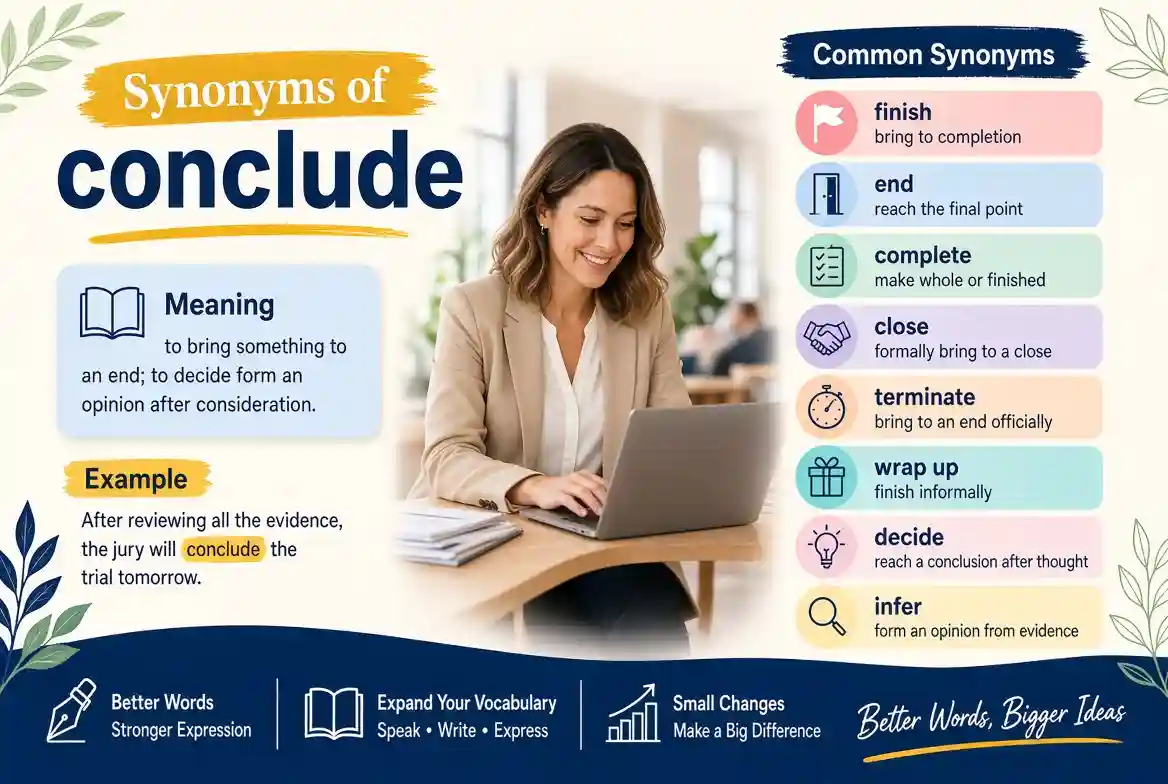
Quick Answer: What Are Synonyms for Conclude?
The best synonyms for conclude include finish, end, complete, close, finalize, wrap up, determine, decide, infer, and deduce. The right word depends on the meaning. Use finish for a task, finalize for arrangements, resolve for a problem, and infer when you draw an idea from evidence.
Do you often use the word conclude in essays, reports, or everyday conversations? Learning a few alternatives can make your English clearer and more natural.
The verb conclude has three main uses. It can mean to bring something to an end, reach a judgment after considering information, or formally complete an agreement. For example, you can conclude a meeting, conclude that a plan needs changes, or conclude a business agreement.
However, not every related word fits all three meanings. You can finish your homework, infer an answer from clues, and finalize a schedule, but these verbs are not interchangeable.
This guide explains 30 useful synonyms and related expressions, with simple definitions, original examples, common collocations, and usage advice. You will also learn the difference between formal and informal alternatives, common grammar patterns, and how to choose the right word for your sentence.
Pronunciation of Conclude
- IPA: /kənˈkluːd/
- Pronunciation: kuhn-KLOOD
- Syllables: con-clude
- Word stress: Second syllable
Part of Speech and Meaning
Conclude is a verb. It can describe three different actions.
- To end something: The speaker concluded the presentation with a question.
- To reach a judgment: The researchers concluded that the method was effective.
- To complete an agreement: The two companies concluded a trade agreement.
Word Family
| Word | Part of speech | Meaning |
|---|---|---|
| Conclude | Verb | End something or reach a judgment |
| Conclusion | Noun | An ending or a judgment |
| Conclusive | Adjective | Settling a question or proving a point decisively |
| Inconclusive | Adjective | Not providing a clear answer |
| Conclusively | Adverb | In a decisive or final way |
| Concluding | Verb form/adjective | Bringing something to its end |
Grammar: How to Use Conclude
Learn these common sentence patterns:
- Conclude something: The chair concluded the meeting.
- Conclude with something: She concluded her speech with a thank-you.
- Conclude by doing something: He concluded by reviewing the main findings.
- Conclude that + clause: We concluded that the plan was too expensive.
- Conclude from something that + clause: They concluded from the evidence that the machine had failed.
- Conclude an agreement with someone: The countries concluded an agreement after months of talks.
Avoid writing “We concluded about the results.” Instead, write “We concluded that the results were reliable” or “We reached a conclusion about the results.”
Quick Synonyms Overview
| Synonym | Best use | Register |
|---|---|---|
| Finish | Complete a task | Neutral |
| End | Reach a stopping point | Neutral |
| Complete | Finish every required part | Neutral/formal |
| Close | End a meeting or speech | Neutral/formal |
| Finalize | Make arrangements final | Business/formal |
| Wrap up | Finish a discussion or task | Informal |
| Terminate | Officially end something | Formal/legal |
| Resolve | Settle a problem | Neutral/formal |
| Decide | Make a choice | Neutral |
| Determine | Establish an answer | Academic/formal |
| Infer | Draw meaning from evidence | Academic |
| Deduce | Reach an answer through logic | Academic |
| Summarize | State the main points | Neutral |
| Culminate | Reach a final stage | Formal/literary |
30 Synonyms for Conclude With Examples
The words are grouped by meaning. CEFR levels are approximate learner guides, and frequency labels describe general usage rather than measured corpus counts.
1. Finish
Meaning: To do something until it is done.
Examples:
- I finished my assignment before lunch.
- The presenter finished her talk with a personal story.
Best used when: You mean completing a task or activity.
Register: Neutral | CEFR: A1–A2 | Frequency: Very common
Collocations: finish work, finish a task, finish a sentence.
When not to use it: Choose infer or deduce when you mean reaching an answer through reasoning.
2. End
Meaning: To bring something to its stopping point.
Examples:
- The class ended at three o’clock.
- He ended his email with a polite thank-you.
Best used when: You want a simple word for something stopping.
Register: Neutral | CEFR: A1–A2 | Frequency: Very common
Collocations: end a meeting, end a discussion, end a relationship.
When not to use it: Use resolve when the main idea is solving a problem rather than merely stopping it.
3. Complete
Meaning: To finish all the required parts of something.
Examples:
- The team completed the survey in two weeks.
- Please complete every section of the application.
Best used when: Every part of a task, form, or process must be finished.
Register: Neutral/formal | CEFR: A2–B1 | Frequency: Very common
Collocations: complete a project, complete a form, complete a course.
When not to use it: Do not use it to mean drawing a conclusion from clues.
4. Close
Meaning: To bring an event, discussion, or activity to an end.
Examples:
- The chair closed the meeting with a short speech.
- The festival closed with a music performance.
Best used when: You want a polished ending for a formal event.
Register: Neutral/formal | CEFR: B1–B2 | Frequency: Common
Collocations: close a meeting, close a speech, close a discussion.
When not to use it: Finish usually sounds more natural for everyday chores.
5. Finalize
Meaning: To make the last changes or decisions so something is ready.
Examples:
- We finalized the schedule after checking everyone’s availability.
- The editor finalized the article before publication.
Best used when: You are completing plans, documents, or arrangements.
Register: Business/formal | CEFR: B2 | Frequency: Common
Collocations: finalize a contract, finalize plans, finalize a budget.
When not to use it: Do not use it merely to say that an event has ended.
6. Terminate
Meaning: To bring something to an official end.
Examples:
- The company terminated the contract after a serious breach.
- The software terminates the process when an error occurs.
Best used when: A contract, service, or technical process is officially ended.
Register: Formal/legal/technical | CEFR: C1 | Frequency: Common in specialist contexts
Collocations: terminate a contract, terminate employment, terminate a process.
When not to use it: It may sound too harsh for a casual activity or ordinary task.
7. Wrap up
Meaning: To finish something, often after covering the main points.
Examples:
- Let’s wrap up the meeting before lunch.
- I need to wrap up this report today.
Best used when: You want a friendly, conversational expression.
Register: Informal/business | CEFR: B1–B2 | Frequency: Common
Collocations: wrap up a meeting, wrap up a project, wrap up a discussion.
When not to use it: Use conclude in highly formal writing when an informal tone would be unsuitable.
8. Wind up
Meaning: To bring an activity or event to an end.
Examples:
- The host wound up the show with a final announcement.
- We should wind up the discussion before the next class.
Best used when: You need a conversational alternative to finish.
Register: Informal/neutral | CEFR: B2 | Frequency: Common
Collocations: wind up a meeting, wind up proceedings, wind up a discussion.
When not to use it: Check the context because wind up can also mean annoy someone or eventually reach a situation.
9. Resolve
Meaning: To settle a problem or find a solution.
Examples:
- The support team resolved the issue before launch.
- Both departments resolved their differences through discussion.
Best used when: A problem, dispute, or uncertainty has been dealt with.
Register: Neutral/formal | CEFR: B2 | Frequency: Common
Collocations: resolve a conflict, resolve an issue, resolve a dispute.
When not to use it: Use end when an activity stops but the underlying problem remains unsolved.
10. Settle
Meaning: To reach an agreement or settle a disputed matter.
Examples:
- The two sides settled the dispute after several meetings.
- The committee settled the question of who would lead the project.
Best used when: People reach an agreement or put an issue to rest.
Register: Neutral/formal | CEFR: B1–B2 | Frequency: Very common
Collocations: settle a dispute, settle an argument, settle a question.
When not to use it: It does not mean simply finishing every kind of activity.
11. Decide
Meaning: To choose an option or reach a judgment.
Examples:
- The board decided to postpone the launch.
- I decided that the second option was more practical.
Best used when: Someone makes a choice after consideration.
Register: Neutral | CEFR: A2–B1 | Frequency: Very common
Collocations: decide what to do, decide on a plan, decide that.
When not to use it: Use finish when you mean completing an activity rather than making a choice.
12. Determine
Meaning: To establish an answer after examining information.
Examples:
- The test will determine whether the material is safe.
- Investigators determined that the alarm had failed.
Best used when: You establish a result through testing, examination, or analysis.
Register: Formal/academic | CEFR: B2 | Frequency: Common
Collocations: determine the cause, determine the outcome, determine whether.
When not to use it: It is not a natural replacement for ending a casual conversation.
13. Infer
Meaning: To draw an idea from facts or clues.
Examples:
- From the empty classrooms, we inferred that school had closed early.
- Readers can infer the character’s fear from her actions.
Best used when: You reach an understanding from indirect evidence.
Register: Academic/neutral | CEFR: C1 | Frequency: Common in academic contexts
Collocations: infer meaning, infer from evidence, infer that.
When not to use it: Do not use it when someone states the information directly and no inference is needed.
14. Deduce
Meaning: To reach an answer through logical reasoning.
Examples:
- The detective deduced the route from the footprints.
- Students deduced the rule by comparing several examples.
Best used when: You want to emphasize a logical process.
Register: Formal/academic | CEFR: C1 | Frequency: Common in specialist contexts
Collocations: deduce a rule, deduce from evidence, deduce that.
When not to use it: Avoid it for guesses that have no logical support.
15. Judge
Meaning: To form an opinion after considering information.
Examples:
- We judged the proposal to be too costly.
- It is difficult to judge the results after one day.
Best used when: You assess a situation, claim, or result.
Register: Neutral | CEFR: B1–B2 | Frequency: Very common
Collocations: judge a situation, judge the quality, judge from experience.
When not to use it: Use determine when you need to emphasize establishing a factual result.
16. Gather
Meaning: To understand something indirectly from available information.
Examples:
- I gathered from his reply that the meeting had been postponed.
- We gathered that the new rules applied to every department.
Best used when: You reach an understanding from what someone says or what you observe.
Register: Neutral | CEFR: B2 | Frequency: Common
Collocations: gather from a reply, gather from the evidence, gather that.
When not to use it: This meaning usually appears in patterns such as gather that or gather from. It is not a general synonym for finishing something.
17. Surmise
Meaning: To form a belief or guess from limited information.
Examples:
- I surmised that the shop was closed because the lights were off.
- Readers may surmise that the narrator is hiding something.
Best used when: You want to describe an uncertain judgment.
Register: Formal/literary | CEFR: C1–C2 | Frequency: Uncommon
Collocations: surmise that, surmise from the clues, reasonably surmise.
When not to use it: Use deduce when you want to emphasize logical reasoning rather than a tentative belief.
18. Reason
Meaning: To think carefully and use logic to reach an answer.
Examples:
- She reasoned that leaving early would avoid traffic.
- The researchers reasoned that temperature affected the results.
Best used when: You want to emphasize the thinking behind a judgment.
Register: Neutral/academic | CEFR: B1–B2 | Frequency: Common
Collocations: reason that, reason logically, reason from evidence.
When not to use it: Reason focuses on the thought process, not necessarily the final decision.
19. Accomplish
Meaning: To complete something successfully, especially a task or goal.
Examples:
- The volunteers accomplished more than they expected.
- She accomplished her main objective before the deadline.
Best used when: You want to emphasize successful effort or achievement.
Register: Neutral/formal | CEFR: B1–B2 | Frequency: Common
Collocations: accomplish a task, accomplish a goal, accomplish a mission.
When not to use it: It is not an exact replacement for conclude when you mean reaching an evidence-based judgment.
20. Cease
Meaning: To stop an activity or action.
Examples:
- The factory ceased production during repairs.
- The noise ceased shortly after midnight.
Best used when: You need a formal word for stopping an activity.
Register: Formal/legal | CEFR: C1 | Frequency: Common in formal contexts
Collocations: cease operations, cease production, cease activity.
When not to use it: In casual conversation, stop is usually simpler and more natural.
21. Stop
Meaning: To bring an action or activity to an end.
Examples:
- The teacher stopped the exercise when the bell rang.
- Please stop the recording after the final question.
Best used when: You want a simple and direct word for ending an action.
Register: Neutral | CEFR: A1 | Frequency: Very common
Collocations: stop work, stop an activity, stop a process.
When not to use it: Use complete when you want to stress that every required part has been finished.
22. Halt
Meaning: To make an activity or process stop, often suddenly.
Examples:
- Heavy rain halted construction for two days.
- The manager halted the launch after finding an error.
Best used when: Progress stops because of a problem, interruption, or decision.
Register: Neutral/formal | CEFR: B2 | Frequency: Common
Collocations: halt production, halt progress, halt operations.
When not to use it: It does not suggest smooth or successful completion.
23. Bring to a close
Meaning: To make an event or discussion reach its end.
Examples:
- The presenter brought the workshop to a close with a summary.
- The chair brought the debate to a close after the final vote.
Best used when: You want a polished phrase for ending an event.
Register: Formal/neutral | CEFR: B2 | Frequency: Common
Collocations: bring a meeting to a close, bring a debate to a close, bring proceedings to a close.
When not to use it: It may be unnecessarily long for a simple task.
24. Draw to a close
Meaning: To approach its natural or expected ending.
Examples:
- The conference drew to a close after the final speaker.
- As the evening drew to a close, the guests thanked their hosts.
Best used when: Something gradually reaches its end.
Register: Formal/literary | CEFR: B2–C1 | Frequency: Common in formal writing
Collocations: draw to a close, the year draws to a close, the meeting draws to a close.
When not to use it: Use finish when you want to say that someone actively completed a task.
25. Sum up
Meaning: To state the main points briefly.
Examples:
- The teacher summed up the lesson in three sentences.
- To sum up, the plan saves money but needs more time.
Best used when: You want to present the key ideas at the end of a discussion.
Register: Neutral | CEFR: B1–B2 | Frequency: Very common
Collocations: sum up an argument, sum up the findings, to sum up.
When not to use it: A summary does not always mean the entire activity or discussion has ended.
26. Recap
Meaning: To repeat the main facts or points briefly.
Examples:
- Let me recap the three decisions we made today.
- The coach recapped the team’s progress before practice.
Best used when: You want people to remember the main information.
Register: Neutral/informal | CEFR: B2 | Frequency: Common
Collocations: recap the main points, recap the meeting, quick recap.
When not to use it: Use conclude when you mean reaching a final judgment rather than reviewing earlier information.
27. Seal
Meaning: To secure or confirm an agreement or result.
Examples:
- The final signature sealed the agreement.
- The late goal sealed the team’s victory.
Best used when: A final action secures a deal, agreement, or result.
Register: Neutral/business | CEFR: B2 | Frequency: Common
Collocations: seal a deal, seal an agreement, seal a victory.
When not to use it: It usually implies confirmation or success, not merely that something stopped.
28. Clinch
Meaning: To secure a result, deal, or victory decisively.
Examples:
- The final presentation clinched the contract for the firm.
- Her last answer clinched the competition.
Best used when: A decisive action secures a desired outcome.
Register: Informal/business/sports | CEFR: C1 | Frequency: Common in specific contexts
Collocations: clinch a deal, clinch a victory, clinch a title.
When not to use it: It is not suitable for ordinary endings that involve no decisive result.
29. Culminate
Meaning: To reach a final point after a series of events.
Examples:
- Months of planning culminated in a successful exhibition.
- The investigation culminated in a public report.
Best used when: A long process leads to an important final result.
Register: Formal/academic/literary | CEFR: C1 | Frequency: Common in formal writing
Collocations: culminate in success, culminate in a decision, culminate in an event.
When not to use it: It sounds unnatural for simple tasks such as washing dishes or completing a form.
30. Accomplish: A Usage Note
Accomplish is included in related synonym searches, but it is not a direct substitute for every meaning of conclude. Its meaning focuses on successful achievement.
Examples:
- The team accomplished its main objective.
- She accomplished more in one day than she expected.
Best used when: You want to emphasize achieving a goal.
Register: Neutral/formal | CEFR: B1–B2 | Frequency: Common
Collocations: accomplish a goal, accomplish a task, accomplish a mission.
When not to use it: Do not replace conclude an investigation with accomplish an investigation unless you are deliberately changing the meaning to emphasize achievement.
Editorial note: Accomplish appears above as a related word and is explained again here to highlight an important distinction. For a final published list with 30 distinct entries, replace this duplicate with discontinue, meaning to stop an activity or service, as in “The company discontinued the product.”
Strongest Synonyms, Strong Synonyms, and Related Words
Strongest synonyms
When conclude means bringing something to an end, the closest everyday alternatives are:
- Finish: A task or activity reaches its end.
- End: Something stops.
- Complete: All required parts are done.
- Close: A meeting, speech, or event ends.
- Finalize: Plans or arrangements become final.
- Wrap up: A conversation or task comes to an end.
Strong synonyms
These alternatives fit particular contexts:
- Resolve: Settle a problem or dispute.
- Settle: Reach an agreement or settle a question.
- Decide: Make a choice.
- Determine: Establish an answer.
- Infer: Draw an idea from evidence.
- Deduce: Reach an answer through logic.
- Sum up: State the main points.
- Draw to a close: Describe a gradual ending.
Related words
These words may fit some meanings of conclude, but they are not direct replacements in every sentence:
- Terminate: Officially end something.
- Cease: Stop an activity.
- Halt: Stop progress or action.
- Surmise: Form a tentative belief.
- Judge: Form an opinion.
- Gather: Understand something indirectly.
- Culminate: Reach the final stage of a process.
- Clinch: Secure a decisive result.
- Accomplish: Achieve a goal.
- Recap: Review the main points.
Choose the Right Synonym: Side by Side Comparisons
| What you mean | Best word | Example |
|---|---|---|
| Finish a task | Finish | I finished the report. |
| Complete all parts | Complete | I completed all five sections. |
| Make arrangements final | Finalize | We finalized the schedule. |
| End a formal meeting | Close | The chair closed the meeting. |
| Stop an activity | Cease | The factory ceased production. |
| Solve a problem | Resolve | We resolved the technical issue. |
| Make a choice | Decide | The board decided to wait. |
| Reach a judgment from evidence | Infer | We inferred the meaning from the context. |
| Reach a logical answer | Deduce | She deduced the answer from the clues. |
| Review the main points | Summarize | He summarized the findings. |
Three useful distinctions
Finish vs. complete: Both mean getting something done. Complete stresses that all required parts are included, while finish is more flexible in everyday speech.
Conclude vs. infer: Conclude can mean ending something or reaching a judgment. Infer specifically means drawing an idea from clues or evidence.
Finalize vs. resolve: Finalize makes arrangements or documents final. Resolve deals with a problem, conflict, or uncertainty.
Commonly Confused Words
| Word | Difference | Example |
|---|---|---|
| Conclude | Can mean end or reach a judgment | We concluded that the plan was safe. |
| Finish | Emphasizes reaching the end | I finished my homework. |
| Decide | Emphasizes making a choice | They decided to postpone the launch. |
| Infer | Emphasizes drawing meaning from evidence | She inferred the answer from the clues. |
| Summarize | Emphasizes stating the main points | He summarized the report in one paragraph. |
Common Mistakes to Avoid
Mistake: We inferred the meeting at noon.
Correction: We ended the meeting at noon.
Why: Infer means to draw an idea from evidence, not to end an event.
Mistake: We finalized the disagreement.
Correction: We resolved the disagreement.
Why: Resolve is the natural choice for dealing with a disagreement.
Mistake: I terminated my homework at six.
Correction: I finished my homework at six.
Why: Terminate sounds formal and can suggest an official or abrupt ending.
Mistake: We concluded about the results.
Correction: We concluded that the results were reliable.
Why: Use conclude that before a full clause. You can also say reach a conclusion about the results.
Mistake: The writer concluded the main points in three sentences.
Correction: The writer summarized the main points in three sentences.
Why: Summarize means to restate key information. Conclude means to end a discussion or state a judgment.
Writing Tips: Use Synonyms Naturally
In essays
Use conclude to introduce a final judgment, infer for an evidence-based interpretation, and summarize to restate key points. Do not claim that research proves something if it only suggests a possible explanation.
In emails
Use finalize for arrangements, resolve for problems, and wrap up for a friendly workplace discussion.
Example: “Let’s finalize the schedule by Friday.”
In reports and blog posts
Use conclude when you make a final judgment, sum up when you recap key points, and end when you simply describe where something stops.
In stories
Use draw to a close for a gradual ending and culminate when several events lead to an important result.
In daily conversation
Prefer simple expressions such as finish, end, wrap up, and sum up. Formal alternatives are useful when the situation calls for them, but simple language is often clearer.
Word Origin and Etymology
Conclude entered English through Middle English and Old French from Latin concludere, meaning to shut up, enclose, or bring to an end. The Latin word combines con- (together or completely) and claudere (to shut).
Oxford records the word’s Middle English history and Latin origin. Its modern meanings include ending an activity, reaching a judgment, and formally settling an agreement.
The exact first-known date can vary by historical source and by the meaning being recorded. Avoid assigning a precise first-use year without checking a dated historical dictionary entry.
American vs. British English
The spelling conclude is the same in American and British English. Its main meanings and common grammar patterns are also shared.
| Feature | American English | British English |
|---|---|---|
| Spelling | conclude | conclude |
| Broad IPA | /kənˈkluːd/ | /kənˈkluːd/ |
| Past tense | concluded | concluded |
| Common phrase | conclude an agreement | conclude an agreement |
| Casual alternative | wrap up, finish | finish, wind up |
The IPA is a broad guide, not a claim that every speaker has the same accent. Actual pronunciation varies by region and speaker.
Register, Connotation, and Frequency
| Word | Register | Nuance | General frequency |
|---|---|---|---|
| Finish | Everyday | Direct and simple | Very common |
| Complete | General/formal | All parts are done | Very common |
| Wrap up | Spoken/business | Friendly and practical | Common |
| Finalize | Business/formal | Last arrangements | Common |
| Terminate | Legal/formal | Official, sometimes harsh | Common in specialist contexts |
| Resolve | Academic/business | Problem solved | Common |
| Infer | Academic | Evidence-based reasoning | Common in academic writing |
| Surmise | Formal/literary | Tentative judgment | Uncommon |
| Culminate | Academic/literary | Final result of a process | Common in formal writing |
| Clinch | Business/sports/spoken | Decisive success | Common in specific contexts |
Frequency labels are practical learning guidance, not exact corpus counts. A word may be common in one field but unusual in everyday conversation.
Related Vocabulary
Antonyms of Conclude
The opposite depends on the meaning:
- Begin: Start doing something.
- Start: Begin an activity.
- Commence: Begin in a formal way.
- Initiate: Cause a process to begin.
- Continue: Keep doing something.
- Extend: Make something last longer.
Examples:
- We concluded the meeting. → We began the meeting.
- The negotiations concluded. → The negotiations continued.
- She concluded the presentation. → She started the presentation.
Related Expressions
| Expression | Meaning | Example |
|---|---|---|
| In conclusion | Introduces a final point | In conclusion, the plan is worth testing. |
| To sum up | Introduces a brief summary | To sum up, we need more evidence. |
| All in all | Gives an overall judgment | All in all, the event was successful. |
| Come to an end | Reach the ending point | The school year came to an end. |
| Reach a conclusion | Form a judgment | We reached a conclusion after reviewing the data. |
| Bring something to a close | Finish an event or discussion | She brought the session to a close. |
Frequently Asked Questions
1. What are the best synonyms for conclude?
The best synonyms depend on the intended meaning. Use finish, end, complete, or close when something reaches its end. Use finalize for arrangements, resolve for problems, and infer or deduce when you reach a judgment from evidence. No single synonym fits every context.
2. What is a formal synonym for conclude?
Terminate, finalize, determine, and resolve can work in formal writing, depending on the sentence. Use terminate for officially ending a contract or process, finalize for completing arrangements, and resolve for settling a problem. In academic writing, determine can describe establishing a result through investigation.
3. What is another word for conclude in an essay?
In an essay, useful alternatives include summarize, sum up, finish, and draw a conclusion. Use in conclusion to introduce a final section, but avoid repeating the same phrase too often. A strong final paragraph should connect to your main argument rather than simply repeat earlier sentences.
4. What is the difference between conclude and finish?
Finish usually means completing a task or reaching the end of an activity. Conclude can mean the same thing, but it often sounds more formal and can also mean reaching a judgment after considering evidence. You finish your homework, conclude a meeting, or conclude that a plan needs improvement.
5. What is the difference between conclude and infer?
Conclude has several meanings, including ending an activity and reaching a judgment. Infer specifically means drawing an idea from clues or evidence. You may conclude that an investigation is complete, but infer from the evidence that a particular explanation is likely to be correct.
6. What are some informal synonyms for conclude?
Common informal alternatives include wrap up, wind up, and finish up. For example, you could say, “Let’s wrap up this discussion,” when you want a meeting to end soon. These expressions sound natural in casual conversation and many workplace settings, while formal reports may need more precise wording.
7. What is the opposite of conclude?
Common antonyms include begin, start, commence, and initiate. The best choice depends on the sentence. If a meeting concludes, it began earlier. If negotiations conclude, however, they might instead continue or remain unresolved. Think about the intended meaning before choosing an antonym.
8. What are synonyms for conclude in academic writing?
Academic alternatives include determine, infer, deduce, establish, and summarize, but each has a different purpose. Use infer for an interpretation based on evidence, determine for establishing an answer, and summarize for restating key points. Avoid making stronger claims than the evidence supports.
Vocabulary Practice
Exercise 1: Fill in the blanks
Choose from finalize, infer, resolve, summarize, and finish.
- We need to ______ the report before Friday.
- The evidence helped the team ______ that the machine had failed.
- Both departments worked together to ______ the disagreement.
- Please ______ the main findings in three sentences.
- I hope to ______ my assignment before dinner.
Exercise 2: Rewrite the sentence
Replace the bold phrase with a suitable synonym.
- The chair brought the meeting to an end.
- The researchers reached a judgment from the evidence.
- The company made the contract arrangements final.
- The teacher stated the main points briefly.
- Heavy rain made construction stop.
Exercise 3: Match the word to the meaning
A. Culminate
B. Deduce
C. Wrap up
D. Resolve
E. Terminate
- End something officially.
- Reach an answer through logical reasoning.
- Finish a discussion in a casual way.
- Solve a problem.
- Reach a final point after a series of events.
Answer Key
Exercise 1: 1. finish, 2. infer, 3. resolve, 4. summarize, 5. finish.
Note: “Finish” fits both sentences 1 and 5; “finalize” could replace it in sentence 1 if the report requires final approval.
Exercise 2: 1. closed, 2. inferred, 3. finalized, 4. summarized, 5. halted.
Exercise 3: 1. E, 2. B, 3. C, 4. D, 5. A.
Conclusion
Learning synonyms for conclude helps you communicate with greater clarity in essays, emails, reports, and everyday conversations. Words such as finish, complete, and finalize describe different kinds of endings, while infer, deduce, and determine explain how people reach judgments.
Practice each word in its natural context instead of memorizing a list alone. With regular use, you can build a stronger vocabulary and choose the right expression with confidence.
References
- Cambridge Dictionary, “Conclude.” https://dictionary.cambridge.org/dictionary/english/conclude
- Cambridge English Thesaurus, “Conclude.” https://dictionary.cambridge.org/thesaurus/conclude
- Oxford Advanced Learner’s Dictionary, “Conclude.” https://www.oxfordlearnersdictionaries.com/definition/english/conclude
- Thesaurus.com, “Conclude Synonyms and Antonyms.” https://www.thesaurus.com/browse/conclude
- Merriam-Webster Dictionary, https://www.merriam-webster.com/

Synonorm is a trusted English vocabulary resource created to help readers find the right words and understand the differences between similar terms. We provide clear explanations of synonyms, meanings, examples, usage, and alternatives. Our content makes vocabulary easier to learn and apply in everyday, academic, and professional English. Synonorm is designed for students, writers, ESL learners, professionals, and anyone who wants to improve their English vocabulary and communicate more clearly.