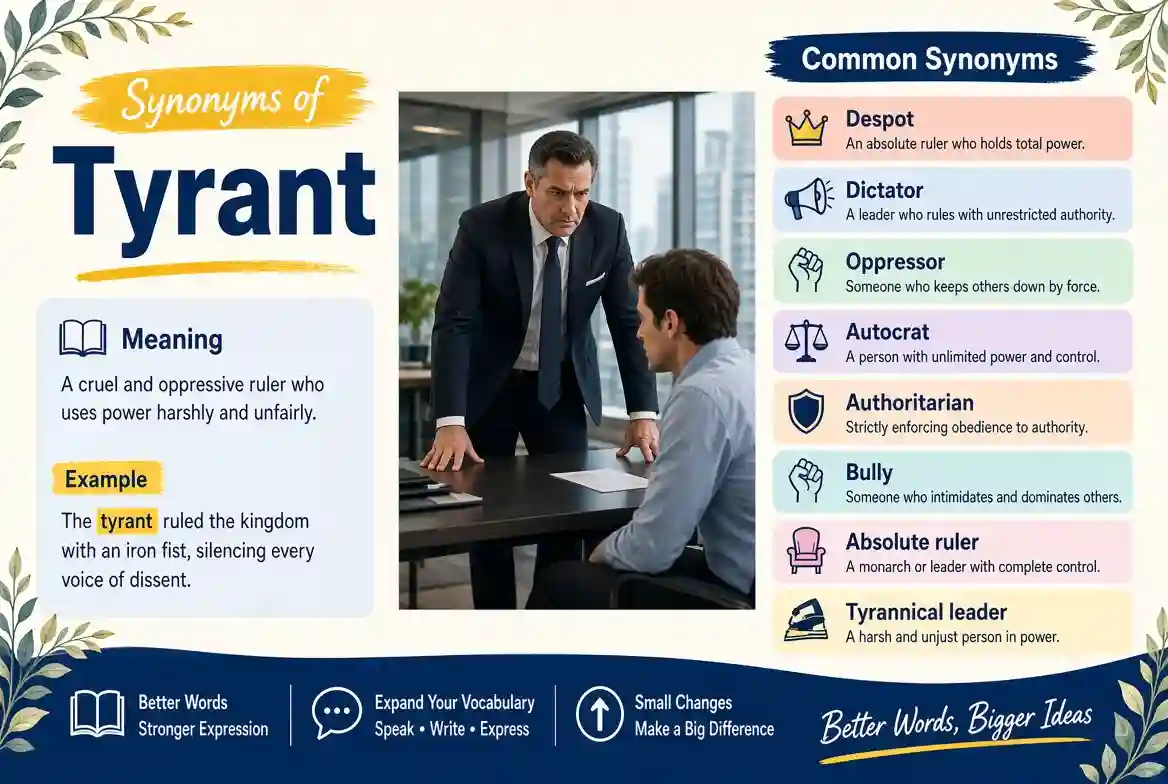
A tyrant is a person who uses power in a cruel, unfair, or oppressive way. Common synonyms for tyrant include dictator, despot, autocrat, oppressor, authoritarian, and bully. However, each word has a different meaning. Use dictator for political power, oppressor for unfair treatment, and bully for intimidation. The best choice depends on the person and situation you want to describe.
What Does Tyrant Mean?
A tyrant is someone who abuses power and treats others unfairly. The word most often describes a cruel ruler, but it can also describe a controlling boss, parent, or other authority figure.
For example, a ruler who punishes people for criticizing the government may be called a tyrant. A manager who threatens employees and refuses to listen to them might also be described as tyrannical.
The word has a strongly negative meaning. It suggests more than strict rules or difficult leadership. It points to unfair control, cruelty, or an abuse of authority.
Pronunciation of Tyrant
- IPA (American): /ˈtaɪrənt/
- IPA (British): /ˈtaɪərənt/
- Easy pronunciation: TIE-runt
- Part of speech: Noun
- Plural: Tyrants
Both American and British English use the same spelling. The main difference is the vowel sound in the second syllable.
definition in the Cambridge English Dictionary+1
Word Origin and First Known Use
Tyrant entered English through Old French and Latin from the Greek word tyrannos. It was first recorded in English around 1250–1300. The exact deeper origin of the Greek word remains uncertain.
Dictionary+1
In ancient Greece, tyrants could describe a ruler who gained power outside the accepted rules of inheritance or custom. The word later became strongly associated with cruel or oppressive rule.
Today, writers also use it figuratively for a person who exercises authority in an unfair or controlling way.
Grammar and Word Forms
| Word | Part of speech | Meaning |
| Tyrant | Noun | A cruel or oppressive person in power |
| Tyranny | Noun | Cruel or unfair use of power |
| Tyrannical | Adjective | Cruel, oppressive, or controlling |
| Tyrannize | Verb | To treat someone cruelly through power |
| Tyrannically | Adverb | In a tyrannical manner |
Examples:
- The tyrant ignored every complaint.
- The people fought against tyranny.
- The manager used tyrannical methods.
- He tyrannized his workers for years.
Grammar tip: Say “He tyrannized his workers,” not “He tyranted his workers.” Tyrant is a noun, while tyrannize is the verb.
Quick Comparison: 30 Synonyms for Tyrant
| Synonym | Main meaning | Register |
| Dictator | Ruler with concentrated political power | Formal |
| Despot | Cruel ruler | Formal |
| Autocrat | Leader with personal authority | Formal |
| Oppressor | Person who unfairly controls others | Formal |
| Bully | Person who intimidates others | Everyday |
| Authoritarian | Person who demands obedience | Academic |
| Strongman | Powerful political leader | Journalistic |
| Taskmaster | Demanding supervisor | Neutral |
| Martinet | Person who insists on strict discipline | Formal |
| Slave driver | Person who demands excessive work | Informal |
| Warlord | Armed leader controlling territory | Political |
| Usurper | Person who takes power unlawfully | Literary |
| Persecutor | Person who repeatedly targets others | Formal |
| Tormentor | Person who causes repeated distress | Neutral |
| Intimidator | Person who uses fear to influence others | Neutral |
| Disciplinarian | Person who strictly enforces rules | Neutral |
| Overlord | Powerful master or ruler | Literary |
| Absolutist | Person who supports absolute authority | Academic |
| Control freak | Person who wants excessive control | Informal |
| Cruel ruler | Ruler who treats people harshly | Neutral |
| Dictatorial leader | Leader who expects obedience | Formal |
| Oppressive ruler | Ruler who restricts people unfairly | Formal |
| Iron-fisted ruler | Ruler who uses harsh control | Literary |
| Hard master | Harsh person in authority | Literary |
| Abuser of power | Person who misuses authority | Professional |
| Persecuting ruler | Ruler who targets people unfairly | Formal |
| Oppressor of the people | Person who unfairly controls a population | Literary |
| Authoritarian ruler | Ruler who limits freedom | Academic |
| Dominator | Person who seeks control over others | Neutral |
| Cruel master | Person who treats those under their control harshly | Literary |
Some entries are descriptive phrases rather than direct synonyms. Words such as dictator, despot, and oppressor are closer matches than disciplinarian or absolutist. The latter terms need context to convey cruelty.
30 Synonyms for Tyrant With Examples
1. Dictator
Meaning: A ruler who holds concentrated political power and may use it unfairly.
- The dictator banned peaceful protests.
- The country struggled under a dictator who refused to share power.
Best used when: Discussing a political leader with few effective limits on authority.
Tone: Formal. CEFR: B2–C1. Frequency: Common.
Collocations: military dictator, ruthless dictator, overthrow a dictator.
When not to use it: Do not use it as an exact substitute for a bully in every personal situation.
2. Despot
Meaning: A ruler who uses power cruelly and unfairly.
- The despot punished anyone who questioned his orders.
- The people hoped to end the despot’s rule.
Best used when: You want to emphasize cruelty and oppressive rule.
Tone: Formal, literary. CEFR: C1. Frequency: Common in formal writing.
Collocations: cruel despot, ruthless despot, despotic rule.
When not to use it: Choose a strict leader when the person is firm but fair.
3. Autocrat
Meaning: A leader who makes decisions through personal authority with little meaningful opposition.
- The autocrat rejected every proposal from parliament.
- Employees had little say under their autocratic director.
Best used when: Emphasizing concentrated decision-making power.
Tone: Formal, academic. CEFR: C1. Frequency: Common in political writing.
Collocations: political autocrat, autocratic rule, absolute authority.
When not to use it: The word does not automatically mean that someone is cruel.
4. Oppressor
Meaning: A person who keeps others under unfair control or causes them to suffer.
- The community organized against its oppressor.
- The novel follows people who resist an oppressive system.
Best used when: Focusing on the harm done to others.
Tone: Formal. CEFR: B2–C1. Frequency: Common.
Collocations: resist an oppressor, fight oppression, oppressive system.
When not to use it: Ordinary disagreement does not make someone an oppressor.
5. Bully
Meaning: A person who uses threats, fear, or hurtful behavior to control others.
- The workplace bully mocked people who made mistakes.
- She refused to let the bully silence her team.
Best used when: Describing intimidation in daily life.
Tone: Everyday, critical. CEFR: A2–B1. Frequency: Very common.
Collocations: school bully, workplace bully, bully someone into doing something.
When not to use it: A bully does not necessarily hold formal power.
6. Authoritarian
Meaning: A person who demands obedience and allows little freedom or disagreement.
- The authoritarian leader rejected public criticism.
- His authoritarian management style discouraged new ideas.
Best used when: Describing strict control and limited freedom.
Tone: Formal, academic. CEFR: C1. Frequency: Common.
Collocations: authoritarian leader, authoritarian government, authoritarian rule.
When not to use it: It describes a style of authority, not necessarily personal cruelty.
7. Strongman
Meaning: A powerful political leader who relies on personal authority, force, or influence.
- The strongman weakened the courts to protect his position.
- The country remained under strongman rule for years.
Best used when: Writing about a powerful leader with limited accountability.
Tone: Political, journalistic. CEFR: C1. Frequency: Common in news writing.
Collocations: political strongman, strongman rule, regional strongman.
When not to use it: Outside politics, strongman can refer to a physically powerful man.
8. Taskmaster
Meaning: A person who demands hard work and expects others to meet strict standards.
- The taskmaster expected the crew to finish before sunset.
- Our editor is a strict taskmaster but gives useful advice.
Best used when: Describing a demanding supervisor.
Tone: Neutral, sometimes literary. CEFR: B2–C1. Frequency: Common.
Collocations: strict taskmaster, demanding taskmaster, work under a taskmaster.
When not to use it: A taskmaster may be demanding without being cruel.
9. Martinet
Meaning: A person who insists on strict discipline and exact obedience.
- The instructor was a martinet about punctuality.
- Nobody enjoyed working for a martinet who criticized every small error.
Best used when: Highlighting rigid rules and discipline.
Tone: Formal. CEFR: C2. Frequency: Uncommon.
Collocations: strict martinet, military martinet, complete martinet.
When not to use it: For general readers, strict disciplinarians may be easier to understand.
10. Slave driver
Meaning: An informal term for someone who demands excessive work from others.
- The team jokingly called their supervisor a slave driver.
- The manager acted like a slave driver during the busy season.
Best used when: Describing an excessively demanding boss.
Tone: Informal. CEFR: B2. Frequency: Common.
Collocations: a real slave driver, work like a slave driver, demanding slave driver.
When not to use it: The phrase has troubling historical associations with slavery. Use exploitative manager when you need a more precise professional term.
11. Warlord
Meaning: A military leader who controls territory through armed force, often where the central government is weak.
- The warlord controlled several towns with his private army.
- Families fled when the warlord expanded his territory.
Best used when: Discussing armed conflict and military control.
Tone: Formal, political. CEFR: C1. Frequency: Common in conflict reporting.
Collocations: regional warlord, powerful warlord, warlord’s militia.
When not to use it: A cruel civilian manager is not normally a warlord.
12. Usurper
Meaning: A person who takes power or a position without rightful authority.
- The prince called his uncle a usurper of the throne.
- The general was accused of being a usurper after seizing control.
Best used when: The main issue is how someone obtained power.
Tone: Formal, literary. CEFR: C1–C2. Frequency: Uncommon.
Collocations: usurper of the throne, seize power, challenge a usurper.
When not to use it: A person can obtain power legally and still behave like a tyrant.
13. Persecutor
Meaning: A person who repeatedly harms or targets others because of their beliefs, identity, or actions.
- The persecutor targeted people who opposed the regime.
- Witnesses described the official as a persecutor of religious minorities.
Best used when: Emphasizing repeated, unfair punishment or harassment.
Tone: Formal. CEFR: C1. Frequency: Uncommon.
Collocations: political persecutor, religious persecution, victims of persecution.
When not to use it: A single argument does not usually amount to persecution.
14. Tormentor
Meaning: A person who repeatedly causes someone pain, fear, or distress.
- The child finally told a teacher about his tormentor.
- The tyrant became the villagers’ chief tormentor.
Best used when: Focusing on suffering rather than official authority.
Tone: Neutral, literary. CEFR: B2–C1. Frequency: Common.
Collocations: relentless tormentor, childhood tormentor, tormentor of the weak.
When not to use it: A tormentor does not need to have political or official power.
15. Intimidator
Meaning: A person who uses fear or threats to influence others.
- The intimidator threatened anyone who challenged his plans.
- She refused to let an intimidator silence the team.
Best used when: Threats and fear are central to the behavior.
Tone: Neutral, professional. CEFR: B2–C1. Frequency: Uncommon.
Collocations: workplace intimidation, intimidation tactics, intimidate a witness.
When not to use it: Not every controlling person uses threats.
16. Disciplinarian
Meaning: A person who strongly enforces rules and expects good behavior.
- The teacher was a disciplinarian who insisted on respect.
- Although she was a disciplinarian, she listened to her students.
Best used when: Describing someone who maintains discipline.
Tone: Neutral, formal. CEFR: B2–C1. Frequency: Common.
Collocations: strict disciplinarian, firm disciplinarian, school disciplinarian.
When not to use it: Fair enforcement of rules does not make someone a tyrant.
17. Overlord
Meaning: A powerful ruler or master who has authority over others.
- The villagers paid taxes to the overlord who controlled the valley.
- The fantasy hero challenged the dark overlord.
Best used when: Writing about feudal history or fantasy.
Tone: Literary, historical. CEFR: C1. Frequency: Uncommon in daily conversation.
Collocations: feudal overlord, dark overlord, serve an overlord.
When not to use it: The word can suggest power without necessarily suggesting cruelty.
18. Absolutist
Meaning: A person who supports absolute authority or holds views in absolute terms.
- The absolutist ruler refused to share power.
- Her absolutist approach left no room for compromise.
Best used when: Discussing absolute authority or uncompromising beliefs.
Tone: Formal, academic. CEFR: C1–C2. Frequency: Uncommon.
Collocations: absolutist monarch, absolutist position, absolutist rule.
When not to use it: The word does not always imply cruelty or oppression.
19. Control freak
Meaning: An informal term for someone who wants to control nearly everything.
- My project partner is a control freak who edits every sentence.
- He became a control freak about how the kitchen was organized.
Best used when: Describing excessive control in everyday life.
Tone: Informal, critical. CEFR: B1–B2. Frequency: Very common.
Collocations: complete control freak, act like a control freak, controlling behavior.
When not to use it: Avoid this expression in formal reports or serious political analysis.
20. Cruel ruler
Meaning: A leader who treats people harshly or causes them harm.
- The cruel ruler raised taxes while families struggled to eat.
- The legend tells of a cruel ruler who feared his own people.
Best used when: You want a clear description that readers of all levels can understand.
Tone: Neutral, descriptive. CEFR: A2–B1. Frequency: Very common.
Collocations: cruel ruler, unjust ruler, rule cruelly.
When not to use it: If unrestricted political power is the main point, a dictator or autocrat may be more precise.
21. Dictatorial leader
Meaning: A leader who expects obedience and makes decisions without proper consultation.
- The dictatorial leader ignored the concerns of local communities.
- Employees left because of the manager’s dictatorial behavior.
Best used when: Describing controlling leadership at work or in politics.
Tone: Formal, professional. CEFR: B2–C1. Frequency: Common.
Collocations: dictatorial behavior, dictatorial style, dictatorial leader.
When not to use it: A difficult decision made after fair discussion is not automatically dictatorial.
22. Oppressive ruler
Meaning: A ruler who restricts freedom or treats people unfairly.
- The oppressive ruler silenced public criticism.
- Citizens protested against the oppressive ruler’s policies.
Best used when: Emphasizing restrictions, unfair laws, or harmful rules.
Tone: Formal. CEFR: B2–C1. Frequency: Common.
Collocations: oppressive regime, oppressive laws, oppressive rule.
When not to use it: Use a more specific term if the problem is only strict discipline at work.
23. Iron fisted ruler
Meaning: A ruler who maintains harsh control and shows little tolerance for opposition.
- The iron-fisted ruler banned public gatherings.
- The region remained under iron-fisted rule for decades.
Best used when: Creating a vivid description of harsh government.
Tone: Literary, journalistic. CEFR: C1. Frequency: Common in descriptive writing.
Collocations: iron-fisted rule, iron-fisted leader, rule with an iron fist.
When not to use it: The phrase may sound dramatic in a neutral academic report.
24. Hard master
Meaning: A person in authority who treats those under their control harshly.
- The workers described the landowner as a hard master.
- In the old tale, the hard master gave his servants little rest.
Best used when: Writing historical fiction or discussing older social systems.
Tone: Literary, historical. CEFR: C1. Frequency: Uncommon.
Collocations: harsh master, serve a hard master, cruel master.
When not to use it: For modern workplaces, abusive employers may be clearer.
25. Abuser of power
Meaning: A person who uses an official role or position for unfair or harmful purposes.
- The investigation exposed the official as an abuser of power.
- An abuser of power may punish people who report misconduct.
Best used when: Discussing misconduct in a workplace, government, or institution.
Tone: Formal, professional. CEFR: B2–C1. Frequency: Common as a phrase.
Collocations: abuse of power, misuse of authority, investigating misconduct.
When not to use it: Use tyrant when the description also needs to convey sustained cruel control.
26. Persecuting ruler
Meaning: A ruler who repeatedly harms or punishes people because of their beliefs or identity.
- The persecuting ruler forced minority groups to leave their homes.
- Historians studied how the ruler targeted religious communities.
Best used when: Systematic persecution is central to the description.
Tone: Formal, historical. CEFR: C1–C2. Frequency: Uncommon as a fixed phrase.
Collocations: persecute minorities, religious persecution, political persecution.
When not to use it: This is a descriptive phrase rather than a fixed one-word synonym.
27. Oppressor of the people
Meaning: A person who uses power to keep a population under unfair control.
- The rebels described the king as an oppressor of the people.
- The poem urges citizens to stand against every oppressor of the people.
Best used when: Writing political speeches, historical accounts, or dramatic narratives.
Tone: Formal, literary. CEFR: C1. Frequency: Uncommon as a phrase.
Collocations: resist oppression, free the people, overthrow an oppressor.
When not to use it: In a short sentence, oppressor is usually enough.
28. Authoritarian ruler
Meaning: A ruler who demands obedience and restricts freedom or political opposition.
- The authoritarian ruler limited the power of independent courts.
- An authoritarian ruler may treat criticism as a threat.
Best used when: Describing a political leader who limits opposition.
Tone: Formal, academic. CEFR: C1. Frequency: Common.
Collocations: authoritarian ruler, authoritarian government, authoritarian policies.
When not to use it: The term describes a style of rule and does not by itself prove personal cruelty.
29. Dominator
Meaning: A person who seeks to control or overpower others.
- The story presents him as a dominator who never accepts advice.
- Her controlling behavior left little room for shared decisions.
Best used when: Emphasizing the desire to dominate others.
Tone: Neutral, sometimes academic. CEFR: C1. Frequency: Uncommon.
Collocations: dominate others, desire for dominance, controlling behavior.
When not to use it: Dominator is less natural than controlling person in many everyday situations.
30. Cruel master
Meaning: A person who treats those under their authority with great harshness.
- The workers feared the cruel master who withheld their pay.
- The story describes a cruel master who punished small mistakes.
Best used when: Writing historical or literary accounts of harsh authority.
Tone: Literary, descriptive. CEFR: B2–C1. Frequency: Common as a phrase.
Collocations: cruel master, harsh master, serve a cruel master.
When not to use it: For a modern workplace, an abusive boss or exploitative employer may be more natural.
Choose the Right Synonym: Side by Side Comparisons
The easiest way to select a synonym is to identify what you want to emphasize.
| If you mean… | Choose… | Why? |
| A cruel political ruler | Despot | Emphasizes cruelty |
| A ruler with concentrated political power | Dictator | Emphasizes political authority |
| A leader who decides everything alone | Autocrat | Emphasizes personal control |
| Someone who harms people through unfair power | Oppressor | Emphasizes the victims’ suffering |
| Someone who uses threats | Bully | Emphasizes intimidation |
| A demanding supervisor | Taskmaster | Emphasizes hard work and high demands |
| Someone who insists on exact rules | Martinet | Emphasizes rigid discipline |
| Someone who takes power unlawfully | Usurper | Emphasizes how power was obtained |
Example: “The manager is a tyrant” is a strong general statement. “The manager is a bully” suggests intimidation, while “the manager is a taskmaster” suggests excessive demands. The second and third sentences give readers more specific information.
Strongest Synonyms, Strong Synonyms, and Related Words
Strongest synonyms
- Despot: Best for cruel, oppressive rule.
- Dictator: Best for concentrated political power.
- Autocrat: Best for personal control over decisions.
- Oppressor: Best for unfair treatment of others.
- Bully: Best for intimidation in everyday situations.
Strong synonyms
- Authoritarian: Emphasizes obedience and restricted freedom.
- Strongman: Emphasizes personal political power.
- Oppressive ruler: Emphasizes unfair restrictions.
- Iron-fisted ruler: Emphasizes harsh control.
- Persecutor: Emphasizes repeated targeting or mistreatment.
Related words
- Taskmaster: A demanding supervisor.
- Martinet: A person who insists on strict discipline.
- Disciplinarian: Someone who enforces rules.
- Usurper: Someone who takes power without rightful authority.
- Tormentor: Someone who repeatedly causes distress.
- Control freak: An informal term for someone who wants excessive control.
These categories are practical guides, not a universal ranking. The strongest word is the one that accurately describes the situation.
American vs. British English
The main synonyms for tyrant have the same spelling and broadly the same meanings in American and British English.
| Word | American English | British English |
| Tyrant | tyrant | tyrant |
| Dictator | dictator | dictator |
| Despot | despot | despot |
| Oppressor | oppressor | oppressor |
| Authoritarian | authoritarian | authoritarian |
| Slave driver | slave driver | slave-driver may also appear |
The pronunciation of tyrant varies slightly by accent, but neither spelling changes. Control freak is informal in both varieties.
Common Mistakes to Avoid
Mistake 1: Calling every strict person a tyrant
Correction: Use strict teacher, firm manager, or disciplinarian when the person enforces fair rules.
Why: A tyrant abuses power. Strictness alone is not enough.
Mistake 2: Using dictator and usurper as identical words
Correction: Use a dictator for concentrated political power and usurper for someone who takes power without rightful authority.
Why: One describes how power is exercised; the other describes how it is obtained.
Mistake 3: Treating authoritarian as a direct synonym for cruel
Correction: Explain the person’s behavior if cruelty is the main point.
Why: Authoritarian mainly describes a preference for strict obedience and concentrated authority.
Mistake 4: Using rare vocabulary to sound intelligent
Correction: Prefer dictator, bully, or oppressor when these words express your meaning clearly.
Why: Clear, accurate language is more useful than an obscure word that readers may misunderstand.
Writing Tips for Using Tyrant Synonyms
- Essays: Use despot, dictator, or authoritarian ruler when discussing politics. Explain the actions that support your description.
- Emails: Avoid personal labels when describing workplace problems. State what happened and how it affected the team.
- Blog posts: Use familiar terms such as bully and controlling boss when writing for a general audience.
- Stories: Use despot, overlord, or iron-fisted ruler to create a dramatic atmosphere.
- Social media: Tyrant and control freak can express frustration, but the tone may sound exaggerated.
- Daily conversations: Choose the word that best describes the behavior rather than using the strongest available term.
Antonyms and Related Vocabulary
There is no perfect opposite for every meaning of tyrant. However, these words can express fair or helpful leadership.
| Word | Meaning |
| Benevolent ruler | A ruler who seeks the people’s welfare |
| Protector | Someone who keeps others safe |
| Advocate | Someone who supports or defends a cause |
| Fair leader | Someone who treats people justly |
| Democrat | Someone who supports democratic government |
| Humanitarian | Someone concerned with helping people and reducing suffering |
Related expressions include abuse of power, rule by fear, iron-fisted rule, power-hungry leader, and domineering behavior.
Frequently Asked Questions
1. What is the closest synonym for tyrant?
Despot and dictator are two of the closest synonyms. Despot emphasizes cruel rule, while dictator emphasizes concentrated political power. Autocrat is another strong option when the focus is on one person making decisions without meaningful opposition.
2. What is another word for a tyrant boss?
A bully, taskmaster, or controlling boss may fit, depending on the behavior. Use bully for intimidation and taskmaster for excessive work demands. If the boss repeatedly abuses authority, tyranny may be appropriate, although it carries a strong negative tone.
3. What is a formal word for tyrant?
Despot, autocrat, and oppressor are useful formal alternatives. Choose despot for cruel rule, autocrat for concentrated personal authority, and oppressor for someone who unfairly controls or harms others. Each word highlights a different part of the meaning.
4. Is a dictator the same as a tyrant?
No. A dictator is a ruler who holds concentrated political power, often with few effective limits. A tyrant is defined more directly by cruel or unfair use of authority. The terms overlap, but they are not identical in every context.
5. What is the difference between a tyrant and a bully?
A tyrant abuses power to control others, often in a position of authority. A bully uses intimidation, threats, or harmful behavior against another person or group. A bully does not need official power, while a tyrant often exercises control over people who have less power.
6. What is the adjective form of tyrant?
The adjective is tyrannical, meaning cruel, oppressive, or excessively controlling. For example, “The manager used tyrannical methods to control the staff.” The noun tyranny describes cruel or unfair use of power, while the verb tyrannize means to treat people in that way.
7. What is the opposite of a tyrant?
There is no single perfect antonym. Depending on the context, you could use benevolent ruler, fair leader, or protector. These terms suggest someone who uses authority to help others rather than oppress them. Democrats may work when the contrast concerns political systems.
8. What are some synonyms for tyrant in literature?
Writers may use despot, overlord, iron-fisted ruler, cruel master, or oppressor. Despot emphasizes cruelty, while overlord suggests a powerful master. Iron-fisted ruler creates a vivid image of harsh control, making it useful in historical fiction and dramatic storytelling.
Vocabulary Quiz
Choose the best answer for each question.
1. Which word best describes a cruel political ruler?
A. Protector
B. Despot
C. Advocate
D. Mediator
2. Which word describes someone who takes power without rightful authority?
A. Taskmaster
B. Usurper
C. Disciplinarian
D. Humanitarian
3. Which word is most suitable for someone who uses threats to control coworkers?
A. Bully
B. Autocrat
C. Overlord
D. Absolutist
4. What does tyrannical mean?
A. Fair and patient
B. Helpful and generous
C. Cruel and controlling
D. Quiet and shy
5. Which word best describes a demanding supervisor who expects hard work?
A. Taskmaster
B. Usurper
C. Persecutor
D. Protector
Score: 0 / 5
Try again
Conclusion
Learning synonyms for tyrants helps you express ideas more accurately in essays, stories, emails, and conversations. Words such as dictator, despot, oppressor, and bully describe different forms of power and control.
Always consider the context before choosing a synonym. Practice these words in your own sentences, and your English vocabulary will become clearer, more natural, and more precise.
References
- Cambridge Dictionary: Synonyms for tyrant.
- Merriam-Webster: Tyrant definition.
- Collins Dictionary: Definition and etymology.
- Thesaurus.com: Synonyms and antonyms.
- Dictionary.com: Definition and word origin.

Synonorm is a trusted English vocabulary resource created to help readers find the right words and understand the differences between similar terms. We provide clear explanations of synonyms, meanings, examples, usage, and alternatives. Our content makes vocabulary easier to learn and apply in everyday, academic, and professional English. Synonorm is designed for students, writers, ESL learners, professionals, and anyone who wants to improve their English vocabulary and communicate more clearly.