What Are Synonyms for Necessity?
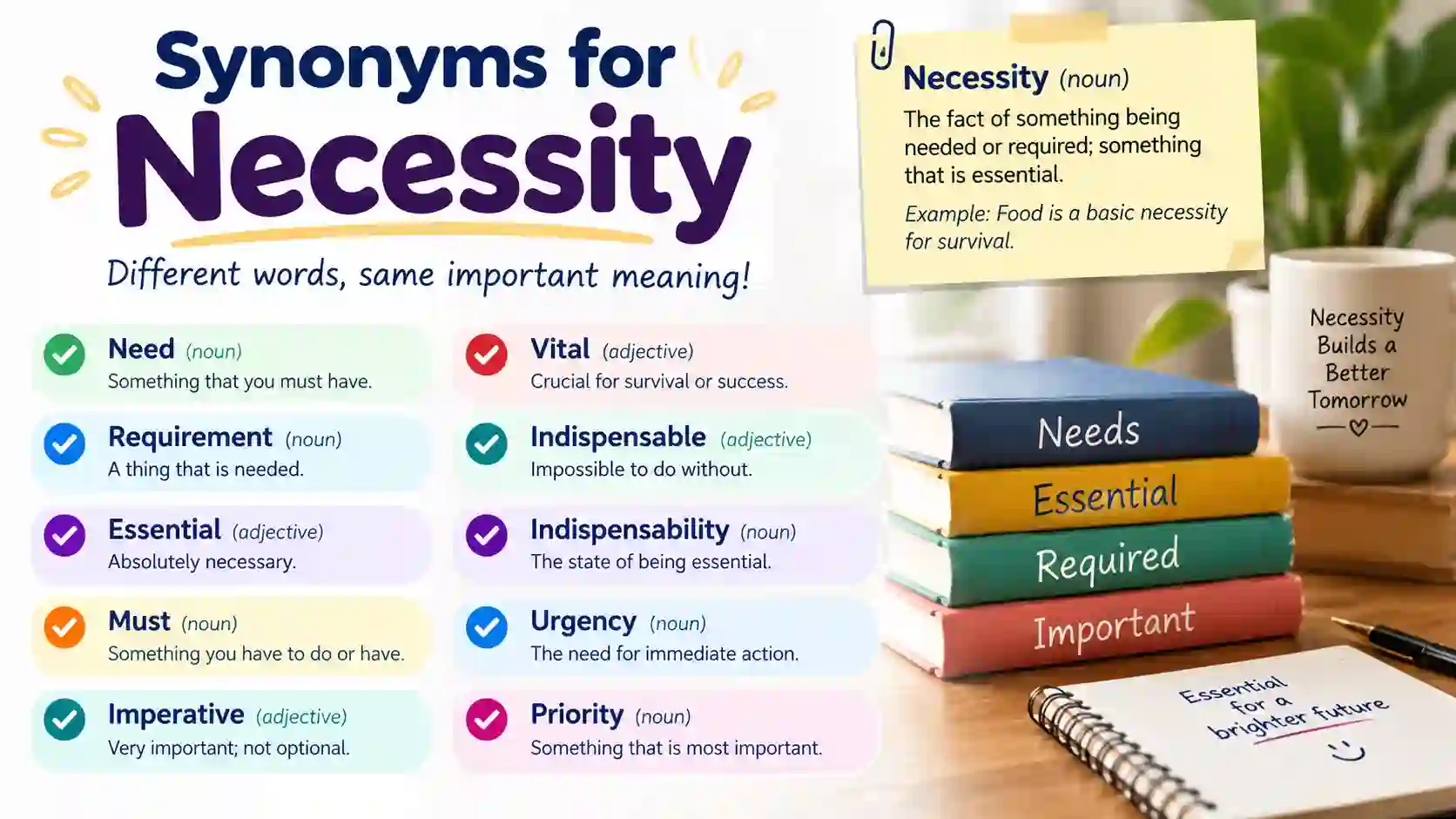
The best synonyms for necessity include need, requirement, essential, prerequisite, requisite, and indispensable. These words describe something that is needed, required, or essential for a particular purpose. However, each word has a slightly different meaning. For example, food is a necessity for life, while a degree may be a requirement for a job.
Have you ever repeated the word necessity several times in an essay, email, or blog post? Using suitable synonyms can make your writing clearer and more natural.
A necessity is something you need or something that must happen. Clean water is a basic necessity, while a valid passport may be a travel requirement. Both involve a need, but they describe different situations.
Learning synonyms for necessity helps students, teachers, bloggers, and professionals explain ideas with greater accuracy. It also improves vocabulary and makes everyday communication easier.
In this guide, you will discover 30 useful words and expressions related to necessity. Each entry explains its meaning, gives original examples, and shows when the word works best. You will also learn common grammar patterns, differences between similar words, and practical ways to improve your English.
Pronunciation of Necessity
- American and British IPA: /nəˈsesəti/
- Simple pronunciation: nuh-SES-uh-tee
- Part of speech: Noun
- Plural: Necessities
The main stress falls on the second syllable, SES. American speakers may pronounce the middle t with a quick flap sound, while British pronunciation commonly retains a clearer /t/.
Part of Speech and Word Family
Necessity is a noun. It refers to something needed or the state of needing something.
| Word | Part of speech | Example |
| Necessity | Noun | Food is a necessity. |
| Necessary | Adjective | Water is necessary for life. |
| Necessarily | Adverb | More expensive does not necessarily mean better. |
| Necessitate | Verb | The damage may necessitate repairs. |
| Necessities | Plural noun | We packed our basic necessities. |
Common Grammar Patterns
- Necessity of something: We discussed the necessity of regular practice.
- Necessity for something: There is a necessity for better planning.
- Necessary for: Exercise is necessary for good health.
- Out of necessity: She accepted the job out of necessity.
- A necessity of life: Clean water is a necessity of life.
In everyday English, need is often more natural than necessity. For example, “We need more time” sounds simpler than “There is a necessity for more time.”
Quick Comparison: Synonyms for Necessity
| Synonym | Main meaning | Register |
| Need | Something required | Neutral |
| Requirement | A rule or condition | Formal/Business |
| Essential | Something vital | Neutral |
| Prerequisite | Something needed beforehand | Academic |
| Requisite | Something required | Formal |
| Indispensable | Impossible or very difficult to do without | Formal |
| Obligation | A duty or responsibility | Formal |
| Urgency | The need to act quickly | Neutral/Formal |
| Imperative | A compelling need for action | Formal |
| Must-have | An essential or highly desirable item | Informal |
30 Synonyms for Necessity With Examples and Explanations
The following list distinguishes close synonyms from related words. Some alternatives fit only specific contexts.
1. Need
Meaning: Something you must have or do.
Examples:
- Every student has a need for a quiet place to study.
- There is no need to finish the task tonight.
Best used when: You want a simple word for everyday conversation.
Register: Neutral. Frequency: Very common. CEFR: A1–A2 estimate.
Collocations: basic need, urgent need, need for help.
When not to use it: Choose a requirement when you mean a formal rule.
2. Requirement
Meaning: Something that a rule, job, or situation demands.
Examples:
- A valid passport is a requirement for this journey.
- Strong communication skills are a requirement for the position.
Best used when: You discuss qualifications, rules, or conditions.
Register: Neutral/Formal. Frequency: Very common. CEFR: B1 estimate.
Collocations: legal requirement, minimum requirement, job requirement.
When not to use it: Do not use it for a personal wish that nobody requires.
3. Essential
Meaning: Something that is absolutely important or needed.
Examples:
- Clean water is essential for human life.
- A reliable internet connection is essential for her online classes.
Best used when: You want to emphasize that something is vital.
Register: Neutral. Frequency: Very common. CEFR: B1 estimate.
Collocations: essential services, essential supplies, daily essentials.
When not to use it: Remember that essential is usually an adjective. As a noun, use an essential or the essentials.
4. Prerequisite
Meaning: Something that must be completed or available beforehand.
Examples:
- Basic computer skills are a prerequisite for the course.
- Passing the first examination is a prerequisite for advanced training.
Best used when: One step must come before another.
Register: Academic/Formal. Frequency: Common. CEFR: B2 estimate.
Collocations: prerequisite for admission, necessary prerequisite, course prerequisite.
When not to use it: Do not use it for an ordinary item someone needs to buy.
5. Requisite
Meaning: Something needed for a particular purpose.
Examples:
- The applicants submitted the requisite documents.
- Patience is a requisite for learning a new language.
Best used when: You need a formal alternative to required or necessary.
Register: Formal. Frequency: Uncommon. CEFR: C1 estimate.
Collocations: requisite skills, requisite knowledge, requisite documents.
When not to use it: In casual conversation, need usually sounds more natural.
6. Indispensable
Meaning: So important that you cannot easily do without it.
Examples:
- Her experience is indispensable to the research team.
- A first-aid kit is indispensable on a long hiking trip.
Best used when: You want to stress that something is vital.
Register: Neutral/Formal. Frequency: Common. CEFR: B2 estimate.
Collocations: indispensable resource, indispensable tool, indispensable to success.
When not to use it: Avoid it for items that are merely convenient.
7. Obligation
Meaning: Something you must do because of a duty, promise, or rule.
Examples:
- Tenants have an obligation to pay rent as agreed.
- She felt an obligation to help her younger brother.
Best used when: You describe a duty or responsibility.
Register: Formal/Neutral. Frequency: Common. CEFR: B1–B2 estimate.
Collocations: legal obligation, moral obligation, contractual obligation.
When not to use it: Food and sleep are necessities, not obligations.
8. Essentiality
Meaning: The quality or state of being essential.
Examples:
- The research examined the essentiality of certain nutrients.
- The report questioned the essentiality of the extra procedure.
Best used when: You discuss the concept of being essential in technical or academic writing.
Register: Academic. Frequency: Uncommon. CEFR: C1 estimate.
Collocations: essentiality of a nutrient, assess essentiality, biological essentiality.
When not to use it: Use importance or need in everyday writing.
9. Precondition
Meaning: A condition that must exist before something can happen.
Examples:
- Trust is a precondition for a successful partnership.
- The software checks each precondition before running the process.
Best used when: You explain the conditions needed for an outcome.
Register: Formal/Technical. Frequency: Common. CEFR: B2 estimate.
Collocations: precondition for success, meet a precondition, necessary precondition.
When not to use it: Use requirements when you mean a specific rule or qualification.
10. Must have
Meaning: Something considered essential or highly desirable.
Examples:
- A warm coat is a winter must-have.
- The guide lists must-have supplies for first-time campers.
Best used when: You discuss products, travel items, or practical essentials.
Register: Informal. Frequency: Common. CEFR: B1 estimate.
Collocations: travel must-have, kitchen must-have, must-have item.
When not to use it: Avoid it in strict legal or academic writing.
11. Fundamental need
Meaning: A basic need that supports life or well-being.
Examples:
- Safe housing is a fundamental need for every family.
- Children have a fundamental need for care and protection.
Best used when: You discuss human needs, education, or society.
Register: Neutral/Academic. Frequency: Common. CEFR: B1–B2 estimate.
Collocations: fundamental human need, meet fundamental needs, need for safety.
When not to use it: Do not use it for a minor preference.
12. Basic need
Meaning: Something essential for survival or a reasonable quality of life.
Examples:
- Clean water is a basic need in every community.
- The charity helps families access food and shelter.
Best used when: You discuss essentials such as food, water, shelter, and safety.
Register: Neutral. Frequency: Very common. CEFR: A2–B1 estimate.
Collocations: basic human needs, meet basic needs, basic needs of life.
When not to use it: Use requirements for formal qualifications.
13. Essential item
Meaning: An object that is needed for a particular purpose.
Examples:
- A flashlight is an essential item for a camping trip.
- The checklist includes essential items for a new baby.
Best used when: You list practical objects people need.
Register: Neutral. Frequency: Common. CEFR: B1 estimate.
Collocations: essential travel items, household essentials, essential supplies.
When not to use it: Do not use it for a responsibility or abstract condition.
14. Demand
Meaning: A strong need, expectation, or desire for something.
Examples:
- The project places heavy demands on the staff.
- Demand for affordable housing has increased.
Best used when: You describe pressure, expectations, or market needs.
Register: Neutral. Frequency: Very common. CEFR: B1 estimate.
Collocations: growing demand, meeting demand, demands of the job.
When not to use it: Demand can refer to what people want to buy, so it does not always mean necessity.
15. Urgent need
Meaning: A need that requires quick attention.
Examples:
- The village has an urgent need for clean drinking water.
- There is an urgent need to repair the damaged bridge.
Best used when: Delaying action could cause harm or serious problems.
Register: Neutral/Formal. Frequency: Common. CEFR: B1 estimate.
Collocations: urgent need for help, address an urgent need, urgent need for action.
When not to use it: Do not use urgent for something that can comfortably wait.
16. Imperative
Meaning: Something extremely important that demands action.
Examples:
- Protecting customer data is an imperative for the company.
- Early action is an imperative when public safety is at risk.
Best used when: You emphasize a compelling need for action.
Register: Formal/Academic. Frequency: Common in formal contexts. CEFR: C1 estimate.
Collocations: moral imperative, strategic imperative, urgent imperative.
When not to use it: Use essential for simple everyday needs.
17. Compulsion
Meaning: A powerful force or feeling that makes someone act.
Examples:
- Financial pressure created a compulsion to find extra work.
- He felt a compulsion to check every detail repeatedly.
Best used when: You describe strong pressure or an urge that limits choice.
Register: Formal/Psychological. Frequency: Context-dependent. CEFR: C1 estimate.
Collocations: compulsion to act, irresistible compulsion, under compulsion.
When not to use it: It is not a general replacement for an ordinary need.
18. Duty
Meaning: Something a person should or must do because of a role or responsibility.
Examples:
- It is the nurse’s duty to care for patients.
- He considered it his duty to protect the family business.
Best used when: You refer to responsibility rather than an essential object.
Register: Neutral/Formal. Frequency: Very common. CEFR: A2–B1 estimate.
Collocations: civic duty, moral duty, sense of duty.
When not to use it: Do not use duty to describe food, water, or shelter.
19. Necessity of life
Meaning: Something essential for living.
Examples:
- Food, water, and shelter are necessities of life.
- The relief program provides necessities of life to displaced families.
Best used when: You discuss basic survival needs.
Register: Neutral. Frequency: Common expression. CEFR: B1 estimate.
Collocations: necessities of life, basic necessities, provide necessities.
When not to use it: Use a more precise term for a legal rule or technical condition.
20. Condition
Meaning: Something that must be true or present for an outcome to happen.
Examples:
- Regular practice is an important condition for improvement.
- Approval is a condition of the agreement.
Best used when: You describe what must be true before something can happen.
Register: Neutral/Formal. Frequency: Very common. CEFR: B1 estimate.
Collocations: necessary condition, condition for success, meet a condition.
When not to use it: Condition has several meanings, including a state of health. Make the intended meaning clear.
21. Urgency
Meaning: The need to act quickly.
Examples:
- The urgency of the repairs became clear after the storm.
- She explained the urgency of submitting the application on time.
Best used when: You emphasize time pressure.
Register: Neutral/Formal. Frequency: Common. CEFR: B1–B2 estimate.
Collocations: sense of urgency, growing urgency, act with urgency.
When not to use it: Use necessity when something is needed but does not require immediate action.
22. Exigency
Meaning: An urgent need or a difficult situation that demands action.
Examples:
- The team changed its plan to meet the emergencies.
- The unexpected emergency required an immediate budget review.
Best used when: You need a formal word for urgent demands created by circumstances.
Register: Formal/Literary. Frequency: Rare. CEFR: C2 estimate.
Collocations: exigencies of war, exigencies of the situation, unexpected exigency.
When not to use it: Most readers will find urgent needs easier to understand.
23. Sine qua non
Meaning: Something absolutely essential for a particular result.
Examples:
- Trust is a sine qua non of a lasting partnership.
- Accurate records are a sine qua non for a reliable audit.
Best used when: You need a precise expression for an indispensable condition.
Register: Literary/Academic. Frequency: Rare. CEFR: C2 estimate.
Collocations: sine qua non of success, sine qua non for progress, a sine qua non.
When not to use it: Avoid this Latin expression in beginner-level writing or casual conversation.
24. Indispensability
Meaning: The quality of being impossible or very difficult to do without.
Examples:
- The report highlighted the indispensability of clean water.
- The project demonstrated the indispensability of accurate records.
Best used when: You discuss the essential role of a person, resource, or quality.
Register: Formal/Academic. Frequency: Uncommon. CEFR: C1 estimate.
Collocations: indispensability of education, demonstrate indispensability, practical indispensability.
When not to use it: Importance or essential role is often clearer.
25. Essential requirement
Meaning: A requirement that must be met.
Examples:
- A signed application is an essential requirement for registration.
- Clear communication is an essential requirement for the position.
Best used when: You need to emphasize a rule that cannot be ignored.
Register: Formal/Business. Frequency: Common phrase. CEFR: B2 estimate.
Collocations: essential requirement for approval, meet requirements, essential job requirement.
When not to use it: Avoid the extra word essential when the requirement already makes the point.
26. Vital factor
Meaning: Something that plays a very important role in an outcome.
Examples:
- Regular feedback is a vital factor in student progress.
- Careful planning was a vital factor in completing the project.
Best used when: You explain an influence on success.
Register: Neutral/Academic. Frequency: Common phrase. CEFR: B1–B2 estimate.
Collocations: vital factor in success, key factor in growth, important factor.
When not to use it: A factor may help an outcome without being strictly necessary.
27. Precondition for success
Meaning: Something that must be in place before success is possible.
Examples:
- Clear goals are a precondition for success in this project.
- Public trust is a precondition for success in the campaign.
Best used when: You explain the starting conditions for achieving a goal.
Register: Academic/Business. Frequency: Common expression. CEFR: B2 estimate.
Collocations: precondition for success, necessary precondition, meet the preconditions.
When not to use it: Do not use it for something that is merely helpful.
28. Basic requirement
Meaning: A minimum condition that must be met.
Examples:
- Reading ability is a basic requirement for the course.
- A secure password is a basic requirement for account protection.
Best used when: You explain minimum standards or entry conditions.
Register: Neutral/Formal. Frequency: Very common. CEFR: B1 estimate.
Collocations: basic requirement for entry, meet basic requirements, minimum requirement.
When not to use it: Use specialist requirements for advanced qualifications.
29. Bare necessity
Meaning: Something you need and nothing more.
Examples:
- They carried only the bare necessities on the hike.
- During the move, we bought only the bare necessities for the apartment.
Best used when: You distinguish essentials from luxuries.
Register: Neutral. Frequency: Common expression. CEFR: B1 estimate.
Collocations: bare necessities of life, pack the bare necessities, reduce spending to the bare necessities.
When not to use it: Do not use it when you mean every possible requirement.
30. Unavoidable need
Meaning: A need that circumstances make difficult or impossible to avoid.
Examples:
- The growing population created an unavoidable need for more housing.
- The damage made repairs unavoidable.
Best used when: You want to emphasize that circumstances leave little choice.
Register: Neutral/Formal. Frequency: Less common expression. CEFR: B2 estimate.
Collocations: unavoidable need for change, unavoidable need to adapt, need for repairs.
When not to use it: The phrase can sound wordy. Use necessity when it expresses the same idea more directly.
Choose the Right Synonym for Necessity
| If you mean… | Choose… | Example |
| Something generally needed | Need | We need more time. |
| A formal rule | Requirement | A degree is a job requirement. |
| Something vital | Essential | Water is essential for life. |
| Something needed beforehand | Prerequisite | Training is a prerequisite for the role. |
| A responsibility | Obligation | Paying rent is a legal obligation. |
| A need for quick action | Urgent need | The town has an urgent need for repairs. |
| A compelling call to act | Imperative | Immediate action is imperative. |
| The minimum essentials | Bare necessities | We packed the bare necessities. |
Commonly Confused Words
| Word | Difference | Example |
| Necessity | Something needed or unavoidable | Sleep is a necessity. |
| Convenience | Something that makes life easier | Online banking is a convenience. |
| Luxury | Something desirable but not essential | A private pool is a luxury. |
| Preference | Something someone likes better | Tea is my preference. |
| Emergency | A serious situation needing immediate action | The flood created an emergency. |
A convenience may be useful without being essential. A luxury is desirable but not required. An emergency is a serious situation that often creates an urgent need for action.
Common Mistakes
Mistake: Clean water is necessary.
Correction: Clean water is a necessity.
Why: Necessary is an adjective, while necessity is a noun.
Mistake: Food is my obligation.
Correction: Food is a necessity.
Why: An obligation is usually a duty or responsibility.
Mistake: A deadline is a prerequisite for acting quickly.
Correction: The approaching deadline creates urgency.
Why: A prerequisite must be satisfied beforehand. Urgency refers to the need for prompt action.
Mistake: Water is an essential sine qua non.
Correction: Water is essential for life.
Why: The original sentence combines two expressions that communicate similar ideas.
Writing Tips for Students, Bloggers, and Professionals
- Essays: Use prerequisite, requirement, or essential when discussing rules and conditions.
- Emails: Use need for simple requests and requirement for formal instructions.
- Blog posts: Use essential for important advice and must-have for informal product lists.
- Stories: Use out of necessity to explain why a character acts.
- Social media: Use short, familiar expressions such as basic needs and must-have.
- Professional writing: Use obligation for responsibilities and imperative when emphasizing a compelling need for action.
- Daily conversation: Prefer need over rare words such as exigency unless the context calls for formal language.
Natural Collocations
These common word combinations help you write more naturally:
- Absolute necessity
- Basic necessities
- Necessity of change
- Out of necessity
- Meet a requirement
- Essential for success
- Prerequisite for admission
- Legal obligation
- Sense of urgency
- Bare necessities of life
These are illustrative examples of natural usage, not quotations from a linguistic corpus.
Related Vocabulary and Antonyms
Antonyms
| Word | Meaning | Example |
| Luxury | Something desirable but not essential | A luxury car is not a basic need. |
| Optional | Not required | Attendance is optional. |
| Nonessential | Not vital | We removed nonessential features. |
| Extra | Something additional | The extra chair is not necessary. |
| Convenience | Something that makes life easier | The service is a convenience, not a necessity. |
Word Family
- Necessity: A need or essential thing.
- Necessary: Needed or required.
- Necessarily: In a way that must be the case.
- Necessitate: To make something necessary.
- Necessities: Things needed for life or a particular purpose.
Word Origin and Etymology
Necessity entered English through Old French necessité, from Latin necessitas, meaning need, compulsion, or inevitability. The Latin word is related to necesse, meaning needful or unavoidable.
Historical dictionary references place the English word in the late 14th century. Its meaning developed around the ideas of something required, the state of needing something, and circumstances that make an outcome unavoidable.
American vs. British English
The spelling of necessity is the same in American and British English. The word has the same basic meaning in both varieties.
| Feature | American English | British English |
| Spelling | Necessity | Necessity |
| Common synonym | Need | Need |
| Formal alternative | Requirement | Requirement |
| Basic essentials | Necessities | Necessities |
| Common expression | Out of necessity | Out of necessity |
Pronunciation varies by accent, but there is no important spelling difference. Words such as requirement, essential, and obligation are also used in both varieties.
Frequently Asked Questions
1. What is the best synonym for necessity?
The best general synonym for necessity is need. It works in everyday speech and many types of writing. However, requirement is better for formal rules, essential describes something vital, and obligation refers to a duty. Choose the word that matches your exact meaning.
2. What are 10 synonyms for necessity?
Ten useful alternatives are need, requirement, essential, prerequisite, requisite, indispensable, obligation, precondition, must-have, and imperative. Some describe things that people need, while others refer to duties or conditions. For example, food is a necessity, while a qualification may be a job requirement.
3. What is a formal word for necessity?
Prerequisite, requisite, imperative, and indispensability can work in formal writing, depending on the meaning. Use prerequisite for something needed beforehand and imperative for a compelling need for action. Choose clear words over complicated ones when both express the same idea.
4. What is the difference between necessity and requirement?
A necessity is something needed or unavoidable, while a requirement is a rule or condition that must be met. Food is a necessity for survival. A completed application may be a requirement for admission. The words overlap, but the requirement is often more precise for formal procedures.
5. What is the opposite of necessity?
Common opposites include luxury, optional, extra, and nonessential. A necessity is something needed, while a luxury is desirable but not essential. An optional activity is not required. The most accurate opposite depends on whether you mean an essential item, a compulsory action, or an unavoidable situation.
6. Is necessity a noun or an adjective?
Necessity is a noun. Its adjective form is necessary, as in “A passport is necessary for this journey.” Its verb form is necessitate, meaning to make something necessary. For example, “The damage may necessitate repairs.” These forms have related meanings but different grammatical roles.
7. How can I use necessity in a sentence?
You can use necessity to describe a need, an essential item, or an unavoidable situation. For example, “Clean water is a necessity for healthy living.” You can also say, “She accepted the job out of necessity,” meaning her circumstances made it necessary.
8. What is the difference between necessity and urgency?
Necessity means something is needed or required. Urgency means something needs attention quickly. Regular exercise may be a necessity for a healthy lifestyle, while a medical emergency creates urgency. A situation can involve both, but the words emphasize different ideas.
Vocabulary Quiz
1. Which word describes something that must be completed before a course begins?
A. Luxury
B. Prerequisite
C. Convenience
D. Preference
2. Which word best describes a legal duty?
A. Must-have
B. Essentiality
C. Obligation
D. Extra
3. Which word emphasizes the need to act quickly?
A. Urgency
B. Requisite
C. Luxury
D. Preference
4. Choose the grammatically correct sentence.
A. Clean water is necessary.
B. Clean water is a necessity.
C. Clean water is a necessity.
D. Clean water is a necessity.
5. Complete the sentence: A valid passport is a _____ for this trip.
A. Requirement
B. Compulsion
C. Urgency
D. Convenience
Answer Key
- B. Prerequisite
- C. Obligation
- A. Urgency
- C. Clean water is a necessity.
- A. Requirement
Conclusion
Learning synonyms for necessity helps you express needs, rules, responsibilities, and urgent situations more clearly. Words such as need, requirement, essential, and prerequisite can improve your essays, emails, blog posts, and conversations when used in the right context.
Practise choosing the most accurate word instead of simply replacing repeated words. With regular practice, you can build a stronger vocabulary and communicate with greater confidence.
References
- Cambridge Dictionary: Necessity Thesaurus
- Oxford Learner’s Dictionaries: Necessity Definition
- Merriam-Webster: Dictionary and Thesaurus
- Collins Dictionary: Synonyms of Necessity
- Thesaurus.com: Necessity Synonyms and Antonyms

Synonorm is a trusted English vocabulary resource created to help readers find the right words and understand the differences between similar terms. We provide clear explanations of synonyms, meanings, examples, usage, and alternatives. Our content makes vocabulary easier to learn and apply in everyday, academic, and professional English. Synonorm is designed for students, writers, ESL learners, professionals, and anyone who wants to improve their English vocabulary and communicate more clearly.