Quick Answer
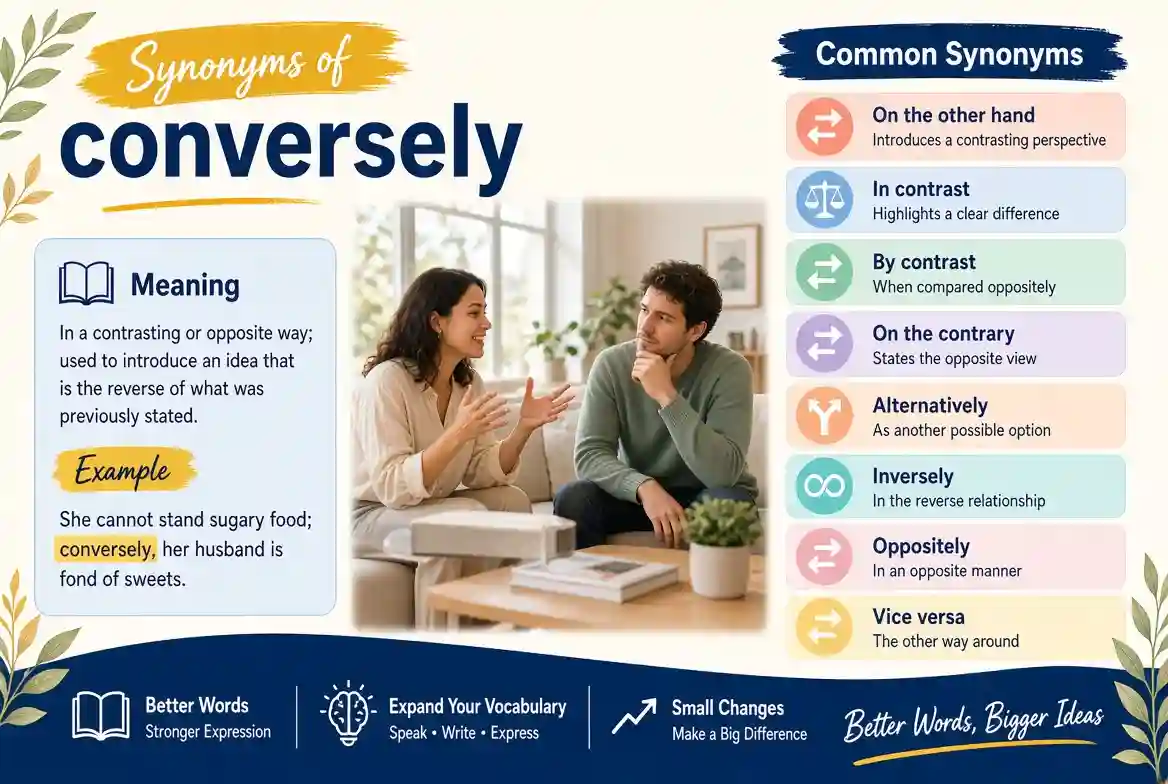
The best synonyms for conversely include in contrast, by contrast, on the other hand, vice versa, contrariwise, and in the opposite way. These expressions help you show differences or explain reversed relationships. Some alternatives, such as however and alternatively, work only in certain contexts, so choose the word that matches your intended meaning.
Do you find yourself using the word conversely too often in essays, emails, or blog posts? Learning synonyms for conversely can help you express contrasting ideas more clearly and make your writing sound more natural.
Conversely is an adverb that introduces an opposite or contrasting situation. For example, you might write, “Some students enjoy studying alone. Conversely, others learn better in groups.”
You could also say, “Some students enjoy studying alone. In contrast, others learn better in groups.”
Both expressions highlight a difference. However, not every related word has the same meaning. Vice versa describes a reversed relationship, while alternatively presents another choice.
This guide explains 30 alternatives with original examples, grammar tips, pronunciation, common collocations, and practical usage advice. Whether you are a student, teacher, blogger, or professional, you will learn how to choose the right expression instead of replacing words blindly.
What Does Conversely Mean?
Conversely means in an opposite or reverse way. Writers often use it to introduce a statement that contrasts with, or reverses, the idea mentioned before.
Example: The northern region receives heavy rainfall. Conversely, the southern region remains dry.
Here, conversely introduces an opposing condition.
Remember: A contrast is not always a complete opposite. Two things can differ without being exact opposites.
Pronunciation of Conversely
- American IPA: /ˈkɑːn.vɝːs.li/
- British IPA: /ˈkɒn.vɜːs.li/
- Simple pronunciation: KON-vurs-lee
- Part of speech: Adverb
- Syllables: Three
The word is spelled the same in American and British English. The main pronunciation difference is the vowel sound.
Grammar and Usage
Use conversely to introduce a contrasting statement or explain a reversed relationship.
Pattern 1: Two separate sentences
The old system requires manual work. Conversely, the new system automates the process.
Pattern 2: After a semicolon
The first product is affordable; conversely, the second offers more features.
Pattern 3: Within a sentence
The plan can increase efficiency or, conversely, create extra work.
When conversely begins a sentence, a comma normally follows it. After a semicolon, a comma is also commonly used.
The word is an adverb. Related forms include converse as a noun, adjective, or verb, but these forms have different meanings.
Synonyms for Conversely: Quick Comparison Table
| Synonym | Main purpose | Formality |
| In contrast | Shows a difference | Neutral |
| By contrast | Highlights a comparison | Formal |
| On the other hand | Presents another perspective | Neutral |
| Vice versa | Reverses a relationship | Neutral |
| In the opposite way | Describes opposite actions | Neutral |
| Contrariwise | Expresses opposition | Literary |
| In reverse | Shows the opposite direction or order | Neutral |
| The other way around | Describes a switched relationship | Informal |
| On the contrary | Corrects an earlier claim | Neutral to formal |
| However | Adds a contrasting point | Neutral |
| Whereas | Joins contrasting clauses | Formal |
| While | Compares two facts | Neutral |
| By comparison | Evaluates differences | Formal |
| Inversely | Describes a reverse relationship | Technical |
| Alternatively | Offers another option | Formal |
| Instead | Replaces one action with another | Neutral |
| Otherwise | Means differently or under another condition | Neutral |
| Differently | Describes a non-identical manner | Neutral |
| Yet | Introduces an unexpected contrast | Neutral |
| But | Joins contrasting ideas | Everyday |
| Still | Shows that something remains true | Neutral |
| Meanwhile | Introduces a parallel event or development | Neutral |
| In another way | Presents a different method | Neutral |
| In comparison | Compares two subjects | Neutral |
| Reciprocally | Describes a mutual relationship | Formal |
| Oppositely | Describes an opposing position | Formal |
| The reverse is true | States the opposite relationship | Neutral |
| By the same token | Applies a similar principle | Formal |
| In the reverse order | Describes a reversed sequence | Neutral |
| On the flip side | Introduces another aspect | Informal |
These expressions are not all exact synonyms. The explanations below show when each one works best.
30 Synonyms for Conversely With Examples
1. In Contrast
Meaning: Shows that two things are different.
Examples:
- My brother enjoys crowded markets. In contrast, I prefer quiet shops.
- The first proposal costs less. In contrast, the second offers better support.
Best used when: Comparing people, ideas, places, or results.
Tone: Neutral, academic, professional.
Frequency: Very common.
Collocations: In sharp contrast, in contrast to, in contrast with.
When not to use it: Avoid it when you need to show that a relationship works in reverse rather than simply differs.
2. By Contrast
Meaning: Highlights a difference between two subjects.
Examples:
- The first village has many schools. By contrast, the nearby village has only one.
- Our previous website was slow. By contrast, the redesigned version loads quickly.
Best used when: Writing comparisons in essays, reports, and professional documents.
Tone: Formal, academic.
Frequency: Common.
Collocations: By contrast, by sharp contrast, in contrast to.
3. On the Other Hand
Meaning: Introduces another side of an issue.
Examples:
- Remote work saves commuting time. On the other hand, it can reduce face-to-face contact.
- The apartment is affordable. On the other hand, it has limited storage space.
Best used when: Discussing advantages and disadvantages or presenting two viewpoints.
Tone: Neutral, conversational.
Frequency: Very common.
Collocations: On the one hand, on the other hand, consider the other side.
Nuance: This phrase usually presents another perspective, not a strict reverse relationship.
4. Vice Versa
Meaning: Means that the reverse relationship is also true.
Examples:
- Teachers learn from students, and vice versa.
- The application transfers files from a phone to a computer and vice versa.
Best used when: Reversing the order of two people, actions, or relationships.
Tone: Neutral, professional.
Frequency: Common.
Collocations: And vice versa, work both ways, apply vice versa.
When not to use it: Do not use it unless the relationship can genuinely be reversed.
5. In the Opposite Way
Meaning: Describes an action that works in a contrary manner.
Examples:
- The first fan pushes air inward, while the second moves it in the opposite way.
- One switch turns the lights on. The other works in the opposite way.
Best used when: Explaining opposite actions or processes in simple English.
Tone: Neutral.
Frequency: Common as a phrase.
Collocations: Work in the opposite way, move in the opposite way, react in the opposite way.
6. Contrariwise
Meaning: In an opposing or contrary way.
Examples:
- The first character fears change; contrariwise, the second welcomes it.
- Some writers value strict rules. Contrariwise, others prefer complete freedom.
Best used when: Writing in a literary or deliberately formal style.
Tone: Literary, formal.
Frequency: Uncommon.
Collocations: Think contrariwise, argue contrariwise.
When not to use it: Prefer in contrast in everyday writing because contrariwise can sound old-fashioned.
7. In Reverse
Meaning: In the opposite direction or order.
Examples:
- The video played in reverse to show the object returning to its starting point.
- Read the instructions in reverse to understand the final stage first.
Best used when: Describing movement, order, or a reversed process.
Tone: Neutral, technical.
Frequency: Common.
Collocations: Play in reverse, move in reverse, put something in reverse.
8. The Other Way Around
Meaning: With two positions or relationships switched.
Examples:
- I thought Ali was helping Sara, but it was the other way around.
- The smaller gear moves the larger one, not the other way around.
Best used when: Correcting a mistaken assumption or describing a reversed relationship.
Tone: Informal, spoken.
Frequency: Very common.
Collocations: It works the other way around, think the other way around.
9. On the Contrary
Meaning: Rejects an earlier claim and presents its opposite.
Examples:
- I am not disappointed. On the contrary, I am delighted.
- The change did not reduce expenses. On the contrary, it increased them.
Best used when: Correcting a belief or directly challenging an earlier statement.
Tone: Neutral to formal.
Frequency: Common.
Collocations: On the contrary, quite the contrary.
Important distinction: On the contrary is stronger than in contrast. It often corrects or rejects a claim.
10. However
Meaning: Introduces a contrasting point or qualification.
Examples:
- The course is expensive. However, it includes personal coaching.
- We prepared carefully. However, the meeting did not go as planned.
Best used when: Introducing a limitation, qualification, or unexpected result.
Tone: Neutral, professional.
Frequency: Very common.
Collocations: However, this means; however, the result; however, there is.
11. Whereas
Meaning: Connects two contrasting facts in one sentence.
Examples:
- My sister works at night, whereas I work during the day.
- This model uses less electricity, whereas the older model consumes more.
Best used when: Comparing two facts within a single sentence.
Tone: Formal, academic.
Frequency: Common.
Collocations: Whereas the first, whereas others, whereas this model.
Grammar note: Whereas is a conjunction, not an adverb. It joins clauses, so it cannot replace conversely in every sentence.
12. While
Meaning: Shows a contrast or describes events happening at the same time.
Examples:
- While Nina prefers tea, her brother chooses coffee.
- While the first plan is cheaper, the second is more reliable.
Best used when: Comparing two facts in one sentence.
Tone: Neutral, academic.
Frequency: Very common.
Collocations: Some people, while others, while this is true.
When not to use it: Make the meaning clear because while can also refer to time.
13. By Comparison
Meaning: Shows how something differs when compared with another thing.
Examples:
- The city apartment costs $1,800 monthly. By comparison, the rural home costs $900.
- The first task took two hours. By comparison, the second took thirty minutes.
Best used when: Comparing prices, results, sizes, or performance.
Tone: Formal, professional.
Frequency: Common.
Collocations: By comparison with, pale by comparison, small by comparison.
14. Inversely
Meaning: In a way where one quantity or effect changes opposite to another.
Examples:
- If distance stays fixed, travel time varies inversely with speed.
- The two measurements changed inversely under the conditions tested.
Best used when: Discussing mathematical, scientific, or technical relationships.
Tone: Technical, academic.
Frequency: Uncommon in everyday speech.
Collocations: Inversely proportional, inversely related, vary inversely.
When not to use it: Do not use inversely for every ordinary contrast.
15. Alternatively
Meaning: Presents another option or possibility.
Examples:
- You can submit the form online. Alternatively, visit the office.
- We could hire a designer. Alternatively, we could create the logo ourselves.
Best used when: Giving a choice between two or more options.
Tone: Formal, business, academic.
Frequency: Common.
Collocations: Alternatively, you could; alternatively, consider; alternatively, choose.
16. Instead
Meaning: In place of something else.
Examples:
- We planned to walk. Instead, we took a taxi.
- Save a copy of the file instead of deleting the original.
Best used when: One action or choice replaces another.
Tone: Neutral, conversational.
Frequency: Very common.
Collocations: Instead of, do this instead, choose instead.
17. Otherwise
Meaning: In a different way, or if a condition is not met.
Examples:
- Save your work now; otherwise, you might lose it.
- The evidence suggests that the system is stable, but recent tests indicate otherwise.
Best used when: Expressing a different result, an alternative condition, or a contrary conclusion.
Tone: Neutral, professional.
Frequency: Very common.
Collocations: Unless otherwise stated, indicate otherwise, otherwise known as.
18. Differently
Meaning: In a way that is not the same.
Examples:
- The two students interpreted the question differently.
- Customers may respond differently to the same advertisement.
Best used when: Describing variation without claiming that two things are exact opposites.
Tone: Neutral.
Frequency: Very common.
Collocations: Think differently, behave differently, respond differently.
19. Yet
Meaning: Introduces a contrasting or unexpected fact.
Examples:
- The task looked simple, yet it took all afternoon.
- The product is affordable, yet it performs well.
Best used when: Showing a surprising contrast within a sentence.
Tone: Neutral, literary.
Frequency: Very common.
Collocations: And yet, small yet powerful, yet another.
20. But
Meaning: Joins ideas that differ or conflict.
Examples:
- The room is small, but it feels comfortable.
- I wanted to call, but my phone had no signal.
Best used when: You want a simple, direct contrast.
Tone: Everyday, neutral.
Frequency: Very common.
Collocations: But still, but also, not only this but that.
21. Still
Meaning: Shows that something remains true despite a difficulty or contrast.
Examples:
- The journey was tiring. Still, everyone enjoyed it.
- The proposal has weaknesses. Still, it deserves consideration.
Best used when: A previous fact does not change the conclusion that follows.
Tone: Neutral, conversational.
Frequency: Very common.
Collocations: Still worth trying, still a concern, still possible.
22. Meanwhile
Meaning: Describes something happening at the same time or another development.
Examples:
- The design team revised the logo. Meanwhile, the developers fixed the website.
- Sales increased in the north. Meanwhile, the southern branch reported a decline.
Best used when: Describing parallel events or separate developments.
Tone: Neutral, narrative.
Frequency: Common.
Collocations: Meanwhile, elsewhere; in the meantime.
Important: Meanwhile does not mean “the opposite.” The two events may simply happen at the same time.
23. In Another Way
Meaning: Using a different method or approach.
Examples:
- We can solve the problem in another way.
- The same evidence can be interpreted in another way.
Best used when: Presenting a different method or explanation.
Tone: Neutral.
Frequency: Common.
Collocations: Explain in another way, approach it in another way, look at it in another way.
24. In Comparison
Meaning: Used to compare two subjects or situations.
Examples:
- In comparison with last year, sales have improved.
- The basic plan is simple. In comparison, the premium plan offers more control.
Best used when: Evaluating similarities or differences.
Tone: Neutral, formal.
Frequency: Common.
Collocations: In comparison with, in comparison to, direct comparison.
25. Reciprocally
Meaning: In a way where actions or relationships work both ways.
Examples:
- The two teams exchanged information reciprocally.
- The partners supported each other reciprocally throughout the project.
Best used when: Describing mutual actions or exchanges.
Tone: Formal, academic.
Frequency: Uncommon.
Collocations: Reciprocally related, reciprocally beneficial, act reciprocally.
Nuance: This word emphasizes mutual action. It is not a general substitute for conversely.
26. Oppositely
Meaning: In an opposing or contrary way.
Examples:
- The two groups reacted oppositely to the proposed change.
- The symbols were arranged oppositely on the diagram.
Best used when: Describing opposing positions, reactions, or arrangements.
Tone: Formal, context-dependent.
Frequency: Uncommon.
Writing tip: In everyday English, in opposite ways or in contrast often sounds more natural.
27. The Reverse Is True
Meaning: States that the opposite relationship applies.
Examples:
- Some plants need direct sunlight. For others, the reverse is true.
- We expected higher costs to reduce demand, but the reverse was true in this case.
Best used when: Explaining a reversed relationship or correcting an expectation.
Tone: Neutral, academic.
Frequency: Common as an expression.
Collocations: The reverse is true, the opposite is true.
28. By the Same Token
Meaning: Applies the same principle or reasoning to another situation.
Examples:
- Managers should respect their staff. By the same token, staff should treat managers fairly.
- The company expects punctuality from employees. By the same token, it should pay them on time.
Best used when: Extending an argument using the same principle.
Tone: Formal, professional.
Frequency: Common in formal discussion.
Nuance: It expresses corresponding reasoning, not necessarily an opposite relationship.
29. In the Reverse Order
Meaning: Arranged in the opposite sequence.
Examples:
- The instructions appeared in the reverse order, so we started with the final step.
- Sort the dates in reverse order to show the newest entry first.
Best used when: Discussing lists, steps, or sequences.
Tone: Neutral, technical.
Frequency: Common.
Collocations: Arrange in reverse order, list in reverse order, sort in reverse order.
30. On the Flip Side
Meaning: Introduces another aspect of a situation, often a disadvantage or alternative perspective.
Examples:
- The job pays well. On the flip side, it requires long hours.
- The new app is easy to use. On the flip side, it offers fewer features.
Best used when: Presenting another side of an issue in conversational writing.
Tone: Informal.
Frequency: Common in speech and casual online writing.
Collocations: On the flip side, look at the flip side, the flip side of the issue.
Strongest Synonyms vs. Related Expressions
Closest alternatives
These choices are usually the best starting point when you need to replace conversely:
- In contrast: highlights a difference.
- By contrast: provides a clear comparison.
- On the other hand: introduces another perspective.
- Vice versa: reverses a relationship.
- In the opposite way: describes opposing actions.
- In reverse: describes a reversed direction or order.
- The other way around: expresses a switched relationship.
- Contrariwise: offers a formal or literary alternative.
Related expressions
These can work in selected sentences, but their meanings differ:
- However: introduces a qualification or unexpected result.
- On the contrary: rejects an earlier claim.
- Alternatively: presents another choice.
- Instead: replace one action with another.
- Meanwhile: introduces parallel events.
- By the same token: applies similar reasoning.
- Inversely: describes a reverse relationship, often technically.
Choose the Right Synonym: Side by Side Examples
| Sentence purpose | Best expression | Example |
| Compare differences | In contrast | The first plan is cheap. In contrast, the second is expensive. |
| Introduce a qualification | However | The plan is costly. However, it offers better support. |
| Correct a claim | On the contrary | I am not worried. On the contrary, I feel confident. |
| Reverse a relationship | Vice versa | I help my friend, and vice versa. |
| Offer another option | Alternatively | You can call. Alternatively, send an email. |
| Replace an action | Instead | We planned to walk. Instead, we took a taxi. |
| Compare clauses | Whereas | The first model is light, whereas the second is heavy. |
| Show parallel developments | Meanwhile | Sales rose in one region. Meanwhile, they fell in another. |
Common Mistakes With Conversely
Mistake 1: Using conversely to add information
Incorrect: The store sells books. Conversely, it sells stationery.
Correct: The store sells books. It also sells stationery.
Why: The two statements add information rather than show an opposite relationship.
Mistake 2: Confusing contrast with contradiction
Incorrect: I expected a poor result. Conversely, the result was excellent.
Better: I expected a poor result. On the contrary, the result was excellent.
Why: On the contrary directly rejects an expectation.
Mistake 3: Using alternatively for an opposite fact
Incorrect: The first road is narrow. Alternatively, the second road is wide.
Better: The first road is narrow. In contrast, the second road is wide.
Why: Alternatively presents another choice, not a contrasting fact.
Mistake 4: Using vice versa without a reversible relationship
Incorrect: The office is busy, and vice versa.
Better: The office is busy, and the nearby café is busy too.
Why: Vice versa needs two related elements whose relationship can be reversed.
Mistake 5: Forgetting punctuation
Incorrect: The first option is cheap, conversely the second costs more.
Correct: The first option is cheap. Conversely, the second costs more.
Why: Separate complete sentences with a period or use a semicolon before the transition.
Writing Tips for Essays, Emails, Blogs, and Conversations
Academic essays
Use conversely, in contrast, or by contrast when comparing findings, theories, or viewpoints.
Example: The survey found high satisfaction among remote workers. Conversely, office-based workers reported more daily interaction.
Business emails and reports
Use however to introduce a limitation and on the other hand to discuss another perspective.
Example: The proposal fits our budget. However, the delivery date may be difficult to meet.
Blog posts
Choose simple transitions that help readers follow your argument. Avoid obscure words just to make the writing sound advanced.
Example: Some readers prefer short articles. By contrast, others enjoy detailed guides.
Stories
Use meanwhile for parallel events and yet for an unexpected contrast.
Example: The village slept peacefully, yet the forest remained noisy.
Everyday conversation
Prefer but, instead, and the other way around when they fit the meaning.
Example: I expected the application to be confusing, but it was easy to use.
Remember: A synonym should improve the sentence, not merely make it different.
Word Origin and Etymology
Conversely comes from converse combined with the adverb-forming suffix -ly. The related word converse traces back through French to Latin conversus, associated with turning or changing direction.
This history helps explain the modern sense of considering the opposite side or reversing a relationship.
For a verified historical account, consult the Oxford English Dictionary and search for conversely. Do not assign a first-known-use date without checking the historical entry. The Oxford Learner’s Dictionary provides the modern definition and pronunciation.
American vs. British English
The spelling and basic meaning of conversely are the same in American and British English.
| Feature | American English | British English |
| Spelling | Conversely | Conversely |
| Meaning | In an opposite way | In an opposite way |
| Pronunciation | /ˈkɑːn.vɝːs.li/ | /ˈkɒn.vɜːs.li/ |
| Common alternatives | In contrast, on the other hand | In contrast, on the other hand |
Pronunciation varies by regional accent, but the word is suitable for academic and professional writing in both countries.
Related Vocabulary
Expressions that show similarity
These are useful when you want to show agreement or a similar pattern rather than an opposite one.
- Similarly: in a similar way.
- Likewise: in the same way.
- Correspondingly: in a matching or related way.
- Equally: to the same degree.
- In the same way: using a similar method or approach.
Word family
| Word | Part of speech | Meaning |
| Converse | Noun, verb, adjective | An opposite statement or situation; to talk |
| Conversely | Adverb | In an opposite or contrasting way |
| Convert | Verb | Change something into another form |
| Conversion | Noun | The act or process of changing |
| Convertible | Adjective | Able to be changed or adapted |
These words share a historical connection, but they do not have identical meanings.
Frequently Asked Questions
1. What are the best synonyms for conversely?
The best alternatives include in contrast, by contrast, on the other hand, and vice versa. Use in contrast to highlight differences and vice versa to reverse a relationship. The best choice depends on whether your sentence compares two facts, presents another viewpoint, or explains an opposite relationship.
2. What is a simple word for conversely?
But it is a simple choice when you want to show a contrast. In contrast, it is useful when comparing two things more directly. For example, “I enjoy summer, but my sister prefers winter.” Choose the expression that matches your meaning rather than replacing conversely automatically.
3. Is, however , the same as conversely?
No. However introduces a qualification or contrasting point, while conversely usually presents an opposite or reversed situation. For example, “The task was difficult. However, we finished it” expresses an unexpected result. A sentence with conversely would more directly compare opposing conditions or relationships.
4. Can I use conversely in academic writing?
Yes. Conversely works well in essays, reports, and research discussions when you explain an opposite or contrasting relationship. Use it to compare findings or viewpoints that genuinely differ. If you only need to introduce a limitation or exception, however, it may be more accurate.
5. What is the difference between conversely and vice versa?
Conversely often introduces a contrasting statement, while vice versa means the reverse relationship also applies. For example, “Parents learn from children, and vice versa” means children also learn from parents. The expressions overlap in meaning, but they do not fit every sentence equally well.
6. Is conversely formal or informal?
Conversely is generally neutral to formal and appears often in explanatory and academic writing. It is suitable for professional reports and essays. In casual conversation, speakers often choose but, instead, or on the other hand because these expressions usually sound more natural in everyday speech.
7. What punctuation follows conversely?
When conversely begins a sentence, place a comma after it. For example, “The first option is affordable. Conversely, the second costs more.” You can also use a semicolon before the word: “The first option is affordable; conversely, the second costs more.”
8. Is conversely the same as alternatively?
No. Conversely shows an opposite or contrasting relationship, while alternatively offers another choice. “The first route is short. Conversely, the second is longer” compares differences. “You can take the first route. Alternatively, you can take the second” presents two options.
Vocabulary Quiz
Choose the best answer for each question.
1. Which expression means that a relationship works both ways?
A. However
B. Vice versa
C. Instead
D. Meanwhile
2. Which word introduces another option?
A. On the contrary
B. Conversely
C. Alternatively
D. Inversely
3. Which expression best corrects the claim that someone is unhappy when they are actually delighted?
A. On the contrary
B. Meanwhile
C. Whereas
D. Otherwise
4. Which word can join two contrasting clauses?
A. Conversely
B. Whereas
C. Vice versa
D. Oppositely
5. Complete the sentence: “The old website loads slowly. _____, the new website loads quickly.”
A. Likewise
B. For example
C. Conversely
D. In addition
Answer Key
- B. Vice versa
- C. Alternatively
- A. On the contrary
- B. Whereas
- C. Conversely
Conclusion
Learning synonyms conversely helps you express differences, opposite relationships, and contrasting ideas with greater accuracy. Expressions such as in contrast, however, and vice versa can make your writing clearer when you use them in the right context.
Practice these alternatives in essays, emails, reports, blog posts, and everyday conversations. Focus on meaning before vocabulary variety. With regular practice, you can build stronger vocabulary and communicate more confidently in written and spoken English.
References
- Cambridge Dictionary. Conversely: Definition and pronunciation.
- Oxford Learner’s Dictionaries. Conversely: Definition and usage.
- Collins Dictionary. Conversely: Definition and synonyms.
- Thesaurus.com. Conversely synonyms and antonyms.
- Oxford English Dictionary. Historical English word research.

Synonorm is a trusted English vocabulary resource created to help readers find the right words and understand the differences between similar terms. We provide clear explanations of synonyms, meanings, examples, usage, and alternatives. Our content makes vocabulary easier to learn and apply in everyday, academic, and professional English. Synonorm is designed for students, writers, ESL learners, professionals, and anyone who wants to improve their English vocabulary and communicate more clearly.