What Are the Synonyms of Conjure?
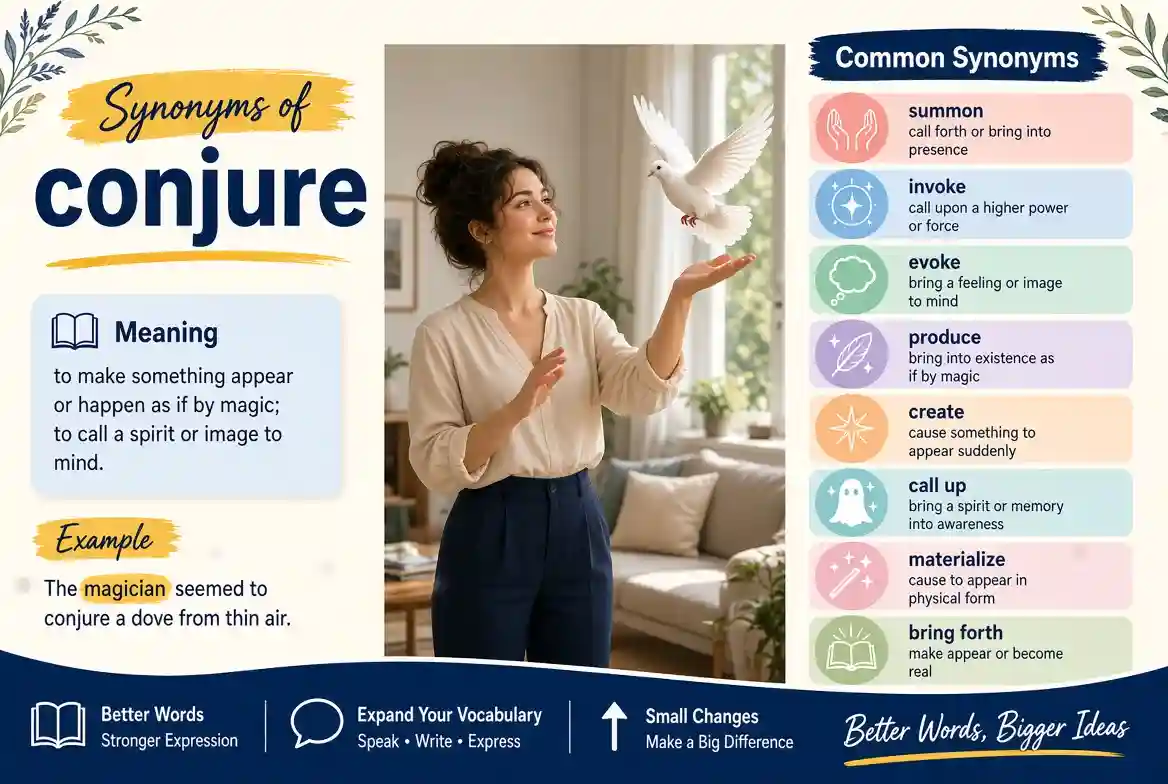
The best synonyms of conjure include summon, evoke, invoke, call forth, bring to mind, produce, create, and conjure up. The right word depends on the context. Use summon to call something to appear, evoke to bring a feeling or memory to mind, and create to make something new.
Have you ever smelled fresh bread and suddenly remembered your childhood home? Or read a story that made you picture a magical kingdom? You can say the smell brought back a memory or that the story conjured up an image.
The verb conjure has several meanings. It can describe magic tricks, the appearance of something unexpected, a mental picture, or a strong memory. It can also mean making a serious or urgent appeal, although that use is less common today.
Learning synonyms of conjure helps you choose words that fit your meaning. Students can improve their essays, writers can create vivid descriptions, and professionals can make their communication clearer. This guide explains 30 related words, shows when each one works, and highlights important differences so you can use them naturally.
Pronunciation of Conjure
- American English IPA: /ˈkɑːn.dʒɚ/
- British English IPA: /ˈkʌn.dʒə(r)/
- Simple pronunciation: KAHN-jer in many American accents; KUN-juh in many British accents.
- Syllables: Two, with stress on the first syllable.
The exact vowel sound varies by accent. The spelling conjure is the same in American and British English.
Part of Speech and Word Forms
Conjure is mainly a verb.
- Conjure: The magician can conjure a coin.
- Conjures: The song conjures memories of home.
- Conjured: She conjured up a clever solution.
- Conjuring: He enjoys conjuring images with words.
Related forms include conjurer (a person who performs magic tricks) and conjuration (an act of conjuring, often associated with magic).
How to Use Conjure in a Sentence
Common patterns include:
| Pattern | Example |
| Conjure something | The magician conjured a dove. |
| Conjure something up | She conjured up a new idea. |
| Conjure an image | His words conjured an image of a quiet village. |
| Conjure up memories | The old song conjured up memories of school. |
| Conjure something from or out of something | The cook conjured a meal from a few basic ingredients. |
The particle up is common in everyday English, especially when the word refers to memories, ideas, or imagined scenes. It is not required in every sentence.
Quick Comparison of Conjure Synonyms
| Synonym | Main meaning | Formality |
| Summon | Call something to appear | Neutral |
| Evoke | Bring a feeling or image to mind | Formal or literary |
| Invoke | Call upon authority or a power | Formal |
| Call forth | Bring something forward | Literary |
| Produce | Make or bring about a result | Neutral |
| Create | Make something new | Neutral |
| Imagine | Form a picture in the mind | Neutral |
| Visualize | Form a clear mental picture | Neutral |
| Elicit | Bring out a response | Formal |
| Trigger | Cause a reaction to begin | Neutral |
| Invent | Develop something new | Neutral |
| Improvise | Create without preparation | Neutral |
These words are not interchangeable in every context. Always check the intended meaning before replacing conjure.
30 Synonyms of Conjure: Meanings and Examples
The words below are grouped by how they relate to the main meanings of conjure. CEFR labels are approximate learning guidance rather than official ratings for every word. Frequency labels are broad judgments about general English use.
1. Summon
Meaning: To call someone or something to appear.
Examples:
- The captain summoned the crew to the deck.
- She summoned the courage to speak in public.
Best used when: Calling a person, spirit, or inner quality into action.
Register: Neutral. CEFR: B1. Frequency: Common.
Collocations: summon help, summon courage, summon a spirit.
2. Evoke
Meaning: To bring a feeling, memory, or image into someone’s mind.
Examples:
- The scent of jasmine evoked memories of her grandmother.
- The painting evokes a feeling of loneliness.
Best used when: Describing the effect of music, art, words, smells, or experiences.
Register: Formal, literary, academic. CEFR: Advanced vocabulary. Frequency: Common.
Collocations: evoke emotion, evoke memories, evoke an image.
3. Invoke
Meaning: To call upon a power, authority, rule, or person for support.
Examples:
- The lawyer invoked a legal principle.
- The characters invoked an ancient spirit in the legend.
Best used when: Referring to authority, tradition, or supernatural power.
Register: Formal, academic. CEFR: Advanced vocabulary. Frequency: Common.
Collocations: invoke the law, invoke authority, invoke a spirit.
4. Call Forth
Meaning: To cause something to appear or become active.
Examples:
- Her speech called forth strong emotions.
- The challenge called forth his hidden courage.
Best used when: You want a dramatic or literary expression.
Register: Literary, formal. CEFR: Upper-intermediate to advanced. Frequency: Uncommon.
Collocations: call forth courage, call forth memories, call forth a response.
5. Conjure Up
Meaning: To bring something to mind or make something seem to appear.
Examples:
- The old photograph conjured up memories of summer.
- The novelist conjured up a city filled with secrets.
Best used when: Talking about imagination, memories, stories, or magic.
Register: Neutral, literary. CEFR: Upper-intermediate. Frequency: Common.
Collocations: conjure up an image, conjure up a memory, conjure up a story.
6. Call Upon
Meaning: To ask someone or use something for help or support.
Examples:
- The teacher called upon a student to answer.
- She called upon her experience to solve the problem.
Best used when: Referring to people, skills, resources, or inner strength.
Register: Neutral, formal. CEFR: Upper-intermediate. Frequency: Common.
Collocations: call upon experience, call upon a witness, call upon someone for help.
7. Raise
Meaning: To bring something up or cause it to become noticeable or active.
Examples:
- The story raised the specter of war.
- The ceremony was said to raise the spirits of the dead.
Best used when: Referring to spirits, questions, concerns, or issues.
Register: Neutral, literary in some uses. CEFR: A2. Frequency: Very common.
Collocations: raise a question, raise concerns, raise spirits.
Note: Raise has many meanings and is not a universal replacement for conjure.
8. Produce
Meaning: To make, create, or bring about something.
Examples:
- The magician produced a flower from an empty-looking box.
- The small team produced an impressive result.
Best used when: The focus is on what appears or what result is achieved.
Register: Neutral, business. CEFR: B1. Frequency: Very common.
Collocations: produce results, produce evidence, produce a solution.
9. Create
Meaning: To make something new.
Examples:
- The artist created a dreamlike landscape.
- The team created a practical plan in an hour.
Best used when: Something is made through imagination, skill, or effort.
Register: Neutral, academic. CEFR: A2. Frequency: Very common.
Collocations: create an image, create an atmosphere, create a solution.
10. Imagine
Meaning: To form an idea or picture in your mind.
Examples:
- Imagine a village hidden among snowy mountains.
- He imagined how the room might look after renovation.
Best used when: Discussing mental pictures, possibilities, or creative thought.
Register: Neutral, conversational. CEFR: A2. Frequency: Very common.
Collocations: imagine a future, imagine a scene, imagine what might happen.
11. Visualize
Meaning: To form a clear mental picture of something.
Examples:
- The coach asked the players to visualize success.
- I visualized the finished garden before planting anything.
Best used when: Describing detailed mental images or planning.
Register: Neutral, professional. CEFR: Upper-intermediate. Frequency: Common.
Collocations: visualize success, visualize a goal, visualize a design.
12. Recall
Meaning: To bring information or a past event back to mind.
Examples:
- She recalled the promise she had made.
- I can still recall the sound of the old clock.
Best used when: The focus is on remembering a fact or experience.
Register: Neutral, formal. CEFR: Upper-intermediate. Frequency: Common.
Collocations: recall a memory, recall details, recall an event.
13. Remember
Meaning: To keep something in mind or bring it back to mind.
Examples:
- I remember the first book I ever owned.
- Remember to send the message before noon.
Best used when: Referring to ordinary memory or a reminder.
Register: Neutral, conversational. CEFR: A1. Frequency: Very common.
Collocations: remember a name, remember a promise, remember to call.
14. Recollect
Meaning: To remember something from the past.
Examples:
- He recollected a conversation from many years ago.
- I cannot recollect where I left the notebook.
Best used when: Describing deliberate or careful remembering.
Register: Formal. CEFR: Advanced vocabulary. Frequency: Common.
Collocations: recollect an event, recollect details, recollect a conversation.
15. Envision
Meaning: To imagine something that may happen or exist.
Examples:
- She envisioned a school where every child felt welcome.
- The designer envisioned a brighter kitchen.
Best used when: Discussing plans, hopes, goals, or future possibilities.
Register: Neutral, professional. CEFR: Upper-intermediate. Frequency: Common.
Collocations: envision a future, envision success, envision a solution.
16. Bring to Mind
Meaning: To make someone think of a person, memory, or idea.
Examples:
- The old bridge brings to mind stories of the past.
- Her kindness brings to mind my favorite teacher.
Best used when: Making a connection between something present and something remembered.
Register: Neutral. CEFR: Intermediate. Frequency: Common.
Collocations: bring to mind a memory, bring to mind an image, bring to mind a person.
17. Inspire
Meaning: To give someone an idea, feeling, or desire to act.
Examples:
- The explorer’s diary inspired a new adventure story.
- Her courage inspired the whole team.
Best used when: Something encourages creativity, emotion, or action.
Register: Neutral, professional. CEFR: B1. Frequency: Very common.
Collocations: inspire creativity, inspire confidence, inspire a story.
Difference: Inspiration may lead to an idea, but it does not mean making something appear magically.
18. Elicit
Meaning: To cause a response, feeling, or piece of information to emerge.
Examples:
- The question elicited an honest answer.
- Her performance elicited tears from several viewers.
Best used when: Describing a response brought out by an action or event.
Register: Formal, academic. CEFR: Advanced vocabulary. Frequency: Common.
Collocations: elicit a response, elicit information, elicit emotion.
19. Trigger
Meaning: To cause a reaction, memory, or event to begin.
Examples:
- The familiar tune triggered a childhood memory.
- The announcement triggered a lively discussion.
Best used when: Explaining what starts a reaction or brings a memory back.
Register: Neutral, professional. CEFR: Upper-intermediate. Frequency: Very common.
Collocations: trigger a memory, trigger a reaction, trigger a response.
20. Awaken
Meaning: To cause a feeling, thought, or interest to become active.
Examples:
- The novel awakened her interest in history.
- The sunrise awakened a sense of hope.
Best used when: Describing the beginning or return of a feeling, interest, or awareness.
Register: Literary. CEFR: Upper-intermediate. Frequency: Common.
Collocations: awaken curiosity, awaken interest, awaken hope.
21. Stir
Meaning: To cause an emotion or thought to rise.
Examples:
- The final scene stirred deep emotions.
- His words stirred memories of their friendship.
Best used when: Describing feelings that rise gradually or strongly.
Register: Neutral, literary. CEFR: B1. Frequency: Very common.
Collocations: stir emotions, stir memories, stir curiosity.
22. Generate
Meaning: To produce or create something.
Examples:
- The discussion generated several fresh ideas.
- The machine generates enough power for the workshop.
Best used when: Talking about ideas, energy, results, or output.
Register: Formal, technical, business. CEFR: Upper-intermediate. Frequency: Very common.
Collocations: generate ideas, generate income, generate electricity.
23. Fabricate
Meaning: To invent or make something; when referring to a story or evidence, it often means making something false.
Examples:
- The witness fabricated a story to avoid blame.
- The workshop fabricated a metal frame for the machine.
Best used when: Describing a false account or the physical making of an object.
Register: Formal, technical. CEFR: Advanced vocabulary. Frequency: Common.
Collocations: fabricate evidence, fabricate a story, fabricate a component.
Caution: Do not use fabricate as a positive substitute for creating when you mean honest, imaginative work.
24. Invent
Meaning: To create a new idea, object, method, or story.
Examples:
- She invented a clever way to organize the books.
- The writer invented a fictional island for the novel.
Best used when: Something is new or has been thought up for a purpose.
Register: Neutral. CEFR: B1. Frequency: Very common.
Collocations: invent a device, invent a story, invent a method.
25. Devise
Meaning: To think of and plan a way to do something.
Examples:
- The students devised a plan to reduce waste.
- He devised a simple test for the new design.
Best used when: A solution or method requires thought and planning.
Register: Formal, academic, business. CEFR: Advanced vocabulary. Frequency: Common.
Collocations: devise a plan, devise a strategy, devise a solution.
26. Improvise
Meaning: To create or perform something without preparing it in advance.
Examples:
- The speaker improvised an answer when the slides failed.
- We improvised a table from two wooden boxes.
Best used when: Someone makes a quick response or solution with what is available.
Register: Neutral. CEFR: Upper-intermediate. Frequency: Common.
Collocations: improvise a solution, improvise a speech, improvise with materials.
Difference: This word is related to creating something unexpectedly, but it does not mean the same as conjure in the magical sense.
27. Manifest
Meaning: To show, express, or make something evident.
Examples:
- Her confidence manifested itself in the way she spoke.
- The stress manifested as difficulty sleeping.
Best used when: Describing how a feeling, quality, or condition becomes visible.
Register: Formal, academic. CEFR: Advanced vocabulary. Frequency: Common.
Collocations: manifest itself, manifest symptoms, manifest a quality.
Difference: Manifest does not automatically mean making something appear by magic.
28. Enchant
Meaning: To delight someone greatly or place someone under a magical spell in a story.
Examples:
- The glowing garden enchanted the young visitors.
- The storyteller enchanted the audience with her voice.
Best used when: Describing magical effects or strong delight.
Register: Literary. CEFR: Upper-intermediate. Frequency: Common.
Collocations: enchant an audience, enchant a visitor, enchant with beauty.
29. Bewitch
Meaning: To attract or control someone as if through magic.
Examples:
- The mysterious melody bewitched the audience.
- In the tale, a sorceress bewitched the prince.
Best used when: Describing powerful attraction or literal magic in fiction.
Register: Literary. CEFR: Advanced vocabulary. Frequency: Uncommon.
Collocations: bewitch an audience, bewitch someone with charm, bewitch the prince.
30. Entreat
Meaning: To ask someone earnestly or urgently to do something.
Examples:
- The traveler entreated the guard to open the gate.
- She entreated her friend to hear her explanation.
Best used when: Referring to a solemn or urgent appeal.
Register: Formal, literary. CEFR: Advanced vocabulary. Frequency: Uncommon.
Collocations: entreat someone to help, entreat someone for mercy, earnestly entreat.
Important distinction: Entreat is related to an older sense of conjure, meaning to appeal solemnly. It is not a synonym for making a mental image or performing magic.
Strongest Synonyms, Strong Synonyms, and Related Words
Strongest Synonyms
These words most closely match common modern meanings of conjure:
- Summon: Call someone or something to appear.
- Evoke: Bring a memory, feeling, or image to mind.
- Invoke: Call upon a power, authority, or spirit.
- Call forth: Cause something to appear or become active.
- Conjure up: Make something appear in the mind or seemingly from nowhere.
Strong Synonyms in Specific Contexts
- Produce: Bring about a result or make something appear.
- Create: Make something new.
- Imagine: Form a mental picture.
- Visualize: Form a clear mental picture.
- Envision: Imagine a future possibility.
- Elicit: Bring out a response.
- Trigger: Cause a reaction to begin.
- Generate: Produce ideas, energy, or results.
- Invent: Develop a new idea or object.
- Devise: Plan a method or solution.
Related Words
Recall, remember, recollect, inspire, awaken, stir, fabricate, improvise, manifest, enchant, bewitch, and entreat overlap with selected meanings of conjure, but they are not direct replacements in every sentence.
Choose the Right Synonym
| Intended meaning | Best word | Example |
| Call a person or spirit to appear | Summon | The king summoned his guards. |
| Bring a memory to mind | Evoke | The song evoked childhood memories. |
| Call upon a rule or authority | Invoke | The lawyer invoked the law. |
| Form a mental picture | Imagine | Imagine a quiet island. |
| Make something new | Create | She created a new design. |
| Bring out a response | Elicit | The question elicited a smile. |
| Invent a false account | Fabricate | He fabricated an excuse. |
| Make something without preparation | Improvise | She improvised a speech. |
Commonly Confused Words
| Words | Difference | Example |
| Conjure vs. evoke | Conjure can suggest magic or mental imagery; evoke focuses on bringing an image, feeling, or memory to mind. | The scent evoked a memory. |
| Conjure vs. summon | Summon emphasizes calling something to appear. | The manager summoned the staff. |
| Conjure vs. invoke | Invocation often involves authority, a principle, or supernatural power. | The judge invoked the law. |
| Conjure vs. imagine | Imagine means forming an idea in the mind without implying magic. | Imagine a house by the sea. |
| Conjure vs. fabricate | Fabricate can mean making something physically or inventing something false. | He fabricated evidence. |
Common Mistakes to Avoid
Mistake 1: Using evoke for physical creation
- Incorrect: She evoked a wooden table.
- Better: She created a wooden table.
- Why: Evoke usually describes an image, feeling, response, or memory.
2: Treating summon and evoke as identical
- Incorrect in an ordinary memory context: The song summoned my childhood memories.
- More natural: The song brought back my childhood memories.
- Why: Summon often suggests a call to action or appearance.
3: Confusing invoke with evoke
- Less natural for an ordinary memory: The music invoked happy memories.
- Better: The music evoked happy memories.
- Why: Invoke often means calling upon authority, a principle, or a power.
4: Using conjure for routine work
- Awkward: The accountant conjured the monthly report.
- Better: The accountant prepared the monthly report.
- Why: Conjure suggests magic, imagination, or an unusual result.
5: Using fabricate when you mean honest creativity
- Awkward: The artist fabricated a beautiful landscape.
- Better: The artist created a beautiful landscape.
- Why: Fabricating a story often suggests that the story is false.
Writing Tips for Essays, Emails, Blogs, and Stories
- Essays: Use evoke when discussing the emotions or images created by a novel, poem, or painting.
- Emails: Prefer clear verbs such as create, develop, or produce for ordinary work.
- Blog posts: Use conjure up or bring to mind to describe a memory or an image.
- Stories: Use summon, enchant, or bewitch when the context involves magic or supernatural events.
- Social media: Use familiar expressions such as reminds me of or brings back memories when writing casually.
- Professional communication: Use generate for results and devise for planned solutions.
- Daily conversation: Choose simple, natural language instead of rare words used only to sound impressive.
Writing tip: A synonym is useful only when it preserves your intended meaning. Do not replace a repeated word automatically if the new word changes the message.
Related Vocabulary and Antonyms
There is no single opposite of conjure that fits every sense.
Depending on the context, possible contrasts include:
- Banish: Send something away.
- Suppress: Prevent a feeling or response from being expressed.
- Forget: Fail to remember something.
- Erase: Remove a mark, record, or trace.
- Dismiss: Send someone away or reject an idea.
Related expressions include out of thin air, bringing back memories, thinking up an idea, working like magic, and calling on someone’s courage.
Word Origin and First Known Use
Conjure entered English through Middle English and Old French, from Latin coniurare, meaning to swear together or conspire. Over time, its meanings developed to include solemn appeals, invoking supernatural forces, and making something seem to appear by magic.
Historical dictionary sources record the word in English from the late 13th century. This date refers to recorded historical evidence, not necessarily the first time anyone ever used the word.
The expression conjure up is commonly used for bringing a memory, image, or idea into the mind.
American vs. British English
The spelling conjure is the same in American and British English. Pronunciation varies mainly in the vowel and the final r sound. Many American speakers pronounce the final r, while many British speakers do not.
Both varieties use phrases such as conjure up a memory and conjure an image. The British expression a name to conjure with can describe a person or thing that is well known and respected in a field.
Frequently Asked Questions
1. What are the best synonyms of conjure?
The best synonyms include summon, evoke, invoke, call forth, and conjure up. Use summon when calling something to appear, evoke for memories and emotions, and invoke when calling upon authority or supernatural power. The best choice depends on the sentence.
2. What does conjure mean in simple English?
Conjure means to make something appear as if by magic or to bring an image, thought, or memory into your mind. A magician may conjure a flower, while a familiar song may conjure memories of childhood. It can also describe producing an unexpected result.
3. Is evoke a synonym for conjure?
Yes, evoke is a close synonym when conjure means bringing an image, feeling, or memory to mind. For example, “The photograph evoked happy memories” means that the photograph brought those memories back. However, evoke does not usually mean performing a magic trick.
4. What is the difference between conjure and summon?
Conjure can mean making something appear as if by magic or creating a mental image. Summon mainly means calling someone or something to appear or become active. A magician might conjure a rabbit, while a teacher might summon a student to the office.
5. What is a formal synonym for conjure?
Evoke, invoke, and elicit can work in formal writing, depending on the meaning. Use evoke for memories and emotions, invoke for authority or principles, and elicit for a response. None of these words replace conjure correctly in every context.
6. What is the opposite of conjure?
The opposite depends on the meaning. Banish can contrast with summoning something, suppress can contrast with bringing a response forward, and forget can contrast with recalling a memory. English has no single antonym that works for all uses of conjure.
7. What is the past tense of conjure?
The past tense and past participle are both conjured. For example, “The magician conjured a dove” uses the past tense, while “She had conjured up a vivid image” uses the past participle with had. The present participle is conjuring.
8. What is the origin of conjure?
Conjure entered English through Middle English and Old French, from Latin coniurare, meaning to swear together or conspire. Its historical meanings included solemn appeals and invoking supernatural forces. The modern expression conjure up can also describe bringing an idea or memory to mind.
Vocabulary Quiz
Choose the best answer for each question.
1. Which word best describes bringing a childhood memory to mind?
A. Fabricate
B. Evoke
C. Summon
D. Entreat
2. Which word means to call someone to appear?
A. Visualize
B. Inspire
C. Summon
D. Manifest
3. Which word can mean inventing a false story?
A. Fabricate
B. Recall
C. Awaken
D. Elicit
4. Which word best completes the sentence: “The question ___ an honest answer”?
A. Enchanted
B. Conjured
C. Elicited
D. Recollected
5. Which word means creating something without preparing it in advance?
A. Invoke
B. Improvise
C. Entreat
D. Remember
Answer Key
- B. Evoke
- C. Summon
- A. Fabricate
- C. Elicited
- B. Improvise
Conclusion
Learning synonyms of conjure helps you describe memories, emotions, ideas, and unexpected appearances with greater precision. Words such as evoke, summon, invoke, and create each have their own role.
Choose words based on meaning rather than variety alone. Practice these alternatives in essays, emails, stories, and daily conversations. With regular use, your vocabulary will grow and your writing will become clearer and more natural.
References
- Cambridge Dictionary. Conjure: Meaning and Usage
- Cambridge Thesaurus. Synonyms of Conjure
- Oxford Learner’s Dictionaries. Conjure: Definition and Word Origin
- Collins Dictionary. Conjure Thesaurus
- Thesaurus.com. Conjure Synonyms and Antonyms

Synonorm is a trusted English vocabulary resource created to help readers find the right words and understand the differences between similar terms. We provide clear explanations of synonyms, meanings, examples, usage, and alternatives. Our content makes vocabulary easier to learn and apply in everyday, academic, and professional English. Synonorm is designed for students, writers, ESL learners, professionals, and anyone who wants to improve their English vocabulary and communicate more clearly.