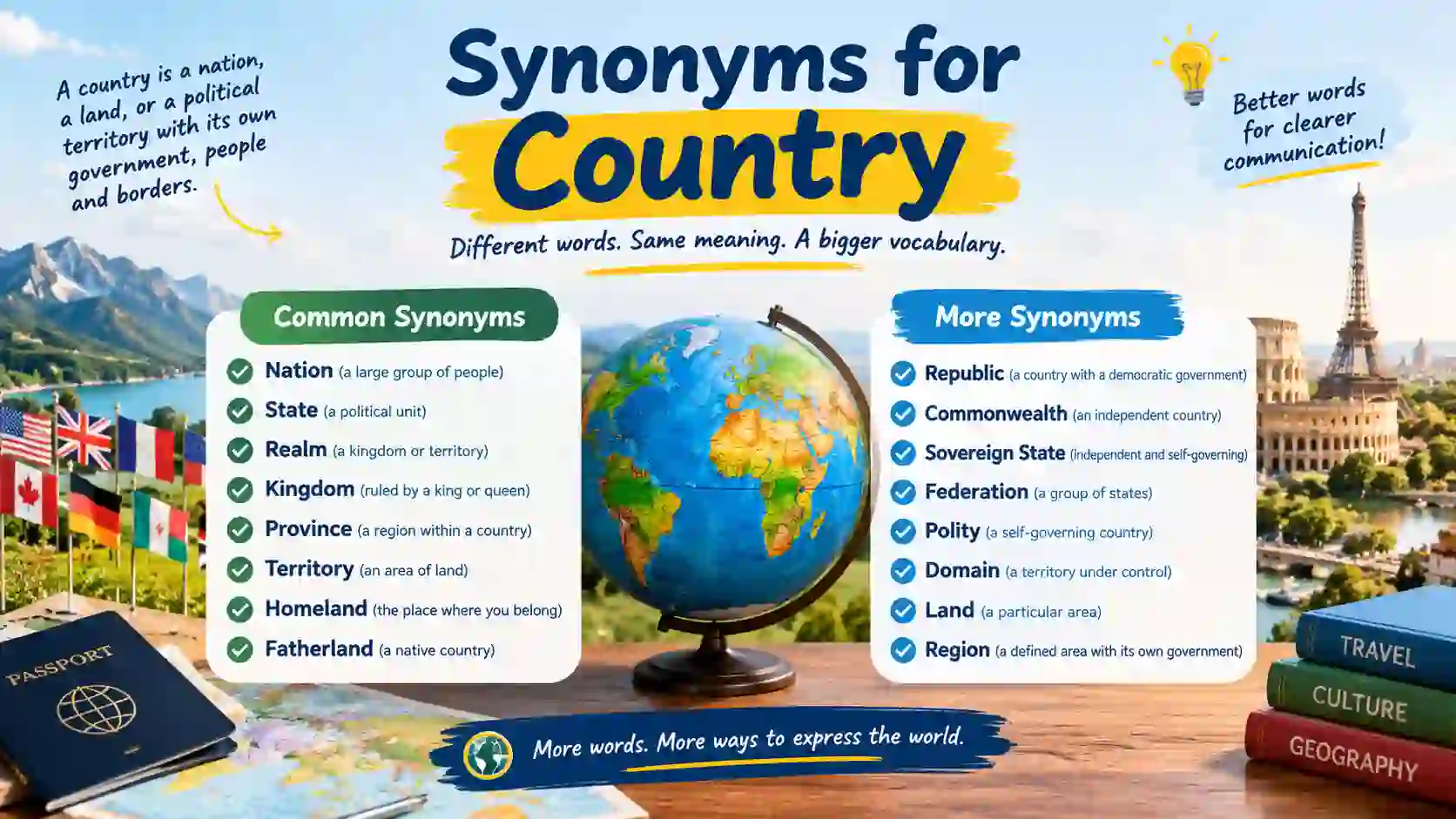
Have you ever used the word country several times in the same essay? Learning a few well-chosen alternatives can make your writing clearer and more natural. However, not every word that relates to a country is a true synonym.
The best synonyms for country include nation, state, homeland, land, and sovereign state. Each word has a different purpose. For example, a nation often focuses on people and shared identity, while the state emphasizes political authority. Homeland expresses a personal or cultural connection to a place.
This guide explains the most useful alternatives, their meanings, examples, common word combinations, and differences in tone. It also covers related geographical words, common mistakes, grammar, and practice exercises for English learners.
Quick Answer: What Are the Best Synonyms for Country?
The closest synonyms for country are nation, state, land, homeland, native country, native land, and sovereign state, depending on the sentence. Use nation to emphasize people and identity, state for political authority, and homeland for a personal or ancestral connection. Words such as republic and territory have more specific meanings.
Country: Meaning and Pronunciation
Definition: A country is a geographical and political area that has, or has had, its own government and laws. The word can also refer to the people of a country or to rural land outside towns and cities.
Pronunciation: /ˈkʌn.tri/
Say it like: KUN-tree
Part of speech: Noun
Plural: Countries
Approximate CEFR level: A1
The three main meanings of country
- Political country: Japan is a country in East Asia.
- People of a country: The whole country celebrated the victory.
- Rural land: We spent the weekend in the country.
These meanings matter because a synonym for one sense may not work for another.
Synonyms for Country: Quick Comparison
| Word | Main meaning | Register | Approximate CEFR |
| Nation | Country and its people or shared identity | Neutral, academic | B2 |
| State | Political entity or government authority | Formal, political | B2 |
| Land | A country or geographical area | Neutral, literary | A2 |
| Homeland | A person’s ancestral or emotional home | Neutral, emotional | B2 |
| Native country | Country of birth or origin | Neutral | B1 |
| Native land | Original or ancestral home | Literary | B2 |
| Country of origin | Where a person or product comes from | Administrative, neutral | B1 |
| Sovereign state | An independently governed political entity | Legal, academic | C1 |
| Nation-state | State closely linked to a national identity | Academic | C1 |
| Motherland | Country viewed as an emotional home | Emotional, political | C1 |
| Fatherland | Ancestral or national home | Historical, literary | C1 |
| Mother country | Original country in certain historical relationships | Historical | C1 |
| Kingdom | Country ruled by a monarch | Neutral, historical | B1 |
| Republic | A political system that is not a monarchy | Political, formal | B2 |
| Territory | An area under a particular form of control | Formal, legal | B2 |
CEFR levels are approximate editorial guidance, not official ratings for every word or sentence.
The 15 Best Synonyms for Country
1. Nation
Meaning: A country or a group of people who share a national identity.
Examples:
- The nation celebrated its independence.
- Education can help a nation build a better future.
Best used when: Discussing people, culture, national identity, or collective goals.
Tone: Neutral, academic, political.
Frequency: Very common.
Collocations: Nation-building, a proud nation, the international community of nations.
When not to use it: Choose a country when you need to focus mainly on geographical land or a political location without emphasizing its people.
2. State
Meaning: A political entity with a government, territory, and legal authority.
Examples:
- The state introduced new rules for public schools.
- Several states signed a trade agreement.
Best used when: Writing about government, law, international relations, or political systems.
Tone: Formal, legal, academic.
Frequency: Very common.
Collocations: Sovereign state, head of state, state policy.
When not to use it: In American English, state often means a subdivision of the United States, such as California or Texas. Make the intended meaning clear.
3. Land
Meaning: An area of the earth that may be viewed as a country, home, or geographical place.
Examples:
- She hopes to return to her native land.
- The land has supported farming communities for generations.
Best used when: Writing about geography, roots, culture, or a place that matters to someone.
Tone: Neutral, descriptive, literary.
Frequency: Very common.
Collocations: Native land, fertile land, land of opportunity.
When not to use it: Land can mean soil or property, so it is not always a political synonym.
4. Homeland
Meaning: A country or place that someone considers home, often because of birth, ancestry, or cultural ties.
Examples:
- After years abroad, she returned to her homeland.
- The poet wrote about the rivers and mountains of his homeland.
Best used when: Expressing belonging, cultural roots, or emotional attachment.
Tone: Neutral, emotional.
Frequency: Common.
Collocations: Ancestral homeland, defend one’s homeland, homeland security.
When not to use it: Do not assume that someone’s homeland is necessarily their current country of residence.
5. Native Country
Meaning: The country where someone was born or considers their original home.
Examples:
- He plans to visit his native country next summer.
- She writes about the traditions of her native country.
Best used when: Discussing someone’s background, birthplace, or original home.
Tone: Neutral.
Frequency: Common.
Collocations: Return to one’s native country, leave one’s native country, traditions of one’s native country.
When not to use it: If you mean the country where someone currently lives, use the country of residence.
6. Native Land
Meaning: The land or country where someone was born or has deep roots.
Examples:
- The poem celebrates the beauty of her native land.
- He returned to his native land after many years away.
Best used when: Writing about ancestry, belonging, or personal history.
Tone: Literary, emotional.
Frequency: Uncommon.
Collocations: Return to one’s native land, defend one’s native land, love of one’s native land.
When not to use it: Use country of birth or country of origin in official documents.
7. Country of Origin
Meaning: The country where a person, product, or thing originally comes from.
Examples:
- The form asks applicants to provide their country of origin.
- The label identifies the product’s country of origin.
Best used when: Discussing migration, background, trade, or official records.
Tone: Neutral, administrative.
Frequency: Common.
Collocations: Declared country of origin, country-of-origin label, country of origin requirements.
When not to use it: It may not identify someone’s current nationality, citizenship, or residence.
8. Sovereign State
Meaning: A political entity with independent authority over its own affairs.
Examples:
- The agreement recognizes the entity as a sovereign state.
- The researchers examined the rights of sovereign states under international law.
Best used when: Independence and political authority are central to the discussion.
Tone: Legal, diplomatic, academic.
Frequency: Uncommon in daily speech.
Collocations: Independent sovereign state, sovereign-state status, sovereignty of a state.
When not to use it: Avoid treating sovereignty as an uncontested fact when the political status is disputed.
9. Nation State
Meaning: A political state whose boundaries and national identity are closely connected.
Examples:
- The course explores the development of the modern nation-state.
- Language can influence the identity of a nation-state.
Best used when: Discussing political theory, history, or national identity.
Tone: Academic, formal.
Frequency: Uncommon in everyday conversation.
Collocations: Modern nation-state, nation-state system, rise of the nation-state.
When not to use it: Do not use it as a casual replacement for every country. It is a more specific political term.
10. Motherland
Meaning: A country viewed as an ancestral or emotional home.
Examples:
- The song expresses love for the motherland.
- The family preserved stories about their motherland.
Best used when: Expressing strong cultural, patriotic, or ancestral attachment.
Tone: Emotional, literary, political.
Frequency: Uncommon.
Collocations: Love for the motherland, defend the motherland, return to the motherland.
When not to use it: Its emotional and political associations may be too strong for neutral reports or business writing.
11. Fatherland
Meaning: A person’s ancestral or national home, expressed in a traditional or patriotic way.
Examples:
- The old poem describes sacrifice for the fatherland.
- The historian examined the word’s use in political speeches.
Best used when: Discussing historical texts, particular cultural traditions, or political rhetoric.
Tone: Historical, literary, political.
Frequency: Rare in everyday English.
Collocations: Defend the fatherland, service to the fatherland, fatherland rhetoric.
When not to use it: Choose a country or homeland for neutral modern communication.
12. Mother Country
Meaning: A country viewed as the original home of people in another place, especially in historical colonial relationships.
Examples:
- The book examines the colony’s relationship with its mother country.
- Trade between the island and its former mother country shaped its economy.
Best used when: Discussing colonial history or older political relationships.
Tone: Historical, formal.
Frequency: Uncommon.
Collocations: Former mother country, ties with the mother country, mother-country rule.
When not to use it: It is not a universal term for someone’s birthplace or current home.
13. Kingdom
Meaning: A country ruled by a king or queen.
Examples:
- The kingdom developed strong trade links with its neighbors.
- The story takes place in a distant kingdom.
Best used when: Discussing monarchies, history, or fictional settings.
Tone: Neutral, historical, literary.
Frequency: Common.
Collocations: Ancient kingdom, royal kingdom, kingdom’s ruler.
When not to use it: A republic should not be called a kingdom simply because both are political entities.
14. Republic
Meaning: A political system in which the country is not a monarchy and its head of state is not a hereditary monarch.
Examples:
- The republic held a national election.
- The constitution established a democratic republic.
Best used when: The country’s form of government matters.
Tone: Formal, political.
Frequency: Common.
Collocations: Democratic republic, republic’s constitution, republic of …
When not to use it: A republic is a specific political form, not a general synonym for every country.
15. Territory
Meaning: An area of land controlled or administered by a government or another authority.
Examples:
- The treaty defined the territory under each administration.
- The expedition crossed a remote territory.
Best used when: Discussing geographical boundaries, control, or disputed areas.
Tone: Formal, legal, academic.
Frequency: Common.
Collocations: Disputed territory, national territory, territorial waters.
When not to use it: A territory may not be an independent country. Use country when you mean a country in general.
Related Words That Are Not Exact Synonyms
Some dictionaries group words by different senses of country. This is useful, but readers need to understand the differences before replacing one word with another.
| Word | Meaning | Example |
| Countryside | Rural land outside towns and cities | We explored the countryside. |
| Rural area | An area outside a town or city | The program supports rural areas. |
| Region | An area defined by location or shared features | The region grows coffee. |
| District | An area marked out for administration or another purpose | The district opened a library. |
| Terrain | The physical features of land | Rocky terrain slowed the hikers. |
| Empire | A political system ruling over multiple territories or peoples | The empire expanded its trade routes. |
| Commonwealth | A political community or association, depending on context | The leaders met at the Commonwealth summit. |
| Realm | A kingdom or area under a ruler | The story describes a distant realm. |
| Principality | A territory associated with a prince or princess | The museum displays a map of the principality. |
| Dominion | A term with specific historical and political meanings | The archive describes the former dominion. |
Remember: These are related terms, not interchangeable replacements. Their usefulness depends on the exact sentence.
Choose the Right Synonym: Side by Side Comparisons
| Intended meaning | Best choice | Example |
| A political place in general | Country | The country held an election. |
| People and shared identity | Nation | The nation celebrated its history. |
| Government and legal authority | State | The state passed a new law. |
| Personal or ancestral home | Homeland | She returned to her homeland. |
| Origin of a person or product | Country of origin | The label lists the country of origin. |
| Political independence | Sovereign state | The treaty recognized a sovereign state. |
| A country ruled by a monarch | Kingdom | The kingdom welcomed its visitors. |
| Rural land | Countryside | We walked through the countryside. |
| A smaller geographical area | Region | The region has a mild climate. |
When you are unsure, choose a country. It is the most general, neutral word for a geographical and political unit.
Grammar: How to Use Country Correctly
Country is a countable noun when it means a political place.
- Singular: This country has a rich history.
- Plural: Many countries trade with one another.
- Possessive: The country’s economy is growing.
- Plural possessive: The countries’ leaders met.
- Common phrase: She lives in a foreign country.
- Across the country: The festival takes place across the country.
When country means rural land, it can be uncountable: “They live in the country.”
Common Mistakes
Mistake: Every country is a republic.
Correction: Some countries are republics, while others are monarchies.
Why: Republic describes a political system.
Mistake: The countryside announced a new law.
Correction: The government announced a new law.
Why: The countryside refers to rural land, not a governing authority.
Mistake: He lives in his country of origin now, so the two terms always mean the same thing.
Correction: His country of origin is where he originally comes from; his country of residence is where he currently lives.
Why: A person’s origin and current residence can differ.
Mistake: There are many countries in the world.
Correction: There are many countries in the world.
Why: The plural of country is countries.
American vs. British English
The word country has the same spelling and nearly identical pronunciation in American and British English.
| Feature | American English | British English |
| Spelling | Country | Country |
| Pronunciation | /ˈkʌn.tri/ | /ˈkʌn.tri/ |
| Plural | Countries | Countries |
| Political meaning | A country or political unit | A country or political unit |
| Rural meaning | The country, countryside | The country, countryside |
Related terms may differ in use. For example, state commonly refers to a subdivision of the United States. In the UK, county often refers to an administrative or geographical area. Neither word is a universal synonym for an independent country.
Word Origin and Etymology
The English word country came through Middle English from Old French. Its history connects to medieval Latin contrata, referring to land in a particular direction or area, and ultimately to Latin contra, meaning “against” or “opposite.”
Dictionary.com records the word’s first known English use around 1200–1250. Its meanings developed over time to include a political place, the people who live there, and rural land outside towns and cities.
Source: Dictionary.com: Country.
Antonyms and Related Expressions
There is no single perfect antonym for country in its political sense. When the word means rural land, useful contrasts include:
- City: A large, organized urban settlement.
- Town: A settlement generally smaller than a city.
- Urban area: A developed area with a concentration of people and buildings.
- Metropolis: A large, important city.
Related expressions include:
- Foreign country: A country other than one’s own.
- Country of residence: The country where someone currently lives.
- Countrywide: Throughout an entire country.
- Across the country: From one part of a country to another.
- National identity: A sense of belonging to a nation.
- International relations: Relationships between countries and political entities.
Frequently Asked Questions
1. What is the best synonym for country?
Nation is one of the best synonyms when you are discussing people, culture, or national identity. State is suitable for political and legal writing, while homeland expresses personal or ancestral ties. For general writing, the country remains the clearest and safest choice.
2. What are five synonyms for a country?
Five useful alternatives are nation, state, land, homeland, and native country. They differ in meaning and tone. Nation emphasizes people and identity, state focuses on political authority, and homeland expresses belonging. Land is more descriptive, while native country emphasizes a person’s original home.
3. Is nation the same as country?
The words overlap, but they do not always mean exactly the same thing. A country usually refers to a geographical and political unit, while a nation often emphasizes people who share a culture, history, or identity. In everyday English, speakers sometimes use them interchangeably.
4. What is a formal word for country?
State is a common formal alternative, especially in legal and political writing. The sovereign state is more precise when independence matters, while the nation-state is useful in academic discussions of politics and identity. Choose the term that matches the meaning rather than using a formal word just to sound sophisticated.
5. What is another word for your native country?
You can use homeland, native land, country of origin, or motherland, depending on context. Homeland expresses a personal or ancestral connection, while country of origin suits official documents. Motherland carries stronger emotional or patriotic associations.
6. What is the difference between country and countryside?
A country can be a political unit with its own government, such as Japan or Pakistan. The countryside refers to rural areas outside towns and cities, including fields, farms, forests, and villages. You can live in a country and visit its countryside for a weekend.
7. What is a synonym for country in an academic essay?
Use nation when discussing people and identity, state when discussing government and authority, and nation-state when studying the relationship between national identity and political boundaries. In geographical discussions, region or territory may be more accurate. Check that the substitute preserves your intended meaning.
8. Are homeland, motherland, and fatherland interchangeable?
They overlap, but their tone differs. Homeland is broadly useful for someone’s home country or ancestral home. Motherland often conveys emotional or patriotic attachment, while fatherland is more literary, historical, or political. For neutral modern writing, homeland is usually the more flexible option.
Vocabulary Quiz
Choose the best answer for each question.
1. Which word most directly emphasizes a country’s people and shared identity?
A. Terrain
B. Nation
C. District
D. Countryside
2. Which word means rural land outside towns and cities?
A. Republic
B. Sovereign state
C. Countryside
D. Commonwealth
3. Which term is most suitable when independent political authority matters?
A. Sovereign state
B. Kingdom
C. Region
D. Motherland
4. What is the correct plural of country?
A. Countrys
B. Countries
C. Countries
D. Countrie
5. Which word describes a country ruled by a king or queen?
A. Republic
B. Kingdom
C. Terrain
D. District
Answer Key
- B. Nation
- C. Countryside
- A. Sovereign state
- C. Countries
- B. Kingdom
Conclusion
Learning synonyms for countries helps you communicate more clearly, strengthen your vocabulary, and write with greater accuracy. Start with nation, state, land, and homeland, then learn when more specific words fit.
Practise these alternatives in essays, emails, schoolwork, and daily conversations. Good vocabulary is not about choosing the hardest word. It is about choosing the right word for your meaning.
References
- Cambridge Dictionary, Country: Definition and Usage.
- Cambridge Thesaurus, Synonyms and Antonyms for Country.
- Oxford Learner’s Dictionaries, Country: Meaning and Usage.
- Thesaurus.com, Country Synonyms and Antonyms.
- Dictionary.com, Country: Definition and Etymology.

Synonorm is a trusted English vocabulary resource created to help readers find the right words and understand the differences between similar terms. We provide clear explanations of synonyms, meanings, examples, usage, and alternatives. Our content makes vocabulary easier to learn and apply in everyday, academic, and professional English. Synonorm is designed for students, writers, ESL learners, professionals, and anyone who wants to improve their English vocabulary and communicate more clearly.