Quick Answer: What Are Relatable Synonyms of Relatable?
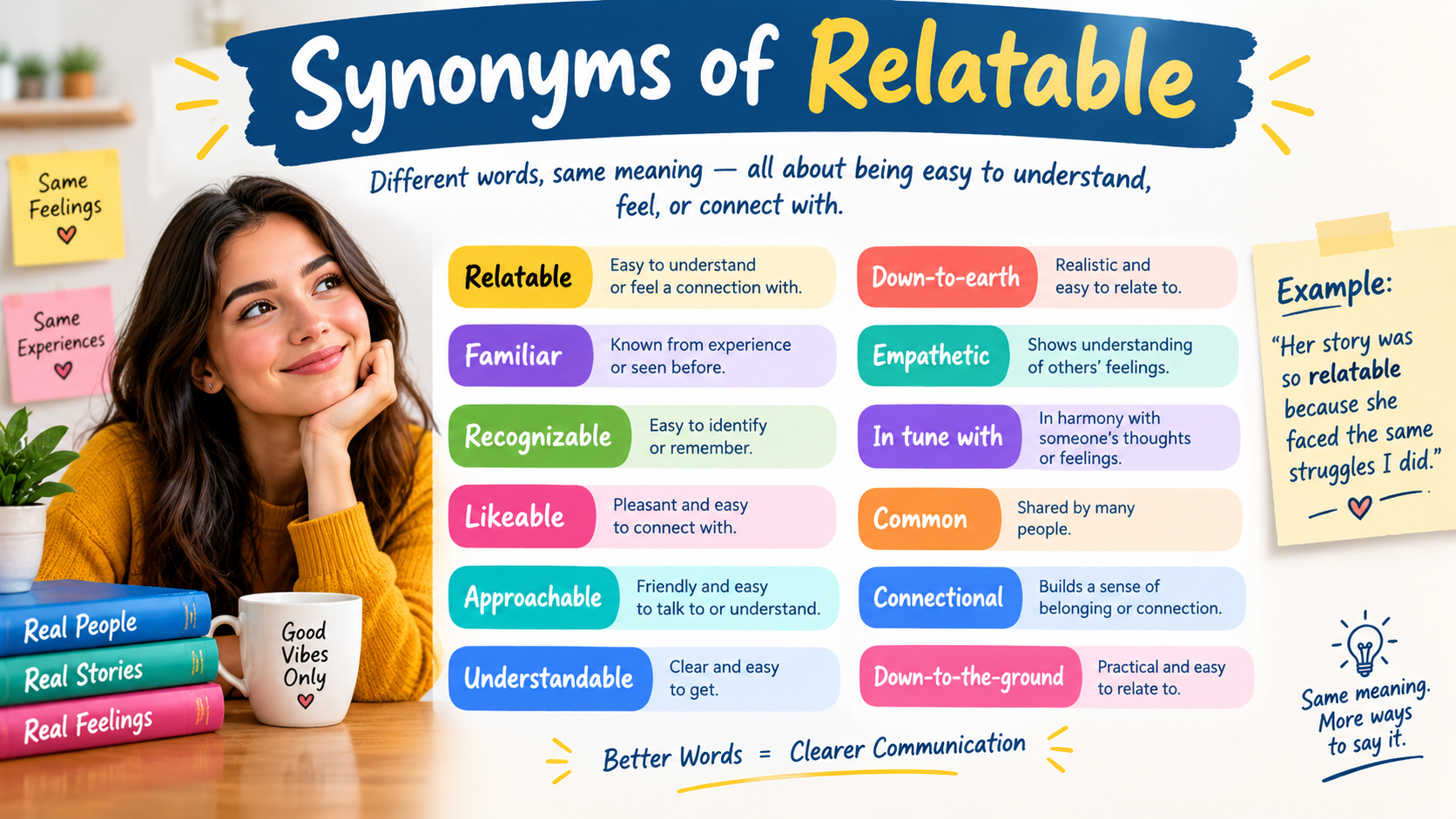
The best synonyms of relatable include easy to identify with, identifiable, sympathetic, familiar, and understandable. These words describe different ways people connect with someone or something. Use familiar for a shared experience, sympathetic for understanding someone’s feelings, and understandable when an action makes sense. The best alternative depends on your sentence.
Have you ever watched a movie and thought, “That character is just like me”? Perhaps the character worries about school, struggles with work, or has trouble making friends. You may call that character relatable because you recognize your own experiences in the story.
However, you do not always need to use the same adjective. Words such as familiar, sympathetic, and understandable can express similar ideas, but each has a different meaning.
Learning synonyms of relatable helps students improve essays, writers create stronger descriptions, and professionals communicate more clearly. It also helps English learners choose words that match their intended message.
This guide explains the most useful alternatives, their meanings, natural examples, grammar patterns, and differences. You will also learn which words work best in formal writing, everyday conversation, and social media.
Meaning of Relatable
Relatable is an adjective that describes someone or something people can understand or feel an emotional connection with, often because they recognize similar experiences or feelings.
Examples:
- The main character is relatable because she struggles with the same problems as other students.
- His honest stories make him relatable to young professionals.
- The video shows a relatable moment from everyday family life.
The word can also mean that one thing can be related or linked to another, especially in technical or formal contexts. In everyday conversation, however, it most often describes an emotional or personal connection.
Pronunciation of Relatable
- IPA: /rɪˈleɪ.tə.bəl/
- Simple pronunciation: ri-LAY-tuh-buhl
- Part of speech: Adjective
- CEFR guidance: C1 is the level associated with the personal-qualities topic entry in the Oxford Advanced Learner’s Dictionary. This is not a universal CEFR rating for every use of the word.
Word Origin and History
Relatable comes from the verb relate and the suffix -able, which often means “capable of being.”
The verb relate has historical roots in Latin relatus, associated with carrying or bringing back. Over time, English developed several meanings, including telling a story, connecting ideas, and establishing a personal connection.
Today, relatable commonly describes something that makes people recognize their own feelings or experiences. For exact historical dates and older meanings, consult a historical dictionary rather than assuming the earliest recorded use represents the modern meaning.
Part of Speech and Grammar
Relatable is an adjective. It usually appears before a noun or after a linking verb.
- Before a noun: She plays a relatable character.
- After a linking verb: His story is relatable.
- With a preposition: The experience is relatable to many students.
- With an infinitive phrase: The character is easy to relate to.
Related word forms include:
- Relate (verb): I can relate to her experience.
- Related (adjective): These issues are related.
- Relation (noun): There is a clear relation between the two ideas.
- Relationship (noun): They have a close relationship.
- Relatability (noun): The character’s relatability attracts viewers.
- Relatably (adverb): This form exists but is uncommon in everyday writing.
Common Grammar Mistake
Incorrect: I can relate with your experience.
Better: I can relate to your experience.
When you mean that you understand someone’s feelings or have experienced something similar, use relate to.
Quick Comparison: Synonyms of Relatable
| Synonym | Main meaning | Formality |
| Easy to identify with | Easy to connect with personally | Neutral |
| Identifiable | Recognizable through shared experiences | Neutral |
| Familiar | Known from previous experience | Neutral |
| Sympathetic | Showing care or understanding | Neutral |
| Understandable | Easy to understand or accept | Neutral |
| Empathetic | Able to understand another’s feelings | Neutral/formal |
| Approachable | Friendly and easy to talk to | Neutral |
| Engaging | Able to hold attention | Neutral |
| Believable | Realistic enough to believe | Neutral |
| Likable | Pleasant and easy to like | Neutral |
| Authentic | Genuine and not artificial | Neutral/formal |
| Accessible | Easy to understand or use | Formal/neutral |
| Recognizable | Easy to identify | Neutral |
| Down-to-earth | Practical and unpretentious | Informal |
| Compassionate | Caring about others’ suffering | Neutral/formal |
These words do not all have identical meanings. Choose an alternative based on what you want to communicate.
15 Useful Synonyms of Relatable
1. Easy to Identify With
Meaning: Easy to connect with because of similar feelings or experiences.
Examples:
- The young character is easy to identify with because she fears failure.
- His story is easy to identify with for people starting their careers.
Best used when: You want the clearest everyday alternative to relatable.
Tone: Neutral. Level: B1–B2 estimate. Frequency: Very common as a phrase.
Collocations: easy to identify with, difficult to identify with, identify with a character.
When not to use it: Avoid confusing identify with and identify. Identifying a problem means finding it; identifying with someone means feeling a connection.
2. Identifiable
Meaning: Easy to recognize or connect with through familiar features or experiences.
Examples:
- The film presents identifiable problems from everyday school life.
- Readers may find the character’s fears identifiable.
Best used when: You discuss recognizable experiences, patterns, or characters.
Tone: Neutral, analytical. Level: B2 estimate. Frequency: Common.
Collocations: identifiable pattern, identifiable experience, clearly identifiable.
When not to use it: Use relatable instead when you want to emphasize an emotional bond rather than simple recognition.
3. Familiar
Meaning: Known because you have seen, heard, or experienced something before.
Examples:
- The story describes familiar problems between parents and teenagers.
- Her nervous laughter felt familiar to everyone in the room.
Best used when: Something reminds people of their own experiences.
Tone: Neutral. Level: A2–B1 estimate. Frequency: Very common.
Collocations: familiar feeling, familiar situation, familiar experience.
When not to use it: A familiar place is not necessarily emotionally meaningful or relatable.
4. Sympathetic
Meaning: Showing care or understanding toward someone’s problems.
Examples:
- The manager was sympathetic when the employee explained the mistake.
- The author creates a sympathetic picture of a struggling family.
Best used when: You want to emphasize compassion or understanding.
Tone: Neutral, warm. Level: B2 estimate. Frequency: Common.
Collocations: sympathetic response, sympathetic character, sympathetic listener.
When not to use it: Do not use sympathetic simply to mean that someone shares your interests or experiences.
5. Understandable
Meaning: Easy to understand or accept as reasonable.
Examples:
- Her frustration was understandable after a difficult week.
- The character’s decision becomes understandable near the end.
Best used when: A feeling, reaction, or decision makes sense.
Tone: Neutral. Level: B1 estimate. Frequency: Very common.
Collocations: understandable concern, understandable reaction, perfectly understandable.
When not to use it: Use relatable when the main point is personal connection rather than logical understanding.
6. Empathetic
Meaning: Able to understand another person’s feelings.
Examples:
- An empathetic teacher listens to students without judging them.
- The counselor offered an empathetic response to the family’s concerns.
Best used when: You describe emotional understanding or sensitivity.
Tone: Professional, positive. Level: B2 estimate. Frequency: Common.
Collocations: empathetic leader, empathetic response, empathetic approach.
When not to use it: Do not use it as a synonym for interesting or popular.
7. Approachable
Meaning: Friendly and easy to talk to.
Examples:
- The new principal is approachable and welcomes questions.
- Her approachable teaching style helps beginners feel comfortable.
Best used when: You describe people, leaders, teachers, or communication styles.
Tone: Positive, professional. Level: B2 estimate. Frequency: Common.
Collocations: approachable manager, approachable manner, approachable style.
When not to use it: A person can be approachable without sharing your experiences.
8. Engaging
Meaning: Interesting enough to hold someone’s attention.
Examples:
- The speaker used engaging stories to explain difficult ideas.
- The article is engaging because it includes practical examples.
Best used when: You discuss content, performances, lessons, or speakers.
Tone: Positive. Level: B2 estimate. Frequency: Very common.
Collocations: engaging story, engaging speaker, engaging content.
When not to use it: Interesting content is not always relatable. Keep the distinction clear.
9. Believable
Meaning: Realistic enough to seem true.
Examples:
- The character’s mistakes make him believable.
- The author gives the story a believable ending.
Best used when: You evaluate fictional characters, dialogue, or explanations.
Tone: Neutral. Level: B1–B2 estimate. Frequency: Common.
Collocations: believable character, believable explanation, believable story.
When not to use it: Do not use believable when you mean that an audience shares the character’s feelings.
10. Likable
Meaning: Pleasant enough to make people like someone.
Examples:
- The hero is likable because he admits when he is wrong.
- Her warm humor makes her a likable presenter.
Best used when: You describe someone’s appeal or personality.
Tone: Neutral, conversational. Level: B1 estimate. Frequency: Common.
Collocations: likable character, likable personality, warm and likable.
When not to use it: A likable character may still feel unfamiliar or difficult to identify with.
Spelling note: American English generally prefers likable. British English also commonly uses likeable words. Both are accepted.
11. Authentic
Meaning: Genuine, real, or not falsely presented.
Examples:
- Her authentic writing style makes the article feel honest.
- The film offers an authentic view of family life.
Best used when: You emphasize honesty or a genuine portrayal of experience.
Tone: Positive, professional. Level: B2 estimate. Frequency: Very common.
Collocations: authentic voice, authentic experience, authentic portrayal.
When not to use it: Authenticity can support a personal connection, but genuine content is not automatically relatable to every reader.
12. Accessible
Meaning: Easy to reach, use, or understand.
Examples:
- The teacher makes complex science accessible to beginners.
- The website uses accessible language for new readers.
Best used when: You describe clear explanations, easy-to-use services, or information for a broad audience.
Tone: Neutral, professional. Level: B2 estimate. Frequency: Very common.
Collocations: accessible language, accessible explanation, accessible format.
When not to use it: Do not use accessible when you specifically mean emotional identification.
13. Recognizable
Meaning: Easy to identify from familiar features or details.
Examples:
- The comedy uses recognizable situations from office life.
- Her reaction is recognizable to people who have faced similar pressure.
Best used when: Readers or viewers recognize a familiar pattern.
Tone: Neutral. Level: B1–B2 estimate. Frequency: Very common.
Collocations: recognizable pattern, recognizable experience, instantly recognizable.
When not to use it: Recognition alone does not mean emotional understanding.
14. Down-to-Earth
Meaning: Practical, natural, and not acting superior to others.
Examples:
- The presenter is down-to-earth and speaks openly about ordinary problems.
- His down-to-earth advice helped the new team relax.
Best used when: You describe someone who seems genuine and approachable.
Tone: Informal, friendly. Level: B2 estimate. Frequency: Common.
Collocations: down-to-earth person, down-to-earth attitude, down-to-earth advice.
When not to use it: The phrase describes personality more than shared experience.
15. Compassionate
Meaning: Caring about the suffering or problems of others.
Examples:
- The compassionate doctor listened to the family’s concerns.
- The novel presents a compassionate view of people facing hardship.
Best used when: You emphasize kindness and concern for others.
Tone: Warm, professional. Level: B2 estimate. Frequency: Common.
Collocations: compassionate care, compassionate response, compassionate leader.
When not to use it: Compassion does not require someone to have experienced the same problem.
Strongest Synonyms, Strong Synonyms, and Related Words
Strongest alternatives
These preserve the personal-connection meaning most clearly:
- Easy to identify with
- Identifiable
- Familiar
- Sympathetic
- Understandable
Strong alternatives for specific contexts
- Empathetic
- Approachable
- Engaging
- Believable
- Likable
- Authentic
- Recognizable
Related words, not exact synonyms
These words may work in particular sentences, but their meanings differ:
- Relevant: Important to a subject or situation.
- Similar: Almost the same in one or more ways.
- Personal: Connected with an individual’s life or feelings.
- Meaningful: Important or valuable.
- Connected: Linked to someone or something.
- Realistic: Representing life in a believable way.
- Personable: Pleasant and friendly in social situations.
For example, an article can be relevant to students without being relatable to them. A character can be realistic without making viewers feel an emotional connection.
Commonly Confused Words
| Word | Main difference | Example |
| Relatable | Creates a personal connection | The character is relatable to new parents. |
| Related | Connected in some way | The two subjects are related. |
| Relevant | Important to a topic | This example is relevant to the discussion. |
| Reliable | Can be trusted | The website is a reliable source. |
| Realistic | Represents life believably | The film presents a realistic picture of school life. |
American and British English
The word relatable has the same spelling and broadly the same meaning in American and British English.
| Feature | American English | British English |
| Main spelling | Relatable | Relatable |
| Pronunciation | /rɪˈleɪ.t̬ə.bəl/ | /rɪˈleɪ.tə.bəl/ |
| Related spelling | Likable | Likeable is also common |
| Everyday meaning | Emotionally easy to connect with | Emotionally easy to connect with |
The pronunciation symbols show a common accent difference, not a rule followed by every speaker. The spelling difference in likable/likeable does not change the meaning.
Common Mistakes When Using Relatable Synonyms
Mistake 1: Choosing a word with a different meaning
Incorrect: The character is relevant, so I understand his feelings.
Better: The character is relatable, so I understand his feelings through my own experiences.
Why: Relevant means important to a topic. It does not automatically describe emotional connection.
Mistake 2: Confusing empathy with shared experience
Incorrect: She is relatable because she cares about everyone.
Better: She is compassionate because she cares about everyone.
Why: Compassion describes concern for others. Relatability describes a connection an audience feels.
Mistake 3: Using an unnatural phrase
Less natural: The story is highly identifiable with me.
Better: I can easily identify with the story.
Why: Identify with is the natural phrase for feeling a personal connection.
Mistake 4: Replacing a clear word with a complicated one
Less natural: His life is extremely recognizable to my personal circumstances.
Better: His life is similar to mine, so I can relate to him.
Why: Clear wording usually communicates the intended meaning more effectively.
How to Choose the Right Synonym
| If you want to express… | Choose… | Example |
| Shared feelings or experiences | Relatable | Her story is relatable. |
| A familiar situation | Familiar | The situation feels familiar. |
| Emotional care | Sympathetic | She was sympathetic toward him. |
| Emotional understanding | Empathetic | He is an empathetic listener. |
| Logical understanding | Understandable | His reaction is understandable. |
| Friendly behavior | Approachable | The manager is approachable. |
| Genuine presentation | Authentic | Her voice sounds authentic. |
| Interesting content | Engaging | The lesson is engaging. |
| Realistic details | Believable | The character feels believable. |
| Importance to a topic | Relevant | This point is relevant to our research. |
Natural Collocations and Everyday Usage
Native speakers often use relatable nouns describing people, stories, feelings, and experiences.
Common combinations include:
- Relatable character
- Relatable story
- Relatable experience
- Relatable content
- Relatable personality
- Relatable example
- Relatable moment
- Relatable struggles
- Highly relatable
- Instantly relatable
- Relatable to young adults
- Easy to relate to
Original usage examples:
- The creator shares relatable moments from everyday family life.
- Her relatable stories help new employees feel less alone.
- The teacher uses relatable examples to explain abstract ideas.
- The character is flawed, funny, and easy to relate to.
- His advice feels authentic because it comes from personal experience.
These are original teaching examples, not quotations from a linguistic corpus.
Related Vocabulary
Antonyms
There is no single opposite that fits every context. Useful choices include:
- Unrelatable: Difficult to connect with personally.
- Unfamiliar: Not known from previous experience.
- Alienating: Making people feel excluded or disconnected.
- Unapproachable: Difficult to talk to.
- Incomprehensible: Very difficult or impossible to understand.
Related expressions
- I can relate to that: I understand because I have had a similar experience.
- Put yourself in someone’s shoes: Imagine being in another person’s situation.
- Common ground: Experiences or interests shared by people.
- Shared experience: Something experienced by two or more people.
- Strike a chord: Create a strong emotional response or sense of recognition.
Frequently Asked Questions
1. What is the best synonym for relatable?
Easy to identify with is often the clearest alternative when you mean that someone or something creates a personal connection. Familiar works for experiences you recognize, while sympathetic emphasizes care and understanding. The best choice depends on your sentence.
2. What does relatable mean in simple English?
Relatable means that you can connect with someone or something because it reminds you of your own feelings, experiences, or life. For example, a student may find a character relatable because that character worries about exams just as the student does.
3. What is another word for relatable in an essay?
Useful alternatives include identifiable, understandable, familiar, and relevant. Choose identifiable when readers recognize their experiences in a character, understandable when an action makes sense, and relevant when information directly supports your topic.
4. What is a formal synonym for relatable?
Understandable, identifiable, and relevant can work in formal writing, depending on your intended meaning. For example, “The character’s concerns are understandable” suits an academic discussion. Avoid selecting a formal word simply because it sounds more advanced.
5. Is relatable the same as understandable?
No. Relatable describes something that creates a personal connection. Understandable means that something makes sense or can be accepted as reasonable. You can understand another person’s decision without having experienced the same situation yourself.
6. What is the opposite of relatable?
Unrelatable is the most direct opposite when something feels difficult to connect with personally. Other words include unfamiliar, alienating, and unapproachable, but each describes a different kind of distance or difficulty.
7. How do you use relatable in a sentence?
Use relatable before a noun or after a linking verb. For example, “She is a relatable character,” or “His experiences are relatable to young adults.” You can also say, “I find her story relatable.”
8. Is relatable formal or informal?
Relatable is a neutral adjective used in everyday conversation, education, reviews, and professional communication. It is especially common when people discuss characters, experiences, and online content. In academic writing, a more precise alternative may sometimes communicate your meaning better.
Vocabulary Quiz
Choose the best answer for each question.
1. Which word best describes a character whose experiences resemble your own?
A. Relevant
B. Relatable
C. Reliable
D. Remote
2. Which word describes someone who cares about another person’s problems?
A. Similar
B. Recognizable
C. Sympathetic
D. Convincing
3. Complete the sentence: “I can relate ___ your experience.”
A. at
B. with
C. to
D. for
4. Which word describes information that matters to a particular topic?
A. Approachable
B. Relevant
C. Likable
D. Human
5. Which word means realistic enough to believe?
A. Engaging
B. Familiar
C. Believable
D. Compassionate
Answer Key
- B. Relatable
- C. Sympathetic
- C. To
- B. Relevant
- C. Believable
Conclusion
Learning synonyms of relatable helps you describe emotions, experiences, and personal connections with greater accuracy. Words such as identifiable, familiar, sympathetic, and understandable each serve a different purpose.
Practice them in essays, emails, blog posts, and everyday conversations. Focus on meaning before choosing a synonym, and your English will become clearer, more natural, and more precise.
References
- Oxford Advanced Learner’s Dictionary: https://www.oxfordlearnersdictionaries.com/definition/english/relatable
- Cambridge Dictionary: https://dictionary.cambridge.org/dictionary/english/relatable
- Collins English Dictionary: https://www.collinsdictionary.com/dictionary/english/relatable
- Thesaurus.com: https://www.thesaurus.com/browse/relatable
- Collins English Thesaurus: https://www.collinsdictionary.com/dictionary/english-thesaurus/relatable

Synonorm is a trusted English vocabulary resource created to help readers find the right words and understand the differences between similar terms. We provide clear explanations of synonyms, meanings, examples, usage, and alternatives. Our content makes vocabulary easier to learn and apply in everyday, academic, and professional English. Synonorm is designed for students, writers, ESL learners, professionals, and anyone who wants to improve their English vocabulary and communicate more clearly.