Quick Answer
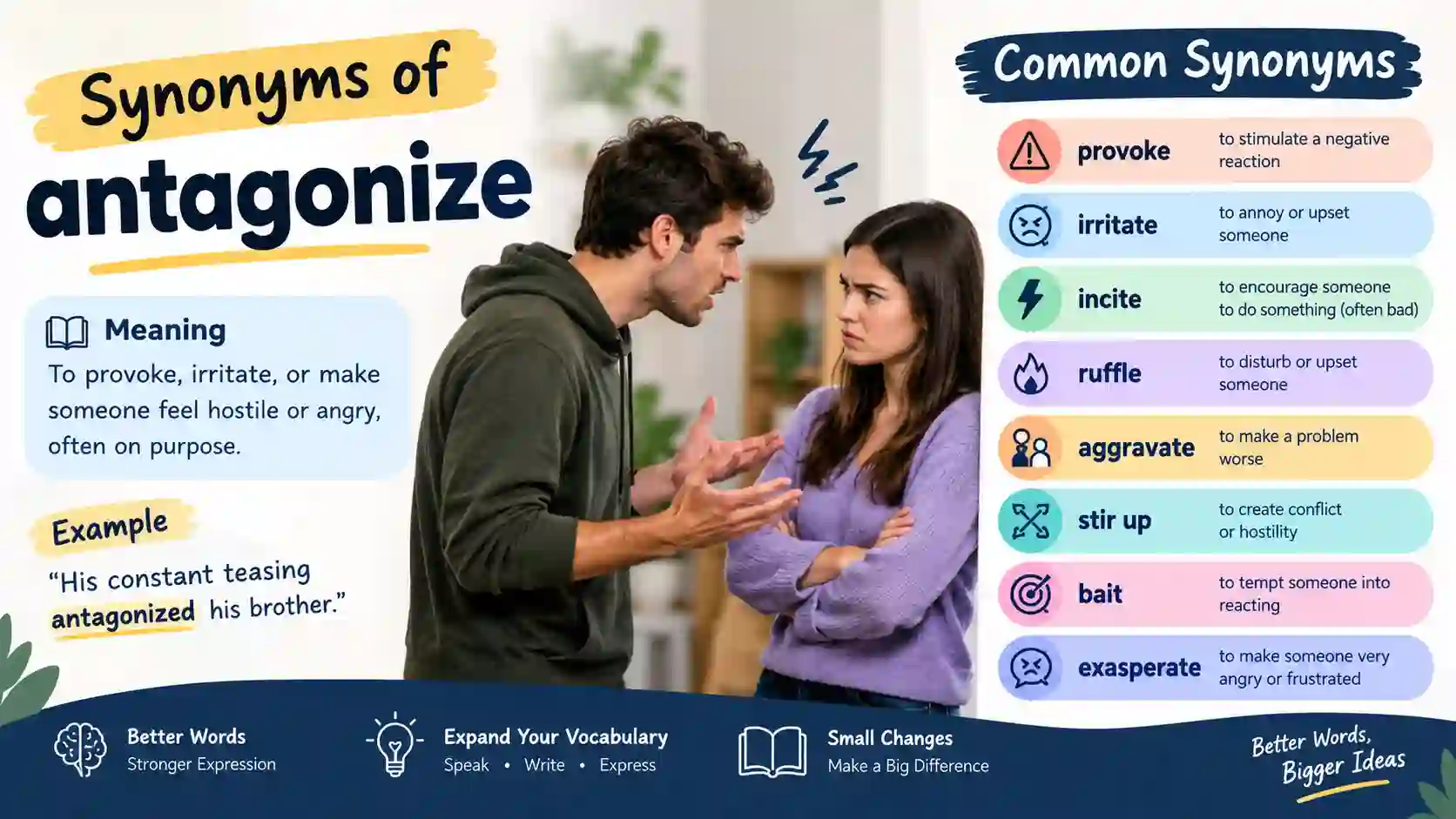
Synonyms of antagonize include provoke, irritate, annoy, anger, offend, infuriate, alienate, aggravate, and exasperate. These words describe different ways of causing anger, annoyance, or hostility. Use annoy for mild irritation, provoke for triggering a reaction, and alienate when someone’s behavior pushes others away.
What Does Antagonize Mean?
Have you ever said something that made another person angry or caused a disagreement? You may have antagonized them.
Antagonize means to make someone feel hostile, angry, or opposed to you. It often describes behavior that creates conflict or damages a relationship.
For example, a manager who ignores employee concerns may antagonize the team. A friend who makes an insulting joke may antagonize someone without realizing it.
Learning synonyms of antagonize helps you describe these situations more precisely. Students can improve their essays, writers can make their stories clearer, and professionals can communicate more carefully during disagreements.
Not every synonym has the same meaning. Some words describe mild irritation, while others suggest intense anger or lasting hostility. Understanding these differences helps you choose the right word for every situation.
Antagonize: Pronunciation and Grammar
- Pronunciation: /ænˈtæɡ.ə.naɪz/
- Simple pronunciation: an-TAG-uh-nize
- Part of speech: Verb
- American spelling: Antagonize
- British spelling: Antagonise
Both spellings have the same meaning. British English commonly uses antagonism, while American English generally uses antagonism.
How to Use Antagonize in a Sentence
The verb usually takes a direct object.
- Correct: His comments antagonized the audience.
- Incorrect: His comments antagonized the audience.
You can also use the word in different tenses:
- Present: Her behavior antagonizes her coworkers.
- Past: His remarks antagonized the customers.
- Future: The decision may antagonize local residents.
- Continuous: He is antagonizing his teammates.
- Passive: Several employees felt antagonized by the policy.
The word often suggests hostility or opposition, not simply a moment of irritation.
Quick Comparison: Synonyms of Antagonize
| Synonym | Main meaning | Strength | Register |
| Provoke | Trigger a reaction | Strong | Neutral |
| Irritate | Cause annoyance | Mild to moderate | Neutral |
| Annoy | Bother someone | Mild | Everyday |
| Anger | Make someone angry | Moderate to strong | Neutral |
| Offend | Hurt someone’s feelings | Context-dependent | Neutral |
| Infuriate | Make someone extremely angry | Very strong | Neutral |
| Enrage | Cause intense anger | Very strong | Neutral |
| Aggravate | Make a problem or feeling worse | Context-dependent | Neutral |
| Alienate | Push someone away | Strong relational effect | Formal |
| Exasperate | Test someone’s patience | Strong irritation | Formal |
| Incite | Encourage action or unrest | Strong | Formal |
| Inflame | Intensify anger or conflict | Strong | Formal |
| Insult | Show disrespect | Strong | Neutral |
| Taunt | Mock someone to upset them | Strong | Neutral |
| Needle | Provoke through repeated remarks | Mild to moderate | Informal |
| Rile | Make someone angry | Moderate | Informal |
| Embitter | Create lasting resentment | Lasting effect | Literary |
| Estrange | Make people distant | Lasting effect | Formal |
| Vex | Annoy or trouble someone | Context-dependent | Literary |
| Aggrieve | Make someone feel unfairly treated | Context-dependent | Formal |
Strength depends on context. For example, an insult may cause mild annoyance in one situation and intense anger in another.
20 Useful Synonyms of Antagonize
1. Provoke
Meaning: To cause someone to react, often with anger.
Examples:
- His sarcastic reply provoked an argument.
- The player tried to provoke the referee into reacting.
Best used when: An action or remark triggers a reaction.
Tone and register: Neutral; common in spoken, journalistic, and academic English.
Common collocations: Provoke anger, provoke a reaction, provoke an argument.
When not to use it: Avoid this word for a minor annoyance that causes no noticeable reaction.
2. Irritate
Meaning: To make someone feel annoyed or impatient.
Examples:
- The constant buzzing irritated everyone in the office.
- She irritated her classmates by interrupting their discussion.
Best used when: Something bothers someone or tests their patience.
Tone and register: Neutral; very common in everyday English.
Common collocations: Irritate someone, irritating noise, deeply irritated.
When not to use it: Use infuriate when the intended meaning is extreme anger.
3. Annoy
Meaning: To make someone feel bothered or slightly angry.
Examples:
- It annoys me when people interrupt important calls.
- The loud music annoyed the neighbors.
Best used when: You want to describe everyday frustration.
Tone and register: Neutral to informal; very common.
Common collocations: Annoy someone, really annoying, annoying habit.
When not to use it: Avoid it when the situation involves serious hostility or a lasting conflict.
4. Anger
Meaning: To make someone feel angry.
Examples:
- The unfair decision angered several employees.
- Her careless remark angered her brother.
Best used when: You need a clear, general word for causing anger.
Tone and register: Neutral; suitable for most situations.
Common collocations: Anger the public, anger customers, deeply angered.
When not to use it: Use alienate when the main result is a loss of support or closeness.
5. Offend
Meaning: To hurt someone’s feelings or make them feel insulted.
Examples:
- His joke offended several guests.
- She apologized because her comment had offended a colleague.
Best used when: Someone feels hurt by disrespectful or inappropriate behavior.
Tone and register: Neutral; common in personal and professional communication.
Common collocations: Offend someone, deeply offended, cause offense.
When not to use it: Someone can feel annoyed without feeling insulted. In that case, annoy may be more accurate.
6. Infuriate
Meaning: To make someone extremely angry.
Examples:
- The repeated delays infuriated the passengers.
- It infuriated Lena when her teammate took credit for her work.
Best used when: You want to express very strong anger.
Tone and register: Strong; common in conversation and formal writing.
Common collocations: Infuriate customers, absolutely infuriated, infuriating behavior.
When not to use it: Do not use it for a small inconvenience unless the reaction is genuinely intense.
7. Enrage
Meaning: To make someone very angry.
Examples:
- The dishonest report enraged the residents.
- His public accusation enraged the athlete.
Best used when: An action causes intense anger or outrage.
Tone and register: Strong; common in news and general writing.
Common collocations: Enrage supporters, enrage the public, become enraged.
When not to use it: Choose irritate or annoy for milder reactions.
8. Aggravate
Meaning: To make an existing problem or unpleasant feeling worse.
Examples:
- His complaints aggravated the situation.
- Refusing to listen only aggravated her frustration.
Best used when: Something worsens an existing problem, tension, or feeling.
Tone and register: Neutral; common in professional and everyday English.
Common collocations: Aggravate a problem, aggravate tensions, aggravate frustration.
When not to use it: Do not confuse making a situation worse with simply causing the first feeling of anger.
9. Alienate
Meaning: To make someone feel distant, excluded, or opposed to you.
Examples:
- The manager alienated employees by ignoring their concerns.
- His harsh criticism alienated several loyal supporters.
Best used when: Behavior damages relationships or pushes people away.
Tone and register: Neutral to formal; common in business and political writing.
Common collocations: Alienate supporters, alienate customers, alienate employees.
When not to use it: A brief disagreement does not necessarily alienate someone. The word suggests distance or opposition.
10. Exasperate
Meaning: To make someone very annoyed, especially through repeated problems.
Examples:
- The endless paperwork exasperated the new employee.
- His refusal to follow instructions exasperated the coach.
Best used when: Repeated behavior tests someone’s patience.
Tone and register: Neutral to formal; useful in descriptive writing.
Common collocations: Exasperate a teacher, increasingly exasperated, exasperating delays.
When not to use it: For a minor, one-time inconvenience, annoyance is usually simpler.
11. Incite
Meaning: To encourage people to take action, especially angry or violent action.
Examples:
- The speaker’s remarks incited anger among the crowd.
- The message was criticized for appearing to incite violence.
Best used when: Words or actions encourage a group to react or act.
Tone and register: Strong; formal, legal, and journalistic.
Common collocations: Incite violence, incite unrest, incite hatred.
When not to use it: Feeling annoyed is not the same as being encouraged to act. Use irritate for simple annoyance.
12. Inflame
Meaning: To make anger, tension, or conflict more intense.
Examples:
- The misleading headline inflamed public anger.
- His accusation inflamed an already tense debate.
Best used when: Something intensifies existing hostility or conflict.
Tone and register: Strong; common in journalism and formal writing.
Common collocations: Inflame tensions, inflame public anger, inflame passions.
When not to use it: Avoid it for ordinary irritation when there is no growing conflict.
13. Insult
Meaning: To speak or act in a way that shows disrespect.
Examples:
- The customer insulted the waiter over a small mistake.
- She felt insulted when her colleague mocked her work.
Best used when: Disrespectful behavior threatens someone’s dignity.
Tone and register: Neutral to strong; common in everyday English.
Common collocations: Insult someone’s intelligence, deliberately insult, deeply insulted.
When not to use it: Honest disagreement or polite criticism is not automatically an insult.
14. Taunt
Meaning: To mock someone in a way meant to upset or provoke them.
Examples:
- The spectators taunted the visiting team.
- He taunted his opponent after winning the match.
Best used when: Someone uses mocking words or actions to upset another person.
Tone and register: Strong; common in sports, stories, and everyday English.
Common collocations: Taunt an opponent, taunting remarks, taunt someone about a mistake.
When not to use it: Friendly teasing is not always taunting. The word suggests an intention to upset or humiliate.
15. Needle
Meaning: To annoy someone through repeated remarks or teasing.
Examples:
- His teammates needled him about missing the final shot.
- She kept needling her brother about his untidy desk.
Best used when: Someone repeatedly teases another person to get a reaction.
Tone and register: Informal; used in spoken English.
Common collocations: Needle someone about something, keep needling, gently needle.
When not to use it: Avoid it in formal reports when provoking or teasing would be clearer.
16. Rile
Meaning: To make someone angry or irritated.
Examples:
- The unfair comparison riled the players.
- Nothing riles him more than being interrupted.
Best used when: You want a conversational word for making someone angry.
Tone and register: Informal; common in casual speech.
Common collocations: Rile someone up, easily riled, rile the crowd.
When not to use it: In formal academic writing, anger or irritation may be more suitable.
17. Embitter
Meaning: To make someone resentful or unhappy over time.
Examples:
- The unfair dismissal embittered several former workers.
- Years of broken promises embittered the community.
Best used when: Repeated hardship or unfair treatment creates lasting resentment.
Tone and register: Strong; literary and formal.
Common collocations: Embitter a relationship, embittered by failure, embittered attitude.
When not to use it: A brief angry reaction does not usually justify this word.
18. Estrange
Meaning: To make people who were once close become distant.
Examples:
- The family dispute estranged the two brothers.
- Her repeated dishonesty estranged her from her friends.
Best used when: Conflict creates a lasting break in a relationship.
Tone and register: Formal; often used in personal or family contexts.
Common collocations: Become estranged, estranged relatives, estrange someone from their family.
When not to use it: Use annoy if the relationship remains close despite a disagreement.
19. Vex
Meaning: To annoy or trouble someone.
Examples:
- The missing documents vexed the office manager.
- The unresolved question continued to vex the researchers.
Best used when: You want a literary or formal word for irritation or difficulty.
Tone and register: Literary to formal; less common in daily conversation.
Common collocations: Vex the mind, vexing problem, deeply vexed.
When not to use it: Choose annoyance for simple, everyday conversations.
20. Aggrieve
Meaning: To make someone feel unfairly treated or wronged.
Examples:
- The policy aggrieved workers who had served the company for years.
- The decision aggrieved residents who received no warning.
Best used when: Someone feels hurt because they believe they have suffered an injustice.
Tone and register: Formal; used in legal, political, and professional writing.
Common collocations: Aggrieved party, aggrieved employees, feel aggrieved.
When not to use it: Do not use aggrieve as a general replacement for annoyance. It emphasizes unfair treatment.
Strongest Synonyms, Strong Synonyms, and Related Words
Strongest Synonyms
These words can express strong anger, deliberate provocation, or serious hostility, depending on context:
- Provoke: Trigger a reaction.
- Infuriate: Cause extreme anger.
- Enrage: Cause intense anger.
- Alienate: Push people away or create opposition.
- Incite: Encourage action or unrest.
- Inflame: Intensify an existing conflict.
Strong Synonyms
These words fit specific situations:
- Anger: Cause anger.
- Offend: Hurt feelings through disrespect.
- Exasperate: Test someone’s patience.
- Aggravate: Make a problem or feeling worse.
- Insult: Show disrespect.
- Taunt: Mock someone to upset them.
- Embitter: Create lasting resentment.
Related Words
These alternatives overlap with antagonize but may not preserve its full meaning:
- Annoy: Cause mild irritation.
- Irritate: Cause annoyance or impatience.
- Needle: Provoke through repeated teasing.
- Rile: Make someone angry.
- Estrange: Create distance in a relationship.
- Vex: Annoy or trouble someone.
- Aggrieve: Make someone feel unfairly treated.
Commonly Confused Words
| Words | Main difference | Example |
| Antagonize vs. annoy | Antagonize often implies hostility; annoy usually means bother. | His insults antagonized the team. |
| Provoke vs. incite | Provoke triggers a reaction; incite encourages action. | The remark provoked an argument. |
| Irritate vs. infuriate | Irritate means bother; infuriate means make extremely angry. | The delay irritated her, but the lie infuriated her. |
| Offend vs. insult | Offend describes the effect; insult describes disrespectful behavior. | His joke offended her. |
| Alienate vs. estrange | Alienate pushes people away; estrange often suggests a lasting break in a relationship. | The decision alienated voters. |
Common Mistakes to Avoid
Mistake 1: Adding an unnecessary preposition
Incorrect: He antagonized his neighbor.
Correct: He antagonized his neighbor.
Explanation: Antagonize normally takes a direct object.
Mistake 2: Treating every synonym as identical
Incorrect: The small delay infuriated me, although I barely noticed it.
Better: The small delay annoyed me.
Explanation: Infuriate suggests intense anger. Annoying fits minor irritations.
Mistake 3: Confusing resent with antagonize
Incorrect: She resented him, meaning she made him angry.
Correct: She antagonized him, meaning she made him angry or hostile.
Explanation: Resent means to feel bitterness or displeasure about something. It describes the person’s feeling, not the action that caused another person’s anger.
Mistake 4: Confusing a related word with a direct synonym
Incorrect: The rude behavior repelled him, meaning it made him angry.
Better, if anger is the intended meaning: The rude behavior angered him.
Explanation: Repel usually means to drive away or cause strong dislike. It may describe a related result, but it does not always mean to antagonize.
Writing Tips for Better Vocabulary
- Essays: Use aggravate, alienate, or incite when they accurately describe the situation.
- Emails: Prefer clear, professional words such as offend, upset, or irritate.
- Blog posts: Explain whether a behavior causes anger, opposition, or damaged relationships.
- Stories: Use taunt, infuriate, or embitter when the context supports the stronger meaning.
- Social media: Familiar words such as annoy and provoke usually communicate clearly.
- Daily conversations: Use simple vocabulary unless a more specific word adds value.
Writing tip: Do not replace a word merely to avoid repetition. Choose a synonym only when it preserves the intended meaning.
Word Origin and Etymology
Antagonize comes from Greek antagōnizesthai, meaning to struggle against, oppose, or compete with someone. The word is related to antagonist and antagonism.
The verb entered English in the seventeenth century. Etymology sources give early recorded-use dates in the 1620s or 1630s, depending on the source. The sense of making someone hostile developed later.
The word family includes:
- Antagonism: Hostility or opposition.
- Antagonistic: Showing hostility or opposition.
- Antagonist: A person who opposes another, especially in a story.
- Antagonize: To create hostility or opposition.
The history of the word helps explain why antagonize can refer to more than anger. It can also describe behavior that creates resistance or conflict.
American vs. British English
| Feature | American English | British English |
| Common spelling | Antagonize | Antagonise |
| Past tense | Antagonized | Antagonised |
| Present participle | Antagonizing | Antagonising |
| Meaning | Make someone hostile or opposed | Make someone hostile or opposed |
Both spellings are correct in their respective conventions. British style guides do not all follow the same preference, so use the spelling required by your publisher or chosen style guide.
Antonyms of Antagonize
Antonyms describe ways to reduce hostility or restore goodwill.
| Antonym | Meaning | Example |
| Appease | Calm someone by meeting demands or making concessions | They offered compensation to appease customers. |
| Pacify | Make someone calm | The mediator pacified the angry group. |
| Placate | Calm an upset person | He tried to placate the dissatisfied client. |
| Conciliate | Restore goodwill or settle differences | The manager worked to conciliate both sides. |
| Reconcile | Restore a friendly relationship | The two friends reconciled after their argument. |
| Mollify | Make someone less angry | Her apology mollified the customer. |
| Soothe | Calm distress or anger | His gentle words soothed the child. |
These words are related opposites, not interchangeable solutions. For example, soothe focuses on calming emotions, while reconcile focuses on repairing a relationship.
Related Expressions and Natural Collocations
Common Expressions
- Rub someone the wrong way: Behave in a way that annoys someone.
- Get under someone’s skin: Annoy someone deeply.
- Rile someone up: Make someone angry or excited.
- Stir up trouble: Cause problems or conflict.
- Fan the flames: Make an existing conflict worse.
- Make enemies: Create hostility or opposition.
Natural Collocations
| Word | Common combinations |
| Antagonize | Antagonize a colleague, antagonize voters, antagonize the authorities |
| Provoke | Provoke anger, provoke a reaction, provoke an argument |
| Alienate | Alienate customers, alienate supporters, alienate friends |
| Irritate | Irritate a listener, irritating noise, irritate the skin |
| Incite | Incite violence, incite unrest, incite hatred |
| Aggravate | Aggravate a problem, aggravate tensions, aggravate frustration |
| Offend | Offend someone, deeply offended, cause offense |
| Infuriate | Infuriate the public, infuriating behavior, absolutely infuriated |
These are common usage patterns, not measured frequency rankings.
Frequently Asked Questions
1. What are the best synonyms of antagonize?
The best synonyms include provoke, irritate, annoy, anger, offend, infuriate, aggravate, and alienate. Use annoy for mild irritation, provoke for triggering a reaction, and alienate when behavior pushes people away. The right word depends on the situation and the emotional effect.
2. What is the closest synonym for antagonize?
Provoke is one of the closest synonyms when antagonize means causing anger or hostility. However, alienation may fit better when someone’s actions create opposition or distance. Choose the word that matches the sentence rather than treating all synonyms as exact replacements.
3. Is antagonize a negative word?
Yes. Antagonize usually describes behavior that creates anger, hostility, or opposition. It does not always mean the person intended to cause trouble. An insensitive comment can antagonize someone even when the speaker did not mean to upset them.
4. What is the opposite of antagonizing?
Common opposites include appease, pacify, placate, soothe, and conciliate. These words describe calming anger, reducing tension, or restoring goodwill. For example, a manager might appease an upset customer by offering a fair solution. Reconciliation is especially useful when people repair a damaged relationship.
5. What is the difference between antagonize and provoke?
Antagonize emphasizes creating hostility or opposition, while provoke emphasizes triggering a reaction. Repeated disrespect may antagonize a coworker, while one insulting remark may provoke an immediate argument. The meanings overlap, but their emphasis differs.
6. Can antagonize be used in professional writing?
Yes. Antagonize is useful in business, politics, academic writing, and professional communication when an action creates hostility or opposition. For example, “The company should avoid antagonizing its largest customers.” If you mean mild irritation, annoy or irritate may be more precise.
7. What is the British spelling of antagonize?
The common British spelling is antagonise, while American English generally uses antagonize. Both spellings have the same meaning. British spelling preferences vary by publisher and style guide, so choose one form and use it consistently throughout your writing.
8. What does antagonizing someone mean?
Antagonizing someone means behaving in a way that makes them angry, hostile, or opposed to you. This could involve repeated teasing, insulting comments, or deliberately provoking an argument. The word often suggests more than simple annoyance, especially when the behavior damages a relationship or creates conflict.
Vocabulary Quiz
Choose the best answer for each question.
1. Which word means to make someone extremely angry?
A. Soothe
B. Infuriate
C. Reconcile
D. Appease
2. Which word describes pushing supporters away through poor behavior?
A. Alienate
B. Pacify
C. Soothe
D. Reconcile
3. Complete the sentence: The rude joke ___ several guests.
A. Appeased
B. Reconciled
C. Offended
D. Soothed
4. Which word can mean encouraging people toward violence or unrest?
A. Annoy
B. Incite
C. Upset
D. Vex
5. Which sentence uses antagonize correctly?
A. He antagonized his friend.
B. She antagonized her colleague with repeated insults.
C. They antagonize at the meeting.
D. He was antagonized with anger.
Answer Key
- B. Infuriate
- A. Alienate
- C. Offended
- B. Incite
- B. She antagonized her colleague with repeated insults.
Conclusion
Learning synonyms of antagonize helps you describe anger, irritation, conflict, and damaged relationships more precisely.
Words such as annoy, provoke, infuriate, and alienate each express a different shade of meaning. Practice them in essays, emails, schoolwork, and conversations.
Focus on choosing the word that fits the situation instead of memorizing long lists. With regular practice, you can build a stronger vocabulary and communicate with greater confidence.
References
- Cambridge Dictionary. Antagonize: definition and usage.
- Cambridge Thesaurus. Synonyms and antonyms of antagonize.
- Thesaurus.com. Antagonize synonyms and antonyms.
- Collins Dictionary. Antagonize English Thesaurus.
- Etymonline. Antagonize: word origin and history.

Synonorm is a trusted English vocabulary resource created to help readers find the right words and understand the differences between similar terms. We provide clear explanations of synonyms, meanings, examples, usage, and alternatives. Our content makes vocabulary easier to learn and apply in everyday, academic, and professional English. Synonorm is designed for students, writers, ESL learners, professionals, and anyone who wants to improve their English vocabulary and communicate more clearly.