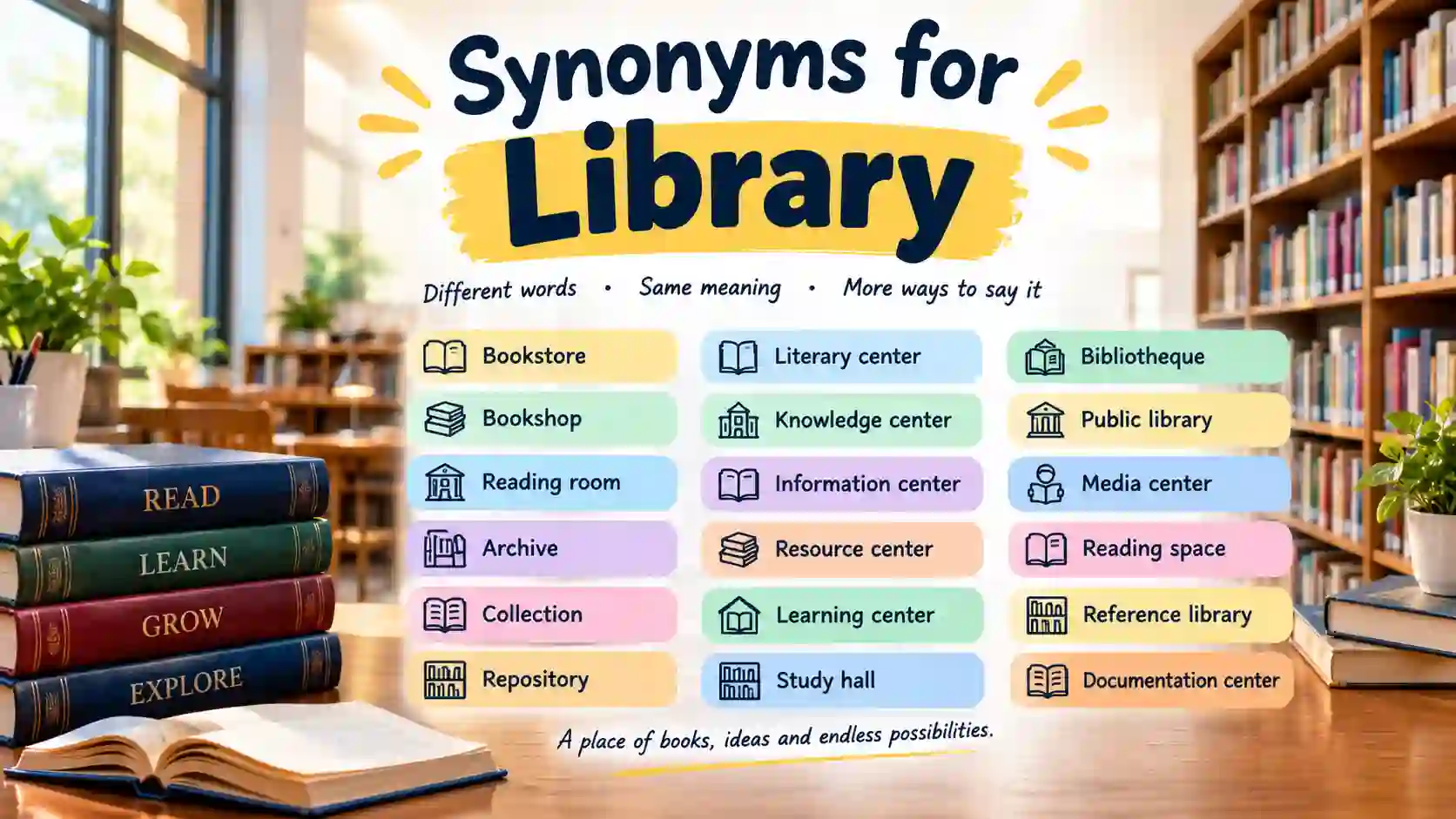
Quick Answer: What Are Synonyms for Library?
Useful synonyms and alternatives for library include reading room, book collection, archive, repository, information center, resource center, and media center. The best choice depends on the context. A reading room is a place to read, an archive preserves records, and a repository stores information. Some related terms describe only one part or type of a library.
Have you ever used the word library several times in an essay and wanted a more precise alternative? The right word can make your writing clearer, but not every word connected with books means the same thing.
A library can be a public building, a collection of books, an online resource, or a set of reusable computer programs. Each meaning calls for different vocabulary.
For example, you might write, “The university library provides access to research papers.” If you want to emphasize the digital storage of those papers, a repository may fit better. If you mean the historical records kept by the university, an archive may be the right choice.
This guide explains 30 useful synonyms, related terms, and context-specific alternatives. You will learn their meanings, examples, formality, word origins, and common mistakes. The goal is not to replace the library every time, but to help you choose the most accurate word.
Pronunciation of Library
- British English IPA: /ˈlaɪ.brər.i/
- American English IPA: /ˈlaɪ.brer.i/
- Simple pronunciation: LYE-bruh-ree or LYE-brer-ee, depending on accent
- Part of speech: Noun
- Plural: Libraries
Pronunciation varies by region and speaker. The spelling remains the same in American and British English.
What Does Library Mean?
A library is a place, organization, or collection that provides books and other resources for reading, learning, research, or borrowing. It may also describe a collection of digital materials, music, or computer code.
For example:
- Physical library: Students studied in the school library.
- Collection: My grandfather built a library of historical books.
- Digital library: Researchers accessed journals through a digital library.
- Computing: The application uses a software library to process images.
Cambridge Dictionary recognizes both the institutional meaning and the broader meaning of a collection of books or recordings. This wider definition explains why the best synonym changes with the context. (See the Cambridge Dictionary definition.)
Word Origin and First Known Use
The word library entered English through Middle English and Anglo-French, with roots in Latin words connected with books. Latin liber means “book,” and librarian was associated with books and book-related places or collections.
Historical dictionaries record the English word in use by the 14th century. The precise date of the earliest surviving written example depends on the historical dictionary and its evidence.
The meaning has grown over time. Today, a library may hold printed books, films, music, electronic documents, or reusable software components.
30 Synonyms and Related Words for Library
The following table separates close alternatives from words that work only in specific contexts. The strength label describes usefulness for a particular meaning, not a universal synonym ranking.
| Word or phrase | Best context | Strength | Register |
| Reading room | A space for reading | Strong in context | Neutral |
| Book collection | A group of books | Strong in context | Neutral |
| Archive | Preserved historical records | Strong in context | Formal |
| Repository | Organized stored resources | Strong in context | Formal |
| Information center | Information services | Strong in context | Neutral |
| Resource center | Learning materials and support | Strong in context | Neutral |
| Media center | Books and other media | Strong in context | Neutral |
| Reference library | Research and reference materials | Strong in context | Formal |
| Lending library | Borrowing services | Strong in context | Neutral |
| Digital library | Electronic resources | Strong in context | Neutral |
| Online library | Internet-based access | Strong in context | Neutral |
| Collection | A group of related items | Related | Neutral |
| Book room | A room for books | Context-specific | Neutral |
| Study | A private workroom | Related | Neutral |
| Athenaeum | A learning or cultural institution | Specialized | Formal |
| Bibliotheca | A historical or specialized library term | Specialized | Literary |
| Depository | A place for safekeeping | Related | Formal |
| Stacks | Shelves or storage areas in a library | Part of a library | Professional |
| Storehouse | A place for stored items | Related | Neutral |
| Treasury | A valuable collection, figuratively | Figurative | Literary |
| Public library | A community-serving library | Library type | Neutral |
| School library | A library in a school | Library type | Neutral |
| University library | A library serving a university | Library type | Academic |
| Private library | A privately owned collection | Library type | Neutral |
| Research library | A library focused on research | Library type | Academic |
| Special collection | A distinct group of materials | Library term | Academic |
| Documentation center | A source of organized documents | Related | Professional |
| Knowledge center | An organized learning resource | Related | Professional |
| Software library | Reusable computer code | Technical meaning | Technical |
| Music library | A collection of music recordings | Technical or general | Neutral |
Important: The table includes both synonyms and related terms. Words such as school library and software library describe particular kinds of libraries, while stacks refers to a section inside one.
The 15 Most Useful Synonyms for Library
1. Reading Room
Meaning: A reading room is a place where people read or study.
Examples:
- The students prepared for their exams in the reading room.
- The reading room offers a quiet place to work.
Best used when: You want to emphasize the space rather than the entire institution.
Register: Neutral. CEFR guidance: Approximately B1. Frequency: Common.
Collocations: quiet reading room, public reading room, reading-room facilities.
When not to use it: A reading room may not offer book borrowing, staff services, or a full library collection.
2. Book Collection
Meaning: A book collection is a group of books kept together.
Examples:
- The school received a book collection from a local family.
- Her book collection covers history, science, and art.
Best used when: You mean the books themselves rather than the building.
Register: Neutral. CEFR guidance: Approximately A2–B1. Frequency: Common.
Collocations: personal book collection, rare book collection, growing collection.
When not to use it: A collection of books does not automatically function as a library.
3. Archive
Meaning: An archive is a place or collection where important records are preserved.
Examples:
- The archive contains letters from the town’s early residents.
- Researchers visited the archive to examine historical photographs.
Best used when: You are describing preserved documents, photographs, records, or manuscripts.
Register: Formal. CEFR guidance: Approximately B2. Frequency: Common.
Collocations: historical archive, digital archive, archive records.
When not to use it: An archive is not necessarily a place where people borrow novels or textbooks.
4. Repository
Meaning: A repository is a place or system used to store and organize materials or information.
Examples:
- The university maintains a repository of academic papers.
- The organization created a repository for its research documents.
Best used when: You want to emphasize organized storage and access.
Register: Formal. CEFR guidance: Approximately C1. Frequency: Common in academic and technical writing.
Collocations: digital repository, data repository, institutional repository.
When not to use it: In everyday conversation, library usually sounds more natural when you mean a place to borrow books.
5. Information Center
Meaning: An information center is a place that provides information and resources.
Examples:
- The visitor information center supplied maps and local guides.
- The campus information center helps students find useful resources.
Best used when: Information services are the main focus.
Register: Neutral. CEFR guidance: Approximately B1–B2. Frequency: Common.
Collocations: visitor information center, student information center, information services.
When not to use it: Not every information center contains books or offers borrowing services.
6. Resource Center
Meaning: A resource center provides materials, tools, or support for a particular purpose.
Examples:
- Teachers found lesson materials at the resource center.
- The language resource center offers dictionaries and practice exercises.
Best used when: You mean a place that supports learning or professional work.
Register: Neutral. CEFR guidance: Approximately B1–B2. Frequency: Common.
Collocations: learning resource center, teaching resource center, resource center materials.
When not to use it: Use library when a book collection and its related services are the main focus.
7. Media Center
Meaning: A media center provides different types of learning or information materials.
Examples:
- Students borrowed films from the school media center.
- The media center provides books, audio recordings, and digital resources.
Best used when: A facility offers books alongside other forms of media.
Register: Neutral. CEFR guidance: Approximately B1–B2. Frequency: Common in educational settings.
Collocations: school media center, digital media center, media center resources.
When not to use it: A media center is not always a traditional library.
8. Reference Library
Meaning: A reference library keeps materials that people consult for information or research.
Examples:
- She checked an encyclopedia in the reference library.
- The reference library provides access to historical maps.
Best used when: People mainly consult materials instead of borrowing them.
Register: Formal to neutral. CEFR guidance: Approximately B2. Frequency: Common in research settings.
Collocations: reference materials, reference library collection, reference section.
When not to use it: The term may be inaccurate for a library that mainly lends books.
9. Lending Library
Meaning: A lending library allows members to borrow books or other resources.
Examples:
- The community opened a lending library for children.
- Members can borrow books from the lending library each week.
Best used when: Borrowing is the main service.
Register: Neutral. CEFR guidance: Approximately B1–B2. Frequency: Common.
Collocations: lending library service, community lending library, lending library membership.
When not to use it: Do not use this term for a collection that people cannot borrow from.
10. Digital Library
Meaning: A digital library organizes electronic books and other digital resources.
Examples:
- The digital library gives students access to online journals.
- Researchers searched the digital library for historical newspapers.
Best used when: You mean an organized collection of electronic resources.
Register: Neutral. CEFR guidance: Approximately B1–B2. Frequency: Common.
Collocations: digital library collection, digital library platform, digital library access.
When not to use it: A website that simply hosts unrelated downloads is not automatically a digital library.
11. Online Library
Meaning: An online library provides resources through the internet.
Examples:
- The online library lets members read selected books on their phones.
- I searched an online library for language-learning materials.
Best used when: You want to emphasize internet access.
Register: Neutral. CEFR guidance: Approximately A2–B1. Frequency: Common.
Collocations: online library access, online library catalogue, free online library.
When not to use it: Online library emphasizes access through the web, while digital library emphasizes the digital collection itself. The terms often overlap.
12. Collection
Meaning: A collection is a group of related items gathered together.
Examples:
- The museum’s collection includes books about ancient cities.
- The library’s collection contains works by local writers.
Best used when: You want to describe the materials held by a library.
Register: Neutral. CEFR guidance: Approximately B1. Frequency: Very common.
Collocations: book collection, reference collection, special collection.
When not to use it: A collection may exist without a building, staff, or borrowing services.
13. Study
Meaning: A study is a room used for reading, writing, or quiet work.
Examples:
- He keeps his reference books in the study.
- She spent the afternoon working in her study.
Best used when: You mean a private room, often in a home.
Register: Neutral. CEFR guidance: Approximately B1. Frequency: Common.
Collocations: private study, home study, study desk.
When not to use it: A study is not usually a public institution that lends books.
14. Athenaeum
Meaning: An athenaeum is an institution or place devoted to learning, literature, or culture, sometimes including a library.
Examples:
- The historic athenaeum hosted a lecture about poetry.
- Members gathered at the athenaeum to discuss new books.
Best used when: You are writing about a historical or cultural institution.
Register: Formal and literary. CEFR guidance: Advanced. Frequency: Rare.
Collocations: literary athenaeum, historic athenaeum, athenaeum membership.
When not to use it: In ordinary writing, the library is clearer and more familiar.
15. Software Library
Meaning: A software library is a collection of reusable code that developers use in computer programs.
Examples:
- The developer used a software library to process images.
- The application relies on a library that handles dates.
Best used when: The subject is programming or software development.
Register: Technical. CEFR guidance: Specialized vocabulary. Frequency: Very common in computing.
Collocations: software library, code library, JavaScript library.
When not to use it: Do not use this term to describe a physical library unless you are discussing the computing meaning.
How to Choose the Right Synonym
Use this quick comparison when editing your work.
| Your intended meaning | Recommended word | Example |
| A quiet place to read | Reading room | We studied in the reading room. |
| A group of books | Book collection | The donation included a book collection. |
| Preserved historical documents | Archive | The archive holds old letters. |
| Stored digital information | Repository | The repository contains research papers. |
| A facility with books and videos | Media center | The media center offers films and books. |
| Electronic books and journals | Digital library | The digital library contains academic journals. |
| A private reading room | Study | I worked on my studies. |
| Reusable computer code | Software library | The program uses a software library. |
The most important rule: Match the replacement to the meaning of the original sentence. A synonym that changes the meaning is not an improvement.
American vs. British English
The spelling of library is the same in both varieties of English.
| Feature | American English | British English |
| Spelling | Library | Library |
| Plural | Libraries | Libraries |
| General meaning | Place or collection for reading and research | Place or collection for reading and research |
| Pronunciation | Often /ˈlaɪ.brer.i/ | Often /ˈlaɪ.brər.i/ |
| Common institutional term | Public library | Public library |
| Storage-area term | Stacks | Stacks |
These pronunciations are common dictionary forms, not strict rules for every speaker. Regional accents can produce other variations.
Commonly Confused Words
| Word | Main difference | Example |
| Library | Provides access to books and other resources | I borrowed a book from the library. |
| Bookstore | A business that sells books | We bought a dictionary at the bookstore. |
| Archive | Preserves records and historical materials | The archive contains old letters. |
| Bookcase | Furniture used to hold books | The dictionary is in the bookcase. |
| Reading room | A space designed for reading | She worked in the reading room. |
Common Mistakes to Avoid
Mistake 1: Using bookstore when you mean library
Incorrect: I borrowed a book from the bookstore.
Correct: I borrowed a book from the library.
Why: A bookstore usually sells books. A library generally provides access to books for reading, research, or borrowing.
Mistake 2: Calling every collection an archive
Incorrect: My archive of new novels is on the table.
Better: My collection of new novels is on the table.
Why: Archive often suggests records preserved for future use. Collection is more suitable for a general group of novels.
Mistake 3: Treating a study as a public library
Incorrect: I borrowed a book from the study.
Correct: I borrowed a book from the library.
Why: A study usually means a room for private reading or work.
Mistake 4: Using rare words to sound more formal
Awkward: I visited the athenaeum to borrow a children’s story.
More natural: I visited the library to borrow a children’s story.
Why: Athenaeum has a specialized meaning and may confuse readers in ordinary situations.
Writing Tips for Students, Bloggers, and Professionals
Essays and schoolwork
Use archive for historical records, reference library for research materials, and digital library for online resources.
Example: The archive provided historical documents for the research project.
Emails and professional writing
Choose words that help readers understand the service or resource.
Example: You can find the reports in our digital library.
Blog posts and articles
Avoid changing libraries just to prevent repetition. Use a more specific term when it adds useful information.
Example: The university library provides books, while the archive preserves historical documents.
Stories and creative writing
Figurative expressions can make a description more vivid.
Example: Her grandmother’s library was a treasure trove of forgotten stories.
Daily conversation and social media
Use familiar terms such as library, book collection, and reading room. Rare vocabulary can sound unnatural in casual conversation.
Example: I found a great collection of books at the local library.
Related Vocabulary and Word Family
Related expressions
- Library card: A card used to access library services.
- Library catalogue: A searchable record of library materials.
- Library membership: Registration that provides access to eligible services.
- Library services: Services offered by a library.
- Reference materials: Resources used to check facts or find information.
- Digital collection: A group of electronic resources.
- Book lending: The process of allowing people to borrow books.
Word family
- Library: A place or collection of resources.
- Libraries: The plural form.
- Librarian: A person who works with library collections and services.
- Librarianship: The profession or practice of managing library services.
- Library-related: Connected with a library.
Does the library have an antonym?
The library has no standard direct antonym. Words such as emptiness or disorganization may express the opposite of a particular feature, but they are not true dictionary opposites of library.
Frequently Asked Questions
1. What is the best synonym for library?
The best alternative depends on what you mean. A reading room describes a place for reading, an archive describes preserved records, and a book collection describes books gathered together. If you mean a public institution that lends books, library is usually the clearest word.
2. What are five synonyms for library?
Five useful alternatives are reading room, book collection, archive, repository, and information center. Each has a different emphasis. Use a reading room for the space, a book collection for the books, and an archive for preserved records. Choose the others when their specific meanings fit.
3. What is a formal word for library?
Repository is a formal alternative when you mean an organized place or system for storing resources. Archive suits preserved records, while athenaeum refers to a learning or cultural institution. These words are not interchangeable in every sentence, so consider the exact meaning before using them.
4. What is another word for a digital library?
An online library is a useful alternative when people access electronic resources through the internet. Digital repository works when you want to emphasize the storage of digital information. A digital library may contain electronic books, journals, images, recordings, and other resources.
5. What is a synonym for a small library?
A book collection describes a small group of books, while a reading room describes a small space where people read. A book room may also work when referring to a room used to store books. Choose the term that matches whether you mean the books, the room, or the service.
6. What is the difference between a library and a bookstore?
A library generally provides access to books and other resources for reading, research, or borrowing. A bookstore sells books to customers. Libraries may offer free services or charge certain fees, while bookstores normally require payment for the books customers purchase.
7. What is a good synonym for library in an essay?
Use a word that describes the institution or collection accurately. Choose an archive for historical records, a reference library for research materials, or a digital library for electronic resources. If none fits, keep the library. Clear and accurate writing matters more than avoiding every repeated word.
8. Is a repository the same as a library?
Not always. A repository stores and organizes materials or information, while a library often provides resources for reading, study, research, and borrowing. Some digital repositories serve functions similar to libraries, but their purpose and services may differ.
Vocabulary Practice
Test your understanding with these five questions.
1. Which word best describes a place that preserves historical records?
A. Bookstore
B. Archive
C. Bookcase
D. Study
2. Which phrase describes a group of books rather than a building?
A. Book collection
B. Reading room
C. Public library
D. Study
3. Where would you normally buy a new dictionary?
A. Archive
B. Repository
C. Bookstore
D. Reference library
4. Which term best describes an organized collection of electronic books and journals?
A. Book room
B. Digital library
C. Stacks
D. Athenaeum
5. Which word best describes a private room used for reading and writing?
A. Depository
B. Archive
C. Study
D. Information center
Answer Key
- B. Archive
- A. Book collection
- C. Bookstore
- B. Digital library
- C. Study
Conclusion
Learning synonyms for libraries helps you describe places, collections, and information services more accurately. Words such as reading room, archive, repository, and digital library can improve your essays, emails, articles, and conversations when you use them correctly.
Focus on meaning instead of variety alone. Practice these alternatives in your own sentences, and your vocabulary will become clearer, more natural, and more effective.
References
- Cambridge Dictionary. Library: Definition and Usage.
- Cambridge Dictionary. Library Thesaurus.
- Thesaurus.com. Library Synonyms and Antonyms.
- Power Thesaurus. Synonyms for Library.
- Merriam-Webster. Dictionary and Thesaurus.

Synonorm is a trusted English vocabulary resource created to help readers find the right words and understand the differences between similar terms. We provide clear explanations of synonyms, meanings, examples, usage, and alternatives. Our content makes vocabulary easier to learn and apply in everyday, academic, and professional English. Synonorm is designed for students, writers, ESL learners, professionals, and anyone who wants to improve their English vocabulary and communicate more clearly.