Quick Answer
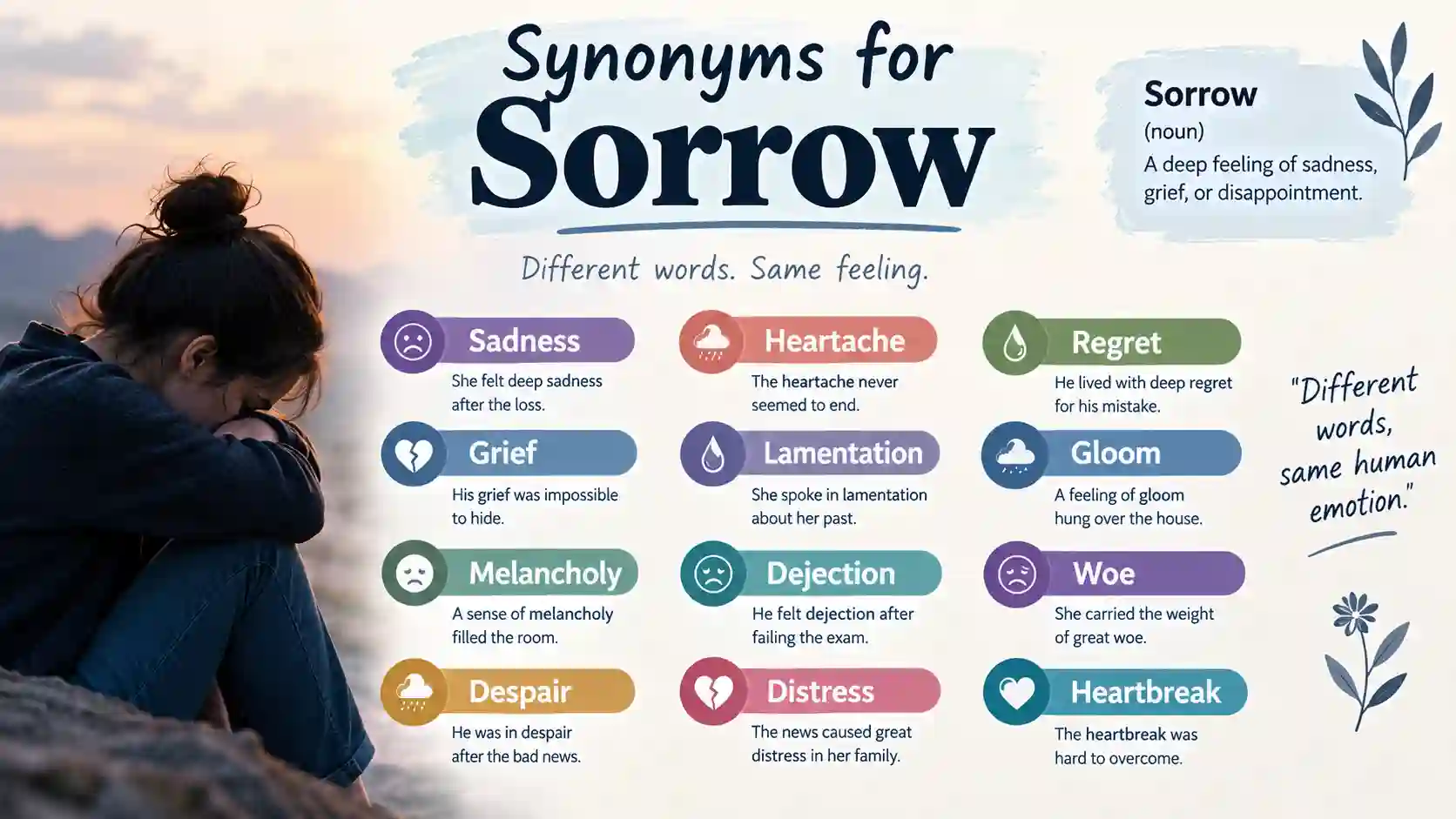
The best synonyms for sorrow include sadness, grief, unhappiness, misery, heartache, anguish, distress, despair, melancholy, and woe. Each word has a slightly different meaning. Use sadness for a general unhappy feeling, grief for deep loss, regret for a past mistake, and anguish for severe emotional pain.
What Does Sorrow Mean?
Sorrow is a feeling of sadness or emotional pain. It can follow a death, a personal loss, a disappointment, or a difficult experience. It may last a short time or remain for much longer.
For example, a student may feel disappointment after failing an exam. Someone who loses a loved one may experience grief. A writer may use melancholy to describe a quiet, thoughtful sadness.
Learning synonyms for sorrow helps you express these feelings more clearly. It also makes your essays, stories, emails, and conversations more natural.
Pronunciation and Word Origin
- Pronunciation: /ˈsɑːroʊ/ in a common American pronunciation; /ˈsɒrəʊ/ in standard British pronunciation.
- Syllables: Two, sor-row.
- Part of speech: Mainly a noun.
- Word family: Sorrowful, sorrowfully, sorrowing, sorrowfulness.
Sorrow comes from Old English forms such as sorg and sorh, which referred to grief, worry, or trouble. The word has Germanic relatives, including German Sorge. Historical dictionary records trace its use back to Old English, though the earliest surviving record is not necessarily the date of its first use.
Etymology, Origin & Meaning+1
30 Synonyms for Sorrow With Meanings and Examples
The list below focuses on useful words, not just the largest possible number. The register and frequency labels are practical guidance rather than official ratings.
| Word | Main meaning | Register | General frequency |
| 1. Sadness | General unhappiness | Neutral | Very common |
| 2. Grief | Deep sadness after a loss | Neutral | Very common |
| 3. Misery | Great or lasting unhappiness | Neutral | Common |
| 4. Unhappiness | Lack of happiness | Neutral | Common |
| 5. Heartache | Deep personal emotional pain | Emotional | Common |
| 6. Anguish | Severe mental or emotional pain | Formal | Common |
| 7. Distress | Suffering, worry, or upset | Formal | Very common |
| 8. Despair | Sadness with little hope | Formal/literary | Common |
| 9. Woe | Sorrow or serious trouble | Literary | Less common |
| 10. Melancholy | Quiet or reflective sadness | Literary | Common |
| 11. Dejection | Sadness after a setback | Formal | Less common |
| 12. Gloom | A sad mood or atmosphere | Neutral | Common |
| 13. Disappointment | Sadness over unmet hopes | Neutral | Very common |
| 14. Regret | Sadness about a past choice | Neutral | Very common |
| 15. Pain | Physical or emotional hurt | Neutral | Very common |
| 16. Suffering | Serious or ongoing distress | Neutral/formal | Very common |
| 17. Agony | Extreme pain | Neutral/dramatic | Common |
| 18. Despondency | Loss of hope or confidence | Formal | Less common |
| 19. Heartbreak | Intense emotional pain after loss | Emotional | Common |
| 20. Dismay | Upset or alarm | Neutral/formal | Common |
| 21. Desolation | Extreme sadness or emptiness | Literary | Less common |
| 22. Ruefulness | Regret mixed with sadness | Literary | Less common |
| 23. Sorrowfulness | The quality of being sorrowful | Literary | Rare |
| 24. Affliction | A cause or state of serious suffering | Formal | Common |
| 25. Tribulation | A serious trial or hardship | Formal/literary | Less common |
| 26. Trouble | Difficulty or a cause of worry | Neutral | Very common |
| 27. Misfortune | An unlucky or harmful event | Neutral | Common |
| 28. Wretchedness | A state of great misery | Literary | Less common |
| 29. Torment | Severe, often ongoing mental or physical pain | Strong | Common |
| 30. Remorse | Deep regret for wrongdoing | Neutral/formal | Common |
Important: Words such as affliction, tribulation, trouble, and misfortune often name the cause of sorrow rather than the emotion itself. They are related alternatives, not exact replacements in every sentence.
Detailed Synonyms: Meanings, Examples, and Usage
1. Sadness
Sadness is the general feeling of being unhappy. It is the safest everyday alternative to sorrow.
- Example: A feeling of sadness came over Leo as he packed his books.
- Example: She noticed sadness in her friend’s voice.
Best for: Everyday speech, schoolwork, and simple writing.
Collocations: deep sadness, feeling of sadness, sadness and joy.
Avoid when: You need to express a specific kind of loss or intense pain.
2. Grief
Grief is deep sadness, especially after someone’s death or a major loss.
- Example: The family supported one another through their grief.
- Example: He needed time to process his grief after losing his home.
Best for: Bereavement and serious personal loss.
Collocations: deep grief, grief support, cope with grief.
Avoid when: The feeling is only mild disappointment.
3. Misery
Misery is great unhappiness or suffering, often over a period of time.
- Example: The long illness brought misery to the household.
- Example: She wanted to help her friend escape a life of misery.
Best for: Ongoing unhappiness or difficult conditions.
Collocations: live in misery, sheer misery, misery and suffering.
Avoid when: You mean a brief or mild sad feeling.
4. Unhappiness
Unhappiness means not feeling happy or satisfied.
- Example: He spoke openly about his unhappiness at work.
- Example: Their unhappiness grew as their problems remained unsolved.
Best for: General dissatisfaction or low spirits.
Collocations: personal unhappiness, deep unhappiness, cause of unhappiness.
Avoid when: A more exact word such as grief or regret fits the cause.
5. Heartache
Heartache is deep emotional pain caused by loss, separation, or personal problems.
- Example: Moving away from her closest friends caused heartache.
- Example: The song reminded him of the heartache of an old relationship.
Best for: Personal and relationship-related pain.
Collocations: deep heartache, years of heartache, pain and heartache.
Avoid when: You need a strictly clinical or technical term.
6. Anguish
Anguish is severe emotional or mental pain.
- Example: The family waited in anguish for news of the missing child.
- Example: She spoke with anguish about the unfair decision.
Best for: Intense distress.
Collocations: mental anguish, deep anguish, cry of anguish.
Avoid when: You are describing ordinary disappointment.
7. Distress
Distress is suffering, worry, or emotional upset.
- Example: The sudden change caused distress among the residents.
- Example: He offered help when he noticed her distress.
Best for: Situations involving worry, upset, or difficulty.
Collocations: emotional distress, severe distress, cause distress.
Avoid when: You want to describe only a quiet, reflective mood.
8. Despair
Despair is a feeling that there is no hope.
- Example: After months without work, he began to feel despair.
- Example: The failed rescue attempt filled the crowd with despair.
Best for: Sadness linked to hopelessness.
Collocations: deep despair, fall into despair, overcome despair.
Avoid when: The person remains hopeful despite feeling sad.
9. Woe
Woe means sorrow or serious trouble. It often sounds literary or dramatic.
- Example: The old sailor told stories of woe and survival.
- Example: The report described the financial woes facing the town.
Best for: Literary writing or expressions such as financial woes.
Collocations: tales of woe, personal woes, financial woes.
Avoid when: You want simple, everyday language.
10. Melancholy
Melancholy is a quiet, thoughtful, or lasting sadness.
- Example: The empty garden gave the house a feeling of melancholy.
- Example: A slow piano melody filled her with melancholy.
Best for: Describing mood, art, music, or reflective writing.
Collocations: quiet melancholy, melancholy mood, sense of melancholy.
Avoid when: You mean sudden, overwhelming emotional pain.
11. Dejection
Dejection is sadness or low spirits after failure or disappointment.
- Example: His dejection was clear when he saw the final results.
- Example: The team tried to overcome its dejection after the loss.
Best for: Setbacks and discouragement.
Collocations: look of dejection, deep dejection, sink into dejection.
Avoid when: A simpler word like disappointment sounds more natural.
12. Gloom
Gloom describes a sad mood or an atmosphere that feels dark and unhappy.
- Example: Gloom spread through the office after the announcement.
- Example: She tried to bring some cheer into the room’s gloom.
Best for: Describing a mood or atmosphere.
Collocations: sense of gloom, gloom and doom, cast a gloom.
Avoid when: You mean grief caused by a particular death.
13. Disappointment
Disappointment is sadness caused by something not meeting your hopes.
- Example: Missing the scholarship brought real disappointment.
- Example: He hid his disappointment when the event was canceled.
Best for: Failed plans, unmet goals, and expectations.
Collocations: bitter disappointment, express disappointment, deep disappointment.
Avoid when: The main emotion is grief over a major loss.
14. Regret
Regret is sadness about something you did or did not do.
- Example: She felt regret after speaking rudely to her teacher.
- Example: He expressed regret for missing his sister’s graduation.
Best for: Past choices, mistakes, and missed chances.
Collocations: deep regret, express regret, regret a decision.
Avoid when: No past choice or action is involved.
15. Pain
Pain can describe physical hurt or emotional suffering.
- Example: The argument caused more pain than either person expected.
- Example: He shared the pain he felt after the friendship ended.
Best for: Broad descriptions of hurt.
Collocations: emotional pain, ease the pain, deep pain.
Avoid when: The sentence needs to make clear whether the pain is physical or emotional.
16. Suffering
Suffering is the experience of serious or ongoing pain and distress.
- Example: The volunteers worked to reduce the suffering of displaced families.
- Example: She kept her suffering private for many months.
Best for: Hardship, ongoing distress, and serious difficulties.
Collocations: human suffering, relieve suffering, pain and suffering.
Avoid when: You mean a small, passing disappointment.
17. Agony
Agony is extreme physical or emotional pain.
- Example: Waiting for the test results felt like agony.
- Example: He felt agony after the sudden end of his marriage.
Best for: Intense, overwhelming pain.
Collocations: in agony, mental agony, emotional agony.
Avoid when: The emotion is mild or short-lived.
18. Despondency
Despondency means losing hope or confidence and feeling very low.
- Example: Repeated failures led to despondency among the students.
- Example: Her mentor helped her move beyond despondency.
Best for: Discouragement that follows repeated setbacks.
Collocations: deep despondency, sink into despondency, overcome despondency.
Avoid when: A common word such as sadness or discouragement would be clearer.
19. Heartbreak
Heartbreak is intense emotional pain, often caused by separation or loss.
- Example: The sudden breakup left him with heartbreak.
- Example: The family faced heartbreak after their beloved pet died.
Best for: Relationship endings and personal loss.
Collocations: suffer heartbreak, experience heartbreak, heartbreak and loss.
Avoid when: You want to describe routine frustration.
20. Dismay
Dismay is upset or alarm caused by something unexpected or unpleasant.
- Example: To her dismay, the application had been rejected.
- Example: The sudden closure caused dismay among local families.
Best for: Unwelcome surprises and bad news.
Collocations: to my dismay, express dismay, widespread dismay.
Avoid when: You mean deep, lasting grief.
21. Desolation
Desolation is extreme sadness or a feeling of emptiness and loss.
- Example: He felt desolation when he returned to his childhood home.
- Example: The deserted street gave the scene an air of desolation.
Best for: Literary descriptions of profound loss or emptiness.
Collocations: utter desolation, sense of desolation, emotional desolation.
Avoid when: You want to describe a small setback.
22. Ruefulness
Ruefulness is regret mixed with sadness, often shown by a rueful smile or expression.
- Example: He gave a rueful smile when he recalled his mistake.
- Example: Her ruefulness showed that she wished she had chosen differently.
Best for: Reflective writing about past mistakes.
Collocations: rueful smile, rueful expression, look back ruefully.
Avoid when: You need a common word for intense grief.
23. Sorrowfulness
Sorrowfulness is the quality of being full of sorrow.
- Example: The sorrowfulness in the singer’s voice moved the audience.
- Example: The story’s sorrowfulness stayed with me after I finished it.
Best for: Literary descriptions.
Collocations: tone of sorrowfulness, quiet sorrowfulness.
Avoid when: Sadness or sorrow can express the idea more naturally.
24. Affliction
Affliction is serious suffering or something that causes it.
- Example: The family faced many hardships while dealing with the affliction.
- Example: The illness became a source of sorrow for everyone involved.
Best for: Serious troubles, especially those that cause suffering.
Collocations: serious affliction, source of affliction, suffer an affliction.
Avoid when: You mean the emotion alone rather than its cause.
25. Tribulation
Tribulation means a serious difficulty or a period of hardship.
- Example: The community stayed united through years of tribulation.
- Example: She wrote about the tribulations of starting a new life.
Best for: Difficult experiences or a series of trials.
Collocations: trials and tribulations, endure tribulation, times of tribulation.
Avoid when: You need a direct word for sadness.
26. Trouble
Trouble is a problem, difficulty, or cause of worry.
- Example: Financial trouble brought stress and sadness to the family.
- Example: He shared his troubles with a trusted friend.
Best for: Everyday difficulties that may cause sorrow.
Collocations: personal trouble, financial trouble, cause trouble.
Avoid when: You mean the emotion itself rather than the problem behind it.
27. Misfortune
Misfortune is an unlucky or harmful event.
- Example: After several misfortunes, the family began again.
- Example: She offered support after his sudden misfortune.
Best for: An unfortunate event that may cause sadness.
Collocations: suffer a misfortune, personal misfortune, a stroke of misfortune.
Avoid when: You need a word for the feeling, not the event.
28. Wretchedness
Wretchedness is a state of extreme misery or unhappiness.
- Example: The novel describes the wretchedness of life during the war.
- Example: He wanted to escape the wretchedness of his situation.
Best for: Strong literary descriptions of suffering.
Collocations: utter wretchedness, live in wretchedness, state of wretchedness.
Avoid when: You need a mild or neutral description.
29. Torment
Torment is severe physical or mental suffering, often lasting or repeated.
- Example: The unanswered questions became a source of torment.
- Example: She endured the torment of not knowing what had happened.
Best for: Pain that feels relentless or difficult to escape.
Collocations: mental torment, cause torment, suffer torment.
Avoid when: The feeling is a brief moment of sadness.
30. Remorse
Remorse is deep regret and guilt about something wrong you have done.
- Example: He felt remorse after realizing how badly he had hurt his friend.
- Example: Her sincere remorse led her to make amends.
Best for: Sadness tied to guilt or wrongdoing.
Collocations: deep remorse, feel remorse, show remorse.
Avoid when: You are sad about a loss that was not caused by your own actions.
Strongest Synonyms, Strong Synonyms, and Related Words
The right word depends on the cause of the feeling, not only its intensity.
Strong emotional pain: anguish, agony, torment, heartbreak, grief, despair.
General or lasting sadness: sadness, misery, unhappiness, melancholy, gloom, dejection.
Sadness caused by an event: disappointment, regret, dismay, remorse.
Related hardships or causes: affliction, tribulation, trouble, misfortune.
Literary alternatives: woe, desolation, ruefulness, sorrowfulness, wretchedness.
Commonly Confused Words
| Word | Main difference | Example |
| Sorrow | Broad emotional sadness | She expressed sorrow over the loss. |
| Grief | Deep sadness following a major loss | He struggled with grief after his death. |
| Regret | Sadness about a past choice | She regretted missing the ceremony. |
| Remorse | Regret and guilt about wrongdoing | He felt remorse for lying. |
| Melancholy | Quiet or reflective sadness | A sense of melancholy filled the room. |
Grammar Rules for Sorrow
Sorrow is usually an uncountable noun when it refers to an emotion.
- Correct: She felt deep sorrow.
- Correct: We share your sorrow.
- Correct: He expressed sorrow over the decision.
- Also correct: The sorrows of his early life shaped his writing.
Useful sentence patterns
- Sorrow over: She expressed sorrow over the loss.
- Sorrow at: He felt sorrow at the news.
- Sorrow for: We felt sorrow for the family.
- A source of sorrow: The conflict remained a source of sorrow.
- Sorrowful + noun: She gave a sorrowful smile.
Sorrow can also be a verb, but this use is uncommon in everyday English. Most speakers prefer to grieve, mourn, or feel sad.
Common Mistakes to Avoid
Mistake 1: Using “a sorrow” for a general emotion
- Incorrect: She felt sorrow after the news.
- Better: She felt sorrow after the news.
General emotional sorrow is normally uncountable, although a sorrow can occur when referring to a particular cause of sadness.
Mistake 2: Confusing regret and remorse
- Example: I regret missing the train.
- Example: I feel remorse for cheating my friend.
Regret does not always involve wrongdoing. Remorse usually includes guilt about an action.
Mistake 3: Calling every sad feeling depression
Depression can refer to a clinical mental health condition. Use sadness, disappointment, or low spirits when that is what you mean. Do not use a synonym as a medical diagnosis.
Mistake 4: Using literary words in everyday conversation
“I am experiencing desolation” sounds much more formal than “I feel deeply sad.” Choose words that match your audience and situation.
American vs. British English
Sorrow has the same spelling and core meaning in American and British English. Pronunciation differs by accent, but the word itself does not have a standard US-versus-UK spelling variation.
| Feature | American English | British English |
| Spelling | Sorrow | Sorrow |
| Broad pronunciation | /ˈsɑːroʊ/ or /ˈsɔːroʊ/ | /ˈsɒrəʊ/ |
| Formal expression | Express deep sorrow | Express deep sorrow |
| Everyday alternative | Sadness, grief | Sadness, grief |
Related Vocabulary
Antonyms of sorrow
- Joy: great happiness.
- Gladness: a feeling of happiness.
- Delight: great pleasure.
- Contentment: satisfaction with your situation.
- Cheerfulness: a positive, happy mood.
- Hopefulness: a feeling that good things may happen.
- Relief: comfort after worry or difficulty ends.
Related expressions
- A heavy heart: a feeling of sadness or worry.
- Down in the dumps: an informal way to say you feel unhappy.
- A shoulder to cry on: someone who offers comfort.
- Grieve for someone: feel deep sadness because of a loss.
- Drown your sorrows: try to forget sadness, often through an activity that may be unhelpful.
- A tale of woe: a story about sadness or trouble.
Word family
| Word | Part of speech | Example |
| Sorrow | Noun | She felt sorrow. |
| Sorrowful | Adjective | He gave a sorrowful look. |
| Sorrowfully | Adverb | She smiled sorrowfully. |
| Sorrowing | Verb form/adjective | The sorrowing family gathered. |
| Sorrowfulness | Noun | The poem expresses sorrowfulness. |
Writing Tips: How to Choose the Right Word
- Essays: Use grief, regret, or disappointment when you can identify the exact emotion.
- Emails: “We express our deep sorrow over your loss” suits a formal condolence message.
- Blog posts: Explain emotional differences instead of repeating sadness.
- Stories: Use melancholy for a reflective mood and anguish for severe pain.
- Social media: Simple words such as sadness and heartbreak often sound natural.
- Professional communication: Use distress for serious worry or upset and regret for an apology or an unfortunate outcome.
- Daily conversation: Choose common words first. Clear language is often more effective than an unusual synonym.
Frequently Asked Questions
1. What are the 10 best synonyms for sorrow?
Ten useful synonyms are sadness, grief, misery, unhappiness, heartache, anguish, distress, despair, melancholy, and regret. They cover different emotions, from general sadness to deep loss and hopelessness. The best word depends on what happened and how the person feels.
2. What is the closest synonym for sorrow?
Sadness is usually the closest everyday synonym because both words describe an unhappy feeling. However, grief may fit better after a death, while anguish describes severe emotional pain. The most accurate choice depends on the situation and the strength of the feeling.
3. What is a stronger word than sorrow?
Anguish, agony, and torment can express more intense emotional pain than ordinary sorrow. Despair adds a sense of hopelessness, while grief is especially suitable for deep sadness following a major loss. No single word is always stronger in every context.
4. What is the difference between sorrow and sadness?
Sadness is a broad term for feeling unhappy. Sorrow often suggests deeper emotional pain connected with loss, hardship, or disappointment. The meanings overlap, so either word may work in many sentences. Sadness is usually the simpler choice in everyday conversation.
5. What is a formal synonym for sorrow?
Anguish, distress, and despondency can suit formal writing, depending on the meaning. Use anguish for severe emotional pain, distress for suffering or worry, and despondency for a loss of hope. In formal condolence messages, deep sorrow is also natural.
6. What is the opposite of sorrow?
Common antonyms include joy, happiness, gladness, delight, and cheerfulness. Joy suggests strong happiness, while contentment means feeling satisfied and at ease. Choose the opposite that fits the sentence rather than replacing sorrow with a word that has a different meaning.
7. Is grief the same as sorrow?
Grief is a type of sorrow, often linked to death or a major loss. Sorrow is broader and can also describe sadness caused by disappointment or hardship. For example, a person may feel sorrow about a canceled plan, but grief is more suitable after losing a loved one.
8. Can I use sorrow in academic writing?
Yes. Sorrow works in academic writing about literature, history, psychology, or human experience. Choose a more specific term when the context calls for it. For example, bereavement describes loss through death, while emotional distress may suit a discussion of psychological suffering.
Vocabulary Quiz
Choose the best answer for each question.
1. Which word best describes sadness after someone’s death?
A. Dismay
B. Grief
C. Regret
D. Gloom
2. Which word includes guilt about wrongdoing?
A. Melancholy
B. Misfortune
C. Remorse
D. Disappointment
3. Which word describes sadness about an unmet expectation?
A. Disappointment
B. Bereavement
C. Torment
D. Desolation
4. Which word suggests a quiet, reflective sadness?
A. Agony
B. Tribulation
C. Melancholy
D. Anguish
5. Which word means losing hope?
A. Contentment
B. Despair
C. Delight
D. Ruefulness
Try again
Conclusion
Learning synonyms for sorrow helps you express emotions with greater accuracy. Words such as sadness, grief, anguish, regret, and melancholy each have a distinct purpose.
Practice these differences in your writing, conversations, essays, and emails. Start with familiar words, then explore more advanced vocabulary as your confidence grows.
The best word is not the rarest one. It is the one that expresses your meaning clearly.
References
- Cambridge Dictionary: Sorrow synonyms and antonyms.
Cambridge English - Merriam-Webster: Dictionary and thesaurus.
- Collins Dictionary: Sorrow synonyms and usage.
Collins English Thesaurus - Thesaurus.com: Sorrow synonyms and antonyms.
thesaurus.com - Online Etymology Dictionary: History of the word sorrow.
Etymology, Origin & Meaning

Synonorm is a trusted English vocabulary resource created to help readers find the right words and understand the differences between similar terms. We provide clear explanations of synonyms, meanings, examples, usage, and alternatives. Our content makes vocabulary easier to learn and apply in everyday, academic, and professional English. Synonorm is designed for students, writers, ESL learners, professionals, and anyone who wants to improve their English vocabulary and communicate more clearly.