What Are Synonyms for Protection?
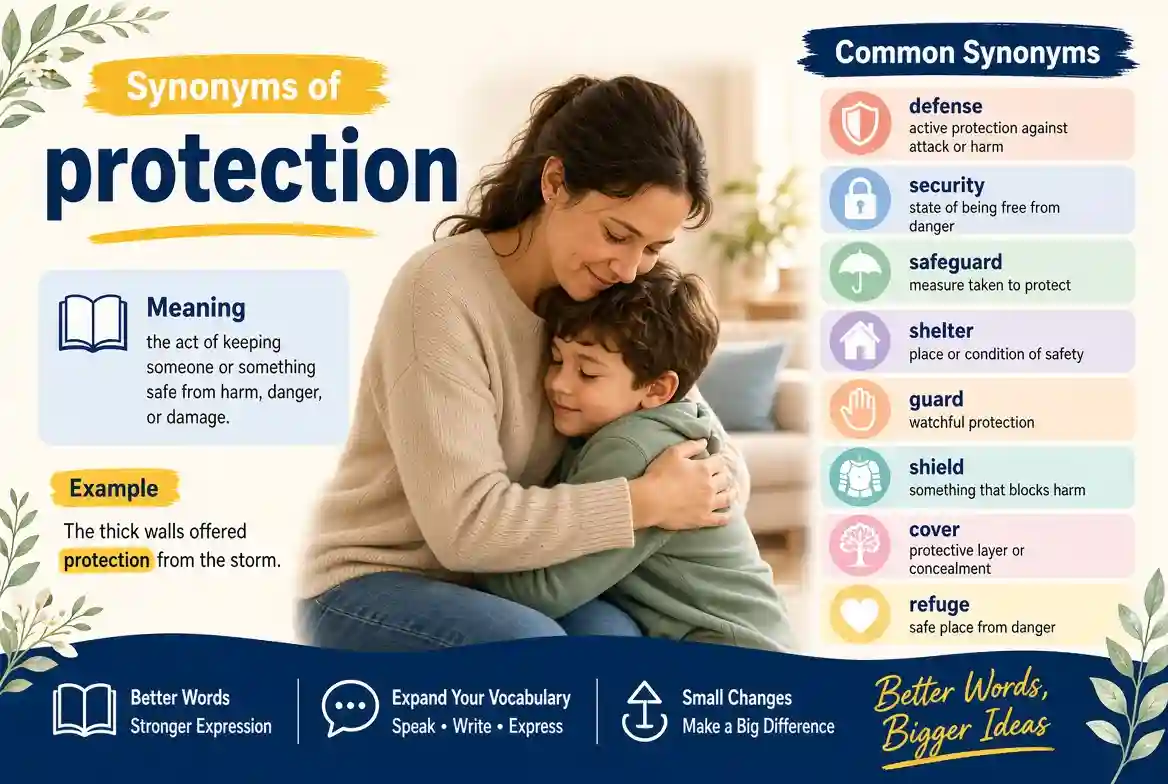
Synonyms for protection include safety, security, defense, safeguard, shield, shelter, and preservation. These words describe ways to keep people, property, rights, or resources safe from harm. However, each word has a different use. Safety describes freedom from danger, while a safeguard is a measure that helps prevent harm.
What word should you use when you want to explain how a law protects workers, a helmet reduces injuries, or a security system prevents theft? The word protection fits all three situations, but a more precise synonym can make your writing clearer.
Learning synonyms for protection helps you avoid repetition and express ideas more accurately. Students can use these words in essays, writers can improve their descriptions, and professionals can communicate risks and safety measures more clearly.
For example, a helmet provides protection, a security camera helps improve security, and a safe building offers shelter during a storm.
This guide explains 30 useful alternatives, their meanings, original examples, common collocations, and the differences that matter most. It also includes grammar advice, American and British spelling, vocabulary practice, and a quiz to help you choose the right word.
Pronunciation of Protection
- IPA: /prəˈtek.ʃən/
- Pronunciation: pruh-TEK-shuhn
- Syllables: Three
- Part of speech: Noun
- Word stress: Second syllable
Part of Speech and Word Family
| Word | Part of speech | Example |
| Protection | Noun | The helmet provides protection. |
| Protect | Verb | Protect your personal information. |
| Protective | Adjective | Wear protective clothing. |
| Protected | Adjective | The files are password-protected. |
| Protector | Noun | The guard acted as a protector. |
| Protectively | Adverb | She stood protectively beside the child. |
Grammar Rules for Protection
Use these common patterns:
- Protection from: Protection from the cold is important.
- Protection against: The system offers protection against theft.
- Protection for: The law provides protection for workers.
- Under the protection of: The family lived under the protection of a local organization.
- Provide protection: The equipment provides protection against heat.
Protection is usually an uncountable noun when it refers to the general idea of keeping something safe. Say “The equipment provides protection,” rather than “The equipment provides protection.”
However, you can use countable expressions such as “a form of protection,” “an extra layer of protection,” and “several legal protections.”
Quick Comparison: 30 Synonyms for Protection
| Synonym | Main meaning | Register |
| 1. Safety | Freedom from danger | Everyday |
| 2. Security | Safety from threats | Everyday / Business |
| 3. Defense | Resistance to an attack | General / Technical |
| 4. Safeguard | A measure that reduces risk | Formal |
| 5. Shield | Something that blocks harm | General |
| 6. Shelter | A protected place or covering | Everyday |
| 7. Guard | A person or thing that protects | General |
| 8. Cover | A covering or insurance protection | General / Business |
| 9. Preservation | Keeping something from damage | Academic |
| 10. Safekeeping | Keeping something secure | General / Formal |
| 11. Safeguarding | The process of preventing harm | Professional |
| 12. Care | Responsible attention | Everyday |
| 13. Refuge | A safe place away from danger | General |
| 14. Sanctuary | A protected place | Formal / Literary |
| 15. Barrier | Something that blocks a threat | General / Technical |
| 16. Buffer | Something that reduces an impact | Business / Technical |
| 17. Insurance | Financial protection against specified losses | Business |
| 18. Coverage | What a policy or service includes | Business |
| 19. Immunity | Resistance to a specific effect or legal process | Academic |
| 20. Guardianship | Legal responsibility for someone’s care | Legal |
| 21. Custody | Care, control, or legal responsibility | Legal |
| 22. Conservation | Careful management of resources | Academic |
| 23. Support | Help that strengthens or assists | Everyday |
| 24. Aid | Help for someone in need | General |
| 25. Assistance | Practical or professional help | Formal |
| 26. Defense system | Coordinated measures against threats | Technical |
| 27. Precaution | An action taken to reduce risk | General |
| 28. Prevention | Stopping a problem before it occurs | Professional |
| 29. Armor | Protective covering | General / Technical |
| 30. Bulwark | A strong defense | Literary / Formal |
These are context-based alternatives, not interchangeable words. Choose one that preserves the original meaning.
30 Synonyms for Protection: Meanings, Examples, and Explanations
1. Safety
Meaning: Safety means being free from danger or injury.
Examples:
- The school checks its buses to improve student safety.
- Wearing a helmet improves safety while cycling.
Best used when: Discussing freedom from accidents, injury, or danger.
Register: Neutral. Frequency: Very common. CEFR: A2, approximately.
Common collocations: public safety, workplace safety, safety rules.
When not to use it: Do not use safety when you specifically mean financial compensation after a loss.
2. Security
Meaning: Security means being safe from threats, crime, or loss.
Examples:
- The office improved security after a break-in.
- Strong passwords improve the security of your account.
Best used when: Discussing crime prevention, personal information, buildings, or financial stability.
Register: Business, general, and technical. Frequency: Very common. CEFR: B1, approximately.
Common collocations: data security, national security, security measures.
Nuance: Safety describes a condition, while security often involves measures taken to prevent threats.
3. Defense (Defence in British English)
Meaning: Defense is action taken to resist an attack or threat.
Examples:
- The town strengthened its defense against invasion.
- The software provides a defense against harmful files.
Best used when: Describing resistance to an attack, accusation, or threat.
Register: General, legal, and technical. Frequency: Very common. CEFR: B1, approximately.
Common collocations: national defense, legal defense, defense system.
Nuance: Defense is more active than general protection because it emphasizes resisting a threat.
4. Safeguard
Meaning: A safeguard is a measure that helps prevent harm.
Examples:
- The school introduced safeguards for children’s online activities.
- Regular backups provide a safeguard against data loss.
Best used when: Referring to a rule, process, or measure that reduces risk.
Register: Formal and professional. Frequency: Common. CEFR: B2, approximately.
Common collocations: legal safeguards, safeguards against fraud, protective safeguards.
Nuance: A safeguard is often a specific action or feature rather than protection in general.
5. Shield
Meaning: A shield is something that blocks or reduces harmful effects.
Examples:
- The thick gloves acted as a shield against the cold.
- The manager shielded the team from unnecessary distractions.
Best used when: Describing something that blocks a threat or harmful influence.
Register: General and sometimes literary. Frequency: Very common. CEFR: B1, approximately.
Common collocations: shield against criticism, protective shield, shield from harm.
Nuance: A shield can be a physical object or a figurative form of defense.
6. Shelter
Meaning: Shelter is a place or covering that protects people from danger or bad weather.
Examples:
- The hikers found shelter during the storm.
- The charity provides shelter for families in need.
Best used when: Discussing housing, emergencies, weather, or a safe place.
Register: Everyday. Frequency: Very common. CEFR: A2, approximately.
Common collocations: emergency shelter, seek shelter, food and shelter.
Nuance: Shelter usually emphasizes a safe place or physical covering.
7. Guard
Meaning: A guard is a person or thing that watches over something to keep it safe.
Examples:
- A guard watched the entrance to the museum.
- The machine has a safety guard to prevent contact with moving parts.
Best used when: Describing a person, device, or measure that prevents access or harm.
Register: General. Frequency: Very common. CEFR: A2, approximately.
Common collocations: security guard, safety guard, guard against damage.
Nuance: Guard can also be a verb: “Guard your personal information.”
8. Cover
Meaning: Cover is something that protects, hides, or provides insurance for a particular risk.
Examples:
- The tent gave us cover from the rain.
- Her policy includes cover for lost luggage.
Best used when: Discussing a physical covering or insurance.
Register: General and business. Frequency: Very common. CEFR: A2, approximately.
Common collocations: insurance cover, protective cover, cover from rain.
Nuance: Cover is common in British insurance language. American English often uses coverage.
9. Preservation
Meaning: Preservation means keeping something safe from damage, loss, or change.
Examples:
- The archive focuses on the preservation of old letters.
- The project supports the preservation of historic buildings.
Best used when: Discussing heritage, records, culture, or valuable objects.
Register: Academic and formal. Frequency: Common. CEFR: B2, approximately.
Common collocations: historic preservation, cultural preservation, preservation of records.
Nuance: Preservation focuses on keeping something in good condition rather than resisting a direct attack.
10. Safekeeping
Meaning: Safekeeping means keeping something safe and secure.
Examples:
- She left the original documents with her lawyer for safekeeping.
- The museum stored the fragile painting in a secure room for safekeeping.
Best used when: Talking about valuables, documents, or belongings entrusted to someone.
Register: General and formal. Frequency: Common. CEFR: B2, approximately.
Common collocations: keep in safekeeping, place in safekeeping, documents for safekeeping.
Nuance: Safekeeping emphasizes responsible care of something that could be lost, stolen, or damaged.
11. Safeguarding
Meaning: Safeguarding is the process of protecting people, rights, or interests from harm.
Examples:
- The organization trains staff in safeguarding children.
- Safeguarding private information is part of the company’s policy.
Best used when: Discussing child welfare, rights, privacy, or professional duties.
Register: Professional and formal. Frequency: Common in specialist settings. CEFR: C1, approximately.
Common collocations: child safeguarding, safeguarding procedures, safeguarding rights.
Nuance: Safeguarding often describes an ongoing process rather than a single measure.
12. Care
Meaning: Care means looking after someone or something responsibly.
Examples:
- The nurse took care of the injured patient.
- Careful storage protects the documents from moisture.
Best used when: Protection comes through attention, kindness, or supervision.
Register: Everyday. Frequency: Very common. CEFR: A1, approximately.
Common collocations: take care of, duty of care, under someone’s care.
Nuance: Care includes attention and support, so it is not always a direct substitute for protection.
13. Refuge
Meaning: Refuge is a safe place or condition away from danger.
Examples:
- The family found refuge in a nearby village.
- The quiet library became a refuge from the noise outside.
Best used when: Someone needs to escape danger, conflict, or distress.
Register: General and literary. Frequency: Common. CEFR: B2, approximately.
Common collocations: seek refuge, find refuge, take refuge in.
Nuance: Refuge emphasizes escaping a threat and reaching safety.
14. Sanctuary
Meaning: A sanctuary is a place where people or animals can find safety.
Examples:
- The wildlife sanctuary protects injured birds.
- The community center offered sanctuary to displaced families.
Best used when: Describing a protected place, refuge, or place of peace.
Register: Formal and literary. Frequency: Common. CEFR: B2, approximately.
Common collocations: wildlife sanctuary, seek sanctuary, sanctuary for refugees.
Nuance: Sanctuary often suggests a special place of safety or peace.
15. Barrier
Meaning: A barrier is something that blocks movement or prevents contact.
Examples:
- A barrier kept visitors away from the damaged bridge.
- The filter creates a barrier against dust.
Best used when: A physical or figurative obstacle blocks a threat.
Register: General and technical. Frequency: Very common. CEFR: B1, approximately.
Common collocations: protective barrier, safety barrier, barrier against infection.
Nuance: A barrier blocks or limits access but does not always guarantee safety.
16. Buffer
Meaning: A buffer is something that reduces the impact of a harmful force or change.
Examples:
- Trees provide a buffer against strong winds.
- Emergency savings offer a buffer during unemployment.
Best used when: Something softens a shock or reduces the effect of a problem.
Register: Business and technical. Frequency: Common. CEFR: B2, approximately.
Common collocations: financial buffer, buffer against risk, protective buffer.
Nuance: A buffer reduces the impact of a problem rather than necessarily stopping it.
17. Insurance
Meaning: Insurance is an arrangement that provides financial help when a covered loss occurs.
Examples:
- Home insurance can cover certain types of storm damage.
- The business purchased insurance for its delivery vehicles.
Best used when: Discussing financial risks, property, travel, or liability.
Register: Business. Frequency: Very common. CEFR: B1, approximately.
Common collocations: health insurance, insurance policy, insurance coverage.
Nuance: Insurance is a specific financial form of protection, not a guarantee that harm will never happen.
18. Coverage
Meaning: Coverage is the extent to which a policy or service includes protection.
Examples:
- The policy provides coverage for certain storm damage.
- The security plan covers every entrance to the building.
Best used when: Discussing insurance, security plans, or the reach of a service.
Register: Business and technical. Frequency: Common. CEFR: B2, approximately.
Common collocations: insurance coverage, coverage limits, coverage for damage.
Nuance: Coverage describes what is included, not necessarily how strong the protection is.
19. Immunity
Meaning: Immunity is resistance to a particular disease, effect, or legal process.
Examples:
- The vaccine helps the body develop immunity to a disease.
- The law grants limited immunity in specific circumstances.
Best used when: Discussing biology, medicine, or legal exemptions.
Register: Academic and legal. Frequency: Common. CEFR: B2, approximately.
Common collocations: immunity to disease, legal immunity, immune system.
Nuance: Immunity is a specific form of resistance, not a general synonym for every kind of protection.
20. Guardianship
Meaning: Guardianship is the legal responsibility to care for and protect someone.
Examples:
- The court reviewed the child’s guardianship arrangements.
- The agreement established guardianship for the adult who needed assistance.
Best used when: Discussing legal responsibility for someone who needs care.
Register: Legal and formal. Frequency: Uncommon outside specialist contexts. CEFR: C1, approximately.
Common collocations: legal guardianship, guardianship arrangements, grant guardianship.
Nuance: Guardianship involves legal responsibility and authority, not simply keeping someone safe.
21. Custody
Meaning: Custody is the care, control, or legal responsibility for a person or object.
Examples:
- The court decided who would have custody of the child.
- The curator kept the rare documents in secure custody.
Best used when: Referring to legal care, control, or the keeping of valuable items.
Register: Legal and formal. Frequency: Common. CEFR: B2, approximately.
Common collocations: child custody, police custody, take into custody.
Nuance: Custody can involve control or detention, so it does not always mean welcome or voluntary protection.
22. Conservation
Meaning: Conservation means protecting natural resources or valuable things from loss or damage.
Examples:
- The project supports the conservation of endangered species.
- Water conservation helps communities prepare for dry seasons.
Best used when: Discussing nature, energy, historic sites, or limited resources.
Register: Academic and formal. Frequency: Common. CEFR: B2, approximately.
Common collocations: wildlife conservation, energy conservation, conservation efforts.
Nuance: Conservation often involves careful management and responsible use of resources.
23. Support
Meaning: Support is help that makes someone or something stronger or more secure.
Examples:
- The community offered support to families affected by the flood.
- A strong frame provides support for the roof.
Best used when: Protection comes through help, resources, or structural strength.
Register: Everyday. Frequency: Very common. CEFR: A2, approximately.
Common collocations: emotional support, financial support, support system.
Nuance: Support can help protect someone, but it may not prevent harm on its own.
24. Aid
Meaning: Aid is help given to someone who needs it.
Examples:
- Emergency aid reached the village after the storm.
- The organization provides legal aid to people who cannot afford a lawyer.
Best used when: Referring to practical help, emergency assistance, or resources for people at risk.
Register: General and formal. Frequency: Very common. CEFR: B1, approximately.
Common collocations: emergency aid, humanitarian aid, financial aid.
Nuance: Aid provides help but does not necessarily prevent future harm.
25. Assistance
Meaning: Assistance is help given to someone who needs support.
Examples:
- Staff offered assistance to visitors during the evacuation.
- The program provides assistance to workers seeking legal advice.
Best used when: Describing organized, practical, or professional help.
Register: Formal and professional. Frequency: Very common. CEFR: B1, approximately.
Common collocations: technical assistance, legal assistance, emergency assistance.
Nuance: Assistance is broader than protection because it can help with tasks that involve no danger.
26. Defense System
Meaning: A defense system is a group of tools or measures designed to resist attacks or threats.
Examples:
- The facility installed a defense system to detect intruders.
- The computer uses several layers of defense against cyberattacks.
Best used when: Discussing coordinated security measures in military, technical, or organizational settings.
Register: Technical and formal. Frequency: Common in specialist settings. CEFR: B2, approximately.
Common collocations: air defense system, layered defense, defense system design.
Nuance: A defense system is more specific than general protection because it refers to coordinated measures.
27. Precaution
Meaning: A precaution is an action taken in advance to reduce the chance of harm.
Examples:
- We checked the weather as a precaution before leaving.
- The laboratory requires safety precautions when handling chemicals.
Best used when: Someone takes steps before a problem occurs.
Register: General and professional. Frequency: Very common. CEFR: B1, approximately.
Common collocations: take precautions, safety precaution, as a precaution.
Nuance: A precaution lowers risk but does not guarantee safety.
28. Prevention
Meaning: Prevention means stopping something harmful from happening.
Examples:
- Early action supports the prevention of workplace injuries.
- The campaign focuses on crime prevention in local neighborhoods.
Best used when: Describing efforts to stop a problem before it begins.
Register: Professional and academic. Frequency: Common. CEFR: B2, approximately.
Common collocations: disease prevention, crime prevention, injury prevention.
Nuance: Prevention focuses on stopping an event, while protection can also reduce harm when a threat is already present.
29. Armor (Armour in British English)
Meaning: Armor is strong material worn or placed over something to protect it from injury or attack.
Examples:
- The worker wore protective armor during the hazardous task.
- The vehicle uses reinforced armor to reduce damage from attacks.
Best used when: Discussing physical defense or using a metaphor for emotional resistance.
Register: General and technical. Frequency: Common. CEFR: B2, approximately.
Common collocations: body armor, armored vehicle, protective armor.
Nuance: Armor is a protective covering, not a general substitute for safety or security.
30. Bulwark
Meaning: A bulwark is a strong defense against danger or unwanted change.
Examples:
- Independent courts can serve as a bulwark against abuses of power.
- The coastal wall acts as a bulwark against powerful waves.
Best used when: Describing a strong defense in formal writing, political discussion, or literature.
Register: Literary and formal. Frequency: Uncommon in everyday speech. CEFR: C2, approximately.
Common collocations: bulwark against tyranny, bulwark of democracy, strong bulwark.
Nuance: Bulwark suggests strength and resistance, often in a figurative sense.
Choose the Right Synonym: Side by Side Comparisons
| Word pair | Main difference | Example |
| Safety vs. security | Safety concerns freedom from harm; security focuses on threats and measures to prevent them. | Safety rules reduce accidents; security cameras help deter theft. |
| Defense vs. safeguard | Defense resists an attack; a safeguard reduces the risk of harm. | A firewall provides defense; access controls are a safeguard. |
| Shelter vs. refuge | Shelter provides a protected place; refuge emphasizes escaping danger. | The hikers found shelter from rain and sought refuge from the wildfire. |
| Preservation vs. conservation | Preservation keeps something intact; conservation often involves careful resource management. | Preserve a historic painting; conserve water. |
| Precaution vs. prevention | A precaution reduces risk; prevention aims to stop a problem from occurring. | Wearing goggles is a precaution; preventing eye injuries is the goal. |
| Insurance vs. coverage | Insurance is a financial arrangement; coverage describes what the policy includes. | Buy home insurance; check coverage for flood damage. |
Remember: The best synonym is the one that expresses your intended meaning, not the one that sounds most complicated.
Common Mistakes With Protection Synonyms
Mistake 1: Treating every word as interchangeable
Mistake: The umbrella provided insurance from the rain.
Correction: The umbrella provided shelter from the rain.
Explanation: Insurance refers to financial protection. Shelter describes a place or covering that protects someone from weather.
Mistake 2: Treating a precaution as a guarantee
Mistake: Wearing a helmet guarantees complete safety.
Correction: Wearing a helmet can reduce the risk of head injury.
Explanation: A precaution lowers risk but cannot guarantee that harm will never occur.
Mistake 3: Using a legal term in an everyday situation
Mistake: The blanket gave the child guardianship from the cold.
Correction: The blanket protected the child from the cold.
Explanation: Guardianship describes legal responsibility for someone’s care, not a physical covering.
Mistake 4: Using the wrong preposition
Mistake: This cream provides protection from the sun.
Correction: This cream provides protection from the sun.
Explanation: Use protection from for a source of harm and protection against when emphasizing a threat or risk.
American vs. British English
The word protection has the same spelling in American and British English. However, some related words differ.
| American English | British English |
| Defense | Defence |
| Armor | Armour |
| Insurance coverage | Insurance cover is also common |
| Protective equipment | Protective equipment |
The pronunciation of protection is broadly similar in both varieties, though accents can affect the exact vowel sounds.
Writing tip: Use defense and armor for American audiences, and defence and armour for British audiences.
Word Origin and Etymology
Protection entered English through Middle English and Anglo-French or Old French forms derived from Latin protectio, meaning the act of covering or protecting. It is related to the Latin verb protegere, meaning to cover in front or protect.
The word is recorded in English from the late 13th or early 14th century, depending on the historical dictionary and the form being dated. This history helps explain why protection can refer to a covering, defense, or measure that keeps something safe.
For historical verification, consult the etymology entries in Collins Dictionary and other established historical dictionaries. Avoid assigning an exact first-use date unless the relevant source confirms it.
Related Vocabulary
Antonyms
- Danger: The possibility of harm.
- Risk: The chance that something harmful may happen.
- Threat: Something that may cause harm.
- Exposure: Being left open to a harmful influence.
- Vulnerability: The condition of being easily harmed.
- Insecurity: A lack of safety or confidence.
- Neglect: Failure to provide proper care.
- Endangerment: Putting someone or something at risk.
These words are not exact opposites in every situation. For example, risk describes the possibility of harm, while neglect describes a failure to provide needed care.
Related Expressions
- Under someone’s protection: Kept safe by another person or organization.
- A safety net: Support that helps prevent serious hardship.
- A line of defense: A measure that helps resist a threat.
- A protective measure: An action intended to reduce risk.
- A safety precaution: An action taken to avoid an accident.
- A layer of protection: One of several safeguards working together.
Frequently Asked Questions
1. What is the best synonym for protection?
The best synonym is usually safety, security, or defense, depending on your sentence. Use safety when you mean freedom from harm, security when you mean protection against threats, and defense when you mean resisting an attack. For legal rules, safeguard may be more precise.
2. What is another word for protection in an essay?
Useful alternatives include safeguarding, preservation, defense, security, and prevention. Choose the word that matches your argument. For example, write “the preservation of historic buildings” when discussing heritage, or “legal safeguards for employees” when explaining workplace rights. Accuracy matters more than complex vocabulary.
3. What is a formal word for protection?
Safeguarding, preservation, defense, and guardianship can sound formal in the right context. For example, “The policy strengthens safeguards against discrimination” suits professional writing. However, guardianship has a specific legal meaning, while preservation usually concerns keeping something safe from damage or loss.
4. What is the difference between safety and protection?
Safety describes a condition in which danger or harm is limited, while protection refers to an action, measure, or condition that keeps someone or something safe. For example, safety rules help create a safer workplace, while protective equipment provides a specific form of protection.
5. What is another word for protection against danger?
Common alternatives include defense, security, safeguard, shield, and precaution. Use defense when resisting a threat, security when preventing unauthorized access or crime, and precaution when taking steps before danger occurs. The most natural choice depends on the type of danger and the action involved.
6. What is the difference between protection and prevention?
Protection helps keep people or things safe from harm, while prevention focuses on stopping an unwanted event from happening. For example, a helmet offers protection during an accident, while road-safety education can help prevent accidents. The two ideas overlap but emphasize different goals.
7. What are some simple synonyms for protection?
Simple alternatives include safety, care, security, shelter, and cover. These words work well in everyday conversations and school assignments. For example, “The shelter gave the family safety during the storm” communicates the general idea, although “The shelter kept the family safe” sounds more natural.
8. What is the opposite of protection?
Common contrasting words include danger, risk, threat, exposure, and vulnerability. Each describes a different aspect of being unsafe. For example, danger refers to the possibility of harm, while vulnerability means being more easily harmed. Choose the opposite that fits your sentence.
Vocabulary Quiz
Choose the best answer for each question.
- Which word describes freedom from danger or injury?
- A. Insurance
- B. Safety
- C. Custody
- D. Bulwark
- Which word means a measure that helps prevent harm?
- A. Safeguard
- B. Refuge
- C. Immunity
- D. Assistance
- Which word means a safe place away from danger?
- A. Coverage
- B. Prevention
- C. Refuge
- D. Guardianship
- Which word completes this sentence: “The policy provides financial ______ for storm damage”?
- A. Shelter
- B. Guard
- C. Coverage
- D. Conservation
- Which word means taking action in advance to reduce risk?
- A. Custody
- B. Precaution
- C. Sanctuary
- D. Armor
Answer Key
- B. Safety: Safety describes being free from danger or injury.
- A. Safeguard: A safeguard is a measure that reduces risk.
- C. Refuge: A refuge is a safe place away from danger.
- C. Coverage: Coverage describes the risks or losses included in an insurance policy.
- B. Precaution: A precaution is an action taken in advance to reduce the chance of harm.
Conclusion
Learning synonyms for protection helps you express ideas more clearly in essays, emails, blog posts, and everyday conversations. Words such as safety, security, defense, safeguard, and shelter each serve a different purpose.
Focus on meaning, context, and natural usage rather than memorizing long lists. With regular practice, you can choose the right word, improve your vocabulary, and communicate with greater confidence.
References
- Cambridge Dictionary: https://dictionary.cambridge.org/
- Collins English Thesaurus: https://www.collinsdictionary.com/dictionary/english-thesaurus/protection
- Thesaurus.com: https://www.thesaurus.com/browse/protection
- Merriam-Webster: https://www.merriam-webster.com/
- Dictionary.com: https://www.dictionary.com/browse/protection

Synonorm is a trusted English vocabulary resource created to help readers find the right words and understand the differences between similar terms. We provide clear explanations of synonyms, meanings, examples, usage, and alternatives. Our content makes vocabulary easier to learn and apply in everyday, academic, and professional English. Synonorm is designed for students, writers, ESL learners, professionals, and anyone who wants to improve their English vocabulary and communicate more clearly.