Quick Answer
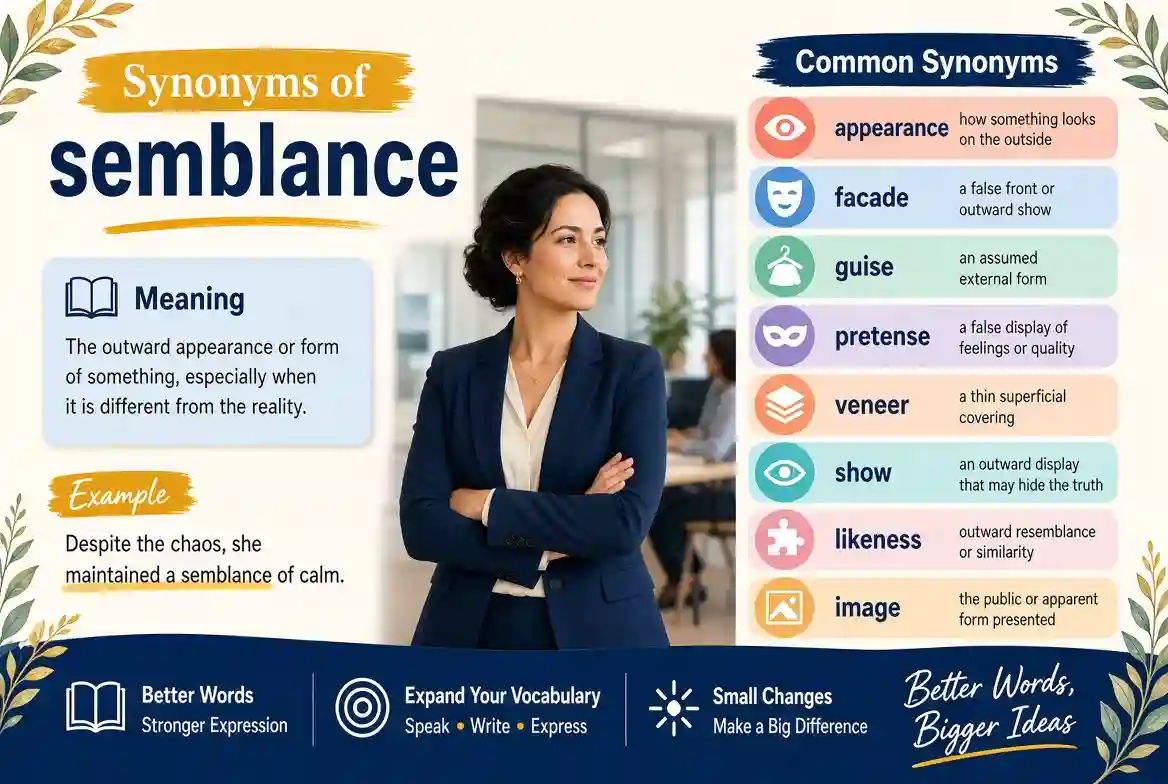
The best synonyms of semblance are appearance, show, likeness, resemblance, aspect, air, pretense, facade, veneer, and impression. The right choice depends on the meaning. Use appearance for how something seems, resemblance for likeness, and facade or pretense when an appearance hides the truth.
Have you ever seen someone act happy while feeling sad, or watched a messy room get arranged just enough to look tidy? English has a useful word for this idea: semblance. It describes an outward appearance, a likeness, or a condition that seems to exist but may not be complete or genuine.
The best synonyms of semblance depend on what you want to express. Appearance is a simple everyday alternative. Resemblance describes things that look alike. Pretense suggests pretending, while veneer describes a surface that hides something underneath.
This guide covers 30 words and related expressions, with definitions, original examples, natural collocations, and notes on when each word fits. You will also learn the word’s history, common grammar patterns, American and British usage, and the difference between close synonyms and related vocabulary. These distinctions will help you write clearly without choosing an impressive-sounding word that changes your meaning.
Pronunciation, Meaning, and Grammar
- Word: Semblance
- Part of speech: Noun
- IPA: /ˈsem.bləns/ in both British and American English
- Pronunciation: SEM-bluhns
- Register: Formal
- Common grammar pattern: a semblance of + noun
- Plural: semblances is possible, but the singular form is much more common in ordinary use.
Semblance describes how something appears or seems, especially when the appearance is incomplete or different from reality. It can also mean a likeness or representation.
Examples:
- The staff restored a semblance of order after the power outage.
- His smile gave a semblance of happiness, but he looked exhausted.
- The portrait bore a close semblance to its subject.
Common Grammar Patterns
| Pattern | Example |
| A semblance of + noun | a semblance of peace |
| Some semblance of + noun | some semblance of normality |
| Maintain a semblance of + noun | maintain a semblance of control |
| Lack any semblance of + noun | lack any semblance of fairness |
| Bear a semblance to + noun | bear a semblance to the original |
The expression “bear a resemblance to” is more idiomatic in everyday English when comparing two things. Use semblance when the focus is on appearance, a limited condition, or a quality that may not be genuine.
Oxford Learner’s Dictionaries+1
Word Origin and First Known Use
Semblance entered English in the Middle English period through Old French semblance, related to sembler, meaning “to seem” or “to appear.” Its deeper history connects to Latin similare and simulare, words associated with likeness and imitation.
The Online Etymology Dictionary records the English noun around 1300, originally referring to the act or fact of appearing. Later senses included outward form, likeness, and a false or assumed appearance.
Etymology, Origin & Meaning
30 Synonyms of Semblance With Examples and Explanations
The first group contains close alternatives. The remaining words are useful in particular contexts, but they are not all direct replacements. Frequency labels are qualitative estimates, not measured corpus rankings. CEFR levels are approximate learning guides.
1. Appearance
Meaning: The way someone or something looks or seems.
Examples:
- The room had the appearance of being clean.
- His calm appearance hid his worry.
Best used when: You need a clear, general alternative.
Tone: Neutral. CEFR: A2. Frequency: Very common.
Collocations: outward appearance, physical appearance, general appearance.
When not to use it: Choose resemblance when comparing two people or objects.
2. Resemblance
Meaning: A similarity between two people or things.
Examples:
- The cousins share a strong resemblance.
- The two designs bear a resemblance to older models.
Best used when: You want to describe shared features.
Tone: Neutral. CEFR: B2. Frequency: Common.
Collocations: striking resemblance, family resemblance, bear a resemblance to.
When not to use it: It does not usually mean a false show of confidence or peace.
3. Likeness
Meaning: The quality of looking like someone or something.
Examples:
- The artist captured her likeness in the portrait.
- There is a clear likeness between the two statues.
Best used when: Describing visual similarity.
Tone: Neutral. CEFR: B1. Frequency: Common.
Collocations: close likeness, true likeness, likeness of a person.
When not to use it: Use appearance for someone’s overall look rather than a comparison.
4. Aspect
Meaning: A particular feature or way something appears.
Examples:
- The building took on a darker aspect at night.
- The report examined every aspect of the problem.
Best used when: Referring to a visible quality or one part of a subject.
Tone: Formal. CEFR: B2. Frequency: Common.
Collocations: outward aspect, physical aspect, important aspect.
When not to use it: It does not automatically suggest that an appearance is false.
5. Show
Meaning: An outward display of a feeling, quality, or condition.
Examples:
- The manager made a show of confidence.
- Their show of unity ended after the meeting.
Best used when: Describing an outward display that may not reflect genuine feelings.
Tone: Neutral. CEFR: A2. Frequency: Very common.
Collocations: show of strength, show of support, make a show of.
When not to use it: Use likeness for visual similarity.
6. Air
Meaning: A quality or impression that someone or something seems to have.
Examples:
- The old house had an air of mystery.
- She spoke with an air of confidence.
Best used when: Describing manner, atmosphere, or an implied quality.
Tone: Neutral to literary. CEFR: B2. Frequency: Common.
Collocations: air of mystery, air of authority, air of confidence.
When not to use it: It is not a direct substitute for a physical copy.
7. Pretense
Meaning: An act of pretending that something is true when it is not.
Examples:
- He made no pretense of understanding the rules.
- Their pretense of friendship soon ended.
Best used when: The focus is on pretending or concealment.
Tone: Formal. CEFR: C1. Frequency: Common.
Collocations: under the pretense of, make no pretense, false pretense.
When not to use it: Use resemblance for genuine likeness.
8. Facade
Meaning: An outward appearance that hides a different reality.
Examples:
- The company maintained a facade of success.
- Her cheerful facade disappeared after the call.
Best used when: You want to suggest that the outside differs from the truth.
Tone: Formal. CEFR: C1. Frequency: Common.
Collocations: maintain a facade, facade of normality, false facade.
When not to use it: For an ordinary building front, facade can be literal, but that meaning differs from semblance.
9. Veneer
Meaning: A surface layer that covers something underneath.
Examples:
- A veneer of politeness hid his anger.
- The interview exposed cracks beneath the company’s veneer of stability.
Best used when: An outward quality conceals a less pleasant reality.
Tone: Formal or literary. CEFR: C1. Frequency: Common.
Collocations: veneer of respectability, thin veneer, veneer of civility.
When not to use it: Do not use it for an exact copy of an object.
10. Impression
Meaning: An idea or feeling formed from what you notice.
Examples:
- The quiet office gave an impression of order.
- His short reply created the impression that he was upset.
Best used when: Describing how something seems to an observer.
Tone: Neutral. CEFR: B1. Frequency: Very common.
Collocations: first impression, general impression, give the impression.
When not to use it: Use facade if you specifically mean an outer image that conceals the truth.
11. Look
Meaning: The way someone or something appears.
Examples:
- The new website has the look of a professional magazine.
- The tired look on his face worried his friends.
Best used when: You want a simple, everyday alternative.
Tone: Informal to neutral. CEFR: A1. Frequency: Very common.
Collocations: similar look, overall look, tired look.
When not to use it: In formal writing, appearance may be more suitable.
12. Image
Meaning: A picture or the impression that a person or organization creates.
Examples:
- The company worked to build an image of reliability.
- The mirror showed an image of the doorway.
Best used when: Discussing visual representations or public perception.
Tone: Neutral. CEFR: A2. Frequency: Very common.
Collocations: public image, mental image, image of success.
When not to use it: Use similarity when comparing shared qualities.
13. Mask
Meaning: Something that hides real feelings or intentions.
Examples:
- His confident mask slipped during the interview.
- She used humor as a mask for her sadness.
Best used when: You want a vivid metaphor for hidden emotions.
Tone: Literary. CEFR: B1. Frequency: Common.
Collocations: wear a mask, hide behind a mask, mask of confidence.
When not to use it: Avoid it for neutral similarities between objects.
14. Front
Meaning: A false outward image used to hide the truth.
Examples:
- He put on a brave front during the crisis.
- The friendly front hid the team’s internal conflict.
Best used when: Someone appears confident or friendly while hiding another reality.
Tone: Neutral. CEFR: B1. Frequency: Common.
Collocations: brave front, friendly front, put on a front.
When not to use it: Use facade for a more formal description of a misleading image.
15. Exterior
Meaning: The outside surface or outward part of something.
Examples:
- The house had a simple exterior.
- Beneath his quiet exterior, he was highly competitive.
Best used when: Contrasting outward appearance with inner qualities.
Tone: Neutral to formal. CEFR: B1. Frequency: Common.
Collocations: building exterior, calm exterior, exterior appearance.
When not to use it: It does not mean that two objects look alike.
16. Seeming
Meaning: An appearance that may not reflect reality.
Examples:
- The seeming calm ended when the alarm rang.
- Their seeming agreement hid a serious disagreement.
Best used when: You want to emphasize the gap between appearance and reality.
Tone: Formal or literary. CEFR: C1. Frequency: Uncommon.
Collocations: seeming calm, seeming agreement, seeming simplicity.
When not to use it: Appearance or apparent is often more natural in everyday English.
17. Form
Meaning: The shape, structure, or visible expression of something.
Examples:
- The event took the form of a small dinner.
- A basic form of order returned to the classroom.
Best used when: Referring to the way something is expressed or organized.
Tone: Neutral. CEFR: A2. Frequency: Very common.
Collocations: take the form of, physical form, basic form.
When not to use it: Use semblance when the key idea is an incomplete or merely apparent condition.
18. Representation
Meaning: Something that depicts, expresses, or stands for something else.
Examples:
- The painting offers a representation of village life.
- The model is a simplified representation of the system.
Best used when: Discussing art, media, diagrams, and abstract ideas.
Tone: Formal or academic. CEFR: B2. Frequency: Common.
Collocations: visual representation, accurate representation, representation of reality.
When not to use it: It does not necessarily imply deception.
19. Copy
Meaning: Something made to reproduce an original.
Examples:
- The student made a copy of the drawing.
- The office kept a copy of the signed agreement.
Best used when: Referring to reproduced documents, images, or objects.
Tone: Neutral. CEFR: A1. Frequency: Very common.
Collocations: exact copy, make a copy, copy of the original.
When not to use it: Use resemblance if two things look alike but neither was copied from the other.
20. Replica
Meaning: An object made to closely resemble another object.
Examples:
- The museum displayed a replica of an ancient ship.
- The designer built a replica of a vintage chair.
Best used when: Describing a carefully reproduced object.
Tone: Neutral to formal. CEFR: B2. Frequency: Common.
Collocations: exact replica, life-size replica, replica model.
When not to use it: It is not a natural substitute in phrases such as “a semblance of peace.”
21. Duplicate
Meaning: A second version or copy of something.
Examples:
- The office stored a duplicate of the contract.
- The database contained a duplicate entry.
Best used when: Discussing records, documents, and repeated items.
Tone: Neutral or technical. CEFR: B1. Frequency: Common.
Collocations: duplicate record, duplicate copy, exact duplicate.
When not to use it: Avoid it when you mean a false appearance or an incomplete condition.
22. Simulacrum
Meaning: An image or representation that resembles something real.
Examples:
- The artificial village was a simulacrum of rural life.
- The installation explored a digital simulacrum of a human face.
Best used when: Writing about philosophy, art, media, or imitation.
Tone: Literary or academic. CEFR: C2. Frequency: Rare.
Collocations: simulacrum of reality, digital simulacrum, artificial simulacrum.
When not to use it: Choose image or representation in ordinary writing.
23. Similitude
Meaning: A resemblance or likeness between things.
Examples:
- The poem draws a similitude between the sea and human emotion.
- The writer used similitude to connect two abstract ideas.
Best used when: A literary or specialized term for likeness fits the context.
Tone: Literary. CEFR: C2. Frequency: Rare.
Collocations: similitude between, likeness and similitude.
When not to use it: Similarity is usually clearer in modern everyday and academic English.
24. Bearing
Meaning: A person’s posture, manner, or outward way of behaving.
Examples:
- Her calm bearing reassured the team.
- The speaker’s confident bearing made the presentation more convincing.
Best used when: Describing the impression created by someone’s manner or posture.
Tone: Formal. CEFR: C1. Frequency: Common.
Collocations: calm bearing, dignified bearing, confident bearing.
When not to use it: Use appearance when discussing physical features or clothing.
25. Mien
Meaning: A person’s outward manner or expression.
Examples:
- The guest’s cheerful mien lifted the mood.
- His stern mien made the students nervous.
Best used when: Writing a literary description of someone’s expression or demeanor.
Tone: Literary. CEFR: C2. Frequency: Rare.
Collocations: cheerful mien, stern mien, troubled mien.
When not to use it: Expression or manner is usually clearer for general readers.
26. Aura
Meaning: A distinctive feeling or quality associated with a person or place.
Examples:
- The old library had an aura of mystery.
- Her award gave the project an aura of importance.
Best used when: Describing an atmosphere or quality that is hard to define.
Tone: Neutral to literary. CEFR: B2. Frequency: Common.
Collocations: aura of mystery, aura of authority, aura of confidence.
When not to use it: Use resemblance for a direct likeness between objects.
27. Illusion
Meaning: A false appearance or belief that makes something seem different from reality.
Examples:
- The lighting created the illusion of a larger room.
- Their early success gave them an illusion of security.
Best used when: You want to emphasize a misleading appearance.
Tone: Neutral. CEFR: B2. Frequency: Very common.
Collocations: optical illusion, illusion of control, create an illusion.
When not to use it: Use impression when the appearance is not necessarily false.
28. Guise
Meaning: An outward appearance or form that something takes, sometimes to conceal its real nature.
Examples:
- The scam operated under the guise of a charity.
- The rule was presented under the guise of public safety.
Best used when: Something is presented as one thing while hiding another purpose.
Tone: Formal. CEFR: C1. Frequency: Common.
Collocations: under the guise of, assume a guise, false guise.
When not to use it: Use look or appearance for a simple description without concealment.
29. Pretext
Meaning: A reason given to hide the real reason for an action.
Examples:
- He used a work meeting as a pretext to leave early.
- The invitation served as a pretext for a difficult conversation.
Best used when: The focus is on a false excuse rather than an outward look.
Tone: Formal. CEFR: C1. Frequency: Common.
Collocations: under the pretext of, use as a pretext, false pretext.
When not to use it: A pretext is a reason or excuse, not a direct synonym for physical appearance.
30. Outward Show
Meaning: A visible display that may not reflect what someone truly feels or believes.
Examples:
- Their outward show of unity hid deep disagreements.
- He made an outward show of confidence before the interview.
Best used when: You need a clear phrase for a display that may be superficial.
Tone: Neutral to formal. CEFR: B2. Frequency: Common as a phrase.
Collocations: outward show of unity, outward show of confidence, mere outward show.
When not to use it: If you need a short, natural alternative, show or appearance may be enough.
Strongest Synonyms, Strong Synonyms, and Related Words
Not every word in a thesaurus has the same meaning. Use these groups as a practical selection guide.
Strongest Synonyms
These are useful for the main meanings of semblance:
- Appearance: the way something looks or seems.
- Show: an outward display of a quality or feeling.
- Pretense: an act of pretending.
- Facade: an outward image that hides reality.
- Veneer: a surface quality that conceals something underneath.
- Likeness: a visual or general similarity.
- Resemblance: shared features between two things.
Strong Synonyms
These work well in specific contexts:
- Aspect
- Air
- Impression
- Look
- Image
- Exterior
- Seeming
- Illusion
- Guise
Related Words
These are useful alternatives only when the context supports them:
- Representation
- Replica
- Copy
- Duplicate
- Simulacrum
- Similitude
- Bearing
- Mien
- Aura
- Pretext
Choose the Right Synonym: Side by Side Comparisons
| Word | Main meaning | Example |
| Appearance | How something looks or seems | The room had the appearance of order. |
| Resemblance | Shared features | The cousins bear a resemblance to each other. |
| Similarity | Shared qualities or patterns | The study found a similarity between the results. |
| Facade | An outer image that hides reality | The company maintained a facade of success. |
| Pretense | An act of pretending | He made no pretense of understanding. |
| Veneer | A surface layer hiding something underneath | A veneer of politeness hid his anger. |
| Impression | An idea formed from what you notice | The report gave an impression of fairness. |
| Illusion | A false appearance or belief | The mirror created an illusion of space. |
| Guise | An appearance used to conceal something | The scam operated under the guise of charity. |
| Replica | A reproduced object | The museum displayed a replica of the ship. |
Quick rule: Use appearance for how something seems, resemblance for how two things look alike, facade for a misleading outer image, and pretext for a false reason.
Commonly Confused Words
| Word | Difference | Example |
| Semblance | An appearance or incomplete condition | They restored a semblance of peace. |
| Similarity | Shared features or qualities | There is a similarity between the plans. |
| Resemblance | A likeness between people or things | The child bears a resemblance to her father. |
| Pretense | Pretending that something is true | He made no pretense of being happy. |
| Facade | An outer image that hides reality | The cheerful facade hid her worries. |
Common Mistakes
Mistake 1: Using similarity to mean a false appearance
Mistake: The company maintained a similarity of success.
Correction: The company maintained a semblance of success.
Why: Similarity compares features. Semblance can describe an appearance that does not reflect the full truth.
Mistake 2: Using semblance when resemblance is more natural
Mistake: The two portraits have a semblance because they show the same person.
Correction: The two portraits show a resemblance.
Why: Resemblance is the natural choice when describing likeness between people or objects.
Mistake 3: Leaving out “of”
Mistake: The staff restored a semblance order.
Correction: The staff restored a semblance of order.
Why: The standard pattern is “a semblance of” followed by a noun.
Mistake 4: Using semblance as an adjective
Mistake: The room looked semblance.
Correction: The room had a semblance of order.
Why: Semblance is a noun. Depending on your meaning, adjectives such as apparent, similar, or superficial may work.
Mistake 5: Assuming every synonym implies deception
Mistake: The twins have a facade.
Correction: The twins have a strong resemblance.
Why: Facade often suggests a misleading outer image. It does not simply mean that two people look alike.
American vs. British English
There is no major American versus British spelling difference for semblance. Both varieties use the same spelling and broadly similar pronunciation.
| Feature | American English | British English |
| Spelling | semblance | semblance |
| IPA | /ˈsem.bləns/ | /ˈsem.bləns/ |
| Formality | Formal | Formal |
| Common phrase | a semblance of normality | a semblance of normality |
| Everyday alternative | appearance, look | appearance, look |
The spelling and core meaning remain the same. Individual accents may differ slightly in vowel quality, but the word does not have a major regional pronunciation contrast.
Related Vocabulary
Antonyms of Semblance
The best opposite depends on which sense you mean.
| Antonym | Meaning | Example |
| Reality | What actually exists | The reality differed from the public image. |
| Truth | What is factually correct | The report revealed the truth. |
| Authenticity | The quality of being genuine | The reviewer questioned the document’s authenticity. |
| Genuineness | The quality of being sincere or real | Her concern showed genuine care. |
| Dissimilarity | A lack of shared features | The study found a marked dissimilarity between the groups. |
| Difference | A state of not being the same | The difference between the designs was clear. |
Useful Expressions
- A semblance of normality: an appearance of ordinary life after a disruption.
- A semblance of control: an outward or limited impression of control.
- A semblance of order: a situation that appears somewhat organized.
- Keep up appearances: preserve a desired public image.
- Put on a brave face: act confidently despite fear or sadness.
- Appearances can be deceiving: what you see may not reflect reality.
- Under the guise of: appearing to do one thing while concealing another purpose.
Word Family
| Word | Part of speech | Meaning |
| Semblance | Noun | Outward appearance or likeness |
| Resemble | Verb | To look like or be similar to |
| Resemblance | Noun | A likeness between people or things |
| Similar | Adjective | Having features in common |
| Similarity | Noun | The state of being alike |
| Similarly | Adverb | In a similar way |
| Simulate | Verb | To imitate or reproduce a condition |
| Simulation | Noun | An imitation or model of a process |
Vocabulary Practice: Mini Exercises
Exercise 1: Fill in the blanks
Choose from resemblance, facade, appearance, illusion, and semblance.
- The twins have a strong ______ to each other.
- The company maintained a ______ of financial success.
- The lighting created the ______ of a larger room.
- The staff restored a ______ of order.
- The house has a modern ______.
Exercise 2: Rewrite the sentences
Replace the bold phrase with a suitable synonym.
- The manager maintained an outward appearance of confidence.
- The two paintings show a strong likeness.
- The company hid its problems behind a misleading outer image.
Exercise 3: Match each word to its meaning
| Word | Definition |
| 1. Veneer | A. A false reason for doing something |
| 2. Replica | B. A surface layer that hides something |
| 3. Resemblance | C. A reproduced object |
| 4. Pretext | D. Similarity between things |
Answer Key
Exercise 1: 1. resemblance, 2. facade, 3. illusion, 4. semblance, 5. appearance.
2:
- The manager maintained a facade of confidence.
- The two paintings show a strong resemblance.
- The company hid its problems behind a facade.
3: 1-B, 2-C, 3-D, 4-A.
Frequently Asked Questions About Synonyms of Semblance
1. What is the best synonym for semblance?
The best general synonym for semblance is appearance. It describes how something looks or seems. However, the best choice changes with context. Use resemblance for shared features, facade for a misleading outer image, and pretense when someone acts as though something is true.
2. What does semblance mean in simple English?
Semblance means an outward appearance, a likeness, or a condition that seems to exist. For example, “a semblance of order” means that things appear somewhat organized, even if the situation is not fully under control. The word is common in formal writing and thoughtful descriptions.
3. Is semblance a positive or negative word?
Semblance can be neutral, positive, or negative depending on the sentence. A semblance of peace may suggest progress, while a semblance of honesty may suggest a misleading appearance. The word often draws attention to a difference between how something seems and what is actually true.
4. What is the difference between semblance and resemblance?
Semblance often refers to an outward appearance or a condition that seems to exist. Resemblance describes a likeness between people or things. For example, “a semblance of calm” describes an appearance of calmness, while “a resemblance between the brothers” means they share similar features.
5. What is the opposite of semblance?
Possible antonyms include reality, truth, authenticity, and genuineness. When semblance means likeness, difference or dissimilarity may be a better opposite. Choose the antonym according to the meaning you want to contrast rather than treating one word as the universal opposite.
6. Is semblance formal or informal?
Semblance is generally a formal word. You will often see it in essays, journalism, literature, and professional writing. Common phrases include “a semblance of normality,” “a semblance of order,” and “a semblance of control.” In casual conversation, appearance, look, or seems like may sound more natural.
7. What is a good synonym for semblance in academic writing?
Useful academic alternatives include appearance, impression, resemblance, similarity, and representation. Use similarity when comparing features or findings, and representation when discussing how something is depicted. Choose a facade when the discussion specifically concerns an outward image that conceals a different reality.
8. Can semblance and similarity be used interchangeably?
No, not in every sentence. Similarity refers to shared features or qualities, while semblance can describe an incomplete or misleading appearance. For example, “a similarity between the studies” compares their findings, whereas “a semblance of normality” describes a limited return to ordinary conditions.
Conclusion
Learning the synonyms of semblance helps you describe appearances, likenesses, and misleading impressions with greater precision. Words such as appearance, resemblance, facade, pretense, and veneer overlap, but each has a distinct use.
Practice these words in essays, emails, blog posts, and daily conversations. Start with common alternatives and gradually learn the more advanced terms. Good vocabulary is not about using difficult words. It is about choosing the right word for the meaning you want to express.
References
- Oxford Learner’s Dictionaries: Semblance definition and usage.
- Cambridge Dictionary: Meaning, pronunciation, and examples.
- Cambridge Thesaurus: Synonyms and related expressions.
- Thesaurus.com: Synonyms and antonyms of semblance.
- Online Etymology Dictionary: Word origin and history.

Synonorm is a trusted English vocabulary resource created to help readers find the right words and understand the differences between similar terms. We provide clear explanations of synonyms, meanings, examples, usage, and alternatives. Our content makes vocabulary easier to learn and apply in everyday, academic, and professional English. Synonorm is designed for students, writers, ESL learners, professionals, and anyone who wants to improve their English vocabulary and communicate more clearly.