Quick Answer
The best synonyms for please depend on the sentence. Use delight, satisfy, amuse, charm, or gratify when you mean to give someone pleasure. Use wish, want, choose, or prefer when you mean doing what someone wants. For polite requests, expressions such as could you please and would you mind are often more natural.
Do you want to say please in a different way without changing your meaning? The right word can make your writing more precise and help you sound natural in English.
The word please has several uses. It can mean making someone happy, asking for something politely, or acting according to someone’s wishes. For example, “The gift pleased her” means that the gift made her happy. “Please open the door” is a polite request. “Do as you please” means to act as you wish.
These sentences need different alternatives. This guide explains 30 synonyms for please, including their meanings, examples, grammar, and tone. It also shows you when a word will not work, so you can choose confidently in essays, emails, conversations, and professional writing.
Pronunciation
- IPA: /pliːz/
- Simple pronunciation: pleez
- Syllables: One
- American and British English: The usual pronunciation is the same in both varieties.
Part of Speech and Grammar
Please have two main grammatical uses.
- Verb: It means to give pleasure or satisfaction. Example: “The result pleased her.”
- Polite request marker: It makes a request or command more courteous. Example: “Please read the instructions.”
It also appears in the expression “as you please,” where it means according to your wishes.
Related forms include pleased (feeling happy or satisfied), pleasing (giving pleasure), and pleasure (enjoyment).
Common sentence patterns
| Pattern | Example |
| Please + base verb | Please check this page. |
| Please someone | The result pleased the coach. |
| Be pleased with + noun | She was pleased with her work. |
| Be pleased to + verb | I am pleased to help. |
| As you please | Arrange the books as you please. |
| Could you please + verb? | Could you please reply today? |
Grammar reminder: Say “I am pleased with the result,” not “I am pleased with the result.”
Synonyms for Please: Overview Table
The strength label below describes how closely a word matches a particular meaning of please. The CEFR and frequency labels are approximate learner guidance, not measured rankings or official classifications for every sense.
| Word | Meaning or use | Register |
| Delight | Give great pleasure | Neutral |
| Satisfy | Meet a need or expectation | Neutral |
| Gratify | Fulfill a wish | Formal |
| Amuse | Entertain or make someone laugh | Neutral |
| Charm | Attract or please | Neutral |
| Gladden | Make happy | Literary |
| Content | Make satisfied | Formal |
| Entertain | Provide enjoyment | Neutral |
| Cheer | Lift someone’s mood | Neutral |
| Suit | Match someone’s needs | Neutral |
| Tickle | Amuse or delight | Informal |
| Enchant | Fill with wonder | Literary |
| Captivate | Hold attention | Neutral |
| Fascinate | Create strong interest | Neutral |
| Thrill | Give great excitement | Neutral |
| Elate | Make extremely happy | Formal |
| Indulge | Allow a wish or pleasure | Neutral |
| Humor / humour | Go along with someone’s wishes | Neutral |
| Oblige | Do someone a favor | Formal |
| Divert | Amuse or distract | Formal |
| Wish | Express a desire | Neutral |
| Want | Desire something | Neutral |
| Choose | Select an option | Neutral |
| Prefer | Like one option more | Neutral |
| Desire | Want something strongly | Formal |
| Opt | Choose an option | Formal |
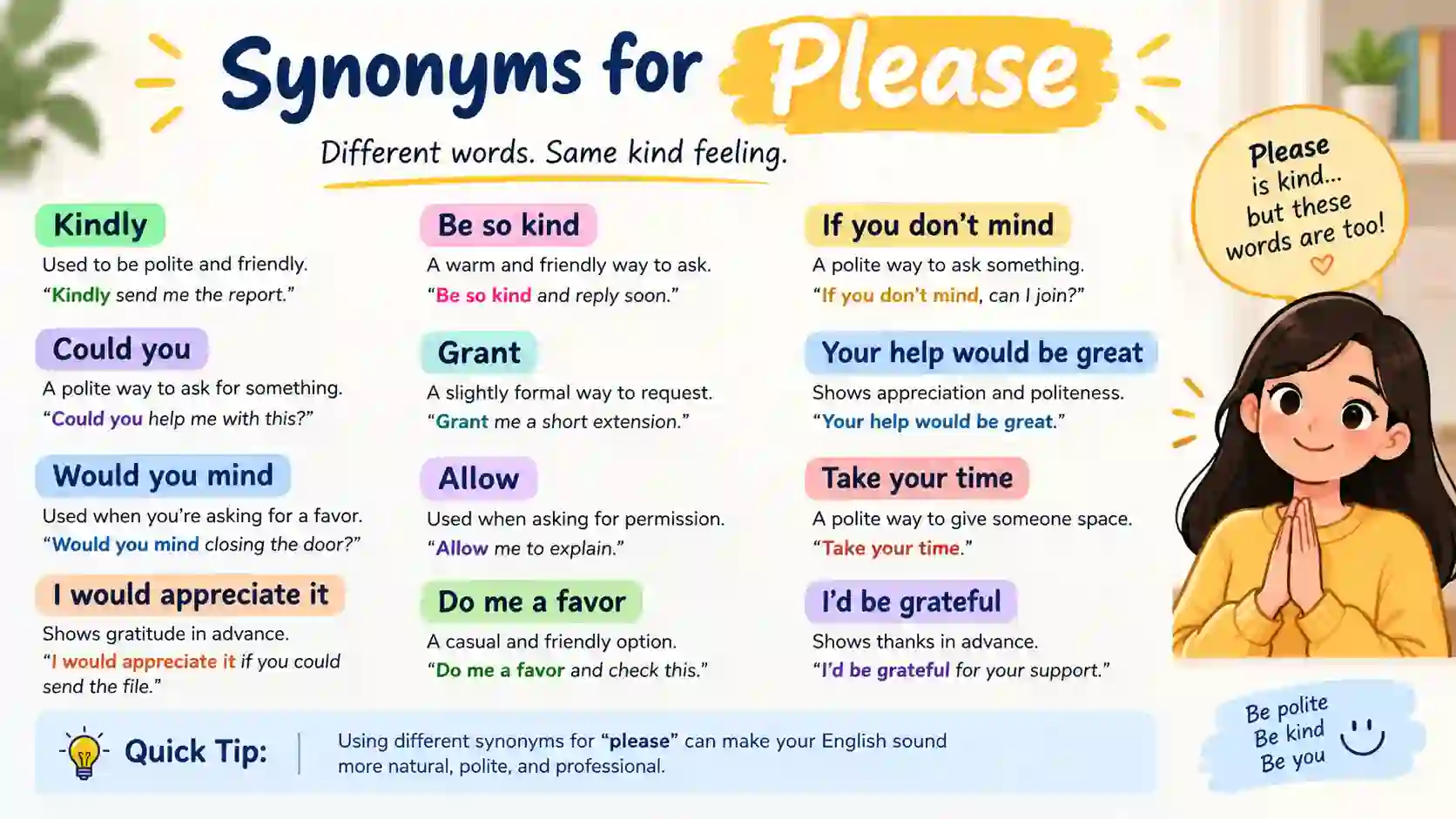
| Kindly | Introduce or describe a polite action | Formal |
| Politely | Describe courteous behavior | Neutral |
| Could you please help me? | Make a polite request | Neutral |
| Would you mind? | Make a considerate request | Neutral |
30 Synonyms for Please With Examples and Explanations
1. Delight
Meaning: To make someone feel great happiness.
Examples:
- The unexpected visit delighted my grandmother.
- The new book delighted young readers.
Best used when: Someone feels strong pleasure or joy.
Tone: Neutral, positive. CEFR: B2. Frequency: Common.
Collocations: Delight an audience, greatly delight, be delighted with.
When not to use it: Do not use it to introduce an ordinary command.
2. Satisfy
Meaning: To meet someone’s needs or expectations.
Examples:
- The answer satisfied my curiosity.
- The new plan satisfies the team’s main needs.
Best used when: A need, condition, or expectation has been met.
Tone: Neutral. CEFR: B1. Frequency: Very common.
Collocations: Satisfy a need, satisfy a customer, satisfy a requirement.
When not to use it: Choose delight when strong happiness matters more than meeting a requirement.
3. Gratify
Meaning: To give pleasure by fulfilling a wish or desire.
Examples:
- The award gratified his desire for recognition.
- It gratified her to see the project succeed.
Best used when: Someone feels pleased because a wish has been fulfilled.
Tone: Formal. CEFR: C1. Frequency: Uncommon.
Collocations: Gratify a desire, gratify curiosity, feel gratified.
When not to use it: Avoid it in simple everyday requests.
4. Amuse
Meaning: To make someone laugh or feel entertained.
Examples:
- The puppy’s playful jumps amused the children.
- Her clever reply amused the audience.
Best used when: Something creates laughter or light enjoyment.
Tone: Neutral. CEFR: B1. Frequency: Common.
Collocations: Amuse the audience, be amused by, greatly amuse.
When not to use it: Use satisfaction for needs and requirements, not entertainment.
5. Charm
Meaning: To attract someone through appealing qualities.
Examples:
- The quiet village charmed the visitors.
- His warm greeting charmed the new students.
Best used when: A person or place creates a pleasant impression.
Tone: Neutral. CEFR: B2. Frequency: Common.
Collocations: Charm an audience, charm someone with natural charm.
When not to use it: Charm does not work as a direct replacement for please in most commands.
6. Gladden
Meaning: To make someone happy.
Examples:
- The news of her return gladdened the family.
- His kind message gladdened my heart.
Best used when: You want to express heartfelt happiness.
Tone: Literary. CEFR: C1. Frequency: Rare in daily speech.
Collocations: Gladden the heart, gladden someone’s spirit.
When not to use it: Use make happy or delight in everyday conversation.
7. Content
Meaning: To make someone quietly satisfied.
Examples:
- The peaceful afternoon satisfied the tired traveler.
- A simple meal satisfied the guests.
Best used when: Someone feels satisfied without needing more.
Tone: Formal or literary. CEFR: C1. Frequency: Uncommon as a verb.
Collocations: Content oneself with, be content with, content a person.
When not to use it: Do not confuse the verb with the adjective in “I am content.”
8. Entertain
Meaning: To provide enjoyment or hold someone’s interest.
Examples:
- The storyteller entertained the children with funny tales.
- The host entertained the guests after dinner.
Best used when: A person or activity provides amusement.
Tone: Neutral. CEFR: B1. Frequency: Very common.
Collocations: Entertain guests, entertain an audience, entertain an idea.
When not to use it: Remember that entertaining an idea means to consider it, not to amuse someone.
9. Cheer
Meaning: To make someone happier or more hopeful.
Examples:
- Her message cheered me up after a difficult day.
- The team’s victory cheered its supporters.
Best used when: Someone needs encouragement or a better mood.
Tone: Friendly. CEFR: A2–B1. Frequency: Common.
Collocations: Cheer someone up, cheer the crowd, cheer loudly.
When not to use it: Use satisfaction when the focus is meeting a practical need.
10. Suit
Meaning: To be appropriate for someone’s needs or preferences.
Examples:
- Friday suits me better than Monday.
- This schedule suits her work routine.
Best used when: Something fits a person’s needs or circumstances.
Tone: Neutral. CEFR: B1. Frequency: Very common.
Collocations: Suit your needs, suit someone’s taste, suit a schedule.
When not to use it: Something can suit a person without making them especially happy.
11. Tickle
Meaning: To amuse someone or give them pleasure.
Examples:
- The funny headline tickled her sense of humor.
- His playful comment tickled the children.
Best used when: Something creates light amusement.
Tone: Informal. CEFR: B2. Frequency: Common.
Collocations: Tickle someone’s fancy, tickle the imagination, tickle someone pink.
When not to use it: Avoid it when discussing serious needs or formal requirements.
12. Enchant
Meaning: To fill someone with wonder or delight.
Examples:
- The glowing garden enchanted the visitors.
- The music enchanted everyone in the hall.
Best used when: Something creates a magical or deeply attractive feeling.
Tone: Literary. CEFR: B2–C1. Frequency: Uncommon.
Collocations: Enchant an audience, enchanted garden, utterly enchanted.
When not to use it: It is usually too expressive for routine business requests.
13. Captivate
Meaning: To attract and hold someone’s attention strongly.
Examples:
- The speaker captivated the audience with a true story.
- The novel captivated me from the first page.
Best used when: Something holds attention for a long time.
Tone: Neutral to formal. CEFR: C1. Frequency: Common.
Collocations: Captivate readers, captivate an audience, completely captivated.
When not to use it: Use satisfy when you mean meeting a requirement.
14. Fascinate
Meaning: To make someone extremely interested.
Examples:
- Ancient maps fascinate my brother.
- The discovery fascinated the science class.
Best used when: Interest and curiosity are the main feelings.
Tone: Neutral. CEFR: B1–B2. Frequency: Common.
Collocations: Fascinate researchers, deeply fascinating, be fascinated by.
When not to use it: Something can fascinate a person without making them happy.
15. Thrill
Meaning: To give someone strong excitement or pleasure.
Examples:
- The invitation thrilled the young athlete.
- The final goal thrilled the crowd.
Best used when: An event creates excitement or anticipation.
Tone: Energetic. CEFR: B1. Frequency: Common.
Collocations: Thrill the crowd, be thrilled about, thrilled to bits.
When not to use it: It may be too strong for an ordinary favor.
16. Elate
Meaning: To make someone extremely happy.
Examples:
- The promotion elated the new manager.
- Her success elated the whole family.
Best used when: A major event creates great happiness.
Tone: Formal. CEFR: C1. Frequency: Uncommon.
Collocations: Be elated by, feel elated, an elated winner.
When not to use it: Choose please or satisfy for mild approval.
17. Indulge
Meaning: To allow someone to enjoy a wish or pleasure.
Examples:
- Her parents indulged her love of painting.
- He indulged himself with a quiet afternoon off.
Best used when: Someone allows a desire or treats themselves to something enjoyable.
Tone: Neutral. CEFR: B2. Frequency: Common.
Collocations: Indulge a wish, indulge a passion, indulge yourself.
When not to use it: It can suggest excess, which please does not always imply.
18. Humor / Humour
Meaning: To go along with someone’s wishes, often to keep them happy.
Examples:
- She humored her little brother by listening to his long story.
- The guide humoured the visitor’s unusual questions.
Best used when: Someone cooperates with another person’s wishes, sometimes without agreeing.
Tone: Neutral, sometimes negative. CEFR: C1. Frequency: Common in this sense.
Collocations: Humor a child, humor someone’s request, humor an idea.
When not to use it: It does not necessarily mean genuine happiness.
Spelling: American English uses humor; British English usually uses humour.
19. Oblige
Meaning: To help someone by doing what they ask.
Examples:
- The assistant obliged my request for a printed copy.
- She was happy to oblige when her neighbor needed help.
Best used when: Someone agrees to do a favor.
Tone: Formal. CEFR: C1. Frequency: Uncommon.
Collocations: Happy to oblige, oblige a request, oblige someone by doing something.
When not to use it: It can suggest duty or a favor rather than happiness.
20. Divert
Meaning: To entertain or distract someone from something else.
Examples:
- The magician diverted the children with a simple trick.
- A short game diverted the guests while dinner was prepared.
Best used when: Something shifts attention or provides temporary amusement.
Tone: Neutral to formal. CEFR: B2. Frequency: Common.
Collocations: Divert attention, divert the audience, divert someone’s thoughts.
When not to use it: It is not a general synonym for making someone happy.
21. Wish
Meaning: To want something to happen or be true.
Examples:
- I wish to speak with the director.
- You may arrange the books as you wish.
Best used when: Expressing a desire or someone’s freedom to choose.
Tone: Neutral. CEFR: A2. Frequency: Very common.
Collocations: Wish to know, wish for success, as you wish.
When not to use it: Wish does not mean “make someone happy.”
22. Want
Meaning: To desire or need something.
Examples:
- I want to learn another language.
- Take whichever seat you want.
Best used when: Expressing a desire directly.
Tone: Neutral, direct. CEFR: A1. Frequency: Very common.
Collocations: Want to go, want something badly, want someone to help.
When not to use it: In a formal request, “I want the report” can sound demanding. Consider “Could you send me the report, please?”
23. Choose
Meaning: To select one option from several.
Examples:
- You can choose the topic that interests you.
- She chose to study in the morning.
Best used when: Someone has options and makes a decision.
Tone: Neutral. CEFR: A2. Frequency: Very common.
Collocations: Choose an option, choose wisely, choose to do something.
When not to use it: Choosing something does not necessarily please anyone.
24. Prefer
Meaning: To like one thing more than another.
Examples:
- I prefer tea to coffee in the morning.
- She prefers studying in a quiet room.
Best used when: Comparing options or expressing a preference.
Tone: Neutral. CEFR: A2–B1. Frequency: Very common.
Collocations: Prefer to do, prefer A to B, would prefer.
When not to use it: It expresses a choice, not the act of making another person happy.
25. Desire
Meaning: To want something strongly.
Examples:
- The team desires a clear answer.
- She desired more time to finish the project.
Best used when: Expressing a strong wish, especially in formal writing.
Tone: Formal. CEFR: B2. Frequency: Common.
Collocations: Desire change, desire to learn, strongly desire.
When not to use it: It may sound stiff in casual conversation, where want is more natural.
26. Opt
Meaning: To choose a particular option.
Examples:
- We opted for the earlier train.
- Students may opt to work in pairs.
Best used when: Describing a deliberate choice between options.
Tone: Neutral to formal. CEFR: B2. Frequency: Common.
Collocations: Opt for, opt to do, opt out.
When not to use it: Opt is about selecting an option, not giving pleasure.
27. Kindly
Meaning: In a kind manner; also used to introduce certain polite requests.
Examples:
- Could you kindly send the updated file?
- The receptionist kindly showed us the way.
Best used when: You want a courteous or formal tone.
Tone: Formal. CEFR: B1. Frequency: Common.
Collocations: Kindly confirm, kindly provide, kindly assist.
When not to use it: Repeated use can sound stiff or commanding. “Could you please send the file?” is often more natural.
28. Politely
Meaning: In a way that shows good manners.
Examples:
- She politely asked the visitor to wait.
- He politely declined the invitation.
Best used when: Describing how someone speaks or acts.
Tone: Neutral. CEFR: B1. Frequency: Very common.
Collocations: Politely ask, politely refuse, speak politely.
When not to use it: It describes the manner of an action, not the result of making someone happy.
29. Could You Please?
Meaning: A polite way to ask someone to do something.
Examples:
- Could you please check this paragraph?
- Could you please send the link before noon?
Best used when: Asking for help in everyday or professional situations.
Tone: Polite, neutral. CEFR: A2–B1. Frequency: Very common.
Collocations: Could you please help, could you please explain, could you please send.
When not to use it: Do not use it to replace please in a sentence about happiness. It is a request pattern, not a synonym for the verb.
30. Would You Mind?
Meaning: A polite expression used to ask someone to do something.
Examples:
- Would you mind closing the window?
- Would you mind reviewing my draft?
Best used when: You want to make a considerate request.
Tone: Polite, neutral. CEFR: B1. Frequency: Very common.
Collocations: Would you mind helping, would you mind waiting, would you mind if I asked.
When not to use it: Follow it with a verb ending in -ing when asking someone to act. Say “Would you mind waiting?” not “Would you mind waiting?”
Synonym Categories
Strongest synonyms for happiness
Use delight, satisfy, gratify, amuse, charm, and gladden when the context involves pleasure or satisfaction. Each word adds a different shade of meaning.
Strong synonyms for interest or enjoyment
Use entertain, cheer, enchant, captivate, fascinate, and thrill when the focus is amusement, attention, wonder, or excitement.
Related words for choice and requests
Use wish, want, choose, prefer, desire, and opt for decisions or wishes. Use kindly, politely, could you please, and would you mind for requests.
Choose the Right Synonym: Side by Side Comparisons
| Word pair | Key difference | Example |
| Please vs. delight | General pleasure vs. great happiness | The news delighted her. |
| Please vs. satisfy | General pleasure vs. meeting a need | The answer satisfied my curiosity. |
| Please vs. amuse | Pleasure vs. entertainment | The joke amused the class. |
| Please vs. suit | Pleasure vs. being appropriate | Tuesday suits me. |
| Please vs. wish | Give pleasure vs. express desire | I wish to leave early. |
| Please vs. kindly | Request marker vs. manner of asking | Kindly sign the form. |
| Please vs. oblige | Give pleasure vs. do a favor | She was happy to oblige. |
| Please vs. prefer | General meaning vs. choosing one option | I prefer the blue one. |
Commonly Confused Words
| Word | Difference | Example |
| Pleased | Feeling happy or satisfied | I am pleased with my grade. |
| Pleasing | Giving pleasure | The room has a pleasing design. |
| Pleasant | Enjoyable or agreeable | We had a pleasant afternoon. |
| Pleasure | Enjoyment; a noun | It was a pleasure to meet you. |
| Appreciate | Value something or feel grateful | I appreciate your help. |
Common Mistakes
Mistake 1: Using delight as a request marker
- Incorrect: “Delight pass me the notebook.”
- Correct: “Please pass me the notebook.”
Why: Delight means to give great pleasure, not to introduce a polite request.
Mistake 2: Confusing please with pleased
- Incorrect: “I am pleased with my progress.”
- Correct: “I am pleased with my progress.”
Why: Use pleased to describe a person’s feeling.
Mistake 3: Using kindly in every request
- Less natural: “Kindly, kindly send the file.”
- Better: “Could you send the file, please?”
Why: Repeating polite markers can sound unnatural.
Mistake 4: Treating want as a polite synonym
- Direct: “I want the report.”
- Softer: “Could you send me the report, please?”
Why: Want expresses desire. A polite question can make a request feel less demanding.
Mistake 5: Confusing satisfy with delight
- Incorrect: “The report delighted the legal requirement.”
- Correct: “The report satisfied the legal requirement.”
Why: Use satisfaction for requirements and delight for happiness.
Writing Tips
- Essays: Choose precise verbs. Write “The evidence satisfied the criteria” instead of a vague statement about pleasing the reader.
- Emails: Use “Could you please review the file?” for a clear, courteous request.
- Blog posts: Explain whether a product satisfies a need, delights customers, or suits a budget.
- Stories: Use amuse for laughter, thrill for excitement, and enchant for wonder.
- Social media: Keep language natural. “That made my day!” may express happiness more clearly than a formal synonym.
- Professional communication: Avoid replacing every instance of please with kindly. Clear wording and a respectful tone matter more than variety.
- Daily conversations: Use familiar expressions such as “Could you help me?” rather than rare or overly formal alternatives.
Writing tip: Never change a word just to avoid repetition. A repeated word is better than an inaccurate synonym.
Word Origin and First Known Use
Please comes from Middle English forms such as plesen and plaisen, influenced by Old French plaisir and ultimately Latin placēre, meaning “to be pleasing” or “to give pleasure.” Collins traces the word to the 14th century.
Collins English Dictionary+1
The modern polite-request use developed from expressions connected with asking what would please another person. This history helps explain why the same word can express happiness, willingness, and courtesy.
American vs. British English
| Feature | American English | British English |
| Please | /pliːz/ | /pliːz/ |
| Humor / humour | Humor | Humour |
| Common request | Could you help me, please? | Could you help me, please? |
| Polite acceptance | Yes, please. | Yes, please. |
The core meanings are the same in both varieties. The most visible spelling difference in this article is humor in American English and humour in British English. The most suitable request expression depends on context and personal style, not a strict national rule.
Collins English Dictionary+1
Related Vocabulary
Antonyms
| Antonym | Meaning | Example |
| Displease | Cause dissatisfaction | The decision displeased the team. |
| Annoy | Cause irritation | The noise annoyed me. |
| Offend | Hurt someone’s feelings | His remark offended the guest. |
| Disappoint | Fail to meet expectations | The result disappointed her. |
| Dissatisfy | Fail to meet a need | The service dissatisfied the customer. |
| Upset | Make someone unhappy or worried | The sudden change upset him. |
Related expressions
- Please yourself: Do what you want.
- As you please: In whatever way you choose.
- Eager to please: Very willing to make others happy.
- Hard to please: Difficult to satisfy.
- Pleased to meet you: A polite greeting.
- Yes, please: A polite way to accept an offer.
- Please do: An encouraging response to an offer or request.
Word family
| Word | Part of speech | Meaning |
| Please | Verb or request marker | Give pleasure or ask politely |
| Pleased | Adjective or participle | Feeling happy or satisfied |
| Pleasing | Adjective or participle | Giving pleasure |
| Pleasant | Adjective | Enjoyable or agreeable |
| Pleasure | Noun | Enjoyment |
| Pleasurable | Adjective | Giving enjoyment |
Frequently Asked Questions
1. What are the best synonyms for please?
The best alternatives include delight, satisfy, amuse, charm, and gratify when you mean giving pleasure. For personal choice, use wish, want, choose, or prefer. For polite requests, expressions such as could you please and would you mind usually work better than a single-word replacement.
2. What is a formal synonym for please?
Formal alternatives depend on the meaning. Gratify can describe fulfilling a wish, oblige can mean doing someone a favor, and kindly can introduce a request. In professional emails, “Could you please review the document?” is often clearer and more natural than an unusually formal expression.
3. What is another word for please in an email?
For requests, try “Could you please,” “Would you mind,” or “Could you kindly.” For example, write “Could you please send the report by Friday?” For a statement about happiness, use a verb such as delight or satisfy if it fits the meaning.
4. What is a synonym for please when it means making someone happy?
Useful choices include delight, gladden, cheer, amuse, and satisfy. Delight suggests strong happiness, cheer suggests a better mood, amuse suggests entertainment, and satisfaction suggests that a need or expectation has been met.
5. Is kindly a synonym for please?
Kindly can serve a similar purpose in some requests, as in “Kindly sign the form.” However, it describes manners and does not replace the verb please in every sentence. Depending on the context, it may sound formal or firm. “Could you please sign the form?” is often a natural alternative.
6. What is the difference between please and satisfy?
Please can mean to make someone happy or satisfied, while satisfied focuses on meeting a need, condition, or expectation. A gift might please someone, while a detailed explanation might satisfy their curiosity. Both words can work in some contexts, but they emphasize different results.
7. What is the opposite of please?
Common opposites include displease, annoy, offend, disappoint, and dissatisfy. The best choice depends on the situation. Displease is a broad opposite, annoy means to irritate, offend suggests hurt feelings, and dissatisfy means failing to meet someone’s needs or expectations.
8. How can I improve my vocabulary with synonyms please?
Learn alternatives by meaning instead of memorizing one long list. Practice delight for strong happiness, satisfy needs, and prefer choices. Write your own examples, compare related words, and read dictionary examples to see how native speakers use them.
Vocabulary Quiz
Choose one answer for each question.
Test your vocabulary
0 of 5 answered
1. Which word means to make someone extremely happy?
A. Annoy
B. Delight
C. Choose
D. Kindly
2. Which sentence is used correctly?
A. Satisfy the door.
B. The answer satisfied my curiosity.
C. I am satisfied with my work.
D. She was very satisfied.
3. Which expression makes a polite request?
A. Would you mind helping me?
B. Delight helping me.
C. Satisfy help me.
D. Cheer to help me.
4. Which word best describes making someone laugh?
A. Gratify
B. Amuse
C. Oblige
D. Prefer
5. Which word means liking one option more than another?
A. Enchant
B. Displease
C. Prefer
D. Gladden
Check answers
Fill in the Blanks
Complete the sentences using delight, satisfy, politely, prefer, or thrill.
- The wonderful news will ______ the family.
- The report must ______ the safety requirements.
- She ______ asked the visitor to wait.
- I ______ tea to coffee.
- The final victory will ______ the players.
Answer key: 1. delight, 2. satisfy, 3. politely, 4. prefer, 5. thrill.
Rewrite the Sentences
Replace please with a more precise word or expression.
- The funny video pleased the children.
- This meeting time pleases everyone.
- Please check the attached file.
- The award pleased him greatly.
Possible answers:
- The funny video amused the children.
- This meeting time suits everyone.
- Could you check the attached file, please?
- The award delighted him.
Conclusion
Learning synonyms for please helps you express happiness, satisfaction, choice, and politeness more clearly. Use delight for great joy, satisfaction for meeting needs, amuse for entertainment, and polite request patterns when asking for help.
Practice these words in emails, essays, and daily conversations. The more you understand their differences, the more natural and confident your English will become.
References
- Cambridge Dictionary: Synonyms and antonyms of please.
- Collins Dictionary: Please synonyms and usage.
- Thesaurus.com: Please synonyms and antonyms.
- Merriam-Webster: Please define synonyms.

Synonorm is a trusted English vocabulary resource created to help readers find the right words and understand the differences between similar terms. We provide clear explanations of synonyms, meanings, examples, usage, and alternatives. Our content makes vocabulary easier to learn and apply in everyday, academic, and professional English. Synonorm is designed for students, writers, ESL learners, professionals, and anyone who wants to improve their English vocabulary and communicate more clearly.