Quick Answer: What Are Synonyms for Zero?
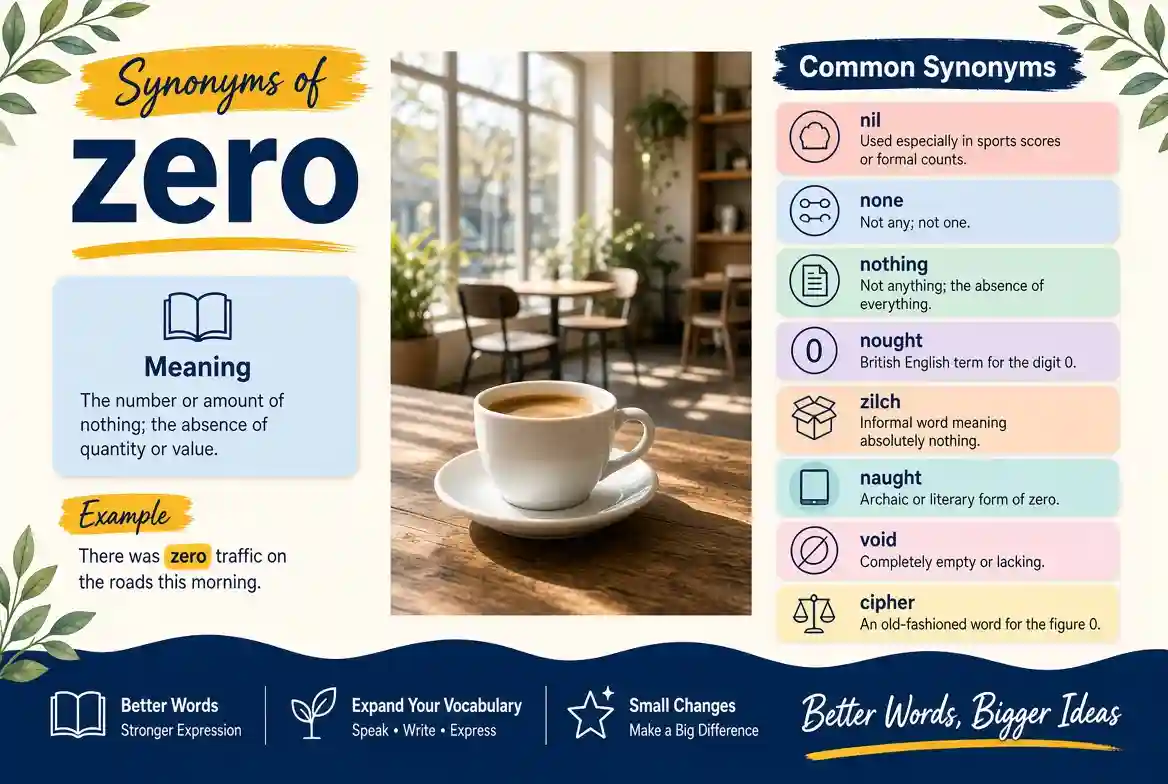
Common synonyms for zero include nought, naught, nil, nothing, none, cipher, zilch, zip, and nada. The best choice depends on context. Use nought for the number, nil for certain scores, none for an absent quantity, and zilch in casual speech. Words such as negligible and minimal describe small amounts, not necessarily zero.
Do you find yourself using the word zero again and again in your writing? Learning synonyms for zero can help you express the same idea in different ways. However, not every alternative fits every sentence.
For example, “The team scored zero points” can become “The team scored nil” in a suitable sports context. But if a spreadsheet contains the number 0, replacing it with blank could change the meaning.
This guide explores 30 words and expressions associated with zero. You will learn their meanings, examples, tones, common word combinations, and limitations. Whether you are an English learner, student, teacher, blogger, or professional writer, these explanations will help you choose accurate words and communicate more naturally.
Pronunciation of Zero
- American IPA: /ˈzɪroʊ/
- British IPA: /ˈzɪərəʊ/
- Simple pronunciation: ZEE-roh, approximately.
- Part of speech: Noun, adjective, and verb.
The plural is commonly written as zeros or zeroes in both American and British English.
Word Origin and Etymology
The English word zero came through Italian zero, from Medieval Latin zephirum, which developed from Arabic ṣifr, meaning “empty” or “zero.” The word entered English in the late 16th century. Merriam-Webster records 1598 as its first known use.
thesaurus.com+1
The related word cipher shares this historical connection. Today, zero is used in mathematics, science, money, temperature, sports, and everyday speech.
Part of Speech and Grammar
| Form | Meaning | Example |
| Noun | The number 0 | The answer is zero. |
| Adjective | Having a value of zero or none | The project has zero funding. |
| Verb | To set something to zero | Zero the scale before weighing the package. |
| Phrasal verb | To focus on a target | We need to zero in on the main problem. |
Grammar tip: Use zero when you mean an exact numerical value. Use none when referring to an absent quantity, and use nothing when referring to the absence of a thing, result, or activity.
Synonyms for Zero: Quick Comparison Table
| Synonym | Meaning or strength | Register |
| Nought | The number 0 | Neutral, especially British |
| Naught | Nothing; zero in some uses | Literary |
| Nil | Zero score or amount | Neutral/formal |
| Nothing | Complete absence | Neutral |
| None | Not one or not any | Neutral |
| Cipher | The numeral zero in historical use | Literary/technical |
| Zilch | Nothing at all | Informal |
| Zip | Nothing or zero | Informal |
| Nada | Nothing | Informal |
| Goose egg | A score of zero | Informal |
| Null | No valid or assigned value in certain systems | Technical |
| Blank | Empty space or missing entry | Neutral |
| Void | Empty or invalid | Formal |
| Nonexistent | Not existing | Formal |
| Negligible | Too small to matter much | Academic/formal |
| Minimal | Very small | Neutral/formal |
| Insignificant | Too small or unimportant to matter | Formal |
| Nadir | Lowest point | Literary/formal |
| Rock bottom | Lowest state or level | Informal |
| Nothingness | State of nonexistence or emptiness | Literary |
The remaining entries cover related expressions and contextual alternatives. They are useful for vocabulary building, but they are not all direct substitutes for zero.
30 Synonyms for Zero With Examples and Explanations
1. Nought
Meaning: Nought is another word for the number zero.
- The temperature fell to nought overnight.
- Write a nought in the empty box.
Best used when: Referring to the number in British English or a traditional numerical context.
Tone: Neutral. CEFR guidance: B2. Frequency: Common in some British contexts.
Collocations: Nought to ten, nought point five, zero or nought.
When not to use it: In everyday American English, zero is often the more natural choice.
2. Naught
Meaning: Naught means nothing or an amount of zero in certain contexts.
- Their careful plans came to naught.
- The effort produced naught.
Best used when: Writing literary prose or using the expression “come to naught.”
Tone: Literary. CEFR guidance: C1. Frequency: Uncommon.
Collocations: Come to naught, all for naught, reduce to naught.
When not to use it: Avoid it in casual conversation if a simpler word would sound more natural.
3. Nil
Meaning: Nil means zero, especially in sports scores or statements about an amount.
- Our team won the match two-nil.
- The chance of delay was virtually nil.
Best used when: Discussing sports results or an amount considered effectively zero.
Tone: Neutral/formal. CEFR guidance: B1–B2. Frequency: Common.
Collocations: Nil score, virtually nil, nil balance.
When not to use it: Do not automatically replace every mathematical zero with nil.
4. Nothing
Meaning: Nothing means no thing or no amount.
- The cupboard contained nothing.
- We learned nothing from the failed test.
Best used when: Talking about the absence of a thing, result, or amount.
Tone: Neutral. CEFR guidance: A1. Frequency: Very common.
Collocations: Nothing happened, nothing left, nothing to report.
When not to use it: Use zero when the exact number is important.
5. None
Meaning: None means not one or not any.
- None of the students arrived late.
- There was none left for dinner.
Best used when: Referring to an absent quantity from a known group or supply.
Tone: Neutral. CEFR guidance: A2. Frequency: Very common.
Collocations: None available, none remaining, none of them.
When not to use it: It does not replace the numeral 0 in every mathematical expression.
6. Cipher
Meaning: Cipher can refer to the numeral zero or a person considered insignificant.
- The old notation used a cipher for zero.
- In the story, he felt like a cipher among the powerful.
Best used when: Discussing historical number systems or writing figuratively.
Tone: Literary/technical. CEFR guidance: C1. Frequency: Uncommon.
Collocations: Numerical cipher, secret cipher, insignificant cipher.
When not to use it: In modern everyday writing, zero is usually clearer.
7. Zilch
Meaning: Zilch is informal slang for nothing at all.
- I know zilch about fixing cars.
- We received zilch in return.
Best used when: Speaking casually or adding humor.
Tone: Informal. CEFR guidance: B2. Frequency: Common in informal American English.
Collocations: Absolutely zilch, zilch experience, zilch to show for it.
When not to use it: Avoid it in formal academic reports.
8. Zip
Meaning: Zip can mean nothing or zero in informal English.
- We made zip dollars from the sale.
- He had zip interest in the proposal.
Best used when: Making a casual statement about a lack of results or interest.
Tone: Informal. CEFR guidance: B1–B2. Frequency: Common in informal speech.
Collocations: Zip chance, zip interest, zip to show for it.
When not to use it: Do not confuse this meaning with the verb zip, which can mean to close something or move quickly.
9. Nada
Meaning: Nada is an informal word meaning nothing.
- We searched every drawer and found nada.
- She had nada to add to the discussion.
Best used when: Speaking casually or using a playful tone.
Tone: Informal. CEFR guidance: B1–B2. Frequency: Common in informal American English.
Collocations: Nada at all, absolutely nada, nada to show for it.
When not to use it: Prefer nothing in formal writing.
10. Goose Egg
Meaning: A goose egg is an informal expression for a score of zero.
- Our team scored a goose egg in the first half.
- I got a goose egg in the final round.
Best used when: Talking about games, tests, or competitions informally.
Tone: Informal/humorous. CEFR guidance: B2. Frequency: Context-dependent.
Collocations: Score a goose egg, finish with a goose egg, a big goose egg.
When not to use it: It is not suitable for formal mathematical definitions.
11. Null
Meaning: Null can mean having no valid or assigned value in a particular system.
- The software returned a null value.
- The database marked the missing field as null.
Best used when: Discussing programming, databases, logic, or certain legal contexts.
Tone: Technical/formal. CEFR guidance: B2–C1. Frequency: Common in technical writing.
Collocations: Null value, null result, null and void.
When not to use it: In a database, null may mean missing or unknown, while 0 is an actual numerical value.
12. Blank
Meaning: A blank is an empty space or unanswered entry.
- I left the last question blank.
- The form contained a blank field.
Best used when: Referring to missing information or an empty space.
Tone: Neutral. CEFR guidance: A2. Frequency: Very common.
Collocations: Blank page, blank answer, blank field.
When not to use it: A blank entry does not prove that the numerical value is zero.
13. Void
Meaning: Void means empty or invalid in certain contexts.
- The agreement was declared void.
- The empty room seemed like a void.
Best used when: Describing emptiness, invalidity, or absence in formal or literary writing.
Tone: Formal/literary. CEFR guidance: B2–C1. Frequency: Common in specialist contexts.
Collocations: Void contract, fill a void, empty void.
When not to use it: Do not use void as a direct replacement for zero in a calculation.
14. Nonexistent
Meaning: Nonexistent means not existing at all.
- The building had nonexistent mobile coverage.
- His chances of winning seemed nonexistent.
Best used when: Emphasizing the absence of something that should or could exist.
Tone: Neutral/formal. CEFR guidance: B2. Frequency: Common.
Collocations: Nonexistent evidence, nonexistent risk, virtually nonexistent.
When not to use it: Use zero when reporting a precise numerical amount.
15. Negligible
Meaning: Negligible means so small that it usually does not matter much.
- The price difference was negligible.
- The delay had a negligible effect on the project.
Best used when: Describing a very small cost, effect, risk, or difference.
Tone: Academic/formal. CEFR guidance: B2–C1. Frequency: Common.
Collocations: Negligible difference, negligible effect, negligible risk.
When not to use it: A negligible amount can still be greater than zero.
16. Minimal
Meaning: Minimal means very small or as small as possible.
- The repair required minimal effort.
- We made minimal changes to the original plan.
Best used when: Describing a small amount, level, or degree.
Tone: Neutral/formal. CEFR guidance: B1–B2. Frequency: Very common.
Collocations: Minimal risk, minimal effort, minimal impact.
When not to use it: Minimal does not mean none.
17. Insignificant
Meaning: Insignificant means too small or unimportant to matter much.
- The difference was insignificant.
- The extra cost was insignificant compared with the total budget.
Best used when: Discussing importance, impact, or the size of a difference.
Tone: Formal/academic. CEFR guidance: B2. Frequency: Common.
Collocations: Insignificant difference, statistically insignificant, insignificant amount.
When not to use it: It does not mean exactly zero.
18. Nadir
Meaning: Nadir means the lowest point in a process or experience.
- The scandal marked the nadir of his career.
- Sales reached their nadir during the crisis.
Best used when: Writing about a low point in performance, history, or personal experience.
Tone: Literary/formal. CEFR guidance: C1–C2. Frequency: Uncommon.
Collocations: Reach a nadir, political nadir, nadir of a career.
When not to use it: It is not a synonym for the number 0.
19. Rock Bottom
Meaning: Rock bottom means the lowest or worst state of something.
- The company’s reputation hit rock bottom.
- His confidence reached rock bottom after the setback.
Best used when: Describing a very low state of mood, quality, or performance.
Tone: Informal. CEFR guidance: B2. Frequency: Common.
Collocations: Hit rock bottom, reach rock bottom, start from rock bottom.
When not to use it: The phrase does not specify a numerical value of zero.
20. Nothingness
Meaning: Nothingness is a state of emptiness or nonexistence.
- The novel explores the idea of nothingness.
- The empty landscape seemed to stretch into nothingness.
Best used when: Discussing philosophical ideas or creating a literary mood.
Tone: Literary/academic. CEFR guidance: C1–C2. Frequency: Uncommon.
Collocations: Absolute nothingness, state of nothingness, sense of nothingness.
When not to use it: Use zero for a precise quantity.
21. Zippo
Meaning: Zippo is an informal expression meaning nothing at all.
- We had zippo time to prepare.
- He offered zippo help during the move.
Best used when: Making a playful or emphatic statement in casual speech.
Tone: Informal. CEFR guidance: C1. Frequency: Uncommon.
Collocations: Zippo chance, absolutely zippo, zippo experience.
When not to use it: Avoid it in academic or formal business writing.
22. Diddly Squat
Meaning: Diddly-squat is slang for nothing or almost nothing.
- I know diddly-squat about car engines.
- We earned diddly-squat from the failed venture.
Best used when: Speaking humorously or emphatically with friends.
Tone: Very informal. CEFR guidance: C1. Frequency: Uncommon.
Collocations: Know diddly-squat, earn diddly-squat, mean diddly-squat.
When not to use it: It is unsuitable for most professional documents.
23. Nada at All
Meaning: Nada at all emphasizes that there is nothing.
- We found nada in the storage room.
- The old device gave us nada at all.
Best used when: Making an informal statement about a complete lack of something.
Tone: Informal. CEFR guidance: B2. Frequency: Conversational.
Collocations: Get nada at all, find nada at all, offer nada at all.
When not to use it: In formal writing, use nothing at all.
24. No One
Meaning: No one means not a single person.
- No one answered the door.
- No one attended the optional meeting.
Best used when: Referring to zero people.
Tone: Neutral. CEFR guidance: A2. Frequency: Very common.
Collocations: No one knows, no one came, no one noticed.
When not to use it: It applies to people, not to amounts of money or other objects.
25. Nobody
Meaning: Nobody means no person.
- Nobody remembered the meeting time.
- Nobody was waiting outside the classroom.
Best used when: Describing the absence of people in everyday English.
Tone: Neutral/conversational. CEFR guidance: A2. Frequency: Very common.
Collocations: Nobody knows, nobody answered, nobody was there.
When not to use it: It cannot replace zero in numerical expressions.
26. No Amount
Meaning: No amount describes a complete lack of a quantity or appears in expressions about the limits of effort.
- No amount of money could change her decision.
- No amount of pressure made him change his mind.
Best used when: Referring to a quantity or using the pattern “no amount of.”
Tone: Neutral/formal. CEFR guidance: B1–B2. Frequency: Common in specific patterns.
Collocations: No amount of effort, no amount of money, no amount of pressure.
When not to use it: The phrase “no amount of effort” does not mean that no effort was made. It means effort could not change the outcome.
27. Not Any
Meaning: Not any expresses the absence of a quantity.
- We did not receive any complaints.
- There was not any milk left in the fridge.
Best used when: Making a negative statement about an amount.
Tone: Neutral. CEFR guidance: A2. Frequency: Very common.
Collocations: Not any money, not any evidence, not any time.
When not to use it: Use natural negative constructions, such as “I don’t have any,” in everyday American English.
28. Nix
Meaning: Nix most commonly means to reject, cancel, or stop something.
- The manager nixed the proposed change.
- The committee nixed the plan after reviewing the costs.
Best used when: Talking informally about rejecting an idea or proposal.
Tone: Informal. CEFR guidance: C1. Frequency: Uncommon to common in conversational usage.
Collocations: Nix the plan, nix the idea, nix the proposal.
When not to use it: Do not treat nix as a standard synonym for the numerical value zero.
29. Absolute Minimum
Meaning: The absolute minimum is the smallest possible amount or level under the stated conditions.
- Keep the number of changes to the absolute minimum.
- The project needs the absolute minimum of equipment.
Best used when: Emphasizing the lowest possible amount.
Tone: Neutral/formal. CEFR guidance: B2. Frequency: Common.
Collocations: Absolute minimum required, absolute minimum cost, reduce to the absolute minimum.
When not to use it: The minimum can be greater than zero.
30. Nonzero
Meaning: Nonzero means having a value other than zero.
- The calculation returned a nonzero result.
- Every nonzero number in the table needs a label.
Best used when: Writing about mathematics, statistics, programming, or numerical data.
Tone: Technical/academic. CEFR guidance: C1. Frequency: Common in specialist contexts.
Collocations: Nonzero value, nonzero probability, nonzero result.
When not to use it: Nonzero is not a synonym for zero. It is included as a related term because it helps explain the distinction between zero and values that are not zero.
Strongest Synonyms, Strong Synonyms, and Related Words
Strongest synonyms
These are the most useful alternatives when the context fits:
- Nought: the number 0.
- Naught: nothing, especially in literary usage.
- Nil: zero in a score or amount.
- Nothing: complete absence.
- None: not one or not any.
- Zilch: nothing in informal speech.
- Zip: nothing or zero in informal speech.
- Nada: nothing in casual speech.
Strong contextual alternatives
These work in particular situations:
- Cipher: the numeral zero in historical or technical contexts.
- Goose egg: a score of zero.
- Null: a missing, invalid, or unassigned value in certain systems.
- Blank: an empty space or unanswered entry.
- No one / nobody: zero people.
- Not any: absence of a quantity.
Related words, not exact synonyms
- Negligible: very small and usually unimportant.
- Minimal: very small.
- Insignificant: unimportant or too small to matter.
- Nadir: the lowest point.
- Rock bottom: the worst or lowest state.
- Nonexistent: not existing.
- Nothingness: emptiness or nonexistence.
- Absolute minimum: the smallest possible amount.
Choose the Right Synonym: Side by Side Comparisons
| Word | Main difference | Example |
| Zero | Exact numerical value | The account balance is zero. |
| Nothing | General absence | There was nothing in the box. |
| None | Not one or not any of a group | None of the answers was correct. |
| Nil | Zero score or amount | The team lost two-nil. |
| Null | No valid or assigned value in a system | The field contains a null value. |
| Negligible | So small it barely matters | The difference was negligible. |
| Nadir | Lowest point in a process | Sales reached their nadir. |
| Zilch | Informal word for nothing | We received zilch in return. |
American vs. British English
| Word | American English | British English |
| Zero | Standard and very common | Standard and very common |
| Nought | Understood, but less common | Used in numerical contexts |
| Nil | Used in sports and formal contexts | Common in sports scores |
| Zilch | Familiar informal expression | Understood, but less characteristic |
| Nada | Informal and familiar | Understood, often conversational |
| Goose egg | Familiar informal expression | Less common than in the US |
Pronunciation also differs slightly. American English commonly uses /ˈzɪroʊ/, while British English commonly uses /ˈzɪərəʊ/. Both zeros and zeroes are accepted plural spellings in both varieties.
Common Mistakes to Avoid
Mistake 1
- Incorrect: The difference was negligible, so it was zero.
- Correct: The difference was negligible, so it was very small.
Why: Negligible does not necessarily mean zero.
Mistake 2
- Incorrect: The spreadsheet cell is blank, so its value must be zero.
- Correct: The spreadsheet cell is blank, so the value may be missing.
Why: Blank cells and numerical zeros can represent different things.
Mistake 3
- Incorrect: The study found zilch evidence of improvement.
- Better: The study found no evidence of improvement.
Why: Zilch is informal, while the second sentence suits academic writing.
Mistake 4
- Incorrect: We made minimal progress, so we made no progress.
- Correct: We made minimal progress, so we made very little progress.
Why: Minimal progress is still progress.
Mistake 5
- Incorrect: The database returned zero, meaning no value was recorded.
- Correct: Check whether the database returned 0 or a null value.
Why: Zero is a numerical value. Null can indicate missing or unassigned data.
Writing Tips for Students, Bloggers, and Professionals
- Essays: Use zero, none, and negligible according to the exact meaning.
- Emails: Prefer clear wording such as “No issues were reported” or “The balance is zero.”
- Blog posts: Use nil for suitable scores and nadir for a low point.
- Stories: Use nothingness or rock bottom when the tone supports them.
- Social media: Informal expressions such as zilch and nada can add humor.
- Business writing: Use precise terms for financial amounts, risks, and results.
Writing tip: Do not change zero every time it appears. Repeating a precise word is better than replacing it with a word that changes the meaning.
Related Vocabulary and Antonyms
Antonyms and contrasting terms
The opposite of zero depends on the context.
- Nonzero: a value other than zero.
- Something: the opposite of nothing in a general sense.
- Positive value: a number greater than zero.
- Full amount: the complete quantity rather than none.
- Maximum: the highest value in a defined range.
- Infinity: an unbounded mathematical concept, not a direct opposite of zero in ordinary arithmetic.
Useful expressions with zero
- Zero out: reduce a balance or value to zero.
- Zero tolerance: a policy allowing no exceptions for specified behavior.
- Zero in on: focus closely on a target or problem.
- Come to naught: fail to produce the intended result.
- Nothing to show for it: have no useful result after an effort.
- Go from zero to hero: rise from obscurity to success.
Word family
| Word | Part of speech | Meaning |
| Zero | Noun | The number 0 |
| Zero | Verb | Set a value to zero |
| Zero | Adjective | Having a value of zero |
| Zeroed | Verb form | Set or adjusted to zero |
| Zeroing | Verb form | The act of setting or adjusting to zero |
| Nonzero | Adjective | Not equal to zero |
Frequently Asked Questions
1. What are the best synonyms for zero?
The best synonyms for zero include nought, naught, nil, nothing, and none. Informal options include zilch, zip, and nada. Choose the word that matches the context. For example, nil works in some sports scores, while none is suitable when no items remain.
2. What is a formal synonym for zero?
Nil and null can work in formal or technical contexts, but they have different meanings. Nil often refers to a zero score or amount. Null can indicate a missing or invalid value in a system. In general writing, zero is often the clearest choice.
3. What is an informal word for zero?
Informal words for zero or nothing include zilch, zip, zippo, and nada. Goose egg is another informal expression for a score of zero. These terms can add humor to casual conversation, but they are usually unsuitable for academic papers, formal reports, and official documents.
4. Is nothing a synonym for zero?
Yes, nothing can express the absence of something and may replace zero in some contexts. However, zero is a specific number, while nothing is a general word for absence. “The score is zero” is more precise than “the score is nothing” in a numerical report.
5. What is the difference between zero and nil?
Both words can refer to zero, but their typical uses differ. Zero is common in mathematics, measurements, and everyday conversation. Nil is particularly familiar in sports scores and expressions such as “virtually nil.” Choose the word that sounds natural for your subject and audience.
6. What is the British English synonym for zero?
Nought is a traditional British English alternative to zero in numerical contexts. Nil is also widely used in British sports reporting. British speakers still use zero regularly, so you do not need to replace it in everyday writing or speech.
7. What is a synonym for zero in mathematics?
In mathematics, zero is usually the most precise term. Nought can also refer to the number 0. However, null may describe a different technical concept, and negligible means very small rather than exactly zero. Always use the term that matches the mathematical meaning.
8. What is another word for a score of zero?
Depending on the sport, you can use nil, goose egg, or simply zero. For example, “The team lost three-nil” is familiar in some football contexts. “The player scored a goose egg” is informal and works better in casual conversation than in an official report.
Vocabulary Quiz
Test your understanding
1. Which word means an amount so small it may not matter much?
A. Nadir
B. Negligible
C. Nought
D. Zilch
2. Which word is commonly used in some sports scores?
A. Nil
B. Void
C. Minimal
D. Nothingness
3. Which expression is informal slang for nothing?
A. Nonexistent
B. Insignificant
C. Diddly-squat
D. Absolute minimum
4. A spreadsheet cell is empty. What can you safely conclude?
A. Its value is definitely zero
B. Its value is definitely positive
C. Its value may be missing
D. Its value must be negligible
5. Which word means the lowest point in a career or period?
A. Cipher
B. Nadir
C. Nada
D. None
Check answers
Mini Practice Exercises
Exercise 1: Fill in the blanks
Choose from nil, negligible, and nought.
- The difference between the two prices was __________.
- The scoreboard showed a score of three to __________.
- In traditional British usage, the number zero can also be called __________.
Exercise 2: Rewrite the sentences
- We received nothing from the supplier. Use zilch.
- The difference was very small and unimportant. Use negligible.
- The company’s performance reached its lowest point. Use nadir.
Exercise 3: Match the words
| Word | Meaning |
| 1. Null | A. Informal expression for nothing |
| 2. Nadir | B. No assigned or valid value in a technical context |
| 3. Zilch | C. The lowest point |
Answer key
- Exercise 1: 1. negligible; 2. nil; 3. nought.
- Exercise 2: 1. We received zilch from the supplier. 2. The difference was negligible. 3. The company’s performance reached its nadir.
- Exercise 3: 1-B, 2-C, 3-A.
Conclusion
Learning synonyms for zero can improve your vocabulary, writing, and speaking skills. Words such as nil, nought, nothing, and none can express the absence of an amount, while negligible, minimal, and nadir describe different ideas.
Focus on meaning and context rather than replacing words just to avoid repetition. Practise these alternatives in emails, essays, blog posts, and daily conversations to become a clearer, more confident communicator.
References
- Merriam-Webster: Zero definition and first known use.
- Cambridge Dictionary: Synonyms and antonyms of zero.
- Thesaurus.com: Zero synonyms and antonyms.
- Collins Dictionary: Zero synonyms in British and American English.
- Online Etymology Dictionary: History and origin of zero.

Synonorm is a trusted English vocabulary resource created to help readers find the right words and understand the differences between similar terms. We provide clear explanations of synonyms, meanings, examples, usage, and alternatives. Our content makes vocabulary easier to learn and apply in everyday, academic, and professional English. Synonorm is designed for students, writers, ESL learners, professionals, and anyone who wants to improve their English vocabulary and communicate more clearly.